Drone Package Delivery Market by Solution (Platform, Infrastructure, Software, Service), Type (Fixed-Wing, Multirotor, Hybrid), Range (Short <25 Km, Long>25 Km), Package Size, Duration, End Use, Operation Mode, and Region - Global Forecast to 2030


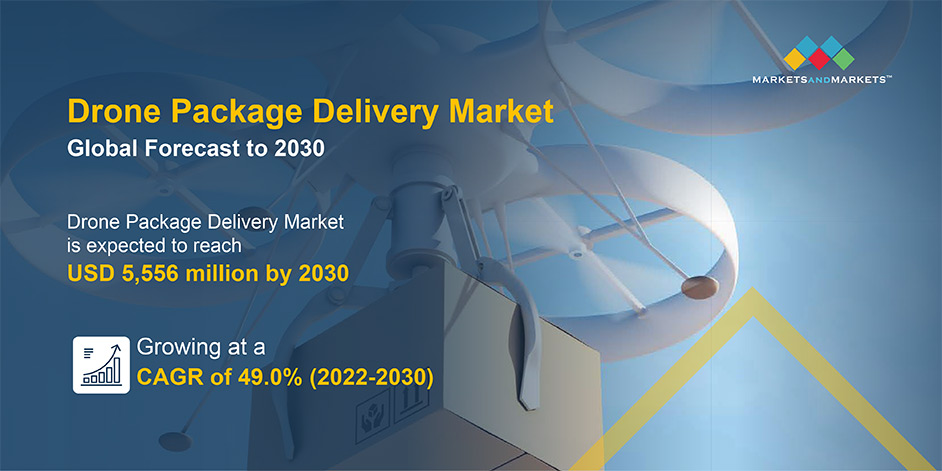
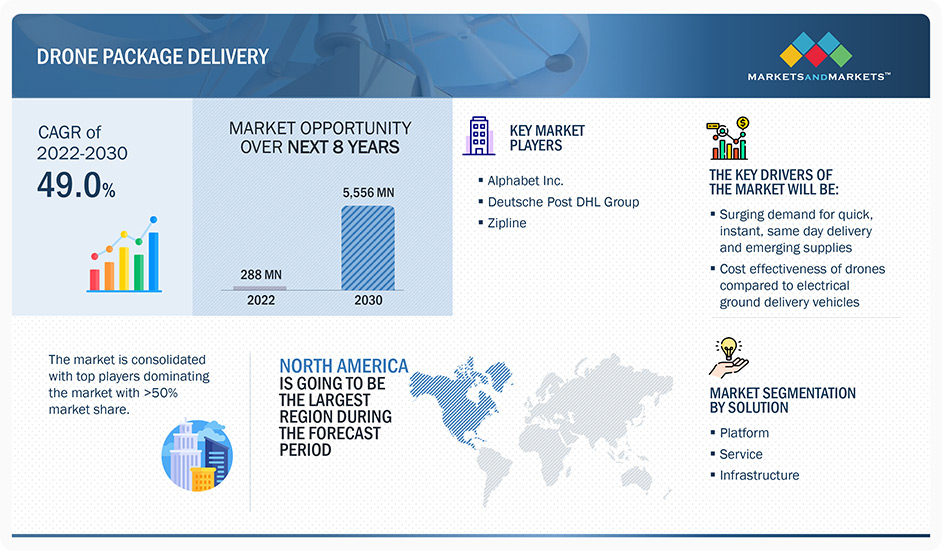
The Drone Package Delivery Market is projected to grow from USD 228 million in 2022 to USD 5,556 million by 2030, at a CAGR of 49.0% from 2022 to 2030.
Technological advancements like VTOL, geospatial mapping, IoT, and machine learning result in higher accuracy in package delivery are some of the factors fueling the growth of the Drone Package Delivery Industry. AI is the next focus of the drone industry. This new technology is expected to enable drones to perform all tasks, right from their launch and navigation to data acquisition, data transmission, and data analysis. In addition,advancements in technology of drone will help in carrying out drone package delivery operations autonomously and safely, thereby contributing to their increased adoption in the drone delivery ecosystem.
Drone Package Delivery Market Forecast to 2030
To know about the assumptions considered for the study, Request for Free Sample Report
COVID-19 impact on the Drone Package Delivery Market
The impact of the COVID-19 pandemic has been unprecedented on a global scale. The consequences have been wide-reaching, particularly for aviation.
The market is still in its nascent stages and will depend on a number of factors such as drone regulations, consumer acceptance, safety, security, and insurance, among others. In pre-COVID-19 times, drones have been experimented with over the years as a delivery option by retailers such as Amazon and Walmart. However, airspace restrictions and concerns about drones crossing over flight routes, drone regulations, consumer acceptance, safety, security, and insurance, among others, meant that these drones are still in their pilot project stage.
In the wake of the COVID-19 pandemic, drone technology has appeared to be a more prominent, valuable asset and one of the safest modes of contactless delivery. The three major use cases of drone technology that were found during the pandemic were associated with transportation services, aerial spraying, and surveillance & inspection. Delivery drones are creating more resilient supply chains and socially distanced delivery services. The COVID-19 crisis is driving innovation in drone policies as society has started to recognize that the utility of drones outweighs potential risks
Drone Package Delivery Market Segment Overview:
Based on solution, the service segment is projected to grow at the highest CAGR during the forecast period.
Based on solution, the market has been classified into platform, software, infrastructure, and service. The growing use of delivery drones leads to the requirement for proper software and infrastructure that support them.
Combined with good logistics software, drones can drastically improve the efficiency. Drone package delivery service providers cater to various applications of product delivery such as drone food delivery, retail goods delivery, postal delivery, medical aids delivery, and others. These service providers function in various logistics processes such as second-party logistics (2PL), third-party logistics (3PL), and fourth-party logistics (4PL).
Based on package size, the <2 kilograms segment is projected to lead the drone package delivery market from 2022 to 2030.
Based on package size, the drone package delivery platform market has been segmented into <2 kilograms, 2–5 kilograms, and >5 kilograms. The <2 kilograms package size segment is anticipated to lead the drone package delivery platform market in 2022, owing to a rise in demand for lightweight retail good packages across the globe.
Based on type, the hybrid segment is projected to grow at the highest CAGR during the forecast period.
Based on type, the drone package delivery platform market has been segmented into fixed-wing, multirotor, and hybrid. The hybrid segment is estimated to register the highest CAGR during the forecast period.
Drone manufacturers across the globe are focusing on the development of drones for use in the delivery of packages within the city limits and also on the advancements of the drone technologies. Features such as vertical landing and AI-based collision avoidance will increase the market for hybrid drones.
The North American region is projected to account for largest share of drone package delivery during the forecast period.
The drone package delivery market in the North American region is expected to witness substantial growth and register the highest CAGR during the forecast period.
The region’s growth is attributed to the increasing trend of online shopping on e-commerce platforms and favorable FAA regulations in the US. Many US companies are working to commercialize drone package delivery for food items, pharmaceutical products, logistics, and retail applications in the region which will contribute towards the growth of region during the forecast period.

Drone Package Delivery Market by Region
To know about the assumptions considered for the study, download the pdf brochure
Drone Package Delivery Industry Companies: Top Key Market Players
The Drone Package Delivery Companies is dominated by globally established players such as
- Alphabet Inc.(US)
- Deutsche Post DHL Group (Germany)
- Zipline (US)
- United Parcel Service of America, Inc. (US)
- FedEx (US)
- Matternet Inc., (US)
- EHang (China)
- Wingcopter (Germany) and
- The Boeing Company (US)
These players have adopted various growth strategies such as contracts, joint ventures, partnerships & agreements, acquisitions, and new product launches to further expand their presence in the drone package delivery market.
Get online access to the report on the World's First Market Intelligence Cloud
- Easy to Download Historical Data & Forecast Numbers
- Company Analysis Dashboard for high growth potential opportunities
- Research Analyst Access for customization & queries
- Competitor Analysis with Interactive dashboard
- Latest News, Updates & Trend analysis

Drone Package Delivery Market Scope
|
Report Metric |
Details |
|
Market size available for years |
2019-2030 |
|
Base year considered |
2021 |
|
Forecast period |
2022-2030 |
|
Forecast units |
Value (USD) |
|
Segments covered |
By Solution, By Type, By Range, By Package Size, By Duration, By End-Use, By Operation mode and By Region |
|
Geographies covered |
North America, Asia Pacific, Europe, the Middle East, Latin America, and Africa |
|
Companies covered |
Alphabet Inc. (US), DHL International GmbH (Germany), Zipline (US), United Parcel Service of America, Inc. (US), FedEx (US), Matternet Inc., (US), Airbus S.A.S. (Netherlands), Wingcopter (Germany), EHang (China), and Boeing (US), among others |
|
Companies covered (Drone start-ups and drone package delivery ecosystem) |
Flytrex (Israel), Swoop Aero (Australia) and Elroy Air (US), Skycart Inc. (US), Altitude Angel (UK), Fli Drone (Caribbean), Volansi (US), and Skyports (UK), among others |
Drone Package Delivery Market Dynamics:
Driver:Technological advancements like VTOL, geospatial mapping, IoT, and machine learning result in higher accuracy in package delivery
Drone technology continues to advance, making drones ideal tools for gathering certain ground data that can pair well with more traditional mapping techniques. Satellites perform this function globally from space, which is in direct contrast to a drone’s size and scope.
In addition, the use of sense & avoid systems in aerial delivery drones is also increasing due to the enhanced safety and beyond visual line of sight features they offer. Sense & avoid systems are a combination of cameras, radar, LiDAR, and other systems that help detect and avoid obstacles successfully. Technological advancements in these systems help in carrying out drone package delivery operations autonomously and safely, thereby contributing to their increased adoption in the drone delivery ecosystem.
Restraint: Bad weather maybe a roadblock to drone delivery schemes
Drone delivery depends a lot on the weather. For instance, when the temperature is very hot, the air density drops, which affects the drone lifting capacity. The same thing goes during cold season when the energy capacity for the drone is severely affected.
Both of these challenges can be surpassed using new technologies, but the weather problem is still not avoidable. Companies are finding it difficult to build a dependable delivery system. In June 2021, Nature Scientific Reports did a study on the impact of weather on drone delivery services. The study says most drones used for commercial applications should never fly in rain or snow but can tolerate temperatures between 0 C and 40 C and winds up to 36 km/h. If then looked at 100 of the world’s most populous cities for the weather. On average, there are only 10 hours a day when the weather lets up sufficiently to let drones fly safely.
Opportunity: Increase in ecommerce sales and demand for contactless delivery post-pandemic
In COVID pandemic aerial delivery drones were widely used by law enforcement agencies, quick service restaurants, logistics companies, healthcare service providers, and various ecommerce companies.
Whether delivering critical medical supplies or a fresh meal from a local restaurant, the aerial logistics capability of drone delivery is becoming increasingly significant by organizations post-pandemic, with countries removing lockdown restrictions
Challenge: Data security breaches and drug trafficking using aerial delivery drones
Operational security is a major concern with the use of aerial delivery drones in civil and commercial applications. The growing use of aerial delivery drones in commercial applications has also resulted in an increased number of drone hacking incidents.
Lack of proper security in these drones makes them vulnerable to hacking. Manufacturers of these drones and providers of services associated with them are offering drone analytics software-as-a-service to their clients.Apart from hacking, countries such as the US, Colombia, and Mexico have also witnessed the use of drones for drug smuggling. For example, In October 2021, the US Drug Enforcement Administration (DEA) seized a 249 g DJI Mini 2 drone with a bundle containing a package filled with 0.57 pounds (259 g) of methamphetamine, allegedly used for drug shipments in the US. Thus, issues with the safety, security and illegal use of these delivery drones may lead to a ban on their use in civil and commercial applications by government agencies, thereby reducing drone package deliveries across the globe.
Drone Package Delivery Market Categorization:
This research report categorizes the Market based on solution, type, range, package size, duration, operation mode end-use and region.
|
Aspects |
Details |
|
By Solution |
|
|
By Type |
|
|
By Range |
|
|
By Package size |
|
|
By Duration |
|
|
By End-use |
|
|
By Operation Mode |
|
|
By Region |
|
Recent Developments in Drone Package Delivery Industry
- In March 2022, EHang partnered with Aerotree Flight Services Sdn. Bhd., a subsidiary of Malaysia’s AEROTREE Group, to jointly develop urban air mobility (UAM) business, including MRO and training, in Malaysia. Pursuant to the partnership, AEROTREE has placed a pre-order for EHang’s 50 units of the EH216 series, as well as 10 units of the VT-30.
- In March 2022, ITOCHU Corporation signed a partnership with Wingcopter to distribute and lease Wingcopter 198 in Japan. The Japanese conglomerate also made a strategic investment in Wingcopter.
- In February 2022, Zipline and Kisumu County, a member of the Lake Region Economic Bloc (LREB), executed an agreement for the storage and delivery of COVID-19 vaccines, blood products, and other medical commodities to health facilities within the Kisumu County.
- In February 2022, Wing Aviation LLC teamed up with Kentucky Fried Chicken (KFC) (Australia) to deliver a range of hot and fresh menu items direct to homes and workplaces in Logan, Queensland.
- In September 2021, Matternet and SkyGo partnered with Abu Dhabi DoH for the world’s first city-wide medical drone network. The network will significantly increase the connectivity of the Emirate’s health ecosystem and position it as a global leader in advanced air mobility
Frequently Asked Questions (FAQ):
What is the current size of the drone package delivery market?
The drone package delivery market is projected to grow from USD 228 million in 2022 to USD 5,556 million by 2030, at a CAGR of 49.0% from 2022 to 2030
Who are the winners in the drone package delivery market?
Alphabet Inc. (US), Deutsche Post DHL Group (Germany), Zipline (US), United Parcel Service of America, Inc. (US), FedEx (US) Matternet Inc., (US), EHang (China), Wingcopter (Germany) and The Boeing Company (US) are some of the winners in the market.
What is the COVID-19 impact on drone package delivery market?
The COVID-19 pandemic has created short-term disruptions and long-term structural changes due to which the ecommerce sector is experiencing sluggish growth in new online categories such as groceries and homecare. This has enabled suppliers to adopt autonomous means such as drones and robots to deliver goods to the customer without human involvement. For instance, UPS, an American multinational package delivery company, entered a collaboration with German drone-maker Wingcopter GmbH to accelerate the adoption of aerial drones for contactless delivery. Various prominent and emerging goods delivery technologies such as UAS are laying a critical role in contactless delivery.
What are some of the technological advancements in the market?
Several technological advancement has been taking place such as robust sense & avoid technology. This refers to a drone’s capability to take off, fly, and land at the intended location and in an intended manner without colliding on the way. To do so, the device must have a continuously functioning and accurate geo-location device, clear vision through cameras (or radar), and well-developed algorithms to execute accurate landing.
The implemtation of AI in aerial delivery drones is increasing the application of these drones in the commercial sector. This technology advancement enable drones to perform all tasks, right from their launch and navigation to data acquisition, data transmission, and data analysis.
What are the factors driving the growth of the market?
Surging demand for quick, instant, same-day delivery, and emergency supplies, Technological advancements like VTOL, geospatial mapping, IoT, and machine learning result in higher accuracy in package delivery, Cost-effectiveness of drones compared to electric ground delivery vehicles and increasing need to lower carbon emissions is driving the growth of the market. .
To speak to our analyst for a discussion on the above findings, click Speak to Analyst
This research study on the drone package delivery market involved extensive use of secondary sources, directories, and databases such as Hoovers, Bloomberg BusinessWeek, and Factiva to identify and collect information relevant to the market. The primary sources considered included industry experts as well as service providers, manufacturers, solution providers, technology developers, alliances, and organizations related to all segments of the value chain of this market. In-depth interviews with various primary respondents, including key industry participants, subject matter experts (SMEs), industry consultants, and C-level executives, were conducted to obtain and verify critical qualitative and quantitative information pertaining to the drone package delivery market as well as assess its growth prospects.
Secondary Research
The secondary sources referred for this research study on the drone package delivery market included financial statements of companies offering delivery drones and drone package delivery services, infrastructure, and software providers, along with various trade, business, and professional associations, among others. The secondary data was collected and analyzed to arrive at the overall size of the drone package delivery market, which was validated by primary respondents.
Primary Research
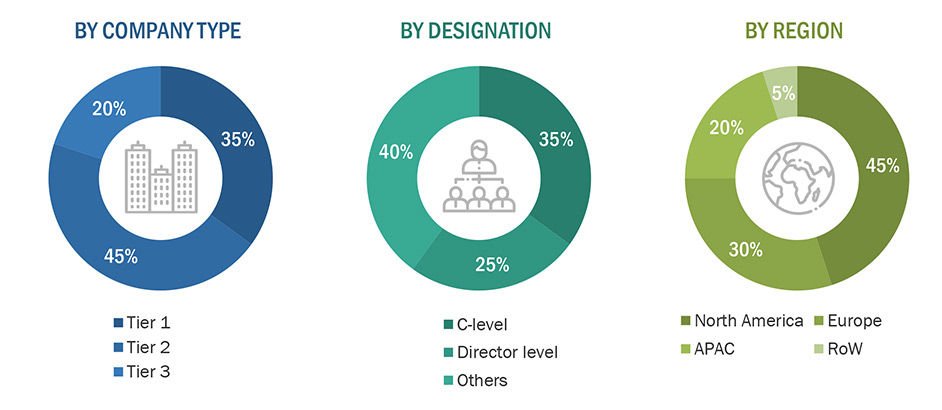
In the primary research process, various sources from the supply and demand sides were interviewed to obtain qualitative and quantitative information on the market. The primary sources from the supply side included industry experts such as chief X officers (CXOs), vice presidents (VPs), directors, regional managers, and business development and product development teams, distributors, and vendors.
Extensive primary research was conducted to obtain qualitative and quantitative information such as market statistics, average selling price, market breakdowns, market size estimations, market forecasting, and data triangulation. Primary research also helped in understanding the various trends related to platforms, system applications, technologies, and regions. Stakeholders from the demand side include logistics companies, end consumers, healthcare industry, and quick-service restaurants who are willing to adopt drone delivery by participating in various trials. Interviews were conducted to understand the different types of trails with delivery drones under the drone legislation of various countries and the impact of COVID-19 on the market and the aviation industry. These primary interviews were conducted with market experts from both the demand and supply sides across North America, Europe, the Middle East, Asia Pacific, and the Rest of the World. The primary data was collected through questionnaires, emails, and telephonic interviews.
To know about the assumptions considered for the study, download the pdf brochure
Market Size Estimation
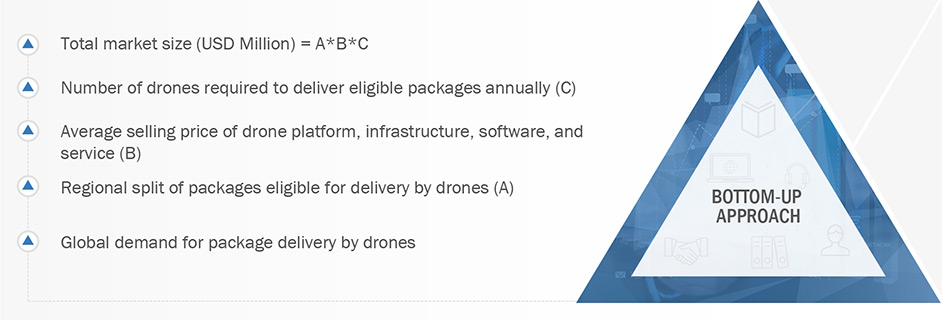
Both, top-down and bottom-up approaches were used to estimate and validate the total size of the drone package delivery market. These methods were also used extensively to estimate the size of various segments and subsegments of the market. The research methodology used to estimate the market size includes the following details:
- Key players in this market were identified through secondary research, and their market share was determined through primary and secondary research. This included a study of the annual and financial reports of top market players and extensive interviews of leaders such as Chief Executive Officers (CEOs), directors, and marketing executives of leading companies operating in the drone package delivery market.
- All percentage shares, splits, and breakdowns were determined using secondary sources and verified through primary sources.
- All possible parameters that affect the markets covered in this research study were accounted for, viewed in extensive detail, verified through primary research, and analyzed to obtain the final quantitative and qualitative data.
Market Size Estimation Methodology: Bottom-up Approach
To know about the assumptions considered for the study, Request for Free Sample Report
Data Triangulation
After arriving at the overall size of the drone package delivery market using the market size estimation processes explained above, the market was split into several segments and subsegments. To complete the overall market engineering process and arrive at the exact statistics of each market segment and subsegment, data triangulation and market breakdown procedures were employed, wherever applicable. The data was triangulated by studying various factors and trends from demand as well as supply sides of the drone package delivery market.
Report Objectives
- To define, describe, segment, and forecast the size of the drone package delivery market based on solution, duration, range, package size, type, operation mode, end-use, and region
- To forecast the size of different segments of the market with respect to various regions, including North America, Europe, Asia Pacific, the Middle East, Latin America, and Africa, along with key countries in each of these regions
- To identify and analyze key drivers, opportunities, and challenges influencing the growth of the market
- To identify technology trends that are currently prevailing in the drone package delivery market
- To provide an overview of the tariff and regulatory landscape with respect to the drone regulations across regions
- To analyze micromarkets1 with respect to individual growth trends, prospects, and their contribution to the overall market
- To analyze opportunities in the market for stakeholders by identifying key market trends
- To analyze the impact of the COVID-19 pandemic on the drone package delivery market and its stakeholders
- To profile key market players and comprehensively analyze their market share and core competencies2
- To analyze the degree of competition in the market by identifying key growth strategies, such as acquisitions, new product launches, new service launches, contracts, and partnerships, adopted by leading market players
- To identify detailed financial positions, key products, and unique selling points of leading companies in the market
- To provide a detailed competitive landscape of the drone package delivery market, along with a ranking analysis, market share analysis, and revenue analysis of key players
Available Customizations
Along with the market data, MarketsandMarkets offers customizations as per the specific needs of companies. The following customization options are available for the report:
Product Analysis
- Product matrix, which gives a detailed comparison of the product portfolio of each company
Regional Analysis
- Further breakdown of the market segments at country-level
Company Information
- Detailed analysis and profiling of additional market players (up to 5)

 Generating Response ...








Growth opportunities and latent adjacency in Drone Package Delivery Market