



MRI Systems Market
Report Code
MD 3220
Published in
May, 2026, By MarketsandMarkets™
MRI Systems Market by Architecture (Open, Closed), Design (Portable, Fixed), Field Strength (1.5T, 3T, Low & Mid-field), Application (Neuro, Spine, Cardiac, Pediatric), End User (Hospital, Imaging Center, ASC), and Procedure Volume - Global Forecast to 2031

$6.88B
MARKET SIZE, 2026
$9.68B
MARKET SIZE, 2031

7.0%
CAGR (2026-2031)

2026-2031
FORECAST PERIOD
MRI SYSTEMS MARKET SIZE, SHARE & GROWTH SNAPSHOT

Source: Secondary Research, Interviews with Experts, MarketsandMarkets Analysis
The global MRI systems market is projected to grow from USD 6.88 billion in 2026 to USD 9.68 billion by 2031, at a CAGR of 7.0% during the forecast period. The market was valued at USD 6.46 billion in 2025. The market for MRI systems is anticipated to experience substantial growth due to the increasing prevalence of various diseases, especially neurological and musculoskeletal conditions, which are expected to rise in the coming years. The expanding aging population, coupled with the growing incidence of chronic diseases such as cancer, is likely to boost the global demand for MRI systems. Furthermore, regulatory support, including encouragement for innovation and more favorable reimbursement policies, will also contribute to the growth of the MRI systems market.
KEY TAKEAWAYS
-
MARKET SNAPSHOT:
Base Year Market Size (2025): USD 6.46 Billion
Current Market Size (2026): USD 6.88 Billion
Forecast Market Size (2031): USD 9.68 Billion
CAGR (2026–2031): 7.0% -
SEGMENT LEADERSHIP:
Regional Outlook: Asia Pacific is projected to register the highest CAGR of 7.4% during the forecast period.
Field Strength Leader: High & very-high field MRI systems segment acquired the largest share of 93.9% of the MRI systems market in 2025.
Architecture Leader: Closed MRI systems segment acquired the largest share of 79.7% of the MRI systems market in 2025.
Design Leader: Fixed/stationary MRI systems segment accounted for the largest market share in 2025. -
MARKET OUTLOOK & COMPETITIVE LANDSCAPE:
Siemens Healthineers (Germany), GE Healthcare (US), Koninklijke Philips N.V. (Netherlands), FUJIFILM Corporation (Japan), and Canon Inc. (Japan) are some of the key players in the competitive landscape for MRI systems. They show depth in the product portfolio with a strong customer footprint in the developed and emerging markets.
Companies such as Time Medical Holding (Hong Kong), Neusoft Medical Systems Co., Ltd. (China), SternMed GmbH (Germany), Hyperfine, Inc. (US), Shenzhen Basda Medical Apparatus Co., Ltd. (China), Magnetica Ltd (Australia), and various regional OEMs are active in niche segments of the MRI systems ecosystem, supplying MRI systems to potential customers.
Awareness regarding preventive healthcare is driving the demand for MRI scans by shifting the use of imaging from being symptom-driven to earlier, risk-based screening. This shift raises scan volumes at hospitals and diagnostic centers, creating a stronger business case for purchasing new machines. As patients become more aware of preventive healthcare, they are more likely to seek imaging earlier, particularly for neurological, musculoskeletal, cancer-related, cardiovascular, and vascular concerns that can be identified before symptoms worsen. As scan volumes rise, healthcare institutions encounter a capacity gap characterized by longer wait times, referral leakage, and limited scheduling flexibility. In response, acquiring a new MRI system becomes a practical solution to accommodate the increased demand for preventive and diagnostic imaging. It can help improve turnaround times and support the expansion of services in radiology departments and imaging centers. These factors are expected to contribute to the growth of the MRI systems market in the near future.
TRENDS & DISRUPTIONS IMPACTING CUSTOMERS' CUSTOMERS
The MRI systems market is evolving to meet consumers' demands for improved efficiency, expanded access, and enhanced diagnostic capabilities. Hospitals and clinics are increasingly adopting helium-free MRI systems to reduce overall ownership costs and maximize system uptime. Additionally, AI-enabled image reconstruction is helping to decrease scan times and enhance diagnostic accuracy. Pediatric MRI systems are becoming more significant as they prioritize patient comfort and minimize the need for sedation. Furthermore, portable or point-of-care MRI systems are improving access to neuro and musculoskeletal imaging in remote, emergency, and mobile settings. At the same time, high-field (7T) and hybrid MRI modalities are catering to advanced imaging requirements for translational research and precision diagnostics.

Source: Secondary Research, Interviews with Experts, MarketsandMarkets Analysis
MARKET DYNAMICS

Drivers
Impact
Level
Level
-
Public-private partnerships to scale diagnostic imaging landscape

-
Growing prevalence of MSDs and increasing geriatric population to increase demand


RESTRAINTS
Impact
Level
Level
-
Complex operation and maintenance of MRI systems

-
Global shortage of helium


OPPORTUNITIES
Impact
Level
Level
-
Emergence of helium-free MRI systems

-
Expansion of pediatric MRI use cases


CHALLENGES
Impact
Level
Level
-
Limited capital budgets

-
Dearth of trained and skilled professionals

Source: Secondary Research, Interviews with Experts, MarketsandMarkets Analysis
Driver: Growing prevalence of MSDs and increasing geriatric population to increase demand
There is an increasing trend where a significant portion of the population is experiencing chronic back or neck pain and musculoskeletal disorders (MSDs) due to a lack of physical activity and an unhealthy lifestyle. This has led to a rise in the prevalence of conditions such as back pain, osteoarthritis, rheumatoid arthritis, and spondylarthritis. MRI is considered the gold standard for imaging soft tissues, nerves, and the spine, making it essential for diagnosing conditions like multiple sclerosis, spinal injuries, and chronic pain syndromes. The growing elderly population, projected to reach nearly 80 million by 2050, will increase the number of patients suffering from neurodegenerative diseases (such as Alzheimer’s and Parkinson’s) and musculoskeletal disorders (like spine degeneration). These conditions require frequent non-invasive diagnostic imaging procedures for proper treatment and diagnosis. As a result, the demand for MRI scans per patient is expected to rise, contributing to the growth of the MRI systems market. Globally, the risk of developing diseases continues to increase. According to the American Medical Association, nearly 60% of individuals aged 65 and older in the U.S. are expected to live with more than one chronic condition. With the rapid growth of the baby boomer population, the prevalence of age-related complications and diseases such as cardiovascular diseases, Alzheimer’s disease, and cancer is consistently rising. These factors are also anticipated to drive up the demand for MRI systems.
Restraint: Global shortage of helium
Helium is an inert gas, meaning it is non-reactive in its natural state. It has the lowest boiling point of any element, at -269 °C (-452 °F), and a low density. Various industrial applications utilize helium to cool instruments and maintain optimal operating conditions. According to a BBC report from 2025, hospitals are the largest consumers of helium worldwide, accounting for approximately 32% of the global market. Helium is essential for cooling the magnets in diagnostic tools like magnetic resonance imaging (MRI) systems. The most recent helium shortage was noted in 2024, which intensified the demand for this gas. Expanding manufacturing capabilities in the semiconductor and battery industries have created new channels for helium demand and usage, highlighting its scarcity. A helium facility in Qatar was temporarily offline for scheduled maintenance, and the ongoing conflict in Ukraine exacerbated supply issues. Additionally, rising tensions in the Middle East may disrupt the helium supply chain, particularly impacting the MRI ecosystem, as a significant portion of the world's helium supply comes from Qatar and nearby Gulf countries. Reports from March to April 2026 indicated that conflict-related disruptions had significantly reduced global helium availability, resulting in sharp price increases. Since helium is used to cool superconducting magnets in conventional MRI systems, higher prices and limited availability could lead to increased operating costs, delays in maintenance, and higher expenses for new MRI deployments at hospitals and diagnostic centers.
Opportunity: Expansion of pediatric MRI use cases
As more hospitals and diagnostic centers develop child-friendly services, there is a growing demand for MRI systems, pediatric coils, faster protocols, and comfort-focused features. This demand directly supports equipment sales and service revenue. Pediatric MRI is largely driven by the increasing prevalence of neurological disorders, congenital anomalies, cancer, and other conditions that require early and precise imaging in children. Children often require shorter scan times, reduced noise levels, and an improved patient experience. As a result, providers cannot always rely on a generic MRI workflow. This need for specialized systems or upgrades prompts institutions to make new investments. Consequently, there is an emerging cycle of replacement and expansion for vendors serving hospitals, diagnostic centers, and specialty clinics.
Challenges: Limited capital budgets
Limited capital budgets among healthcare providers, such as hospitals and diagnostic imaging centers—especially in tier 2 and tier 3 cities, as well as community hospitals and outpatient centers—have resulted in the extended use of MRI systems beyond their recommended operational warranties. The American College of Radiology recommends upgrading MRI equipment every 7 to 10 years; however, real-world usage often extends to 12 to 15 years due to financial constraints. According to a 2023 report by GE Healthcare, nearly 60% of mid-sized radiology departments in the U.S. have delayed MRI upgrades after the pandemic, focusing on financial recovery rather than capital expenditure. Consequently, many aging MRI systems with lower signal-to-noise ratios and slower scan speeds continue to be used, which can compromise image quality and diagnostic accuracy—especially in complex neurological or oncological cases. Additionally, legacy systems frequently lack compatibility with modern imaging advancements, such as AI-based reconstruction, compressed sensing, and advanced coil technologies. Original Equipment Manufacturers (OEMs) like Siemens and Philips have noted that these limitations can reduce the clinical value of imaging, increase the rate of false negatives, and limit throughput.
MRI SYSTEMS MARKET: COMMERCIAL USE CASES ACROSS INDUSTRIES
| COMPANY | USE CASE DESCRIPTION | BENEFITS |
|---|---|---|
 |
Remote MRI scanning support (syngo Virtual Cockpit) at multiple hospital sites (InHealth/GenesisCare) | Enabled expert radiographers to support scans remotely | Reduced need for travel | Improved scheduling flexibility | Reduced bottlenecks in oversight |
 |
Macka EMAR Diagnostic Center (Istanbul): Upgrade to SIGNA Works with AIR Recon DL + Multi-Purpose Coils | Reduced scan times (average drop from 45 to 28 min) | Better image quality | Fewer repeats | Improved throughput |
 |
St. Joseph’s Hospital (Phoenix, Arizona): MRI in Neuro ED with fast protocols | Enabled richer diagnosis (soft tissues, spinal cord) vs CT | Reduction in scan time to ~10 min in some protocols |
 |
Entry into US market | First US installation of uMR 570 1.5T MRI | Market expansion | Baseline clinical viability | Building service infrastructure in US |
Logos and trademarks shown above are the property of their respective owners. Their use here is for informational and illustrative purposes only.
MARKET ECOSYSTEM
The MRI systems ecosystem comprises a multi-layered value chain that connects manufacturers, distributors, component and raw material suppliers, and end users, including hospitals, diagnostic imaging centers, and specialty clinics. Manufacturers such as Siemens Healthineers, GE HealthCare, Canon Medical Systems, Philips, Fujifilm, and United Imaging create MRI platforms that cater to conventional, advanced, and specialty applications. Distributors like Block Imaging, Probo Medical, Med Square, DirectMed Imaging, and MXR help expand market reach and ensure equipment accessibility across various regions. Raw material and component suppliers, which include companies like MXR, Noras MRI Products, Analogic, NeoCoil, and DirectMed Imaging, enhance scanner performance through the provision of coils, electronics, and other related parts. End users, including RadNet, Mayo Clinic, Prime Diagnostic Imaging, Alliance Medical, and American Health Associates, drive demand by fulfilling clinical imaging needs, expanding capacity, and upgrading technology. Together, these stakeholders influence system adoption, service demand, and long-term market growth.

Logos and trademarks shown above are the property of their respective owners. Their use here is for informational and illustrative purposes only.
MARKET SEGMENTS

Source: Secondary Research, Interviews with Experts, MarketsandMarkets Analysis
MRI Systems Market, By Architecture
By architecture, the MRI systems market is segmented into open MRI systems and closed MRI systems. In 2025, the closed MRI systems segment accounted for the largest market share. This significant share can be attributed to the excellent image quality produced by wide-bore MRI systems and the introduction of new products by key market players. A closed MRI machine captures detailed images of the body's anatomy within a narrow cylindrical chamber. Most high-field superconducting MRI scanners are designed as closed systems. Closed MRI systems are considered the industry standard due to their high efficiency, superior image quality, and increased throughput, all of which result from their stronger magnetic field strengths.
MRI Systems Market, By Design
The fixed/stationary MRI systems segment accounted for the largest market share in 2025. This segment's dominance can be attributed to its superior image quality, full-body scanning capabilities, enhanced workflow efficiency, and long-term cost-effectiveness. Typically, fixed MRI units operate at magnetic field strengths of 1.5T or 3T, which produce high-resolution images with excellent soft tissue contrast. In addition, fixed MRI systems support full-body imaging, making them a preferred choice for hospitals and imaging centers. They facilitate higher patient throughput and allow for seamless integration with Picture Archiving and Communication Systems (PACS) and AI-driven analytics. This integration ensures efficient data processing and reporting, further enhancing their appeal.
MRI Systems Market, By Application
By application, the MRI systems market is segmented into brain & neurological MRI, spine & musculoskeletal MRI, pelvic & abdominal MRI, vascular MRI, breast MRI, cardiac MRI, and other applications. The brain & neurological MRI segment is expected to register the highest growth rate during the forecast period. The major factors responsible for the highest growth rate of this segment are the advanced AI features and the rising use of novel equipment that allows precise targeting of internal organs, supporting real-time imaging. The geriatric population is continuously growing, leading to an increase in the prevalence of neurological conditions such as stroke, dementia, Parkinson's disease, and epilepsy. These conditions often require MRI procedures for diagnosis. As a result, the demand for MRI scans is expected to rise, which will, in turn, drive the market for MRI systems.
REGION
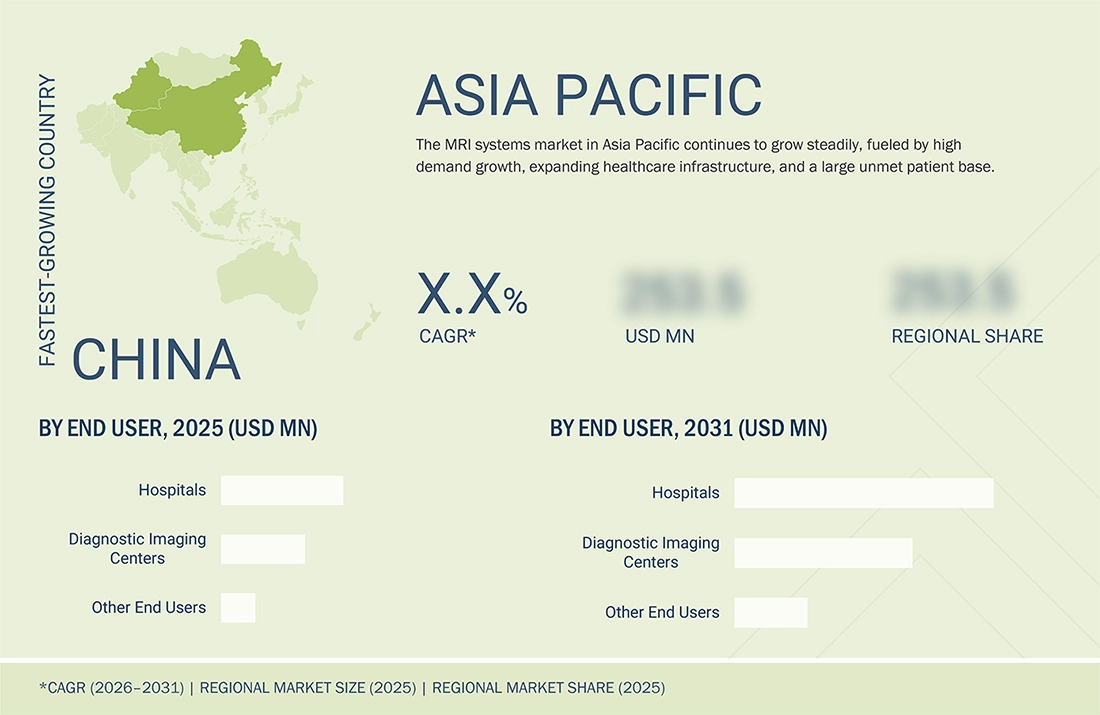
Asia Pacific is expected to grow at the highest CAGR in the MRI systems market during the forecast period
The Asia Pacific region is experiencing rapid growth, particularly in China, India, and Southeast Asia. There is a faster adoption of advanced imaging technologies, mobile and portable MRI systems, and AI-enabled workflows. This trend is leading to an increase in scan volumes and equipment purchases, outpacing growth in more established markets. The region boasts a large patient population, and the prevalence of chronic diseases, neurological disorders, and cancer is on the rise, resulting in a higher demand for advanced diagnostics such as MRI. The significant growth in the Asia Pacific market can largely be attributed to lower labor costs and a substantial rise in capital expenditures by hospitals. Additional factors driving this growth include an increasing range of healthcare applications and a favorable funding environment for end-user facilities. Furthermore, the rapid growth of the elderly population and the establishment of diagnostic imaging centers are contributing to the expansion of the market.
MRI SYSTEMS MARKET: COMPANY EVALUATION MATRIX
Siemens Healthineers is situated in the 'Stars' quadrant due to its strong market share and extensive range of products in the MRI systems market. The company maintains this position by offering a diverse portfolio that includes high-end and routine MRI systems, building strong brand trust, and continually investing in innovation, such as AI-enabled imaging, faster workflows, and advanced clinical applications. United Imaging is categorized in the 'Emerging Leaders' quadrant because it is expanding its presence with competitive technology and a growing global footprint. The company pursues a strategy of offering advanced MRI systems that deliver strong value, which helps it secure business in both developed and emerging markets. Its focus on product expansion, regional growth, and technology-driven differentiation strengthens its market position.

Source: Secondary Research, Interviews with Experts, MarketsandMarkets Analysis
KEY MARKET PLAYERS
- Siemens Healthineers (Germany)
- GE Healthcare (US)
- Koninklijke Philips N.V. (Netherlands)
- FUJIFILM Corporation (Japan)
- Canon Inc. (Japan)
- Fonar Corporation (US)
- Shanghai United Imaging Healthcare Co., Ltd (China)
- Time Medical Holding (Hong Kong)
- Neusoft Medical Systems Co., Ltd. (China)
- Hyperfine, Inc. (US)
MARKET SCOPE
| REPORT METRIC | DETAILS |
|---|---|
| Market Size in 2025 (Value) | USD 6.46 Billion |
| Market Size in 2026 (Value) | USD 6.88 Billion |
| Market Forecast in 2031 (Value) | USD 9.68 Billion |
| Growth Rate | CAGR of 7.0% from 2026–2031 |
| Years Considered | 2024–2031 |
| Base Year | 2025 |
| Forecast Period | 2026–2031 |
| Units Considered | Value (USD Billion) |
| Report Coverage | Revenue forecast, company ranking, competitive landscape, growth factors, and trends |
| Segments Covered |
|
| Regions Covered | North America, Europe, Asia Pacific, Latin America, Middle East & Africa |
WHAT IS IN IT FOR YOU: MRI SYSTEMS MARKET REPORT CONTENT GUIDE

DELIVERED CUSTOMIZATIONS
We have successfully delivered the following deep-dive customizations:
| CLIENT REQUEST | CUSTOMIZATION DELIVERED | VALUE ADDS |
|---|---|---|
| Biopharmaceutical Companies |
|
|
RECENT DEVELOPMENTS
- February 2026 : GE HealthCare received FDA 510 (k) clearances for three MRI innovations, namely SIGNA Sprint with Freelium, SIGNA Bolt, and SIGNA One. The clearances aimed at precision imaging and clinical efficiency.
- November 2025 : Philips introduced InkSpace Imaging’s Snuggle flexible pediatric MRI coil for its 3.0T MR systems to improve imaging precision, efficiency, and comfort.
- February 2025 : Koninklijke Philips N.V. (Netherlands), as part of the Dutch National Growth Fund project Polaris with the Government of the Netherlands, aimed to advance radio frequency (RF) technology, enhancing MRI scan speed and accuracy for improved diagnostics.
- January 2025 : Siemens Healthineers (Germany) commenced the construction of a new manufacturing facility dedicated to the diagnostic imaging portfolio in China.
Table of Contents
 Exclusive indicates content/data unique to MarketsandMarkets and not available with any competitors.
TITLE
PAGE NO
1
INTRODUCTION
24
2
EXECUTIVE SUMMARY
29
3
PREMIUM INSIGHTS
34
4
MARKET OVERVIEW
AI-driven MRI innovations tackle helium shortages and enhance pediatric imaging efficiency.
37
4.1
INTRODUCTION
4.2
MARKET DYNAMICS
4.2.1
DRIVERS
4.2.1.1
PUBLIC-PRIVATE PARTNERSHIPS TO SCALE DIAGNOSTIC IMAGING LANDSCAPE
4.2.1.2
GROWING PREVALENCE OF MSDS AND INCREASING GERIATRIC POPULATION
4.2.1.3
INTEGRATION OF IMRI INTO SURGERY
4.2.2
RESTRAINTS
4.2.2.1
COMPLEX OPERATION AND MAINTENANCE OF MRI SYSTEMS
4.2.2.2
GLOBAL HELIUM SHORTAGE
4.2.3
OPPORTUNITIES
4.2.3.1
EMERGENCE OF HELIUM-FREE MRI SYSTEMS
4.2.3.2
EXPANSION OF PEDIATRIC MRI USE CASES
4.2.3.3
AI INTEGRATION WITH MRI TECHNOLOGY FOR PROCESS OPTIMIZATION
4.2.4
CHALLENGES
4.2.4.1
LIMITED CAPITAL BUDGETS
4.2.4.2
DEARTH OF TRAINED AND SKILLED PROFESSIONALS
4.3
UNMET NEEDS
4.4
INTERCONNECTED MARKETS AND CROSS-SECTOR OPPORTUNITIES
4.5
STRATEGIC MOVES BY TIER-1/2/3 PLAYERS
4.5.1
OVERVIEW OF STRATEGIES ADOPTED BY PLAYERS IN MRI SYSTEMS MARKET
5
INDUSTRY TRENDS
Navigate competitive landscapes with insights on pricing, supply chain dynamics, and market entry threats.
46
5.1
PORTER’S FIVE FORCES ANALYSIS
5.1.1
BARGAINING POWER OF BUYERS
5.1.2
BARGAINING POWER OF SUPPLIERS
5.1.3
THREAT OF NEW ENTRANTS
5.1.4
THREAT OF SUBSTITUTES
5.1.5
INTENSITY OF COMPETITIVE RIVALRY
5.2
MACROECONOMIC INDICATORS
5.2.1
INTRODUCTION
5.2.2
GDP TRENDS AND FORECAST
5.2.3
TRENDS IN DIAGNOSTIC IMAGING INDUSTRY
5.3
SUPPLY CHAIN ANALYSIS
5.3.1
PROMINENT COMPANIES
5.3.2
SMALL & MEDIUM-SIZED ENTERPRISES
5.3.3
DISTRIBUTION/DISTRIBUTOR
5.3.4
END USERS
5.4
VALUE CHAIN ANALYSIS
5.4.1
RESEARCH & PRODUCT DEVELOPMENT
5.4.2
RAW MATERIAL PROCUREMENT
5.4.3
MANUFACTURING
5.4.4
DISTRIBUTION, MARKETING & SALES, AND POST-SALES SERVICES
5.5
ECOSYSTEM ANALYSIS
5.6
PRICING ANALYSIS
5.6.1
AVERAGE SELLING PRICE TREND, BY KEY PLAYER, 2023–2025
5.6.2
AVERAGE SELLING PRICE TREND, BY REGION, 2023–2025
5.7
TRADE ANALYSIS
5.7.1
IMPORT DATA (HS CODE 901813)
5.7.2
EXPORT DATA (HS CODE 901813)
5.8
KEY CONFERENCES AND EVENTS, 2026–2027
5.9
TRENDS/DISRUPTIONS IMPACTING CUSTOMER BUSINESS
5.10
INVESTMENT AND FUNDING SCENARIO
5.11
CASE STUDY ANALYSIS
5.12
IMPACT OF 2025 US TARIFF – MRI SYSTEMS MARKET
5.12.1
INTRODUCTION
5.12.2
KEY TARIFF RATES
5.12.3
KEY TARIFF RATES
5.12.4
PRICE IMPACT ANALYSIS
5.12.5
IMPACT ON COUNTRIES/REGIONS
5.12.5.1
US
5.12.5.2
EUROPE
5.12.5.3
ASIA PACIFIC
5.12.6
IMPACT ON END-USE INDUSTRIES
6
TECHNOLOGICAL ADVANCEMENTS, AI-DRIVEN IMPACT, PATENTS, INNOVATIONS, AND FUTURE APPLICATIONS
AI-driven MRI innovations redefine diagnostics, enhancing market potential and regulatory landscapes globally.
65
6.1
KEY EMERGING TECHNOLOGIES
6.1.1
ARTIFICIAL INTELLIGENCE–DRIVEN IMAGE RECONSTRUCTION AND DIAGNOSTIC ASSISTANCE
6.1.2
ULTRA-LOW-FIELD AND PORTABLE MRI PLATFORMS
6.2
COMPLEMENTARY TECHNOLOGIES
6.2.1
PICTURE ARCHIVING AND COMMUNICATION SYSTEMS (PACS) AND HEALTH INFORMATION SYSTEM INTEGRATION
6.2.2
SIMULTANEOUS MULTI-SLICE AND ADVANCED PARALLEL IMAGING ACCELERATION
6.3
ADJACENT TECHNOLOGIES
6.3.1
MRI-COMPATIBLE INTERVENTIONAL AND SURGICAL NAVIGATION TECHNOLOGIES
6.4
PATENT ANALYSIS
6.5
IMPACT OF AI ON MRI SYSTEMS MARKET
6.5.1
TOP USE CASES AND MARKET POTENTIAL
6.5.2
KEY COMPANIES IMPLEMENTING AI
6.5.3
BEST PRACTICES IN MRI SYSTEMS MARKET
6.5.4
INTERCONNECTED ADJACENT ECOSYSTEMS AND IMPACT ON MARKET PLAYERS
6.5.5
CLIENTS' READINESS TO ADOPT AI IN MRI SYSTEMS
6.6
SUCCESS STORIES AND REAL-WORLD APPLICATIONS
6.7
REGULATORY LANDSCAPE
6.7.1
REGULATORY BODIES, GOVERNMENT AGENCIES, AND OTHER ORGANIZATIONS
6.7.2
REGULATIONS, BY REGION
6.7.2.1
NORTH AMERICA
6.7.2.1.1
US
6.7.2.1.2
CANADA
6.7.2.2
EUROPE
6.7.2.3
ASIA PACIFIC
6.7.2.3.1
JAPAN
6.7.2.3.2
CHINA
6.7.2.3.3
INDIA
6.8
REIMBURSEMENT SCENARIO ANALYSIS
6.8.1
RELEVANT REIMBURSEMENT CODE, BY COUNTRY
6.8.2
REIMBURSEMENT TRENDS, BY REGION, 2023–2025
6.8.2.1
NORTH AMERICA
6.8.2.2
EUROPE
6.8.2.3
ASIA PACIFIC
6.8.2.4
LATIN AMERICA
6.8.2.5
MIDDLE EAST & AFRICA
7
CUSTOMER LANDSCAPE AND BUYER BEHAVIOR
Understand key stakeholder dynamics and unmet needs to unlock market profitability.
83
7.1
DECISION-MAKING PROCESS
7.2
KEY STAKEHOLDERS INVOLVED IN BUYING PROCESS AND THEIR EVALUATION CRITERIA
7.2.1
KEY STAKEHOLDERS IN BUYING PROCESS
7.2.2
BUYING CRITERIA
7.3
ADOPTION BARRIERS AND INTERNAL CHALLENGES
7.4
UNMET NEEDS OF VARIOUS END-USE INDUSTRIES
7.5
MARKET PROFITABILITY
8
MRI SYSTEMS MARKET, BY APPLICATION
Market Size & Growth Rate Forecast Analysis to 2031 in USD Million | 9 Data Tables
87
8.1
INTRODUCTION
8.2
BRAIN & NEUROLOGICAL MRI
8.2.1
NEW THERAPIES AND GUIDELINES TO ENHANCE DEMAND FOR MRI SYSTEMS
8.3
SPINE & MUSCULOSKELETAL MRI
8.3.1
GROWING PREVALENCE OF MUSCULOSKELETAL DISORDERS TO DRIVE MARKET
8.4
VASCULAR MRI
8.4.1
USE OF VASCULAR MRI AS ALTERNATIVE TO CT TO SUPPORT MARKET GROWTH
8.5
PELVIC & ABDOMINAL MRI
8.5.1
NEED FOR DETECTING PROSTATE AND CERVICAL CANCERS TO PROPEL MARKET
8.6
BREAST MRI
8.6.1
GROWING AWARENESS OF EARLY CANCER SCREENING TO DRIVE MARKET GROWTH
8.7
CARDIAC MRI
8.7.1
UPDATED MEDICAL GUIDELINES FOR CARDIAC THERAPY PLANNING TO DRIVE MARKET GROWTH
8.8
PEDIATRIC MRI
8.8.1
NEED FOR EFFICIENT DIAGNOSTIC ACCURACY AND EARLY DETECTION TO PROMOTE USE OF PEDIATRIC MRI
8.9
OTHER APPLICATIONS
9
MRI SYSTEMS MARKET, BY ARCHITECTURE
Market Size & Growth Rate Forecast Analysis to 2031 in USD Million | 6 Data Tables
96
9.1
INTRODUCTION
9.2
CLOSED MRI SYSTEMS
9.2.1
STANDARD BORE MRI SYSTEMS
9.2.1.1
HIGH ACCURACY AND SENSITIVITY OF SYSTEMS TO PROPEL MARKET
9.2.2
WIDE-BORE MRI SYSTEMS
9.2.2.1
HIGH-QUALITY IMAGES AND IMPROVED PATIENT COMFORT TO DRIVE MARKET
9.3
OPEN MRI SYSTEMS
9.3.1
USE FOR CHILDREN AND OBESE PATIENTS TO DRIVE MARKET
10
MRI SYSTEMS MARKET, BY DESIGN
Market Size & Growth Rate Forecast Analysis to 2031 in USD Million | 6 Data Tables
102
10.1
INTRODUCTION
10.2
FIXED/STATIONARY MRI SYSTEMS
10.2.1
FLOOR-FIXED MRI SYSTEMS
10.2.1.1
HIGH FLEXIBILITY AND LOW INITIAL INSTALLATION COSTS TO DRIVE DEMAND
10.2.2
CEILING-FIXED MRI SYSTEMS
10.2.2.1
NEED FOR MRI SYSTEMS WITH HIGH STABILITY AND MORE SPACE TO DRIVE MARKET
10.3
PORTABLE MRI SYSTEMS
10.3.1
PROTOCOLIZED ADOPTION OF PORTABLE MRI SYSTEMS TO DRIVE MARKET GROWTH
11
MRI SYSTEMS MARKET, BY END USER
Market Size & Growth Rate Forecast Analysis to 2031 in USD Million | 4 Data Tables
108
11.1
INTRODUCTION
11.2
HOSPITALS
11.2.1
UPDATES IN DIAGNOSTIC IMAGING GUIDELINES TO PROPEL MARKET GROWTH
11.3
DIAGNOSTIC IMAGING CENTERS
11.3.1
INCREASED PRIVATE IMAGING CENTERS AND SHIFT TOWARD OUTPATIENT FACILITIES TO DRIVE MARKET GROWTH
11.4
OTHER END USERS
12
MRI SYSTEMS MARKET, BY FIELD STRENGTH
Market Size & Growth Rate Forecast Analysis to 2031 in USD Million and Units | 7 Data Tables
113
12.1
INTRODUCTION
12.2
HIGH-TO-VERY-HIGH-FIELD MRI SYSTEMS
12.2.1
1.5T
12.2.1.1
RISING USE OF 1.5T MRI SYSTEMS FOR ROUTINE EXAMINATIONS TO PROPEL MARKET
12.2.2
3T
12.2.2.1
STRONG GRADIENT PROFILE AND EASE OF USE TO DRIVE MARKET GROWTH
12.3
LOW-TO-MID-FIELD MRI SYSTEMS
12.3.1
INCREASING NEED FOR LUNG AND CARDIAC IMAGING TO DRIVE MARKET GROWTH
12.4
ULTRA-HIGH-FIELD MRI SYSTEMS
12.4.1
RISING INNOVATION AND DEEP RESEARCH TO DRIVE MARKET GROWTH
13
MRI SYSTEMS MARKET, BY REGION
Comprehensive coverage of 8 Regions with country-level deep-dive of 14 Countries | 50 Data Tables.
120
13.1
INTRODUCTION
13.2
NORTH AMERICA
13.2.1
US
13.2.1.1
INCREASED DIAGNOSTIC IMAGING UTILIZATION AND STRATEGIC REIMBURSEMENT REFORMS TO DRIVE MARKET GROWTH
13.2.2
CANADA
13.2.2.1
PROGRESSIVE GOVERNMENT POLICIES AND GROWING PULSE OF DIAGNOSTIC IMAGING TO SPUR MARKET
13.3
EUROPE
13.3.1
GERMANY
13.3.1.1
DIGITAL PUSH IN HEALTHCARE ACCESS AND SHIFT TOWARD OUTPATIENT/CLINIC SETTINGS TO DRIVE MARKET GROWTH
13.3.2
UK
13.3.2.1
STRONG POLICY PUSH FOR COMMUNITY DIAGNOSTIC CENTERS AND CAPACITY EXPANSION TO DRIVE MARKET GROWTH
13.3.3
FRANCE
13.3.3.1
INCREASING PATIENT POPULATION AND REFORMS IN MRI COVERAGE POLICIES TO BOOST GROWTH
13.3.4
ITALY
13.3.4.1
EU-FUNDED HOSPITAL UPGRADES TO INCREASE CAPITAL EXPENDITURE ABILITY
13.3.5
SPAIN
13.3.5.1
STRATEGIC POLICY REFORMS AND INCREASED MRI SCANS FROM PRIVATE HOSPITAL CHAINS TO GROW MARKET
13.3.6
REST OF EUROPE
13.4
ASIA PACIFIC
13.4.1
JAPAN
13.4.1.1
NATIONWIDE DIAGNOSTIC IMAGING COVERAGE PLANS AND SUPPORTIVE GOVERNMENT REIMBURSEMENT POLICIES TO BOOST GROWTH
13.4.2
CHINA
13.4.2.1
FOREIGN COLLABORATIONS AND STRONG DEMAND FROM PUBLIC HEALTHCARE FACILITIES TO DRIVE MARKET GROWTH
13.4.3
INDIA
13.4.3.1
STRONG PUBLIC-PRIVATE PARTNERSHIPS TO PROPEL MARKET
13.4.4
AUSTRALIA
13.4.4.1
NEW RESEARCH INITIATIVES AND POLICY ENHANCEMENTS TO PROMOTE GROWTH
13.4.5
SOUTH KOREA
13.4.5.1
SUPPORTIVE GOVERNMENT POLICIES TO PROMOTE GROWTH
13.4.6
REST OF ASIA PACIFIC
13.5
LATIN AMERICA
13.5.1
BRAZIL
13.5.1.1
INCREASING DISEASE BURDEN AND GROWING ADOPTION OF HEALTHCARE INSURANCE TO DRIVE MARKET
13.5.2
MEXICO
13.5.2.1
INDUSTRY PARTNERSHIPS TO DRIVE MARKET GROWTH
13.5.3
REST OF LATIN AMERICA
13.6
MIDDLE EAST & AFRICA
13.6.1
GCC COUNTRIES
13.6.1.1
FAVORABLE GOVERNMENT INITIATIVES TO CONTRIBUTE TO MARKET GROWTH
13.6.2
REST OF MIDDLE EAST & AFRICA
13.6.2.1
INCREASED ADOPTION OF MRI SYSTEMS TO CONTRIBUTE TO GROWTH
14
COMPETITIVE LANDSCAPE
Discover strategic dominance and emerging leaders shaping the future of the MRI systems market.
150
14.1
INTRODUCTION
14.2
KEY PLAYER COMPETITIVE STRATEGIES/RIGHT TO WIN, 2023–2026
14.2.1
OVERVIEW OF STRATEGIES ADOPTED BY KEY PLAYERS IN MRI SYSTEMS MARKET
14.3
REVENUE ANALYSIS, 2021–2025
14.4
MARKET SHARE ANALYSIS, 2025
14.4.1
MARKET RANKING OF KEY PLAYERS, 2025
14.5
COMPANY VALUATION AND FINANCIAL METRICS
14.5.1
FINANCIAL METRICS
14.5.2
COMPANY VALUATION
14.6
BRAND/PRODUCT COMPARISON
14.7
COMPANY EVALUATION MATRIX: KEY PLAYERS, 2025
14.7.1
STARS
14.7.2
EMERGING LEADERS
14.7.3
PERVASIVE PLAYERS
14.7.4
PARTICIPANTS
14.7.5
COMPANY FOOTPRINT: KEY PLAYERS, 2025
14.7.5.1
COMPANY FOOTPRINT
14.7.5.2
REGION FOOTPRINT
14.7.5.3
FIELD STRENGTH FOOTPRINT
14.7.5.4
APPLICATION FOOTPRINT
14.7.5.5
END USER FOOTPRINT
14.8
COMPANY EVALUATION MATRIX: STARTUPS/SMES, 2025
14.8.1
PROGRESSIVE COMPANIES
14.8.2
RESPONSIVE COMPANIES
14.8.3
DYNAMIC COMPANIES
14.8.4
STARTING BLOCKS
14.8.5
COMPETITIVE BENCHMARKING OF STARTUPS/SMES, 2025
14.8.5.1
DETAILED LIST OF KEY STARTUPS/SMES
14.8.5.2
COMPETITIVE BENCHMARKING OF KEY STARTUPS/SMES
14.9
COMPETITIVE SCENARIO
14.9.1
PRODUCT LAUNCHES
14.9.2
DEALS
14.9.3
EXPANSIONS
15
COMPANY PROFILES
In-depth Company Profiles of Leading Market Players with detailed Business Overview, Product and Service Portfolio, Recent Developments, and Unique Analyst Perspective (MnM View)
171
15.1
KEY PLAYERS
15.1.1
SIEMENS HEALTHINEERS
15.1.1.1
BUSINESS OVERVIEW
15.1.1.2
PRODUCTS OFFERED
15.1.1.3
RECENT DEVELOPMENTS
15.1.1.3.1
PRODUCT LAUNCHES
15.1.1.3.2
DEALS
15.1.1.3.3
EXPANSIONS
15.1.1.4
MNM VIEW
15.1.1.4.1
RIGHT TO WIN
15.1.1.4.2
STRATEGIC CHOICES
15.1.1.4.3
WEAKNESSES & COMPETITIVE THREATS
15.1.2
KONINKLIJKE PHILIPS N.V.
15.1.3
GE HEALTHCARE
15.1.4
CANON MEDICAL SYSTEM
15.1.5
FUJIFILM CORPORATION
15.1.6
FONAR CORPORATION
15.1.7
ESAOTE S.P.A
15.1.8
SHANGHAI UNITED IMAGING HEALTHCARE CO., LTD.
15.1.9
ASPECT IMAGING LTD.
15.1.10
TIME MEDICAL HOLDING
15.1.11
NEUSOFT MEDICAL SYSTEMS CO., LTD.
15.1.12
STERNMED GMBH
15.1.13
HYPERFINE, INC.
15.1.14
SHENZHEN BASDA MEDICAL APPARATUS CO., LTD.
15.1.15
SHENZHEN ANKE HIGH-TECH., LTD.
15.2
OTHER PLAYERS
15.2.1
MAGNETICA LTD
15.2.2
AURORA HEALTHCARE US CORP
15.2.3
INNERVISION MRI LTD.
15.2.4
BEIJING WANDONG MEDICAL TECHNOLOGY CO., LTD.
15.2.5
MEDONICA CO., LTD
15.2.6
NEOSCAN SOLUTIONS GMBH
15.2.7
KANGDA INTERCONTINENTAL MEDICAL EQUIPMENT CO., LTD.
15.2.8
MINFOUND MEDICAL SYSTEMS CO., LTD.
15.2.9
SYNAPTIVE MEDICAL
15.2.10
XINGAOYI MEDICAL EQUIPMENT CO., LTD
16
RESEARCH METHODOLOGY
216
16.1
RESEARCH DATA
16.1.1
SECONDARY RESEARCH
16.1.1.1
KEY SECONDARY SOURCES
16.1.1.2
KEY DATA FROM SECONDARY SOURCES
16.1.1.3
OBJECTIVES OF SECONDARY RESEARCH
16.1.2
PRIMARY RESEARCH
16.1.2.1
KEY PRIMARY SOURCES
16.1.2.2
KEY SUPPLY- AND DEMAND-SIDE PARTICIPANTS
16.1.2.3
BREAKDOWN OF PRIMARY INTERVIEWS
16.1.2.4
OBJECTIVES OF PRIMARY RESEARCH
16.1.2.5
KEY PRIMARY INSIGHTS
16.2
MARKET SIZE ESTIMATION
16.2.1
BOTTOM-UP APPROACH
16.2.1.1
COMPANY REVENUE ESTIMATION
16.2.1.2
CUSTOMER-BASED MARKET ESTIMATION
16.2.1.3
PRIMARY INTERVIEWS
16.2.2
TOP-DOWN APPROACH
16.3
GROWTH RATE ASSUMPTIONS
16.4
DATA TRIANGULATION
16.5
RESEARCH ASSUMPTIONS
16.6
RESEARCH LIMITATIONS
16.7
RISK ANALYSIS
17
APPENDIX
232
17.1
DISCUSSION GUIDE
17.2
KNOWLEDGESTORE: MARKETSANDMARKETS’ SUBSCRIPTION PORTAL
17.3
CUSTOMIZATION OPTIONS
17.4
RELATED REPORTS
17.5
AUTHOR DETAILS
LIST OF TABLES
TABLE 1
MRI SYSTEMS MARKET: UNMET NEEDS
TABLE 2
OVERVIEW OF STRATEGIES DEPLOYED BY KEY COMPANIES IN THE MRI SYSTEMS MARKET
TABLE 3
IMPACT OF PORTER’S FIVE FORCES ON MRI SYSTEMS MARKET
TABLE 4
AVERAGE SELLING PRICE OF MRI SYSTEMS, BY KEY PLAYER, 2023–2025
TABLE 5
AVERAGE SELLING PRICE OF MRI SYSTEMS, BY REGION, 2023–2025
TABLE 6
IMPORT DATA FOR MRI SYSTEMS, BY COUNTRY, 2021–2025 (USD THOUSAND)
TABLE 7
EXPORT DATA FOR MRI SYSTEMS, BY COUNTRY, 2021–2025 (USD THOUSAND)
TABLE 8
MRI SYSTEMS MARKET: LIST OF MAJOR CONFERENCES AND EVENTS IN 2026–2027
TABLE 9
CASE STUDY 1: DEPLOYMENT OF WIDE-BORE 3T MRI SYSTEMS TO ENHANCE ONCOLOGICAL DIAGNOSTIC THROUGHPUT IN LARGE TERTIARY HOSPITAL NETWORK
TABLE 10
CASE STUDY 2: INTEGRATION OF AI-AUGMENTED 1.5T MRI SYSTEMS IN INDEPENDENT DIAGNOSTIC IMAGING CHAIN TO OPTIMIZE MUSCULOSKELETAL REPORTING EFFICIENCY
TABLE 11
US-ADJUSTED RECIPROCAL TARIFF RATES
TABLE 12
MRI SYSTEMS MARKET: KEY PATENTS, 2024–2026
TABLE 13
REGULATORY BODIES, GOVERNMENT AGENCIES, AND OTHER ORGANIZATIONS
TABLE 14
US FDA: MEDICAL DEVICE CLASSIFICATION
TABLE 15
US: MEDICAL DEVICE REGULATORY APPROVAL PROCESS
TABLE 16
CANADA: MEDICAL DEVICE REGULATORY APPROVAL PROCESS
TABLE 17
JAPAN: MEDICAL DEVICE CLASSIFICATION UNDER PMDA
TABLE 18
CHINA: CLASSIFICATION OF MEDICAL DEVICES
TABLE 19
NORTH AMERICA: RELEVANT MRI REIMBURSEMENT CODE
TABLE 20
EUROPE: RELEVANT MRI REIMBURSEMENT CODE
TABLE 21
ASIA PACIFIC: RELEVANT MRI REIMBURSEMENT CODE
TABLE 22
INFLUENCE OF STAKEHOLDERS ON BUYING PROCESS FOR TOP THREE END USERS (%)
TABLE 23
KEY BUYING CRITERIA FOR TOP THREE END USERS
TABLE 24
MRI SYSTEMS MARKET, BY APPLICATION, 2024–2031 (USD MILLION)
TABLE 25
BRAIN & NEUROLOGICAL MRI SYSTEMS MARKET, BY REGION, 2024–2031 (USD MILLION)
TABLE 26
SPINE & MUSCULOSKELETAL MRI SYSTEMS MARKET, BY REGION, 2024–2031 (USD MILLION)
TABLE 27
VASCULAR MRI SYSTEMS MARKET, BY REGION, 2024–2031(USD MILLION)
TABLE 28
PELVIC & ABDOMINAL MRI SYSTEMS MARKET, BY REGION, 2024–2031 (USD MILLION)
TABLE 29
BREAST MRI SYSTEMS MARKET, BY REGION, 2024–2031 (USD MILLION)
TABLE 30
CARDIAC MRI SYSTEMS MARKET, BY REGION, 2024–2031 (USD MILLION)
TABLE 31
PEDIATRIC MRI SYSTEMS MARKET, BY REGION, 2024–2031 (USD MILLION)
TABLE 32
OTHER APPLICATIONS: MRI SYSTEMS MARKET, BY REGION, 2024–2031 (USD MILLION)
TABLE 33
MRI SYSTEMS MARKET, BY ARCHITECTURE, 2024–2031 (USD MILLION)
TABLE 34
CLOSED MRI SYSTEMS MARKET, BY TYPE, 2024–2031 (USD MILLION)
TABLE 35
CLOSED MRI SYSTEMS MARKET, BY REGION, 2024–2031 (USD MILLION)
TABLE 36
STANDARD BORE MRI SYSTEMS MARKET, BY REGION, 2024–2031 (USD MILLION)
TABLE 37
WIDE-BORE MRI SYSTEMS MARKET, BY REGION, 2024–2031 (USD MILLION)
TABLE 38
OPEN MRI SYSTEMS MARKET, BY REGION, 2024–2031 (USD MILLION)
TABLE 39
MRI SYSTEMS MARKET, BY DESIGN, 2024–2031 (USD MILLION)
TABLE 40
FIXED/STATIONARY MRI SYSTEMS MARKET, BY TYPE, 2024–2031 (USD MILLION)
TABLE 41
FIXED/STATIONARY MRI SYSTEMS MARKET, BY REGION, 2024–2031 (USD MILLION)
TABLE 42
FLOOR-FIXED MRI SYSTEMS MARKET, BY REGION, 2024–2031 (USD MILLION)
TABLE 43
CEILING-FIXED MRI SYSTEMS MARKET, BY REGION, 2024–2031 (USD MILLION)
TABLE 44
PORTABLE MRI SYSTEMS MARKET, BY REGION, 2024–2031 (USD MILLION)
TABLE 45
MRI SYSTEMS MARKET, BY END USER, 2024–2031 (USD MILLION)
TABLE 46
MRI SYSTEMS MARKET FOR HOSPITALS, BY REGION, 2024–2031 (USD MILLION)
TABLE 47
MRI SYSTEMS MARKET FOR DIAGNOSTIC IMAGING CENTERS, BY REGION, 2024–2031 (USD MILLION)
TABLE 48
MRI SYSTEMS MARKET FOR OTHER END USERS, BY REGION, 2024–2031 (USD MILLION)
TABLE 49
MRI SYSTEMS MARKET, BY FIELD STRENGTH, 2024–2031 (USD MILLION)
TABLE 50
MRI SYSTEMS MARKET, BY REGION, 2024–2026 (UNITS)
TABLE 51
HIGH-TO-VERY-HIGH-FIELD MRI SYSTEMS MARKET, BY REGION, 2024–2031 (USD MILLION)
TABLE 52
1.5T MRI SYSTEMS MARKET, BY REGION, 2024–2031 (USD MILLION)
TABLE 53
3T MRI SYSTEMS MARKET, BY REGION, 2024–2031 (USD MILLION)
TABLE 54
LOW-TO-MID-FIELD MRI SYSTEMS MARKET, BY REGION, 2024–2031 (USD MILLION)
TABLE 55
ULTRA-HIGH-FIELD MRI SYSTEMS MARKET, BY REGION, 2024–2031 (USD MILLION)
TABLE 56
MRI SYSTEMS MARKET, BY REGION, 2024–2031 (USD MILLION)
TABLE 57
NORTH AMERICA: MRI SYSTEMS MARKET, BY COUNTRY, 2024–2031 (USD MILLION)
TABLE 58
NORTH AMERICA: MRI SYSTEMS MARKET, BY FIELD STRENGTH, 2024–2031 (USD MILLION)
TABLE 59
NORTH AMERICA: MRI SYSTEMS MARKET, BY ARCHITECTURE, 2024–2031 (USD MILLION)
TABLE 60
NORTH AMERICA: MRI SYSTEMS MARKET, BY DESIGN, 2024–2031 (USD MILLION)
TABLE 61
NORTH AMERICA: MRI SYSTEMS MARKET, BY APPLICATION, 2024–2031 (USD MILLION)
TABLE 62
NORTH AMERICA: MRI SYSTEMS MARKET, BY END USER, 2024–2031 (USD MILLION)
TABLE 63
US: MRI SYSTEMS MARKET, BY FIELD STRENGTH, 2024–2031 (USD MILLION)
TABLE 64
CANADA: MRI SYSTEMS MARKET, BY FIELD STRENGTH, 2024–2031 (USD MILLION)
TABLE 65
EUROPE: MRI SYSTEMS MARKET, BY COUNTRY, 2024–2031 (USD MILLION)
TABLE 66
EUROPE: MRI SYSTEMS MARKET, BY FIELD STRENGTH, 2024–2031 (USD MILLION)
TABLE 67
EUROPE: MRI SYSTEMS MARKET, BY ARCHITECTURE, 2024–2031 (USD MILLION)
TABLE 68
EUROPE: MRI SYSTEMS MARKET, BY DESIGN, 2024–2031 (USD MILLION)
TABLE 69
EUROPE: MRI SYSTEMS MARKET, BY APPLICATION, 2024–2031 (USD MILLION)
TABLE 70
EUROPE: MRI SYSTEMS MARKET, BY END USER, 2024–2031 (USD MILLION)
TABLE 71
GERMANY: MRI SYSTEMS MARKET, BY FIELD STRENGTH, 2024–2031 (USD MILLION)
TABLE 72
UK: MRI SYSTEMS MARKET, BY FIELD STRENGTH, 2024–2031 (USD MILLION)
TABLE 73
FRANCE: MRI SYSTEMS MARKET, BY FIELD STRENGTH, 2024–2031 (USD MILLION)
TABLE 74
ITALY: MRI SYSTEMS MARKET, BY FIELD STRENGTH, 2024–2031 (USD MILLION)
TABLE 75
SPAIN: MRI SYSTEMS MARKET, BY FIELD STRENGTH, 2024–2031 (USD MILLION)
TABLE 76
REST OF EUROPE: MRI SYSTEMS MARKET, BY FIELD STRENGTH, 2024–2031 (USD MILLION)
TABLE 77
ASIA PACIFIC: MRI SYSTEMS MARKET, BY COUNTRY, 2024–2031 (USD MILLION)
TABLE 78
ASIA PACIFIC: MRI SYSTEMS MARKET, BY FIELD STRENGTH, 2024–2031 (USD MILLION)
TABLE 79
ASIA PACIFIC: MRI SYSTEMS MARKET, BY ARCHITECTURE, 2024–2031 (USD MILLION)
TABLE 80
ASIA PACIFIC: MRI SYSTEMS MARKET, BY DESIGN, 2024–2031 (USD MILLION)
TABLE 81
ASIA PACIFIC: MRI SYSTEMS MARKET, BY APPLICATION, 2024–2031 (USD MILLION)
TABLE 82
ASIA PACIFIC: MRI SYSTEMS MARKET, BY END USER, 2024–2031 (USD MILLION)
TABLE 83
JAPAN: MRI SYSTEMS MARKET, BY FIELD STRENGTH, 2024–2031 (USD MILLION)
TABLE 84
CHINA: MRI SYSTEMS MARKET, BY FIELD STRENGTH, 2024–2031 (USD MILLION)
TABLE 85
INDIA: MRI SYSTEMS MARKET, BY FIELD STRENGTH, 2024–2031 (USD MILLION)
TABLE 86
AUSTRALIA: MRI SYSTEMS MARKET, BY FIELD STRENGTH, 2024–2031 (USD MILLION)
TABLE 87
SOUTH KOREA: MRI SYSTEMS MARKET, BY FIELD STRENGTH, 2024–2031 (USD MILLION)
TABLE 88
REST OF ASIA PACIFIC: MRI SYSTEMS MARKET, BY FIELD STRENGTH, 2024–2031 (USD MILLION)
TABLE 89
LATIN AMERICA: MRI SYSTEMS MARKET, BY COUNTRY, 2024–2031 (USD MILLION)
TABLE 90
LATIN AMERICA: MRI SYSTEMS MARKET, BY FIELD STRENGTH, 2024–2031 (USD MILLION)
TABLE 91
LATIN AMERICA: MRI SYSTEMS MARKET, BY ARCHITECTURE, 2024–2031 (USD MILLION)
TABLE 92
LATIN AMERICA: MRI SYSTEMS MARKET, BY DESIGN, 2024–2031 (USD MILLION)
TABLE 93
LATIN AMERICA: MRI SYSTEMS MARKET, BY APPLICATION, 2024–2031 (USD MILLION)
TABLE 94
LATIN AMERICA: MRI SYSTEMS MARKET, BY END USER, 2024–2031 (USD MILLION)
TABLE 95
BRAZIL: MRI SYSTEMS MARKET, BY FIELD STRENGTH, 2024–2031 (USD MILLION)
TABLE 96
MEXICO: MRI SYSTEMS MARKET, BY FIELD STRENGTH, 2024–2031 (USD MILLION)
TABLE 97
REST OF LATIN AMERICA: MRI SYSTEMS MARKET, BY FIELD STRENGTH, 2024–2031 (USD MILLION)
TABLE 98
MIDDLE EAST & AFRICA: MRI SYSTEMS MARKET, BY COUNTRY, 2024–2031 (USD MILLION)
TABLE 99
MIDDLE EAST & AFRICA: MRI SYSTEMS MARKET, BY FIELD STRENGTH, 2024–2031 (USD MILLION)
TABLE 100
MIDDLE EAST & AFRICA: MRI SYSTEMS MARKET, BY ARCHITECTURE, 2024–2031 (USD MILLION)
TABLE 101
MIDDLE EAST & AFRICA: MRI SYSTEMS MARKET, BY DESIGN, 2024–2031 (USD MILLION)
TABLE 102
MIDDLE EAST & AFRICA: MRI SYSTEMS MARKET, BY APPLICATION, 2024–2031 (USD MILLION)
TABLE 103
MIDDLE EAST & AFRICA: MRI SYSTEMS MARKET, BY END USER, 2024–2031 (USD MILLION)
TABLE 104
GCC COUNTRIES: MRI SYSTEMS MARKET, BY FIELD STRENGTH, 2024–2031 (USD MILLION)
TABLE 105
REST OF MIDDLE EAST & AFRICA: MRI SYSTEMS MARKET, BY FIELD STRENGTH, 2024–2031 (USD MILLION)
TABLE 106
OVERVIEW OF STRATEGIES DEPLOYED BY KEY PLAYERS IN MRI SYSTEMS MARKET, 2023–2026
TABLE 107
MRI SYSTEMS MARKET: DEGREE OF COMPETITION
TABLE 108
MRI SYSTEMS MARKET: REGION FOOTPRINT
TABLE 109
MRI SYSTEMS MARKET: FIELD STRENGTH FOOTPRINT
TABLE 110
MRI SYSTEMS MARKET: APPLICATION FOOTPRINT
TABLE 111
MRI SYSTEMS MARKET: END USER FOOTPRINT
TABLE 112
MRI SYSTEMS MARKET: DETAILED LIST OF KEY STARTUPS/SMES
TABLE 113
MRI SYSTEMS MARKET: COMPETITIVE BENCHMARKING OF KEY STARTUPS/SMES
TABLE 114
MRI SYSTEMS MARKET: PRODUCT LAUNCHES, JANUARY 2023– MAY 2026
TABLE 115
MRI SYSTEMS MARKET: DEALS, JANUARY 2023– MAY 2026
TABLE 116
MRI SYSTEMS MARKET: EXPANSIONS, JANUARY 2023– MAY 2026
TABLE 117
THERMO FISHER SCIENTIFIC INC.: COMPANY OVERVIEW
TABLE 118
SIEMENS HEALTHINEERS: PRODUCTS OFFERED
TABLE 119
SIEMENS HEALTHINEERS: PRODUCT LAUNCHES
TABLE 120
SIEMENS HEALTHINEERS: DEALS
TABLE 121
SIEMENS HEALTHINEERS: EXPANSIONS
TABLE 122
KONINKLIJKE PHILIPS N.V.: COMPANY OVERVIEW
TABLE 123
KONINKLIJKE PHILIPS N.V.: PRODUCTS OFFERED
TABLE 124
KONINKLIJKE PHILIPS N.V.: PRODUCT LAUNCHES
TABLE 125
KONINKLIJKE PHILIPS N.V.: DEALS
TABLE 126
KONINKLIJKE PHILIPS N.V.: EXPANSIONS
TABLE 127
GE HEALTHCARE: COMPANY OVERVIEW
TABLE 128
GE HEALTHCARE: PRODUCTS OFFERED
TABLE 129
GE HEALTHCARE: PRODUCT LAUNCHES
TABLE 130
GE HEALTHCARE: DEALS
TABLE 131
GE HEALTHCARE: EXPANSIONS
TABLE 132
CANON MEDICAL SYSTEMS: COMPANY OVERVIEW
TABLE 133
CANON MEDICAL SYSTEMS: PRODUCTS OFFERED
TABLE 134
CANON MEDICAL SYSTEMS: PRODUCT LAUNCHES
TABLE 135
CANON MEDICAL SYSTEMS: DEALS
TABLE 136
FUJIFILM CORPORATION: COMPANY OVERVIEW
TABLE 137
FUJIFILM CORPORATION: PRODUCTS OFFERED
TABLE 138
FUJIFILM CORPORATION: PRODUCT LAUNCHES
TABLE 139
FUJIFILM CORPORATION: DEALS
TABLE 140
FONAR CORPORATION: COMPANY OVERVIEW
TABLE 141
FONAR CORPORATION: PRODUCTS OFFERED
TABLE 142
FONAR CORPORATION: DEALS
TABLE 143
ESAOTE SPA: COMPANY OVERVIEW
TABLE 144
ESAOTE SPA: PRODUCTS OFFERED
TABLE 145
ESAOTE SPA: PRODUCT LAUNCHES
TABLE 146
ESAOTE SPA: DEALS
TABLE 147
SHANGHAI UNITED IMAGING HEALTHCARE CO., LTD.: COMPANY OVERVIEW
TABLE 148
SHANGHAI UNITED IMAGING HEALTHCARE CO., LTD.: PRODUCTS OFFERED
TABLE 149
SHANGHAI UNITED IMAGING HEALTHCARE CO., LTD.: PRODUCT LAUNCHES AND APPROVALS, JANUARY 2023–MAY 2026
TABLE 150
SHANGHAI UNITED IMAGING HEALTHCARE CO., LTD.: DEALS, JANUARY 2023–MAY 2026
TABLE 151
SHANGHAI UNITED IMAGING HEALTHCARE CO., LTD.: EXPANSIONS
TABLE 152
ASPECT IMAGING LTD.: COMPANY OVERVIEW
TABLE 153
ASPECT IMAGING LTD.: PRODUCTS OFFERED
TABLE 154
TIME MEDICAL HOLDING: COMPANY OVERVIEW
TABLE 155
TIME MEDICAL HOLDING: PRODUCTS OFFERED
TABLE 156
TIME MEDICAL HOLDING: PRODUCT LAUNCHES AND APPROVALS, JANUARY 2023–MAY 2026
TABLE 157
TIME MEDICAL HOLDING: EXPANSIONS, JANUARY 2023–MAY 2026
TABLE 158
NEUSOFT MEDICAL SYSTEMS CO., LTD. : COMPANY OVERVIEW
TABLE 159
NEUSOFT MEDICAL SYSTEMS CO., LTD.: PRODUCTS OFFERED
TABLE 160
NEUSOFT MEDICAL SYSTEMS CO., LTD.: DEALS, JANUARY 2023–MAY 2026
TABLE 161
STERNMED GMBH: COMPANY OVERVIEW
TABLE 162
STERNMED GMBH: PRODUCTS OFFERED
TABLE 163
STERNMED GMBH: DEALS, JANUARY 2023–MAY 2026
TABLE 164
HYPERFINE, INC.: COMPANY OVERVIEW
TABLE 165
HYPERFINE, INC.: PRODUCTS OFFERED
TABLE 166
HYPERFINE, INC.: PRODUCT LAUNCHES AND APPROVALS, JANUARY 2023–MAY 2026
TABLE 167
HYPERFINE, INC.: DEALS, JANUARY 2023–MAY 2026
TABLE 168
SHENZHEN BASDA MEDICAL APPARATUS CO., LTD.: COMPANY OVERVIEW
TABLE 169
SHENZHEN BASDA MEDICAL APPARATUS CO., LTD.: PRODUCTS OFFERED
TABLE 170
SHENZHEN ANKE HIGH-TECH., LTD.: COMPANY OVERVIEW
TABLE 171
SHENZHEN ANKE HIGH-TECH., LTD: PRODUCTS OFFERED
TABLE 172
MAGNETICA LTD: COMPANY OVERVIEW
TABLE 173
AURORA HEALTHCARE US CORP: COMPANY OVERVIEW
TABLE 174
INNERVISION MRI LTD.: COMPANY OVERVIEW
TABLE 175
BEIJING WANDONG MEDICAL TECHNOLOGY CO., LTD.: COMPANY OVERVIEW
TABLE 176
MEDONICA CO., LTD: COMPANY OVERVIEW
TABLE 177
NEOSCAN SOLUTIONS GMBH: COMPANY OVERVIEW
TABLE 178
KANGDA INTERCONTINENTAL MEDICAL EQUIPMENT CO., LTD.: COMPANY OVERVIEW
TABLE 179
MINFOUND MEDICAL SYSTEMS CO., LTD.: COMPANY OVERVIEW
TABLE 180
SYNAPTIVE MEDICAL: COMPANY OVERVIEW
TABLE 181
XINGAOYI MEDICAL EQUIPMENT CO,. LTD: COMPANY OVERVIEW
TABLE 182
MRI SYSTEMS MARKET: RESEARCH ASSUMPTIONS
TABLE 183
MRI SYSTEMS MARKET: RISK ANALYSIS
LIST OF FIGURES
FIGURE 1
MARKET SCENARIO
FIGURE 2
GLOBAL MRI SYSTEMS MARKET, 2024–2031
FIGURE 3
MAJOR STRATEGIES ADOPTED BY KEY PLAYERS IN MRI SYSTEMS MARKET, 2024–2025
FIGURE 4
DISRUPTIONS INFLUENCING GROWTH OF MRI SYSTEMS MARKET
FIGURE 5
HIGH-GROWTH SEGMENTS IN MRI SYSTEMS MARKET, 2026–2031
FIGURE 6
ASIA PACIFIC TO REGISTER HIGHEST CAGR IN MRI SYSTEMS MARKET, IN TERMS OF VALUE, DURING FORECAST PERIOD
FIGURE 7
GROWING BURDEN OF CHRONIC AND AGE-RELATED DISEASES TO DRIVE MARKET
FIGURE 8
CHINA AND JAPAN TO HOLD MAJOR SHARE IN ASIA PACIFIC MARKET IN 2025
FIGURE 9
CHINA TO REGISTER HIGHEST CAGR FROM 2026 TO 2031
FIGURE 10
MRI SYSTEMS MARKET: DRIVERS, RESTRAINTS, OPPORTUNITIES, AND CHALLENGES
FIGURE 11
MRI SYSTEMS MARKET: PORTER’S FIVE FORCES ANALYSIS
FIGURE 12
MRI SYSTEMS MARKET: SUPPLY CHAIN ANALYSIS
FIGURE 13
MRI SYSTEMS MARKET: VALUE CHAIN ANALYSIS
FIGURE 14
MRI SYSTEMS MARKET: ECOSYSTEM ANALYSIS
FIGURE 15
AVERAGE SELLING PRICE TREND OF MRI SYSTEMS, BY KEY PLAYER, 2023–2025 (USD MILLION)
FIGURE 16
AVERAGE SELLING PRICE TREND OF MRI SYSTEMS, BY REGION, 2023–2025 (USD MILLION)
FIGURE 17
IMPORT SCENARIO FOR MRI SYSTEMS (HS CODE 901813) (USD THOUSAND)
FIGURE 18
IMPORT SCENARIO FOR MRI SYSTEMS (HS CODE 901813) (USD THOUSAND)
FIGURE 19
MRI SYSTEMS MARKET: TRENDS/DISRUPTIONS IMPACTING CUSTOMER BUSINESS
FIGURE 20
MRI SYSTEMS MARKET: INVESTMENT AND FUNDING SCENARIO, 2019–2023
FIGURE 21
MRI SYSTEMS MARKET: NUMBER OF INVESTOR DEALS, BY KEY PLAYER, 2019–2023
FIGURE 22
MRI SYSTEMS MARKET: VALUE OF INVESTOR DEALS, BY KEY PLAYER, 2019–2023 (USD MILLION)
FIGURE 23
PATENTS APPLIED AND GRANTED, 2015–2025
FIGURE 24
INFLUENCE OF STAKEHOLDERS ON BUYING PROCESS FOR TOP THREE END USERS
FIGURE 25
KEY BUYING CRITERIA FOR TOP THREE END USERS
FIGURE 26
NORTH AMERICA: MRI SYSTEMS MARKET SNAPSHOT
FIGURE 27
ASIA PACIFIC: MRI SYSTEMS MARKET SNAPSHOT
FIGURE 28
REVENUE ANALYSIS OF KEY PLAYERS IN MRI SYSTEMS MARKET, 2021–2025 (USD MILLION)
FIGURE 29
SHARE ANALYSIS OF KEY PLAYERS IN MRI SYSTEMS MARKET, 2025
FIGURE 30
RANKING OF KEY PLAYERS IN MRI SYSTEMS MARKET, 2025
FIGURE 31
EV/EBITDA OF TOP THREE PLAYERS (2026)
FIGURE 32
YEAR-TO-DATE (YTD) PRICE, TOTAL RETURN, AND 5-YEAR STOCK BETA OF TOP THREE PLAYERS (2026)
FIGURE 33
MRI SYSTEMS MARKET: BRAND/PRODUCT COMPARATIVE ANALYSIS
FIGURE 34
MRI SYSTEMS MARKET: COMPANY EVALUATION MATRIX (KEY PLAYERS), 2025
FIGURE 35
COMPANY FOOTPRINT
FIGURE 36
MRI SYSTEMS MARKET: COMPANY EVALUATION MATRIX (STARTUPS/SMES), 2025
FIGURE 37
SIEMENS HEALTHINEERS: COMPANY SNAPSHOT (2025)
FIGURE 38
KONINKLIJKE PHILIPS N.V.: COMPANY SNAPSHOT (2025)
FIGURE 39
GE HEALTHCARE: COMPANY SNAPSHOT (2025)
FIGURE 40
CANON MEDICAL SYSTEMS: COMPANY SNAPSHOT (2025)
FIGURE 41
FUJIFILM CORPORATION: COMPANY SNAPSHOT (2025)
FIGURE 42
FONAR CORPORATION: COMPANY SNAPSHOT (2025)
FIGURE 43
SHANGHAI UNITED IMAGING HEALTHCARE CO., LTD.: COMPANY SNAPSHOT (2025)
FIGURE 44
HYPERFINE, INC.: COMPANY SNAPSHOT (2024)
FIGURE 45
MRI SYSTEMS MARKET: RESEARCH DATA
FIGURE 46
MRI SYSTEMS MARKET: RESEARCH DESIGN
FIGURE 47
MRI SYSTEMS MARKET: KEY SECONDARY SOURCES
FIGURE 48
MRI SYSTEMS MARKET: KEY DATA FROM SECONDARY SOURCES
FIGURE 49
MRI SYSTEMS MARKET: KEY PRIMARY SOURCES (DEMAND AND SUPPLY SIDES)
FIGURE 50
MRI SYSTEMS MARKET: KEY SUPPLY- AND DEMAND-SIDE PARTICIPANTS
FIGURE 51
MRI SYSTEMS MARKET: BREAKDOWN OF PRIMARY INTERVIEWS (BY COMPANY TYPE, DESIGNATION, AND REGION)
FIGURE 52
MRI SYSTEMS MARKET: KEY INSIGHTS FROM PRIMARY EXPERTS
FIGURE 53
RESEARCH METHODOLOGY: HYPOTHESIS BUILDING
FIGURE 54
MRI SYSTEMS MARKET: COMPANY REVENUE ESTIMATION
FIGURE 55
MRI SYSTEMS MARKET: END USER AND REVENUE MAPPING-BASED MARKET SIZE ESTIMATION METHODOLOGY
FIGURE 56
MRI SYSTEMS MARKET: TOP-DOWN APPROACH
FIGURE 57
GROWTH PROJECTIONS ON REVENUE IMPACT OF KEY MACRO INDICATORS
FIGURE 58
MRI SYSTEMS MARKET: DATA TRIANGULATION METHODOLOGY
Methodology
This study balanced primary and secondary research for the MRI systems market by analyzing various market variables affecting small, medium, and large businesses. The next step involved conducting primary research with industry experts along the value chain to validate the findings, assumptions, and market sizing. Multiple methodologies, including top-down and bottom-up approaches, were employed to estimate the overall market size. The study encompasses market segments, evolving trends, regulatory frameworks, and competitive dynamics. It examines leading market players and the strategies they employ in this sector. In conclusion, the total market size was estimated using a combination of top-down and bottom-up approaches, with data triangulation to finalize the market size. Primary research was conducted throughout the study to validate and test each hypothesis.
Secondary Research
During the study, secondary research was conducted using a range of sources, including directories and databases, such as Bloomberg Businessweek, D&B Hoovers, and Factiva. Additional materials included white papers, annual reports, SEC filings, and investor presentations. This research approach was adopted to collect and analyze data that provides comprehensive, technical, and market-focused insights into the MRI systems market. The findings offer insights into key players and market segmentation, informed by recent industry trends and significant developments. A database comprising leading industry figures was also created as part of this secondary research.
Primary Research
Primary research involved activities designed to gather qualitative and quantitative data. A variety of individuals from the supply and demand sides were interviewed during this phase. On the supply side, key figures such as CEOs, vice presidents, directors of marketing and sales, directors of technology and innovation, and other important leaders were interviewed by industry experts. On the demand side, primary sources included academic institutions and research organizations. This research aimed to validate market segmentation, identify prominent market participants, and gain insights into significant industry trends and market dynamics through a real-world primary study.
A breakdown of the primary respondents is provided below:

Notes:
- Others include distributors, suppliers, product managers, business development managers, marketing managers, and sales managers.
- Companies are categorized into tiers based on their total revenue. Here are the categories used:
As of 2025, Tier 1 = >USD 1,000 million, Tier 2 = USD 500–1,000 million, and Tier 3 = <USD 500 million.
To know about the assumptions considered for the study, download the pdf brochure
Market Size Estimation
This report provides an analysis of the global MRI systems market size by reviewing the revenue shares of prominent companies. Key players with significant market shares were identified through secondary research, and their revenue from MRI systems sales was calculated and subsequently validated through primary research. The secondary research included an analysis of annual and financial reports from leading market participants. Meanwhile, the primary research involved in-depth interviews with key thought leaders, such as directors, CEOs, and marketing executives.
To calculate the global market value, segmental revenue was determined based on the revenue mapping of service and product providers. The process involved the following steps:
- Generating a list of key players that operate in the MRI systems market at the regional or global levels
- Mapping the products of manufacturers of MRI systems and related product lines at the regional level
- Mapping the revenues of listed players through the sales of MRI systems and related products
- Mapping the revenues of major players to cover at least ~90% of the global market share as of 2025
- Extrapolating the mapped revenues of players to arrive at the global market value for the respective segment
- Summing up the market value for all segments and subsegments to achieve the actual value of the global MRI systems market
MRI Systems Market : Top-Down and Bottom-Up Approach

Data Triangulation
After estimating the overall market size, the MRI systems market was classified into various subsegments. The overall market engineering process was finalized through data triangulation and market segmentation, yielding accurate statistics for all segments and subsegments. This triangulation involved analyzing various trends and factors on both the demand and supply sides. Furthermore, the MRI systems market data was verified and validated using both top-down and bottom-up approaches.
Market Definition
Magnetic resonance imaging (MRI) is a diagnostic technique designed to visualize/create images of the internal structures of the human body using magnetic and electromagnetic fields, which induce a resonance effect of hydrogen atoms in body parts. The associated software registers and processes the electromagnetic emission created by these atoms to produce images of the body structures. These modalities help healthcare professionals visualize the internal structure and surrounding tissues. MRI systems are primarily used in hospitals and diagnostic imaging centers
Key Stakeholders
- Academic and Research Institutes
- Regulatory Authorities and Industry Associations
- Hospitals
- Clinics
- Diagnostic Imaging Centers
- Manufacturers and Suppliers of MRI Systems
- Product Suppliers, Distributors, and Channel Partners
- Research Institutes
- Regulatory Authorities and Industry Associations
- Venture Capitalists and Investment Firms
- Research Labs
Report Objectives
- To define, describe, and forecast the size of the MRI systems market based on field strength, architecture, design, application, end user, and region
- To provide detailed information regarding the factors (drivers, restraints, opportunities, challenges, and trends) influencing the growth potential of the global MRI systems market
- To analyze micro markets with respect to individual growth trends, prospects, and contributions to the global MRI systems market
- To analyze key growth opportunities in the global MRI systems market for key stakeholders and provide details of the competitive landscape for market leaders
- To forecast the size of market segments and/or subsegments concerning five regions, namely, North America (US and Canada), Europe (Germany, France, the UK, Spain, Italy, and the Rest of Europe), Asia Pacific (Japan, China, India, Australia, South Korea, and the Rest of Asia Pacific), Latin America (Brazil, Mexico, and the Rest of Latin America), and the Middle East & Africa (GCC Countries and the Rest of the Middle East & Africa).
- To profile the key players in the MRI systems market and comprehensively analyze their market share and core competencies
- To track and analyze the competitive developments undertaken in the global MRI systems market. Some of the developments are product launches/approvals, agreements, expansions, collaborations, and acquisitions
Available customizations:
With the given market data, MarketsandMarkets offers customizations based on your company’s specific needs. The following customization options are available for the present global MRI systems market report:
Product Analysis
- Product matrix, which gives a detailed comparison of the product portfolios of the top 15 companies
Regional Analysis
- Further breakdown of the Rest of Europe MRI systems market into Russia, Belgium, the Netherlands, Switzerland, Austria, Finland, Sweden, Poland, and Portugal
- Further breakdown of the Rest of Asia Pacific MRI systems market into Singapore, Taiwan, New Zealand, the Philippines, Malaysia, and other Asia Pacific countries
- Further breakdown of the Rest of Latin America MRI systems into Argentina, Chile, Peru, and Colombia
Company Information
- Detailed analysis and profiling of additional market players (up to 13)
Key Questions Addressed by the Report
What is the expected CAGR of the market during the forecast period?
The global MRI systems market is expected to grow at a CAGR of 6.5% during the forecast period.
By field strength, which segment is expected to grow at the highest CAGR?
The ultra-high-field MRI systems market segment is expected to grow at the highest rate.
What strategies are the top market players adopting to penetrate emerging regions?
Partnerships, distribution agreements, collaborations, and product launches are key strategies used to expand in emerging economies.
What are the major factors expected to limit the growth of the MRI systems market?
Hospital budget cuts and a shortage of skilled professionals are expected to limit the adoption of hospital MRI systems.
Who are the leading players in the MRI systems market?
GE HealthCare (US), Siemens Healthineers (Germany), and Koninklijke Philips N.V. (Netherlands).
Fact checked
Personalize This Research
- Triangulate with your Own Data
- Get Data as per your Format and Definition
- Gain a Deeper Dive on a Specific Application, Geography, Customer or Competitor
- Any level of Personalization
Let Us Help You
- What are the Known and Unknown Adjacencies Impacting the MRI Systems Market
- What will your New Revenue Sources be?
- Who will be your Top Customer; what will make them switch?
- Defend your Market Share or Win Competitors
- Get a Scorecard for Target Partners

Custom Market Research Services
We Will Customise The Research For You, In Case The Report Listed Above Does Not Meet With Your Requirements
Get 10% Free CustomisationTESTIMONIALS

JAYANT RAJPUROHIT
Director of Market Insights, Data and Analytics
SFI Health,
Leading Pharmaceutical Companywww.sfihealth.com/

We at SFI Health approached MarketsandMarkets for an Opportunity Assessment on "Incidence and Prevalence of Focus Indications" as we wanted to know the most attractive HCPs like Physician, Functional MD, Naturopath and Pharmacist. The project was critical for us to ensure our focus on the right target which would enable sustainable growth and profitability for SFI Health. The business insights provided exceeded our expectations and we were extremely impressed. The team at MarketsandMarkets is highly professional and detail oriented and very well understood our business needs. MarketsandMarkets offers a unique combination of expertise and dedicated engagement model. We identified 2 new products to be launched in coming months, based on the research findings provided by MarketsandMarkets. We are happy with the services and would strongly recommend MarketsandMarkets to my peers in the industry.

BEATRIZ DE LA CALLE
Head of Commercial Analytics
Qualicaps,
Leading Pharmaceutical Companywww.qualicaps.com/

We partnered with MarketsandMarkets for an assessment study on hard empty capsules. The team was extremely professional in understanding our business requirements and we received timely responses to all our queries. The market intelligence and the recommendations has met our business requirements. We were extremely impressed to see the final study results; it really exceeded our expectations. The market intelligence offered by MarketsandMarkets, and clarity on next steps will help us achieve our business objective for the Year 2021. We are happy with the services and would strongly recommend MarketsandMarkets to my peers in the industry.

Bob Williams,
Senior Director Business Development & Innovation
Bracco Diagnostics Inc.,
Italian Multinational in life sciences sector and a World Leader in imaging diagnosticsimaging.bracco.com/us-en
We were pleased with targeted insights that MarketsandMarkets identified from a custom study on the 'Radiation Dose Management Solutions Market'. Your team identified and characterized the market participants as well as underlying trends accurately. This study was useful to Bracco in formulating business strategies for our dose monitoring product lines and we thank MarketsandMarkets for the job well done.
Cody Coonradt,
Market Development and Strategy Manager
3M Health Information Systems,
Leader in Health care Coding, Payment & Analytics Solutions.www.3m.com/3M/en_US/health-information-systems-us
The value for our organization comes from three things: depth of research, specificity of segments and being easy to work with. As important as the first two are, the third can't be underestimated. MarketsandMarkets, maybe more than any other research vendor, wants to know what is top of mind for our team and what big questions we are grappling to answer.
Their customer first approach and high value engagement model, have given us great analysis and excellent value for money
- Canada MRI Systems Market
- US MRI Systems Market
- Germany MRI Systems Market
- UK MRI Systems Market
- France MRI Systems Market
- Italy MRI Systems Market
- Spain MRI Systems Market
- Japan MRI Systems Market
- China MRI Systems Market
- India MRI Systems Market
- Australia MRI Systems Market
- South Korea MRI Systems Market
- Brazil MRI Systems Market
- Mexico MRI Systems Market
- Rest Of Europe MRI Systems Market
- Rest Of Asia Pacific MRI Systems Market
Growth opportunities and latent adjacency in MRI Systems Market






Tyler
Jul, 2026
While going through the MRI Systems Market report, I was able to better assess how pricing pressures and replacement cycles are influencing procurement decisions across both private and public healthcare providers..
Violet
Jul, 2026
The MRI Systems Market analysis gave me a clearer technical perspective on how advancements in high-field strength systems and AI-enabled imaging workflows are improving diagnostic efficiency in clinical settings.
Sean
Jul, 2026
From a strategic planning angle, the MRI Systems Market insights around regional demand shifts and growing outpatient imaging centers helped me rethink expansion priorities for the next investment cycle.