



Directed Energy Weapon Market by Military High Energy Lasers and High-Power Microwave
Report Code
AS 2316
Published in
Mar, 2026, By MarketsandMarkets™
Directed Energy Weapon (DEW) Market Size, Share, and Trends by Technology (High Energy Lasers, High-Power Microwave, Radio Frequency Devices, Particle Beam), Investment (Procurement, RDT&E), Customer, Application, Mission, Architecture, Deployment, and Region - Global Forecast to 2035

USD 12.11 BN
MARKET SIZE, 2035

CAGR 11.4%
(2026-2035)

390
REPORT PAGES

600
MARKET TABLES
DIRECTED ENERGY WEAPON MARKET SIZE, SHARE, AND TRENDS OVERVIEW
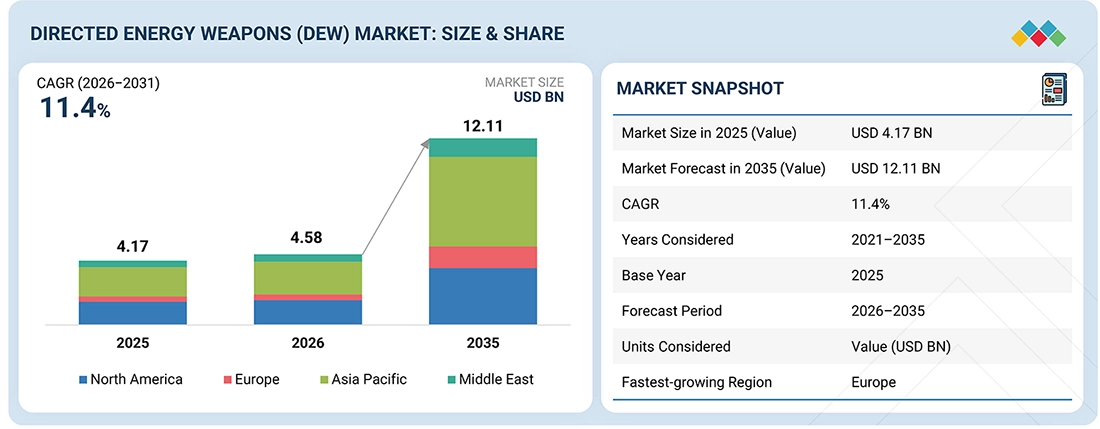
According to Marketsandmarkets, the Global Directed Energy Weapon Market Size was valued at USD 4.58 billion in 2026 and is projected to reach USD 12.11 billion by 2035, growing at a CAGR of 11.4% from 2026–2035. The market is growing as militaries look for effective ways to counter drones, rockets, artillery and missiles. Additionally, governments are increasing investment in laser and microwave technologies as part of defense modernization programs. Moreover, improvements in power generation, energy storage and cooling systems are enabling deployment of DEW systems on operational platforms. All these factors are driving the growth of the directed energy weapons (DEW) market.
MARKET SNAPSHOT TABLE
| REPORT METRIC | DETAILS |
|---|---|
| Market Size in 2025 (Value) | USD 4.17 Billion |
| Market Forecast in 2035 (Value) | USD 12.11 Billion |
| CAGR | 11.4% for 2026–2035 |
| Years Considered | 2021–2035 |
| Base Year | 2025 |
| Forecast Period | 2026–2035 |
| Units Considered | Value (USD Billion) |
| Report Coverage | Revenue forecast, company ranking, competitive landscape, growth factors, and trends |
| Top Companies |
|
| Growth Drivers |
|
| Segments Covered |
|
| Regions Covered | North America, Asia Pacific, Europe, and Middle East |
DIRECTED ENERGY WEAPONS MARKET Size & Forecast
• 2025 Market Size (Value): USD 4.17 Billion
• 2035 Market Forecast (Value): USD 12.11 Billion
• CAGR: 11.4% for 2026–2035
• Asia Pacific: Accounted for a 45.7% Market Share
• High-Energy Lasers (HEL) Segment: Highest CAGR of 16.6%
KEY TAKEAWAYS
-
Paragraph ContentThe directed energy weapons (DEW) market is supported by rising defense budgets and ongoing military modernization programs across major economies. Active conflicts and geopolitical tensions are driving the need to replenish stockpiles and be ready for operations. Governments are investing in domestic production to reduce supply chain risks and ensure a steady supply. As countries prioritize defense preparedness and long-term procurement planning, the growth of the directed energy weapons (DEW) market is expected to accelerate in the coming years.
-
By RegionThe Asia Pacific directed energy weapons market accounted for a 45.7% market share in 2025.
-
By TechnologyBy technology, the high-energy lasers (HEL) segment is projected to register the highest CAGR of 16.6% during the forecast period.
-
By InvestmentBy investment, the procurement segment is expected to be a dominant market during the forecast period.
-
By ApplicationBy application, the land segment is expected to account for the largest share during the forecast period.
-
By CustomerBy customer, the military segment is expected to lead the market during the forecast period.
-
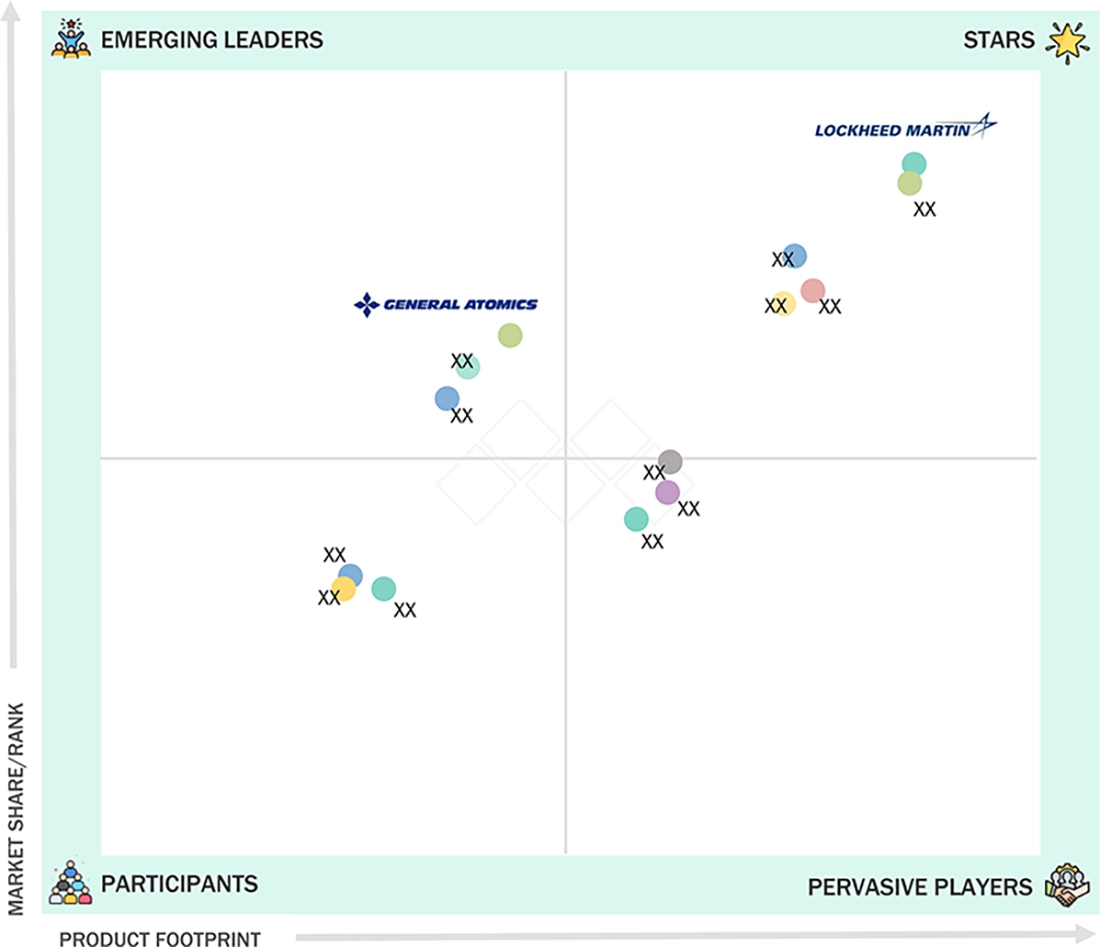
Competitive Landscape- Key PlayersLockheed Martin Corporation, RTX, and MBDA were identified as some of the star players in the directed energy weapons (DEW) market, given their strong market share and product footprint.
-
Competitive Landscape- Other PlayersLeonardo S.p.A, QINETIQ, and Rheinmetall AG., among others, have distinguished themselves among startups and SMEs by securing strong footholds in specialized niche areas, underscoring their potential as emerging market leaders.
Source: Secondary Research, Interviews with Experts, MarketsandMarkets Analysis
TRENDS & DISRUPTIONS IMPACTING CUSTOMERS' CUSTOMERS
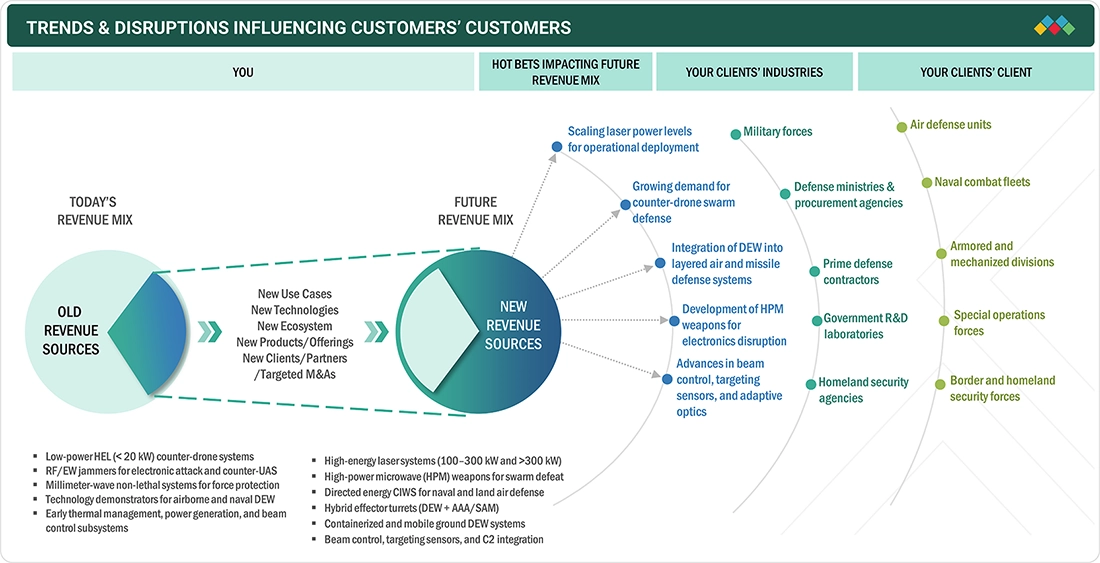
The Directed Energy Weapons (DEW) Industry is changing based on the needs of military forces and homeland security agencies. At present, their focus is on low-power laser systems for counter-drone use, electronic warfare jammers, and early deployment on land and naval platforms. However, in the coming years, demand is expected to shift to high-power laser systems, high-power microwave weapons, and layered air and missile defense systems. Additionally, there is a need for beam control, sensors, and command and control systems. To cater to this need, companies need to focus on system integration, power, cooling and deployment across platforms.
Source: Secondary Research, Interviews with Experts, MarketsandMarkets Analysis
DIRECTED ENERGY WEAPONS MARKET DYNAMICS

Drivers
Impact
Level
Level
-
Increasing demand for counter-drone, rocket, artillery, and missile defense systems across multiple military platforms

-
Growing government RDT&E and procurement investments in laser, microwave, and directed energy technologies


RESTRAINTS
Impact
Level
Level
-
High power generation, energy storage, and thermal management requirements for operational deployment

-
Performance limitations of directed energy systems under adverse atmospheric and environmental conditions


OPPORTUNITIES
Impact
Level
Level
-
Integration of directed energy weapons with layered air and missile defense architectures

-
Expansion of deployment across land, naval, airborne, unmanned, and space platforms


CHALLENGES
Impact
Level
Level
-
Continued reliance on kinetic interceptors and electronic warfare systems for defense missions

-
Export controls and technology security restrictions affecting international collaboration and sales

Source: Secondary Research, Interviews with Experts, MarketsandMarkets Analysis
Driver: Increasing demand for counter-drone, rocket, artillery, and missile defense systems across multiple military platforms
Military forces are encountering an increasing array of low-cost threats, including drones, rockets, and artillery, that have been utilized in recent conflicts. These challenges necessitate systems capable of responding swiftly and engaging multiple targets without solely depending on expensive interceptors. As a result, directed energy systems are being assessed for land vehicles, naval vessels, and airborne platforms to enhance short-range and point defense capabilities.
Restraint: High power generation, energy storage, and thermal management requirements for operational deployment
Directed energy weapons need a large and stable power supply, as well as effective cooling systems to operate continuously. Many military platforms, particularly vehicles and aircraft, have limited onboard power and space, which complicates integration. Additionally, incorporating extra systems for power generation, energy storage, and thermal management adds weight, increases costs, and raises engineering complexity.
Opportunity: Integration of directed energy weapons with layered air and missile defense architectures
Air and missile defense networks are increasingly built around layered systems that combine sensors, interceptors, and command systems. Directed energy weapons can complement missile and gun systems by engaging short-range threats, such as drones or rockets. Integrating DEW with existing air defense platforms can improve response capacity while reducing the use of interceptor missiles for lower-cost targets.
Challenge: Continued reliance on kinetic interceptors and electronic warfare systems for similar defense missions
Many armed forces continue to rely on established solutions, such as missile interceptors, anti-aircraft guns, and electronic warfare jammers. These systems are already deployed, have been tested in combat, and are integrated into existing defense networks. Consequently, procurement programs may prioritize upgrades to these systems instead of adopting directed energy technologies in the near term.
DIRECTED ENERGY WEAPONS MARKET SIZE, SHARE & TRENDS: COMMERCIAL USE CASES ACROSS INDUSTRIES
| COMPANY | USE CASE DESCRIPTION | BENEFITS |
|---|---|---|
 |
Supply of a 50 kW-class high-energy lasers (HEL) for integration into the US Army’s DE M-SHORAD Iteration 2 system on the Stryker vehicle to counter drones, rockets, artillery, mortars, and aircraft | Increased counter-UAS and short-range air defense capability | Low cost per engagement than kinetic interceptors | Rapid engagement and deep magazine capacity | Integration of directed energy on mobile land platforms |
 |
Development and delivery of the Phantom 10-kW miniaturized high-energy laser system for the US Armed Forces, for rapid integration into tactical defense solutions to counter drones, rockets, artillery, mortars, missiles, and fast attack boats | Portable and lightweight DEW system for field deployment | Rapid integration across tactical platforms | Counter-UAS and short-range threat defense capability | Reduced collateral damage compared with kinetic systems |
 |
Development and delivery of 300 kW-class High Energy Laser (HEL) systems for the US Army’s IFPC-HEL prototype program, to protect deployed forces from drones, rockets, artillery, mortars, and aircraft as part of layered air defense | High-power laser for short-range air and missile defense | Integration into layered air defense systems | Counter-UAS and C-RAM capability | Reduced reliance on kinetic interceptors |
Logos and trademarks shown above are the property of their respective owners. Their use here is for informational and illustrative purposes only.
DIRECTED ENERGY WEAPONS MARKET ECOSYSTEM
The directed energy weapons (DEW) market ecosystem includes system manufacturers, subsystem and solution providers, and end users. These participants support defense and security operations. Companies such as Lockheed Martin, RTX, MBDA, Rafael, and Boeing develop and integrate laser-based weapon systems across different platforms. Subsystem providers, such as Coherent, IPG Photonics, and QinetiQ, supply key elements like laser sources, beam control, and supporting technologies. End users mainly include armed forces such as the US Army, European armies, and other defense organizations. The market operates through government contracts, development programs, and system integration activities.

Logos and trademarks shown above are the property of their respective owners. Their use here is for informational and illustrative purposes only.
DIRECTED ENERGY WEAPONS MARKET SEGMENTS
Source: Secondary Research, Interviews with Experts, MarketsandMarkets Analysis
Directed Energy Weapons (DEW) Market, By Technology
In 2025, the high-energy lasers (HEL) segment held the largest share of the directed energy weapons (DEW) market. This dominance is attributed to the fact that most operational DEW programs are focused on laser technology. The military sector is actively testing and deploying HEL systems for various missions, including counter-drone operations and defense against rockets, artillery, and missiles, utilizing land vehicles and naval ships. Furthermore, laser systems are more advanced compared to other DEW technologies and can easily be integrated into existing air defense platforms.
Directed Energy Weapons (DEW) Market, By Investment
The procurement segment is expected to grow at a higher rate than the RDT&E segment during the forecast period. This is because procurement systems are ready for use, and governments have already started placing large orders, focusing on buying and deploying systems rather than early-stage research. Additionally, the replacement of older systems and wider deployment are also increasing procurement spending, which is also impacting segment growth.
Directed Energy Weapons (DEW) Market, By Customer
The homeland security segment is expected to grow at a higher rate than the military segment during the forecast period as agencies intensify their efforts to protect borders, ports, and critical infrastructure from drones and other low-cost aerial threats. Directed energy systems offer a method to disable or deter these threats without relying on large explosive interceptors. Their capability to support continuous surveillance and provide rapid responses makes them well-suited for border protection and counter-drone security operations.
Directed Energy Weapons (DEW) Market, By Application
In 2025, the land segment accounted for the largest share of the directed energy weapons market. This is primarily because most early deployments and testing programs focus on ground-based platforms, such as tactical trucks, armored vehicles, and containerized systems. Additionally, land platforms offer more space and power for integrating lasers and supporting subsystems, like energy storage and cooling. These systems are being utilized for missions such as counter-drone operations and short-range air defense at forward bases and operational areas.
Directed Energy Weapons (DEW) Market, By Mission
The counter-unmanned aircraft systems (C-UAS) segment accounted for the largest share of the directed energy weapons market in 2025. These types of drones are increasingly utilized for surveillance and attacks in modern conflicts. Additionally, they are needed to quickly engage numerous small and low-cost drones. Directed energy systems are being developed and tested to fulfill this requirement, as they allow for rapid engagement without solely depending on missile interceptors.
Directed Energy Weapons (DEW) Market, By Architecture
The standalone directed energy weapon (DEW) systems (Fixed/towed & mobile) segment—comprising fixed, towed, and mobile units—accounted for the largest market share in 2025. This is primarily because most directed energy programs focus on complete weapon systems that can be deployed on vehicles, ships, or fixed defense sites. Defense forces are currently testing and deploying these self-contained systems for missions such as counter-drone operations and short-range air defense. This approach allows for faster deployment and easier integration compared to more complex hybrid systems.
Directed Energy Weapons (DEW) Market, By Solution
The beam DEW generation & control system segment accounted for the largest share in 2025. This is because it encompasses the essential components needed to generate, direct, and stabilize the energy beam toward its target. These systems are necessary for all directed energy weapon platforms, including laser and microwave systems. Current development programs and prototypes place a strong emphasis on beam generation, beam directing, and tracking systems to ensure accurate targeting and effective engagement.
Directed Energy Weapons (DEW) Market, By Deployment
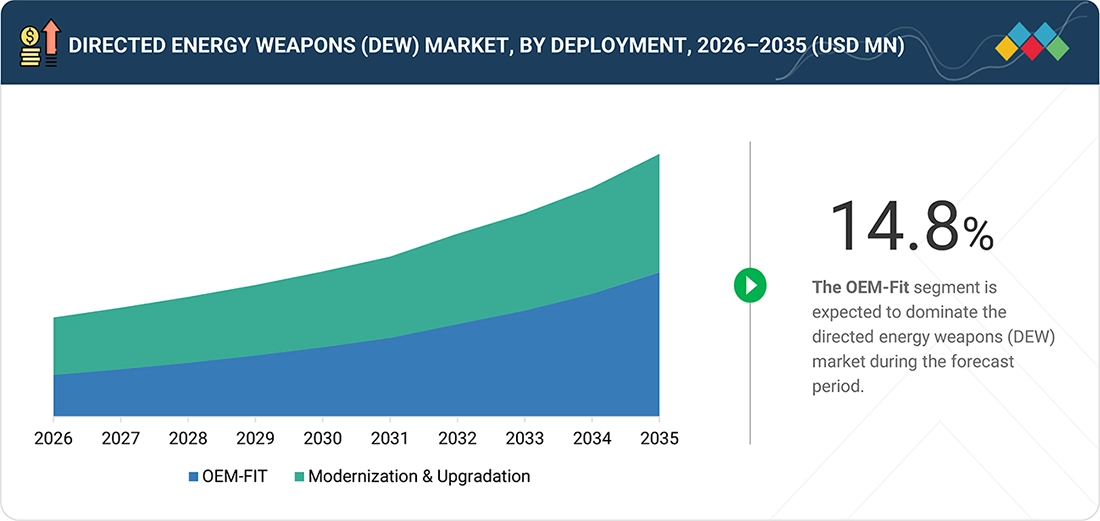
The OEM-Fit segment is expected to grow at a higher rate than the modernization & upgradation segment during the forecast period as directed energy weapons (DEW) are increasingly integrated during the design phase of new military platforms. Incorporating these systems during manufacturing allows for improved power supply, cooling, and overall system integration compared to upgrades made later. As new land vehicles, naval ships, and aircraft are being developed, many programs are now considering DEW systems as part of their original equipment configuration.
DIRECTED ENERGY WEAPONS MARKET REGION
Europe is expected to be the fastest-growing region in the directed energy weapons (DEW) market during forecast period
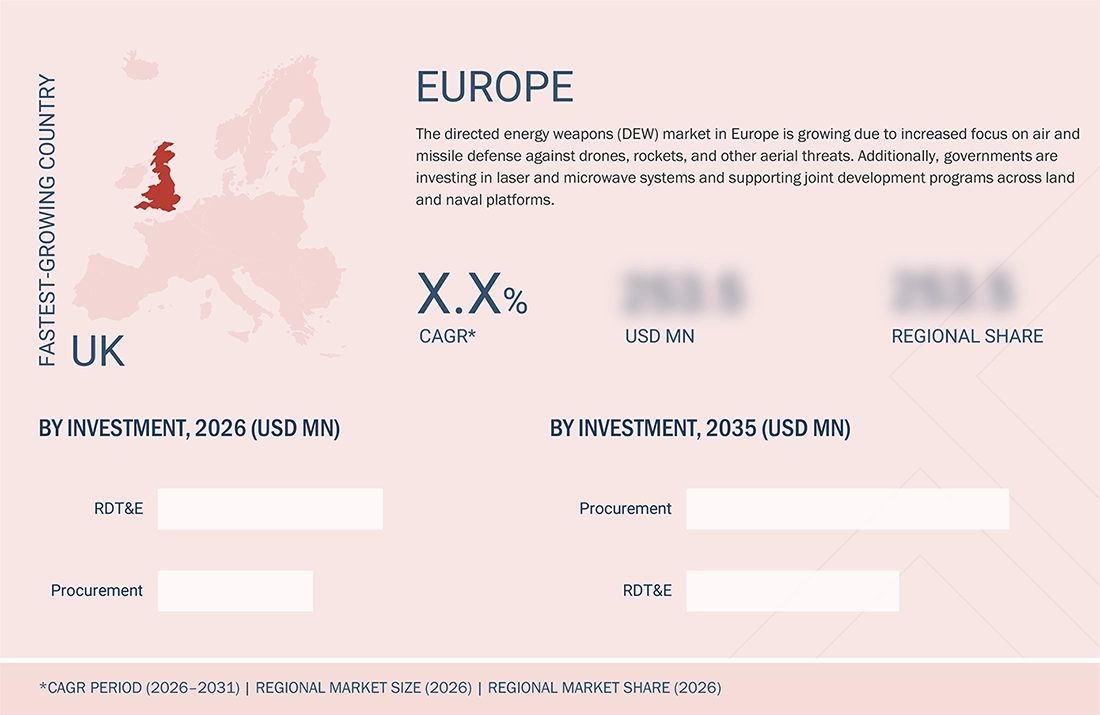
Europe is expected to be the fastest-growing region in the directed energy weapons (DEW) market during the forecast period, as European countries are increasing investments in air and missile defense following recent regional security concerns. Additionally, governments are funding programs to develop laser and microwave systems for counter-drone and short-range air defense. Several European defense companies are also testing and integrating these systems on land vehicles and naval vessels.
DIRECTED ENERGY WEAPONS MARKET SIZE, SHARE & TRENDS: COMPANY EVALUATION MATRIX
In the directed energy weapons (DEW) market, Lockheed Martin Corporation (Star) holds a strong position due to its involvement in several high-energy laser weapon programs. The company develops and supplies laser systems for various missions, including counter-drone operations, rocket and artillery defense, and missile defense. Lockheed Martin's long-term contracts with the US Department of Defense, along with the integration of laser systems on land and naval platforms, bolster its role in the directed energy weapons market. General Atomics (Emerging Player) is emerging as a leader in the directed energy weapons market by developing high-energy laser systems for defense applications. The company is engaged in projects aimed at counter-drone capabilities, missile defense, and the protection of military platforms. Its advancements in laser technologies and the integration of these systems on airborne and land platforms enhance its presence in the directed energy weapons market.
Source: Secondary Research, Interviews with Experts, MarketsandMarkets Analysis
DIRECTED ENERGY WEAPONS MARKET KEY PLAYERS
List of Top Directed Energy Weapons (DEW) Market Companies
- Lockheed Martin Corporation (US)
- RTX (US)
- Leidos (US)
- MBDA (France)
- RAFAEL Advanced Defense Systems Ltd (Israel)
- Boeing (US)
- BAE Systems (UK)
- L3Harris Technologies (US)
- General Atomics (US)
- General Dynamics Corporation (US)
- Elbit Systems Ltd (Israel)
- Thales (France)
- Northrop Grumman (US)
- Israel Aerospace Industries (Israel)
- Epirus Inc. (US)
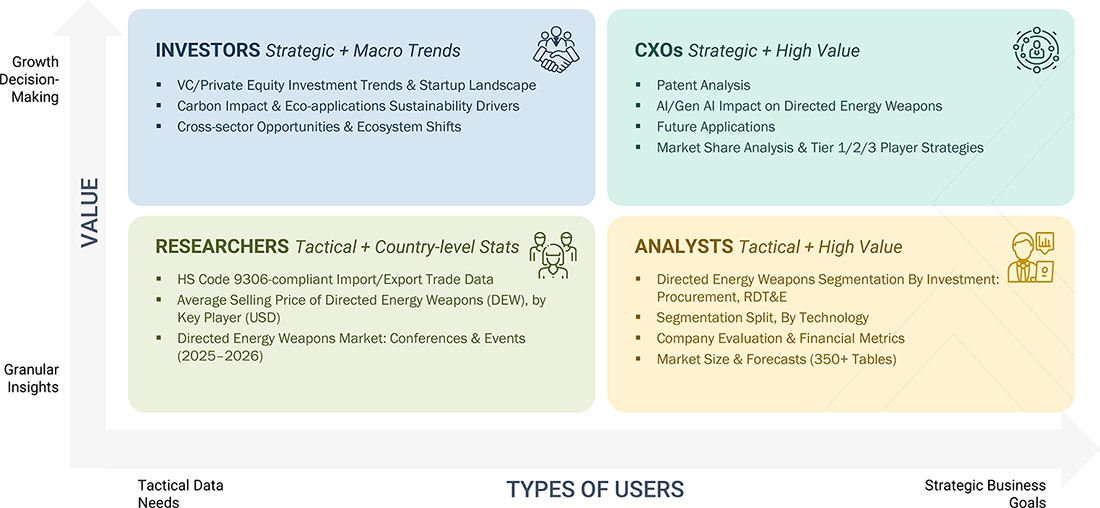
WHAT IS IN IT FOR YOU: DIRECTED ENERGY WEAPONS MARKET SIZE, SHARE & TRENDS REPORT CONTENT GUIDE
DELIVERED CUSTOMIZATIONS
We have successfully delivered the following deep-dive customizations:
| CLIENT REQUEST | CUSTOMIZATION DELIVERED | VALUE ADDS |
|---|---|---|
| Leading Manufacturer | Additional segment breakdown for countries | Additional country-level market sizing tables for segments/sub-segments covered at the regional/global level to gain an understanding of market potential by each country |
| Emerging Leader | Additional company profiles | Competitive information on targeted players to gain granular insights on direct competition |
| Regional Market Leader | Additional country market estimates | Additional country-level deep dive for a more targeted understanding of the total addressable market |
RECENT DEVELOPMENTS
- January 2026 : QinetiQ secured a contract for £67 million (approximately USD 90–91 million) from MBDA to develop and supply the laser source for the DragonFire directed energy weapon program. The system will be integrated on Royal Navy ships from 2027 to strengthen naval air defense against aerial threats.
- November 2025 : MBDA secured a contract for £316 million (USD 426–427 million) from the UK Ministry of Defence to advance the DragonFire high-energy laser weapon system for the Royal Navy. The program would support the development and integration of laser weapons on Type 45 destroyers to counter drones, missiles, and aerial threats as part of naval air defense.
- December 2023 : nLIGHT secured a contract for USD 34.5 million to supply a 50 kW-class high energy laser for the US Army’s DE M-SHORAD Iteration 2 program. The laser will be integrated on a Stryker combat vehicle to support air defense missions against drones, rockets, artillery, mortars, and aircraft.
- August 2023 : Northrop Grumman delivered the Phantom 10 kW miniaturized high-energy laser system to the US Government. The lightweight system is designed for rapid integration into tactical platforms to counter drones, rockets, artillery, mortars, missiles, and fast attack boats.
Table of Contents
 Exclusive indicates content/data unique to MarketsandMarkets and not available with any competitors.
TITLE
PAGE NO
1
INTRODUCTION
39
2
EXECUTIVE SUMMARY
44
3
PREMIUM INSIGHTS
49
4
MARKET OVERVIEW
Directed energy weapon advancements unlock new defense capabilities across diverse military platforms.
52
4.1
INTRODUCTION
4.2
MARKET DYNAMICS
4.2.1
DRIVERS
4.2.1.1
INCREASING DEMAND FOR COUNTER-DRONE, ROCKET, ARTILLERY, AND MISSILE DEFENSE ACROSS MULTIPLE MILITARY PLATFORMS
4.2.1.2
GROWING GOVERNMENT RDT&E AND PROCUREMENT INVESTMENTS IN LASER, MICROWAVE, AND DIRECTED ENERGY TECHNOLOGIES
4.2.1.3
ADVANCEMENTS IN POWER SCALING, BEAM CONTROL, AND THERMAL MANAGEMENT ENABLING TRANSITION FROM PROTOTYPE SYSTEMS TO OPERATIONAL DEPLOYMENT
4.2.2
RESTRAINTS
4.2.2.1
HIGH POWER GENERATION, ENERGY STORAGE, AND THERMAL MANAGEMENT REQUIREMENTS FOR OPERATIONAL DEPLOYMENT
4.2.2.2
PERFORMANCE LIMITATIONS OF DIRECTED ENERGY SYSTEMS UNDER ADVERSE ATMOSPHERIC AND ENVIRONMENTAL CONDITIONS
4.2.3
OPPORTUNITIES
4.2.3.1
INTEGRATION OF DIRECTED ENERGY WEAPONS WITH LAYERED AIR AND MISSILE DEFENSE ARCHITECTURE
4.2.3.2
EXPANSION OF DEPLOYMENT ACROSS LAND, NAVAL, AIRBORNE, UNMANNED, AND SPACE PLATFORMS
4.2.4
CHALLENGES
4.2.4.1
CONTINUED RELIANCE ON KINETIC INTERCEPTORS AND ELECTRONIC WARFARE SYSTEMS FOR SIMILAR DEFENSE MISSIONS
4.2.4.2
EXPORT CONTROLS AND TECHNOLOGY SECURITY RESTRICTIONS AFFECTING INTERNATIONAL COLLABORATION AND SALES
4.3
UNMET NEEDS AND WHITE SPACES IN DIRECTED ENERGY WEAPONS (DEW) MARKET
4.4
INTER-CONNECTED MARKETS AND CROSS-SECTOR OPPORTUNITIES
4.5
STRATEGIC MOVES BY TIER 1/2/3 PLAYERS
4.5.1
STRATEGIC MOVES BY TIER 1, 2, AND 3 PLAYERS
5
INDUSTRY TRENDS
Navigate global defense industry shifts with insights on DEW pricing, trade, and investment trends.
59
5.1
INTRODUCTION
5.2
MACROECONOMIC INDICATORS
5.2.1
INTRODUCTION
5.2.2
GDP TRENDS AND FORECAST
5.2.3
TRENDS IN GLOBAL DIRECTED ENERGY WEAPON (DEW) INDUSTRY
5.2.4
TRENDS IN GLOBAL DEFENSE INDUSTRY
5.3
VALUE CHAIN ANALYSIS
5.4
ECOSYSTEM ANALYSIS
5.5
TRADE ANALYSIS
5.5.1
IMPORT SCENARIO (HS CODE 9301)
5.5.2
EXPORT SCENARIO (HS CODE 9301)
5.6
KEY CONFERENCES & EVENTS, 2025–2026
5.7
TRENDS AND DISRUPTIONS IMPACTING CUSTOMER BUSINESS
5.8
INVESTMENT & FUNDING SCENARIO
5.9
PRICING ANALYSIS
5.9.1
AVERAGE SELLING PRICE TREND FOR DIRECTED ENERGY WEAPONS, KEY PLAYER
5.9.2
AVERAGE SELLING PRICE TREND, BY REGION
5.10
OPERATIONAL DATA
5.11
TOTAL COST OF OWNERSHIP
5.11.1
TOTAL COST OF OWNERSHIP (TCO) FOR DIRECTED ENERGY WEAPONS
5.11.1.1
INTEGRATION AND FIELDING
5.11.1.2
TRAINING AND SPARES COSTS
5.11.1.3
ANNUAL O&M COSTS
5.11.1.4
MID-LIFE OVERHAUL COSTS
5.11.1.5
OTHER COSTS
5.12
CASE STUDIES
5.12.1
CASE STUDY 1: DEPLOYMENT OF SHIPBORNE HIGH-ENERGY LASER SYSTEMS FOR AIR AND DRONE DEFENSE
5.12.2
CASE STUDY 2: HIGH-POWER MICROWAVE (HPWM) SYSTEM FOR SWARM DEFEAT BY EPIRUS
5.12.3
CASE STUDY 3: DEPLOYMENT OF HIGH-ENERGY LASERS (HEL) FOR COUNTER-UAS (LAND PLATFORM) BY AEROVIRONMENT
5.13
IMPACT OF 2025 US TARIFFS
5.13.1
INTRODUCTION
5.13.2
KEY TARIFF RATES
5.13.3
PRICE IMPACT ANALYSIS
5.13.4
IMPACT ON COUNTRY/REGION
5.13.4.1
US
5.13.4.2
EUROPE
5.13.4.3
ASIA PACIFIC
5.13.5
IMPACT ON END-USER INDUSTRIES
5.14
BILL OF MATERIALS (BOM) ANALYSIS
5.14.1
BILL OF MATERIALS (BOM) ANALYSIS FOR DIRECTED ENERGY WEAPONS
5.15
VOLUME DATA
5.16
BUSINESS MODELS
5.16.1
DIRECT PROCUREMENT MODEL
5.16.2
RESEARCH, DEVELOPMENT, TEST, AND EVALUATION MODEL
6
TECHNOLOGICAL ADVANCEMENTS, AI-DRIVEN IMPACT, PATENTS, INNOVATIONS, AND FUTURE APPLICATIONS
AI-driven advancements revolutionize directed energy weapons, unlocking unprecedented market potential and strategic applications.
93
6.1
KEY EMERGING TECHNOLOGIES
6.1.1
ULTRA-SHORT PULSE LASERS
6.1.2
PLASMA WEAPONRY
6.2
COMPLEMENTARY TECHNOLOGIES
6.2.1
ADAPTIVE OPTICS (AO)
6.2.2
PRECISION SENSORS AND IMU/GNSS
6.3
ADJACENT TECHNOLOGIES
6.3.1
RAILGUNS
6.3.2
COILGUNS (GAUSS GUNS)
6.3.3
HYPERVELOCITY PROJECTILE ARTILLERY
6.3.4
DIRECTED ENERGY DEPOSITION (DED)
6.3.5
COUNTER-DIRECTED ENERGY (CDEW)
6.4
TECHNOLOGY ROADMAP
6.5
EMERGING TECHNOLOGY TRENDS
6.6
PATENT ANALYSIS
6.7
FUTURE APPLICATIONS
6.8
IMPACT OF AI/GENERATIVE AI ON DIRECTED ENERGY WEAPONS (DEW) MARKET
6.8.1
TOP USE CASES AND MARKET POTENTIAL
6.8.2
BEST PRACTICES IN DIRECTED ENERGY WEAPONS (DEW) MARKET
6.8.3
INTERCONNECTED ADJACENT ECOSYSTEM AND IMPACT ON MARKET PLAYERS
6.8.4
CLIENTS’ READINESS TO ADOPT GENERATIVE AI IN DIRECTED ENERGY WEAPONS (DEW) MARKET
6.9
SUCCESS STORIES AND REAL-WORLD APPLICATIONS
6.9.1
LOCKHEED MARTIN - NAVAL LASER SYSTEM INTEGRATION FOR AIR DEFENSE
6.9.2
RTX - MICROWAVE-BASED COUNTER-DRONE SYSTEM DEPLOYMENT
6.9.3
RHEINMETALL AG - MOBILE LASER AIR DEFENSE SYSTEM INTEGRATION SYSTEM PROVIDER
7
SUSTAINABILITY AND REGULATORY LANDSCAPE
Navigate global sustainability through evolving regulations and energy-efficient innovations across key regions.
106
7.1
REGIONAL REGULATIONS AND COMPLIANCE
7.1.1
TARIFF DATA
7.1.2
REGULATORY BODIES, GOVERNMENT AGENCIES, AND OTHER ORGANIZATIONS
7.2
REGULATORY FRAMEWORK
7.2.1
NORTH AMERICA
7.2.2
EUROPE
7.2.3
ASIA PACIFIC
7.2.4
MIDDLE EAST
7.2.5
INDUSTRY STANDARDS
7.3
SUSTAINABILITY INITIATIVES
7.3.1
ENERGY-EFFICIENT POWER AND COOLING SYSTEMS
7.3.2
SYSTEM DESIGN AND LIFECYCLE UPGRADES
7.4
IMPACT OF REGULATORY POLICIES ON SUSTAINABILITY INITIATIVES
8
CUSTOMER LANDSCAPE & BUYER BEHAVIOR
Unlock strategic insights into buyer decision dynamics and unmet industry needs for competitive advantage.
112
8.1
DECISION-MAKING PROCESS
8.2
BUYER STAKEHOLDERS AND BUYING EVALUATION CRITERIA
8.2.1
KEY STAKEHOLDERS IN BUYING PROCESS
8.2.2
BUYING CRITERIA
8.3
ADOPTION BARRIERS & INTERNAL CHALLENGES
8.4
UNMET NEEDS FROM VARIOUS END-USE INDUSTRIES
9
DIRECTED ENERGY WEAPONS (DEW) MARKET, BY TECHNOLOGY
Market Size & Growth Rate Forecast Analysis to 2035 in USD Million | 12 Data Tables
117
9.1
INTRODUCTION
9.2
HIGH-ENERGY LASERS (HEL)
9.2.1
< 20 KW
9.2.1.1
LASERS WITH POWER UNDER 20 KW ARE MAINLY USED FOR COUNTER-DRONE MISSIONS AND TECHNOLOGY TESTING
9.2.2
20–100 KW
9.2.2.1
MID-POWER LASERS SUPPORT SHORT-RANGE AIR DEFENSE AGAINST DRONES AND SMALL AERIAL THREATS
9.2.3
101–300 KW
9.2.3.1
HIGH-POWER LASERS ARE DESIGNED TO COUNTER ROCKETS, ARTILLERY, MORTARS, AND LARGER DRONES
9.2.4
> 300 KW
9.2.4.1
VERY HIGH-POWER LASERS ARE USED FOR ADVANCED AIR AND MISSILE DEFENSE MISSIONS
9.3
HIGH-POWER MICROWAVES (HPWM)
9.3.1
10–500 MW
9.3.1.1
HPWM SYSTEMS IN 10–500 MW POWER RANGE ARE USED FOR TACTICAL ELECTRONIC DISRUPTION AND COUNTER-DRONE MISSIONS
9.3.2
501 MW–1 GW
9.3.2.1
MICROWAVE SYSTEMS PROVIDE STRONGER ELECTRONIC DISRUPTION AGAINST LARGER DRONES AND GUIDED MUNITIONS
9.3.3
1–100 GW
9.3.3.1
HPWM SYSTEMS IN 1–100 GW POWER RANGE SUPPORT ADVANCED ELECTRONIC ATTACK MISSIONS AGAINST RADAR AND COMMUNICATION SYSTEMS
9.3.4
101–300 GW
9.3.4.1
HIGH-INTENSITY MICROWAVE SYSTEMS ARE DESIGNED FOR WIDE-AREA ELECTRONIC DISRUPTION AND COUNTER-SWARM OPERATIONS
9.3.5
> 300 GW
9.3.5.1
HPWM SYSTEMS WITH POWER ABOVE 300 GW ARE RESEARCHED FOR LARGE-SCALE ELECTRONIC DISRUPTION IN HIGH-INTENSITY CONFLICT ENVIRONMENTS
9.4
MILLIMETER WAVE DEVICES
9.4.1
10–50 KW
9.4.1.1
MILLIMETER WAVE SYSTEMS WITH 10–50 KW POWER RANGE ARE USED FOR SHORT-RANGE NON-LETHAL SECURITY AND TESTING APPLICATIONS
9.4.2
51–100 KW
9.4.2.1
MILLIMETER WAVE SYSTEMS OPERATING BETWEEN 50 AND 100 KW IMPROVE RANGE AND EFFECTIVENESS FOR VEHICLE-MOUNTED NON-LETHAL SECURITY OPERATIONS
9.4.3
> 100 KW
9.4.3.1
MILLIMETER WAVE SYSTEMS ABOVE 100 KW POWER RANGE PROVIDE WIDER COVERAGE AND STRONGER DETERRENCE FOR LARGE SECURITY ZONES
9.5
RADIOFREQUENCY DEVICES & ELECTRONIC WARFARE (EW) JAMMERS
9.5.1
< 100 W
9.5.1.1
RF JAMMERS WITH POWER BELOW 100 W PROVIDE PORTABLE SHORT-RANGE DISRUPTION FOR COUNTER-DRONE AND LOCAL SECURITY MISSIONS
9.5.2
100 W–1 KW
9.5.2.1
RADIOFREQUENCY JAMMERS IN THIS POWER RANGE SUPPORT VEHICLE-MOUNTED COUNTER-UAS AND TACTICAL COMMUNICATION DISRUPTION OPERATIONS
9.5.3
2–10 KW
9.5.3.1
RF AND EW JAMMERS IN THIS RANGE ENABLE TACTICAL ELECTRONIC WARFARE AGAINST DRONES, RADAR, AND BATTLEFIELD COMMUNICATIONS
9.5.4
> 10 KW
9.5.4.1
RF JAMMERS WITH POWER ABOVE 10 KW DELIVER HIGH-POWER ELECTRONIC WARFARE CAPABILITIES AGAINST RADAR AND COMMUNICATION NETWORKS
9.6
PARTICLE BEAM
9.6.1
50–200 MEV/M
9.6.1.1
PARTICLE BEAM SYSTEMS OPERATING IN 50–200 MEV/M ENERGY RANGE REPRESENT EARLY-STAGE ACCELERATOR-BASED DIRECTED ENERGY SYSTEMS
9.6.2
201–400 MEV/M
9.6.2.1
PARTICLE BEAM SYSTEMS WITHIN 200–400 MEV/M RANGE REPRESENT MORE ADVANCED ACCELERATOR TECHNOLOGIES CAPABLE OF GENERATING SIGNIFICANTLY HIGHER ENERGY PARTICLE STREAMS
10
DIRECTED ENERGY WEAPONS (DEW) MARKET, BY INVESTMENT
Market Size & Growth Rate Forecast Analysis to 2035 in USD Million | 2 Data Tables
130
10.1
INTRODUCTION
10.2
PROCUREMENT
10.2.1
PROCUREMENT PROGRAMS ARE INCREASING AS DIRECTED ENERGY SYSTEMS MOVE FROM TESTING TO OPERATIONAL DEPLOYMENT
10.3
RDT&E
10.3.1
RDT&E INVESTMENT SUPPORTS RESEARCH, TESTING, AND TECHNOLOGY DEVELOPMENT FOR FUTURE DIRECTED ENERGY CAPABILITIES
11
DIRECTED ENERGY WEAPONS (DEW) MARKET, BY CUSTOMER
Market Size & Growth Rate Forecast Analysis to 2035 in USD Million | 2 Data Tables
134
11.1
INTRODUCTION
11.2
MILITARY
11.2.1
NEED FOR MILITARY FORCES TO ADOPT DIRECTED ENERGY SYSTEMS TO DRIVE MARKET
11.3
HOMELAND SECURITY
11.3.1
HOMELAND SECURITY AGENCIES ARE EXPLORING DIRECTED ENERGY TECHNOLOGIES TO PROTECT INFRASTRUCTURE AND COUNTER UNAUTHORIZED DRONES
12
DIRECTED ENERGY WEAPONS (DEW) MARKET, BY APPLICATION
Market Size & Growth Rate Forecast Analysis to 2035 in USD Million | 12 Data Tables
138
12.1
INTRODUCTION
12.2
AIRBORNE
12.2.1
FIGHTER JETS
12.2.1.1
FIGHTER AIRCRAFT ARE BEING STUDIED AS PLATFORMS FOR DIRECTED ENERGY SYSTEMS TO IMPROVE SELF-PROTECTION AGAINST MISSILES AND AERIAL THREATS
12.2.2
ATTACK HELICOPTERS
12.2.2.1
HELICOPTERS USE COMPACT DIRECTED ENERGY SYSTEMS TO COUNTER LOW-ALTITUDE DRONES AND SUPPORT SHORT-RANGE DEFENSIVE MISSIONS
12.2.3
SPECIAL MISSION AIRCRAFT
12.2.3.1
SPECIAL MISSION AIRCRAFT SUPPORT DIRECTED ENERGY OPERATIONS SUCH AS ELECTRONIC DISRUPTION, SURVEILLANCE PROTECTION, AND COUNTER-DRONE MISSIONS
12.2.4
UNMANNED AERIAL VEHICLES (UAVS)
12.2.4.1
UAVS ARE USED AS PLATFORMS FOR SMALLER DIRECTED ENERGY SYSTEMS THAT CAN REMOTELY ENGAGE DRONES AND ELECTRONIC TARGETS
12.3
MUNITIONS
12.3.1
CRUISE MISSILES
12.3.1.1
CRUISE MISSILES ARE LONG-RANGE PRECISION STRIKE WEAPONS USED TO ATTACK STRATEGIC TARGETS DURING MODERN MILITARY OPERATIONS
12.3.2
LOITERING MUNITIONS
12.3.2.1
LOITERING MUNITIONS COMBINE SURVEILLANCE AND STRIKE FUNCTIONS BY SEARCHING FOR TARGETS BEFORE CARRYING OUT DIRECT ATTACKS
12.3.3
ROCKET ARTILLERY
12.3.3.1
ROCKET ARTILLERY SYSTEMS DELIVER RAPID, LONG-RANGE FIREPOWER TO SUPPORT GROUND OPERATIONS AND SUPPRESS ENEMY POSITIONS
12.4
LAND
12.4.1
FIXED
12.4.1.1
PALLETIZED/CONTAINERIZED SYSTEMS
12.4.1.1.1
CONTAINERIZED DIRECTED ENERGY SYSTEMS ALLOW RAPID TRANSPORT AND DEPLOYMENT OF COUNTER-DRONE CAPABILITIES
12.4.1.2
HEAVY-TRAILER-MOUNTED SYSTEMS
12.4.1.2.1
TRAILER-MOUNTED PLATFORMS PROVIDE SEMI-MOBILE DEPLOYMENT OF HIGHER-POWER DIRECTED ENERGY SYSTEMS
12.4.2
MOBILE
12.4.2.1
INFANTRY FIGHTING VEHICLES
12.4.2.1.1
INFANTRY FIGHTING VEHICLES INTEGRATE COMPACT DIRECTED ENERGY SYSTEMS TO PROTECT FRONTLINE TROOPS FROM AERIAL THREATS
12.4.2.2
ARMORED PERSONNEL CARRIERS
12.4.2.2.1
ARMORED PERSONNEL CARRIERS SUPPORT MOBILE DEFENSE ROLES BY CARRYING DIRECTED ENERGY SYSTEMS FOR PROTECTION AGAINST AERIAL ATTACKS
12.4.2.3
TACTICAL TRUCKS
12.4.2.3.1
TACTICAL TRUCKS PROVIDE SPACE AND POWER CAPACITY TO TRANSPORT AND OPERATE DIRECTED ENERGY SYSTEMS FOR BASE DEFENSE AND CONVOY PROTECTION
12.4.2.4
UNMANNED GROUND VEHICLES
12.4.2.4.1
UNMANNED GROUND VEHICLES ENABLE REMOTE OPERATION OF DIRECTED ENERGY SYSTEMS IN HIGH-RISK ENVIRONMENTS WITHOUT EXPOSING SOLDIERS TO DANGER
12.5
NAVAL
12.5.1
DESTROYERS
12.5.1.1
DESTROYERS HAVE POWER CAPACITY AND SPACE REQUIRED TO SUPPORT HIGHER-POWER DIRECTED ENERGY SYSTEMS FOR SHIP DEFENSE
12.5.2
AMPHIBIOUS ASSAULT/LANDING SHIPS
12.5.2.1
AMPHIBIOUS SHIPS USE DIRECTED ENERGY SYSTEMS TO PROTECT TROOPS, LANDING OPERATIONS, AND NEARBY VESSELS FROM AERIAL THREATS
12.5.3
FRIGATES & LITTORAL COMBAT SHIPS (LCS)
12.5.3.1
FRIGATES AND LITTORAL COMBAT SHIPS STRENGTHEN SHORT-RANGE MARITIME DEFENSE
12.5.4
PATROL BOATS
12.5.4.1
PATROL BOATS CAN DEPLOY SMALLER DIRECTED ENERGY SYSTEMS FOR COASTAL SECURITY AND COUNTER-DRONE MISSIONS
12.5.5
UNMANNED SURFACE VEHICLES
12.5.5.1
UNMANNED SURFACE VEHICLES MAY OPERATE DIRECTED ENERGY PAYLOADS TO SUPPORT REMOTE MARITIME SURVEILLANCE AND DEFENSE TASKS
12.6
SPACE
12.6.1
LOW EARTH ORBIT (LEO) SATELLITES
12.6.1.1
LEO SATELLITES ARE STUDIED FOR RECEIVING AND CONVERTING TRANSMITTED LASER ENERGY FOR POWER AND OTHER SPACE OPERATIONS
12.6.2
SPACEPLANES
12.6.2.1
SPACEPLANES ARE EXAMINED FOR POTENTIAL USE OF LASER ENERGY IN PROPULSION CONCEPTS AND FUTURE SPACE MISSION SUPPORT
13
DIRECTED ENERGY WEAPONS (DEW) MARKET, BY MISSION
Market Size & Growth Rate Forecast Analysis to 2035 in USD Million | 2 Data Tables
154
13.1
INTRODUCTION
13.2
COUNTER-UNMANNED AERIAL SYSTEMS (C-SUAS/C-UAS)
13.2.1
RISING DRONE THREATS TO DRIVE ADOPTION OF DIRECTED ENERGY WEAPONS FOR COUNTER-UAS MISSIONS
13.3
COUNTER-ROCKET, ARTILLERY, AND MORTAR (C-RAM)
13.3.1
FOCUS ON PROTECTING FORWARD FORCES FROM INDIRECT FIRE THREATS TO DRIVE C-RAM MISSIONS TO BOOST GROWTH
13.4
CRUISE MISSILE DEFENSE (CMD)
13.4.1
GROWING CRUISE MISSILE THREATS TO STRENGTHEN ROLE OF DIRECTED ENERGY WEAPONS IN AIR DEFENSE
13.5
BALLISTIC & HYPERSONIC MISSILE DEFENSE
13.5.1
FOCUS ON EMERGING HIGH-SPEED MISSILE THREATS TO DRIVE RESEARCH IN DIRECTED ENERGY DEFENSE
13.6
COUNTER-ELECTRONICS & CISR DEFEAT AND SENSOR BUILDING
13.6.1
ELECTRONIC WARFARE REQUIREMENTS TO EXPAND USE OF DIRECTED ENERGY WEAPONS FOR SENSOR DISRUPTION
13.7
COUNTER-ELECTRONICS & CISR DEFEAT AND SENSOR BUILDING
13.7.1
NAVAL SECURITY CHALLENGES TO DRIVE DEMAND FOR DIRECTED ENERGY AGAINST SMALL ATTACK BOATS
13.8
COUNTER-ELECTRONICS & CISR DEFEAT AND SENSOR BUILDING
13.8.1
GROWING DEMAND FOR SCALABLE AND NON-LETHAL SECURITY SOLUTIONS TO DRIVE ADOPTION OF DIRECTED ENERGY WEAPONS
14
DIRECTED ENERGY WEAPONS (DEW), BY ARCHITECTURE
Market Size & Growth Rate Forecast Analysis to 2035 in USD Million | 8 Data Tables
161
14.1
INTRODUCTION
14.2
STANDALONE DEW SYSTEMS (FIXED/TOWED & MOBILE)
14.2.1
EMPHASIS ON DEPLOYING INDEPENDENT DIRECTED ENERGY SYSTEMS ON FIXED SITES AND MOBILE MILITARY PLATFORMS TO DRIVE GROWTH
14.3
HYBRID EFFECTOR TURRETS
14.3.1
DEW WITH ANTI-AIRCRAFT ARTILLERY (AAA)
14.3.1.1
NEED FOR COMBINING DIRECTED ENERGY SYSTEMS WITH ANTI-AIRCRAFT GUNS FOR SHORT-RANGE AIR DEFENSE TO DRIVE MARKET
14.3.2
DEW WITH SURFACE-TO-AIR MISSILE (SAM)
14.3.2.1
FOCUS ON COMBINING DIRECTED ENERGY WEAPONS AND MISSILE SYSTEMS TO SUPPORT LAYERED AIR DEFENSE TO DRIVE MARKET
14.3.3
DEW WITH AAA & SHORAD MISSILE
14.3.3.1
NEED FOR USING DIRECTED ENERGY, ARTILLERY, AND SHORT-RANGE MISSILES TOGETHER FOR MULTI-LAYER DEFENSE TO BOOST GROWTH
14.4
DIRECTED ENERGY CLOSE-IN WEAPON SYSTEMS (DE-CIWS)
14.4.1
NAVAL DE-CIWS
14.4.1.1
NEED FOR DEPLOYING DIRECTED ENERGY CLOSE-IN DEFENSE SYSTEMS ON NAVAL SHIPS TO COUNTER MISSILES AND DRONES TO DRIVE MARKET
14.4.2
LAND-BASED DE-CIWS
14.4.2.1
FOCUS ON USING DIRECTED ENERGY CLOSE-IN WEAPON SYSTEMS TO PROTECT MILITARY BASES AND GROUND INSTALLATIONS TO BOOST MARKET
14.5
EXPENDABLE PAYLOADS/WARHEADS
14.5.1
SINGLE-USE EMP PAYLOAD
14.5.1.1
ELECTROMAGNETIC PULSE PAYLOADS DISRUPT ELECTRONIC CIRCUITS AND COMMUNICATION SYSTEMS
14.5.2
MICROWAVE WARHEADS
14.5.2.1
HIGH-POWER MICROWAVE ENERGY INTERFERES WITH ELECTRONIC SYSTEMS ON MILITARY TARGETS
15
DIRECTED ENERGY WEAPONS (DEW) MARKET, BY SOLUTION
Market Size & Growth Rate Forecast Analysis to 2035 in USD Million | 10 Data Tables
169
15.1
INTRODUCTION
15.2
POWER GENERATION & ENERGY STORAGE SYSTEM
15.2.1
PRIME POWER GENERATION SYSTEM
15.2.1.1
RELIABLE ONBOARD ELECTRICITY GENERATION IS ESSENTIAL TO SUPPORT CONTINUOUS OPERATION OF DIRECTED ENERGY WEAPONS
15.2.2
POWER DISTRIBUTION SYSTEM
15.2.2.1
NEED FOR EFFICIENT POWER DISTRIBUTION TO ENSURE HIGH ELECTRICAL LOADS FROM DIRECTED ENERGY WEAPONS TO DRIVE MARKET
15.2.3
PULSED POWER SYSTEM
15.2.3.1
PULSED POWER SYSTEMS ENABLE DIRECTED ENERGY WEAPONS TO RELEASE LARGE AMOUNTS OF ENERGY IN VERY SHORT BURSTS
15.2.4
ENERGY STORAGE SYSTEM
15.2.4.1
ENERGY STORAGE SYSTEMS PROVIDE RESERVE POWER THAT ALLOWS DIRECTED ENERGY WEAPONS TO OPERATE DURING HIGH-ENERGY ENGAGEMENTS
15.3
THERMAL MANAGEMENT SYSTEM (TMS)
15.3.1
LIQUID COOLING SYSTEM
15.3.1.1
LIQUID COOLING SYSTEMS REMOVE HEAT QUICKLY FROM LASER COMPONENTS TO PREVENT OVERHEATING AND MAINTAIN CONTINUOUS WEAPON OPERATION
15.3.2
HEAT ABSORPTION SYSTEM
15.3.2.1
HEAT ABSORPTION SYSTEMS USE ADVANCED MATERIALS TO STORE AND DISSIPATE EXCESS HEAT PRODUCED DURING LASER OPERATION
15.4
BEAM GENERATION & CONTROL SYSTEM
15.4.1
BEAM DIRECTOR ASSEMBLY SYSTEM
15.4.1.1
BEAM DIRECTOR ASSEMBLIES GUIDE AND FOCUS ENERGY BEAM TOWARD TARGET WITH HIGH ACCURACY
15.4.2
BEAM GENERATION SYSTEM
15.4.2.1
BEAM GENERATION SYSTEMS CONVERT ELECTRICAL POWER INTO FOCUSED LASER OR MICROWAVE ENERGY USED TO ENGAGE TARGETS
15.4.3
TURRET & STABILIZATION SYSTEM
15.4.3.1
TURRET AND STABILIZATION SYSTEMS MAINTAIN BEAM ACCURACY BY COMPENSATING FOR PLATFORM MOVEMENT AND VIBRATION
15.5
OTHERS
15.5.1
SENSOR & TARGET ACQUISITION SYSTEM
15.5.1.1
SENSOR AND TARGET ACQUISITION SYSTEMS DETECT AND TRACK THREATS SO THAT DIRECTED ENERGY WEAPONS CAN ENGAGE THEM
15.5.2
COMMAND & CONTROL SYSTEM
15.5.2.1
COMMAND AND CONTROL SYSTEMS COORDINATE TARGET ENGAGEMENT AND MANAGE OPERATION OF DIRECTED ENERGY WEAPONS
15.5.3
PLATFORM INTEGRATION SYSTEMS
15.5.3.1
PLATFORM INTEGRATION SYSTEMS ENSURE THAT DIRECTED ENERGY WEAPONS OPERATE EFFECTIVELY WITHIN HOST VEHICLE OR PLATFORM
16
DIRECTED ENERGY WEAPONS (DEW) MARKET, BY DEPLOYMENT
Market Size & Growth Rate Forecast Analysis to 2035 in USD Million | 2 Data Tables
180
16.1
INTRODUCTION
16.2
OEM-FIT
16.2.1
INTEGRATION OF DIRECTED ENERGY WEAPONS DURING PLATFORM MANUFACTURING TO SUPPORT STABLE DEPLOYMENT AND SYSTEM COMPATIBILITY
16.3
MODERNIZATION & UPGRADATION
16.3.1
NEED FOR UPGRADING EXISTING MILITARY PLATFORMS WITH DIRECTED ENERGY WEAPONS TO DRIVE MARKET
17
DIRECTED ENERGY WEAPONS (DEW) MARKET, BY REGION
Comprehensive coverage of 5 Regions with country-level deep-dive of 12 Countries | 266 Data Tables.
183
17.1
INTRODUCTION
17.2
NORTH AMERICA
17.2.1
US
17.2.1.1
ONGOING US MILITARY PROGRAMS AND PROTOTYPE DEVELOPMENT TO SUPPORT TRANSITION OF DIRECTED ENERGY WEAPONS FROM RESEARCH TO FIELD DEPLOYMENT
17.3
ASIA PACIFIC
17.3.1
CHINA
17.3.1.1
CHINA EXPANDS DIRECTED ENERGY WEAPON DEVELOPMENT TO STRENGTHEN COUNTER-DRONE AND ADVANCED AIR DEFENSE CAPABILITIES
17.3.2
JAPAN
17.3.2.1
JAPAN DEPLOYS HIGH-POWER MICROWAVE AND LASER SYSTEMS TO BUILD COST-EFFECTIVE COUNTER-DRONE DEFENSE CAPABILITIES
17.3.3
INDIA
17.3.3.1
NEED TO DEVELOP DOMESTICALLY BUILT LASER-BASED DIRECTED ENERGY WEAPONS TO COUNTER DRONES AND IMPROVE AIR DEFENSE RESPONSE
17.3.4
SOUTH KOREA
17.3.4.1
FOCUS ON STRENGTHENING COUNTER-DRONE DEFENSE THROUGH ACQUISITION AND LOCAL PRODUCTION OF HIGH-ENERGY LASER WEAPON SYSTEMS
17.3.5
AUSTRALIA
17.3.5.1
NEED FOR DEPLOYING INTEGRATED COUNTER-UAS TECHNOLOGIES TO ADDRESS DRONE THREATS TO DRIVE MARKET
17.4
EUROPE
17.4.1
GERMANY
17.4.1.1
TECHNOLOGICAL ADVANCEMENTS IN NAVAL LASER WEAPON DEVELOPMENT TO DRIVE MARKET
17.4.2
FRANCE
17.4.2.1
FRANCE EXPANDS DIRECTED ENERGY CAPABILITIES TO DEVELOP INTEGRATED COUNTER-DRONE AND FORCE PROTECTION LASER SOLUTIONS
17.4.3
UK
17.4.3.1
NEED TO ACCELERATE DEPLOYMENT OF DRAGONFIRE LASER WEAPON PROGRAM TO STRENGTHEN NAVAL AIR DEFENSE
17.5
MIDDLE EAST
17.5.1
GCC
17.5.1.1
UAE
17.5.1.1.1
FOCUS ON STRENGTHENING AIR DEFENSE THROUGH LASER-BASED AIRCRAFT PROTECTION AND COUNTER-DRONE PROGRAMS TO SPUR DEMAND
17.5.1.2
SAUDI ARABIA
17.5.1.2.1
EMPHASIS ON EXPANDING COUNTER-DRONE AND AIR DEFENSE CAPABILITIES TO BOOST GROWTH
17.5.2
ISRAEL
17.5.2.1
NEED FOR STRENGTHENING MULTI-LAYERED AIR DEFENSE SYSTEMS TO PROPEL DEMAND
17.5.3
TURKEY
17.5.3.1
FOCUS ON DEVELOPING AND TESTING MOBILE LASER WEAPON SYSTEMS TO DRIVE MARKET
18
COMPETITIVE LANDSCAPE
Discover market dominance tactics and revenue shifts among top defense giants through 2025.
286
18.1
INTRODUCTION
18.2
KEY PLAYER STRATEGIES/RIGHT TO WIN, 2021–2025
18.3
REVENUE ANALYSIS, 2021–2025
18.4
MARKET SHARE ANALYSIS, 2025
18.4.1
LOCKHEED MARTIN CORPORATION (US)
18.4.2
RTX (US)
18.4.3
NORTHROP GRUMMAN (US)
18.4.4
BOEING (US)
18.4.5
L3HARRIS TECHNOLOGIES, INC. (US)
18.5
BRAND/PRODUCT COMPARISON
18.6
COMPANY VALUATION AND FINANCIAL METRICS
18.7
COMPANY EVALUATION MATRIX: KEY PLAYERS, 2025
18.7.1
STARS
18.7.2
EMERGING LEADERS
18.7.3
PERVASIVE PLAYERS
18.7.4
PARTICIPANTS
18.7.5
COMPANY FOOTPRINT
18.7.5.1
COMPANY FOOTPRINT
18.7.5.2
REGION FOOTPRINT
18.7.5.3
TECHNOLOGY FOOTPRINT
18.7.5.4
INVESTMENT FOOTPRINT
18.8
COMPETITIVE SCENARIO
18.8.1
PRODUCT LAUNCHES
18.8.2
DEALS
18.8.3
OTHER DEVELOPMENTS
19
COMPANY PROFILES
In-depth Company Profiles of Leading Market Players with detailed Business Overview, Product and Service Portfolio, Recent Developments, and Unique Analyst Perspective (MnM View)
304
19.1
KEY PLAYERS
19.1.1
LOCKHEED MARTIN CORPORATION
19.1.1.1
BUSINESS OVERVIEW
19.1.1.2
PRODUCTS OFFERED
19.1.1.3
RECENT DEVELOPMENTS
19.1.1.3.1
OTHER DEVELOPMENTS
19.1.1.4
MNM VIEW
19.1.1.4.1
RIGHT TO WIN
19.1.1.4.2
STRATEGIC CHOICES
19.1.1.4.3
WEAKNESSES AND COMPETITIVE THREATS
19.1.2
RTX
19.1.3
NORTHROP GRUMMAN
19.1.4
BOEING
19.1.5
L3HARRIS TECHNOLOGIES, INC.
19.1.6
BAE SYSTEMS
19.1.7
GENERAL DYNAMICS CORPORATION
19.1.8
THALES
19.1.9
ELBIT SYSTEMS LTD.
19.1.10
GENERAL ATOMICS
19.1.11
LEIDOS
19.1.12
RAFAEL ADVANCED DEFENSE SYSTEMS LTD.
19.1.13
EPIRUS INC.
19.1.14
ISRAEL AEROSPACE INDUSTRIES
19.1.15
MBDA
19.2
OTHER PLAYERS
19.2.1
AEROVIRONMENT, INC.
19.2.2
RHEINMETALL AG
19.2.3
MBDA
19.2.4
LEONARDO DRS
19.2.5
QINETIQ
19.2.6
CILAS
19.2.7
APPLIED RESEARCH ASSOCIATES, INC.
19.2.8
EAGLEPICHER TECHNOLOGIES
20
RESEARCH METHODOLOGY
357
20.1
RESEARCH DATA
20.1.1
SECONDARY DATA
20.1.1.1
KEY DATA FROM SECONDARY SOURCES
20.1.2
PRIMARY DATA
20.1.2.1
PRIMARY INTERVIEW PARTICIPANTS
20.1.2.2
KEY DATA FROM PRIMARY SOURCES
20.1.2.3
BREAKDOWN OF PRIMARY INTERVIEWS
20.1.2.4
INSIGHTS FROM INDUSTRY EXPERTS
20.2
FACTOR ANALYSIS
20.2.1
MACRO-ECONOMIC AND POLICY FACTORS
20.2.2
INDUSTRY AND OPERATIONAL FACTORS
20.2.3
DEMAND-SIDE AND END-USER FACTORS
20.2.4
QUANTITATIVE WEIGHTING AND SENSITIVITY
20.2.5
DEMAND-SIDE INDICATORS
20.2.6
SUPPLY-SIDE INDICATORS
20.3
MARKET SIZE ESTIMATION
20.3.1
BOTTOM-UP APPROACH
20.3.1.1
MARKET SIZE ESTIMATION METHODOLOGY
20.3.2
TOP-DOWN APPROACH
20.4
DATA TRIANGULATION
20.5
RESEARCH ASSUMPTIONS
20.6
RESEARCH LIMITATIONS
20.7
RISK ASSESSMENT
21
APPENDIX
375
21.1
DISCUSSION GUIDE
21.2
KNOWLEDGESTORE: MARKETSANDMARKETS’ SUBSCRIPTION PORTAL
21.3
CUSTOMIZATION OPTIONS
21.4
RELATED REPORTS
21.5
AUTHOR DETAILS
LIST OF TABLES
TABLE 1
USD EXCHANGE RATES, 2021–2025
TABLE 2
GDP PERCENTAGE CHANGE, BY COUNTRY, 2021–2030
TABLE 3
ROLE OF COMPANIES IN ECOSYSTEM
TABLE 4
IMPORT DATA FOR HS CODE 9301-COMPLIANT PRODUCTS, BY COUNTRY, 2021–2024 (USD THOUSAND)
TABLE 5
EXPORT DATA FOR HS CODE 9301-COMPLIANT PRODUCTS, BY COUNTRY, 2021–2024 (USD THOUSAND)
TABLE 6
KEY CONFERENCES & EVENTS, 2025–2026
TABLE 7
AVERAGE SELLING PRICE TREND FOR DIRECTED ENERGY WEAPON TECHNOLOGIES, BY KEY PLAYER, 2019—2025 (USD MILLION)
TABLE 8
AVERAGE SELLING PRICE TREND, BY REGION, 2019—2025 (USD MILLION)
TABLE 9
ASIA PACIFIC: DIRECTED ENERGY WEAPONS (DEW) MARKET, NEW PROCUREMENT VS. NEW R&D UNITS, 2021—2025 (UNITS)
TABLE 10
ASIA PACIFIC: DIRECTED ENERGY WEAPONS (DEW) MARKET, NEW PROCUREMENT VS. NEW R&D UNITS, 2026—2035 (UNITS)
TABLE 11
EUROPE: DIRECTED ENERGY WEAPONS (DEW) MARKET, NEW PROCUREMENT VS. NEW R&D UNITS, 2021—2025 (UNITS)
TABLE 12
EUROPE: DIRECTED ENERGY WEAPONS (DEW) MARKET, NEW PROCUREMENT VS. NEW R&D UNITS, 2026—2035 (UNITS)
TABLE 13
MIDDLE EAST: DIRECTED ENERGY WEAPONS (DEW) MARKET, NEW PROCUREMENT VS. NEW R&D UNITS, 2021—2025 (UNITS)
TABLE 14
MIDDLE EAST: DIRECTED ENERGY WEAPONS (DEW) MARKET, NEW PROCUREMENT VS. NEW R&D UNITS, 2026—2035 (UNITS)
TABLE 15
NORTH AMERICA: DIRECTED ENERGY WEAPONS (DEW) MARKET, NEW PROCUREMENT VS. NEW R&D UNITS, 2021—2025 (UNITS)
TABLE 16
NORTH AMERICA: DIRECTED ENERGY WEAPONS (DEW) MARKET, NEW PROCUREMENT VS. NEW R&D UNITS, 2026—2035 (UNITS)
TABLE 17
AISA PACIFIC: DIRECTED ENERGY WEAPONS (DEW) MARKET, ACTIVE RDT&E UNITS VS. INSTALLED BASE, BY REGION, 2021—2025 (UNITS)
TABLE 18
ASIA PACIFIC: DIRECTED ENERGY WEAPONS (DEW) MARKET, ACTIVE RDT&E UNITS VS. INSTALLED BASE, 2026—2035 (UNITS)
TABLE 19
EUROPE: DIRECTED ENERGY WEAPONS (DEW) MARKET, ACTIVE RDT&E UNITS VS. INSTALLED BASE, 2021—2025 (UNITS)
TABLE 20
EUROPE: DIRECTED ENERGY WEAPONS (DEW) MARKET, ACTIVE RDT&E UNITS VS. INSTALLED BASE, 2026—2035 (UNITS)
TABLE 21
MIDDLE EAST: DIRECTED ENERGY WEAPONS (DEW) MARKET, ACTIVE RDT&E UNITS VS. INSTALLED BASE, 2021—2025 (UNITS)
TABLE 22
MIDDLE EAST: DIRECTED ENERGY WEAPONS (DEW) MARKET, ACTIVE RDT&E UNITS VS. INSTALLED BASE, 2026—2035 (UNITS)
TABLE 23
NORTH AMERICA: DIRECTED ENERGY WEAPONS (DEW) MARKET, ACTIVE RDT&E UNITS VS. INSTALLED BASE, 2021—2025 (UNITS)
TABLE 24
NORTH AMERICA: DIRECTED ENERGY WEAPONS (DEW) MARKET, ACTIVE RDT&E UNITS VS. INSTALLED BASE, 2026—2035 (UNITS)
TABLE 25
DIRECTED ENERGY WEAPONS (DEW) MARKET: PRODUCT SPECIFICATIONS, BY COMPANY
TABLE 26
TOTAL COST OF OWNERSHIP (TCO) FOR DIRECTED ENERGY WEAPONS
TABLE 27
RECIPROCAL TARIFF RATES ADJUSTED BY US
TABLE 28
KEY PRODUCT-RELATED TARIFF EFFECTIVE FOR DIRECTED ENERGY WEAPONS (DEW) MARKET
TABLE 29
EXPECTED CHANGE IN PRICES AND LIKELY IMPACT ON CUSTOMER MARKET DUE TO TARIFF IMPACT
TABLE 30
BILL OF MATERIALS (BOM) ANALYSIS FOR TECHNOLOGIES, BY SUBSYSTEM/ COST BUCKET
TABLE 31
DIRECTED ENERGY WEAPONS (DEW) MARKET, BY TECHNOLOGY, 2021—2025 (UNITS)
TABLE 32
DIRECTED ENERGY WEAPONS (DEW) MARKET, BY TECHNOLOGY, 2025—2035 (UNITS)
TABLE 33
KEY PATENTS, 2017–2025
TABLE 34
TOP USE CASES AND MARKET POTENTIAL
TABLE 35
BEST PRACTICES: COMPANIES IMPLEMENTING USE CASES
TABLE 36
INTERCONNECTED ADJACENT ECOSYSTEM AND IMPACT ON MARKET PLAYERS
TABLE 37
NORTH AMERICA: REGULATORY BODIES, GOVERNMENT AGENCIES, AND OTHER ORGANIZATIONS
TABLE 38
EUROPE: REGULATORY BODIES, GOVERNMENT AGENCIES, AND OTHER ORGANIZATIONS
TABLE 39
ASIA PACIFIC: REGULATORY BODIES, GOVERNMENT AGENCIES, AND OTHER ORGANIZATIONS
TABLE 40
MIDDLE EAST: REGULATORY BODIES, GOVERNMENT AGENCIES, AND OTHER ORGANIZATIONS
TABLE 41
GLOBAL INDUSTRY STANDARDS IN DIRECTED ENERGY WEAPONS (DEW) MARKET
TABLE 42
INFLUENCE OF STAKEHOLDERS ON BUYING PROCESS, BY CUSTOMER (%)
TABLE 43
KEY BUYING CRITERIA, BY CUSTOMER
TABLE 44
DIRECTED ENERGY WEAPONS (DEW) MARKET, BY TECHNOLOGY, 2021–2025 (USD MILLION)
TABLE 45
DIRECTED ENERGY WEAPONS (DEW) MARKET, BY TECHNOLOGY, 2026–2035 (USD MILLION)
TABLE 46
DIRECTED ENERGY WEAPONS (DEW) MARKET, BY HIGH-ENERGY LASER (HEL), 2021–2025 (USD MILLION)
TABLE 47
DIRECTED ENERGY WEAPONS (DEW) MARKET, BY HIGH-ENERGY LASER (HEL), 2026–2035 (USD MILLION)
TABLE 48
DIRECTED ENERGY WEAPONS (DEW) MARKET, BY HIGH-POWER MICROWAVE (HPWM), 2021–2025 (USD MILLION)
TABLE 49
DIRECTED ENERGY WEAPONS (DEW) MARKET, BY HIGH-POWER MICROWAVE (HPWM), 2026–2035 (USD MILLION)
TABLE 50
DIRECTED ENERGY WEAPONS (DEW) MARKET, BY MILLIMETER WAVE DEVICE, 2021–2025 (USD MILLION)
TABLE 51
DIRECTED ENERGY WEAPONS (DEW) MARKET, BY MILLIMETER WAVE DEVICE, 2026–2035 (USD MILLION)
TABLE 52
DIRECTED ENERGY WEAPONS (DEW) MARKET, BY RADIOFREQUENCY DEVICE & ELECTRONIC WARFARE (EW) JAMMER, 2021–2025 (USD MILLION)
TABLE 53
DIRECTED ENERGY WEAPONS (DEW) MARKET, BY RADIOFREQUENCY DEVICE & ELECTRONIC WARFARE (EW) JAMMER, 2026–2035 (USD MILLION)
TABLE 54
DIRECTED ENERGY WEAPONS (DEW) MARKET, BY PARTICLE BEAM, 2021–2025 (USD MILLION)
TABLE 55
DIRECTED ENERGY WEAPONS (DEW) MARKET, BY PARTICLE BEAM, 2026–2035 (USD MILLION)
TABLE 56
DIRECTED ENERGY WEAPONS (DEW) MARKET, BY INVESTMENT, 2021–2025 (USD MILLION)
TABLE 57
DIRECTED ENERGY WEAPONS (DEW) MARKET, BY INVESTMENT, 2026–2035 (USD MILLION)
TABLE 58
DIRECTED ENERGY WEAPONS (DEW) MARKET, BY CUSTOMER, 2021–2025 (USD MILLION)
TABLE 59
DIRECTED ENERGY WEAPONS (DEW) MARKET, BY CUSTOMER, 2026–2035 (USD MILLION)
TABLE 60
DIRECTED ENERGY WEAPONS (DEW) MARKET, BY APPLICATION, 2021–2025 (USD MILLION)
TABLE 61
DIRECTED ENERGY WEAPONS (DEW) MARKET, BY APPLICATION, 2026–2035 (USD MILLION)
TABLE 62
DIRECTED ENERGY WEAPONS (DEW) MARKET, BY AIRBORNE APPLICATION, 2021–2025 (USD MILLION)
TABLE 63
DIRECTED ENERGY WEAPONS (DEW) MARKET, BY AIRBORNE APPLICATION, 2026–2035 (USD MILLION)
TABLE 64
DIRECTED ENERGY WEAPONS (DEW) MARKET, BY MUNITION APPLICATION, 2021–2025 (USD MILLION)
TABLE 65
DIRECTED ENERGY WEAPONS (DEW) MARKET, BY MUNITION APPLICATION, 2026–2035 (USD MILLION)
TABLE 66
DIRECTED ENERGY WEAPONS (DEW) MARKET, BY LAND APPLICATION, 2021– 2025 (USD MILLION)
TABLE 67
DIRECTED ENERGY WEAPONS (DEW) MARKET, BY LAND APPLICATION, 2026–2035 (USD MILLION)
TABLE 68
DIRECTED ENERGY WEAPONS (DEW) MARKET, BY NAVAL APPLICATION, 2021–2025 (USD MILLION)
TABLE 69
DIRECTED ENERGY WEAPONS (DEW) MARKET, BY NAVAL APPLICATION, 2026–2035 (USD MILLION)
TABLE 70
DIRECTED ENERGY WEAPONS (DEW) MARKET, BY SPACE APPLICATION, 2021–2025 (USD MILLION)
TABLE 71
DIRECTED ENERGY WEAPONS (DEW) MARKET, BY SPACE APPLICATION, 2026–2035 (USD MILLION)
TABLE 72
DIRECTED ENERGY WEAPONS (DEW) MARKET, BY MISSION, 2021–2025 (USD MILLION)
TABLE 73
DIRECTED ENERGY WEAPONS (DEW) MARKET, BY MISSION, 2026–2035 (USD MILLION)
TABLE 74
DIRECTED ENERGY WEAPONS (DEW) MARKET, BY ARCHITECTURE, 2021–2025 (USD MILLION)
TABLE 75
DIRECTED ENERGY WEAPONS (DEW) MARKET, BY ARCHITECTURE, 2026–2035 (USD MILLION)
TABLE 76
DIRECTED ENERGY WEAPONS (DEW) MARKET, BY HYBRID EFFECTOR TURRET, 2021–2025 (USD MILLION)
TABLE 77
DIRECTED ENERGY WEAPONS (DEW) MARKET, BY HYBRID EFFECTOR TURRET, 2026–2035 (USD MILLION)
TABLE 78
DIRECTED ENERGY WEAPONS (DEW) MARKET, BY DIRECTED ENERGY CLOSE-IN WEAPON SYSTEM (DE-CIWS), 2021–2025 (USD MILLION)
TABLE 79
DIRECTED ENERGY WEAPONS (DEW) MARKET, BY DIRECTED ENERGY CLOSE-IN WEAPON SYSTEM (DE-CIWS), 2026–2035 (USD MILLION)
TABLE 80
DIRECTED ENERGY WEAPONS (DEW) MARKET, BY EXPENDABLE PAYLOAD/WARHEAD, 2021–2025 (USD MILLION)
TABLE 81
DIRECTED ENERGY WEAPONS (DEW) MARKET, BY EXPENDABLE PAYLOAD/WARHEAD, 2026–2035 (USD MILLION)
TABLE 82
DIRECTED ENERGY WEAPONS (DEW) MARKET, BY SOLUTION, 2021–2025 (USD MILLION)
TABLE 83
DIRECTED ENERGY WEAPONS (DEW) MARKET, BY SOLUTION, 2026–2035 (USD MILLION)
TABLE 84
DIRECTED ENERGY WEAPONS (DEW) MARKET, BY POWER GENERATION & ENERGY STORAGE SYSTEM, 2021–2025 (USD MILLION)
TABLE 85
DIRECTED ENERGY WEAPONS (DEW) MARKET, BY POWER GENERATION & ENERGY STORAGE SYSTEM, 2026–2035 (USD MILLION)
TABLE 86
DIRECTED ENERGY WEAPONS (DEW) MARKET, BY THERMAL MANAGEMENT SYSTEM (TMS), 2021–2025 (USD MILLION)
TABLE 87
DIRECTED ENERGY WEAPONS (DEW) MARKET, BY THERMAL MANAGEMENT SYSTEM (TMS), 2026–2035 (USD MILLION)
TABLE 88
DIRECTED ENERGY WEAPONS (DEW) MARKET, BY BEAM GENERATION & CONTROL SYSTEM, 2021–2025 (USD MILLION)
TABLE 89
DIRECTED ENERGY WEAPONS (DEW) MARKET, BEAM GENERATION & CONTROL SYSTEM, 2026–2035 (USD MILLION)
TABLE 90
DIRECTED ENERGY WEAPONS (DEW) MARKET, BY OTHER SOLUTION TYPE, 2021–2025 (USD MILLION)
TABLE 91
DIRECTED ENERGY WEAPONS (DEW) MARKET, BY OTHER SOLUTION TYPE, 2026–2035 (USD MILLION)
TABLE 92
DIRECTED ENERGY WEAPONS (DEW) MARKET, BY DEPLOYMENT, 2021–2025 (USD MILLION)
TABLE 93
DIRECTED ENERGY WEAPONS (DEW) MARKET, BY DEPLOYMENT, 2026–2035 (USD MILLION)
TABLE 94
DIRECTED ENERGY WEAPONS (DEW) MARKET, BY REGION, 2021–2025 (USD MILLION)
TABLE 95
DIRECTED ENERGY WEAPONS (DEW) MARKET, BY REGION, 2026–2035 (USD MILLION)
TABLE 96
NORTH AMERICA: DIRECTED ENERGY WEAPONS (DEW) MARKET, BY COUNTRY, 2021–2025 (USD MILLION)
TABLE 97
NORTH AMERICA: DIRECTED ENERGY WEAPONS (DEW) MARKET, BY COUNTRY, 2026–2035 (USD MILLION)
TABLE 98
NORTH AMERICA: DIRECTED ENERGY WEAPONS (DEW) MARKET, BY TECHNOLOGY, 2021–2025 (USD MILLION)
TABLE 99
NORTH AMERICA: DIRECTED ENERGY WEAPONS (DEW) MARKET, BY TECHNOLOGY, 2026–2035 (USD MILLION)
TABLE 100
NORTH AMERICA: DIRECTED ENERGY WEAPONS (DEW) MARKET, BY INVESTMENT, 2021–2025 (USD MILLION)
TABLE 101
NORTH AMERICA: DIRECTED ENERGY WEAPONS (DEW) MARKET, BY INVESTMENT, 2026–2035 (USD MILLION)
TABLE 102
NORTH AMERICA: DIRECTED ENERGY WEAPONS (DEW) MARKET, BY CUSTOMER, 2021–2025 (USD MILLION)
TABLE 103
NORTH AMERICA: DIRECTED ENERGY WEAPONS (DEW) MARKET, BY CUSTOMER, 2026–2035 (USD MILLION)
TABLE 104
NORTH AMERICA: DIRECTED ENERGY WEAPONS (DEW) MARKET, BY APPLICATION, 2021–2025 (USD MILLION)
TABLE 105
NORTH AMERICA: DIRECTED ENERGY WEAPONS (DEW) MARKET, BY APPLICATION, 2026–2035 (USD MILLION)
TABLE 106
NORTH AMERICA: DIRECTED ENERGY WEAPONS (DEW) MARKET, BY MISSION, 2021–2025 (USD MILLION)
TABLE 107
NORTH AMERICA: DIRECTED ENERGY WEAPONS (DEW) MARKET, BY MISSION, 2026–2035 (USD MILLION)
TABLE 108
NORTH AMERICA: DIRECTED ENERGY WEAPONS (DEW) MARKET, BY ARCHITECTURE, 2021–2025 (USD MILLION)
TABLE 109
NORTH AMERICA: DIRECTED ENERGY WEAPONS (DEW) MARKET, BY ARCHITECTURE, 2026–2035 (USD MILLION)
TABLE 110
NORTH AMERICA: DIRECTED ENERGY WEAPONS (DEW) MARKET, BY SOLUTION, 2021–2025 (USD MILLION)
TABLE 111
NORTH AMERICA: DIRECTED ENERGY WEAPONS (DEW) MARKET, BY SOLUTION, 2026–2035 (USD MILLION)
TABLE 112
NORTH AMERICA: DIRECTED ENERGY WEAPONS (DEW) MARKET, BY DEPLOYMENT, 2021–2025 (USD MILLION)
TABLE 113
NORTH AMERICA: DIRECTED ENERGY WEAPONS (DEW) MARKET, BY DEPLOYMENT, 2026–2035 (USD MILLION)
TABLE 114
ASIA PACIFIC: DIRECTED ENERGY WEAPONS (DEW) MARKET, BY COUNTRY, 2021–2025 (USD MILLION)
TABLE 115
ASIA PACIFIC: DIRECTED ENERGY WEAPONS (DEW) MARKET, BY COUNTRY, 2026–2035 (USD MILLION)
TABLE 116
ASIA PACIFIC: DIRECTED ENERGY WEAPONS (DEW) MARKET, BY TECHNOLOGY, 2021–2025 (USD MILLION)
TABLE 117
ASIA PACIFIC: DIRECTED ENERGY WEAPONS (DEW) MARKET, BY TECHNOLOGY, 2026–2035 (USD MILLION)
TABLE 118
ASIA PACIFIC: DIRECTED ENERGY WEAPONS (DEW) MARKET, BY INVESTMENT, 2021–2025 (USD MILLION)
TABLE 119
ASIA PACIFIC: DIRECTED ENERGY WEAPONS (DEW) MARKET, BY INVESTMENT, 2026–2035 (USD MILLION)
TABLE 120
ASIA PACIFIC: DIRECTED ENERGY WEAPONS (DEW) MARKET, BY CUSTOMER, 2021–2025 (USD MILLION)
TABLE 121
ASIA PACIFIC: DIRECTED ENERGY WEAPONS (DEW) MARKET, BY CUSTOMER, 2026–2035 (USD MILLION)
TABLE 122
ASIA PACIFIC: DIRECTED ENERGY WEAPONS (DEW) MARKET, BY APPLICATION, 2021–2025 (USD MILLION)
TABLE 123
ASIA PACIFIC: DIRECTED ENERGY WEAPONS (DEW) MARKET, BY APPLICATION, 2026–2035 (USD MILLION)
TABLE 124
ASIA PACIFIC: DIRECTED ENERGY WEAPONS (DEW) MARKET, BY MISSION, 2021–2025 (USD MILLION)
TABLE 125
ASIA PACIFIC: DIRECTED ENERGY WEAPONS (DEW) MARKET, BY MISSION, 2026–2035 (USD MILLION)
TABLE 126
ASIA PACIFIC: DIRECTED ENERGY WEAPONS (DEW) MARKET, BY ARCHITECTURE, 2021–2025 (USD MILLION)
TABLE 127
ASIA PACIFIC: DIRECTED ENERGY WEAPONS (DEW) MARKET, BY ARCHITECTURE, 2026–2035 (USD MILLION)
TABLE 128
ASIA PACIFIC: DIRECTED ENERGY WEAPONS (DEW) MARKET, BY SOLUTION, 2021–2025 (USD MILLION)
TABLE 129
ASIA PACIFIC: DIRECTED ENERGY WEAPONS (DEW) MARKET, BY SOLUTION, 2026–2035 (USD MILLION)
TABLE 130
ASIA PACIFIC: DIRECTED ENERGY WEAPONS (DEW) MARKET, BY DEPLOYMENT, 2021–2025 (USD MILLION)
TABLE 131
ASIA PACIFIC: DIRECTED ENERGY WEAPONS (DEW) MARKET, BY DEPLOYMENT, 2026–2035 (USD MILLION)
TABLE 132
CHINA: DIRECTED ENERGY WEAPONS (DEW) MARKET, BY TECHNOLOGY, 2021–2025 (USD MILLION)
TABLE 133
CHINA: DIRECTED ENERGY WEAPONS (DEW) MARKET, BY TECHNOLOGY, 2026–2035 (USD MILLION)
TABLE 134
CHINA: DIRECTED ENERGY WEAPONS (DEW) MARKET, BY INVESTMENT, 2021–2025 (USD MILLION)
TABLE 135
CHINA: DIRECTED ENERGY WEAPONS (DEW) MARKET, BY INVESTMENT, 2026–2035 (USD MILLION)
TABLE 136
CHINA: DIRECTED ENERGY WEAPONS (DEW) MARKET, BY CUSTOMER, 2021–2025 (USD MILLION)
TABLE 137
CHINA: DIRECTED ENERGY WEAPONS (DEW) MARKET, BY CUSTOMER, 2026–2035 (USD MILLION)
TABLE 138
CHINA: DIRECTED ENERGY WEAPONS (DEW) MARKET, BY APPLICATION, 2021–2025 (USD MILLION)
TABLE 139
CHINA: DIRECTED ENERGY WEAPONS (DEW) MARKET, BY APPLICATION, 2026–2035 (USD MILLION)
TABLE 140
CHINA: DIRECTED ENERGY WEAPONS (DEW) MARKET, BY MISSION, 2021–2025 (USD MILLION)
TABLE 141
CHINA: DIRECTED ENERGY WEAPONS (DEW) MARKET, BY MISSION, 2026–2035 (USD MILLION)
TABLE 142
CHINA: DIRECTED ENERGY WEAPONS (DEW) MARKET, BY ARCHITECTURE, 2021–2025 (USD MILLION)
TABLE 143
CHINA: DIRECTED ENERGY WEAPONS (DEW) MARKET, BY ARCHITECTURE, 2026–2035 (USD MILLION)
TABLE 144
CHINA: DIRECTED ENERGY WEAPONS (DEW) MARKET, BY SOLUTION, 2021–2025 (USD MILLION)
TABLE 145
CHINA: DIRECTED ENERGY WEAPONS (DEW) MARKET, BY SOLUTION, 2026–2035 (USD MILLION)
TABLE 146
CHINA: DIRECTED ENERGY WEAPONS (DEW) MARKET, BY DEPLOYMENT, 2021–2025 (USD MILLION)
TABLE 147
CHINA: DIRECTED ENERGY WEAPONS (DEW) MARKET, BY DEPLOYMENT, 2026–2035 (USD MILLION)
TABLE 148
JAPAN: DIRECTED ENERGY WEAPONS (DEW) MARKET, BY TECHNOLOGY, 2021–2025 (USD MILLION)
TABLE 149
JAPAN: DIRECTED ENERGY WEAPONS (DEW) MARKET, BY TECHNOLOGY, 2026–2035 (USD MILLION)
TABLE 150
JAPAN: DIRECTED ENERGY WEAPONS (DEW) MARKET, BY INVESTMENT, 2021–2025 (USD MILLION)
TABLE 151
JAPAN: DIRECTED ENERGY WEAPONS (DEW) MARKET, BY INVESTMENT, 2026–2035 (USD MILLION)
TABLE 152
JAPAN: DIRECTED ENERGY WEAPONS (DEW) MARKET, BY CUSTOMER, 2021–2025 (USD MILLION)
TABLE 153
JAPAN: DIRECTED ENERGY WEAPONS (DEW) MARKET, BY CUSTOMER, 2026–2035 (USD MILLION)
TABLE 154
JAPAN: DIRECTED ENERGY WEAPONS (DEW) MARKET, BY APPLICATION, 2021–2025 (USD MILLION)
TABLE 155
JAPAN: DIRECTED ENERGY WEAPONS (DEW) MARKET, BY APPLICATION, 2026–2035 (USD MILLION)
TABLE 156
JAPAN: DIRECTED ENERGY WEAPONS (DEW) MARKET, BY MISSION, 2021–2025 (USD MILLION)
TABLE 157
JAPAN: DIRECTED ENERGY WEAPONS (DEW) MARKET, BY MISSION, 2026–2035 (USD MILLION)
TABLE 158
JAPAN: DIRECTED ENERGY WEAPONS (DEW) MARKET, BY ARCHITECTURE, 2021–2025 (USD MILLION)
TABLE 159
JAPAN: DIRECTED ENERGY WEAPONS (DEW) MARKET, BY ARCHITECTURE, 2026–2035 (USD MILLION)
TABLE 160
JAPAN: DIRECTED ENERGY WEAPONS (DEW) MARKET, BY SOLUTION, 2021–2025 (USD MILLION)
TABLE 161
JAPAN: DIRECTED ENERGY WEAPONS (DEW) MARKET, BY SOLUTION, 2026–2035 (USD MILLION)
TABLE 162
JAPAN: DIRECTED ENERGY WEAPONS (DEW) MARKET, BY DEPLOYMENT, 2021–2025 (USD MILLION)
TABLE 163
JAPAN: DIRECTED ENERGY WEAPONS (DEW) MARKET, BY DEPLOYMENT, 2026–2035 (USD MILLION)
TABLE 164
INDIA: DIRECTED ENERGY WEAPONS (DEW) MARKET, BY TECHNOLOGY, 2021–2025 (USD MILLION)
TABLE 165
INDIA: DIRECTED ENERGY WEAPONS (DEW) MARKET, BY TECHNOLOGY, 2026–2035 (USD MILLION)
TABLE 166
INDIA: DIRECTED ENERGY WEAPONS (DEW) MARKET, BY INVESTMENT, 2021–2025 (USD MILLION)
TABLE 167
INDIA: DIRECTED ENERGY WEAPONS (DEW) MARKET, BY INVESTMENT, 2026–2035 (USD MILLION)
TABLE 168
INDIA: DIRECTED ENERGY WEAPONS (DEW) MARKET, BY CUSTOMER, 2021–2025 (USD MILLION)
TABLE 169
INDIA: DIRECTED ENERGY WEAPONS (DEW) MARKET, BY CUSTOMER, 2026–2035 (USD MILLION)
TABLE 170
INDIA: DIRECTED ENERGY WEAPONS (DEW) MARKET, BY APPLICATION, 2021–2025 (USD MILLION)
TABLE 171
INDIA: DIRECTED ENERGY WEAPONS (DEW) MARKET, BY APPLICATION, 2026–2035 (USD MILLION)
TABLE 172
INDIA: DIRECTED ENERGY WEAPONS (DEW) MARKET, BY MISSION, 2021–2025 (USD MILLION)
TABLE 173
INDIA: DIRECTED ENERGY WEAPONS (DEW) MARKET, BY MISSION, 2026–2035 (USD MILLION)
TABLE 174
INDIA: DIRECTED ENERGY WEAPONS (DEW) MARKET, BY ARCHITECTURE, 2021–2025 (USD MILLION)
TABLE 175
INDIA: DIRECTED ENERGY WEAPONS (DEW) MARKET, BY ARCHITECTURE, 2026–2035 (USD MILLION)
TABLE 176
INDIA: DIRECTED ENERGY WEAPONS (DEW) MARKET, BY SOLUTION, 2021–2025 (USD MILLION)
TABLE 177
INDIA: DIRECTED ENERGY WEAPONS (DEW) MARKET, BY SOLUTION, 2026–2035 (USD MILLION)
TABLE 178
INDIA: DIRECTED ENERGY WEAPONS (DEW) MARKET, BY DEPLOYMENT, 2021–2025 (USD MILLION)
TABLE 179
INDIA: DIRECTED ENERGY WEAPONS (DEW) MARKET, BY DEPLOYMENT, 2026–2035 (USD MILLION)
TABLE 180
SOUTH KOREA: DIRECTED ENERGY WEAPONS (DEW) MARKET, BY TECHNOLOGY, 2021–2025 (USD MILLION)
TABLE 181
SOUTH KOREA: DIRECTED ENERGY WEAPONS (DEW) MARKET, BY TECHNOLOGY, 2026–2035 (USD MILLION)
TABLE 182
SOUTH KOREA: DIRECTED ENERGY WEAPONS (DEW) MARKET, BY INVESTMENT, 2021–2025 (USD MILLION)
TABLE 183
SOUTH KOREA: DIRECTED ENERGY WEAPONS (DEW) MARKET, BY INVESTMENT, 2026–2035 (USD MILLION)
TABLE 184
SOUTH KOREA: DIRECTED ENERGY WEAPONS (DEW) MARKET, BY CUSTOMER, 2021–2025 (USD MILLION)
TABLE 185
SOUTH KOREA: DIRECTED ENERGY WEAPONS (DEW) MARKET, BY CUSTOMER, 2026–2035 (USD MILLION)
TABLE 186
SOUTH KOREA: DIRECTED ENERGY WEAPONS (DEW) MARKET, BY APPLICATION, 2021–2025 (USD MILLION)
TABLE 187
SOUTH KOREA: DIRECTED ENERGY WEAPONS (DEW) MARKET, BY APPLICATION, 2026–2035 (USD MILLION)
TABLE 188
SOUTH KOREA: DIRECTED ENERGY WEAPONS (DEW) MARKET, BY MISSION, 2021–2025 (USD MILLION)
TABLE 189
SOUTH KOREA: DIRECTED ENERGY WEAPONS (DEW) MARKET, BY MISSION, 2026–2035 (USD MILLION)
TABLE 190
SOUTH KOREA: DIRECTED ENERGY WEAPONS (DEW) MARKET, BY ARCHITECTURE, 2021–2025 (USD MILLION)
TABLE 191
SOUTH KOREA: DIRECTED ENERGY WEAPONS (DEW) MARKET, BY ARCHITECTURE, 2026–2035 (USD MILLION)
TABLE 192
SOUTH KOREA: DIRECTED ENERGY WEAPONS (DEW) MARKET, BY SOLUTION, 2021–2025 (USD MILLION)
TABLE 193
SOUTH KOREA: DIRECTED ENERGY WEAPONS (DEW) MARKET, BY SOLUTION, 2026–2035 (USD MILLION)
TABLE 194
SOUTH KOREA: DIRECTED ENERGY WEAPONS (DEW) MARKET, BY DEPLOYMENT, 2021–2025 (USD MILLION)
TABLE 195
SOUTH KOREA: DIRECTED ENERGY WEAPONS (DEW) MARKET, BY DEPLOYMENT, 2026–2035 (USD MILLION)
TABLE 196
AUSTRALIA: DIRECTED ENERGY WEAPONS (DEW) MARKET, BY TECHNOLOGY, 2021–2025 (USD MILLION)
TABLE 197
AUSTRALIA: DIRECTED ENERGY WEAPONS (DEW) MARKET, BY TECHNOLOGY, 2026–2035 (USD MILLION)
TABLE 198
AUSTRALIA: DIRECTED ENERGY WEAPONS (DEW) MARKET, BY INVESTMENT, 2021–2025 (USD MILLION)
TABLE 199
AUSTRALIA: DIRECTED ENERGY WEAPONS (DEW) MARKET, BY INVESTMENT, 2026–2035 (USD MILLION)
TABLE 200
AUSTRALIA: DIRECTED ENERGY WEAPONS (DEW) MARKET, BY CUSTOMER, 2021–2025 (USD MILLION)
TABLE 201
AUSTRALIA: DIRECTED ENERGY WEAPONS (DEW) MARKET, BY CUSTOMER, 2026–2035 (USD MILLION)
TABLE 202
AUSTRALIA: DIRECTED ENERGY WEAPONS (DEW) MARKET, BY APPLICATION, 2021–2025 (USD MILLION)
TABLE 203
AUSTRALIA: DIRECTED ENERGY WEAPONS (DEW) MARKET, BY APPLICATION, 2026–2035 (USD MILLION)
TABLE 204
AUSTRALIA: DIRECTED ENERGY WEAPONS (DEW) MARKET, BY MISSION, 2021–2025 (USD MILLION)
TABLE 205
AUSTRALIA: DIRECTED ENERGY WEAPONS (DEW) MARKET, BY MISSION, 2026–2035 (USD MILLION)
TABLE 206
AUSTRALIA: DIRECTED ENERGY WEAPONS (DEW) MARKET, BY ARCHITECTURE, 2021–2025 (USD MILLION)
TABLE 207
AUSTRALIA: DIRECTED ENERGY WEAPONS (DEW) MARKET, BY ARCHITECTURE, 2026–2035 (USD MILLION)
TABLE 208
AUSTRALIA: DIRECTED ENERGY WEAPONS (DEW) MARKET, BY SOLUTION, 2021–2025 (USD MILLION)
TABLE 209
AUSTRALIA: DIRECTED ENERGY WEAPONS (DEW) MARKET, BY SOLUTION, 2026–2035 (USD MILLION)
TABLE 210
AUSTRALIA: DIRECTED ENERGY WEAPONS (DEW) MARKET, BY DEPLOYMENT, 2021–2025 (USD MILLION)
TABLE 211
AUSTRALIA: DIRECTED ENERGY WEAPONS (DEW) MARKET, BY DEPLOYMENT, 2026–2035 (USD MILLION)
TABLE 212
EUROPE: DIRECTED ENERGY WEAPONS (DEW) MARKET, BY COUNTRY, 2021–2025 (USD MILLION)
TABLE 213
EUROPE: DIRECTED ENERGY WEAPONS (DEW) MARKET, BY COUNTRY, 2026–2035 (USD MILLION)
TABLE 214
EUROPE: DIRECTED ENERGY WEAPONS (DEW) MARKET, BY TECHNOLOGY, 2021–2025 (USD MILLION)
TABLE 215
EUROPE: DIRECTED ENERGY WEAPONS (DEW) MARKET, BY TECHNOLOGY, 2026–2035 (USD MILLION)
TABLE 216
EUROPE: DIRECTED ENERGY WEAPONS (DEW) MARKET, BY INVESTMENT, 2021–2025 (USD MILLION)
TABLE 217
EUROPE: DIRECTED ENERGY WEAPONS (DEW) MARKET, BY INVESTMENT, 2026–2035 (USD MILLION)
TABLE 218
EUROPE: DIRECTED ENERGY WEAPONS (DEW) MARKET, BY CUSTOMER, 2021–2025 (USD MILLION)
TABLE 219
EUROPE: DIRECTED ENERGY WEAPONS (DEW) MARKET, BY CUSTOMER, 2026–2035 (USD MILLION)
TABLE 220
EUROPE: DIRECTED ENERGY WEAPONS (DEW) MARKET, BY APPLICATION, 2021–2025 (USD MILLION)
TABLE 221
EUROPE: DIRECTED ENERGY WEAPONS (DEW) MARKET, BY APPLICATION, 2026–2035 (USD MILLION)
TABLE 222
EUROPE: DIRECTED ENERGY WEAPONS (DEW) MARKET, BY MISSION, 2021–2025 (USD MILLION)
TABLE 223
EUROPE: DIRECTED ENERGY WEAPONS (DEW) MARKET, BY MISSION, 2026–2035 (USD MILLION)
TABLE 224
EUROPE: DIRECTED ENERGY WEAPONS (DEW) MARKET, BY ARCHITECTURE, 2021–2025 (USD MILLION)
TABLE 225
EUROPE: DIRECTED ENERGY WEAPONS (DEW) MARKET, BY ARCHITECTURE, 2026–2035 (USD MILLION)
TABLE 226
EUROPE: DIRECTED ENERGY WEAPONS (DEW) MARKET, BY SOLUTION, 2021–2025 (USD MILLION)
TABLE 227
EUROPE: DIRECTED ENERGY WEAPONS (DEW) MARKET, BY SOLUTION, 2026–2035 (USD MILLION)
TABLE 228
EUROPE: DIRECTED ENERGY WEAPONS (DEW) MARKET, BY DEPLOYMENT, 2021–2025 (USD MILLION)
TABLE 229
EUROPE: DIRECTED ENERGY WEAPONS (DEW) MARKET, BY DEPLOYMENT, 2026–2035 (USD MILLION)
TABLE 230
GERMANY: DIRECTED ENERGY WEAPONS (DEW) MARKET, BY TECHNOLOGY, 2021–2025 (USD MILLION)
TABLE 231
GERMANY: DIRECTED ENERGY WEAPONS (DEW) MARKET, BY TECHNOLOGY, 2026–2035 (USD MILLION)
TABLE 232
GERMANY: DIRECTED ENERGY WEAPONS (DEW) MARKET, BY INVESTMENT, 2021–2025 (USD MILLION)
TABLE 233
GERMANY: DIRECTED ENERGY WEAPONS (DEW) MARKET, BY INVESTMENT, 2026–2035 (USD MILLION)
TABLE 234
GERMANY: DIRECTED ENERGY WEAPONS (DEW) MARKET, BY CUSTOMER, 2021–2025 (USD MILLION)
TABLE 235
GERMANY: DIRECTED ENERGY WEAPONS (DEW) MARKET, BY CUSTOMER, 2026–2035 (USD MILLION)
TABLE 236
GERMANY: DIRECTED ENERGY WEAPONS (DEW) MARKET, BY APPLICATION, 2021–2025 (USD MILLION)
TABLE 237
GERMANY: DIRECTED ENERGY WEAPONS (DEW) MARKET, BY APPLICATION, 2026–2035 (USD MILLION)
TABLE 238
GERMANY: DIRECTED ENERGY WEAPONS (DEW) MARKET, BY MISSION, 2021–2025 (USD MILLION)
TABLE 239
GERMANY: DIRECTED ENERGY WEAPONS (DEW) MARKET, BY MISSION, 2026–2035 (USD MILLION)
TABLE 240
GERMANY: DIRECTED ENERGY WEAPONS (DEW) MARKET, BY ARCHITECTURE, 2021–2025 (USD MILLION)
TABLE 241
GERMANY: DIRECTED ENERGY WEAPONS (DEW) MARKET, BY ARCHITECTURE, 2026–2035 (USD MILLION)
TABLE 242
GERMANY: DIRECTED ENERGY WEAPONS (DEW) MARKET, BY SOLUTION, 2021–2025 (USD MILLION)
TABLE 243
GERMANY: DIRECTED ENERGY WEAPONS (DEW) MARKET, BY SOLUTION, 2026–2035 (USD MILLION)
TABLE 244
GERMANY: DIRECTED ENERGY WEAPONS (DEW) MARKET, BY DEPLOYMENT, 2021–2025 (USD MILLION)
TABLE 245
GERMANY: DIRECTED ENERGY WEAPONS (DEW) MARKET, BY DEPLOYMENT, 2026–2035 (USD MILLION)
TABLE 246
FRANCE: DIRECTED ENERGY WEAPONS (DEW) MARKET, BY TECHNOLOGY, 2021–2025 (USD MILLION)
TABLE 247
FRANCE: DIRECTED ENERGY WEAPONS (DEW) MARKET, BY TECHNOLOGY, 2026–2035 (USD MILLION)
TABLE 248
FRANCE: DIRECTED ENERGY WEAPONS (DEW) MARKET, BY INVESTMENT, 2021–2025 (USD MILLION)
TABLE 249
FRANCE: DIRECTED ENERGY WEAPONS (DEW) MARKET, BY INVESTMENT, 2026–2035 (USD MILLION)
TABLE 250
FRANCE: DIRECTED ENERGY WEAPONS (DEW) MARKET, BY CUSTOMER, 2021–2025 (USD MILLION)
TABLE 251
FRANCE: DIRECTED ENERGY WEAPONS (DEW) MARKET, BY CUSTOMER, 2026–2035 (USD MILLION)
TABLE 252
FRANCE: DIRECTED ENERGY WEAPONS (DEW) MARKET, BY APPLICATION, 2021–2025 (USD MILLION)
TABLE 253
FRANCE: DIRECTED ENERGY WEAPONS (DEW) MARKET, BY APPLICATION, 2026–2035 (USD MILLION)
TABLE 254
FRANCE: DIRECTED ENERGY WEAPONS (DEW) MARKET, BY MISSION, 2021–2025 (USD MILLION)
TABLE 255
FRANCE: DIRECTED ENERGY WEAPONS (DEW) MARKET, BY MISSION, 2026–2035 (USD MILLION)
TABLE 256
FRANCE: DIRECTED ENERGY WEAPONS (DEW) MARKET, BY ARCHITECTURE, 2021–2025 (USD MILLION)
TABLE 257
FRANCE: DIRECTED ENERGY WEAPONS (DEW) MARKET, BY ARCHITECTURE, 2026–2035 (USD MILLION)
TABLE 258
FRANCE: DIRECTED ENERGY WEAPONS (DEW) MARKET, BY SOLUTION, 2021–2025 (USD MILLION)
TABLE 259
FRANCE: DIRECTED ENERGY WEAPONS (DEW) MARKET, BY SOLUTION, 2026–2035 (USD MILLION)
TABLE 260
FRANCE: DIRECTED ENERGY WEAPONS (DEW) MARKET, BY DEPLOYMENT, 2021–2025 (USD MILLION)
TABLE 261
FRANCE: DIRECTED ENERGY WEAPONS (DEW) MARKET, BY DEPLOYMENT, 2026–2035 (USD MILLION)
TABLE 262
UK: DIRECTED ENERGY WEAPONS (DEW) MARKET, BY TECHNOLOGY, 2021–2025 (USD MILLION)
TABLE 263
UK: DIRECTED ENERGY WEAPONS (DEW) MARKET, BY TECHNOLOGY, 2026–2035 (USD MILLION)
TABLE 264
UK: DIRECTED ENERGY WEAPONS (DEW) MARKET, BY INVESTMENT, 2021–2025 (USD MILLION)
TABLE 265
UK: DIRECTED ENERGY WEAPONS (DEW) MARKET, BY INVESTMENT, 2026–2035 (USD MILLION)
TABLE 266
UK: DIRECTED ENERGY WEAPONS (DEW) MARKET, BY CUSTOMER, 2021–2025 (USD MILLION)
TABLE 267
UK: DIRECTED ENERGY WEAPONS (DEW) MARKET, BY CUSTOMER, 2026–2035 (USD MILLION)
TABLE 268
UK: DIRECTED ENERGY WEAPONS (DEW) MARKET, BY APPLICATION, 2021–2025 (USD MILLION)
TABLE 269
UK: DIRECTED ENERGY WEAPONS (DEW) MARKET, BY APPLICATION, 2026–2035 (USD MILLION)
TABLE 270
UK: DIRECTED ENERGY WEAPONS (DEW) MARKET, BY MISSION, 2021–2025 (USD MILLION)
TABLE 271
UK: DIRECTED ENERGY WEAPONS (DEW) MARKET, BY MISSION, 2026–2035 (USD MILLION)
TABLE 272
UK: DIRECTED ENERGY WEAPONS (DEW) MARKET, BY ARCHITECTURE, 2021–2025 (USD MILLION)
TABLE 273
UK: DIRECTED ENERGY WEAPONS (DEW) MARKET, BY ARCHITECTURE, 2026–2035 (USD MILLION)
TABLE 274
UK: DIRECTED ENERGY WEAPONS (DEW) MARKET, BY SOLUTION, 2021–2025 (USD MILLION)
TABLE 275
UK: DIRECTED ENERGY WEAPONS (DEW) MARKET, BY SOLUTION, 2026–2035 (USD MILLION)
TABLE 276
UK: DIRECTED ENERGY WEAPONS (DEW) MARKET, BY DEPLOYMENT, 2021–2025 (USD MILLION)
TABLE 277
UK: DIRECTED ENERGY WEAPONS (DEW) MARKET, BY DEPLOYMENT, 2026–2035 (USD MILLION)
TABLE 278
MIDDLE EAST: DIRECTED ENERGY WEAPONS (DEW) MARKET, BY COUNTRY, 2021–2025 (USD MILLION)
TABLE 279
MIDDLE EAST: DIRECTED ENERGY WEAPONS (DEW) MARKET, BY COUNTRY, 2026–2035 (USD MILLION)
TABLE 280
MIDDLE EAST: DIRECTED ENERGY WEAPONS (DEW) MARKET, BY TECHNOLOGY, 2021–2025 (USD MILLION)
TABLE 281
MIDDLE EAST: DIRECTED ENERGY WEAPONS (DEW) MARKET, BY TECHNOLOGY, 2026–2035 (USD MILLION)
TABLE 282
MIDDLE EAST: DIRECTED ENERGY WEAPONS (DEW) MARKET, BY INVESTMENT, 2021–2025 (USD MILLION)
TABLE 283
MIDDLE EAST: DIRECTED ENERGY WEAPONS (DEW) MARKET, BY INVESTMENT, 2026–2035 (USD MILLION)
TABLE 284
MIDDLE EAST: DIRECTED ENERGY WEAPONS (DEW) MARKET, BY CUSTOMER, 2021–2025 (USD MILLION)
TABLE 285
MIDDLE EAST: DIRECTED ENERGY WEAPONS (DEW) MARKET, BY CUSTOMER, 2026–2035 (USD MILLION)
TABLE 286
MIDDLE EAST: DIRECTED ENERGY WEAPONS (DEW) MARKET, BY APPLICATION, 2021–2025 (USD MILLION)
TABLE 287
MIDDLE EAST: DIRECTED ENERGY WEAPONS (DEW) MARKET, BY APPLICATION, 2026–2035 (USD MILLION)
TABLE 288
MIDDLE EAST: DIRECTED ENERGY WEAPONS (DEW) MARKET, BY MISSION, 2021–2025 (USD MILLION)
TABLE 289
MIDDLE EAST: DIRECTED ENERGY WEAPONS (DEW) MARKET, BY MISSION, 2026–2035 (USD MILLION)
TABLE 290
MIDDLE EAST: DIRECTED ENERGY WEAPONS (DEW) MARKET, BY ARCHITECTURE, 2021–2025 (USD MILLION)
TABLE 291
MIDDLE EAST: DIRECTED ENERGY WEAPONS (DEW) MARKET, BY ARCHITECTURE, 2026–2035 (USD MILLION)
TABLE 292
MIDDLE EAST: DIRECTED ENERGY WEAPONS (DEW) MARKET, BY SOLUTION, 2021–2025 (USD MILLION)
TABLE 293
MIDDLE EAST: DIRECTED ENERGY WEAPONS (DEW) MARKET, BY SOLUTION, 2026–2035 (USD MILLION)
TABLE 294
MIDDLE EAST: DIRECTED ENERGY WEAPONS (DEW) MARKET, BY DEPLOYMENT, 2021–2025 (USD MILLION)
TABLE 295
MIDDLE EAST: DIRECTED ENERGY WEAPONS (DEW) MARKET, BY DEPLOYMENT, 2026–2035 (USD MILLION)
TABLE 296
UAE: DIRECTED ENERGY WEAPONS (DEW) MARKET, BY TECHNOLOGY, 2021–2025 (USD MILLION)
TABLE 297
UAE: DIRECTED ENERGY WEAPONS (DEW) MARKET, BY TECHNOLOGY, 2026–2035 (USD MILLION)
TABLE 298
UAE: DIRECTED ENERGY WEAPONS (DEW) MARKET, BY INVESTMENT, 2021–2025 (USD MILLION)
TABLE 299
UAE: DIRECTED ENERGY WEAPONS (DEW) MARKET, BY INVESTMENT, 2026–2035 (USD MILLION)
TABLE 300
UAE: DIRECTED ENERGY WEAPONS (DEW) MARKET, BY CUSTOMER, 2021–2025 (USD MILLION)
TABLE 301
UAE: DIRECTED ENERGY WEAPONS (DEW) MARKET, BY CUSTOMER, 2026–2035 (USD MILLION)
TABLE 302
UAE: DIRECTED ENERGY WEAPONS (DEW) MARKET, BY APPLICATION, 2021–2025 (USD MILLION)
TABLE 303
UAE: DIRECTED ENERGY WEAPONS (DEW) MARKET, BY APPLICATION, 2026–2035 (USD MILLION)
TABLE 304
UAE: DIRECTED ENERGY WEAPONS (DEW) MARKET, BY MISSION, 2021–2025 (USD MILLION)
TABLE 305
UAE: DIRECTED ENERGY WEAPONS (DEW) MARKET, BY MISSION, 2026–2035 (USD MILLION)
TABLE 306
UAE: DIRECTED ENERGY WEAPONS (DEW) MARKET, BY ARCHITECTURE, 2021–2025 (USD MILLION)
TABLE 307
UAE: DIRECTED ENERGY WEAPONS (DEW) MARKET, BY ARCHITECTURE, 2026–2035 (USD MILLION)
TABLE 308
UAE: DIRECTED ENERGY WEAPONS (DEW) MARKET, BY SOLUTION, 2021–2025 (USD MILLION)
TABLE 309
UAE: DIRECTED ENERGY WEAPONS (DEW) MARKET, BY SOLUTION, 2026–2035 (USD MILLION)
TABLE 310
UAE: DIRECTED ENERGY WEAPONS (DEW) MARKET, BY DEPLOYMENT, 2021–2025 (USD MILLION)
TABLE 311
UAE: DIRECTED ENERGY WEAPONS (DEW) MARKET, BY DEPLOYMENT, 2026–2035 (USD MILLION)
TABLE 312
SAUDI ARABIA: DIRECTED ENERGY WEAPONS (DEW) MARKET, BY TECHNOLOGY, 2021–2025 (USD MILLION)
TABLE 313
SAUDI ARABIA: DIRECTED ENERGY WEAPONS (DEW) MARKET, BY TECHNOLOGY, 2026–2035 (USD MILLION)
TABLE 314
SAUDI ARABIA: DIRECTED ENERGY WEAPONS (DEW) MARKET, BY INVESTMENT, 2021–2025 (USD MILLION)
TABLE 315
SAUDI ARABIA: DIRECTED ENERGY WEAPONS (DEW) MARKET, BY INVESTMENT, 2026–2035 (USD MILLION)
TABLE 316
SAUDI ARABIA: DIRECTED ENERGY WEAPONS (DEW) MARKET, BY CUSTOMER, 2021–2025 (USD MILLION)
TABLE 317
SAUDI ARABIA: DIRECTED ENERGY WEAPONS (DEW) MARKET, BY CUSTOMER, 2026–2035 (USD MILLION)
TABLE 318
SAUDI ARABIA: DIRECTED ENERGY WEAPONS (DEW) MARKET, BY APPLICATION, 2021–2025 (USD MILLION)
TABLE 319
SAUDI ARABIA: DIRECTED ENERGY WEAPONS (DEW) MARKET, BY APPLICATION, 2026–2035 (USD MILLION)
TABLE 320
SAUDI ARABIA: DIRECTED ENERGY WEAPONS (DEW) MARKET, BY MISSION, 2021–2025 (USD MILLION)
TABLE 321
SAUDI ARABIA: DIRECTED ENERGY WEAPONS (DEW) MARKET, BY MISSION, 2026–2035 (USD MILLION)
TABLE 322
SAUDI ARABIA: DIRECTED ENERGY WEAPONS (DEW) MARKET, BY ARCHITECTURE, 2021–2025 (USD MILLION)
TABLE 323
SAUDI ARABIA: DIRECTED ENERGY WEAPONS (DEW) MARKET, BY ARCHITECTURE, 2026–2035 (USD MILLION)
TABLE 324
SAUDI ARABIA: DIRECTED ENERGY WEAPONS (DEW) MARKET, BY SOLUTION, 2021–2025 (USD MILLION)
TABLE 325
SAUDI ARABIA: DIRECTED ENERGY WEAPONS (DEW) MARKET, BY SOLUTION, 2026–2035 (USD MILLION)
TABLE 326
SAUDI ARABIA: DIRECTED ENERGY WEAPONS (DEW) MARKET, BY DEPLOYMENT, 2021–2025 (USD MILLION)
TABLE 327
SAUDI ARABIA: DIRECTED ENERGY WEAPONS (DEW) MARKET, BY DEPLOYMENT, 2026–2035 (USD MILLION)
TABLE 328
ISRAEL: DIRECTED ENERGY WEAPONS (DEW) MARKET, BY TECHNOLOGY, 2021–2025 (USD MILLION)
TABLE 329
ISRAEL: DIRECTED ENERGY WEAPONS (DEW) MARKET, BY TECHNOLOGY, 2026–2035 (USD MILLION)
TABLE 330
ISRAEL: DIRECTED ENERGY WEAPONS (DEW) MARKET, BY INVESTMENT, 2021–2025 (USD MILLION)
TABLE 331
ISRAEL: DIRECTED ENERGY WEAPONS (DEW) MARKET, BY INVESTMENT, 2026–2035 (USD MILLION)
TABLE 332
ISRAEL: DIRECTED ENERGY WEAPONS (DEW) MARKET, BY CUSTOMER, 2021–2025 (USD MILLION)
TABLE 333
ISRAEL: DIRECTED ENERGY WEAPONS (DEW) MARKET, BY CUSTOMER, 2026–2035 (USD MILLION)
TABLE 334
ISRAEL: DIRECTED ENERGY WEAPONS (DEW) MARKET, BY APPLICATION, 2021–2025 (USD MILLION)
TABLE 335
ISRAEL: DIRECTED ENERGY WEAPONS (DEW) MARKET, BY APPLICATION, 2026–2035 (USD MILLION)
TABLE 336
ISRAEL: DIRECTED ENERGY WEAPONS (DEW) MARKET, BY MISSION, 2021–2025 (USD MILLION)
TABLE 337
ISRAEL: DIRECTED ENERGY WEAPONS (DEW) MARKET, BY MISSION, 2026–2035 (USD MILLION)
TABLE 338
ISRAEL: DIRECTED ENERGY WEAPONS (DEW) MARKET, BY ARCHITECTURE, 2021–2025 (USD MILLION)
TABLE 339
ISRAEL: DIRECTED ENERGY WEAPONS (DEW) MARKET, BY ARCHITECTURE, 2026–2035 (USD MILLION)
TABLE 340
ISRAEL: DIRECTED ENERGY WEAPONS (DEW) MARKET, BY SOLUTION, 2021–2025 (USD MILLION)
TABLE 341
ISRAEL: DIRECTED ENERGY WEAPONS (DEW) MARKET, BY SOLUTION, 2026–2035 (USD MILLION)
TABLE 342
ISRAEL: DIRECTED ENERGY WEAPONS (DEW) MARKET, BY DEPLOYMENT, 2021–2025 (USD MILLION)
TABLE 343
ISRAEL: DIRECTED ENERGY WEAPONS (DEW) MARKET, BY DEPLOYMENT, 2026–2035 (USD MILLION)
TABLE 344
TURKEY: DIRECTED ENERGY WEAPONS (DEW) MARKET, BY TECHNOLOGY, 2021–2025 (USD MILLION)
TABLE 345
TURKEY: DIRECTED ENERGY WEAPONS (DEW) MARKET, BY TECHNOLOGY, 2026–2035 (USD MILLION)
TABLE 346
TURKEY: DIRECTED ENERGY WEAPONS (DEW) MARKET, BY INVESTMENT, 2021–2025 (USD MILLION)
TABLE 347
TURKEY: DIRECTED ENERGY WEAPONS (DEW) MARKET, BY INVESTMENT, 2026–2035 (USD MILLION)
TABLE 348
TURKEY: DIRECTED ENERGY WEAPONS (DEW) MARKET, BY CUSTOMER, 2021–2025 (USD MILLION)
TABLE 349
TURKEY: DIRECTED ENERGY WEAPONS (DEW) MARKET, BY CUSTOMER, 2026–2035 (USD MILLION)
TABLE 350
TURKEY: DIRECTED ENERGY WEAPONS (DEW) MARKET, BY APPLICATION, 2021–2025 (USD MILLION)
TABLE 351
TURKEY: DIRECTED ENERGY WEAPONS (DEW) MARKET, BY APPLICATION, 2026–2035 (USD MILLION)
TABLE 352
TURKEY: DIRECTED ENERGY WEAPONS (DEW) MARKET, BY MISSION, 2021–2025 (USD MILLION)
TABLE 353
TURKEY: DIRECTED ENERGY WEAPONS (DEW) MARKET, BY MISSION, 2026–2035 (USD MILLION)
TABLE 354
TURKEY: DIRECTED ENERGY WEAPONS (DEW) MARKET, BY ARCHITECTURE, 2021–2025 (USD MILLION)
TABLE 355
TURKEY: DIRECTED ENERGY WEAPONS (DEW) MARKET, BY ARCHITECTURE, 2026–2035 (USD MILLION)
TABLE 356
TURKEY: DIRECTED ENERGY WEAPONS (DEW) MARKET, BY SOLUTION, 2021–2025 (USD MILLION)
TABLE 357
TURKEY: DIRECTED ENERGY WEAPONS (DEW) MARKET, BY SOLUTION, 2026–2035 (USD MILLION)
TABLE 358
TURKEY: DIRECTED ENERGY WEAPONS (DEW) MARKET, BY DEPLOYMENT, 2021–2025 (USD MILLION)
TABLE 359
TURKEY: DIRECTED ENERGY WEAPONS (DEW) MARKET, BY DEPLOYMENT, 2026–2035 (USD MILLION)
TABLE 360
KEY PLAYER STRATEGIES/RIGHT TO WIN, JANUARY 2021–SEPTEMBER 2025
TABLE 361
DIRECTED ENERGY WEAPONS (DEW) MARKET: DEGREE OF COMPETITION
TABLE 362
REGION FOOTPRINT
TABLE 363
TECHNOLOGY FOOTPRINT
TABLE 364
INVESTMENT FOOTPRINT
TABLE 365
DIRECTED ENERGY WEAPONS (DEW) MARKET: PRODUCT LAUNCHES, JANUARY 2021–SEPTEMBER 2025
TABLE 366
DIRECTED ENERGY WEAPONS (DEW) MARKET: DEALS, JANUARY 2021–SEPTEMBER 2025
TABLE 367
DIRECTED ENERGY WEAPONS (DEW) MARKET: OTHER DEVELOPMENTS, JANUARY 2021–SEPTEMBER 2025
TABLE 368
LOCKHEED MARTIN CORPORATION: COMPANY OVERVIEW
TABLE 369
LOCKHEED MARTIN CORPORATION: PRODUCTS OFFERED
TABLE 370
LOCKHEED MARTIN CORPORATION: OTHER DEVELOPMENTS
TABLE 371
RTX: COMPANY OVERVIEW
TABLE 372
RTX: PRODUCTS OFFERED
TABLE 373
RTX: DEALS
TABLE 374
RTX: OTHER DEVELOPMENTS
TABLE 375
NORTHROP GRUMMAN: COMPANY OVERVIEW
TABLE 376
NORTHROP GRUMMAN: PRODUCTS OFFERED
TABLE 377
NORTHROP GRUMMAN: OTHER DEVELOPMENTS
TABLE 378
BOEING: COMPANY OVERVIEW
TABLE 379
BOEING: PRODUCTS OFFERED
TABLE 380
BOEING: OTHER DEVELOPMENTS
TABLE 381
L3HARRIS TECHNOLOGIES, INC.: COMPANY OVERVIEW
TABLE 382
L3HARRIS TECHNOLOGIES, INC.: PRODUCTS OFFERED
TABLE 383
BAE SYSTEMS: COMPANY OVERVIEW
TABLE 384
BAE SYSTEMS: PRODUCTS OFFERED
TABLE 385
BAE SYSTEMS: DEALS
TABLE 386
GENERAL DYNAMICS CORPORATION: COMPANY OVERVIEW
TABLE 387
GENERAL DYNAMICS CORPORATION: PRODUCTS OFFERED
TABLE 388
GENERAL DYNAMICS CORPORATION: DEALS
TABLE 389
THALES: COMPANY OVERVIEW
TABLE 390
THALES: PRODUCTS OFFERED
TABLE 391
THALES: OTHER DEVELOPMENTS
TABLE 392
ELBIT SYSTEMS LTD.: COMPANY OVERVIEW
TABLE 393
ELBIT SYSTEMS LTD.: PRODUCTS OFFERED
TABLE 394
ELBIT SYSTEMS LTD.: OTHER DEVELOPMENTS
TABLE 395
GENERAL ATOMICS: COMPANY OVERVIEW
TABLE 396
GENERAL ATOMICS: PRODUCTS OFFERED
TABLE 397
LEIDOS: COMPANY OVERVIEW
TABLE 398
LEIDOS: PRODUCTS OFFERED
TABLE 399
RAFAEL ADVANCED DEFENSE SYSTEMS LTD.: COMPANY OVERVIEW
TABLE 400
RAFAEL ADVANCED DEFENSE SYSTEMS LTD.: PRODUCTS OFFERED
TABLE 401
RAFAEL ADVANCED DEFENSE SYSTEMS LTD.: PRODUCT LAUNCHES
TABLE 402
RAFAEL ADVANCED DEFENSE SYSTEMS LTD.: DEALS
TABLE 403
RAFAEL ADVANCED DEFENSE SYSTEMS LTD.: OTHER DEVELOPMENTS
TABLE 404
EPIRUS INC.: COMPANY OVERVIEW
TABLE 405
EPIRUS INC.: PRODUCTS OFFERED
TABLE 406
EPIRUS INC.: DEALS
TABLE 407
EPIRUS INC.: OTHER DEVELOPMENTS
TABLE 408
ISRAEL AEROSPACE INDUSTRIES: COMPANY OVERVIEW
TABLE 409
ISRAEL AEROSPACE INDUSTRIES: PRODUCTS OFFERED
TABLE 410
MBDA: COMPANY OVERVIEW
TABLE 411
MBDA: PRODUCTS OFFERED
TABLE 412
MBDA: DEALS
TABLE 413
MBDA: OTHER DEVELOPMENTS
TABLE 414
AEROVIRONMENT, INC.: COMPANY OVERVIEW
TABLE 415
RHEINMETALL AG: COMPANY OVERVIEW
TABLE 416
MBDA: COMPANY OVERVIEW
TABLE 417
LEONARDO DRS: COMPANY OVERVIEW
TABLE 418
QINETIQ: COMPANY OVERVIEW
TABLE 419
CILAS: COMPANY OVERVIEW
TABLE 420
APPLIED RESEARCH ASSOCIATES, INC.: COMPANY OVERVIEW
TABLE 421
EAGLEPICHER TECHNOLOGIES: COMPANY OVERVIEW
LIST OF FIGURES
FIGURE 1
MARKET SCENARIO
FIGURE 2
DIRECTED ENERGY WEAPONS (DEW) MARKET, 2021–2031
FIGURE 3
MAJOR STRATEGIES ADOPTED BY KEY PLAYERS IN DIRECTED ENERGY WEAPONS (DEW) MARKET
FIGURE 4
HIGH-GROWTH SEGMENTS IN DIRECTED ENERGY WEAPONS (DEW) MARKET
FIGURE 5
EUROPE TO BE FASTEST-GROWING MARKET DURING FORECAST PERIOD
FIGURE 6
RISING DEFENSE SPENDING AND DEMAND FOR COUNTER-DRONE AND MISSILE DEFENSE TO DRIVE GROWTH
FIGURE 7
HIGH-ENERGY LASERS (HEL) SEGMENT TO LEAD MARKET DURING FORECAST PERIOD
FIGURE 8
MILITARY TO BE DOMINANT SEGMENT DURING FORECAST PERIOD
FIGURE 9
PROCUREMENT TO BE LEADING SEGMENT DURING FORECAST PERIOD
FIGURE 10
MODERNIZATION & UPGRADATION TO BE LARGER SEGMENT THAN OEM-FIT SEGMENT IN 2026
FIGURE 11
DIRECTED ENERGY WEAPONS (DEW) MARKET: DRIVERS, RESTRAINTS, OPPORTUNITIES, AND CHALLENGES
FIGURE 12
VALUE CHAIN ANALYSIS
FIGURE 13
ECOSYSTEM ANALYSIS
FIGURE 14
IMPORT DATA FOR HS CODE 9301-COMPLIANT PRODUCTS, BY COUNTRY, 2021–2024 (USD THOUSAND)
FIGURE 15
EXPORT DATA FOR HS CODE 9301-COMPLIANT PRODUCTS, BY COUNTRY, 2021–2024 (USD THOUSAND)
FIGURE 16
TRENDS AND DISRUPTIONS IMPACTING CUSTOMER BUSINESS
FIGURE 17
INVESTMENT & FUNDING SCENARIO, 2021–2025 (USD BILLION)
FIGURE 18
LOCKHEED MARTIN: AVERAGE SELLING PRICE TREND FOR DIRECTED ENERGY WEAPONS, BY TECHNOLOGY, 2019–2025 (USD MILLION)
FIGURE 19
RTX: AVERAGE SELLING PRICE TREND FOR DIRECTED ENERGY WEAPONS, BY TECHNOLOGY, 2019–2025 (USD MILLION)
FIGURE 20
LEIDOS: AVERAGE SELLING PRICE TREND FOR DIRECTED ENERGY WEAPONS, BY TECHNOLOGY, 2019–2025 (USD MILLION)
FIGURE 21
AVERAGE PRICE TREND, BY REGION, 2019–2025 (USD MILLION)
FIGURE 22
DIRECTED ENERGY WEAPONS (DEW) MARKET: BUSINESS MODELS
FIGURE 23
TECHNOLOGY ROADMAP, 2020–2035
FIGURE 24
EMERGING TECHNOLOGY TRENDS
FIGURE 25
PATENT ANALYSIS, 2017–2025
FIGURE 26
FUTURE APPLICATIONS
FIGURE 27
DIRECTED ENERGY WEAPONS (DEW) MARKET: IMPACT OF AI/GENERATIVE AI
FIGURE 28
DIRECTED ENERGY WEAPONS (DEW) MARKET: DECISION-MAKING FACTORS
FIGURE 29
INFLUENCE OF STAKEHOLDERS ON BUYING PROCESS, BY CUSTOMER
FIGURE 30
KEY BUYING CRITERIA, BY CUSTOMER
FIGURE 31
ADOPTION BARRIERS & INTERNAL CHALLENGES
FIGURE 32
HIGH-ENERGY LASERS (HEL) SEGMENT TO WITNESS HIGHEST GROWTH DURING FORECAST PERIOD
FIGURE 33
PROCUREMENT SEGMENT TO WITNESS HIGHER CAGR THAN RDT&E SEGMENT DURING FORECAST PERIOD
FIGURE 34
MILITARY SEGMENT TO ACCOUNT FOR LARGER MARKET SHARE THAN HOMELAND SECURITY DURING FORECAST PERIOD
FIGURE 35
LAND SEGMENT TO ACCOUNT FOR LARGEST SHARE DURING FORECAST PERIOD
FIGURE 36
COUNTER-UNMANNED AERIAL SYSTEMS (C-SUAS/C-UAS) SEGMENT TO ACCOUNT FOR LARGEST SHARE DURING FORECAST PERIOD
FIGURE 37
STANDALONE DEW SYSTEMS (FIXED/TOWED & MOBILE) SEGMENT TO LEAD MARKET DURING FORECAST PERIOD
FIGURE 38
POWER GENERATION & ENERGY STORAGE SYSTEM SEGMENT TO ACCOUNT FOR LARGEST SHARE DURING FORECAST PERIOD
FIGURE 39
OEM-FIT SEGMENT TO LEAD MARKET DURING FORECAST PERIOD
FIGURE 40
ASIA PACIFIC TO ACCOUNT FOR LARGEST SHARE IN 2026
FIGURE 41
NORTH AMERICA: DIRECTED ENERGY WEAPONS (DEW) MARKET SNAPSHOT
FIGURE 42
ASIA PACIFIC: DIRECTED ENERGY WEAPONS (DEW) MARKET SNAPSHOT
FIGURE 43
EUROPE: DIRECTED ENERGY WEAPONS (DEW) MARKET SNAPSHOT
FIGURE 44
MIDDLE EAST: DIRECTED ENERGY WEAPONS (DEW) MARKET SNAPSHOT
FIGURE 45
REVENUE ANALYSIS OF TOP FIVE PLAYERS, 2021–2025 (USD MILLION)
FIGURE 46
MARKET SHARE ANALYSIS OF KEY PLAYERS, 2025
FIGURE 47
BRAND/PRODUCT COMPARISON
FIGURE 48
FINANCIAL METRICS OF PROMINENT PLAYERS, 2026
FIGURE 49
COMPANY VALUATION, 2026
FIGURE 50
DIRECTED ENERGY WEAPONS (DEW) MARKET: COMPANY EVALUATION MATRIX (KEY PLAYERS), 2025
FIGURE 51
COMPANY FOOTPRINT
FIGURE 52
LOCKHEED MARTIN CORPORATION: COMPANY SNAPSHOT
FIGURE 53
RTX: COMPANY SNAPSHOT
FIGURE 54
NORTHROP GRUMMAN: COMPANY SNAPSHOT
FIGURE 55
BOEING: COMPANY SNAPSHOT
FIGURE 56
L3HARRIS TECHNOLOGIES, INC.: COMPANY SNAPSHOT
FIGURE 57
BAE SYSTEMS: COMPANY SNAPSHOT
FIGURE 58
GENERAL DYNAMICS CORPORATION: COMPANY SNAPSHOT
FIGURE 59
THALES: COMPANY SNAPSHOT
FIGURE 60
ELBIT SYSTEMS LTD.: COMPANY SNAPSHOT
FIGURE 61
RAFAEL ADVANCED DEFENSE SYSTEMS LTD.: COMPANY SNAPSHOT
FIGURE 62
ISRAEL AEROSPACE INDUSTRIES: COMPANY SNAPSHOT
FIGURE 63
RESEARCH DESIGN MODEL
FIGURE 64
RESEARCH DESIGN
FIGURE 65
BOTTOM-UP APPROACH
FIGURE 66
TOP-DOWN APPROACH
FIGURE 67
DATA TRIANGULATION
Methodology
The study involved four major activities in estimating the current size of the directed energy weapons (DEW) market. Exhaustive secondary research was done to collect information on the directed energy weapons (DEW) market, its adjacent markets, and its parent market. The next step was to validate these findings, assumptions, and sizing with industry experts across the value chain through primary research. Demand-side analysis was conducted to estimate the overall market size. After that, market breakdown and data triangulation procedures were employed to estimate the sizes of various segments and subsegments within the directed energy weapons (DEW) market.
Secondary Research
During the secondary research process, various sources were consulted to identify and collect information for this study. Secondary sources included government sources, such as SIPRI, corporate filings, including annual reports, press releases, and investor presentations from companies, white papers, journals, and certified publications, and articles from recognized authors, directories, and databases.
Primary Research
Extensive primary research was conducted after acquiring information regarding the directed energy weapons (DEW) market scenario through secondary research. Several primary interviews were conducted with market experts from the demand and supply sides across major countries of North America, Europe, Asia Pacific, the Middle East, and the rest of the world. Primary data was collected through questionnaires, emails, and telephonic interviews.

To know about the assumptions considered for the study, download the pdf brochure
Market Size Estimation
The top-down and bottom-up approaches were used to estimate and validate the size of the directed energy weapons (DEW) market. The research methodology used to estimate the size of the market included the following details:
- Key players in the directed energy weapons (DEW) market were identified through secondary research, and their market shares were determined through a combination of primary and secondary research. This included a study of the annual and financial reports of the top market players, as well as extensive interviews with leaders, including directors, engineers, marketing executives, and other key stakeholders of leading companies operating in the market.
- All percentage shares, splits, and breakdowns were determined using secondary sources and verified through primary sources.
- All possible parameters that affect the markets covered in this research study were accounted for, viewed in extensive detail, verified through primary research, and analyzed to obtain the final quantitative and qualitative data on the directed energy weapons (DEW) Market. This data was consolidated, enhanced with detailed inputs, analyzed by MarketsandMarkets, and presented in this report.

Data Triangulation
After determining the overall market size, the total market was divided into several segments and subsegments. The data triangulation and market breakdown procedures explained below were implemented, wherever applicable, to complete the overall market engineering process and arrive at the estimated market numbers for the market segments and subsegments. The data was triangulated by studying various factors and trends from the demand and supply sides. Additionally, the market size was validated using top-down and bottom-up approaches.
Market Definition
The directed energy weapons (DEW) market covers the development, production, and integration of systems that use focused energy means, such as lasers, microwaves, and radio frequency, to disable or destroy targets. These systems are deployed on land, naval, airborne, and space platforms for missions including counter-drone, missile defense, and electronic disruption.
Key Stakeholders
- Defense Ministries
- Military
- Homeland Security Agencies
- Defense Prime Contractors
- Directed Energy Technology Developers
- Subsystem and Component Suppliers
- Research Laboratories and Defense R&D Agencies
- Platform Manufacturers and Integrators
Report Objectives
- To define, describe, and forecast the directed energy weapons (DEW) market based on technology, investment, customer, application, mission, architecture, solution, deployment, and region
- To forecast the size of different segments of the market with respect to North America, Europe, Asia Pacific, and Middle East
- To identify and analyze the drivers, restraints, opportunities, and challenges influencing the growth of the market
- To identify industry trends, market trends, and technology trends currently prevailing in the market
- To analyze micro markets with respect to individual growth trends, prospects, and their contribution to the overall market
- To analyze the degree of competition in the market by analyzing recent developments adopted by leading market players
- To provide a detailed competitive landscape of the market, along with a ranking analysis of key players, and an analysis of startup companies in the market
- To strategically profile the key market players and comprehensively analyze their core competencies
- To provide a detailed competitive landscape of the directed energy weapons (DEW) market, along with a market share analysis and revenue analysis of key players.
Available customizations:
MarketsandMarkets offers the following customizations for this market report:
- Additional country-level analysis of the directed energy weapons (DEW) market
- Profiling of other market players (up to 5)
Product Analysis
- Product matrix, which provides a detailed comparison of the product portfolio of each company in the directed energy weapons (DEW) market
Key Questions Addressed by the Report
How is the directed energy weapons market expected to grow by 2035?
The global directed energy weapons market is projected to grow from USD 4.58 billion in 2026 to USD 12.11 billion by 2035, registering a CAGR of 11.4% during the forecast period.
What factors are driving the adoption of directed energy weapons across military forces?
Growing threats from drones, rockets, artillery, and missiles are increasing demand for directed energy weapons, while advances in power generation, energy storage, cooling technologies, and defense modernization programs are supporting deployment across operational platforms.
Which region currently holds the largest share of the directed energy weapons market?
Asia Pacific accounted for 45.7% of the global directed energy weapons market in 2025 due to increasing defense investments, military modernization programs, and growing deployment of advanced air and missile defense systems.
Why is the high energy laser segment expected to record the fastest growth?
The high energy laser segment is projected to register a CAGR of 16.6% because laser technologies are more mature than other directed energy solutions and are increasingly being deployed for counter drone, rocket, artillery, and missile defense missions.
How are directed energy weapons supporting modern air and missile defense architectures?
Directed energy weapons complement traditional missile and gun based systems by engaging short range threats such as drones and rockets, helping improve response capacity while reducing reliance on expensive interceptor missiles.
What opportunity is emerging through the integration of directed energy weapons into layered defense networks?
Integration with layered air and missile defense systems creates opportunities to enhance protection against low cost aerial threats, improve operational efficiency, and support multi layer defensive strategies across military platforms.
What challenge is slowing the wider deployment of directed energy weapon systems?
High power generation requirements, energy storage demands, and thermal management challenges make integration difficult, particularly on aircraft and mobile platforms where space, weight, and power availability are limited.
Why does the land application segment account for the largest market share?
Land based platforms dominate because tactical vehicles, armored systems, and containerized defense units provide sufficient space and power capacity for integrating laser systems, cooling equipment, and energy storage technologies.
Why is the procurement segment expected to dominate investment spending in the market?
Procurement spending is increasing because governments are transitioning from research and development activities to large scale acquisition and deployment of operational directed energy weapon systems across defense forces.
Which companies are recognized as leading participants in the directed energy weapons market?
Lockheed Martin Corporation, RTX, Leidos, MBDA, RAFAEL Advanced Defense Systems, Boeing, BAE Systems, L3Harris Technologies, General Atomics, and Northrop Grumman are among the leading companies, with Lockheed Martin recognized for its strong position in high energy laser weapon programs.
Fact checked
Personalize This Research
- Triangulate with your Own Data
- Get Data as per your Format and Definition
- Gain a Deeper Dive on a Specific Application, Geography, Customer or Competitor
- Any level of Personalization
Let Us Help You
- What are the Known and Unknown Adjacencies Impacting the Directed Energy Weapon (DEW) Market
- What will your New Revenue Sources be?
- Who will be your Top Customer; what will make them switch?
- Defend your Market Share or Win Competitors
- Get a Scorecard for Target Partners

Custom Market Research Services
We Will Customise The Research For You, In Case The Report Listed Above Does Not Meet With Your Requirements
Get 10% Free CustomisationTESTIMONIALS
- China Directed Energy Weapons (DEW) Market
- Japan Directed Energy Weapons (DEW) Market
- India Directed Energy Weapons (DEW) Market
- South Korea Directed Energy Weapons (DEW) Market
- Australia Directed Energy Weapons (DEW) Market
- Germany Directed Energy Weapons (DEW) Market
- France Directed Energy Weapons (DEW) Market
- UK Directed Energy Weapons (DEW) Market
- UAE Directed Energy Weapons (DEW) Market
- Saudi Arabia Directed Energy Weapons (DEW) Market
- Israel Directed Energy Weapons (DEW) Market
- Turkey Directed Energy Weapons (DEW) Market
Growth opportunities and latent adjacency in Directed Energy Weapon (DEW) Market






Francis
Apr, 2026
Can I explore how DEWs are being integrated into layered air and missile defense architectures alongside traditional kinetic systems?.
Christian
Apr, 2026
Do you analyze key applications such as counter UAS, C-RAM, cruise missile defense, and electronic warfare disruption?.
Doug
Aug, 2019
New start company based on material science. I am assessing market opportunities in directed energy as a subsystem supplier of optical and high voltage components..