



Electric Vehicle Market Size, Share & Analysis
Report Code
AT 4907
Published in
Oct, 2026, By MarketsandMarkets™
Electric Vehicle Market by Vehicle Type, Propulsion, Vehicle Connectivity, Component, End Use, P-EV market by EV Architecture, Top Speed, Drive Type, Body Type, H-EV market by Configuration, MHEV market by Topology, and Region - Global Forecast 2035

USD 1,312.73 BN
MARKET SIZE, 2035

CAGR 5.7%
(2026-2035)

400
REPORT PAGES

200
MARKET TABLES
OVERVIEW
Source: Secondary Research, Interviews with Experts, MarketsandMarkets Analysis
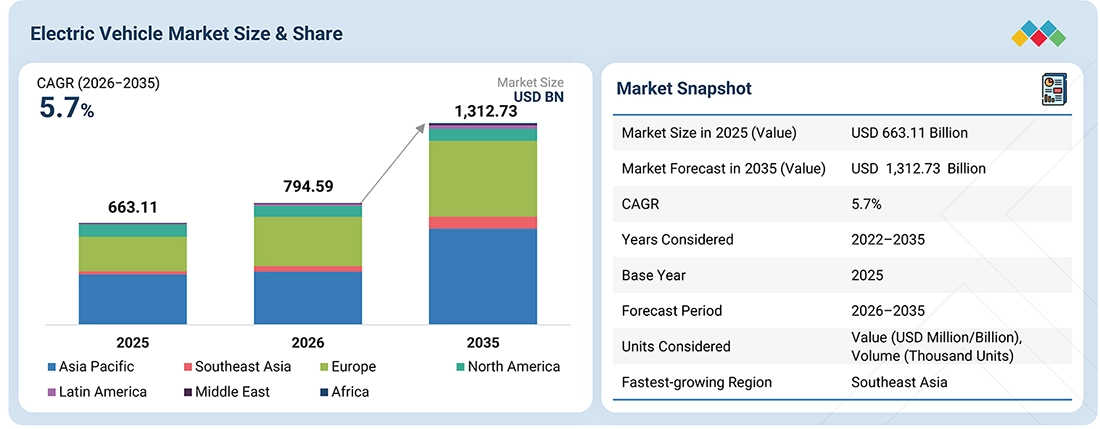
The electric vehicle market is projected to grow from USD 794.59 billion in 2026 to USD 1,312.73 billion in 2035, at a CAGR of 5.7%. EV adoption is increasingly supported by a combination of policy support, lower operating costs, battery cost reductions, and improving vehicle economics, reducing reliance on purchase incentives alone. The IEA reports that global electric car sales exceeded 20 million units in 2025, with EVs accounting for one in four new cars sold, while average battery prices declined 8% in 2025 as manufacturing efficiency, battery chemistry improvements, and stronger competition reduced costs. This improving cost position is creating a stronger business case for both private vehicles and commercial fleets, while continued investment in charging infrastructure is addressing the operational constraints associated with wider deployment. The next stage of growth is also opening new revenue opportunities beyond vehicle sales, including Charging-as-a-Service, fleet charging, wireless and dynamic charging, bidirectional charging, and smart parking, which can turn EV charging infrastructure into an integrated energy and mobility service. A recent example is BYD's expansion of its V2G partnership with Amber Electric, allowing the Sealion 7 to participate in a vehicle-to-grid program and use its battery for household energy management and grid electricity trading. Strategically, the market is moving from simply selling electric vehicles toward building an ecosystem in which lower vehicle costs, advanced batteries, commercial fleet utilization, charging services, and bidirectional energy flows reinforce EV adoption and create additional recurring revenue streams.
KEY TAKEAWAYS
-
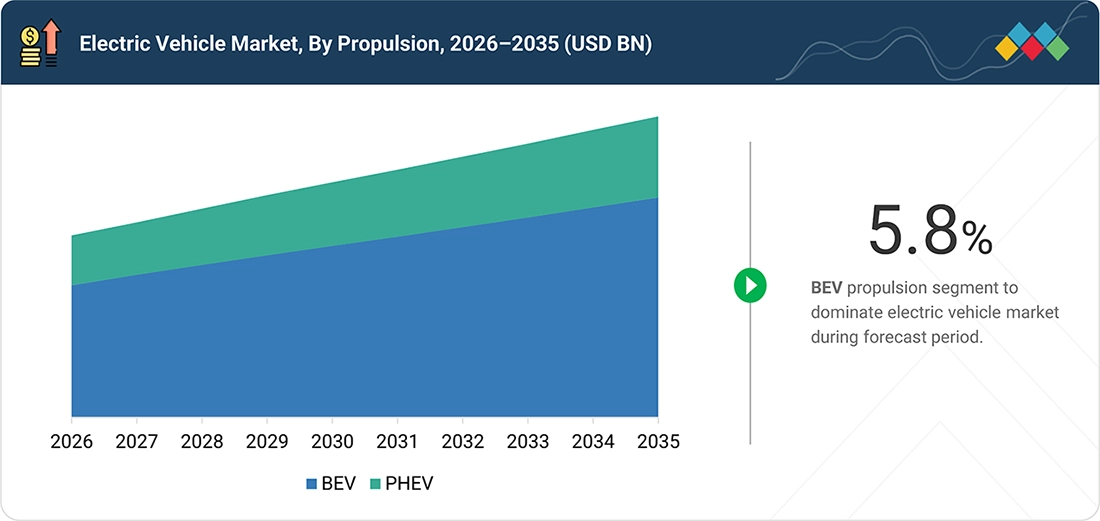
BY PROPULSIONThe BEV segment is projected to grow at a CAGR of 5.8% during the forecast period to reach a market size of USD 958.96 billion by 2035.
-
BY VEHICLE TYPEThe passenger cars segment is projected to grow from USD 794.59 billion in 2026 to USD 1,312.72 billion by 2035 at a CAGR of 5.7% during the forecast period.
-
BY E/E ARCHITECTURE TYPEThe 800V segment is projected to grow from 3,383 thousand units in 2026 to 16,375 thousand units by 2035 at a CAGR of 19.5% during the forecast period.
-
BY VEHICLE BODY TYPEThe SUV/MPV segment is projected to grow from 12,937 thousand units in 2026 to 25,925 thousand units by 2035 at a CAGR of 5.7% during the forecast period.
-
BY REGIONThe market in Asia Pacific is projected to grow from USD 345.15 billion in 2026 and reach 625.15 million units by 2035.
-
COMPETITIVE LANDSCAPEBYD Company Ltd. is categorized as a Star, and Changan Automobile as an Emerging Leader, among key players.
-
COMPETITIVE LANDSCAPENio is categorized as a Progressive Company, and Rivian as a Responsive Company.
The electric vehicle market is projected to grow steadily over the next decade, supported by advancements in battery technologies and power electronics. Automakers are increasingly adopting EVs for their low-emission, energy-efficient, and high-performance motors and battery packs, making them valuable in passenger cars and commercial vehicles. Growing emphasis on sustainable mobility, stricter emission regulations, and supportive government policies further strengthen EV adoption, setting the foundation for widespread market growth across global automotive sectors.
TRENDS & DISRUPTIONS IMPACTING CUSTOMERS' CUSTOMERS
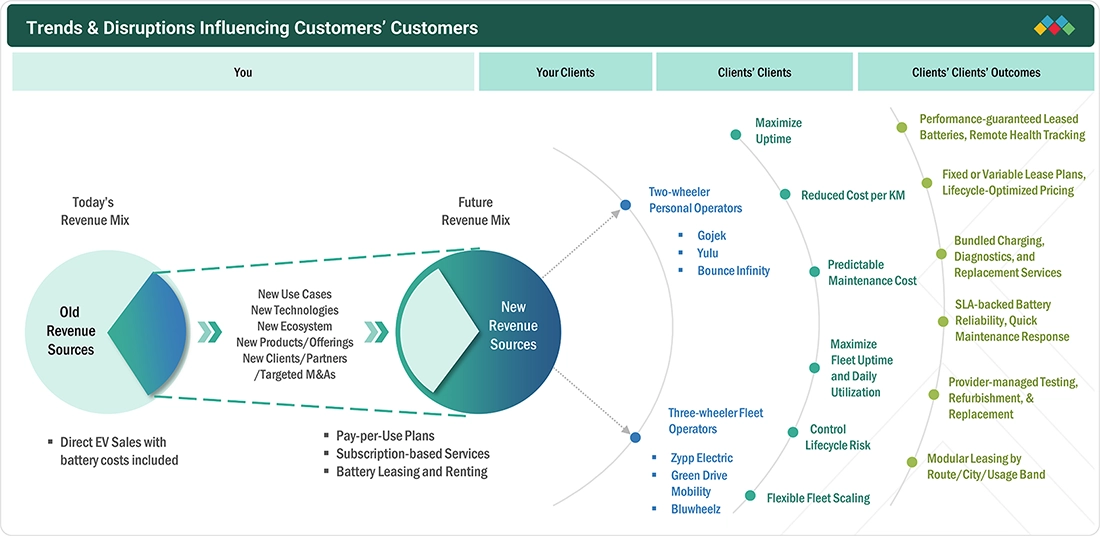
The past revenue mix was heavily dominated by conventional ICE vehicles, with only a small portion attributed to EVs. Even though EVs were a smaller part of the revenue mix, their presence indicated emerging opportunities in the market. The future revenue mix shows a significant shift toward EVs, with a major portion of revenue expected to come from EVs. The share of ICE vehicles in the revenue mix is considerably reduced, indicating a major industry shift toward electrification. The EV market presents opportunities for new use cases that were not feasible or practical with ICE vehicles. Advancements in technology, particularly in battery efficiency, power electronics, and autonomous driving, are expected to drive the EV market. The shift to EVs is leading to the development of new products and service offerings, such as battery swapping and ultra-fast charging. Infrastructure development allows for rapid charging of EV batteries, significantly reducing charging times. Improvements in battery technology are increasing vehicle range on a single charge.
Source: Secondary Research, Interviews with Experts, MarketsandMarkets Analysis
MARKET DYNAMICS

Drivers
Impact
Level
Level
-
Policy support for EV adoption

-
Zero tailpipe and vehicle lifecycle emissions


RESTRAINTS
Impact
Level
Level
-
High initial purchase price

-
Capital-intensive charging infrastructure deployment


OPPORTUNITIES
Impact
Level
Level
-
Fleet electrification and commercial deployment

-
Expansion of Charging-as-a-Service (CaaS) business model


CHALLENGES
Impact
Level
Level
-
Extended charging duration constraints

-
Fragmented charging standards and infrastructure

Source: Secondary Research, Interviews with Experts, MarketsandMarkets Analysis
Driver: Policy support for EV adoption
Government regulations, incentives, and charging infrastructure investments are accelerating EV adoption by improving vehicle economics and reducing deployment barriers. Major markets including the US, Europe, China, and Canada are supporting EV sales and manufacturing through purchase incentives, tax exemptions, charging investments, and stricter emissions standards. Europe is targeting a major shift away from new ICE vehicle sales by 2035, while the UK's ZEV mandate requires 80% of new cars and 70% of new vans to be zero-emission by 2030, rising to 100% by 2035. The US has also supported EV infrastructure and industry investment, while London is targeting a fully zero-emission bus fleet by 2034. These measures are strengthening EV demand while creating additional opportunities across charging infrastructure, connectors, cables, adapters, and related equipment.
Restraint: High initial purchase price
Despite lower operating and maintenance costs, the higher upfront price of EVs remains a key barrier to mass adoption, largely due to battery costs, financing constraints, and uncertain resale values. EVs therefore remain less accessible to price-sensitive and lower-income consumers, while available incentives often do not fully offset the price gap. For example, an electric vehicle can command a materially higher purchase price than a comparable ICE model, with the Audi Q5 e-tron priced substantially above the Audi Q5. Although battery cost reductions and manufacturing scale are expected to narrow this gap, the current price premium continues to limit mainstream adoption and keeps demand concentrated among higher-income consumers and early adopters. Over time, declining battery costs and improved financing and residual-value confidence will be critical to shifting EV economics from a higher upfront cost model toward a lower total cost of ownership proposition.
Opportunity: Fleet electrification and commercial deployment
Fleet operators across mobility, logistics, delivery, leasing, rental, FMCG, and pharmaceutical sectors are accelerating EV adoption as lower operating costs, regulatory pressure, and corporate decarbonization targets improve the commercial case for electrification. Major commitments include Lyft targeting around 2 million EVs by 2030, and Amazon and DHL targeting 100,000 and 80,000 EVs, respectively, while the EV100 initiative has 121 members committed to fleet electrification. Government support is also strengthening this transition, with India encouraging fleet operators to shift toward EVs by 2030 and the UK targeting government fleet electrification by 2027. Commercial orders such as Mullen Automotive's 40-vehicle European delivery fleet order further indicate growing demand from last-mile applications. The strategic opportunity is shifting from individual EV adoption toward large-scale fleet deployment, where predictable utilization, lower operating costs, and policy requirements can accelerate vehicle volumes while creating demand for fleet charging, leasing, energy management, and related services.
Challenge: Fragmented charging standards and infrastructure
Differences in charging voltage, connectors, and fast-charging standards remain a barrier to a seamless global EV ecosystem, with CHAdeMO dominant in Japan, CCS widely used in Europe, the US, and South Korea, and GB/T in China, while Tesla historically operated a proprietary charging network. Although India moved from requiring multiple fast-charging standards to allowing developers to select their preferred technology in 2019, fragmented standards can still increase infrastructure costs, complicate network deployment, and reduce charging accessibility. Automakers are increasingly addressing this issue through interoperability initiatives, such as Ford and General Motors adopting Tesla's charging technology, supporting broader charger compatibility and improving consumer convenience. Greater standardization and interoperability can reduce infrastructure complexity, improve charger utilization, and strengthen consumer confidence, making charging networks a stronger enabler of EV adoption.
ELECTRIC VEHICLE MARKET SIZE, SHARE & ANALYSIS: COMMERCIAL USE CASES ACROSS INDUSTRIES
| COMPANY | USE CASE DESCRIPTION | BENEFITS |
|---|---|---|
 |
Uses advanced Blade Battery technology and ultra-fast flash charging to reduce charging time and improve EV usability for long-distance travel (BYD) | Improves charging convenience, vehicle range, and battery safety while reducing charging downtime, supporting wider EV adoption |
 |
Uses bidirectional charging to enable compatible EVs to supply electricity to homes during grid outages, positioning the vehicle as a mobile energy storage asset (Tesla) | Adds energy management and backup power value to EV ownership while increasing the utility of the vehicle beyond transportation |
 |
Deploys advanced battery technology, fast charging, and battery swapping solutions to provide faster and more convenient energy replenishment for EV users (ENERGEE) | Reduces charging-related downtime, improves vehicle utilization, and supports higher EV adoption across passenger and commercial mobility applications |
 |
Integrates bidirectional charging with EVs, home energy systems, electricity tariffs, and digital applications to enable vehicle-to-grid (V2G) energy management (Volkswagen Group) | Allows EV owners to optimize energy consumption and potentially reduce mobility and electricity costs while creating additional value from vehicle batteries |
 |
Uses vehicle-to-home (V2H) technology across compatible EVs to supply stored battery power to homes during outages and integrate EVs with home energy systems (gmenergy.gm.com) | Provides backup electricity, improves household energy resilience, and creates additional revenue opportunities through GM Energy products and services |
Logos and trademarks shown above are the property of their respective owners. Their use here is for informational and illustrative purposes only.
MARKET ECOSYSTEM
The ecosystem shows how EV business models are shifting from hardware sales to recurring services. It maps a flow from your clients (two-wheeler personal operators like Gojek, Yulu, and Bounce Infinity, and three-wheeler fleet operators like Zypp Electric, Green Drive Mobility, and Bluwheelz) through their imperatives—maximizing fleet uptime and utilization, controlling lifecycle risk, keeping maintenance costs predictable, scaling fleets flexibly, and lowering cost per km—to the outcomes providers deliver, including SLA-backed battery reliability, performance-guaranteed leased batteries with remote health tracking, provider-managed testing, refurbishment and replacement, and modular leasing priced by route, city, or usage. The central message is a revenue-mix shift from 20% today to 80% in the future, moving away from direct EV sales with battery included toward pay-per-use plans, subscriptions, and battery leasing, which in turn opens new use cases, technologies, ecosystems, offerings, and partnerships or M&A.
Logos and trademarks shown above are the property of their respective owners. Their use here is for informational and illustrative purposes only.
MARKET SEGMENTS
Source: Secondary Research, Interviews with Experts, MarketsandMarkets Analysis
Electric Vehicle Market, By Propulsion
BEVs are the largest and fastest-growing propulsion type, supported by improving price competitiveness and advances in charging performance. Falling battery and component costs are bringing BEVs closer to, and in several markets below, comparable ICE vehicle prices, while higher charging power and improved battery technology are reducing charging time and range concerns. The IEA reports that nearly 70% of BEVs sold in China in 2025 were cheaper than comparable ICE vehicles before incentives. This cost advantage is being reinforced by technology improvements, with BYD introducing its Super e-Platform in March 2025, featuring 1,000 V architecture, up to 1,000 kW charging, and the ability to add up to 400 km of range in 5 minutes.
Electric Vehicle Market, By Vehicle Type
Passenger cars account for the largest share of the EV market because OEMs are concentrating EV launches and battery platforms on high-volume passenger models, while increasing model availability is expanding consumer choice across price points. The growing availability of affordable compact and mid-sized EVs is also reducing the dependence of EV adoption on premium buyers, while SUVs and other passenger vehicle formats are being increasingly electrified. The IEA expects more than 1,100 electric car models to be available globally in 2026, with around 150 new electric car models announced for the year, demonstrating the continued expansion of EV offerings within the passenger car segment.
Electric Vehicle Market, By E/E Architecture Type
800 V architecture is the fastest-growing E/E architecture type because it enables substantially higher charging power while reducing electrical losses during high-power operation. Higher system voltage allows EVs to deliver more power without a proportional increase in current, supporting faster charging, improved powertrain efficiency, and smaller high-current electrical components. The technology is also moving beyond premium EVs, with Geely developing a 1,000 V architecture in 2026 after expanding its use of 800 V systems, indicating that high-voltage platforms are becoming an important foundation for next-generation EVs.
Electric Vehicle Market, By Top Speed
EVs with top speeds above 110 mph are the largest and fastest-growing category because improvements in electric motor power, battery output, and high-voltage architectures are enabling higher performance without the mechanical complexity associated with conventional high-performance powertrains. The expansion of 800 V and 1,000 V platforms is particularly important because it allows higher electrical power delivery to the motor, supporting both acceleration and sustained high-speed performance. BYD's Super e-Platform, launched in 2025, supports motor output of up to 580 kW and vehicle speeds above 300 km/h, demonstrating how high-voltage EV platforms are increasing the performance capability of production EVs.
Electric Vehicle Market, By Vehicle Body Type
SUV and MPV EVs are the fastest-growing body types because their larger dimensions provide greater flexibility for battery packaging while meeting consumer demand for passenger space, cargo capacity, and longer driving range. The increasing price competitiveness of electric SUVs is further widening their addressable market, particularly in China, where EVs have achieved much stronger price parity with ICE vehicles. The IEA reported that large cars and SUVs represented almost 70% of global EV models in 2025, while the number of large and SUV EV models in China increased by more than 25%, reflecting strong OEM focus on these body formats.
Hybrid Electric Vehicle, By Configuration Type
Parallel HEV configuration is the largest and fastest-growing configuration because it allows the electric motor and ICE to directly provide propulsion, enabling efficient engine operation while retaining the performance and refueling convenience of an ICE powertrain. Its relatively direct mechanical configuration also makes it suitable for deployment across high-volume passenger vehicle platforms, particularly where automakers are expanding hybrid offerings without fully transitioning to dedicated BEV platforms. Honda's continued investment in its next-generation hybrid system, including an updated system planned for the next-generation CR-V, reflects ongoing OEM focus on parallel hybrid technology as part of broader electrification strategies.
Electric Vehicle Market, By Drive Type
Front-wheel drive is the largest and fastest-growing drive type because a single front-mounted electric motor provides adequate performance for mainstream passenger EVs while reducing drivetrain cost, weight, and energy consumption compared with dual-motor AWD systems. The simpler configuration is particularly suited to affordable mass-market EVs, where manufacturers are prioritizing lower vehicle costs and efficient use of battery capacity. The rapid expansion of lower-priced Chinese EVs into emerging markets is reinforcing demand for cost-efficient single-motor configurations, with the IEA reporting around 80% growth in EV sales across emerging markets outside China during 2025.
REGION
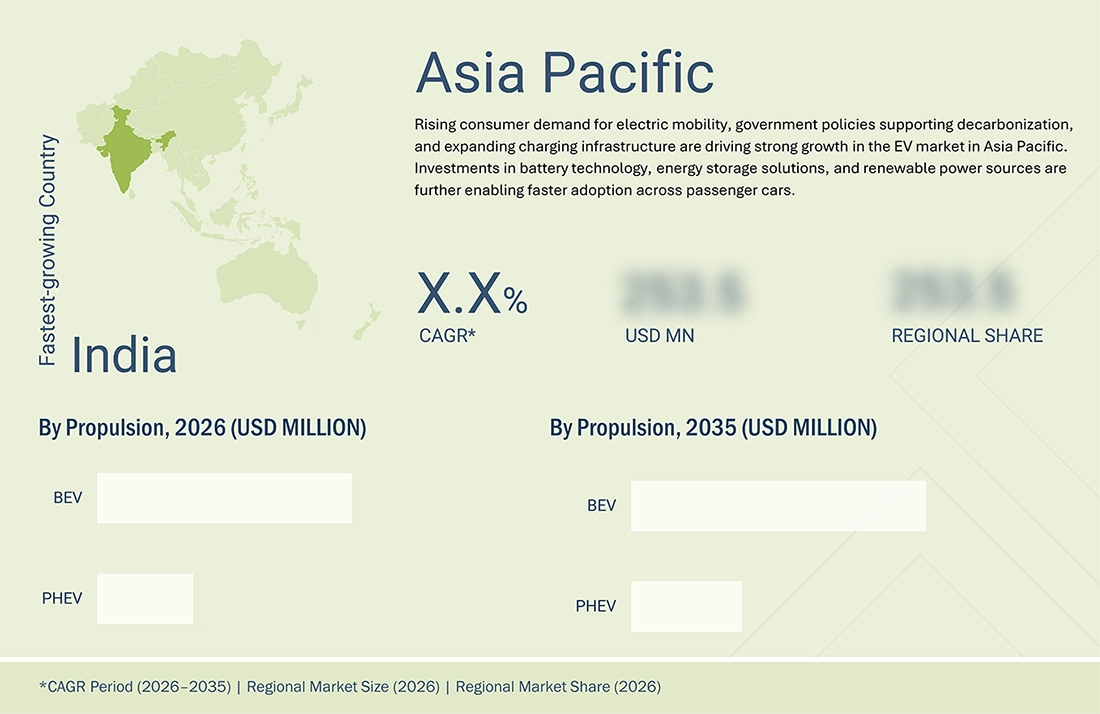
Asia Pacific to be the largest region in the global electric vehicle market during the forecast period
Asia Pacific is the largest region in the EV market, supported by China's cost-competitive EV manufacturing ecosystem and the rapid localization of EV production across Southeast Asia. China's scale in batteries, components, and vehicle manufacturing has reduced EV prices and enabled Chinese brands to expand rapidly across emerging markets, while Thailand, Indonesia, and other Southeast Asian markets are increasingly attracting local EV and battery manufacturing. The momentum is evident in Q1 2026, when EV sales in Asia Pacific excluding China increased by 80% year-on-year, with full-year sales expected to grow by more than 50%.
ELECTRIC VEHICLE MARKET SIZE, SHARE & ANALYSIS: COMPANY EVALUATION MATRIX
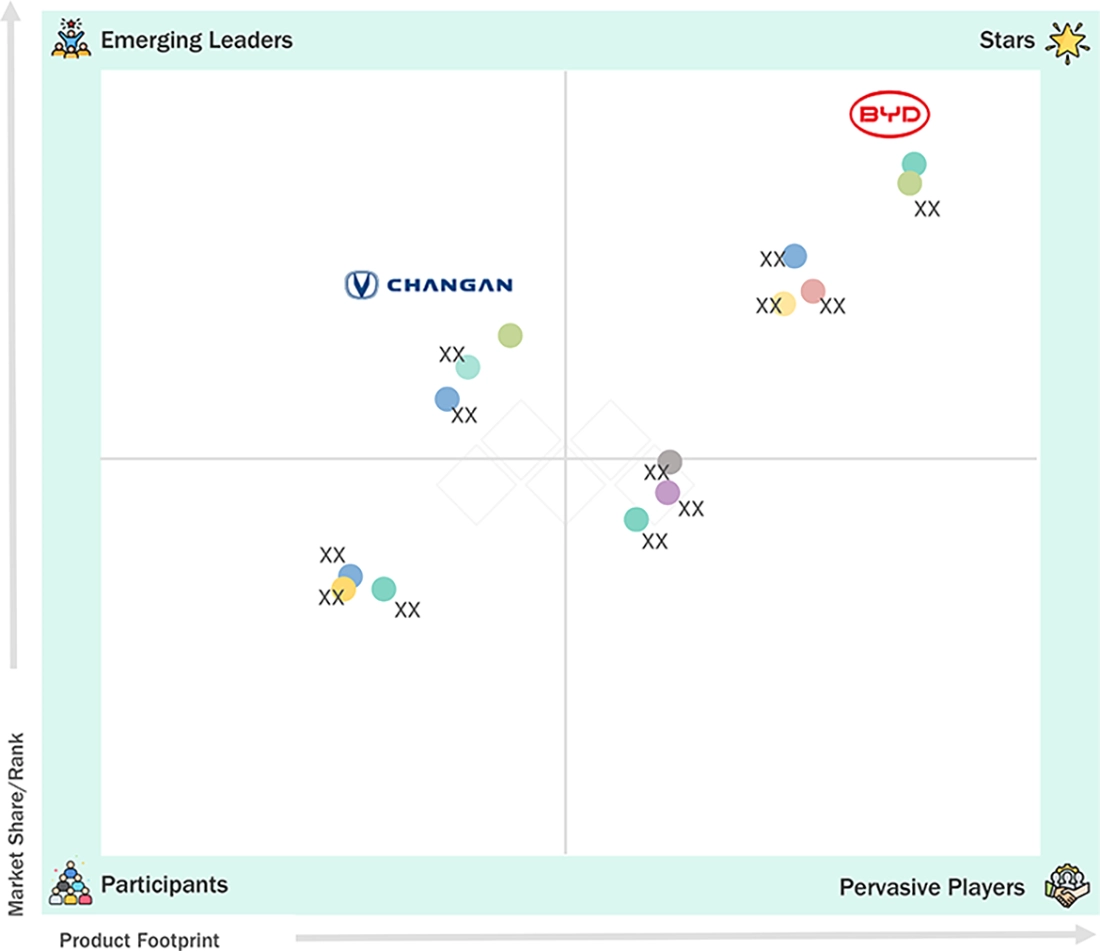
In the electric vehicle market matrix, BYD Company Ltd. (Star) leads with a strong market presence and diverse product lineup, driving large-scale adoption in passenger cars and commercial vehicles. Changan Automobile (Emerging Leader) is gaining momentum with new EV models and strategic partnerships in urban mobility and fleet solutions. While BYD dominates with scale and infrastructure, Changan shows strong growth potential to advance toward the leaders’ quadrant.
Source: Secondary Research, Interviews with Experts, MarketsandMarkets Analysis
KEY MARKET PLAYERS
- BYD Company Ltd. (China)
- Tesla (US)
- Zhejiang Geely Holding Group (China)
- Volkswagen Group (Germany)
- General Motors (US)
- Changan (China)
- BMW Group (Germany)
- Li Auto Inc. (China)
- Hyundai Motor Group (South Korea)
- GAC Group (China)
- Stellantis NV (Netherlands)
- Great Wall Motor (China)
MARKET SCOPE
| REPORT METRIC | DETAILS |
|---|---|
| Market Size in 2025 (Value) | USD 663.11 Billion |
| Market Estimation in 2026 (Value) | USD 794.59 Billion |
| Market Forecast in 2035 (Value) | USD 1,312.73 Billion |
| Growth Rate | CAGR of 5.7% from 2026–2035 |
| Actual Data | 2022–2035 |
| Base Year | 2025 |
| Forecast Period | 2026–2035 |
| Units Considered | Volume (Thousand Units), Value (USD Million/Billion) |
| Report Coverage | Revenue forecast, company ranking, competitive landscape, growth factors, and trends |
| Segments Covered |
|
| Regional Scope | Asia Pacific, Southeast Asia, Europe, North America, Latin America, Middle East, Africa |
WHAT IS IN IT FOR YOU: ELECTRIC VEHICLE MARKET SIZE, SHARE & ANALYSIS REPORT CONTENT GUIDE
DELIVERED CUSTOMIZATIONS
We have successfully delivered the following deep-dive customizations:
| CLIENT REQUEST | CUSTOMIZATION DELIVERED | VALUE ADDS |
|---|---|---|
| EV Manufacturer expanding in Latin America |
|
|
| EV Manufacturer in Indonesia gauging SEA market potential |
|
|
| Tier 1 Auto Component Provider planning for EV shift |
|
|
| OEM planning GTM strategy for new EV market |
|
|
| Tier 1 Auto Component Provider assessing North American EV demand |
|
|
| Battery Supplier entering the EV market |
|
|
| Fleet Operator planning EV transition |
|
|
RECENT DEVELOPMENTS
- September 2026 : BYD unveiled its European heavy electric truck portfolio at IAA Transportation 2026, including the ETT 44 tractor with a 651 kWh Blade Battery, up to 600 km range, and charging capability of up to 1.5 MW.
- September 2026 : GM completed a closed-loop battery recycling pilot using recovered nickel, cobalt, and manganese from end-of-life EV batteries. New battery cells were produced using cathode material containing 100% recycled nickel, cobalt, and manganese.
- September 2026 : Nissan unveiled the Pixo, an affordable electric city vehicle with a reported range of 259 km and a starting price below USD 25,000.
- August 2026 : Hyundai announced internally developed battery cells with more than twice the output of its previous high-nickel cells and 40% faster charging. It also plans mid-nickel NCM cells that can reduce battery cost by around 30%.
- April 2026 : Volkswagen and Elli announced plans to launch an integrated vehicle-to-grid (V2G) offering for private customers in Germany from Q4 2026, combining EVs, bidirectional charging, smart meters, electricity tariffs, and energy management.
Table of Contents
 Exclusive indicates content/data unique to MarketsandMarkets and not available with any competitors.
TITLE
PAGE NO
1
INTRODUCTION
15
2
EXECUTIVE SUMMARY
3
PREMIUM INSIGHTS
4
MARKET OVERVIEW
Presents a concise view of industry direction, strategic priorities, and key indicators influencing market momentum.
4.1
INTRODUCTION
4.2
MARKET DYNAMICS
4.2.1
DRIVERS
4.2.1.1
GOVERNMENT INCENTIVES FOR ELECTRIFICATION
4.2.1.2
LOW OPERATING COST
4.2.1.3
ADVANCEMENTS IN BATTERY TECHNOLOGY
4.2.1.4
LOW EMISSIONS
4.2.1.5
DECLINING COSTS OF EV BATTERIES
4.2.2
RESTRAINTS
4.2.2.1
HIGH UPFRONT COST
4.2.2.2
HIGH INITIAL INVESTMENT FOR INSTALLING ELECTRIC VEHICLE FAST-CHARGING INFRASTRUCTURE
4.2.2.3
BATTERY LONGEVITY AND REPLACEMENT COST
4.2.2.4
GEOPOLITICAL INSTABILITY AND SUPPLY CHAIN DISRUPTIONS
4.2.3
OPPORTUNITIES
4.2.3.1
RAPID INVESTMENT IN CHARGING INFRASTRUCTURE
4.2.3.2
ADVANCEMENT IN WIRELESS ELECTRIC VEHICLE CHARGING TECHNOLOGY FOR ON-THE-GO CHARGING
4.2.3.3
USE OF ELECTRIC VEHICLES FOR FLEETS AND COMMERCIAL APPLICATIONS
4.2.3.4
EXPANSION OF CHARGING-AS-A-SERVICE (CAAS) BUSINESS MODEL
4.2.4
CHALLENGES
4.2.4.1
LONGER CHARGING TIME
4.2.4.2
LACK OF STANDARDIZATION OF ELECTRIC VEHICLE CHARGING INFRASTRUCTURE
5
INDUSTRY TRENDS
Explains the evolving landscape through demand-side drivers, supply-side constraints, and opportunity hotspots.
5.1
MACROECONOMICS INDICATORS
5.1.1
INTRODUCTION
5.1.2
GDP TRENDS AND FORECAST
5.1.3
TRENDS IN GLOBAL EV INDUSTRY
5.1.4
TRENDS IN GLOBAL AUTOMOTIVE & TRANSPORTATION INDUSTRY
5.2
ECOSYSTEM ANALYSIS
5.3
SUPPLY CHAIN ANALYSIS
5.4
PRICING ANALYSIS
5.4.1
INDICATIVE SELLING PRICE, BY KEY PLAYERS,
5.4.2
AVERAGE SELLING PRICE TREND, BY VEHICLE TYPE, 2022–2024
5.4.3
AVERAGE SELLING PRICE TREND, BY REGION, 2022–2024
5.5
TRENDS/DISRUPTIONS IMPACTING CUSTOMER’S BUSINESS
5.6
INVESTMENT AND FUNDING SCENARIO
5.7
TRADE ANALYSIS
5.7.1
IMPORT SCENARIO (HS CODE 870380)
5.7.2
EXPORT SCENARIO (HS CODE 870380)
5.8
KEY CONFERENCES & EVENTS, 2025-2026
5.9
CASE STUDY ANALYSIS
6
STRATEGIC DISRUPTION THROUGH TECHNOLOGY, PATENTS, DIGITAL, AND AI ADOPTIONS
6.1
KEY EMERGING TECHNOLOGIES
6.1.1
V2X CHARGING
6.1.2
V2L
6.1.3
SOLID-STATE BATTERIES
6.1.4
DIRECT BOROHYDRIDE FUEL CELLS
6.2
COMPLEMENTARY TECHNOLOGIES
6.2.1
IOT IN ELECTRIC VEHICLES
6.2.2
METHANE FUEL CELLS
6.3
TECHNOLOGY/PRODUCT ROADMAP
6.3.1
SHORT-TERM (2025-2027) | FOUNDATION & EARLY COMMERCIALIZATION
6.3.2
MID-TERM (2027-2030) | EXPANSION & STANDARDIZATION
6.3.3
LONG-TERM (2030-2035+) | MASS COMMERCIALIZATION & DISRUPTION
6.4
PATENT ANALYSIS
6.4.1
INTRODUCTION
6.4.2
METHODOLOGY
6.4.3
INSIGHTS
6.4.4
LEGAL STATUS OF PATENTS
6.4.5
JURISDICTION ANALYSIS
6.4.6
TOP APPLICANTS
6.4.7
LIST OF PATENTS
6.5
FUTURE APPLICATIONS
6.5.1
INTEGRATION WITH V2X ECOSYSTEMS
6.5.2
MULTI-LAYERED CONTEXTUAL MAPPING
6.6
IMPACT OF AI/GEN AI ON ELECTRIC VEHICLE MARKET
6.6.1
TOP USE CASES AND MARKET POTENTIAL
6.6.2
BEST PRACTICES IN EV DEVELOPMENT
6.6.3
CASE STUDIES OF AI IMPLEMENTATION IN THE ELECTRIC VEHICLE MARKET
6.6.4
INTERCONNECTED AND ADJACENT ECOSYSTEM AND IMPACT ON MARKET PLAYERS
6.6.5
CLIENTS’ READINESS TO ADOPT AI/GEN AI IN ELECTRIC VEHICLE MARKET
6.7
SUCCESS STORIES AND REAL-WORLD APPLICATIONS
6.7.1
PEPSICO’S BATTERY-ELECTRIC BIG RIGS
6.7.2
AMAZON AND RIVIAN
7
SUSTAINABILITY AND REGULATORY LANDSCAPE
7.1
REGIONAL REGULATIONS AND COMPLIANCE
7.1.1
INDUSTRY STANDARDS
7.2
SUSTAINABILITY INITIATIVES
7.2.1
CARBON IMPACT OF EVS
7.2.1.1
CARBON REDUCTION BY EVS
7.3
CERTIFICATIONS, LABELING, ECO-STANDARDS
8
CUSTOMER LANDSCAPE & BUYER BEHAVIOR
8.1
DECISION-MAKING PROCESS
8.2
BUYER STAKEHOLDERS AND BUYING EVALUATION CRITERIA
8.2.1
KEY STAKEHOLDERS IN THE BUYING PROCESS
8.2.2
BUYING CRITERIA
8.3
ADOPTION BARRIERS & INTERNAL CHALLENGES
8.4
MARKET PROFITABILITY
8.4.1
REVENUE POTENTIAL
8.4.2
COST DYNAMICS
8.4.3
MARGIN OPPORTUNITIES BY APPLICATION
9
ELECTRIC VEHICLE MARKET, BY VEHICLE TYPE
Market Size, Volume & Forecast – USD Million
9.1
INTRODUCTION
9.2
PASSENGER CARS
9.3
COMMERCIAL VEHICLES
9.4
KEY PRIMARY INSIGHTS
10
ELECTRIC VEHICLE MARKET, BY VEHICLE TOP SPEED
Market Size, Volume & Forecast – USD Million
10.1
INTRODUCTION
10.2
<125 MPH
10.3
>125 MPH
10.4
KEY PRIMARY INSIGHTS
11
ELECTRIC VEHICLE MARKET, BY VEHICLE DRIVE TYPE
Market Size, Volume & Forecast – USD Million
11.1
INTRODUCTION
11.2
FRONT-WHEEL DRIVE
11.3
REAR-WHEEL DRIVE
11.4
ALL WHEEL DRIVE
11.5
KEY PRIMARY INSIGHTS
12
ELECTRIC VEHICLE MARKET, BY VEHICLE CLASS
Market Size, Volume & Forecast – USD Million
12.1
INTRODUCTION
12.2
LOW-MOBILITY
12.3
MID-PRICED
12.4
LUXURY
12.5
KEY PRIMARY INSIGHTS
13
ELECTRIC VEHICLE MARKET, BY VEHICLE CONNECTIVITY
Market Size, Volume & Forecast – USD Million
QUALITATIVE ANALYSIS
13.1
INTRODUCTION
13.2
V2B OR V2I
13.3
VEHICLE-TO-GRID
13.4
VEHICLE-TO-VEHICLE
13.5
KEY PRIMARY INSIGHTS
14
ELECTRIC VEHICLE MARKET, BY CHARGING POINT TYPE
Market Size, Volume & Forecast – USD Million
14.1
INTRODUCTION
14.2
AC CHARGING
14.3
DC CHARGING
14.4
KEY PRIMARY INSIGHTS
15
ELECTRIC VEHICLE MARKET, BY PROPULSION
Market Size, Volume & Forecast – USD Million
15.1
INTRODUCTION
15.2
BATTERY ELECTRIC VEHICLE
15.3
FUEL CELL ELECTRIC VEHICLE
15.4
PLUG-IN HYBRID ELECTRIC VEHICLE
15.5
HYBRID ELECTRIC VEHICLE
15.6
MILD HYBRID ELECTRIC VEHICLE
15.7
KEY PRIMARY INSIGHTS
16
ELECTRIC VEHICLE MARKET, BY E/E ARCHITECTURE
Market Size, Volume & Forecast – USD Million
16.1
INTRODUCTION
16.2
400V
16.3
800V
16.4
KEY PRIMARY INSIGHTS
17
ELECTRIC VEHICLE MARKET, BY COMPONENT
Market Size, Volume & Forecast – USD Million
QUALITATIVE ANALYSIS
17.1
INTRODUCTION
17.2
BATTERY CELLS AND PACKS
17.3
ON-BOARD CHARGERS
17.4
MOTORS
17.5
POWER CONTROL UNITS
17.6
BATTERY MANAGEMENT SYSTEMS
17.7
FUEL CELL STACKS
17.8
FUEL PROCESSORS
17.9
POWER CONDITIONERS
17.10
AIR COMPRESSORS
17.11
HUMIDIFIERS
17.12
KEY PRIMARY INSIGHTS
18
ELECTRIC VEHICLE MARKET, BY END USE
Market Size, Volume & Forecast – USD Million
QUALITATIVE ANALYSIS
18.1
INTRODUCTION
18.2
PRIVATE
18.3
COMMERCIAL FLEETS
18.4
KEY PRIMARY INSIGHTS
19
ELECTRIC VEHICLE MARKET, BY REGION
Market Size, Volume & Forecast – USD Million
19.1
ASIA PACIFIC
19.1.1
MACROECONOMICS OUTLOOK FOR ASIA PACIFIC
19.1.2
CHINA
19.1.3
JAPAN
19.1.4
INDIA
19.1.5
SOUTH KOREA
19.2
SOUTHEAST ASIA
19.2.1
MACROECONOMICS OUTLOOK FOR SOUTHEAST ASIA
19.2.2
THAILAND
19.2.3
MALAYSIA
19.2.4
INDONESIA
19.2.5
VIETNAM
19.2.6
SINGAPORE
19.2.7
PHILIPPINES
19.2.8
AUSTRALIA
19.3
EUROPE
19.3.1
MACROECONOMICS OUTLOOK FOR EUROPE
19.3.2
NETHERLANDS
19.3.3
FRANCE
19.3.4
GERMANY
19.3.5
NORWAY
19.3.6
AUSTRIA
19.3.7
SPAIN
19.3.8
UK
19.3.9
SWEDEN
19.3.10
SWITZERLAND
19.3.11
DENMARK
19.3.12
RUSSIA
19.3.13
ITALY
19.4
NORTH AMERICA
19.4.1
MACROECONOMICS OUTLOOK FOR NORTH AMERICA
19.4.2
US
19.4.3
CANADA
19.4.4
MEXICO
19.5
LATIN AMERICA
19.5.1
MACROECONOMICS OUTLOOK FOR LATIN AMERICA
19.5.2
BRAZIL
19.5.3
COLOMBIA
19.5.4
CHILE
19.5.5
URUGUAY
19.5.6
COSTA RICA
19.6
MIDDLE EAST
19.6.1
MACROECONOMICS OUTLOOK FOR MIDDLE EAST
19.6.2
UAE
19.6.3
SAUDI ARABIA
19.6.4
ISRAEL
19.7
AFRICA
19.7.1
MACROECONOMICS OUTLOOK FOR AFRICA
19.7.2
SOUTH AFRICA
19.7.3
EGYPT
19.7.4
MOROCCO
20
COMPETITIVE LANDSCAPE
20.1
OVERVIEW
20.2
KEY PLAYERS’ STRATEGIES/RIGHT TO WIN
20.3
MARKET SHARE ANALYSIS OF KEY PLUG-IN EV MANUFACTURERS,
20.4
REVENUE ANALYSIS OF TOP LISTED/PUBLIC PLAYERS,
20.5
BRAND/PRODUCT COMPARISON
20.6
COMPANY VALUATION AND FINANCIAL METRICS
20.7
COMPANY EVALUATION MATRIX: KEY PLAYERS,
20.7.1
STARS
20.7.2
EMERGING LEADERS
20.7.3
PERVASIVE PLAYERS
20.7.4
PARTICIPANTS
20.7.5
COMPANY FOOTPRINT: KEY PLAYERS,
20.7.5.1
COMPANY FOOTPRINT
20.7.5.2
REGION FOOTPRINT
20.7.5.3
TOP SPEED FOOTPRINT
20.7.5.4
VEHICLE DRIVE TYPE FOOTPRINT
20.7.5.5
PROPULSION FOOTPRINT
20.8
COMPANY EVALUATION MATRIX: START-UPS/SMES,
20.8.1
PROGRESSIVE COMPANIES
20.8.2
RESPONSIVE COMPANIES
20.8.3
DYNAMIC COMPANIES
20.8.4
STARTING BLOCKS
20.8.5
COMPETITIVE BENCHMARKING: START-UPS/SMES,
20.8.5.1
DETAILED LIST OF KEY STARTUPS/SMES
20.8.5.2
COMPETITIVE BENCHMARKING OF KEY START-UPS/SMES
20.9
COMPETITIVE SCENARIO
20.9.1
PRODUCT LAUNCHES
20.9.2
DEALS
20.9.3
EXPANSIONS
20.9.4
OTHERS
21
COMPANY PROFILES
21.1
KEY PLAYERS
21.1.1
BYD COMPANY LTD.
21.1.1.1
BUSINESS OVERVIEW
21.1.1.2
PRODUCTS/SOLUTIONS/SERVICES OFFERED
21.1.1.3
MNM VIEW
21.1.2
TESLA
21.1.3
ZHEJIANG GEELY HOLDING GROUP
21.1.4
VOLKSWAGEN GROUP
21.1.5
GENERAL MOTORS
21.1.6
CHANGAN
21.1.7
BMW GROUP
21.1.8
LI AUTO INC.
21.1.9
HYUNDAI MOTOR GROUP
21.1.10
GAC GROUP
21.1.11
STELLANTIS NV
21.1.12
GREAT WALL MOTOR
21.2
OTHER KEY PLAYERS
22
APPENDIX
22.1
RESEARCH METHODOLOGY
22.1.1
RESEARCH DATA
22.1.2
SECONDARY DATA
22.1.2.1
KEY DATA FROM SECONDARY SOURCES
22.1.3
PRIMARY DATA
22.1.3.1
KEY DATA FROM PRIMARY SOURCES
22.1.3.2
KEY PRIMARY PARTICIPANTS
22.1.3.3
BREAKDOWN OF PRIMARY INTERVIEWS
22.1.3.4
KEY INDUSTRY INSIGHTS
22.1.4
MARKET SIZE ESTIMATION
22.1.4.1
BOTTOM-UP APPROACH
22.1.4.2
TOP-DOWN APPROACH
22.1.5
BASE NUMBER CALCULATION
22.1.6
APPROACH 1: SUPPLY-SIDE ANALYSIS
22.1.6.1
APPROACH 2: DEMAND-SIDE ANALYSIS
22.1.7
MARKET FORECAST APPROACH
22.1.7.1
SUPPLY SIDE
22.1.7.2
DEMAND SIDE
22.1.8
DATA TRIANGULATION
22.1.9
FACTOR ANALYSIS
22.1.10
RESEARCH ASSUMPTIONS
22.1.11
RESEARCH LIMITATIONS AND RISK ASSESSMENT
22.2
DISCUSSION GUIDE
22.3
KNOWLEDGESTORE: MARKETSANDMARKETS’ SUBSCRIPTION PORTAL
22.4
CUSTOMIZATION OPTIONS
22.5
RELATED REPORTS
22.6
AUTHOR DETAILS
Methodology
The research study involves extensive use of secondary sources such as company annual reports/presentations, industry association publications, magazine articles, directories, technical handbooks, World Economic Outlook, trade websites, technical articles, and databases to identify and collect information on the electric vehicle market. In-depth interviews have been conducted with various primary sources, experts from related industries, auto component providers, and service providers, to obtain and verify critical information, as well as assess the growth prospects and market estimations.
Secondary Research
Secondary sources for this research study include corporate filings, such as annual reports, investor presentations, and financial statements; trade, business, and professional associations; whitepapers and electric-vehicle-related journals; certified publications; articles by recognized authors; directories; and databases. Secondary data has been collected and analyzed to determine the overall market size, further validated by primary research.
Primary Research
Extensive primary research has been conducted after understanding the electric vehicle market scenario through secondary research. Several primary interviews have been conducted with market experts from demand (fleet operators, consumers) and supply (OEMs, EV battery manufacturers, country-level government associations, and trade associations) sides. The regions considered for the research include North America, Europe, Asia Pacific, Southeast Asia, Latin America, Middle East, and Africa. Approximately 32% and 68% of primary interviews have been conducted from the demand and supply sides, respectively. Primary data has been collected through questionnaires, emails, and telephonic interviews. In the canvassing of primaries, various departments within organizations, such as sales, operations, and marketing, have been covered to provide a holistic viewpoint in this report.
After interacting with industry experts, brief sessions have been conducted with experienced independent consultants to reinforce the findings from the primaries. This, along with the in-house subject matter experts’ opinions, has led to the findings described in this report.

Note: Others include sales, managers, and product managers.
Company tiers are based on the value chain; the company's revenue is not considered.
To know about the assumptions considered for the study, download the pdf brochure
Market Size Estimation
As mentioned below, a detailed market estimation approach has been followed to estimate and validate the volume and value of the electric vehicle market and other submarkets.
- The market size has been derived by using parameters such as sales of EVs.
- Segment split has been identified through primary and secondary research.
- Key players in the global electric vehicle market have been identified through secondary research, and their global market ranking has been determined through primary and secondary research.
- The research methodology includes the study of the annual and quarterly financial reports and regulatory filings of major market players, as well as interviews with industry experts for detailed market insights.
- All major penetration rates, percentage shares, splits, and breakdowns for the global electric vehicle market have been determined by using secondary sources and verified through primary sources.
- All key macro indicators affecting the revenue growth of the market segments and subsegments have been accounted for, viewed in extensive detail, verified through primary research, and analyzed to get the validated and verified quantitative and qualitative data.
- The gathered market data has been consolidated and added with detailed inputs, analyzed, and presented in this report.

Data Triangulation
After arriving at the overall market size through the aforementioned methodology, the electric vehicle market has been split into several segments and subsegments. The data triangulation procedure has been employed, wherever applicable, to complete the overall market engineering process and arrive at the exact market value for key segments and subsegments. The extrapolated market data has been triangulated by studying various macro indicators and regional trends from both the demand- and supply-side participants.
Market Definition
An electric vehicle (EV) is an automobile propelled by one or more electric motors. An EV uses energy stored in rechargeable batteries, which can be charged using private or public charging infrastructure. There are five major types of EVs: battery electric vehicles (BEVs), plug-in hybrid electric vehicles (PHEVs), hybrid electric vehicles (HEVs), mild hybrid electric vehicles (MHEVs), and fuel cell electric vehicles (FCEVs).
Key Stakeholders
- Associations, forums, and alliances related to EVs
- Automobile manufacturers
- Battery distributors
- Battery manufacturers
- Charging infrastructure providers
- Charging services providers
- EV charging station service providers
- EV component manufacturers
- EV distributors and retailers
- EV manufacturers
- Government agencies and policymakers
Report Objectives
- To analyze and forecast the electric vehicle market in terms of volume (thousand units) and value (USD million) from 2026 to 2035
- To define, describe, and forecast the market by propulsion, component, end use, vehicle connectivity, vehicle type, hybrid electric vehicle market by configuration type, mild hybrid electric vehicle market by topology, plug-in electric vehicle market by electric architecture, vehicle body type, vehicle drive type, vehicle top speed, and region
- To segment and forecast the market based on propulsion (plug-in hybrid electric vehicle (PHEV) and battery electric vehicle (BEV))
- To segment and forecast the market based on vehicle type (passenger car and commercial vehicle)
- To segment and provide qualitative insights into the market based on component (battery cells and packs, on-board chargers, motors, power control units, battery management systems, fuel cell stacks, fuel processors, power conditioners, air compressors, humidifiers)
- To segment and provide qualitative insights into the market based on vehicle connectivity (V2B or V2I, V2G, and V2V)
- To segment and provide qualitative insights into the market based on end use (private and commercial)
- To segment and forecast the hybrid electric vehicle market by configuration type (series, parallel, and series-parallel)
- To segment and provide qualitative insights into the mild hybrid electric vehicle market by topology (P0, P1, P2, P3, and P4)
- To segment and forecast the plug-in electric vehicle market by electric architecture (400V and 800V)
- To segment and forecast the plug-in electric vehicle market by vehicle body type (SUV/MPV, sedan, and hatchback)
- To segment and forecast the plug-in electric vehicle market by vehicle drive type (front-wheel drive (FWD), rear-wheel drive (RWD), and all-wheel drive (AWD))
- To segment and forecast the plug-in electric vehicle market based on vehicle top speed (<110 mph and >110 mph)
- To segment the market and forecast its size by volume based on region (Asia Pacific, Southeast Asia, Europe, North America, Latin America, Middle East, and Africa)
- To identify and analyze key drivers, challenges, restraints, and opportunities influencing the market growth
- To strategically analyze the market, considering individual growth trends, prospects, and contributions to the total market
- To study the following with respect to the market
- Supply chain analysis
- Ecosystem analysis
- Technology analysis
- Trade analysis
- Case study analysis
- Patent analysis
- Regulatory landscape
- Average selling price analysis
- Trends/disruptions impacting customers’ business
- Impact of AI/Gen AI
- Key stakeholders and buying criteria
- Key conferences and events
- MNM insights on the electric vehicle market trends
- To strategically profile the key players and comprehensively analyze their market share and core competencies
- To track and analyze competitive developments such as deals (joint ventures, mergers and acquisitions, partnerships, collaborations), product developments and launches, and other activities undertaken by the key industry participants
Available customizations:
With the given market data, MarketsandMarkets offers customizations in accordance with the company's specific needs.
- Electric vehicle market, by commercial vehicle type at regional level (for regions covered in the report)
- Electric vehicle market, by propulsion, for additional countries (for countries not covered in the report)
- Additional company profiles (up to 5)
Key Questions Addressed by the Report
What is the current market size of the Electric Vehicle Market, and how is it expected to grow?
The Electric Vehicle Market is projected to grow from USD 1,145.51 billion in 2025 to USD 1,857.34 billion by 2035, at a CAGR of 5.0% during the forecast period.
What are the key factors driving the growth of the Electric Vehicle Market?
The market is driven by stringent emission regulations, government incentives, declining battery costs, expanding charging infrastructure, and increasing investments in dedicated EV platforms.
Which region is expected to dominate the Electric Vehicle Market during the forecast period?
Asia Pacific is expected to dominate the Electric Vehicle Market due to its strong EV manufacturing ecosystem, supportive government policies, high consumer adoption, and expanding charging infrastructure.
What are the latest trends shaping the Electric Vehicle Market?
Key trends include the adoption of 800V EV architectures, software-defined vehicles, faster charging technologies, advanced battery chemistries, and over-the-air (OTA) software updates.
Who are the leading companies in the Electric Vehicle Market, and what strategies are they adopting?
Leading companies are focusing on expanding EV portfolios, developing next-generation battery technologies, enhancing software capabilities, and forming strategic partnerships to strengthen their global market position.
Fact checked
Personalize This Research
- Triangulate with your Own Data
- Get Data as per your Format and Definition
- Gain a Deeper Dive on a Specific Application, Geography, Customer or Competitor
- Any level of Personalization
Let Us Help You
- What are the Known and Unknown Adjacencies Impacting the Electric Vehicle Market
- What will your New Revenue Sources be?
- Who will be your Top Customer; what will make them switch?
- Defend your Market Share or Win Competitors
- Get a Scorecard for Target Partners

Custom Market Research Services
We Will Customise The Research For You, In Case The Report Listed Above Does Not Meet With Your Requirements
Get 10% Free CustomisationTESTIMONIALS

JIM NAAS
PRODUCT DIRECTOR, WEASLER
Weasler Engineering, a CentroMotion organization
Global Provider of Industrial Actuation & Control Solutionswww.weasler.com
Our organization was interested in learning more about the attractiveness of a particular market space. We contacted MarketsandMarkets to help us based on previous positive experiences we had with them. The results did not disappoint! We discussed our objectives with them, and the team at MarketsandMarkets developed and executed a proposal that met our needs precisely. We were very impressed by their level of expertise, the quality of the analysis and their insightful recommendations. We would not hesitate in working with them again in the future.

Matt Kardel,
Vice President
Aptiv,
A global technology company that develops safer, greener and more connected solutions.www.aptiv.com
We contracted with
MarketsandMarkets to evaluate the value chain and potential go-to-market partners related to our
interest in the Fleet Management space. The team successfully completed the work on time and at the
pricing agreed. MarketsandMarkets listened and understood our objectives and collaborated well with
us to help us get the visibility we needed to make an investment.
We have subsequently used
MarketsandMarkets again related to Smart Cities to good results.
- China Electric Vehicle Market
- India Electric Vehicle Market
- Japan Electric Vehicle Market
- South Korea Electric Vehicle Market
- Thailand Electric Vehicle Market
- Indonesia Electric Vehicle Market
- Malaysia Electric Vehicle Market
- Vietnam Electric Vehicle Market
- Singapore Electric Vehicle Market
- Philippines Electric Vehicle Market
- Australia Electric Vehicle Market
- Canada Electric Vehicle Market
- Mexico Electric Vehicle Market
- Germany Electric Vehicle Market
- France Electric Vehicle Market
- Netherlands Electric Vehicle Market
- Norway Electric Vehicle Market
- Sweden Electric Vehicle Market
- UK Electric Vehicle Market
- Denmark Electric Vehicle Market
- Austria Electric Vehicle Market
- Switzerland Electric Vehicle Market
- Spain Electric Vehicle Market
- Russia Electric Vehicle Market
- Italy Electric Vehicle Market
- UAE Electric Vehicle Market
- Saudi Arabia Electric Vehicle Market
- Israel Electric Vehicle Market
- Brazil Electric Vehicle Market
- Colombia Electric Vehicle Market
- Chile Electric Vehicle Market
- Egypt Electric Vehicle Market
- South Africa Electric Vehicle Market
- US Electric Vehicle Market
- Costa Rica Electric Vehicle Market
- Uruguay Electric Vehicle Market
- Morocco Electric Vehicle Market
Growth opportunities and latent adjacency in Electric Vehicle Market



Mathew
May, 2022
We want to know the competitive scenario for Electric Vehicle Market? and the Top vendors in the EV Market for the Forecast period 2022 to 2030. .
Jhon
Dec, 2022
For the Asia market, we have provided the latest industry trends from both supply-side and demand-side, market insights for ASIA at the total and country-level (China, India, Japan and South Korea), and quantified the market size in units and revenues and growth forecast to 2030..
Wills
Dec, 2022
Electric Vehicle Market report also includes the latest industry trends from both supply-side and demand-side, market insights for ASIA market at the total and country-level (China, India, Japan and South Korea) data as well, and quantified the market size in units and revenues and growth forecast to 2030..
Bhushan
Jun, 2026
Does it have EV Manufacturing process details?.
jean
Jun, 2026
SES MANAGEMENT is involved with our Partners in the electrical mobility in Africa and Middle East Regions.. Actually we want to know more about the full electrical motorisation versus hybrid solution including electrical with range extender... .