
Video Analytics Market

Video Analytics Market by Offering, Application (Intrusion Management, Incident Detection, Traffic Monitoring), Deployment Model, Type, Vertical (Critical Infrastructure, Government & Defense, Manufacturing), and Region - Global Forecast to 2031




OVERVIEW
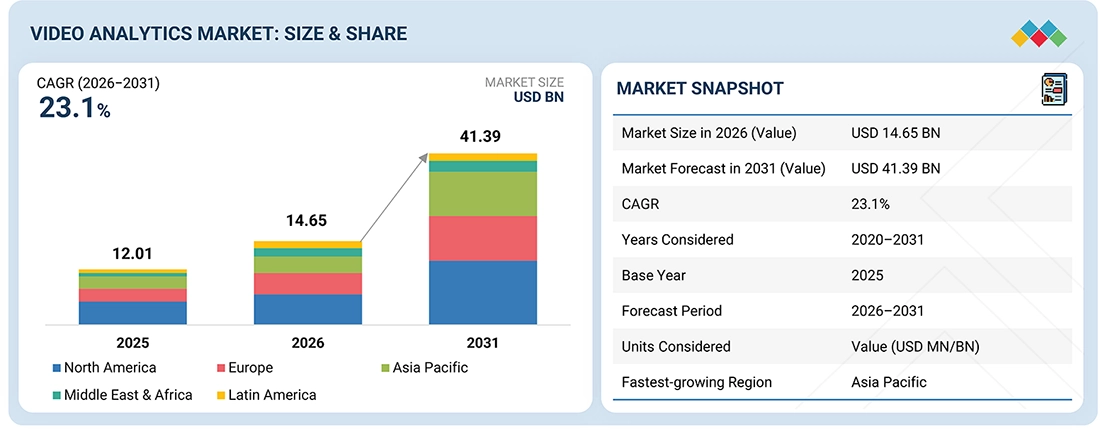
Source: Secondary Research, Interviews with Experts, MarketsandMarkets Analysis
The video analytics market is expected to grow from USD 14.65 billion in 2026 to USD 41.39 billion by 2031 at a CAGR of 23.1%. Growth is driven by rising demand for AI-powered surveillance, expanding smart city deployments, increasing security concerns, retail behavior analytics, traffic monitoring, and wider adoption of edge and cloud-based video analytics platforms.
KEY TAKEAWAYS
-
By RegionAsia Pacific is the fastest-growing region, projected at 24.4% CAGR.
-
By OfferingServices is the fastest-growing offering, projected at 23.7% CAGR.
-
By ApplicationFacial recognition is the fastest-growing service model, forecasted to grow at a 24.3% CAGR.
-
By Deployment ModeCloud deployment is the fastest-growing deployment mode.
-
By TypeEdge-based is the fastest-growing type.
-
By VerticalTransportation & logistics sector is the fastest-growing vertical.
-
Competitive Landscape – Large ProvidersCompanies such as Avigilon, Axis Communications, and Cisco are well-positioned at the forefront of artificial intelligence-based video analysis and integrated surveillance systems.
-
Competitive Landscape – Emerging ProvidersIntuVision, Digital Barriers, and Qognify developing intelligent monitoring and real-time analysis capabilities are gaining a foothold in the marketplace.
The video analytics market is expanding as organizations increasingly use AI and computer vision to derive actionable insights from video data. Integration with IoT, edge computing, and cloud platforms enables real-time monitoring, enhanced security, improved traffic management, and better operational decision-making across industries.
TRENDS & DISRUPTIONS IMPACTING CUSTOMERS' CUSTOMERS
The video analytics market is transforming as businesses increasingly implement AI-driven visual systems to enhance security, operational effectiveness, and situational insight. Current trends involve swift integration of AI-based object detection, behavioral analysis, and real-time surveillance in smart cities, transportation, and retail. The move to edge-based analytics allows quicker processing and lowers bandwidth needs. Future expansion will be propelled by closer integration with IoT systems, sophisticated deep learning algorithms, privacy-focused analytics, and scalable cloud-based video intelligence platforms that assist extensive distributed surveillance networks.
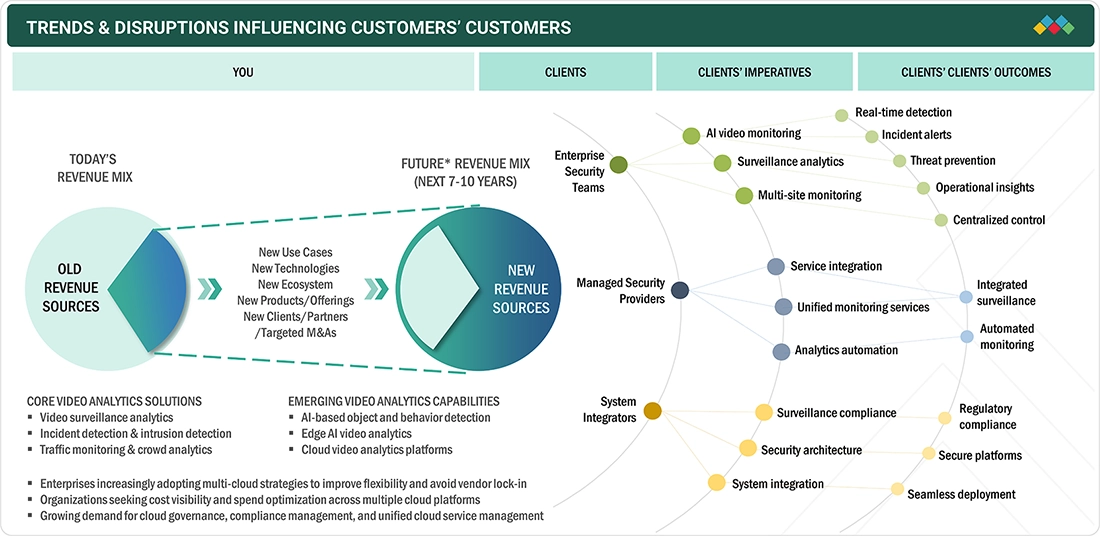
Source: Secondary Research, Interviews with Experts, MarketsandMarkets Analysis
MARKET DYNAMICS

Level
-
Rising security and surveillance needs across public infrastructure and enterprises

-
Increasing adoption of AI-powered computer vision for real-time insights


Level
-
Privacy concerns and regulatory restrictions on video data usage

-
High infrastructure and deployment costs for large video analytics systems


Level
-
Expansion of smart city and intelligent transportation initiatives

-
Integration of edge computing for real-time video processing


Level
-
Managing large-scale video data and processing requirements

-
Accuracy limitations in complex environments and varying conditions

Source: Secondary Research, Interviews with Experts, MarketsandMarkets Analysis
Driver — Increasing adoption of AI-powered computer vision for real-time insights
Organizations across industries are increasingly deploying AI-enabled video analytics to enhance security monitoring, improve operational efficiency, and strengthen situational awareness. The growing need for automated threat detection, behavioral analysis, and real-time surveillance across smart cities, transportation networks, retail spaces, and industrial facilities is driving the adoption of advanced video analytics platforms capable of processing large volumes of video data and generating actionable insights for faster decision-making.
Restraint — Privacy concerns and regulatory restrictions on video data usage
Video analytics deployments often face regulatory scrutiny related to data privacy, facial recognition technologies, and biometric surveillance. Governments and regulatory bodies are introducing stricter data protection frameworks that limit unrestricted use of video analytics in public environments. Organizations must ensure compliance with regional privacy laws while maintaining transparency and responsible use of surveillance technologies, which can slow adoption of advanced analytics systems.
Opportunity — Expansion of smart city and intelligent transportation initiatives
Governments worldwide are investing heavily in smart city development and intelligent transportation infrastructure. These initiatives require advanced video analytics capabilities for traffic monitoring, crowd management, public safety surveillance, and automated incident detection. As cities deploy connected surveillance networks and AI-enabled monitoring systems, demand for scalable video analytics platforms capable of processing real-time video streams across urban environments continues to grow.
Challenge — Managing large-scale video data and processing requirements
Enormous amounts of video data are created by video analytics systems. This leads to demands for high storage, computing, and processing capacities to perform in real time. It is technically difficult to consistently detect objects, behaviours, or anomalies across diverse environments, including crowded spaces, variable lighting, and multi-camera perspectives. Vendors must continually improve their AI models and infrastructure to meet the need for consistent accuracy and scalability in large-scale surveillance installations.
VIDEO ANALYTICS MARKET: COMMERCIAL USE CASES ACROSS INDUSTRIES
| COMPANY | USE CASE DESCRIPTION | BENEFITS |
|---|---|---|
 |
Implementation of BriefCam Video Analytics was used to enhance police investigations of recorded video by providing AI based video search and filter, and classifying objects in video footage. | Increased the efficiency of investigations | Reduced time to identify those involved with cases | Reduced personnel utilized to analyze video | Allowed Law Enforcement Agencies to use multiple video formats and have more accurate investigations |
 |
Implemented AllGoVision video analytics technology to provide real-time visitor counting and enable linkage between store visitor statistics and point of sale (POS) in order to enhance the analysis of retail performance. | Achieved over 95% accuracy in visitor counting, allowing for the identification of meaningful and actionable customer flow patterns and peak periods | Helped in making more informed retail decisions via conversion rate and customer behavior analysis |
 |
Integrated the Genetec Security Center platform to streamline incident management and improve security coordination through video surveillance, alarm monitoring, and map navigation capabilities utilized for real-time monitoring of crowds and overall security efforts. | Increased the speed of responding to incidents | Added the capability of issuing real-time video alerts to help facilitate rapid security decision-making | Improved crowd management capabilities with improved collaboration and communication with law enforcement via shared access to surveillance video footage |
Logos and trademarks shown above are the property of their respective owners. Their use here is for informational and illustrative purposes only.
MARKET ECOSYSTEM
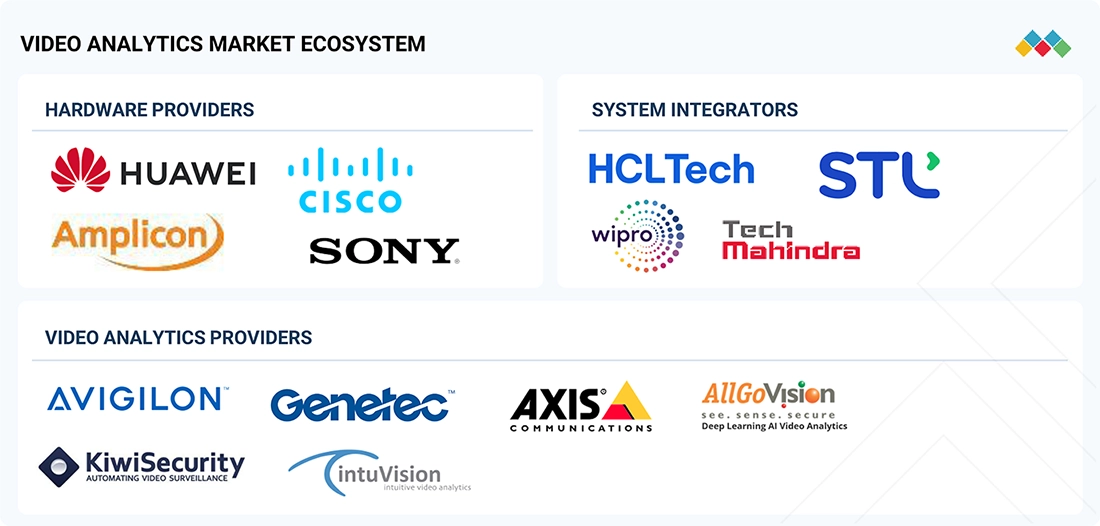
Logos and trademarks shown above are the property of their respective owners. Their use here is for informational and illustrative purposes only.
MARKET SEGMENTS
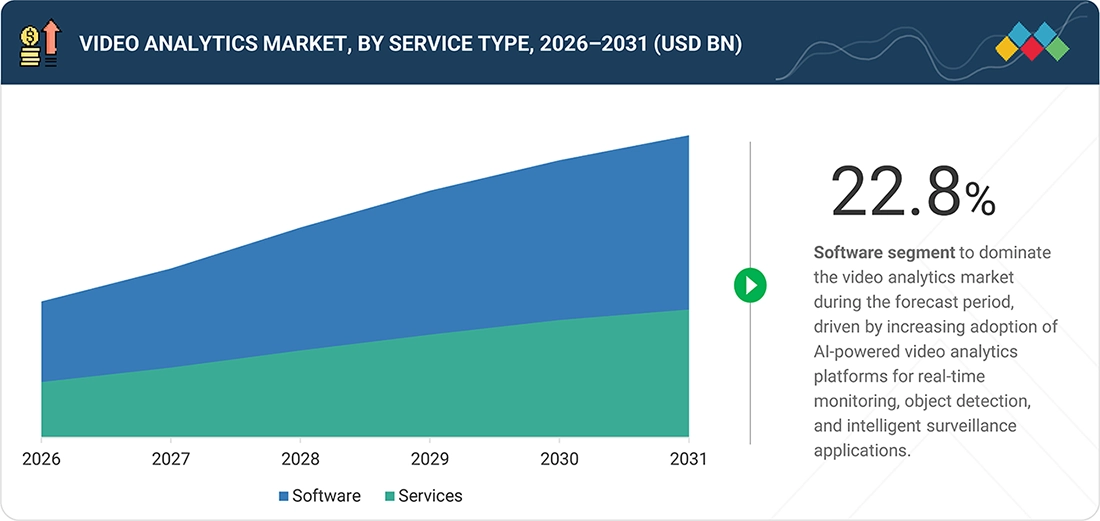
Source: Secondary Research, Interviews with Experts, MarketsandMarkets Analysis
By offering
Software represents the largest market segment within video analytics due to the use of state-of-the-art video analytics, artificial intelligence, and video management systems to automate video stream analysis and facilitate real-time event detection. These platforms are used not only for security but also for applications like crowd behavior analysis, traffic monitoring, retail analytics, and operational intelligence in all industries.
By application
Intrusion management represents the largest application due to the widespread need for continuous perimeter monitoring across sensitive facilities. Government sites, industrial plants, campuses, and transportation hubs require automated detection of unauthorized access. Video analytics enables proactive monitoring of restricted areas and faster security response across large environments.
By deployment model
On-premises deployment holds the largest share, as surveillance systems frequently operate in environments that require strong data governance and operational control. Local infrastructure ensures secure handling of video data, consistent performance for real-time analytics, and seamless integration with command centers and existing security management systems.
By type
Due to the need for centralized processing across large camera networks in major surveillance systems, the dominant data processing method today is server-based analytics. It requires high-performance servers that support advanced analytical models, can analyze multiple video streams simultaneously, and can scale into multiple monitoring environments (i.e., enterprise facilities, transportation hubs, and urban surveillance).
By vertical
The largest vertical is the government and defense sector, as governments continue to invest in public safety, border security, and urban monitoring. As a result of these extensive investments by governments, authorities include vast arrays of camera networks throughout cities and at critical infrastructure sites. To facilitate large-scale video surveillance and coordination of public security operations, authorities deploy advanced video analytics platforms.
REGION
Asia Pacific to be the fastest-growing region in the video analytics market during the forecast period
Asia Pacific is expected to witness the fastest growth in the video analytics market, driven by expanding smart city programs, large-scale public surveillance deployments, and rising enterprise security investments across China, India, Japan, and South Korea. Increasing adoption of AI-enabled cameras and edge analytics platforms is accelerating regional market expansion.
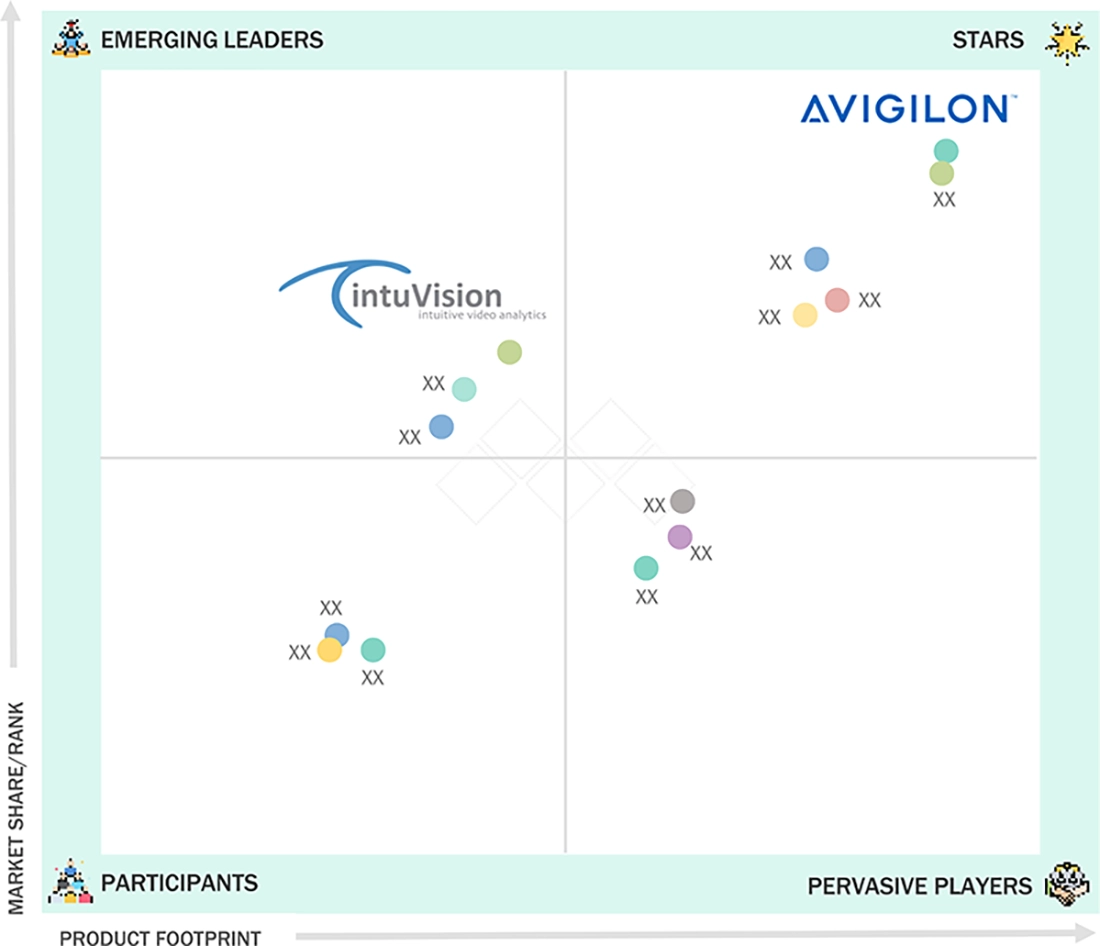
VIDEO ANALYTICS MARKET: COMPANY EVALUATION MATRIX
In the video analytics market evaluation matrix, Avigilon is positioned in the Stars quadrant due to its strong global presence and well-established service and product capabilities. intuVision is categorized as an Emerging Leader as it continues to expand its capabilities and strengthen its position in the evolving video analytics market.
Source: Secondary Research, Interviews with Experts, MarketsandMarkets Analysis
KEY MARKET PLAYERS
- Avigilon (Canada)
- Axis Communications (Sweden)
- Cisco (US)
- Honeywell (US)
- IBM (US)
- AllGoVision (India)
- Genetec (Canada)
- IntelliVision (US)
- Gorilla Technology (Taiwan)
- Eagle Eye Networks (US)
- ADT (US)
- IntuVision (US)
- Securitas (Sweden)
- PureTech Systems (US)
- Hikvision (China)
- Dahua Technology (China)
- Iomniscient (Australia)
- NEC (Japan)
- Huawei (China)
- Intelligent Security Systems (US)
- Verint Systems (US)
- Viseum (UK)
- BriefCam (Israel)
- Bosch Security Systems (Germany)
- I2V (Japan)
- Digital Barriers (UK)
- Senstar (Canada)
- Qognify (US)
- Identiv (US)
- Ipsotek (UK)
MARKET SCOPE
| REPORT METRIC | DETAILS |
|---|---|
| Market Size in 2026 (Value) | USD 14.65 Billion |
| Market Size in 2031 (Value) | USD 41.39 Billion |
| Growth Rate | CAGR of 23.1% from 2026 to 2031 |
| Years Considered | 2020–2031 |
| Base Year | 2025 |
| Forecast Period | 2026–2031 |
| Units Considered | Value (USD Million/Billion) |
| Report Coverage | Revenue forecast, company ranking, competitive landscape, growth factors, and trends |
| Segments Covered |
|
| Regions Covered | North America, Europe, Asia Pacific, Middle East & Africa, Latin America |
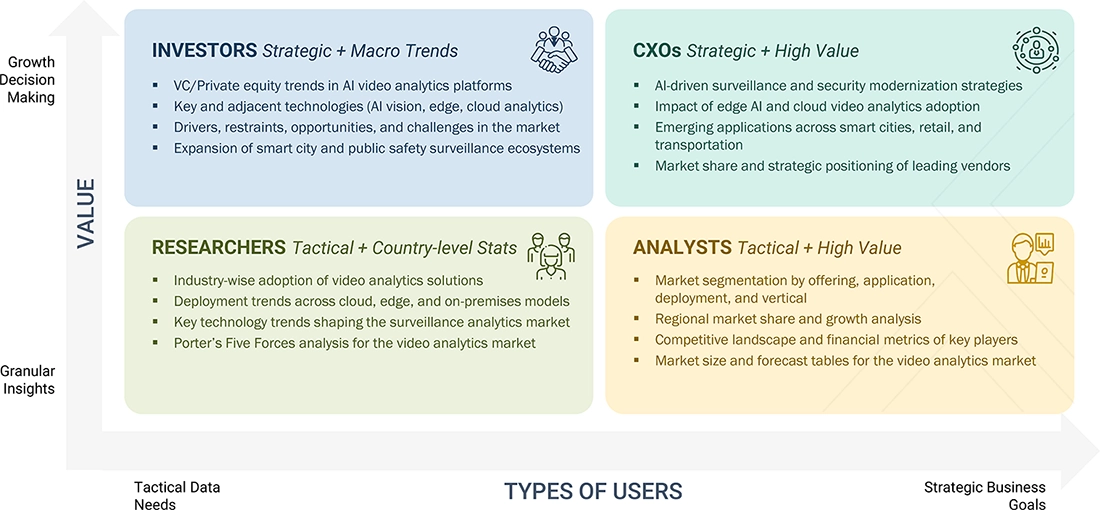
WHAT IS IN IT FOR YOU: VIDEO ANALYTICS MARKET REPORT CONTENT GUIDE
DELIVERED CUSTOMIZATIONS
We have successfully delivered the following deep-dive customizations:
| CLIENT REQUEST | CUSTOMIZATION DELIVERED | VALUE ADDS |
|---|---|---|
| Smart City Authority | Vendor benchmarking of video analytics solutions for city surveillance, traffic monitoring, and public safety applications | Support technology selection to strengthen urban security and traffic management initiatives |
| Transportation & Logistics Operator | Vendor landscape analysis focused on AI-based traffic monitoring, ANPR, and incident detection solutions | Enable informed investment decisions for transportation monitoring and safety operations |
| Retail Enterprise | Market sizing, segment analysis, and adoption trends for video analytics solutions across retail stores and shopping centers | Identify opportunities to improve store security, customer analytics, and operational efficiency |
RECENT DEVELOPMENTS
- February 2026 : Genetec has added new capabilities to Security Center SaaS, enabling enterprise customers to conduct investigations across multiple sites and with multiple camera vendors more efficiently than ever. Security Center SaaS now provides AI-driven natural language search, timeline previews, trajectory/movement analysis, and stronger case and evidence management features to reduce the time required to investigate an event from hours to minutes for those dealing with this type of security operation.
- November 2025 : Motorola Solutions acquired Blue Eye to add a human-verification remote video monitoring (RVM) layer to its AI-based automated video verification workflows (Avigilon was already a Blue Eye partner). This strengthens detection → verification → response orchestration, helps reduce false alarms/alarm fatigue, and supports escalation to public safety with higher-confidence verified incidents.
- September 2025 : Axis Communications introduced new multisensory security solutions at GSX 2025, including a bispectral PTZ camera that combines thermal and visual imaging, AI-enabled bullet cameras, next-generation radar systems, and an air-quality sensor. Built on the ARTPEC-9 platform, these devices support advanced edge analytics, including human and vehicle detection, classification, and counting. The integrated sensing capabilities—thermal, visual, radar, audio, and environmental—enhance situational awareness and enable more accurate real-time monitoring across security environments.
Table of Contents
 Exclusive indicates content/data unique to MarketsandMarkets and not available with any competitors.
Methodology
The study involved four major activities in estimating the current video analytics market size. We performed extensive secondary research to collect information on the market, the competitive market, and the parent market. The next step was to validate these findings, assumptions, and sizing with industry experts across the value chain through primary research. Both top-down and bottom-up approaches were employed to estimate the complete market size. After that, we used the market breakup and data triangulation procedures to estimate the market size of the various segments in the video analytics market.
Secondary Research
This research study used extensive secondary sources, directories, and databases, such as D&B Hoovers, DiscoverOrg, Factiva, vendor data sheets, product demos, Cloud Computing Association (CCA), Vendor Surveys, Asia Cloud Computing Association, and The Software Alliance. We referred to these sources to identify and collect valuable information for this technical, market-oriented, and commercial study of the video analytics market.
Primary Research
Primary sources were several industry experts from the core and related industries, preferred software providers, hardware manufacturers, distributors, service providers, technology developers, alliances, and organizations related to all segments of the industry's value chain. In-depth interviews were conducted with primary respondents, including key industry participants, subject-matter experts, C-level executives of key market players, and industry consultants, to obtain and verify critical qualitative and quantitative information and assess the market's prospects.
We conducted primary interviews to gather insights, such as market statistics, the latest trends disrupting the market, new use cases implemented, data on revenue collected from products and services, market breakups, market size estimations, market forecasts, and data triangulation. Primary research also helped understand various technology trends, segmentation types, industry trends, and regions. Demand-side stakeholders, such as Chief Information Officers (CIOs), Chief Technology Officers (CTOs), and Chief Security Officers (CSOs); the installation teams of governments/end users using video analytics software & services; and digital initiatives project teams, were interviewed to understand the buyer's perspective on suppliers, products, service providers, and their current use of services, which would affect the overall video analytics market.
To know about the assumptions considered for the study, download the pdf brochure
Market Size Estimation
We used top-down and bottom-up approaches to estimate and forecast the video analytics market and other dependent submarkets. We deployed a bottom-up procedure to arrive at the overall market size using the revenues and offerings of key companies in the market. With data triangulation methods and validation through primary interviews, this study determined and confirmed the exact value of the overall parent market size. We used the overall market size in the top-down procedure to estimate the size of other individual markets via percentage splits of the market segments.
We used top-down and bottom-up approaches to estimate and validate the size of the video analytics market and various other dependent subsegments.
The research methodology used to estimate the market size included the following details:
- We identified key players in the market through secondary research. We then determined their revenue contributions in the respective countries through primary and secondary research.
- This entire procedure included studying top market players' annual and financial reports and extensive interviews for key insights from industry leaders, such as Chief Executive Officers (CEOs), VPs, directors, and marketing executives.
- All percentage splits and breakups were determined using secondary sources and verified through primary sources.
All the possible parameters that affect the market covered in this research study have been accounted for, viewed in extensive detail, verified through primary research, and analyzed to get the final quantitative and qualitative data. This data is consolidated and added with detailed inputs and analysis from MarketsandMarkets.
Data Triangulation
The market was split into several segments and subsegments after arriving at the overall market size—using the market size estimation processes as explained above. Where applicable, data triangulation and market breakup procedures were employed to complete the overall market engineering process and arrive at the exact statistics of each market segment and subsegment. The data was triangulated by studying several factors and trends from both the demand and supply sides in the video analytics market.
Market Definition
Video analytics is the technology used for computerized processing and analysis of video streams. It is also known as Video Content Analysis (VCA), intelligent video analysis, or video surveillance analytics. The video streams used for analysis are captured using various devices, such as network cameras, Digital Video Recorders (DVRs), and Network Video Recorders (NVRs). The captured video streams are then analyzed using video analytics software for various purposes, such as recognizing people, sending safety alerts, recognizing license plates, detecting unattended objects, and tracking footfalls.
Key Stakeholders
- Video Analytics Software Providers
- Video Surveillance System Providers
- Video Management Software Providers
- Internet Service Providers (ISPs)
- Cloud Service Providers (CSPs)
- Security Camera Manufacturers
- System Integrators
- Networking Companies
- Third-party Providers
- Value-added Resellers (VARs)
- Government Agencies
- Law Enforcement Agencies
- Consultants/Consultancies/Advisory Firms
- Support and Maintenance Service Providers
- Artificial Intelligence (AI) Solutions Providers
- Facial Recognition Solution Providers
- Smart Initiatives Project Teams
Report Objectives
- To define, describe, and forecast the video analytics market based on offerings, applications, deployment models, types, industry verticals, and regions
- To forecast the market size of the five major regional segments: North America, Europe, Asia Pacific, Middle East & Africa, and Latin America
- To strategically analyze the market subsegments concerning individual growth trends, prospects, and contributions to the total market
- To provide detailed information related to the significant factors influencing the growth of the market (drivers, restraints, opportunities, and challenges)
- To strategically analyze the macro and micromarkets1 concerning growth trends, prospects, and their contributions to the overall market
- To analyze the industry trends, patents and innovations, and pricing data related to the video analytics market.
- To analyze the opportunities in the market for stakeholders and provide details of the competitive landscape for major players.
- To profile the key players in the market and comprehensively analyze their market share/ranking and core competencies across segments and subsegments.
- To track and analyze the competitive developments, such as mergers and acquisitions, product developments, and partnerships and collaborations in the market.
Available Customizations
With the given market data, MarketsandMarkets offers customizations per the company's specific needs. The following customization options are available for the report:
Product Analysis
- The product matrix provides a detailed comparison of the product portfolio of each company.
Geographic Analysis
- Further breakup of the Asia Pacific market into countries contributing 75% to the regional market size
- Further breakup of the North American market into countries contributing 75% to the regional market size
- Further breakup of the Latin American market into countries contributing 75% to the regional market size
- Further breakup of the Middle Eastern & African market into countries contributing 75% to the regional market size
- Further breakup of the European market into countries contributing 75% to the regional market size
Company Information
- Detailed analysis and profiling of additional market players (up to 5)
Need a Tailored Report?
Customize this report to your needs
Get 10% FREE Customization
Customize This ReportPersonalize This Research
- Triangulate with your Own Data
- Get Data as per your Format and Definition
- Gain a Deeper Dive on a Specific Application, Geography, Customer or Competitor
- Any level of Personalization
Let Us Help You
- What are the Known and Unknown Adjacencies Impacting the Video Analytics Market
- What will your New Revenue Sources be?
- Who will be your Top Customer; what will make them switch?
- Defend your Market Share or Win Competitors
- Get a Scorecard for Target Partners

Custom Market Research Services
We Will Customise The Research For You, In Case The Report Listed Above Does Not Meet With Your Requirements
Get 10% Free CustomisationTESTIMONIALS
Growth opportunities and latent adjacency in Video Analytics Market

Still Researching the
Video Analytics Ecosystem?
See the competitors, opportunity evaluation, and growth signals shaping it - Instantly!
Generate 15+ consulting-grade strategic intelligence outputs - from competitor analysis to board-ready strategy decks, tailored to your Video Analytics growth question.







MnM Analyst
Apr, 2026
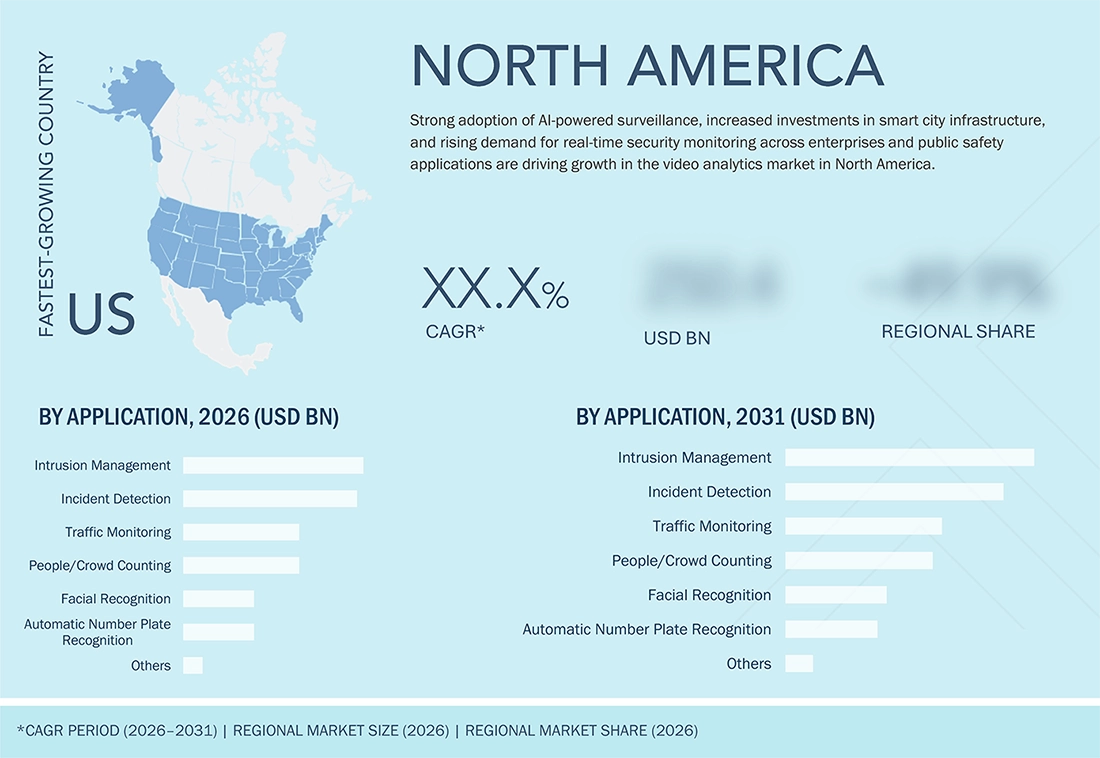
North America remains a priority due to early adoption of AI-driven video analytics, strong presence of leading technology vendors, and continuous investments in advanced security infrastructure across industries..
Anthony
Apr, 2026
What is driving the rapid growth of the video analytics market?.
Grace
Apr, 2026
Why is cloud and edge deployment gaining popularity in video analytics?.
Steven
Apr, 2026
Why does North America continue to be a key market for video analytics investments?.
Mark
Apr, 2026
How effectively can video analytics address workplace safety challenges in EHS environments?.