Pressure Transmitter Market by Technology, Type (Absolute, Gauge, Differential, Multivariable), Design & Functionality (Diaphragm, Hygienic, Wireless), Fluid Type (Liquid, Gas, Steam), Measurement Application, Industry - Global Forecast to 2032

icon1
USD 4.15 BN
MARKET SIZE, 2032
icon2
CAGR 3.8%
(2026-2032)
icon3
300
REPORT PAGES
icon4
150
MARKET TABLES

OVERVIEW

pressure-transmitters-market Overview

Source: Secondary Research, Interviews with Experts, MarketsandMarkets Analysis

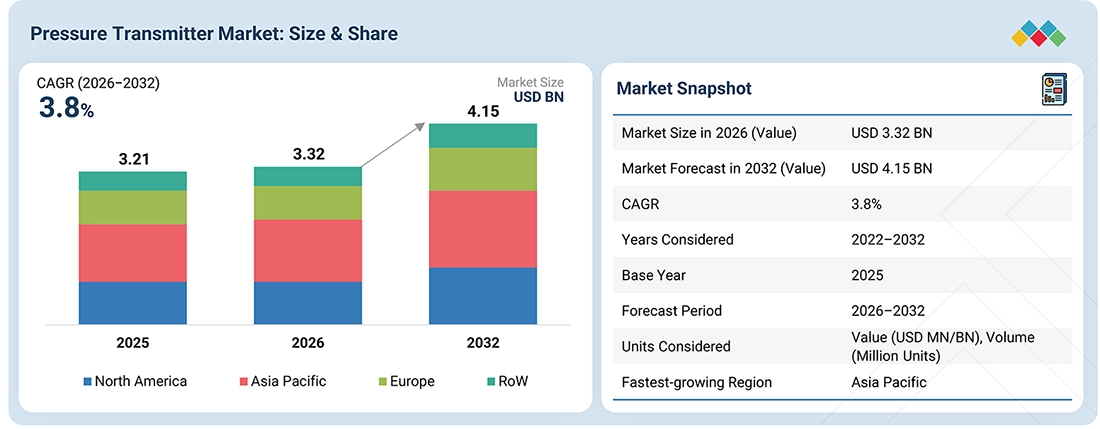
The pressure transmitter market is projected to reach USD 4.15 billion by 2032 from an estimated USD 3.32 billion in 2026, growing at a CAGR of 3.8% during 2026–2032. The market is expected to grow steadily, driven by increasing adoption of industrial automation, process control, and smart manufacturing across key industries. Rising demand for accurate and reliable pressure measurement, expanding investments in oil & gas infrastructure, chemical processing, power generation, and water & wastewater treatment, and growing emphasis on operational efficiency and process safety are further accelerating market adoption. Additionally, advancements in smart pressure transmitters, multivariable measurement technologies, digital communication protocols, wireless instrumentation, and Industrial Internet of Things (IIoT) integration are enabling real-time process monitoring, remote diagnostics, predictive maintenance, and improved measurement accuracy across diverse end-use industries.

KEY TAKEAWAYS

  • By Region
    Asia Pacific is expected to account for ~39% of the global pressure transmitter market by 2032.
  • By Type
    Based on type, differential pressure transmitters are expected to account for the largest market share of ~53% by 2032.
  • By Industry
    Based on industry, the water & wastewater treatment segment is expected to register the highest CAGR of 4.6% in the pressure transmitter market during the forecast period.
  • By Application
    Based on application, the level measurement segment is expected to account for the largest market share of ~53% in the pressure transmitter market by 2032.
  • By Fluid Type
    Based on fluid type, the liquid segment is expected to account for the largest market share in the pressure transmitter market by 2032.
  • Competitive Landscape (Key Players)
    Key players in the pressure transmitter market include Emerson Electric Co., Honeywell International Inc., Siemens, ABB Ltd., and Yokogawa Electric Corporation, supported by continuous advancements in smart pressure measurement technologies, differential and multivariable sensing, digital communication protocols, wireless instrumentation, and Industrial Internet of Things (IIoT)-enabled process monitoring solutions.
  • Competitive Landscape (SMEs/Startup Players)
    • Key emerging and specialized players in the pressure transmitter market include BD
    • SENSORS GmbH, VEGA Grieshaber KG, Trafag AG, Setra Systems, Brooks Instrument, and JUMO GmbH & Co. KG. These companies are strengthening their market presence through innovations in high-precision pressure measurement, compact transmitter designs, application-specific sensing solutions, and advanced digital communication capabilities. Their focus on developing reliable, cost-effective, and application-oriented pressure measurement technologies is supporting adoption across oil & gas, chemicals, power generation, water & wastewater treatment, pharmaceuticals, and industrial automation applications.

The pressure transmitter market is witnessing steady growth, driven by the increasing adoption of industrial automation, process control systems, and smart manufacturing technologies. Growing demand for accurate pressure measurement, real-time process monitoring, and operational efficiency is accelerating the deployment of pressure transmitters across oil & gas, chemicals, power generation, water & wastewater treatment, pharmaceuticals, and food & beverages industries. Additionally, advancements in smart pressure transmitters, multivariable measurement technologies, digital communication protocols, wireless instrumentation, and Industrial Internet of Things (IIoT) integration are further supporting market expansion globally.

TRENDS & DISRUPTIONS IMPACTING CUSTOMERS' CUSTOMERS

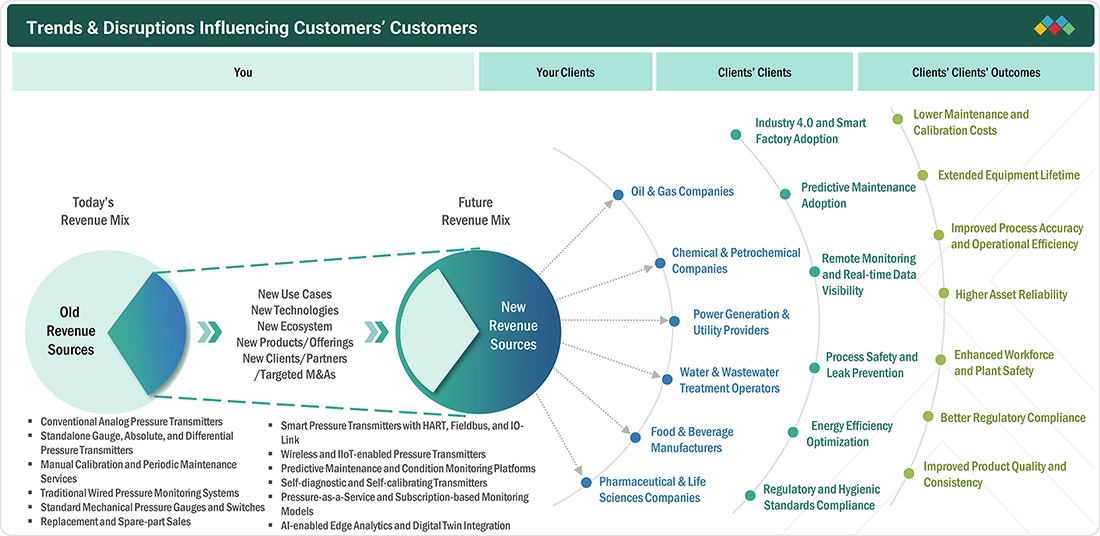
Trends in Industrial IoT (IIoT), Industry 4.0, smart manufacturing, and digital transformation are reshaping the demand for pressure transmitters globally. Manufacturers and process industries across oil & gas, chemicals, power generation, water & wastewater treatment, and pharmaceuticals are increasingly deploying advanced pressure transmitters to enable accurate, real-time process monitoring, automated control, and operational efficiency. These trends are accelerating demand for smart pressure transmitters, multivariable measurement technologies, wireless instrumentation, digital communication protocols, and IIoT-enabled monitoring platforms, supporting improved process reliability, predictive maintenance, enhanced safety, reduced downtime, and optimized operating costs.

pressure-transmitters-market Disruptions

Source: Secondary Research, Interviews with Experts, MarketsandMarkets Analysis

MARKET DYNAMICS

Drivers
Impact
Level
  • Increasing adoption of industrial automation and process control systems is driving demand for accurate and reliable pressure measurement solutions
  • Rising investments in water and wastewater treatment infrastructure are accelerating the deployment of pressure transmitters across treatment facilities
RESTRAINTS
Impact
Level
  • High initial investment and installation costs associated with advanced pressure transmitters can restrict adoption among small and medium-sized enterprises
  • Availability of alternative pressure measurement technologies, including pressure gauges and switches, can limit transmitter adoption in basic applications
OPPORTUNITIES
Impact
Level
  • Increasing adoption of smart manufacturing and IIoT technologies is creating opportunities for digitally enabled pressure transmitters with advanced monitoring capabilities
  • Growing investments in smart water management and wastewater infrastructure modernization are creating new opportunities for pressure transmitter manufacturers
CHALLENGES
Impact
Level
  • Integrating advanced pressure transmitters with legacy industrial control systems increases implementation complexity, engineering requirements, and overall deployment costs
  • Maintaining measurement accuracy under extreme temperatures, pressure fluctuations, vibration, and corrosive environments remains a significant operational challenge

Source: Secondary Research, Interviews with Experts, MarketsandMarkets Analysis

Driver: Increasing adoption of industrial automation and process control systems is driving demand for accurate and reliable pressure measurement solutions

The increasing adoption of industrial automation and process control systems is driving demand for accurate and reliable pressure measurement solutions across key process industries. Pressure transmitters play a critical role in monitoring and controlling pressure levels in pipelines, storage tanks, reactors, and processing equipment. Growing investments in automated manufacturing facilities, process optimization, and digital control systems are encouraging industries to deploy advanced pressure transmitters to improve operational efficiency, ensure process stability, and enhance workplace safety.

Restraint: Availability of alternative pressure measurement technologies, including pressure gauges and switches, can limit transmitter adoption in basic applications

The availability of alternative pressure measurement technologies, including conventional pressure gauges and pressure switches, can limit the adoption of pressure transmitters in basic industrial applications. These alternatives generally offer simpler measurement capabilities and lower initial acquisition costs, making them suitable for applications that do not require continuous monitoring or automated process control. Consequently, cost-sensitive end users and small-scale industrial facilities may prefer conventional instruments over advanced pressure transmitters, restricting market penetration in certain applications.

Opportunity: Increasing adoption of smart manufacturing and IIoT technologies is creating opportunities for digitally enabled pressure transmitters with advanced monitoring capabilities

The growing adoption of smart manufacturing and Industrial Internet of Things (IIoT) technologies is creating significant opportunities for digitally enabled pressure transmitters with advanced monitoring capabilities. Smart pressure transmitters equipped with digital communication protocols, remote diagnostics, and real-time data transmission enable seamless integration with industrial automation platforms. Increasing demand for predictive maintenance, equipment health monitoring, and process optimization is encouraging manufacturers to develop intelligent pressure measurement solutions that improve operational visibility, reduce unplanned downtime, and enhance productivity.

Challenge: Integrating advanced pressure transmitters with legacy industrial control systems increases implementation complexity, engineering requirements, and overall deployment costs

Integrating advanced pressure transmitters with legacy industrial control systems remains a significant challenge for end users across process industries. Older control infrastructure may lack compatibility with modern digital communication protocols, wireless technologies, and IIoT-enabled monitoring platforms, requiring additional hardware, software upgrades, and engineering modifications. These integration requirements can increase installation complexity, commissioning time, and overall deployment costs, potentially delaying the adoption of advanced pressure transmitter solutions across existing industrial facilities.

PRESSURE TRANSMITTER MARKET SIZE, SHARE & TRENDS, 2025 TO 2030: COMMERCIAL USE CASES ACROSS INDUSTRIES

COMPANY USE CASE DESCRIPTION BENEFITS
company logo
Deployment of 27 Rosemount 3051S Wireless Pressure Transmitters at a North American refinery's coking unit to continuously monitor pressure relief valves and detect volatile organic compound (VOC) releases. The wireless network enabled automated pressure monitoring and reporting, eliminating the need for manual compliance logs and improving visibility into pressure relief valve performance. Improved VOC emission monitoring | Elimination of false emission reports | Reduced VOC emissions through timely operator intervention | Minimized regulatory fines | Eliminated manual compliance reporting
company logo
Integration of Honeywell SmartLine pressure transmitters with the Experion distributed control system (DCS) at OMV Petrom's Petrobrazi Refinery in Romania. The implementation modernized existing field instrumentation, improved system integration, and enabled faster commissioning through automated device commissioning and preconfigured templates. Improved process stability and system reliability | Doubled turnaround intervals from two to four years | Reduced maintenance costs | Faster commissioning and installation | Improved operational efficiency
company logo
Deployment of 148 SITRANS P320 pressure and differential pressure transmitters at Linde Gas Produktionsgesellschaft's facility in Herne, Germany. The transmitters were integrated with the existing SIMATIC PCS 7 control system through 4–20 mA HART communication, enabling reliable pressure measurement and remote safety handling from the control room. Improved measurement reliability and accuracy | Reduced manual device handling | Faster commissioning and configuration | Simplified integration with existing control systems | Improved operational efficiency
company logo
Deployment of 190 ABB 2600T series pressure transmitters in Venice's MOSE flood protection system to measure compressed air and water pressure within subsea flap gates. The pressure measurements help determine gate positions and enable automated control of the barriers to protect the Venice lagoon from high tides and flooding. Accurate monitoring of water and compressed air pressure | Automated flap gate positioning | Improved flood protection and operational reliability | Enhanced monitoring of subsea infrastructure | Improved control of flood barriers
company logo
Deployment of the EJX910A multivariable pressure transmitter with Micro-Orifice by a chemical industry customer to measure mass flow, differential pressure, static pressure, and process temperature in analyzer sampling applications. The solution enabled remote monitoring of analyzer shelters, reducing the need for technicians to perform manual inspection rounds. Improved workforce productivity | Reduced manual inspection rounds | Enhanced process monitoring and product quality | Lower installation and modification costs | Faster identification of analyzer shelter issues

Logos and trademarks shown above are the property of their respective owners. Their use here is for informational and illustrative purposes only.

MARKET ECOSYSTEM

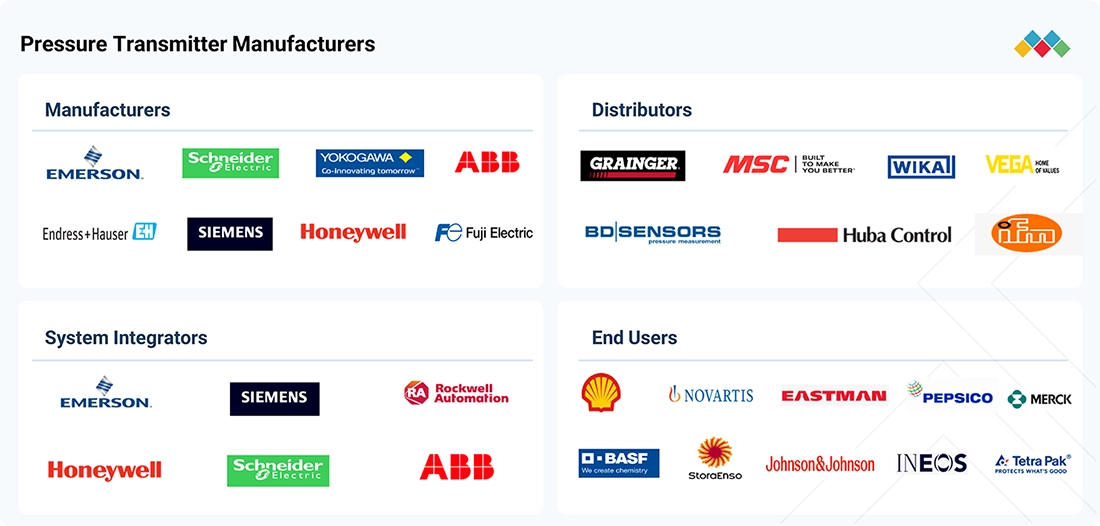
The pressure transmitter market ecosystem comprises sensing element and component suppliers, semiconductor providers, pressure transmitter manufacturers, process instrumentation and automation solution providers, system integrators, distributors, and end users. Component suppliers provide pressure-sensitive elements, diaphragms, strain gauges, and electronic components required for accurate pressure measurement. Pressure transmitter manufacturers integrate these components into differential, gauge, absolute, and multivariable transmitters for industrial applications. Automation providers and system integrators support installation, calibration, connectivity, and integration with process control and IIoT platforms. End users across oil & gas, chemicals, power generation, water & wastewater treatment, pharmaceuticals, and food & beverages deploy these solutions for efficient process monitoring and control.

pressure-transmitters-market Ecosystem

Logos and trademarks shown above are the property of their respective owners. Their use here is for informational and illustrative purposes only.

MARKET SEGMENTS

pressure-transmitters-market Segments

Source: Secondary Research, Interviews with Experts, MarketsandMarkets Analysis

Pressure Transmitter Market, by Industry

The oil & gas segment is projected to account for the largest share of the pressure transmitter market during the forecast period, driven by the extensive use of pressure transmitters for monitoring and controlling pressure across upstream, midstream, and downstream operations. Increasing investments in oil & gas exploration, production, pipeline infrastructure, refining, and petrochemical processing are driving demand for accurate and reliable pressure measurement solutions. Furthermore, the growing emphasis on process safety, operational efficiency, leak detection, and real-time monitoring, coupled with the adoption of industrial automation and digital technologies, is expected to sustain the segment’s market dominance throughout the forecast period.

Pressure Transmitter Market, by Application

The level measurement segment is projected to register the highest CAGR during the forecast period, driven by increasing demand for accurate and reliable level monitoring across storage tanks, vessels, pipelines, and process equipment. Growing investments in oil & gas, chemicals, water & wastewater treatment, and power generation are accelerating the adoption of pressure transmitters for hydrostatic and differential pressure-based level measurement. Furthermore, the rising focus on process safety, inventory management, operational efficiency, and automated process control is expected to create significant growth opportunities for the segment throughout the forecast period.

Pressure Transmitter Market, by Fluid Type

The liquid segment is projected to register the highest CAGR during the forecast period, driven by increasing demand for accurate and reliable pressure measurement across liquid-handling processes in key industries. Growing investments in water and wastewater treatment infrastructure, oil & gas pipelines, chemical processing, power generation, and food & beverage manufacturing are accelerating the adoption of pressure transmitters for monitoring liquid pressure, flow, and level. Furthermore, the rising focus on efficient fluid management, leak detection, process optimization, and real-time monitoring is expected to create significant growth opportunities for the segment throughout the forecast period.

Pressure Transmitter Market, by Type

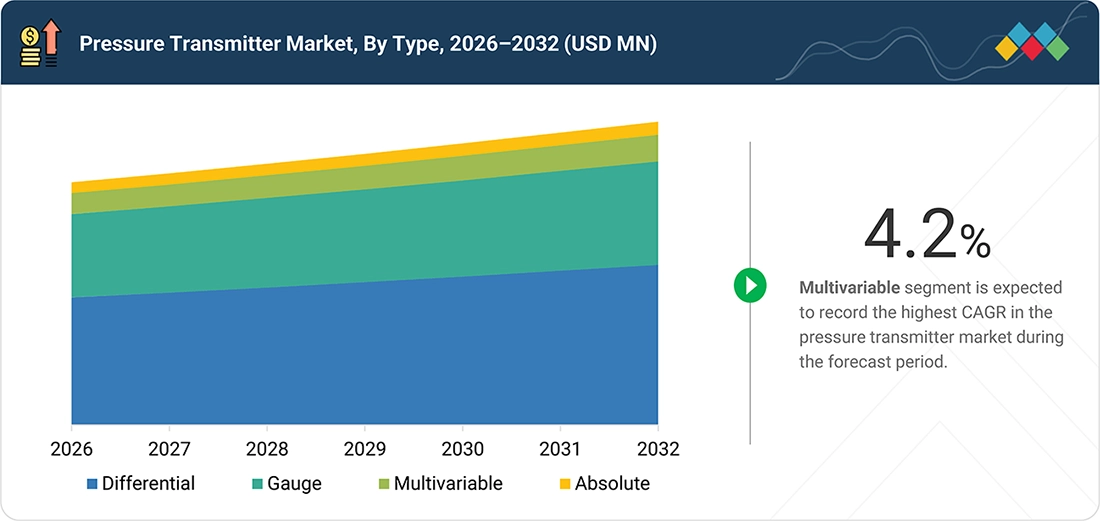
The multivariable pressure transmitter segment is projected to register the highest CAGR during the forecast period, driven by increasing demand for advanced measurement solutions that can simultaneously monitor differential pressure, static pressure, and process temperature through a single device. Growing adoption across oil & gas, chemicals, power generation, and other process industries is accelerating the deployment of multivariable transmitters for accurate mass flow measurement, dynamic compensation, and process optimization. Furthermore, their ability to reduce instrumentation requirements, simplify installation, lower maintenance costs, and improve measurement accuracy is expected to create significant growth opportunities for the segment throughout the forecast period.

REGION

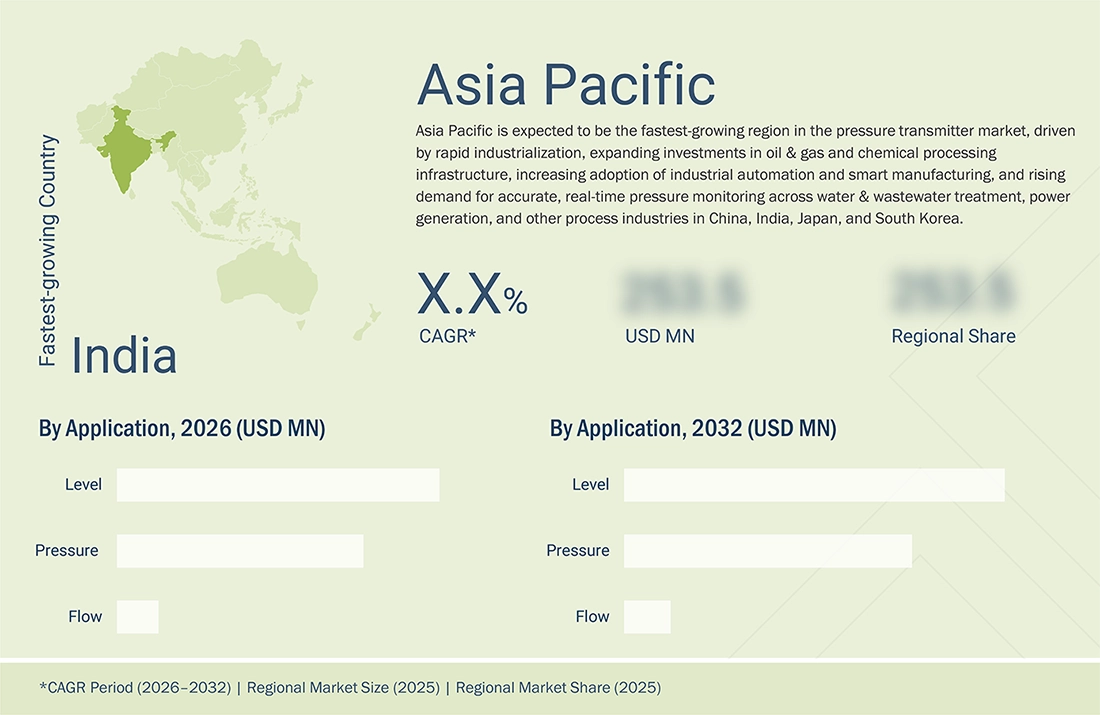
Asia Pacific is expected to record the fastest growth in the global pressure transmitter market during the forecast period

Asia Pacific is expected to register the highest CAGR in the pressure transmitter market during the forecast period, supported by rapid industrialization, expanding manufacturing activities, and increasing adoption of industrial automation and Industry 4.0 initiatives across China, India, Japan, and South Korea. Growing investments in oil & gas infrastructure, chemical processing, power generation, and water & wastewater treatment facilities are accelerating the deployment of pressure transmitters across the region. Additionally, rising demand for smart manufacturing, process optimization, and real-time monitoring, along with increasing investments in digital industrial infrastructure, is further driving pressure transmitter adoption across Asia Pacific.

pressure-transmitters-market Region

PRESSURE TRANSMITTER MARKET SIZE, SHARE & TRENDS, 2025 TO 2030: COMPANY EVALUATION MATRIX

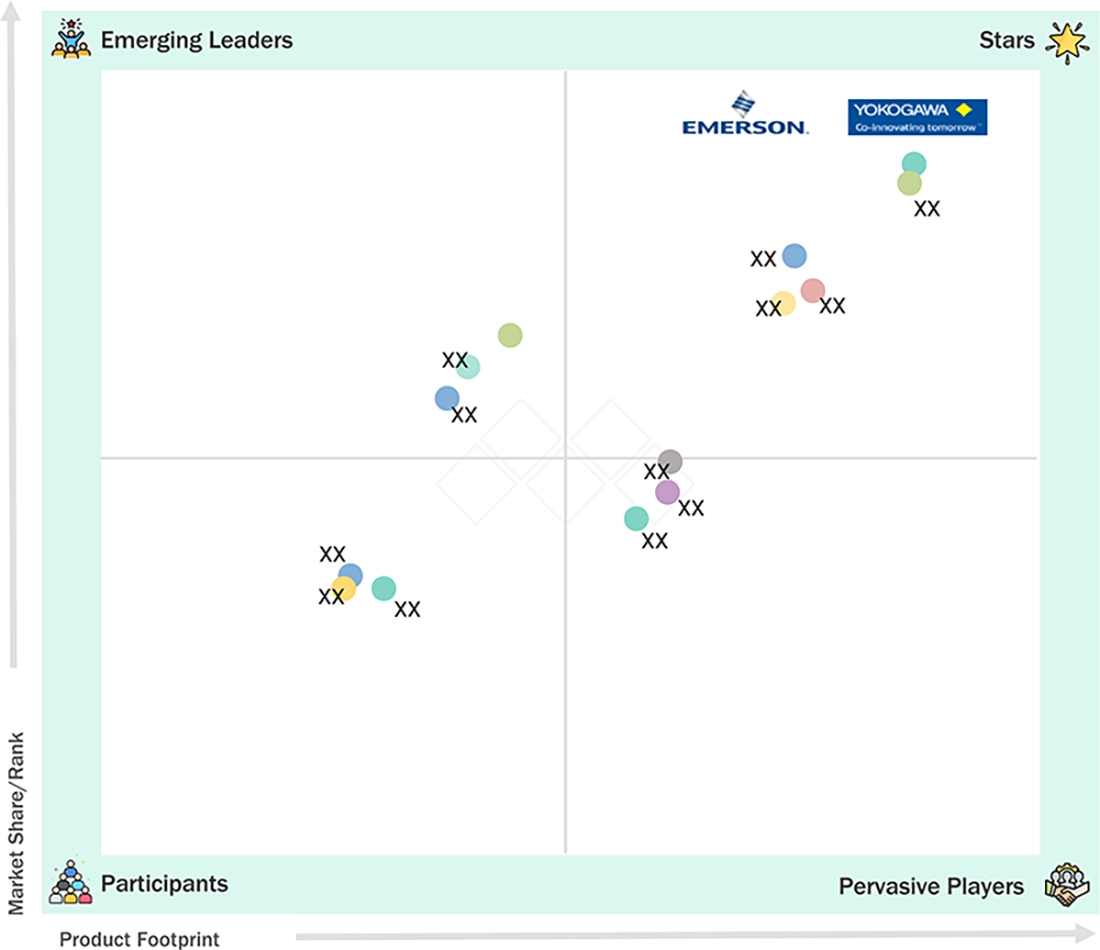
In the pressure transmitter market matrix, Emerson Electric Co. is positioned as a Star, supported by its extensive Rosemount pressure transmitter portfolio, strong process instrumentation capabilities, advanced measurement technologies, and established presence across oil & gas, chemicals, power generation, and other process industries. Yokogawa Electric Corporation is also positioned as a Star, driven by its comprehensive portfolio of differential, gauge, absolute, and multivariable pressure transmitters, strong expertise in process automation and control systems, and extensive global presence across key industrial applications.

pressure-transmitters-market Evaluation Metrics

Source: Secondary Research, Interviews with Experts, MarketsandMarkets Analysis

KEY MARKET PLAYERS

MARKET SCOPE

REPORT METRIC DETAILS
Market Size in 2025 (Value) USD 3.21 Billion
Market Size in 2026 (Value) USD 3.32 Billion
Market Forecast in 2032 (Value) USD 4.15 Billion
Growth Rate 3.8%
Years Considered 2022-2032
Base Year 2025
Forecast Period 2026-2032
Units Considered Value (USD Million/Billion), Volume (Million Units)
Report Coverage Revenue Forecast, Company Ranking, Competitive Landscape, Growth Factors, and Trends
Segments Covered
  • By Type:
    • Differential
    • Gauge
    • Multivariable
    • Absolute
  • By Fluid Type:
    • Liquid
    • Gas
    • Steam
  • By Application:
    • Level
    • Pressure
    • Flow
  • By Industry:
    • Oil & Gas
    • Chemicals
    • Power
    • Metals & Mining
    • Food & Beverages
    • Water & Wastewater
    • Pulp and Paper
    • Pharmaceuticals
    • Other Industries
Regions Covered North America, Europe, Asia Pacific, RoW

WHAT IS IN IT FOR YOU: PRESSURE TRANSMITTER MARKET SIZE, SHARE & TRENDS, 2025 TO 2030 REPORT CONTENT GUIDE

pressure-transmitters-market Content Guide

DELIVERED CUSTOMIZATIONS

We have successfully delivered the following deep-dive customizations:

CLIENT REQUEST CUSTOMIZATION DELIVERED VALUE ADDS
Pressure Transmitter Manufacturers
  • Market opportunity assessment by transmitter type (differential, gauge, absolute, and multivariable) and application (flow, level, and pressure)
  • Competitive benchmarking of leading manufacturers
  • Product portfolio and pricing analysis
  • Technology roadmap assessment
  • Optimized product portfolio
  • Improved R&D prioritization
  • Stronger competitive positioning
  • Identification of high-growth product segments
Sensing Element & Component Providers
  • Demand assessment for pressure sensing technologies and components
  • Analysis of strain gauge, capacitive, piezoresistive, and piezoelectric technologies
  • Component supplier benchmarking
  • OEM partnership opportunity assessment
  • Identification of high-demand components
  • Improved customer targeting
  • Stronger OEM relationships
  • Enhanced product development
Industrial Automation & Process Control Providers
  • Market opportunity assessment by end-use industry
  • Analysis of pressure transmitter integration with DCS, PLC, and SCADA systems
  • Assessment of digital communication protocols and IIoT-enabled solutions
  • Regional demand analysis
  • Identification of automation opportunities
  • Improved solution development
  • Enhanced system integration capabilities
  • Stronger market penetration
Distributors & Channel Partners
  • Regional market attractiveness assessment
  • Analysis of demand by pressure transmitter type, industry, and application
  • Competitive pricing and distribution channel benchmarking
  • Identification of potential OEM and end-user customers
  • Improved market expansion planning
  • Better customer acquisition
  • Optimized distribution strategies
  • Increased sales opportunities
Industrial End Users
  • Application-specific pressure transmitter selection analysis
  • Technology and vendor benchmarking
  • Total cost of ownership assessment
  • Evaluation of smart transmitters, remote monitoring, and predictive maintenance capabilities
  • Improved procurement decisions
  • Reduced operating and maintenance costs
  • Enhanced process reliability
  • Improved operational efficiency

RECENT DEVELOPMENTS

  • February 2026 : Yokogawa introduced the EJX S Series as the successor to its EJX A pressure transmitter lineup, with enhancements in accuracy, long-term stability, durability, and maintenance efficiency. The series offers accuracy of up to ±0.025%, long-term stability of ±0.1% over 20 years, and rangeability of up to 400:1. It also supports HART and PROFINET communication protocols, with IP68 protection and SIL2 compliance.
  • May 2026 : Ashcroft launched the ZT61 High Purity Surface Mount Pressure Transmitter with Display for semiconductor manufacturing and high-purity gas delivery applications. The compact transmitter features a rotatable LED display, 316L stainless steel pressure fitting, corrosion-resistant wetted materials, and helium leak testing. Its cleanroom packaging and compact design support installation in gas cabinets, gas panels, and valve manifold boxes.
  • October 2025 : Emerson announced the Rosemount 4051S Pressure Transmitter, featuring a 20-year warranty, 20-year stability specification, and a fast response time of 40 milliseconds. The product incorporates advanced diagnostics, Bluetooth connectivity, guided proof testing, and a graphical backlit display. Its integrated relay switches also enable local control of pumps and other equipment, reducing the need for separate control devices in certain applications.
  • October 2025 : LEEG Instruments launched a new generation of modular pressure transmitters with improvements in internal data storage, terminal connections, display functionality, and maintenance accessibility. The updated design allows independent calibration and replacement of the measuring element, while detachable terminal modules simplify field maintenance. The enhancements are intended to reduce servicing time and improve product lifecycle management.
  • September 2025 : ABB announced the US-market availability of its P-300 pressure transmitter series for petrochemical, chemical, power, pulp and paper, and other industrial applications. The transmitter offers measurement accuracy of up to 0.055%, a backlit HMI display, and QR-code-enabled Digital Advanced Diagnostics. It is designed to improve process control, simplify maintenance, and support energy efficiency in industrial facilities.


Table of Contents

checkmarkExclusive indicates content/data unique to MarketsandMarkets and not available with any competitors.

TITLE
PAGE NO
1
INTRODUCTION


15
2
EXECUTIVE SUMMARY


3
PREMIUM INSIGHTS


4
MARKET OVERVIEW
Covers the key developments, trend analysis, and actionable insights to support strategic planning and positioning.


4.1
INTRODUCTION


4.2
MARKET DYNAMICS


4.2.1
DRIVERS


4.2.2
RESTRAINTS


4.2.3
OPPORTUNITIES


4.2.4
CHALLENGES


4.3
INTERCONNECTED MARKETS AND CROSS-SECTOR OPPORTUNITIES


4.4
STRATEGIC MOVES BY TIER 1/2/3 PLAYERS


5
INDUSTRY TRENDS
Presents a concise view of industry direction, strategic priorities, and key indicators influencing market momentum.


5.1
PORTER’S FIVE FORCES ANALYSIS


5.2
MACROECONOMIC OUTLOOK


5.2.1
INTRODUCTION


5.2.2
GDP TRENDS AND FORECAST


5.2.3
TRENDS IN INDUSTRIAL IOT (IIOT) AND WIRELESS CONNECTIVITY IN PRESSURE TRANSMITTER INDUSTRY


5.2.4
TRENDS IN SMART PRESSURE SENSING AND MULTIVARIABLE MEASUREMENT TECHNOLOGIES


5.3
VALUE CHAIN ANALYSIS


5.4
ECOSYSTEM ANALYSIS


5.5
PRICING ANALYSIS


5.5.1
AVERAGE SELLING PRICE TREND OF PRESSURE TRANSMITTER, BY KEY PLAYER (2022–2025)


5.5.2
AVERAGE SELLING PRICE TREND OF PRESSURE TRANSMITTER, BY REGION (2022–2025)


5.6
TRADE ANALYSIS


5.6.1
IMPORT SCENARIO


5.6.2
EXPORT SCENARIO


5.7
KEY CONFERENCES AND EVENTS, 2026–2027


5.8
TRENDS/DISRUPTIONS IMPACTING CUSTOMER BUSINESS


5.9
INVESTMENT AND FUNDING SCENARIO


5.10
CASE STUDY ANALYSIS


5.11
IMPACT OF US TARIFF – PRESSURE TRANSMITTER MARKET


5.11.1
INTRODUCTION


5.11.2
KEY TARIFF RATES


5.11.3
PRICE IMPACT ANALYSIS


5.11.4
IMPACT ON COUNTRIES/REGIONS


5.11.4.1
US


5.11.4.2
EUROPE


5.11.4.3
ASIA PACIFIC


5.11.5
IMPACT ON END USERS
 
 
6
TECHNOLOGICAL ADVANCEMENTS, AI-DRIVEN IMPACT, PATENTS, INNOVATIONS, AND FUTURE APPLICATIONS


6.1
KEY/EMERGING TECHNOLOGIES


6.2
COMPLEMENTARY TECHNOLOGIES


6.3
TECHNOLOGY/PRODUCT ROADMAP


6.4
PATENT ANALYSIS


6.5
FUTURE APPLICATIONS


6.6
IMPACT OF AI/GEN AI ON PRESSURE TRANSMITTER MARKET


6.6.1
TOP USE CASES AND MARKET POTENTIAL


6.6.2
BEST PRACTICES IN PRESSURE TRANSMITTER MARKET


6.6.3
CASE STUDIES OF AI IMPLEMENTATION IN PRESSURE TRANSMITTER MARKET


6.6.4
INTERCONNECTED ECOSYSTEM AND IMPACT ON MARKET PLAYERS


6.6.5
CLIENTS’ READINESS TO ADOPT GENERATIVE AI IN PRESSURE TRANSMITTER MARKET
 
 
7
REGULATORY LANDSCAPE AND SUSTAINABILITY INITIATIVES


7.1
REGIONAL REGULATIONS AND COMPLIANCE


7.1.1
REGULATORY BODIES, GOVERNMENT AGENCIES, AND OTHER ORGANIZATIONS


7.1.2
INDUSTRY STANDARDS


7.2
SUSTAINABILITY INITIATIVES


7.3
SUSTAINABILITY IMPACT AND REGULATORY POLICY INITIATIVES


7.4
CERTIFICATIONS, LABELING, AND ECO-STANDARDS


8
CUSTOMER LANDSCAPE AND BUYER BEHAVIOR


8.1
DECISION-MAKING PROCESS


8.2
KEY STAKEHOLDERS IN BUYING PROCESS


8.3
BUYING CRITERIA


8.4
ADOPTION BARRIERS AND INTERNAL CHALLENGES


8.5
UNMET NEEDS OF VARIOUS END USERS


9
PRESSURE TRANSMITTER MARKET, BY TECHNOLOGY
Market Size, Volume & Forecast – USD Million


9.1
INTRODUCTION


9.2
PIEZORESISTIVE


9.3
CAPACITIVE


9.4
THIN-FILM RESISTIVE


9.5
FIBER-OPTIC


10
PRESSURE TRANSMITTER MARKET, BY TYPE
Market Size, Volume & Forecast – USD Million


10.1
INTRODUCTION


10.2
ABSOLUTE PRESSURE TRANSMITTER


10.3
GAUGE PRESSURE TRANSMITTER


10.4
DIFFERENTIAL PRESSURE TRANSMITTER


10.5
MULTIVARIABLE PRESSURE TRANSMITTER


11
PRESSURE TRANSMITTER MARKET, BY FLUID TYPE
Market Size, Volume & Forecast – USD Million


11.1
INTRODUCTION


11.2
LIQUID


11.3
STEAM


11.4
GAS


12
PRESSURE TRANSMITTER MARKET, BY DESIGN & FUNCTIONALITY
Market Size, Volume & Forecast – USD Million


12.1
INTRODUCTION


12.2
DIAPHRAGM SEAL PRESSURE TRANSMITTERS


12.3
HYDROSTATIC PRESSURE TRANSMITTERS FOR LEVEL MEASUREMENT


12.4
HYGIENIC PRESSURE TRANSMITTERS


12.5
WIRELESS PRESSURE TRANSMITTERS


13
PRESSURE TRANSMITTER MARKET, BY APPLICATION
Market Size, Volume & Forecast – USD Million


13.1
INTRODUCTION


13.2
FLOW


13.3
LEVEL


13.4
PRESSURE


14
PRESSURE TRANSMITTER MARKET, BY END USER
Market Size, Volume & Forecast – USD Million


14.1
INTRODUCTION


14.2
OIL & GAS


14.3
CHEMICALS


14.4
WATER & WASTEWATER


14.5
FOOD & BEVERAGES


14.6
POWER


14.7
PULP & PAPER


14.8
METALS & MINING


14.9
PHARMACEUTICALS


14.10
OTHER END USERS


15
PRESSURE TRANSMITTER MARKET, BY REGION
Market Size, Volume & Forecast – USD Million


15.1
INTRODUCTION


15.2
NORTH AMERICA


15.2.1
US


15.2.2
CANADA


15.2.3
MEXICO


15.3
EUROPE


15.3.1
GERMANY


15.3.2
UK


15.3.3
FRANCE


15.3.4
ITALY


15.3.5
SPAIN


15.3.6
POLAND


15.3.7
NORDICS


15.3.8
REST OF EUROPE


15.4
ASIA PACIFIC


15.4.1
CHINA


15.4.2
JAPAN


15.4.3
INDIA


15.4.4
SOUTH KOREA


15.4.5
AUSTRALIA


15.4.6
INDONESIA


15.4.7
MALAYSIA


15.4.8
VIETNAM


15.4.9
REST OF ASIA PACIFIC


15.5
ROW


15.5.1
SOUTH AMERICA


15.5.2
MIDDLE EAST


15.5.2.1
BAHRAIN


15.5.2.2
KUWAIT


15.5.2.3
OMAN


15.5.2.4
QATAR


15.5.2.5
SAUDI ARABIA


15.5.2.6
UNITED ARAB EMIRATES (UAE)


15.5.2.7
REST OF MIDDLE EAST


15.5.3
AFRICA


15.5.3.1
SOUTH AFRICA


15.5.3.2
REST OF AFRICA
 
16
COMPETITIVE LANDSCAPE


16.1
OVERVIEW


16.2
KEY PLAYER COMPETITIVE STRATEGIES/RIGHT TO WIN (JANUARY 2023 TO OCTOBER 2026)


16.3
REVENUE ANALYSIS, 2021–2025


16.4
MARKET SHARE ANALYSIS,


16.5
BRAND/PRODUCT COMPARISON


16.6
COMPANY EVALUATION MATRIX: KEY PLAYERS,


16.6.1
STARS


16.6.2
EMERGING LEADERS


16.6.3
PERVASIVE PLAYERS


16.6.4
PARTICIPANTS


16.6.5
COMPANY FOOTPRINT: KEY PLAYERS,


16.6.5.1
COMPANY FOOTPRINT


16.6.5.2
REGION FOOTPRINT


16.6.5.3
INDUSTRY FOOTPRINT


16.6.5.4
FLUID TYPE FOOTPRINT


16.6.5.5
TYPE FOOTPRINT


16.6.5.6
APPLICATION FOOTPRINT
 
 
16.7
COMPANY EVALUATION MATRIX: STARTUPS/SMES,


16.7.1
PROGRESSIVE COMPANIES


16.7.2
RESPONSIVE COMPANIES


16.7.3
DYNAMIC COMPANIES


16.7.4
STARTING BLOCKS


16.7.5
COMPETITIVE BENCHMARKING: STARTUPS/SMES,


16.7.5.1
DETAILED LIST OF KEY STARTUPS/SMES


16.7.5.2
COMPETITIVE BENCHMARKING OF KEY STARTUPS/SMES
 
 
16.8
COMPANY VALUATION AND FINANCIAL METRICS


16.9
COMPETITIVE SCENARIO


16.9.1
PRODUCT LAUNCHES


16.9.2
DEALS


16.9.3
EXPANSIONS
 
 
17
COMPANY PROFILES


17.1
INTRODUCTION


17.2
KEY PLAYERS


17.2.1
EMERSON ELECTRIC CO.


17.2.2
ABB


17.2.3
SIEMENS


17.2.4
SCHNEIDER ELECTRIC


17.2.5
YOKOGAWA ELECTRIC CORPORATION


17.2.6
HONEYWELL INTERNATIONAL INC.


17.2.7
ENDRESS+HAUSER GROUP SERVICES AG


17.2.8
FUJI ELECTRIC CO., LTD.


17.2.9
DANFOSS


17.2.10
AZBIL CORPORATION


17.2.11
BAKER HUGHES COMPANY


17.2.12
KROHNE GROUP


17.2.13
ASHCROFT, INC.


17.2.14
HUBA CONTROL


17.3
OTHER PLAYERS


17.3.1
WIKA ALEXANDER WIEGAND SE & CO. KG


17.3.2
DWYER INSTRUMENTS, INC.


17.3.3
VEGA


17.3.4
KELLER DRUCKMESSTECHNIK AG


17.3.5
KLAY INSTRUMENTS BV


17.3.6
JUMO GMBH & CO. KG


17.3.7
BROOKS INSTRUMENT


17.3.8
BD|SENSORS GMBH


17.3.9
SETRA SYSTEMS


17.3.10
OMEGA ENGINEERING, INC.


17.3.11
APLISENS
 
 
18
RESEARCH METHODOLOGY


18.1
RESEARCH DATA


18.1.1
SECONDARY DATA


18.1.1.1
KEY DATA FROM SECONDARY SOURCES


18.1.1.2
LIST OF KEY SECONDARY SOURCES


18.1.2
PRIMARY DATA


18.1.2.1
KEY DATA FROM PRIMARY SOURCES


18.1.2.2
KEY PRIMARY PARTICIPANTS


18.1.2.3
BREAKDOWN OF PRIMARY INTERVIEWS


18.1.2.4
KEY INDUSTRY INSIGHTS
 
 
18.2
MARKET SIZE ESTIMATION


18.2.1
BOTTOM-UP APPROACH


18.2.2
TOP-DOWN APPROACH


18.2.3
MARKET SIZE CALCULATION FOR BASE YEAR


18.3
MARKET FORECAST APPROACH


18.3.1
SUPPLY SIDE


18.3.2
DEMAND SIDE


18.4
DATA TRIANGULATION


18.5
RESEARCH ASSUMPTIONS


18.6
RESEARCH LIMITATIONS


18.7
RISK ASSESSMENT


19
APPENDIX


19.1
DISCUSSION GUIDE


19.2
KNOWLEDGESTORE: MARKETSANDMARKETS’ SUBSCRIPTION PORTAL


19.3
CUSTOMIZATION OPTIONS



19.4
RELATED REPORTS


19.5
AUTHOR DETAILS


Methodology

The study involved major activities in estimating the current market size for the pressure transmitter market. Exhaustive secondary research was done to collect information on the pressure transmitter industry. The next step was to validate these findings, assumptions, and sizing with industry experts across the value chain using primary research. Different approaches, such as top-down and bottom-up, were employed to estimate the total market size. After that, the market breakup and data triangulation procedures were used to estimate the market size of the segments and subsegments of the pressure transmitter market.

Secondary Research

The market for the companies offering pressure transmitters was arrived at by secondary data available through paid and unpaid sources, analyzing the product portfolios of the major companies in the ecosystem, and rating the companies by their performance and quality. Various sources were referred to in the secondary research process to identify and collect information for this study. The secondary sources include annual reports, press releases, investor presentations of companies, white papers, journals, certified publications, and articles from recognized authors, directories, and databases. In the secondary research process, various secondary sources were referred to for identifying and collecting information related to the study. Secondary sources included annual reports, press releases, and investor presentations of vendors, forums, certified publications, and white papers. The secondary research was used to obtain critical information on the industry's value chain, the total pool of key players, market classification, and segmentation from the market and technology-oriented perspectives.

Primary Research

Extensive primary research has been conducted after understanding and analyzing the current scenario of the pressure transmitter market through secondary research. Several primary interviews have been conducted with the key opinion leaders from the demand and supply sides across four main regions—North America, Europe, Asia Pacific, and the Rest of the World (RoW). Approximately 30% of the primary interviews were conducted with the demand-side respondents, while approximately 70% were conducted with the supply-side respondents. The primary data has been collected through questionnaires, emails, and telephone interviews.

After interacting with industry experts, brief sessions were conducted with highly experienced independent consultants to reinforce the findings from our primary. This, along with the in-house subject matter experts’ opinions, has led us to the findings as described in the remainder of this report. The breakdown of primary respondents is as follows:

Pressure Transmitter Market 
 Size, and Share

Note: Other designations include product, sales, and marketing managers.
Three tiers of companies have been defined based on their total revenue as of 2025: tier 3: revenue less than USD 50 million; tier 2: revenue between USD 50 million and USD 150 million; and tier 1: revenue more than USD 150 million.

 RoW mainly includes South America, Africa, and the Middle East

To know about the assumptions considered for the study, download the pdf brochure

Market Size Estimation

In the market engineering process, both top-down and bottom-up approaches, along with data triangulation methods, were used to estimate and validate the size of the pressure transmitter market and its dependent submarkets. The research methodology used to estimate the market sizes includes the following:

  • Identifying investments and spending across key industries, including oil & gas, chemicals, power, metals & mining, food & beverages, water & wastewater, pulp & paper, pharmaceuticals, and other industries, while considering industry-wise adoption trends and demand for pressure measurement solutions.
  • Identifying the major stakeholders influencing the pressure transmitter market, including pressure transmitter manufacturers, industrial automation solution providers, process instrumentation suppliers, distributors, system integrators, and end users across key industries.
  • Analyzing leading companies operating in the pressure transmitter market and studying their product portfolios, technological capabilities, manufacturing facilities, application areas, industry presence, strategic developments, and research and development activities.
  • Assessing the adoption of pressure transmitters across major application areas, including pressure and flow measurement, and evaluating their usage across different industrial processes and operating environments.
  • Evaluating the adoption of different pressure transmitter types, including differential pressure, gauge pressure, multivariable, and absolute pressure transmitters, based on their measurement capabilities, technical specifications, and suitability for various industrial applications.
  • Assessing the demand for pressure transmitters based on fluid types, including liquid, gas, and steam, considering their applications across process industries and industrial operating conditions.
  • Estimating the market share and value contribution of various pressure transmitter types, application areas, fluid types, and end-use industries.
  • Aggregating revenues generated by pressure transmitter manufacturers from the sales of different types of pressure transmitters across various applications and industries to estimate the global pressure transmitter market size.
  • Segmenting the overall market into various categories, including application (pressure and flow), fluid type (liquid, gas, and steam), type (differential pressure, gauge, multivariable, and absolute), industry (oil & gas, chemicals, power, metals & mining, food & beverages, water & wastewater, pulp & paper, pharmaceuticals, and other industries), and region.
  • Analyzing regional- and country-level market splits across North America, Europe, Asia Pacific, and the Rest of the World, while evaluating country-specific industrial investments, manufacturing activities, and demand for pressure measurement instruments.
  • Tracking recent and upcoming market developments, including product launches, technological advancements, collaborations, partnerships, investments, and capacity expansions, and forecasting market growth based on these developments and other critical market parameters.
  • Conducting multiple discussions with key opinion leaders to understand technology adoption trends, purchasing patterns, application-specific requirements, pricing trends, competitive strategies, and future developments in the pressure transmitter market.
  • Validating market estimates at every level through discussions with key opinion leaders, including chief executive officers (CXOs), vice presidents, business development managers, product managers, R&D heads, technology specialists, procurement managers, distributors, system integrators, and independent industry experts.

The market size was arrived at using the following approaches:

Pressure Transmitter Market Top Down and Bottom Up Approach

Data Triangulation

After arriving at the overall market size using the market size estimation processes as explained above, the market was split into several segments and subsegments. The data triangulation and market breakdown procedures were employed, wherever applicable, to complete the overall market engineering process and arrive at the exact statistics of each market segment and subsegment. The data was triangulated by studying various factors and trends from the demand and supply sides.

Market Definition

A pressure transmitter is a field instrument that determines the pressure, level, and flow of liquid, gas, and steam in various applications of process industries. It is used to measure the pressure or level of industrial liquids and gases, the output of which is transmitted to a control system. It utilizes a pressure transducer (for pressure sensing), which is combined with numerous electronic components to allow a digital or analog signal to be transmitted over long distances. The pressure transmitter provides stable and accurate process measurements, which are used to ensure reliability, optimum productivity, and safety in various industries.

Key Stakeholders

  • Pressure Transmitter Manufacturers
  • Industrial Pressure Sensor Manufacturers
  • Process Instrumentation and Measurement Equipment Manufacturers
  • Semiconductor and Integrated Circuit (IC) Manufacturers
  • Sensing Element and MEMS Technology Providers
  • Industrial Automation and Control System Providers
  • Wireless Instrumentation and Communication Technology Providers
  • Original Equipment Manufacturers (OEMs)
  • System Integrators and Industrial Solution Providers
  • Process Control and Engineering Solution Providers
  • Distributors and Channel Partners
  • Government and Regulatory Organizations
  • Research Institutions and Industry Associations
  • End Users

Report Objectives

  • To describe and forecast the pressure transmitter market, in terms of value, based on type, fluid type, application, industry, and region
  • To forecast the market size, in terms of value, for four main regions—North America, Europe, Asia Pacific (APAC), and the Rest of the World (RoW)
  • To provide detailed information regarding drivers, restraints, opportunities, and challenges influencing the market growth
  • To provide a detailed overview of the value chain of the pressure transmitter ecosystem
  • To strategically analyze micromarkets with respect to individual growth trends, prospects, and contributions to the total market
  • To analyze the opportunities in the market for stakeholders and details of the competitive landscape of the market
  • To strategically profile the key players and comprehensively analyze their market position in terms of ranking and core competencies
  • To analyze the major growth strategies implemented by key market players, such as agreements, acquisitions, product launches, expansions, and partnerships
  • To study the impact of AI on the market under study, along with macroeconomic outlook for each region

Available customizations:

With the given market data, MarketsandMarkets offers customizations according to the specific requirements of companies. The following customization options are available for the report:

  • Detailed analysis and profiling of additional market players (up to 5)


Key Questions Addressed by the Report

What is the current size and forecast of the Pressure Transmitter Market?

The global Pressure Transmitter Market is valued at USD 3.56 billion in 2025 and is projected to reach USD 4.42 billion by 2030, growing at a CAGR of 4.4% during the forecast period.

What are the major trends shaping the Pressure Transmitter industry?

Key trends include the adoption of smart pressure transmitters, wireless communication technologies, Industrial IoT (IIoT), predictive maintenance, and AI-enabled process automation.

What are the key growth drivers of the Pressure Transmitter Market?

Growing industrial automation, increasing demand for real-time process monitoring, expansion of Industry 4.0, and rising investments in oil & gas, water treatment, and manufacturing industries are major growth drivers.

Which pressure transmitter type holds the largest market share?

Gauge pressure transmitters account for the largest share due to their widespread use in process industries, manufacturing plants, and industrial automation applications.

Which end-use industries are driving demand for pressure transmitters?

Oil & gas, chemicals, water and wastewater treatment, power generation, food & beverage, pharmaceuticals, and automotive industries are major end users of pressure transmitters.

Which region dominates the Pressure Transmitter Market?

Asia Pacific holds the largest market share owing to rapid industrialization, growing manufacturing activities, and increasing investments in process industries across China, India, Japan, and South Korea.

Which region is expected to witness the highest growth through 2030?

Asia Pacific is expected to register the highest CAGR through 2030, supported by expanding industrial automation projects and smart manufacturing initiatives.

Which companies are leading the Pressure Transmitter Market?

Leading players include Emerson Electric Co., Yokogawa Electric Corporation, Endress+Hauser Group, Honeywell International Inc., ABB Ltd., Siemens AG, Schneider Electric SE, and Fuji Electric Co., Ltd.

How does the MarketsandMarkets report analyze the Pressure Transmitter Market?

The report provides detailed analysis by type, fluid, technology, application, end-use industry, and region. It evaluates market size, growth opportunities, competitive landscape, and future trends using primary and secondary research methodologies.

What opportunities are emerging in the Pressure Transmitter industry?

Opportunities are increasing in smart factories, digital process automation, IIoT-enabled monitoring, hydrogen projects, and AI-based predictive maintenance systems. The adoption of intelligent pressure transmitters is expected to accelerate as industries

Personalize This Research

  • Triangulate with your Own Data
  • Get Data as per your Format and Definition
  • Gain a Deeper Dive on a Specific Application, Geography, Customer or Competitor
  • Any level of Personalization
Request A Free Customisation

Let Us Help You

  • What are the Known and Unknown Adjacencies Impacting the Pressure Transmitter Market
  • What will your New Revenue Sources be?
  • Who will be your Top Customer; what will make them switch?
  • Defend your Market Share or Win Competitors
  • Get a Scorecard for Target Partners
Customized Workshop Request

Custom Market Research Services

We Will Customise The Research For You, In Case The Report Listed Above Does Not Meet With Your Requirements

Get 10% Free Customisation

TESTIMONIALS

Growth opportunities and latent adjacency in Pressure Transmitter Market

avtar

Elliot

Apr, 2026

What are the major cost factors, investment requirements, and ROI timelines for entering or expanding in this market?.

avtar

Adam

Apr, 2026

Will it help me make a specific decision (market entry, product launch, investment, partnership)?.

THIS REPORT TELLS YOU

How big the Pressure Transmitter market is, and who leads it.

GROWTHIQ TELLS YOU NEW

Where your company should play next, and who is taking your share.

Get your company's view of this market. Free snapshot.

DMCA.com Protection Status
popup img