How Buyers Experience Nurture Emails from Sales Teams
February 27, 2026
Every sales team believes their nurture emails are working. They track open rates, click-throughs, and reply percentages. But here's what most revenue leaders miss: the data showing email performance tells you nothing about the buyer experience on the receiving end.
When buyers describe their experience with sales follow-up emails, the disconnect becomes impossible to ignore. While your CRM shows a carefully orchestrated nurture sequence, buyers see something entirely different: repetitive messaging, generic content, and a complete absence of relevance to their actual business context.
This article reveals how buyers truly experience your nurture campaigns — and more importantly, what that means for B2B teams trying to build pipeline without burning relationships.
SalesPlay by MarketsandMarkets analyzed buyer feedback across 2,400 enterprise decision-makers receiving sales nurture campaigns throughout 2025. The findings expose a fundamental misalignment between seller intent and buyer reception.
Sixty-eight percent of buyers report receiving follow-up emails that feel automated rather than personalized. More striking: 73% say they can identify template-based messaging within the first three sentences. The result? Immediate deletion without reading beyond the opening.
Buyers don't reject nurture emails because they don't want to hear from sellers. They reject them because the content demonstrates zero awareness of their business situation, recent changes, or timing relevance. A follow-up email sent three days after a funding announcement carries weight. The same email sent three months later signals the seller isn't paying attention.
Traditional sales automation enables volume. SalesPlay research shows the average buyer receives 47 sales nurture emails per month from various vendors. Of those 47 emails, buyers estimate only six contain information that feels remotely specific to their company.
This isn't a failure of effort. Sales teams write thoughtful initial templates. The breakdown happens when those templates scale across hundreds of prospects without adjustment for account context, signal timing, or individual relevance.
The hard truth: expert lead nurturing tactics fail when they prioritize efficiency over buyer experience. Automation should accelerate personalization, not replace it.
Sales teams measure opens and clicks. Buyers remember something entirely different: whether the email acknowledged their world or ignored it.
When SalesPlay surveyed buyers about memorable sales emails, the responses clustered around three patterns:
None of these elements require advanced AI. They require continuous account intelligence and the operational discipline to connect that intelligence to messaging before hitting send.
Most sales organizations know what good nurture looks like. The challenge isn't knowledge - it's execution under pressure.
Effective B2B lead nurturing requires sellers to understand each account before every touchpoint. That means checking recent news, reviewing signal data, confirming contact relevance, and adjusting messaging accordingly.
For a rep managing 80 accounts with an average of 4.3 active opportunities, this translates to 344 account reviews per month just to maintain context. If each review takes 20 minutes, that's 114 hours of research - nearly three full work weeks — before writing a single email.
The math doesn't work. So teams compromise. They default to templates, hope for the best, and measure activity instead of impact.
Buyers respond to relevance, and relevance is perishable. A nurture email about cost optimization lands differently the week after earnings miss than it does three months later during a growth phase.
Traditional sales cadences operate on fixed schedules: Day 1, Day 3, Day 7, Day 14. But accounts don't move on schedules. They move on signals. Leadership changes, funding events, regulatory shifts, product launches, competitive losses - these create windows of relevance that standard nurture sequences miss entirely.
SalesPlay data from Q4 2025 shows that nurture emails sent within 72 hours of a relevant account signal generate 3.4x higher response rates than the same messaging sent without signal context. The difference isn't the words. It's the timing.
Complex B2B deals require engaging multiple stakeholders. But here's where most nurture campaigns fail: messaging that works for a CFO doesn't work for a VP of Sales. Different people care about different things.
Maintaining message consistency while personalizing for individual roles, functions, and priorities demands more than templates. It requires understanding the buying center dynamics inside each account and adapting content accordingly - without losing the central narrative that ties the deal together.
When sellers manually manage this complexity, inconsistencies appear. One stakeholder gets deep product details. Another gets high-level ROI. A third gets competitor comparisons. None of it connects. The buyer experience fragments, and deals stall.
The good news: buyers don't reject nurture campaigns outright. They reject nurture campaigns that waste their time. Understanding the distinction changes everything.
Buyers value a single well-timed email over five generic check-ins. When SalesPlay asked buyers to describe the last sales email they responded to, 81% mentioned timing as a primary factor. The email arrived when they were actively thinking about the problem it addressed.
This challenges the conventional wisdom around cadence persistence. More touchpoints don't increase engagement. Better-timed touchpoints do. Expert lead nurturing tactics prioritize signal-triggered engagement over calendar-based sequences.
Buyers want emails that get to the point without sacrificing depth. The ideal nurture email:
Three sentences. No feature dumping. No generic value propositions. Just signal, connection, and action.
Buyers don't need more follow-ups. They need follow-ups that demonstrate the seller understands their business better than competitors do. That differentiation comes from depth of account knowledge, not frequency of contact.
When your follow-up email references specific account developments that matter - and connects them to concrete outcomes you've driven for similar companies — buyers pay attention. When your email could have been sent to 500 other prospects with a mail merge, they delete it.
The difference is operationalizing account intelligence at scale, which brings us to how SalesPlay by MarketsandMarkets solves this challenge.
The gap between buyer expectations and seller execution isn't a people problem. It's a system problem. SalesPlay closes that gap by automating the account intelligence work that makes nurture campaigns relevant.
SalesPlay's Auto-Nurture Agent eliminates the false choice between scale and personalization. Here's how it works operationally:
Sellers select opportunities they want to nurture, choose contacts within those accounts, and define campaign parameters (number of touches, timing intervals). SalesPlay handles everything else:
The result: nurture campaigns that scale without sacrificing the context buyers demand. Every email reads like it was researched and written for that specific person, because the intelligence layer behind it actually tracks what's happening in their business.
SalesPlay's Signals Agent continuously monitors target accounts for developments that create engagement opportunities: leadership changes, financial events, market shifts, product launches, regulatory impacts.
When a relevant signal fires, it triggers reassessment of nurture timing and messaging. If your prospect just announced a CFO departure, the Auto-Nurture Agent adjusts upcoming emails to reflect that context. If a regulatory change impacts their industry, messaging pivots to address that pressure.
This is the operational advantage buyers experience but can't always articulate: your follow-ups feel informed because they are informed. You're not guessing about timing. You're responding to actual business movement.
Complex deals require engaging multiple people within the same account, each with different priorities. SalesPlay's intelligence layer ensures consistency without duplication.
When running nurture campaigns across a buying center, the Spot Contacts Agent identifies relevant stakeholders and maps them to specific opportunities. The Auto-Nurture Agent then generates role-specific messaging that maintains narrative coherence:
All three messages reference the same underlying opportunity, but each speaks to what that person actually cares about. This is expert lead nurturing tactics at scale: personalization without fragmentation.
The fundamentals of B2B lead nurturing haven't changed. What has changed is the operational capability required to execute them consistently.
Lead-based nurture treats every contact as an isolated entity. Account-based nurture recognizes that enterprise buying decisions involve multiple people influenced by the same business context.
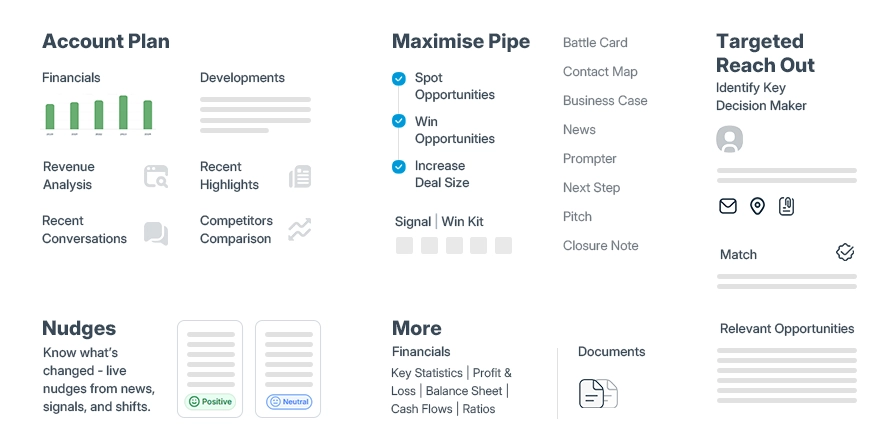
SalesPlay's Account Intelligence Agent provides the foundation for this approach by consolidating everything that matters about an account in one view: financial data, business developments, recent conversations, opportunity signals, and buying center composition.
When your nurture campaigns reference account-level context rather than generic lead attributes, buyers recognize you understand their world. That recognition drives engagement.
Generic relationship-building emails don't build relationships. They get ignored. Effective sales follow-up emails connect to concrete opportunities inside the account — problems you can solve, initiatives you can support, risks you can mitigate.
SalesPlay's Spot Opportunities Agent identifies these openings by analyzing account signals and matching them to your offerings. Each opportunity comes with:
When you build nurture campaigns around identified opportunities instead of abstract value propositions, every email has a reason to exist. Buyers feel the difference.
The metrics most sales teams track - emails sent, open rates, click rates - measure activity, not impact. Buyer experience improves when you measure what matters: response quality, meeting conversion, opportunity progression.
SalesPlay shifts the measurement framework by connecting nurture activity to deal outcomes. Instead of celebrating 100 emails sent with 23% open rates, teams focus on how many opportunities moved forward because of timely, relevant outreach.
This isn't anti-automation. It's pro-effectiveness. Automation should enable better outcomes, not just more outputs.
The best expert lead nurturing tactics combine automation's efficiency with human judgment at critical moments. SalesPlay operationalizes this balance:
Buyers respond positively to this approach because they experience the benefits of both: the consistency and context that automation enables, with the strategic thinking that only humans provide.
Even sophisticated sales teams make predictable errors that undermine nurture effectiveness. SalesPlay research across thousands of campaigns identifies the patterns that consistently damage buyer relationships.
Some teams treat account-based selling as an excuse to email everyone at the company. Buyers inside large organizations talk to each other. When four people in the same department receive identical sales emails from your team, it signals desperation, not strategy.
Effective B2B lead nurturing requires coordination across a buying center, not saturation. SalesPlay prevents this mistake by mapping stakeholders to relevant opportunities and ensuring message distribution makes strategic sense.
Many nurture campaigns front-load personalization in the opening email, then default to generic templates for all follow-ups. Buyers notice. If your first email demonstrated account knowledge but subsequent messages ignore recent developments, you've signaled that the initial personalization was performative.
SalesPlay's continuous account monitoring ensures every email in a nurture sequence reflects current account context, not just the context from when you started the campaign.
The worst sales follow-up emails are those that add nothing: "Just checking in..." or "Wanted to bump this up in your inbox..." These emails train buyers to ignore you.
Every nurture touch should introduce new information, new context, or new relevance. If you don't have something meaningful to add, don't send the email. SalesPlay's approach ensures each message connects to either a new signal, a new angle on the opportunity, or new supporting evidence for the value proposition.
A follow-up email about pricing and implementation details sent to a prospect still exploring the problem space creates friction. Similarly, high-level vision content sent to a buyer deep in vendor evaluation feels disconnected.
SalesPlay's Win Opportunities Agent stages messaging appropriately by tracking where each opportunity sits in progression and adjusting talking points, questions, and next steps accordingly.
The gap between knowing what works and actually doing it at scale is where most revenue strategies break down. SalesPlay by MarketsandMarkets solves the operational challenge, not just the conceptual one.
Remember the math from earlier: 344 account reviews per month per rep, requiring 114 hours before writing any emails. SalesPlay collapses that timeline to minutes.
The Account Intelligence Agent continuously monitors connected accounts, consolidating all relevant context in a single view. When a seller opens an account, they immediately see:
No manual research required. No jumping between tools. No outdated notes. The intelligence layer updates continuously as accounts move, ensuring context stays current without seller effort.
Here's the real workflow sales teams follow when running nurture campaigns through SalesPlay:
Step 1: Identify Opportunities
The Spot Opportunities Agent surfaces relevant opportunities inside target accounts, ranked by strength of signal. Sellers review these opportunities, decide which to pursue, and push selected opportunities into Win mode.
Step 2: Map Buying Centers
For each opportunity, the Spot Contacts Agent identifies relevant stakeholders. Sellers see who matters for this specific opportunity and why, eliminating guesswork about who to engage.
Step 3: Configure Nurture Campaign
Sellers select contacts for the campaign, choose the number of touches, and set timing intervals. SalesPlay drafts every email with opportunity-specific and person-specific context.
Step 4: Review and Approve
Before any email sends, sellers review generated content. They can edit, adjust, or regenerate messages. This ensures human judgment stays in the loop while eliminating the blank-page problem.
Step 5: Campaign Execution
Once approved, SalesPlay runs the campaign automatically, sending personalized emails at defined intervals while continuing to monitor account signals that might warrant message adjustments.
The workflow takes minutes to set up. The alternative - manually researching accounts, writing custom emails, tracking send schedules, and monitoring for trigger events — consumes hours per deal.
The right metrics change behavior. The wrong metrics create theater. For sales follow-up emails and nurture campaigns, most teams measure the wrong things.
Activity metrics (emails sent, open rates, click rates) tell you what happened. Impact metrics (response quality, meeting conversion, pipeline velocity, deal size) tell you whether it mattered.
SalesPlay by MarketsandMarkets shifts focus toward impact by connecting nurture activity to opportunity outcomes:
These metrics surface what's working and what isn't at the tactical level, enabling continuous improvement without guesswork.
Traditional sales analytics focus on individual rep performance. But buyer experience happens at the account level, which often involves multiple sellers, multiple touchpoints, and multiple messages.
SalesPlay provides account-level visibility that reveals coordination gaps: duplicate outreach, message inconsistency, signal timing misses. Fixing these issues improves buyer experience more than optimizing individual email templates.
The ultimate measure of nurture effectiveness isn't conversion on the current opportunity. It's whether buyers engage with you again on future opportunities. Aggressive, poorly-timed, or generic nurture campaigns may convert once but destroy long-term relationships.
SalesPlay's approach prioritizes sustainable engagement: relevance over volume, timing over persistence, and value over pressure. This builds account relationships that compound over years, not quarters.
SalesPlay by MarketsandMarkets isn't a point solution for email automation. It's a revenue intelligence platform that makes account-aware selling operationally feasible at scale. Nurture campaigns improve as a natural consequence of better account intelligence, not because of better email templates.
After implementing SalesPlay for nurture campaigns, revenue leaders report consistent patterns:
Many tools automate emails. SalesPlay automates the intelligence work that makes those emails valuable. The platform continuously monitors accounts, detects signals, identifies opportunities, maps buying centers, and generates context-aware messaging - all before you write a single word.
This integrated approach solves the operational challenge that fragments most sales tech stacks: research tools disconnected from engagement tools, data platforms disconnected from CRM, signal detection disconnected from messaging. SalesPlay connects all of it, creating a unified system where account intelligence flows directly into action.
The disconnect between how sales teams send nurture emails and how buyers experience them isn't a messaging problem. It's an intelligence problem. Buyers don't reject follow-ups because they don't want to buy. They reject follow-ups that demonstrate the seller isn't paying attention to their world.
Closing that gap at scale requires operational capability most teams don't have: continuous account monitoring, signal detection, opportunity identification, buying center mapping, and context-aware messaging generation. Attempting this manually creates bottlenecks. Attempting it with disconnected tools creates fragmentation.
SalesPlay by MarketsandMarkets solves the operational challenge by automating the intelligence layer while maintaining human judgment at decision points. The result: nurture campaigns that scale without sacrificing the relevance buyers demand.
Expert lead nurturing tactics in 2026 aren't about better email templates. They're about better account intelligence, better timing, and better alignment between what you know and what you send. That's what SalesPlay delivers.
Buyers report three primary issues with sales follow-up emails: lack of account-specific context (68% say emails feel automated rather than personalized), poor timing disconnected from business signals (73% can identify template messaging within three sentences), and generic value propositions that don't address their specific business situation. The problem isn't frequency-it's relevance. Buyers don't reject nurture campaigns; they reject campaigns that waste their time by demonstrating the seller isn't paying attention to their actual business context.
SalesPlay transforms nurture campaigns through its Auto-Nurture Agent, which automatically drafts personalized emails using continuous account intelligence. The platform monitors target accounts for business developments, financial changes, and relevant signals, then generates messaging that reflects current account context. Each email is customized by opportunity and individual recipient role, ensuring relevance without manual research. SalesPlay also enables signal-triggered engagement rather than calendar-based sequences, so follow-ups arrive when accounts are actually moving, not just when your cadence says to send another email.
Expert lead nurturing tactics in 2026 focus on account intelligence over email volume. Best practices include: building nurture around accounts rather than isolated leads, connecting every email to specific opportunities identified through signal analysis, triggering outreach based on business developments rather than fixed schedules, maintaining multi-stakeholder consistency without message fragmentation, and measuring engagement quality instead of just activity metrics. The key shift is from template-based automation to intelligence-based personalization, where continuous account monitoring informs every touchpoint.
Account intelligence eliminates the research bottleneck that forces sales teams to choose between scale and personalization. With continuous monitoring of financial data, business developments, leadership changes, and market signals, account intelligence platforms like SalesPlay enable nurture campaigns that stay relevant as accounts evolve. Instead of spending hours manually researching each account before every follow-up, sellers access consolidated account views that update automatically. This allows nurture messaging to reference current business context, connect to specific opportunities, and engage the right stakeholders at the right time-at scale.
Effective nurture measurement shifts from activity metrics to impact metrics. Instead of focusing solely on emails sent, open rates, and click rates, revenue leaders should track: opportunity progression rate (how many nurtured opportunities advance stages compared to dormant ones), response quality (substantive replies vs. brush-offs), meeting conversion (nurture touches resulting in scheduled conversations), and time-to-engagement (response speed for signal-triggered outreach vs. generic cadences). Account-level metrics also matter: coordination across buying centers, message consistency, and relationship health over time. These metrics reveal whether nurture campaigns improve buyer experience and accelerate deals, not just whether emails get opened.
SalesPlay's Auto-Nurture Agent allows sellers to select opportunities, choose contacts within target accounts, and define campaign parameters (number of touches, timing intervals). The Agent then drafts every email with account-specific context from continuous monitoring, personalizes messaging by both opportunity and individual role, ensures variety across touches to avoid repetitive patterns, and adapts automatically when account signals shift. Sellers review and approve messages before they send, maintaining human judgment while eliminating the blank-page problem. The workflow takes minutes to configure compared to hours of manual research, writing, and coordination required for traditional nurture campaigns.
See how SalesPlay's account intelligence changes everything about B2B lead nurturing.
🎯 Request Your Demo Today

Category: Uncategorized Tags: ai, AIOps, Artificial Intelligence, cloud, cloud platform, Cybersecurity, Information and Communications Technology , VR