Most revenue leaders face a paradox. Board demands are climbing. Quotas keep expanding. Yet hiring freezes lock teams at current capacity. The predictable response—work harder, move faster, add more tools—leads straight to burnout without meaningfully changing pipeline coverage. But here's what few executives grasp: your existing accounts already contain untapped revenue waiting to be discovered. Not through aggressive upselling or spray-and-pray outreach. Through intelligent, systematic identification of opportunities that already exist inside accounts you've already won. The constraint isn't headcount. It's visibility. When sellers can't see what's changing inside their accounts, they can't act on the moments that matter. They research manually. They guess at timing. They miss expansion signals until competitors surface them first. The path forward isn't more bodies. It's more intelligence applied to the accounts you already own. Pipeline generation from existing accounts becomes predictable when teams replace reactive selling with proactive opportunity detection powered by real-time business context.
Why Traditional Account Expansion Fails at Scale
Account managers know their portfolios carry expansion potential. Every strategic account review surfaces possibilities for deeper penetration, additional products, new business units. Yet these same accounts consistently underperform revenue targets. The breakdown happens at execution, not strategy. Traditional approaches to pipeline generation from existing accounts collapse under three fundamental constraints that no amount of willpower overcomes.
First, account managers operate with incomplete context. They inherit tribal knowledge from previous owners, scan outdated account plans, and manually piece together intelligence from fragmented sources. LinkedIn for org charts. News sites for business developments. CRM notes that may or may not reflect current reality. By the time they assemble a coherent picture, the account has moved. Budget priorities shift. Stakeholders change roles. Strategic initiatives launch or die. What looked like opportunity last quarter becomes irrelevant this week, and sellers discover this only after investing hours in research and outreach that goes nowhere.
Second, opportunity identification depends on pattern recognition that human sellers can't scale. Experienced account managers develop intuition for expansion signals. They notice when hiring accelerates in relevant departments. They connect regulatory changes to budget allocation. They recognize when customer pain points align with additional products. But this expertise lives in individual heads, applies inconsistently across teams, and breaks down entirely when account portfolios exceed human capacity to monitor continuously. The best sellers become bottlenecks. The rest guess. Neither scales.
Third, prioritization without data becomes political theater rather than revenue optimization. Which accounts deserve focus this quarter? Which opportunities warrant investment? These decisions default to whoever makes the loudest case in pipeline reviews rather than which signals indicate genuine buying readiness. Sales leaders lack the granular intelligence to separate real opportunity from wishful thinking, so they default to activity metrics that measure effort rather than probability. Calls made. Emails sent. Meetings held. All trackable. None predictive. The result: teams work hard on the wrong accounts while high-probability expansion opportunities sit undetected in accounts no one thought to investigate.
The Revenue Intelligence Approach to Enterprise Pipeline Growth
Revenue intelligence platforms fundamentally change how teams identify and pursue expansion inside existing accounts. Rather than relying on periodic manual research, these systems continuously monitor target accounts for business changes that create buying opportunities. Financial results. Leadership transitions. Strategic announcements. Technology investments. Competitive movements. Every signal gets captured, connected to your offerings, and surfaced when it becomes actionable. This isn't predictive analytics guessing about future behavior. It's real-time detection of what's already happening inside accounts you already own.
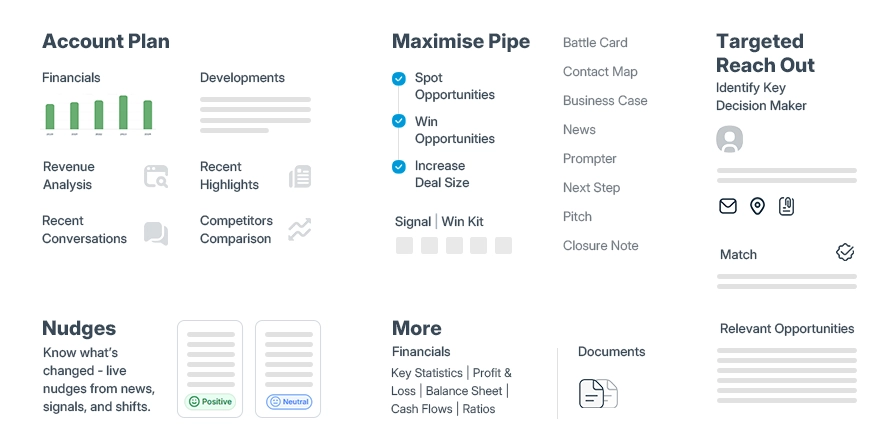
The operational shift moves from reactive to systematic. Instead of sellers asking "what should I research this week?" the platform answers "here's what changed in your accounts that creates opportunity right now." Account managers see consolidated intelligence in a single view. Five-year revenue history showing growth trajectory and investment capacity. Recent business developments contextualized against their product portfolio. Buying center identification that maps decision-makers to specific opportunities. Messaging frameworks that connect account priorities to value propositions. Everything needed to move from research to action without jumping between tools or manually synthesizing disparate data sources.
What makes this approach scale isn't just automation. It's the systematic connection between business movement and selling motion. When a target account announces expansion into a new geographic market, revenue intelligence doesn't just flag the news. It identifies which products support geographic expansion. It surfaces relevant customer stories from similar situations. It locates the stakeholders responsible for expansion decisions. It drafts initial outreach that references the specific business context. The seller reviews, refines, and executes rather than starting from blank pages. This compression of time from signal to action transforms how many opportunities teams can pursue simultaneously without proportional headcount increases.
For enterprise pipeline growth, the compounding advantage comes from visibility into account movements that traditional selling misses entirely. Most expansion conversations start when sellers notice obvious signals—renewal coming up, usage metrics climbing, stakeholder reaching out. These represent a fraction of actual opportunity. The majority of expansion potential hides in business changes that don't trigger automatic alerts. Department reorganizations that create new budget lines. Technology roadmap shifts that obsolete current solutions. Competitive vulnerabilities that open doors for displacement. Regulatory pressures that accelerate buying timelines. Revenue intelligence surfaces these hidden signals continuously, expanding the aperture of what teams can see and therefore what they can sell.
Account Expansion Strategy: From Signal to Closed Deal
Effective account expansion strategy starts with opportunity detection, not opportunity creation. The accounts you already serve are making business decisions daily that intersect with your capabilities. New initiatives launch. Priorities shift. Problems surface. Your expansion success depends entirely on whether you identify these moments before competitors do and respond with relevant, timely engagement that connects their business reality to your solutions. This requires replacing periodic account planning with continuous account monitoring that tracks what matters and filters what doesn't.
Continuous Account Monitoring Beats Periodic Planning
Traditional account planning happens quarterly at best. Teams gather stakeholders, review opportunities, build expansion roadmaps. By the time the plan reaches sellers, half the intelligence is stale. Account contexts change faster than planning cycles update. The alternative: continuous monitoring systems that watch accounts the way sellers would if they had unlimited time. Every earnings call. Every press release. Every leadership announcement. Every technology investment. The system processes signals continuously, categorizes them by relevance to your offerings, and surfaces opportunities ranked by probability and timing. Account managers get dynamic intelligence that updates as accounts move rather than static plans that age poorly.
Opportunity Scoring That Reflects Business Reality
Not every signal indicates real opportunity. Revenue intelligence platforms distinguish between noise and signal by connecting business movements to buying behavior patterns. When an account announces leadership transition, the system doesn't just flag it. It analyzes whether similar transitions historically preceded buying activity. It evaluates whether the new leader's background suggests strategic shifts that align with your solutions. It scores opportunity probability based on multiple correlated signals rather than single data points. This multi-dimensional scoring prevents teams from chasing every headline while ensuring genuinely high-probability opportunities receive appropriate attention and resources.
Automated Buying Center Identification
Expansion selling fails when teams contact the wrong people. Even with solid opportunity identification, reaching out to stakeholders without buying authority or budget control wastes everyone's time. Modern account expansion strategy includes automated buying center mapping that identifies decision-makers for specific opportunities. The system doesn't just pull job titles from LinkedIn. It analyzes organizational structure, maps functional responsibilities to opportunity types, and surfaces the individuals who actually control budget and decisions for the specific capability you're selling. Account managers see not just who to contact, but why each person matters to this particular opportunity and what message will resonate based on their role and priorities.
Contextual Messaging That Demonstrates Business Understanding
Generic outreach fails in expansion selling because existing customers have higher expectations. They've already bought from you once. They expect you to understand their business, recognize their priorities, and connect your capabilities to their specific context. Revenue intelligence enables this by generating contextual messaging frameworks automatically. For each identified opportunity, sellers receive battle cards that explain why this opportunity exists, what business drivers created it, which product capabilities address it, and how to position value in language that resonates with this account's situation. This isn't mail merge personalization. It's genuine business context that proves you're paying attention to what matters to them right now.
Implementing Pipeline Generation Without Resource Expansion
The primary objection to systematic pipeline generation from existing accounts centers on bandwidth. Account managers already carry full portfolios. Adding expansion motion seems like piling more work onto already-maxed capacity. But this misses the essential insight: properly implemented revenue intelligence doesn't add work. It eliminates low-value activities that consume seller time without producing proportional results. Manual research. Contact hunting. Message drafting. Meeting preparation. These tasks don't disappear, but they compress dramatically when intelligence platforms handle the heavy lifting.
Time Compression Through Intelligent Automation
Consider the traditional process for identifying a single expansion opportunity. Sellers research account news, analyze financial reports, map organizational changes, identify relevant contacts, develop messaging hypotheses, draft outreach, and prepare for conversations. Even efficient sellers spend hours per opportunity. Scale this across a portfolio of strategic accounts, and capacity constraints become obvious. Revenue intelligence compresses this timeline by 90% or more. The system continuously monitors accounts, identifies opportunities, scores them by probability, surfaces relevant contacts, and drafts contextual messaging. Sellers invest minutes reviewing and refining rather than hours researching and building from scratch. This time compression is what enables the same team to pursue meaningfully more opportunities without proportional headcount increases.
Focus on Highest-Probability Opportunities
Without systematic prioritization, account managers spread effort evenly across portfolios or chase whichever opportunity feels hottest this week. Revenue intelligence introduces discipline by ranking opportunities based on actual buying signals rather than gut feel. Accounts showing multiple correlated signals—leadership changes plus technology investments plus strategic announcements—receive higher priority than accounts with single, weak indicators. This prevents teams from wasting cycles on low-probability situations while ensuring high-probability opportunities receive appropriate attention. The same headcount produces better results because focus aligns with genuine readiness rather than distributed equally across all accounts regardless of actual expansion potential.
Consistent Execution Across Teams
Top performers have always known how to work existing accounts effectively. They build deep relationships. They stay current on account developments. They connect business changes to expansion opportunities. But this excellence doesn't scale because it depends on individual capability rather than systematic process. Revenue intelligence democratizes best practices by embedding them in platform workflows. Every account manager sees the same quality intelligence. Everyone receives the same contextual messaging frameworks. Everyone benefits from the same continuous monitoring. Performance variance narrows because execution quality no longer depends entirely on individual skill and experience. Average performers improve significantly. Top performers maintain their edge while handling larger portfolios. The overall result: better enterprise pipeline growth from the same team size.
Real-World Application: Turning Intelligence Into Revenue
Understanding the concept of pipeline generation from existing accounts matters less than seeing how it operates in practice. The transition from theory to execution reveals where platforms add genuine value versus where they simply digitize existing inefficiency. Successful implementations share common patterns: they start with account intelligence that updates continuously, they surface opportunities that align with current business context, they provide execution frameworks that compress time-to-action, and they measure outcomes that matter rather than activity that's easy to track.
Scenario: Detecting Budget Reallocation Signals
An enterprise software company serves a Fortune 500 financial services firm. Current deployment covers risk management in one business unit. The account has sat stable for eighteen months—no contraction, no expansion, no particular engagement beyond renewal cycles. Traditional account management would classify this as "maintain and protect" rather than "grow." Revenue intelligence tells a different story. The platform detects the account's recent announcement of a digital transformation initiative spanning multiple business units. It identifies strategic hires in departments that don't currently use the company's software. It connects these signals to historical patterns showing that similar transformations preceded enterprise-wide deployment expansions. Opportunity score: high probability. The system surfaces the relevant buying center, generates messaging that connects the transformation initiative to proven value from the existing deployment, and drafts outreach positioning expansion as de-risking transformation rather than selling additional software. The account manager reviews the intelligence, refines the message, and engages. Total time from signal detection to qualified conversation: three days. Traditional approach would have missed this entirely or discovered it months later when the account was already evaluating competitors.
Scenario: Competitive Displacement Opportunity
A SaaS company maintains relationships with mid-market accounts across multiple verticals. One account currently uses a competitor's solution for half their organization while using this company's product for the other half. The split deployment has persisted for years with no particular urgency to consolidate. Revenue intelligence surfaces a pattern: the competitor experienced a significant service outage affecting multiple customers including this account. Social listening detects frustration from stakeholders at the account. The platform identifies this as a displacement opportunity, scores it high-priority, and generates a battle card explaining how to position consolidation as solving reliability concerns rather than opportunistic sales pitch. It locates the technical decision-maker who experienced the outage directly and drafts empathetic outreach that acknowledges the challenge and offers to discuss how full migration could improve consistency. The account manager executes within hours of the outage rather than waiting weeks to hear about it secondhand. This speed and relevance convert what might have been a missed opportunity into a qualified expansion conversation specifically because intelligence surfaced the signal and provided context-appropriate response frameworks immediately.
Measuring What Matters: Pipeline Quality Over Activity Volume
Implementation success depends on measuring outcomes rather than outputs. Traditional metrics track activity: number of accounts researched, opportunities identified, contacts engaged, meetings held. These measure effort without measuring effectiveness. Revenue intelligence shifts focus to quality indicators: what percentage of identified opportunities advance to qualified pipeline? How many progress to closed-won? What's the average deal size compared to initial deployment? How does win rate compare between intelligence-surfaced opportunities versus seller-sourced opportunities? These metrics reveal whether the platform actually improves account expansion strategy execution or simply automates busy work without changing results. Successful teams obsess over conversion rates and deal velocity rather than activity counts, because these reflect whether intelligence creates genuine advantage or just digitizes existing inefficiency.
Common Pitfalls and How to Avoid Them
Revenue intelligence platforms promise efficiency gains that seem almost too good to be true: same team, more pipeline, less manual work. The technology delivers on these promises when implemented thoughtfully. It fails spectacularly when treated as plug-and-play automation that requires no process change or seller adoption. The difference between success and expensive disappointment comes down to avoiding predictable implementation mistakes that undermine platform value before teams discover what's actually possible.
Pitfall: Treating Intelligence as Optional Enhancement
The most common failure pattern: companies implement revenue intelligence but leave it optional for account managers to use. Sellers continue working their portfolios the way they always have. The platform sits unused because accessing it requires changing comfortable habits. Intelligence becomes a nice-to-have rather than the primary workflow. Fix this by making platform usage mandatory for opportunity identification and pipeline reviews. If an opportunity isn't in the system, it doesn't get discussed in forecast calls. This forces adoption and ensures teams actually benefit from the intelligence they're paying for. Half-adopted tools deliver zero value. Full adoption transforms how teams operate and what results they produce.
Pitfall: Ignoring Data Quality at Account Level
Revenue intelligence depends on accurate CRM data to function effectively. When account records contain outdated contacts, incorrect ownership assignments, or incomplete firmographic details, the platform can't surface relevant opportunities to the right people at the right time. Implementation requires CRM hygiene as a prerequisite, not an eventual goal. Clean up account data before rolling out intelligence capabilities. Establish data quality standards and hold teams accountable for maintaining accuracy. This foundational work isn't glamorous, but it determines whether intelligence flows to sellers who can act on it or disappears into inboxes no one monitors because routing depends on data that's fundamentally wrong.
Pitfall: Overwhelming Teams with Undifferentiated Signals
Early implementations often make the mistake of surfacing every signal the platform detects rather than filtering for genuine relevance. Account managers receive dozens of notifications daily about news mentions, website changes, hiring posts, and other developments that may or may not indicate real opportunity. This flood of information creates alert fatigue. Sellers start ignoring notifications because separating signal from noise requires too much effort. The fix: aggressive filtering based on opportunity scoring. Only surface signals that meet meaningful probability thresholds. Start conservative and expand gradually rather than overwhelming teams immediately. Better to surface ten high-quality opportunities per week that sellers actually pursue than fifty notifications per day that everyone learns to ignore. Effective revenue intelligence is about precision, not volume.
Pitfall: Neglecting Seller Enablement and Training
Technology alone doesn't change outcomes. Sellers need to understand not just how to use the platform, but why it matters and how it fits their workflow. Without proper enablement, account managers view intelligence tools as additional burden rather than time-saving capability. They don't trust the opportunity scores. They ignore the suggested messaging. They stick with familiar approaches rather than adopting new workflows. Address this through comprehensive enablement that demonstrates clear value. Show concrete examples of opportunities the platform surfaced that sellers would have missed. Prove the time savings through side-by-side comparisons. Celebrate early wins from teams using intelligence effectively. Make it obvious that adopting these tools makes their jobs easier and their results better rather than adding complexity without clear benefit.
The Compounding Advantage of Systematic Account Intelligence
Short-term benefits of pipeline generation from existing accounts are measurable and meaningful. Teams identify more opportunities. They engage faster. They close deals they would have missed. But the real advantage compounds over time in ways that aren't immediately obvious. Every opportunity surfaced teaches the system more about what predicts buying behavior in your accounts. Every conversation adds context that improves future opportunity scoring. Every closed deal refines messaging frameworks that accelerate subsequent executions. The platform becomes progressively more valuable the longer you use it because intelligence accumulates and accuracy improves based on your specific patterns.
This learning effect separates sustained competitive advantage from temporary efficiency gains. Competitors can implement similar technology. They can't replicate the institutional knowledge embedded in systems that have monitored your accounts, tracked your opportunities, and learned your patterns for months or years. Your platform knows which signals matter most for your specific offerings. It understands which buying centers typically control decisions in your target accounts. It recognizes patterns between business movements and expansion readiness that only emerge across hundreds of interactions. This accumulated intelligence creates moats that widen over time rather than commoditize as more vendors adopt similar technology.
The strategic implication: early adoption matters more than perfect implementation. Teams that start building this intelligence advantage now, even imperfectly, will develop institutional knowledge that late adopters can't quickly replicate. The accounts you monitor continuously become better understood. The opportunities you identify and pursue generate data that improves future identification. The messaging that works gets codified and reused rather than rediscovered repeatedly. This compounds into differentiation that shows up as persistently better enterprise pipeline growth from existing accounts compared to competitors still relying on periodic planning and manual research. The technology enables the advantage, but the compounding comes from consistent application over time that builds knowledge that can't be purchased or implemented overnight.
Integration with Existing Sales Motion
Revenue intelligence platforms don't replace existing sales processes. They augment them by eliminating information gaps that undermine execution. The goal isn't to rip out current workflows and install completely new systems. It's to embed intelligence into existing motions at points where sellers currently struggle with incomplete context or manual research that consumes disproportionate time. Successful integration feels less like learning new software and more like suddenly having answers to questions that previously required hours of investigation.
Pipeline Review Enhancement
Traditional pipeline reviews depend on seller-provided context that may or may not reflect current account reality. Account managers report their assessment of opportunity probability, expected close dates, and next steps. Sales leaders ask probing questions, but their ability to challenge assumptions depends entirely on their independent knowledge of these accounts. Revenue intelligence changes this dynamic by providing objective account context that everyone can see. When discussing an expansion opportunity, leaders see the same business signals that triggered opportunity identification. They review the same buying center analysis. They evaluate the same competitive context. This shared intelligence makes pipeline reviews more substantive because conversations focus on strategy rather than validating basic account facts that should already be known.
Account Planning Acceleration
Strategic account planning typically requires significant time investment to research account priorities, map organizational structures, identify opportunities, and develop engagement strategies. Revenue intelligence compresses this timeline dramatically by pre-populating account plans with current business context, opportunity identification, and recommended approaches. Account managers start from 70% complete rather than blank templates. They spend time refining strategies rather than gathering basic intelligence. This acceleration doesn't just save time. It improves plan quality because the foundation comes from systematic monitoring rather than periodic research that inevitably misses developments between planning cycles. Plans stay current because underlying intelligence updates continuously rather than aging immediately after creation.
Meeting Preparation Efficiency
Sellers meeting with existing customers should demonstrate deep understanding of their business, their priorities, and how your solutions create value in their specific context. Achieving this traditionally requires hours researching recent developments, reviewing past interactions, and preparing relevant talking points. Revenue intelligence provides one-page meeting briefs that consolidate everything sellers need: recent business developments relevant to the discussion, account history highlighting previous conversations and commitments, opportunity context explaining why this meeting matters, suggested discussion topics based on current account priorities, and smart questions designed to advance specific opportunities. Preparation time drops from hours to minutes while quality improves because briefs incorporate systematic intelligence rather than whatever the seller remembers or has time to research.
Measuring ROI: Beyond Pipeline Creation
Justifying investment in revenue intelligence platforms requires demonstrating value that exceeds cost. The most obvious metric—incremental pipeline generated from existing accounts—tells only part of the story. Comprehensive ROI assessment includes time savings, win rate improvement, deal velocity acceleration, and team capacity expansion. These factors compound to deliver returns that significantly exceed simple pipeline addition, but only when teams measure them systematically rather than relying on anecdotal evidence or gut feel about whether the platform helps.
Time Savings Per Opportunity
Track how long account managers spend identifying and qualifying expansion opportunities before and after platform implementation. Measure research time, contact identification time, and message development time separately. Typical implementations show 70-80% reduction in time from opportunity identification to first qualified conversation. Apply this time savings across the number of opportunities your team pursues quarterly to calculate total hours recovered. Value these hours at fully-loaded seller cost to determine direct efficiency gains. This typically justifies platform investment within first quarter for teams managing significant account portfolios, before considering any pipeline quality improvements or win rate changes.
Pipeline Quality Improvement
Not all pipeline is created equal. Opportunities identified through systematic intelligence monitoring typically demonstrate higher win rates and faster close times compared to seller-sourced opportunities. Measure conversion rates from identified opportunity to closed-won separately for intelligence-generated versus traditional pipeline. Track average deal size and sales cycle duration for each category. The difference represents quality improvement attributable to better opportunity selection and timing enabled by continuous account monitoring. Teams consistently see 15-25% higher win rates on intelligence-sourced opportunities because the platform surfaces situations where buying signals are genuine rather than opportunities sellers manufacture through persistent outreach.
Account Coverage Expansion
Before revenue intelligence, account manager capacity limited how many strategic accounts received active expansion attention. Most accounts got reactive service while a subset received proactive development. Continuous monitoring removes this constraint by scaling attention across entire portfolios. Every account gets monitored for expansion signals regardless of whether a human has bandwidth to research them manually. Measure what percentage of your account base showed active expansion motion before and after implementation. The increase represents previously-ignored opportunity now being systematically captured and pursued. For most organizations, this coverage expansion reveals that 40-50% of accounts contain actionable opportunities at any given time, but only 20-30% received attention under capacity-constrained manual approaches.
Future-Proofing Your Account Expansion Motion
Market dynamics continue accelerating. Buying committees expand. Decision cycles compress. Competitive alternatives proliferate. The approaches that drove account expansion strategy success five years ago underperform today because account complexity and buying process sophistication have evolved faster than sales methodologies adapted. Looking forward, the gap will widen between teams operating with systematic intelligence and teams relying on periodic planning with manual research. The question isn't whether to adopt these capabilities. It's whether to build competitive advantage now or play catch-up later when institutional knowledge gaps become harder to close.
Several trends accelerate the urgency for systematic approach to pipeline generation from existing accounts. First, account buying centers continue fragmenting. Individual stakeholders no longer make unilateral decisions even for departmental purchases. Every opportunity involves multiple influencers across functions. Tracking these relationships manually exceeds human capacity at scale. Platforms that map buying centers automatically and update them as organizations change become essential infrastructure rather than nice-to-have enhancement. Second, business contexts change faster. Technology shifts create new problems that demand new solutions. Regulatory changes alter budget priorities overnight. Competitive movements open or close windows unexpectedly. Sellers can't monitor these developments across portfolios without systematic intelligence that surfaces relevant changes immediately rather than waiting for quarterly account reviews.
Third, personalization expectations climb. Existing customers expect you to know their business deeply because you already serve them. Generic outreach feels lazy or disrespectful. Demonstrating genuine understanding requires connecting your message to specific account context—their recent announcements, their strategic priorities, their current challenges. Achieving this manually limits how many accounts receive appropriate attention. Platforms that generate contextually-relevant messaging automatically scale personalization across entire portfolios rather than restricting it to handful of top accounts that receive white-glove treatment while others get generic templates.
The compound effect of these trends: traditional account expansion motion breaks down under complexity that exceeds manual process capacity. Teams that continue operating periodically with manual research will progressively underperform against teams operating continuously with systematic intelligence. This performance gap will widen over time as the latter group accumulates institutional knowledge and refines execution while the former group struggles with growing account complexity using approaches that don't scale. The window for building competitive advantage through early adoption remains open, but narrows as more organizations recognize that enterprise pipeline growth from existing accounts depends on capabilities that manual processes fundamentally can't deliver regardless of effort or skill.
From Headcount Constraints to Intelligence Advantage
The central insight transforming pipeline generation from existing accounts is simple but profound: your constraint isn't people, it's information. Account managers can't pursue opportunities they don't know exist. They can't engage stakeholders they haven't identified. They can't craft relevant messages without understanding current account context. Adding more sellers doesn't solve these problems—it just distributes the same information gaps across a larger team. The breakthrough comes from eliminating information gaps through systematic intelligence that monitors accounts continuously, identifies opportunities automatically, and provides execution frameworks that compress time from signal to action.
Implementation requires shifting from periodic planning to continuous monitoring, from manual research to automated intelligence, and from gut-feel prioritization to data-driven opportunity scoring. These changes feel significant because they challenge comfortable habits built over years or decades of traditional account management. But the alternative—continuing to operate with periodic planning and manual research while account complexity accelerates and competitive intensity increases—guarantees progressively worse results from the same effort. Teams that embrace systematic intelligence gain compounding advantages that manifest as better pipeline quality, higher win rates, faster deal velocity, and expanded account coverage, all without proportional headcount increases.
The path forward starts with honest assessment of your current approach. How much time do account managers spend manually researching accounts versus engaging with genuine opportunities? What percentage of your account base receives active expansion attention versus reactive service? How many expansion opportunities do you miss because sellers don't have visibility into what's changing across portfolios? If these questions reveal gaps between ideal and actual performance, revenue intelligence platforms offer specific solutions to specific problems rather than vague promises of AI-powered improvement. The technology works when applied thoughtfully to real constraints. It fails when treated as magic automation that requires no process change or adoption effort.
Start small. Pick a segment of strategic accounts. Implement systematic monitoring. Measure time savings and pipeline quality improvements against control groups using traditional approaches. Let data prove or disprove whether this delivers meaningful advantage for your specific situation. Most teams discover that results exceed expectations because the gap between what sellers could know about their accounts and what they actually know is larger than anyone realized. Closing this gap doesn't require doubling headcount. It requires applying intelligence systematically to accounts you already own, opportunities that already exist, and moments that are already happening—you're just not seeing them fast enough to act. Fix the visibility problem, and pipeline generation transforms from capacity-constrained grind to systematic execution that scales with intelligence rather than bodies.
See Revenue Intelligence in Action
SalesPlay provides the revenue intelligence capabilities enterprise sales teams need to generate predictable pipeline from existing accounts without adding headcount. Our platform continuously monitors your target accounts, identifies expansion opportunities as they emerge, and provides execution frameworks that compress time from signal to closed deal. We eliminate the manual research and guesswork that constrains account expansion while surfacing opportunities your team would otherwise miss.
Book Demo Now to see how SalesPlay transforms account intelligence into revenue growth.
Frequently Asked Questions
How can I generate more pipeline from existing accounts without hiring more salespeople?
Generate more pipeline by implementing revenue intelligence platforms that continuously monitor your existing accounts for expansion signals. These systems track business changes, identify opportunities automatically, and provide execution frameworks that compress research time by 70-80%. Your current team can pursue significantly more opportunities because they spend minutes reviewing intelligence rather than hours manually researching each account. Focus shifts from capacity constraints to systematic opportunity detection across your entire account portfolio.
What is revenue intelligence and how does it help with account expansion?
Revenue intelligence platforms continuously monitor target accounts for business changes that create buying opportunities—financial results, leadership transitions, strategic announcements, technology investments, and competitive movements. Rather than relying on periodic manual research, these systems detect what is happening inside your accounts in real-time, connect business movements to your offerings, score opportunities by probability, and surface them when they become actionable. This systematic approach reveals expansion potential that traditional account management misses entirely.
How much time does revenue intelligence actually save account managers?
Typical implementations show 70-80% reduction in time from opportunity identification to first qualified conversation. Tasks that previously required hours—account research, contact identification, message development, meeting preparation—compress to minutes because intelligence platforms handle the heavy lifting. Account managers review and refine rather than build from scratch. This time compression enables the same team to pursue 3-5x more opportunities without proportional headcount increases while maintaining or improving engagement quality.
What types of signals indicate expansion opportunities in existing accounts?
High-probability expansion signals include: leadership transitions that suggest strategic shifts, department hiring accelerations indicating budget availability, technology roadmap changes creating solution gaps, competitive vulnerabilities opening displacement opportunities, geographic expansions requiring additional capabilities, regulatory changes accelerating buying timelines, and financial results showing investment capacity. Revenue intelligence platforms track these signals continuously, correlate multiple indicators to score opportunity probability, and surface combinations that historically preceded buying activity in similar accounts.
How do I identify the right contacts for expansion opportunities?
Modern account expansion strategy includes automated buying center mapping that identifies decision-makers for specific opportunities. These systems analyze organizational structure, map functional responsibilities to opportunity types, and surface individuals who control budget and decisions for the specific capability you are selling. You see not just job titles, but why each person matters to this particular opportunity, what message will resonate based on their role and priorities, and how they connect to the broader buying committee.
What is the typical win rate improvement when using revenue intelligence?
Teams consistently see 15-25% higher win rates on intelligence-sourced opportunities compared to seller-sourced pipeline. This improvement comes from better opportunity selection and timing—the platform surfaces situations where buying signals are genuine rather than opportunities manufactured through persistent outreach. Additionally, contextual messaging frameworks demonstrate business understanding that resonates with existing customers who expect you to know their priorities and connect your capabilities to their specific situation.
Can small teams really manage more accounts with revenue intelligence?
Yes. Before revenue intelligence, account manager capacity limited how many strategic accounts received active expansion attention. Most accounts got reactive service while a subset received proactive development. Continuous monitoring removes this constraint by scaling attention across entire portfolios. Every account gets monitored for expansion signals regardless of whether a human has bandwidth to research them manually. Most organizations discover that 40-50% of accounts contain actionable opportunities at any given time, but only 20-30% received attention under capacity-constrained manual approaches.
How long does it take to see results from implementing revenue intelligence?
Teams typically see measurable results within the first quarter. Time savings become apparent immediately as research compression is noticeable from first use. Pipeline quality improvements manifest within 60-90 days as intelligence-sourced opportunities move through sales cycles. Win rate improvements become statistically significant after 90-120 days with sufficient deal volume. The real advantage compounds over time as the system learns which signals predict buying behavior in your specific accounts, refines opportunity scoring based on your patterns, and accumulates institutional knowledge that late adopters cannot quickly replicate.
What is the difference between account expansion strategy and traditional upselling?
Traditional upselling is product-push focused—you have additional capabilities and look for accounts that might buy them. Account expansion strategy is signal-driven and contextual—you monitor what is changing inside accounts and identify opportunities where business movements create genuine need for your solutions. The former relies on seller intuition and periodic outreach. The latter uses systematic intelligence to surface moments when accounts are actually ready to buy based on their business reality, not your quota pressure. This fundamental shift improves relevance, timing, and win rates.
How does revenue intelligence integrate with our existing CRM and sales tools?
Revenue intelligence platforms augment existing workflows rather than replace them. They integrate with Salesforce and other CRMs to access account data, opportunity information, and contact records. Intelligence flows into tools sellers already use—pipeline reviews gain objective account context everyone can see, account plans pre-populate with current business intelligence, and meeting preparation briefs consolidate everything needed in one page. The goal is embedding intelligence at points where sellers currently struggle with incomplete context or manual research, not forcing adoption of completely new systems that disrupt established processes.
What are the most common mistakes when implementing revenue intelligence?
Common implementation failures include: treating intelligence as optional enhancement rather than mandatory workflow, ignoring CRM data quality prerequisites that determine routing accuracy, overwhelming teams with undifferentiated signals instead of filtering for genuine relevance, and neglecting seller enablement that demonstrates clear value. Success requires making platform usage mandatory for opportunity identification, cleaning account data before rollout, aggressive filtering based on opportunity scoring, and comprehensive training that proves time savings and result improvements through concrete examples rather than theoretical benefits.
How do I measure ROI on revenue intelligence platforms?
Comprehensive ROI assessment includes: time savings per opportunity (track hours from identification to qualified conversation before and after), pipeline quality improvement (measure win rates and deal velocity for intelligence-sourced versus traditional opportunities), and account coverage expansion (percentage of portfolio receiving active expansion attention). Time savings typically justify investment within first quarter. Win rate improvements of 15-25% and coverage expansion revealing that 40-50% of accounts contain actionable opportunities demonstrate value that significantly exceeds cost when measured systematically across these dimensions.
Does revenue intelligence work for mid-market accounts or just enterprise?
Revenue intelligence delivers value across account segments, though the specific signals and opportunity types vary. Enterprise accounts generate more public business intelligence—earnings calls, analyst coverage, press releases—that platforms monitor easily. Mid-market accounts require different signal sources—local news, industry publications, hiring patterns, technology adoption indicators. The core principle remains constant: systematic monitoring surfaces expansion opportunities that manual research misses regardless of account size. Mid-market teams often see proportionally larger impact because they have less existing infrastructure for account intelligence compared to enterprise-focused organizations.
Can revenue intelligence help with customer retention and churn prevention?
Yes. The same continuous monitoring that identifies expansion opportunities also surfaces retention risks. Leadership changes, budget cuts, competitive evaluations, usage pattern shifts, and strategic pivots all appear as signals that platform intelligence tracks. Early detection enables proactive engagement before accounts reach crisis points. Account managers see warning signs months before renewal dates and can address concerns while retention is still achievable. This risk mitigation value often justifies platform investment independently from expansion pipeline generation, as preventing churn typically delivers higher ROI than acquiring new logos.
What makes SalesPlay different from other revenue intelligence platforms?
SalesPlay focuses on revealing what is changing inside your accounts right now and connecting those changes to specific actions sellers should take. Rather than dumping data or requiring sellers to interpret signals themselves, SalesPlay provides execution-ready frameworks—battle cards, messaging, talking points, next steps—tied directly to detected opportunities. The platform answers not just 'what is happening' but 'where should I act, who should I engage, and how should I message.' This shift from intelligence delivery to execution enablement compresses time-to-action and ensures insights convert to revenue rather than sitting unused in dashboards.