Account Intelligence Tools for B2B Teams: Training & Adoption
August 29, 2025

Did you know that 78% of B2B organizations without account intelligence are essentially shooting in the dark?
Purchasing account intelligence software represents a significant investment—both financially and in terms of team adoption. But here's the thing: even the most powerful tools gather digital dust when teams don't know how to use them effectively. According to recent studies, companies waste approximately 37% of their software spend on unused or underutilized tools.
I've seen this scenario play out countless times. A company excitedly invests in a fancy new platform, has a single onboarding call, then expects magic to happen. Spoiler alert: it rarely does.
The good news? With proper training and adoption strategies, account intelligence tools can transform your B2B sales and marketing efforts. Teams using these tools effectively report 68% higher win rates and 40% larger deal sizes.
In this article, I'll walk you through everything you need to know about selecting the right account intelligence tools and—more importantly—how to ensure your team actually uses them. Let's jump in!
Ready to turn your Rep
INTO BEST PERFORMER ?
Account intelligence represents the gold standard of aggregated, high-quality marketing data that transforms how B2B teams connect with prospects and customers. Unlike traditional approaches that focus on individual leads, account intelligence takes a holistic view by combining multiple data sources to build complete pictures of target organizations.
At its fundamental level, account intelligence combines your internal (first-party) data with external (third-party) insights to create actionable intelligence about your most valuable accounts. This powerful combination removes guesswork from your sales and marketing strategies, enabling precisely targeted engagement at exactly the right moment.
The foundation of effective account intelligence rests on five critical data types:
Demographic data - Information about individual buyers and decision-makers
Firmographic data - Company-level details like size, revenue, and industry
Technographic data - Tools and technologies the account currently uses
Intent data - Signals indicating buying interest and research activities
Engagement data - How accounts interact with your content and communications
Why does this matter? In today's complex B2B buying environment, decisions rarely come from a single person. Most purchase decisions involve six to ten stakeholders, each with their own priorities and concerns. Meanwhile, sales representatives capture only about five percent of a buyer's total journey time. This limited window makes every interaction critically important.
Furthermore, manually gathering, verifying, and integrating all this data would be nearly impossible for most teams. Account intelligence platforms automate this process, creating a unified view that both sales and marketing can leverage to make informed decisions.
The strategic value of account intelligence becomes apparent through several measurable benefits. Organizations implementing account intelligence report 28% improvement in sales efficiency and 23% increase in average deal size. These improvements stem from the ability to:
Enhance personalization - Understanding an account's unique challenges allows for tailored messaging that resonates with specific decision-makers
Optimize resource allocation - Teams can focus time and energy on high-value accounts most likely to convert
Strengthen relationships - Detailed knowledge fosters meaningful interactions based on client needs and goals
Improve forecasting - Predictive insights help prioritize leads, anticipate risks, and align marketing and sales efforts
Additionally, account intelligence serves as the bridge between marketing and sales teams. By providing a single, shared view of each account, it aligns these traditionally separate departments around common objectives. This alignment ensures consistent messaging throughout the buyer journey and prevents the fragmented approach that often confuses prospects.
Without account intelligence, your go-to-market strategy relies largely on educated guesses about who might buy, what they need, and when they're ready to purchase. In contrast, with robust account intelligence, you can identify your ideal prospects with precision, understand their needs before your first conversation, and engage them with relevant content at moments of highest buying potential.
Beyond merely collecting data, effective account intelligence transforms raw information into insights that drive action. For instance, recognizing a prospect's recent business expansion might prompt an offer specifically tailored to scaling solutions, ensuring your outreach aligns perfectly with their current priorities.
In essence, account intelligence provides the clarity and focus needed to navigate today's complex B2B landscape, where buying committees, lengthy decision cycles, and information overload often create barriers to success.
Effective account intelligence relies on five distinct data types that together create a complete picture of your target accounts. Each data type serves a unique purpose in helping your team identify opportunities, personalize outreach, and close deals faster.
Demographic data focuses on individual prospects rather than companies. This information includes age, gender, job title, department, years of experience, educational background, and employment history. By collecting rich demographic details, your sales and marketing teams can create detailed buyer profiles that enable precise segmentation and personalized messaging.
Consider this the foundation for understanding the actual people behind purchase decisions. With demographic data, you can identify and prioritize relevant decision-makers at target accounts, then customize your approach based on their specific role in the buying process. For example, you might create different versions of educational content addressing the specific concerns of individual contributors versus executive-level roles.
Firmographic data is essentially demographics for organizations rather than individuals. These attributes describe business characteristics including:
Industry or vertical
Annual revenue
Number of employees
Growth rate
Geographic location
Ownership structure (public vs. private)
Years in business
Through firmographic data, your marketing team can enhance segmentation and targeting, while sales teams use this information to prioritize outreach, address objections, and tailor conversations. For instance, you could leverage firmographic insights to target accounts in specific stages of their buying journey with relevant case studies from customers in the same industry or similar size.

Technographic data reveals what software and hardware solutions your prospects currently use, how they use them, and their appetite for trying new technology. This information covers:
Customer relationship management (CRM) systems
Marketing automation platforms
Cloud hosting services
HR and recruiting software
E-learning tools
Analytics solutions
Notably, advanced account intelligence tools can even identify technologies used behind firewalls—information not readily available through basic web scraping. By understanding a prospect's tech stack, your team can identify competitive displacement opportunities, potential integration points, and technology gaps your solution might fill.
Technographic data also helps predict which solutions customers might need in the future, allowing you to develop targeted campaigns specifically around those anticipated needs.
Intent data captures online behaviors that signal a prospect's interest in products or services similar to yours. These signals include:
Website visits to product comparison pages
Downloads of industry whitepapers
Email open rates
Social media interactions
Search engine queries
This information provides critical insight into what topics, products, or services your prospects are actively researching—and their current likelihood to purchase. Intent data helps your team prioritize accounts showing genuine interest and engage them at precisely the right moment in their buying journey.
For example, if your intent data shows a prospect visited pricing pages, downloaded buying guides, and spent time reading customer reviews, you can confidently reach out with a personalized demo offer, knowing they're likely in the decision phase.
Engagement data tracks how accounts interact directly with your content and communications. This first-party data comes from sources like:
Website traffic patterns
Email engagement metrics
Campaign responses
Sales interactions
Customer support inquiries
By analyzing engagement data, you can measure which accounts are actively interacting with your business and gage interest levels across target segments. Many organizations use engagement scoring models to quantify this activity, helping prioritize accounts showing the strongest interest.
Through careful analysis of these five data types, account intelligence transforms raw information into actionable insights that guide strategic decisions and meaningful customer interactions.
Modern B2B teams face increasingly complex sales environments where every interaction matters. Account intelligence serves as the backbone that empowers these teams to work smarter and more effectively.
Account intelligence transforms how sales teams identify and pursue opportunities. By analyzing micro-behaviors and engagement patterns, sales professionals can determine which accounts deserve immediate attention. This capability enables teams to spend time on prospects most likely to convert, significantly boosting efficiency.
Account intelligence platforms assist sales teams by centralizing real-time customer data from multiple sources. These tools aggregate information, then leverage AI to identify patterns, recommend next actions, and generate comprehensive views of each contact. Consequently, sales representatives can:
Discover which accounts are worth pursuing based on engagement levels, sales history, and firmographic data
Organize leads according to predictive scoring, focusing on those most likely to convert
Allocate resources strategically to high-potential prospects while routing lower-priority leads to automated nurture tracks
Organizations using predictive account scoring see a 28% improvement in sales efficiency and a 23% increase in average deal size. Throughout the sales process, account intelligence provides crucial insights about buyer pain points, decision-making criteria, and competitive positioning—all essential elements for crafting compelling pitches.
STOP CHASING PROSPECTS
START CLOSING DEALS!!
Personalization has moved beyond simply inserting a prospect's name into an email. Account intelligence enables marketing teams to create truly customized experiences that resonate with target accounts.
With enriched CRM data, marketing teams can improve segmentation and target prospects with highly relevant campaigns. Above all, this enhances engagement across multiple touchpoints. Insights from account intelligence allow marketers to:
Create hyper-personalized content that addresses specific pain points and goals of each account. Indeed, 77% of companies that personalize B2B experiences report increased market share.
Anticipate customer needs based on intent signals and engagement patterns, subsequently developing more targeted campaigns.
Deliver relevant solutions at precisely the right moment in the buyer's journey, significantly improving conversion rates.
Marketing teams can leverage firmographic data to enhance segmentation and messaging, while technographic data helps identify in-market buyers ready for new solutions. Moreover, intent data provides valuable understanding of what topics and products prospects are interested in, allowing for precisely timed outreach.
Perhaps the most powerful aspect of account intelligence is its ability to bridge the traditional gap between sales and marketing departments. According to Forrester Research, aligned sales and marketing teams witness an average of 32% yearly revenue growth, whereas companies with unaligned teams see a 7% negative growth.
Account intelligence creates this alignment through several mechanisms:
First, it provides a single, unified view of each account that both teams can access. This shared visibility eliminates silos and encourages collaboration. When both departments work from the same data, they develop consistent messaging and coordinated approaches.
Second, it establishes common objectives and metrics. Sales and marketing can jointly identify high-value accounts, agree on targeting strategies, and measure success using the same KPIs.
Third, it facilitates continuous feedback loops between teams. Sales insights inform marketing content creation, whereas marketing campaign data helps sales representatives understand prospect engagement history.
Through DemandBase Account Intelligence, sales and marketing teams maintain shared views of target accounts. Both teams can access identical data points such as firmographics, technographics, and intent signals to pinpoint accounts most likely to convert or offer significant revenue opportunities.
The resulting alignment creates a friction-free buyer journey that offers value at every stage. Teams can orchestrate sales and marketing moves across channels, inject relevance into every step of the B2B buying process, and develop informed strategies that allow them to sell smarter rather than harder.
Selecting the right account intelligence tool can dramatically impact your go-to-market success. Here's a breakdown of eight leading platforms that help B2B teams identify opportunities, prioritize accounts, and accelerate revenue growth.
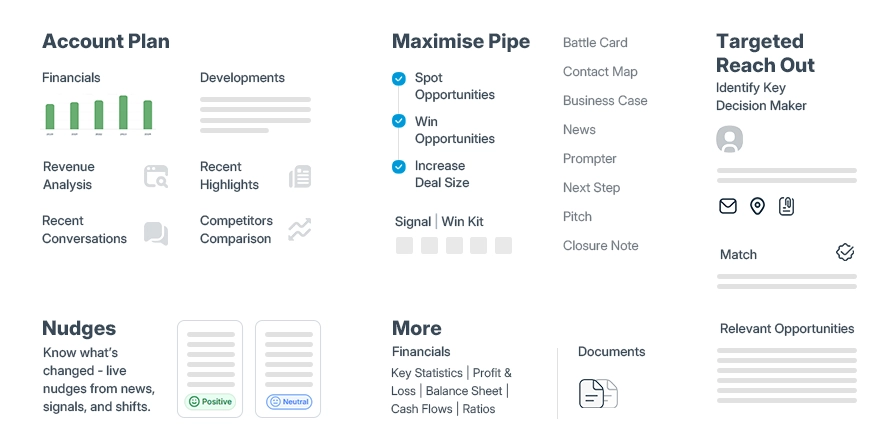
SalesPlay is the world's first AI Sales intelligence platform that transforms sales execution speed and precision through its revolutionary suite of 7 AI Agents. Unlike competitors offering fragmented data, SalesPlay delivers pitch-ready opportunity ecosystems—hyper-personalized sales kits, mapped buying centers, and conversion-ready outreach sequences that eliminate 80% of manual work while consistently closing deals others can't identify.
Built on exclusive MarketsandMarkets intelligence and thousands of premium data sources, and exclusive vendor partnerships, the platform creates a competitive moat that drives 3x productivity gains by enabling every rep to execute with the precision of your organization's elite performers.
Make Every Rep Speak
Like Your Top 1%
ZoomInfo stands out with its massive B2B database containing over 100 million business contacts and extensive intent data. The platform helps teams identify and prioritize high-potential leads while reducing time spent on unqualified prospects. Their AI-fueled Copilot feature automatically tracks accounts and contacts that users engage with, surfacing relevant buying signals in an Activity-Based Account Feed. This integration creates a unified sales and marketing approach with real-time data, intelligent automation, and precise targeting capabilities.
6sense Revenue AI leverages artificial intelligence, big data, and machine learning to enhance pipeline quality and accelerate sales velocity. Their platform captures anonymous buying signals for precise account targeting and delivers personalized content recommendations. 6sense's AI predicts which accounts are most likely to convert by analyzing behavior patterns and competitive research. The platform reveals exactly which topics prospects are researching, even when they don't fill out forms, helping sales teams identify the 10% of accounts that are in-market right now.
Demandbase One fuses your first-party data with trusted B2B insights driven by AI. Their predictive models analyze data from more than 40,000 sources, applying machine learning and human validation to deliver exceptional accuracy. The platform's comprehensive intelligence covers 100M companies with detailed firmographics, 810K+ intent keywords, 47K technologies (including software hidden behind firewalls), and 176M B2B contacts.
Bombora specializes in intent data that helps shorten sales cycles by identifying businesses actively searching for particular topics. Their identity resolution determines who visited a website at a company level, as well as the visitor's seniority and functional area. Bombora's domain resolution employs deterministic methods through IP addresses and first-party cookies, alongside behavioral modeling powered by their Data Co-op. This approach enables sales teams to prioritize accounts showing interest, craft messaging aligned to researched topics, and identify competitive opportunities.
Apollo.io offers an extensive B2B database of 210M+ contacts and 35M+ companies. Unlike single-purpose tools, Apollo combines sales intelligence with engagement capabilities, allowing teams to find and reach out to prospects in one place. Their AI helps uncover key decision-makers, discover lookalike accounts, and prioritize leads using real-time web data [26]. Additionally, the platform automates engagement across email and phone while keeping messaging relevant with real-time signals.
Lead Forensics specializes in B2B website visitor identification, revealing the corporate identity of previously unknown website visitors. With what they claim is the world's largest wholly-owned B2B matched IP address database, the platform provides instantaneous alerts when prospects visit your website. This intelligence helps sales teams focus on high-intent opportunities that convert at five times the rate of traditional outreach methods. The platform also delivers business contact information directly to your team, enabling highly relevant pitches.
RollWorks Account-Based Platform gives B2B marketers tools for precise targeting with a dataset of 4.2 billion digital profiles. The platform leverages AI and machine learning to transform buyer data into actionable insights for display and social advertising. Their advanced data science model automatically emails sales reps when accounts they own are "Spiking" and showing buying interest. This intelligence appears directly in Salesforce or HubSpot CRM, making it visible and accessible to revenue teams.
HockeyStack identifies buyers, influencers, blockers, and champions across every deal using internal and external signals. The platform builds account plans in Salesforce in real-time, based on everything from web activity to objection history. Users receive clear visibility into deal health, past interactions, and stakeholder behavior, along with best next steps presented in a clear to-do list format. Consequently, teams can coordinate actions across sales, marketing, and RevOps with shared messaging and value propositions.
Choosing the right account intelligence tool requires careful evaluation of several key factors beyond flashy feature lists. The ideal platform should align with your specific business needs and team structure to drive maximum value.
Start by identifying your biggest sales bottleneck. Instead of trying to transform everything at once, focus on the single most significant challenge in your process—whether it's research, engagement, or forecasting. Choose a solution specifically designed to address that challenge rather than being distracted by impressive features that don't support your actual use cases.
It's not about how many features the tool offers, but whether they support your specific selling approach. For instance, a platform with exceptional technographic data isn't helpful if you primarily sell to HR departments. Therefore, match platform capabilities to your particular sales motion and industry focus.
Data quality forms the foundation of any account intelligence platform. Verify coverage in your specific target industries and regions, as many platforms have major blind spots outside North America. Ask pointed questions about how often their data refreshes, how they validate information accuracy, and what happens when conflicting data appears from different sources.
Organizations should evaluate platforms based on data quality metrics including accuracy, completeness, consistency, timeliness, uniqueness, and validity. Poor data quality can lead to flawed outputs, diminishing the effectiveness of your account intelligence efforts. Consequently, regular monitoring of data accuracy can help detect changes and take corrective action before inaccuracies impact the business.
Beyond checking that connectors exist, investigate how deep these integrations go. The best AI tool becomes useless if it doesn't work with your existing systems. Prioritize solutions that integrate with your current CRM and communication platforms.
Consider whether:
Account scores automatically update in your CRM
Intent signals appear directly in your sales engagement platform
Intelligence flows directly into tools where your team already works
Real integration means making account intelligence accessible within established workflows, which typically achieves higher adoption rates and faster time-to-value. Hence, evaluate not just the presence of integrations but their depth and functionality.
Many platforms fail because they're too complex for daily use by busy sales and marketing teams. Watch for confusing navigation and cumbersome workflows during demos. The best tools balance sophisticated features with intuitive interfaces that don't require constant re-training or data science expertise.
User adoption is crucial for the success of any account intelligence initiative. Look for a tool with an intuitive user interface that is easy to navigate and allows for customizable dashboards and reports. The platform should empower users across different departments to explore data independently, visualize insights effectively, and create ad-hoc reports without extensive training.
Rather than rolling out across your entire organization, start with a small team of early adopters who can test the solution and become internal champions. Finally, establish clear success metrics before implementation—whether increased pipeline, shorter sales cycles, or higher win rates, clear metrics will help evaluate ROI.
Your SDRs work 9–5
AI Sales works 24/7!!
Implementing an account intelligence platform marks just the beginning of your journey. Without proper training, even the most powerful tool will sit unused. A structured training approach ensures your team can extract maximum value from your investment.
Successful onboarding starts with understanding your team's specific needs. Instead of a generic approach, create structured onboarding processes tailored to different user roles. Although some vendors claim setup takes just 30 minutes, effective onboarding should be methodical rather than rushed.
Begin by identifying clear success criteria that are measurable and achievable during the onboarding period. Soon after, schedule a kickoff meeting between your team and the vendor to align expectations and outline the scope of training. Remember that proper onboarding focuses not just on features but on how the tool solves your specific business challenges.
Virtually all account intelligence vendors offer extensive training materials. Despite differences in quality, these resources should form the foundation of your training program. Investigate the vendor's onboarding process, available resources, and ongoing support options before making your final selection.
Many vendors now offer self-serve instructions that allow teams to learn at their own pace. Altogether, these might include:
Video tutorials and knowledge bases
Certification programs
Regular update notifications
Educational newsletters
Quarterly review sessions
Particularly valuable are reference customers who can share their experiences getting teams up to speed. Their insights often reveal practical training approaches that worked in similar environments.
One-time training rarely sticks. Ongoing, engaging programs help teams truly master account intelligence tools. Richardson Sales Performance found that scenario-based practice, spaced over short intervals, plays a crucial role in changing behavior and retaining skill development.
For today's short-attention-span workforce, keep training formats brief and engaging. As the PWC CEO Advisor noted, "We have what we call 'prompting parties' to enrich AI learning... Different professionals come together across the business to talk about what they're learning".
Combine concept teaching with hands-on experimentation in real application environments. Afterwards, encourage teams to immediately apply what they've learned to active deals or campaigns, making the training immediately relevant.
Tool champions serve as internal experts who help drive adoption. One of the most effective approaches is upskilling existing employees through specialized training programs and certifications. These champions can then provide peer-level support to colleagues.
Additionally, consider partnering with AI vendors and technology providers to gain specialized knowledge without building everything from scratch. Low-code or no-code AI platforms can likewise allow employees with limited technical backgrounds to work effectively with account intelligence.
The best champions are often those who can demonstrate tangible wins using the platform. IBM found that highlighting these success stories throughout the organization encourages wider adoption and creates momentum for your account intelligence initiative.
Success with account intelligence hinges not just on selecting the right tools, but on ensuring your teams actually use them. Even the most powerful platforms fail when they collect digital dust on virtual shelves. Let's explore practical strategies for driving adoption across both sales and marketing departments.
The foundation of successful adoption begins with aligned objectives. Create a centralized intelligence hub where both sales and marketing teams can access real-time account insights. Establish shared dashboards to monitor engagement signals, pipeline progress, and conversion metrics across departments.
Define clear, measurable KPIs including:
Account engagement scores
Deal velocity
Influenced revenue
Furthermore, implement multi-touch attribution models to track the direct impact of account intelligence on sales success. Organizations with this approach report 94% improved sales-marketing alignment through shared account dashboards.
For sustained adoption, account intelligence must become part of everyday processes rather than an additional task. Thoughtful automation implementations save teams an average of 12+ hours weekly on manual monitoring tasks, freeing time for high-value activities.
Your integration strategy should address data governance and quality management with established validation rules and regular monitoring. Whenever possible, customize the deployment to align with existing processes rather than forcing teams to adapt to new workflows.
Nothing drives adoption faster than proving immediate value. Real-time alerts help representatives reach out at precisely the right moment with perfect context. This transforms account intelligence from a reference tool into an active guide for daily decision-making.
The most effective platforms function as always-on sales intelligence engines—analyzing customer data, CRM records, and social media cues, then pushing only what matters to the right representative at the right moment. These timely prompts maintain engagement with the platform while delivering tangible business results.
Highlight concrete outcomes to build momentum. Organizations like Snowflake saw a 19.5% increase in feature adoption among targeted accounts and a 45% higher meeting-to-conversion rate after implementing AI-powered account intelligence.
Regular performance reviews help identify opportunities for process improvements and additional training needs. Moreover, establishing baseline performance metrics before implementation allows teams to track progress and demonstrate clear ROI throughout deployment and maturation phases.
Investing in account intelligence marks only half the journey toward sales and marketing transformation. The long-term success of your program depends on consistent maintenance and optimization. Here's how to ensure your investment continues to deliver value year after year.
On average, 70.3% of B2B data goes out of date every year, potentially costing businesses up to $15 million annually in poor decisions and missed opportunities. Establishing a structured data hygiene strategy is crucial for maintaining accuracy. I recommend:
Setting monthly audits for your CRM and quarterly reviews for your data warehouse
Focusing on revenue-critical data like customer contact information and account details
Implementing validation rules to prevent bad information from entering your systems
Clean, accurate data drives faster time-to-value and higher intelligence accuracy compared to organizations relying on fragmented or low-quality data sources.
Regular performance reviews help identify opportunities for process improvements and additional training needs. Schedule quarterly sessions to evaluate how teams are using the platform, which features deliver value, and where configuration adjustments might enhance results.
Markets and customer behaviors inevitably evolve. Your account scoring models must keep pace with these changes to remain effective. Plan periodic reviews to reassess attribute weights, data sources, and scoring criteria. In particular, ensure your model stays aligned with evolving market conditions by comparing predicted high-value accounts to actual outcomes.
Account intelligence should ultimately support your account-based marketing approach. Create feedback loops on your programs by tracking both quantitative and qualitative measurements. Additionally, establish "north star" metrics that both sales and marketing teams align on.
Remember that ABM is not a static approach—it requires ongoing measurement, collaboration, and evolution. I suggest using dynamic account intelligence tools that update regularly, helping you obtain contextual information precisely when needed. Consider promoting and demoting accounts between your one-to-few and one-to-many programs based on recent first-party and intent data insights.
Account intelligence has transformed from a luxury to a necessity for successful B2B sales and marketing teams. Throughout this article, we've explored how these powerful tools combine multiple data types to create actionable insights that drive results. Certainly, the right account intelligence platform can significantly improve targeting precision, personalization efforts, and ultimately, your bottom line.
However, buying sophisticated software represents only the first step toward transformation. Most organizations fail to realize value from their investment because they neglect the critical human element - training and adoption. Without proper implementation strategies, even the most advanced platforms gather digital dust.
Teams that successfully implement account intelligence tools follow a structured approach. First, they select platforms aligned with their specific sales motion and data needs. Then, they develop thorough training programs tailored to different user roles. Finally, they focus on driving adoption by embedding the tools into daily workflows and celebrating early wins.
Remember that account intelligence requires ongoing attention. Data degrades quickly, with over 70% of B2B information becoming outdated annually. Therefore, establishing regular data hygiene practices, reviewing usage patterns, and refining scoring models ensures your platform continues delivering value year after year.
The distinction between companies that merely purchase account intelligence tools and those that truly benefit from them comes down to execution. Teams that prioritize training, create clear adoption strategies, and maintain their systems witness dramatic improvements in efficiency, deal size, and win rates.
Your journey with account intelligence shouldn't end after implementation. Rather, it should evolve alongside your business as markets change and customer behaviors shift. Though the path requires dedication, the rewards - aligned teams, targeted outreach, and accelerated growth - make account intelligence one of the smartest investments for forward-thinking B2B organizations.
Account intelligence combines internal and external data to create actionable insights about target organizations. It's crucial for B2B teams as it enables precise targeting, personalized engagement, and improved sales efficiency by providing a holistic view of potential customers.
Account intelligence tools provide a unified view of each account that both sales and marketing can access. This shared visibility eliminates silos, encourages collaboration, and helps teams develop consistent messaging and coordinated approaches, leading to more effective customer engagement.
The core data types in account intelligence include demographic data (about individual buyers), firmographic data (company-level insights), technographic data (tools and platforms used), intent data (signals of buying interest), and engagement data (how accounts interact with your company).
Effective training involves creating role-specific onboarding plans, utilizing vendor-provided resources, conducting internal workshops with hands-on practice, and assigning tool champions within departments. Ongoing, engaging programs help teams truly master the tools and extract maximum value.
To ensure long-term success, regularly clean and update data, review tool usage, refine scoring models over time, and align tool usage with your account-based marketing strategy. Establish feedback loops and "north star" metrics that both sales and marketing teams can align on.

Category: Uncategorized Tags: ai, AIOps, Artificial Intelligence, cloud, cloud platform, Cybersecurity, Information and Communications Technology , VR