Turning Account Changes into Qualified Pipeline Automatically
February 06, 2026
Attention: Your best accounts are changing right now. Budget shifts. Leadership transitions. Technology expansions. Compliance mandates. These movements create windows where buying happens. Most sales teams discover these windows weeks after they open—when competitors have already positioned, when urgency has cooled, when the buying center has moved forward without you. By the time your seller finishes researching an account manually, the context that made the opportunity real has already evolved. The gap between account change and seller action represents millions in pipeline leakage.
Interest: What if account movements automatically became qualified opportunities—complete with buying center mapping, business context, and messaging frameworks—before your competitors even detected the signal? Desire: Enterprise sales teams are replacing manual account monitoring with continuous intelligence systems that watch target accounts, connect business changes to opportunity relevance, and produce execution-ready pipeline while sellers focus on conversations, not research. Action: This operational shift transforms how pipeline gets created. Not through more activity. Through better timing.
Sales leaders face a persistent contradiction.
They need pipeline. Quality pipeline. Pipeline that converts.
They hire sellers to create it. They implement methodologies. They invest in tools. They track activity metrics.
Yet pipeline quality remains inconsistent. Conversion rates stagnate. Forecast accuracy disappoints.
The root cause is not effort. It is information asymmetry.
By the time sellers manually discover why an account might buy, buying centers have already formed opinions. Evaluation criteria have solidified. Competitors have established presence.
Late-stage entry masquerades as pipeline creation. It is actually pipeline rescue.
Real pipeline creation happens when sellers engage accounts during business movement—when change creates evaluation windows, when buying centers are forming requirements, when your solution can shape the conversation.
This requires different mechanics. Not faster activity. Earlier intelligence.
Not all account activity matters equally.
Generic company news—product launches, partnerships, award announcements—creates conversational hooks. It does not create buying windows.
Pipeline-relevant changes share specific characteristics. They indicate resource reallocation, operational pressure, or strategic reorientation.
When an account's quarterly revenue deviates from historical patterns, resource allocation decisions follow. Growth acceleration triggers expansion budgets. Revenue compression forces efficiency mandates.
These movements precede technology evaluations by 60-90 days. Sellers who engage during this window participate in requirement formation instead of responding to baked RFPs.
New executives bring mandate windows. They have 100 days to demonstrate impact. They audit existing vendor relationships. They champion initiatives that differentiate their tenure.
When a new CFO joins, finance system evaluations accelerate. When a new Chief Revenue Officer arrives, sales technology gets scrutinized. When a new Head of IT starts, infrastructure modernization projects gain momentum.
The executive transition itself is not the signal. The initiative pressure it creates is.
Accounts that adopt adjacent technologies signal expansion intent. When an account implements a new marketing automation platform, sales intelligence tools become relevant. When they deploy cloud infrastructure, security and compliance solutions gain urgency.
Technology adoptions cluster. One implementation creates cascading requirements across connected systems.
Sellers who map technology dependencies convert stack expansion into multi-product pipeline.
Regulatory changes create non-discretionary budgets. GDPR compliance, SOC 2 requirements, industry-specific mandates—these are not nice-to-have initiatives.
Accounts facing compliance deadlines have compressed evaluation cycles and pre-approved budgets. The challenge is not creating urgency. The challenge is being present when the buying center forms.
Sales leaders understand account change matters. They build processes to track it.
These processes break predictably.
A mid-market seller manages 80-120 accounts. An enterprise seller covers 15-25. Even with rigorous discipline, sellers can deeply research 2-3 accounts weekly.
That means 90% of their territory gets reviewed monthly at best. More realistically, quarterly.
By the time a seller's research rotation returns to an account, multiple buying windows have opened and closed.
Coverage gaps are not execution failures. They are mathematical certainties.
Comprehensive account intelligence requires synthesizing multiple sources. CRM data. Financial databases. News feeds. Social signals. Technology stack intelligence. Org charts.
Each source lives in a separate system. Each requires different access methods, search syntax, and interpretation frameworks.
Sellers spend more time navigating tools than analyzing accounts. The research process itself becomes the blocker.
Account monitoring tools generate volume. Alerts. Updates. News mentions.
Most of this information is noise. It has no connection to buying windows or opportunity creation.
Sellers either ignore monitoring tools completely or drown in irrelevant signals. Both outcomes kill pipeline creation.
The problem is not information scarcity. It is relevance bankruptcy.
Automated pipeline creation requires different system design.
Instead of sellers periodically researching accounts, intelligence systems continuously watch them. Instead of generic news feeds, relevance engines filter for opportunity-connected signals. Instead of research outputs, the system produces execution-ready opportunities.
This architecture has four operational layers.
The system maintains active connections to target accounts defined in your CRM. It watches these accounts continuously, not episodically.
When account changes occur—financial data updates, executive movements, technology stack additions, regulatory filings—the system detects them in real-time.
This is not alert-based monitoring. The system does not wait for sellers to check dashboards. It actively tracks accounts as living entities.
Detection without interpretation creates noise.
The second layer connects account changes to your specific offerings. When a manufacturing company expands into new regions, this matters for supply chain solutions but not necessarily for HR tech.
Relevance mapping answers: "Why does this change create a buying window for us?"
This requires understanding product fit, buying center implications, and timing dynamics. Generic account intelligence platforms stop at detection. Revenue intelligence systems continue to interpretation.
Solutions like SalesPlay AI Sales and Revenue Intelligence Co-pilot exemplify this approach—connecting account movements directly to opportunity creation rather than just surfacing information.
Opportunities without contacts remain hypothetical.
The third layer maps account changes to buying center participants. When a compliance mandate creates urgency, who owns the evaluation? When an executive transition happens, who gains decision authority?
This is not static org chart mapping. Buying centers form dynamically based on initiative type, budget source, and political capital distribution.
Automated systems that connect account changes to relevant stakeholders enable immediate outreach instead of sequential research.
The final layer converts intelligence into action.
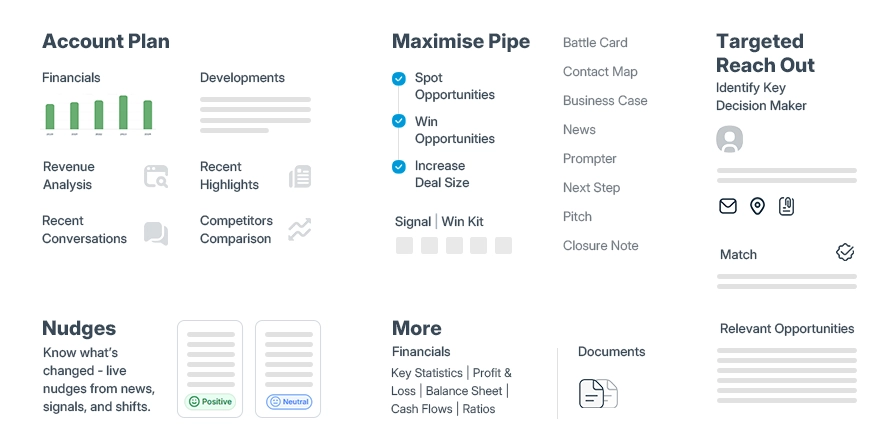
For each qualified opportunity, the system generates messaging frameworks, conversation starters, and sequencing guidance. Sellers receive not just "who to contact" but "what to say and why it matters to them."
This eliminates the preparation gap between opportunity identification and seller engagement.
reduction in time from signal detection to qualified conversation when intelligence systems automate opportunity packaging
Continuous intelligence systems require deliberate implementation. The technology enables new workflows, but execution determines results.
Intelligence systems watch what you tell them to watch. Vague account definitions create vague pipeline.
Start with CRM integration. Connect your target account list. Segment by tier—enterprise, mid-market, growth accounts—because monitoring intensity should match account value.
For each tier, define the account changes that matter. Enterprise accounts might require board-level movement tracking. Mid-market accounts might prioritize technology stack signals.
Precision here determines signal quality downstream. Learn more about effective account-based approaches that align with intelligence-driven selling.
Not every account change should generate an opportunity.
Work with your intelligence system to define relevance scoring. What signal combinations indicate high-probability buying windows? What changes are informative but not actionable?
This calibration is iterative. Start conservative—surface only high-confidence opportunities. As your team's conversion data accumulates, refine thresholds.
The goal is not maximum opportunity volume. It is maximum conversion efficiency.
The best intelligence fails if sellers do not see it.
Route qualified opportunities directly into seller workflow. This might mean CRM tasks, dedicated pipeline review sessions, or integrated intelligence views within your sales platform.
Sellers should never need to "check the intelligence system." Intelligence should surface where sellers already work.
Understand how modern revenue intelligence platforms embed directly into existing sales processes rather than creating parallel workflows.
Sellers will accept some opportunities and reject others. This acceptance data trains the system.
Create simple mechanisms for sellers to indicate: "This opportunity is real" or "This is not relevant." Do not require lengthy explanations. Simple binary feedback is sufficient.
As acceptance patterns emerge, your intelligence system learns which signal combinations your specific sellers find actionable. Relevance calibration becomes continuous, not static.
When account changes convert to pipeline automatically, seller behavior shifts fundamentally.
Sellers stop spending hours per account on manual research. The system provides consolidated account context—financial history, recent changes, opportunity rationale—in minutes.
New sellers ramp faster. They do not need to build institutional knowledge manually. The system provides account intelligence that used to require years of experience.
Generic outreach dies when every opportunity includes specific account context.
Sellers reference actual business changes in their messaging. They connect outreach to real account movements, not hypothetical pain points.
This specificity changes response rates. Buying centers engage because the seller clearly understands their current situation.
When opportunities include creation context—which signal triggered them, what account change made them relevant—sales leaders can measure pipeline quality scientifically.
Which account change types convert best? Which signal combinations predict closed-won outcomes? Which buying center entry points accelerate deal velocity?
This data refines future opportunity generation. Pipeline creation becomes a learning system, not a static process.
When sellers manually monitor accounts, coverage is sparse. When systems monitor continuously, every target account gets watched equally.
This eliminates the territory blind spots where opportunities die unnoticed. Smaller accounts receive the same intelligence coverage as enterprise accounts.
Coverage consistency transforms pipeline predictability.
Implementation success requires specific metrics.
What percentage of detected account changes produce qualified opportunities? This metric indicates relevance calibration effectiveness.
Early implementations might see 15-20% conversion. Mature systems achieve 40-50% as relevance models learn.
What percentage of system-generated opportunities do sellers pursue? Low acceptance rates indicate relevance problems. High acceptance rates validate the intelligence quality.
Target: 70%+ acceptance rate within 90 days of implementation.
How quickly do sellers act on opportunities after the system identifies them? This measures workflow integration effectiveness.
Manual processes show 7-14 day lag times. Automated systems should achieve 24-48 hour engagement windows.
What percentage of created pipeline originated from automated account intelligence versus traditional prospecting?
This metric shows system impact on overall pipeline health. Mature implementations see 40-60% of new pipeline attributed to automated account change detection.
Explore how revenue operations teams use these metrics to optimize pipeline generation processes.
Experienced sellers trust their instincts. They question opportunities they did not personally discover.
Address this through transparency. Show sellers exactly why the system flagged each opportunity. Connect the opportunity to specific account changes. Provide supporting evidence.
Early wins convert skeptics. When sellers close deals from system-generated opportunities, adoption accelerates.
If relevance thresholds are too loose, sellers receive more opportunities than they can pursue.
This is a calibration problem, not a system problem. Tighten relevance scoring. Prioritize opportunities by account tier. Implement capacity-based routing—sellers receive opportunities they can actually work.
Account situations evolve. An opportunity that was relevant last week might not be relevant today.
Continuous monitoring solves this. The same system that detected the original opportunity should update context as accounts change. Sellers should see "this opportunity is still relevant" or "account context has shifted" automatically.
Automated pipeline creation does not just fill the funnel. It changes what sales teams know.
As the system processes account changes over months and years, it builds institutional knowledge. It learns which signals predict buying behavior. It identifies account movement patterns that precede purchasing decisions.
This knowledge does not live in individual sellers' heads. It lives in the system. It is available to every seller, new or experienced.
Sales teams become smarter over time without adding headcount. They see patterns invisible to manual research. They engage accounts at precisely the right moments.
This is the compounding advantage of continuous intelligence systems. They get better as they run.
See how revenue intelligence systems convert account changes into qualified opportunities automatically—without adding research burden to your sellers.
Request DemoCurrent systems detect account changes and generate opportunities reactively. They see what has already happened and interpret implications.
The next evolution is predictive. Intelligence systems that identify accounts likely to change before movements occur.
This requires analyzing historical patterns. Which account characteristics precede budget expansions? Which financial indicators predict technology evaluations? Which organizational structures correlate with buying activity?
When systems move from reactive to predictive, sellers engage accounts before buying windows open. They shape requirements instead of responding to them.
Early implementations of predictive intelligence show promise. Accounts flagged as "likely to buy within 90 days" based on pattern matching convert at 2-3x the rate of standard prospecting.
This is not hypothetical. Leading revenue intelligence platforms are deploying these capabilities now. Understanding revenue operations platforms that incorporate predictive intelligence helps teams prepare for this shift.
Pipeline creation has been a volume game. More calls. More emails. More activity.
This approach ignores timing. It treats all accounts as equally ready to buy. It forces sellers to create urgency instead of finding it.
Continuous intelligence systems change the game. They find accounts where urgency already exists—where business changes have created evaluation windows, where buying centers are forming, where your solution solves problems that just became acute.
Automated pipeline creation is not about replacing sellers. It is about directing their energy toward accounts where conversations matter, where timing is right, where deals actually close.
Sales leaders who implement these systems see consistent results. Higher pipeline quality. Faster conversion. Better forecast accuracy. Not because their sellers work harder. Because their sellers work on the right accounts at the right time.
The mechanics are operational, not theoretical. Connect your CRM. Define target accounts. Calibrate relevance. Route opportunities into workflow. Measure acceptance and conversion.
The teams that master this approach stop chasing pipeline. Pipeline comes to them—automatically, continuously, qualified.
Qualified pipeline emerges from specific account movements: budget reallocation signals, executive leadership transitions, technology stack expansions, regulatory compliance shifts, merger and acquisition activity, geographic expansion announcements, and quarterly earnings pattern changes. These movements indicate timing windows where buying centers are actively evaluating solutions. The key is not just detecting changes but understanding which changes correlate with your specific solution category and buying patterns.
Signal separation requires three filtering layers: relevance to your specific offerings, proximity to budget allocation cycles, and connection to identifiable buying centers. Generic company news becomes actionable signal only when tied to your solution category and mapped to decision-making units with demonstrated authority. Effective systems learn from your team's historical conversion data—which signals actually predicted closed deals—and continuously refine relevance scoring based on this feedback.
Execution-ready opportunities include four components: identified buying center contacts with accurate role and contact information, business context explaining why now matters for this specific account, messaging framework tied to account-specific movements rather than generic value propositions, and clear next-step sequencing that guides seller actions. Interesting signals without these elements remain research, not pipeline. The difference between intelligence and action is preparation depth.
Conversion speed depends on detection latency and execution readiness. When account intelligence systems continuously monitor target accounts and pre-build opportunity context, sellers can move from signal detection to qualified conversation within 24-48 hours instead of weeks of manual research. The fastest conversions happen when the system not only identifies the opportunity but also packages buying center contacts, contextual messaging, and next-step guidance automatically. Manual processes typically show 7-14 day lag times between signal and engagement.
CRM integration enables bidirectional intelligence flow. Target account definitions, opportunity stages, and engagement history flow from CRM into intelligence systems, ensuring monitoring focuses on accounts that matter to your business. Qualified opportunities, updated buying center mapping, and account movement context flow back into CRM, creating seller visibility where they already work. This creates a continuous loop where pipeline quality improves as account knowledge compounds. Without tight CRM integration, intelligence systems become parallel workflows that sellers ignore.


Category: Uncategorized Tags: ai, AIOps, Artificial Intelligence, cloud, cloud platform, Cybersecurity, Information and Communications Technology , VR