What is Sales Intelligence? Complete Guide for 2025
August 21, 2025
Sales Intelligence transforms how top performers close deals in 2025. Did you know that companies using sales intelligence tools see a 35% increase in lead conversion rates and 34% faster sales cycles?
I've seen firsthand how the right sales intelligence platform can turn average sales teams into revenue powerhouses. This technology goes far beyond basic contact information - it delivers real-time insights about prospects, buying signals, and competitive intelligence that sales teams couldn't access before. Additionally, modern sales coaching software uses this data to help reps improve their approach with each interaction.
Gone are the days when sales success depended on gut feelings and generic pitches. Today, sales intelligence equips teams with data-driven insights to identify high-value prospects, personalize outreach, and time their follow-ups perfectly. In fact, organizations implementing these tools report a 28% improvement in win rates across their pipelines.
Throughout this comprehensive sales intelligence platform guide, I'll show you exactly what sales intelligence is, why it matters more than ever in 2025, and how to implement it effectively in your organization. Whether you're just starting to explore this technology or looking to upgrade your current approach, you'll find actionable strategies to boost your sales performance.
Let's explore how sales intelligence can become your competitive advantage in today's data-driven sales landscape!
At its foundation, sales intelligence serves as the backbone of modern sales strategies. This powerful approach collects and analyzes data to guide sales decisions and improve outcomes. Sales intelligence equips sellers with crucial information about prospects and customers, helping them understand needs and close deals more effectively.
Ready to turn your Rep
INTO BEST PERFORMER ?
Sales intelligence primarily refers to the gathering and analysis of information that salespeople use to make informed decisions throughout the selling cycle. More specifically, it's the process of collecting data from multiple sources—including news feeds, social media, company databases, and public filings—to understand prospect behavior and context.
The core purpose of sales intelligence is straightforward: to prepare sellers with data and insights before they engage with prospects. By conducting thorough research, sales professionals can approach conversations confidently and tailor their presentations to resonate with each prospect's unique situation. For instance, a project management software salesperson might discover that a retail prospect is expanding into Europe and then highlight how their product can streamline international expansion projects.
Sales intelligence functions across the entire sales cycle—from prospecting to closing deals. Initially, it helps sellers prioritize leads and personalize outreach. As the sales process progresses, more detailed intelligence is gathered, creating a robust set of data that enables highly targeted solutions.
Although often confused, sales intelligence and business intelligence serve different purposes. Business intelligence functions as your company's history textbook—cataloging past data, analytics, summaries, and decisions. It's concerned with what happened in your business operations.
Sales intelligence, conversely, focuses on why certain events occurred and how to improve future outcomes. While business intelligence creates long-term plans that typically implement slowly, sales intelligence outlines immediate, actionable steps.
Moreover, business intelligence encompasses all areas of business data analysis—including finance, marketing, and operations—to drive overall performance. Sales intelligence specifically targets sales data to inform strategies and decisions.
Sales intelligence relies on five main types of data that create a complete picture of prospects and their needs:
Firmographic data: This includes industry, company size, number of employees, physical locations, annual revenue, growth stage, and products/services offered. This information helps match companies with specialists in specific territories or industries.
Contact data: Also called personal or demographic data, this covers names, job titles, departments, social media profiles, email addresses, and phone numbers. Sales teams use this information to personalize outreach and contact prospects through multiple channels.
Technographic data: This details a prospect's technology consumption and usage, including tools, software, hardware, processes, and IT infrastructure. Sellers can use this data to show how their products complement or improve a company's existing technology stack.
Sales event triggers: These buyer signals include expansion into new markets, new funding, hiring activity, promotions, layoffs, mergers, acquisitions, and recognitions. Such events create timely opportunities to demonstrate how a solution addresses changing needs.
Deal data: This information emerges during the sales process or from historical deals, covering budgets, pricing, timelines, competitor feedback, and potential upsells. Deal data helps identify trends that guide sellers toward solutions that resonate with prospects.
Furthermore, modern sales intelligence increasingly incorporates intent data, which shows when an account is actively researching solutions by analyzing the content they consume. This allows sales teams to identify prospects at their most receptive moments, reaching them before competitors do.
Sales intelligence has experienced a remarkable transformation over the years. No longer limited to simple contact databases, today's sales intelligence has evolved into sophisticated platforms delivering actionable insights on buyer intent, decision-maker identification, and vendor relationship mapping.
The earliest forms of sales intelligence focused on descriptive analytics—analyzing historical data to provide insights into past performance. This approach primarily served to describe what happened before data collection, using large volumes of accumulated data to extract relevant information.
However, the landscape has changed dramatically. Nearly half of businesses still perform descriptive analytics, using static and backward-looking data to measure what happened. The big shift has been toward predictive analytics, which uses historical data and advanced statistical techniques to forecast future outcomes.
Predictive analytics employs sophisticated algorithms to analyze patterns from past activity data and applies them to forecast future results. These forecasts include critical sales metrics such as:
Supply and demand fluctuations
Consumer opinions on products and services
Credit rating assessments
Sales and market forecasts
This evolution represents a fundamental change from using data to measure past performance to determining what to do in the future. Notably, organizations using predictive account scoring see a 28% improvement in sales efficiency and a 23% increase in average deal size.
Artificial intelligence stands at the core of modern sales intelligence evolution. AI has transformed sales intelligence from basic Customer Relationship Management systems to advanced platforms offering real-time insights and predictive analysis.
The impact of AI on sales intelligence is substantial:
76% of sales professionals predict most software they use will have built-in AI capabilities by 2030
64% of professionals save 1-5 hours weekly using AI to automate manual tasks
73% state that AI tools have increased their team's productivity
AI can help train new sales representatives 42% faster than traditional methods
AI's influence extends across multiple dimensions of sales intelligence. First, it analyzes customer data to craft tailored email outreach, refines sales scripts based on real-time feedback, and suggests optimal next actions for each prospect. Additionally, AI-powered analytics platforms can monitor customer interactions across multiple channels to provide a complete view of each customer.
Furthermore, AI transforms sales teams from data searchers into strategic problem solvers. Tasks that previously took days can now be completed in hours. As one expert explains, "If in the past a proper account research effort would take up to five days, now all the data is already available. We don't need to spend five days; we can spend one hour analyzing the data and generating insights".

Real-time sales intelligence has become essential for modern enterprises looking to enhance their data-driven sales strategy framework. By leveraging updated data, companies can gain actionable insights, make data-driven decisions, and streamline operations.
The significance of real-time insights has grown because they put data to use when it's most valuable. Unlike traditional data analytics, real-time analytics enables whole new ways of doing business by letting teams take immediate action.
Several factors make real-time insights particularly valuable today:
Swift response capability: Real-time analytics allows businesses to respond immediately to market trends, customer preferences, and competitive dynamics.
Personalization opportunities: Learning about user preferences and behaviors in real-time enables companies to personalize their communication, ensuring higher customer satisfaction. In fact, 80% of consumers say they are more likely to purchase from a brand that offers personalized experiences.
Continuous optimization: Real-time data allows for ongoing monitoring and adjustment of sales tactics, ensuring the most effective strategies are employed.
Process improvement: Access to real-time data helps determine challenges and inefficiencies affecting the sales process, improving overall productivity.
As we move through 2025, the transition toward real-time, AI-powered predictive sales intelligence continues to accelerate, with businesses that embrace these technologies gaining significant competitive advantages in an increasingly data-driven marketplace.
In 2025, the business landscape has shifted dramatically, making sales intelligence no longer optional but essential. The data confirms what I've observed firsthand: today's buyers behave differently, prospects are harder to identify, and sales teams face unprecedented productivity challenges.
The modern buyer's journey has transformed. Research shows that 81% of prospects conduct their own research before even inquiring about products or services. This fundamental shift means buyers have already formed opinions about offerings before engaging with any content.
At the same time, buyers spend just 17% of their buying time meeting with potential vendors—and less than 6% with any single sales rep. Despite this limited window, 91% of buyers remain open to engaging with sales representatives early in their process, especially when approached with valuable insights rather than generic pitches.
The global pandemic accelerated these changes, creating a truly digital-first marketplace where personalized experiences are now expected. According to research, over 90% of consumers will spend more with companies offering personalization and streamlined experiences.
What makes this particularly challenging is that consumer sentiment and spending are no longer neatly aligned. Traditional frameworks for predicting consumer behavior have become insufficient as today's buyers make unexpected trade-offs across categories—trading down in one area while simultaneously splurging elsewhere.
Nearly half of sales representatives (42%) consider prospecting the most difficult part of the sales process. Without a steady stream of qualified leads, nothing else moves forward. Yet despite this challenge, top-performing salespeople generate up to 2.7x more conversions by treating prospecting as a daily discipline.
The quality of prospecting matters more than ever for several reasons:
50% of prospects aren't a good fit for what you're selling
Cold calling success rates have plummeted, with most decision-makers screening calls
80% of sales require five or more follow-ups, yet 44% of reps give up after just one attempt
This mismatch between effort and outcome explains why sales intelligence platforms have become critical. By leveraging data, these tools help identify high-intent prospects, allowing teams to focus their resources where they'll have the greatest impact.
Consequently, companies need to build a 360-degree view of their consumers that enables proactive decision-making. This requires new capabilities like AI-powered social-listening tools and ensuring organizations have granular behavioral data from websites or stores.
The productivity impact of sales intelligence is substantial. AI-powered tools now allow sales professionals to save 1-5 hours weekly by automating manual tasks. Furthermore, 73% of professionals report that AI tools have increased their team's productivity.
Perhaps most striking is how sales intelligence addresses the core problem of selling time. Sellers typically spend only about 25% of their time actually selling to customers. Sales intelligence tools could potentially double that percentage by handling tasks that surround selling but don't add significant value.
These productivity gains translate directly to business outcomes. Companies implementing AI sales tools have seen an average increase of 25% in sales productivity and a 15% boost in revenue. Teams using AI-powered CRMs and intelligent workflows report improvements in sales pipeline velocity, conversion rates, and customer satisfaction.
By 2026, 85% of executives believe their workforce will make real-time, data-driven decisions using AI agent recommendations. This represents a fundamental shift in how sales organizations operate—moving from reactive and fragmented approaches to proactive, integrated, and predictive models.
Above all, effective sales intelligence allows teams to prioritize high-value activities. Instead of wasting time researching prospects or updating CRM records, sales professionals can focus on what truly matters: building relationships and closing deals.
A robust sales intelligence system relies on three foundational components working in harmony. These technical elements transform raw data into actionable insights that drive sales performance. Let me break down each essential component and explain how they function together.
STOP CHASING PROSPECTS
START CLOSING DEALS!!
The foundation of any sales intelligence platform begins with data aggregation—collecting information from various sources including CRM systems, social media, market reports, and customer interactions. This raw data then undergoes cleaning to remove inconsistencies, duplicates, and errors.
Data enrichment takes this process further by enhancing existing customer information with additional relevant data. Essentially, it means taking basic data points like a contact name or company and adding missing information to create a more complete profile. Without a proper data enrichment process, sales teams risk:
Missing revenue by targeting the wrong contacts or stale accounts
Slow routing of high-intent leads due to unverified data
Personalization efforts that fall flat because of inaccurate customer information
The most effective data enrichment follows three key steps:
Append: Add missing fields like job titles, phone numbers, or company firmographics
Verify: Confirm data accuracy using trusted third-party sources
Refresh: Keep customer data current through scheduled or real-time updates
Customer Relationship Management (CRM) systems serve as the central hub for sales intelligence, unifying and centralizing both internal and external data. A modern CRM can automatically capture and sync relevant sales intelligence from emails, calendars, and calls, eliminating error-prone manual entry.
Marketing automation tools complement CRMs by focusing on campaign management, email marketing, and customer segmentation. Together, they create a powerful combination—CRM provides the customer data that marketing automation needs as its fuel.
Integrating these systems yields significant benefits. First, customer data flows seamlessly between tools with no information getting lost in transit. Second, after marketing actions, CRM data gets enriched with information on how customers responded to messages. Finally, unified reporting gives both sales and marketing teams a complete view of the funnel from lead generation through closing deals.
Lead scoring provides an objective approach to ranking lead quality using data. This component identifies your most promising leads by tracking online behaviors, email engagement, and other activities.
Modern lead scoring can be:
Manual: Points assigned based on demographic, company, behavioral, and spam data, typically on a 1-100 scale
Predictive: Using AI and machine learning to analyze historical data and predict conversion likelihood
Predictive lead scoring offers substantial advantages—it automates the process, improves accuracy, analyzes vast amounts of data from multiple sources, and routes high-scoring leads to appropriate reps.
Similarly, segmentation allows for targeted messaging to specific audiences. AI-driven segmentation goes beyond traditional factors like industry or company size, identifying patterns in how leads interact with your brand. This enables dynamic grouping based on intent signals, engagement levels, and predictive scores.
By establishing these three core components—data enrichment, CRM/marketing automation integration, and lead scoring/segmentation—your sales intelligence system creates a foundation for informed decision-making throughout the sales process.
Make Every Rep Speak
Like Your Top 1%
Sales intelligence delivers practical value across multiple business functions. Through my experience with top-performing sales teams, I've identified three critical applications where sales intelligence consistently produces measurable results.
First and foremost, sales intelligence plays a crucial role in lead generation by collecting, analyzing, and transforming data into actionable insights. This process helps sales representatives discover high-quality leads, understand prospect behavior, and generate personalized outreach strategies. The best sales intelligence software uses analytical tools, artificial intelligence, and machine learning to identify prospective leads from vast amounts of unfiltered data.
Sales intelligence platforms collect valuable information from multiple sources including:
CRM systems and ERPs
Social media and company websites
Job boards and third-party databases
Previous customer interactions and feedback
The results speak for themselves. Since implementing proper sales intelligence tools, UserEvidence increased its cold-calling pipeline by 33%. Likewise, organizations find that sales intelligence drives smarter prospecting by ensuring reps always talk to the right decision-makers, resulting in higher revenue generation.
The B2B sales cycle can be painfully long—averaging 83 days according to recent data. Therefore, shortening this cycle represents a major opportunity. Sales intelligence speeds up this process by helping teams find and reach decision-makers who show buyer intent, allowing teams to focus on leads likely to close.
Sales intelligence tools provide several key advantages that accelerate deals:
Sales event triggers act as flags that alert representatives when prospects show buying signals such as visiting pricing pages, engaging with sales emails repeatedly, or watching purchasing tutorials. Subsequently, sales teams can step in at precisely the right moment.
For teams using AI-powered sales intelligence, the impact is substantial—saving US sales professionals upwards of 2 hours per day. As a result, Gartner predicts that by 2026, B2B sales organizations using generative AI will reduce time spent on prospecting and customer-meeting preparation by over 50%.
Personalization has become essential rather than optional. Research shows that 71% of consumers expect companies to deliver personalized interactions, with 76% becoming frustrated when this doesn't happen. Sales intelligence provides the foundation for this personalization.
With sales intelligence, representatives gain valuable insights into:
Customer pain points and specific requirements
Recent business developments affecting prospects
Short-term goals and priorities
Armed with this information, sales teams can craft highly personalized pitches that address specific needs. This targeted approach yields impressive results—personalization drives 10-15% revenue lift on average (with company-specific lift spanning 5-25%).
Beyond just content personalization, timing becomes a strategic advantage. Sales intelligence tools monitor digital signals and behavior patterns to identify when prospects are most receptive to outreach. For instance, tools like 6sense use artificial intelligence to analyze these signals and predict buying intent, enabling sales teams to prioritize hot leads. Certainly, this capability explains why 78% of consumers are likely to make repeat purchases from companies that use personalization effectively.
Predictive intelligence has reshaped how sales teams approach their daily work. By examining patterns in both historical and real-time data, organizations now pinpoint opportunities before they fully materialize.
Predictive analytics employs statistical algorithms and machine learning techniques to analyze historical data, identifying patterns that forecast future behaviors. This approach applies advanced models to various data sources, analyzing current trends to predict an event's likelihood.
In sales contexts, predictive analytics examines extensive user activities—including site visits, content downloads, and search queries—to recognize purchasing intent. These models analyze millions of leads simultaneously, identifying which ones indicate the highest buying intent or purchase readiness in seconds.
The technology has become increasingly accessible. AI-powered sales solutions employ machine learning and predictive models to scan through a wider range of inputs. For example, some platforms automatically capture and analyze over 300 buying signals, including customer interactions, historical sales data, and information from integrated apps.
Your SDRs work 9–5
AI Sales works 24/7!!
Predictive sales analytics uses data, statistical algorithms, and machine learning to forecast various outcomes. These might include:
How much you'll sell over a given period
What percentage of deals are likely to close
Which sales representatives will hit their targets
Today's intelligent analytics solutions analyze real-time trends and apply predictive models to determine what's most likely to occur in the future. By analyzing historical data alongside insights from current deals' sales calls, these systems assign a predictive score for each opportunity in your pipeline—the higher the score, the more likely a deal is to close.
This capability transforms traditional forecasting. Nearly half of businesses still perform descriptive analytics using static, backward-looking data. Yet predictive models provide a fundamental advantage—they estimate future events' probability rather than simply reporting what happened.
The impact is significant. According to recent data, high-performing sales teams are four times more likely to use predictive analytics in their strategies. Organizations using AI-powered sales tools have seen an average increase of 25% in sales productivity and a 15% boost in revenue.
Perhaps the most valuable application of predictive analytics is identifying high-intent prospects. These models recognize buying signals by analyzing behavioral patterns including:
Research around specific solutions
Content downloads related to pain points
Time spent on pricing pages
Demo requests
Comparison tool usage
Direct competitor research
For instance, a predictive model might pinpoint a small business that visited your pricing page several times and completed a contact form—strong indicators of high interest. Or it might flag when a company has recently received funding, hired new executives, and increased technology spending.
These insights allow teams to prioritize outreach effectively. With predictive scores, sales representatives can focus on the most promising leads first. An effective lead scoring mechanism employs predictive analytics to evaluate prospects according to both behavioral interests and demographic fit.
The results speak for themselves. According to data from Gong Labs, this approach can increase win rates by 35%. Additionally, predictive models help businesses forecast which products customers might purchase next and precisely when they're ready to buy.
As predictive sales intelligence continues evolving, it's becoming increasingly central to modern sales strategy—transforming gut feelings and educated guesses into data-driven decisions with measurable business impact.
The market offers powerful sales intelligence platforms in 2025, each with unique capabilities tailored to different business needs. Let's examine the leading tools transforming how sales teams operate today.
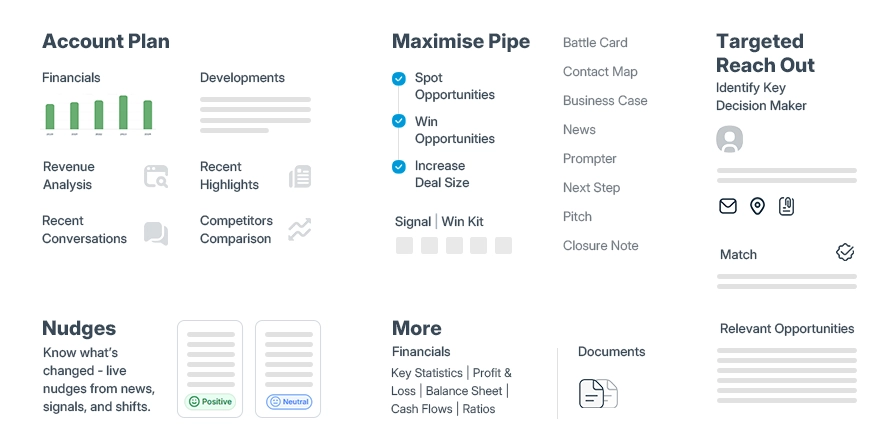
SalesPlay is the world's first AI-powered sales intelligence platform that transforms sales execution speed and precision through its revolutionary suite of 7 AI Agents. Unlike competitors offering fragmented data, SalesPlay delivers pitch-ready opportunity ecosystems—hyper-personalized sales kits, mapped buying centers, and conversion-ready outreach sequences that eliminate 80% of manual work while consistently closing deals others can't identify. Built on exclusive MarketsandMarkets intelligence and thousands of premium data sources, and exclusive vendor partnerships, the platform creates a competitive moat that drives 3x productivity gains by enabling every rep to execute with the precision of your organization's elite performers.
Zendesk Sell focuses on streamlining workflows and increasing customer engagement through its clean, simple interface. This sales CRM tool improves productivity with features like automated sequences for lead engagement, customer conversation tracking, and advanced user permissions. Zendesk Sell particularly excels in improving customer relationships by providing a centralized platform for managing leads and interactions. Its mobile accessibility keeps teams productive on the go without requiring IT support.
HubSpot Sales Hub streamlines workflows and empowers data-driven decisions with comprehensive CRM capabilities. The platform automates sales processes and provides powerful reporting features that deliver real-time insights. HubSpot's customization options allow users to tailor objects with relevant properties aligned to their business needs. The platform includes lead management, prospecting tools, email templates, tracking, and AI-powered sales automation to enhance team productivity.
ZoomInfo stands out with its vast database of B2B contact and company information. The platform leverages AI and machine learning to deliver detailed insights for targeted outreach strategies. ZoomInfo offers four main products: SalesOS for prospecting, MarketingOS for account-based marketing, OperationsOS for data management, and ZoomInfo Copilot, an AI-powered solution to help sellers improve performance. The platform's expansive database and sophisticated analytics capabilities make it ideal for comprehensive market research.
Apollo.io provides a comprehensive sales automation platform for lead generation, contact management, and email outreach. With a database exceeding 275 million contacts and 60 million companies, Apollo.io offers tools for finding prospects with intent data, LinkedIn connections, email sequences, and A/B testing. The platform emphasizes engagement analytics, allowing users to track email performance metrics and optimize their strategies accordingly. Apollo.io's free entry point makes it accessible for startups and small businesses.
LinkedIn Sales Navigator equips sellers with enhanced features for finding buyers and winning deals faster. The platform includes advanced search filters, AI-driven insights through Account IQ and Lead IQ, CRM integrations, and direct outreach via InMail. Sales Navigator allows unlimited searches with customizable settings based on region, industry, function, and seniority level. The platform automatically highlights noteworthy results via Sales Spotlights, identifying individuals who've recently changed jobs or share common experiences.
Groove functions as a Clari company providing sales engagement tools that improve sales productivity. The platform offers meeting and deal management dashboards, conversation intelligence, and campaign performance analytics. Groove helps sales teams track goals and assess interactions through automatically recorded metrics and performance data.
Seamless.ai focuses on finding accurate lead information in real-time. The platform allows users to discover anyone's email address and mobile number within seconds, with access to over 1.8 billion business emails and 414 million phone numbers. Seamless.ai's AI-powered search engine researches and validates business contact information in real-time, ensuring high data accuracy. Users report significant sales increases, with some generating hundreds of thousands in revenue shortly after implementation.
Salesforce Sales Cloud combines predictive, generative, and autonomous AI with powerful CRM capabilities. The platform monitors pipeline health, flags at-risk deals, and generates tailored recommendations for next actions. Its Einstein Conversation Insights identifies trends and coaching moments, while Agentforce nurtures leads 24/7. Sales Cloud provides customizable dashboards with real-time insights into opportunities and team performance for intelligent sales forecasting.
Implementing sales intelligence requires methodical planning and execution. Effectively introducing these powerful tools into your existing workflows takes more than just purchasing software—it demands a strategic approach.
First, conduct a thorough evaluation of your existing sales processes and identify areas needing improvement. Analyze your strengths, weaknesses, and pain points to determine where sales intelligence can make the strongest impact. Understanding your current state helps pinpoint specific challenges—whether that's repetitive tasks, data management difficulties, or ineffective lead handling. This assessment creates clarity on goals before selecting tools, ensuring your sales intelligence investment addresses actual needs.
Selecting appropriate sales intelligence tools requires careful consideration of several factors:
Integration capabilities with your existing tech stack
User interface simplicity for team-wide adoption
Scalability to grow with your business
Quality of customer support and training resources
The wrong tool will fail to drive revenue growth and waste your investment. Prior to making a decision, research various platforms, evaluate their customization options, and verify compatibility with your CRM system. Consider implementing a pilot program to test effectiveness with a small user group before full deployment.
Once you've selected a platform, focus on proper training. Sales leaders should become familiar with the tool first, then run comprehensive programs for managers and representatives. Create dedicated manuals with best practices and provide ongoing support resources to encourage user adoption.
Establish a feedback loop between teams to address concerns and identify areas for improvement. This continuous communication helps fine-tune the integration and maximizes the platform's effectiveness. Remember that adoption takes time—simplify the journey with sufficient training materials users can reference while learning the system.
Sales intelligence has transformed from basic contact databases to sophisticated, AI-powered systems that provide actionable insights in real-time. Throughout this guide, we've seen how modern sales teams now rely on data-driven strategies rather than gut feelings to identify prospects, personalize outreach, and close deals effectively.
Most importantly, sales intelligence addresses the fundamental challenges of today's sales environment. Buyer behavior has shifted dramatically, with prospects conducting extensive research before engaging with salespeople. Additionally, finding qualified leads has become increasingly difficult, while sales productivity remains a constant struggle. Sales intelligence tools tackle these issues head-on by identifying high-intent prospects, shortening sales cycles, and enabling truly personalized interactions.
The core components—data aggregation and enrichment, CRM integration, and predictive analytics—work together to create a powerful ecosystem that drives results. Organizations implementing these tools report significant improvements in win rates, lead conversion, and overall sales efficiency.
Certainly, choosing the right platform for your specific needs requires careful assessment of your current processes. Whether you select Zendesk Sell, HubSpot Sales Hub, ZoomInfo, or another solution, the key lies in proper implementation. Therefore, training and adoption strategies should be prioritized to ensure your team actually uses the tools effectively.
As we move further into 2025, sales intelligence will continue to evolve, offering even more sophisticated capabilities for teams willing to embrace data-driven selling. The companies that adapt quickly to these technologies will gain substantial advantages over competitors still relying on outdated methods.
Remember that sales intelligence isn't merely about having access to more data—it's about transforming that data into meaningful insights that guide smart decisions throughout the sales process. After all, the ultimate goal remains the same: connecting with the right prospects, at the right time, with the right message to drive revenue growth.
A. Sales intelligence refers to the collection and analysis of data to guide sales decisions and improve outcomes. It's important because it equips sales teams with crucial information about prospects and customers, helping them understand needs, personalize outreach, and close deals more effectively in today's data-driven sales landscape.
A. While business intelligence focuses on analyzing past data to inform long-term business strategies, sales intelligence is specifically tailored to sales processes. It provides immediate, actionable insights to improve sales outcomes and focuses on why certain events occurred in the sales cycle, rather than just what happened.
A. The key components of a sales intelligence system include data aggregation and enrichment, CRM and marketing automation integration, and lead scoring and segmentation. These elements work together to transform raw data into actionable insights that drive sales performance.
A. Predictive sales intelligence uses advanced analytics and machine learning to forecast future sales outcomes, identify high-intent leads, and optimize sales strategies. It can increase win rates, improve lead prioritization, and help sales teams focus their efforts on the most promising opportunities.
A. Some of the leading sales intelligence tools in 2025 include Zendesk Sell, HubSpot Sales Hub, ZoomInfo, Apollo.io, LinkedIn Sales Navigator, Groove, Seamless.ai, and Salesforce Sales Cloud. Each of these platforms offers unique features and capabilities to enhance sales processes and drive revenue growth.


Category: Uncategorized Tags: ai, AIOps, Artificial Intelligence, cloud, cloud platform, Cybersecurity, Information and Communications Technology , VR