For the past decade, sales leaders have been engaged in a high-stakes pursuit of the "Internal Truth." We have invested billions collectively into optimizing Customer Relationship Management (CRM) systems, transcribing Zoom calls, and analyzing email sentiment. We built dashboard after dashboard to answer one burning question: What is happening inside our sales funnel?
This was Revenue Intelligence (RI) 1.0. It was a necessary evolution, bringing rigorous data analysis to a profession previously ruled by gut instinct and charisma. It turned sales art into sales science.
But as we look toward 2026, a new, uncomfortable reality has set in. Despite all this internal data, forecast accuracy hovers around 50% for many organizations. Deals that "looked good" in the CRM stall indefinitely. Quotas remain elusive.
Why? Because your CRM is an echo chamber. It only knows what your sales reps tell it. It is blind to the 83% of the B2B buying journey that happens without you.
To win in the modern landscape, we must evolve from analyzing internal activities to mastering external realities. Welcome to Revenue Intelligence 2.0—where market-level signals, not just sales activities, dictate the strategy.

The Paradigm Shift: From Activity to Intent
Revenue Intelligence 1.0 was about efficiency: making reps faster and managers smarter about deal inspection. Revenue Intelligence 2.0 is about effectiveness: ensuring reps are in the right room, at the right time, with the right message.
The distinction is not subtle—it is structural.
|
Feature
|
Revenue Intelligence 1.0 (The Old Way)
|
Revenue Intelligence 2.0 (The New Way)
|
|
Primary Data Source
|
Internal CRM, Email, Calendar, Call Logs
|
Market Intelligence, News, Regulatory Filings, Competitor Moves
|
|
Focus
|
"What did the rep do today?"
|
"What is the market doing today?"
|
|
Lead Scoring
|
Static Firmographics (Size, Revenue, Industry)
|
Dynamic Signals (Funding, M&A, Tech Stack Changes)
|
|
Forecasting
|
Weighted Pipeline Probability
|
Predictive AI based on Market Propensity
|
|
Buyer Context
|
Based on last conversation
|
Based on Mission Critical Priorities (MCPs)
|
The shift is clear: RI 1.0 optimizes the conversation; RI 2.0 tells you who to have the conversation with and why.
STOP GUESSING YOUR PIPELINE
START GROWING IT WITH AI SALES!!
The Anatomy of a Market-Level Signal
A "signal" is not just a piece of news. In the context of Revenue Intelligence 2.0, a market-level signal is a data point that mathematically increases the probability of a purchase.
Research from Gartner indicates that B2B buyers spend only 17% of their buying journey meeting with potential suppliers. The rest is spent independently researching, framing problems, and building consensus. By the time they contact you, the decision criteria are often already set.
Market signals allow you to intercept this process before the competition does.
1. Macro-Economic & Regulatory Signals
These are the seismic shifts that create budget where there was none.
-
The Signal: A new environmental regulation is passed requiring carbon reporting for manufacturing firms.
-
The Insight: Every VP of Operations in that sector now has a "Mission Critical Priority" to solve this compliance issue.
-
The Play: You don't pitch "software"; you pitch "compliance safety."
2. Corporate Strategy Signals (M&A and Funding)
Money in motion is the strongest indicator of purchase intent.
-
The Signal: A mid-sized Fintech company raises a Series B round or announces an acquisition of a smaller competitor.
-
The Insight: Funding rounds usually trigger three things: aggressive hiring, tech stack upgrades, and geographic expansion. M&A activity signals a chaotic need for integration services.
-
The Play: Contact the CTO immediately with a solution for "scaling infrastructure" or "unifying data silos."
3. Technographic Shifts
Your prospect’s technology stack tells a story about their maturity and pain points.
-
The Signal: A healthcare provider uninstalls a legacy on-premise server solution and posts job openings for "Cloud Architects."
-
The Insight: They are in the middle of a digital transformation/migration project.
-
The Play: Offer solutions that de-risk cloud migration or ensure data security during the transition.
Expert Opinion: "Data without context is noise. In B2B sales, 'Context' is the market. You cannot accurately forecast revenue based solely on the sentiment of a sales call; you must know if the market wind is at your back or in your face." — Lead Analyst, Enterprise Sales Strategy


You’re Losing Deals Before You Even See Them
SalesPlay exposes hidden market intent.
View Interactive Demo
The Data-Driven Case for External Intelligence
Why is this shift non-negotiable? Because the math of the "old way" no longer works.
According to research by McKinsey, organizations that leverage data-driven behavioral insights and analytics outperform their peers by 85% in sales growth. Furthermore, incorporating external data into forecasting models can reduce error rates by up to 30-50%.
Consider the cost of not knowing. Gartner estimates that poor data quality and lack of visibility cost organizations an average of $12.9 million annually. This isn't just lost revenue; it is wasted time on dead-end accounts and "zombie deals" that linger in the pipeline because the rep doesn't know the prospect's budget was cut months ago.
Key Performance Indicators of RI 2.0:
-
35% Higher Win Rates: When you engage a prospect regarding a specific "trigger event" (e.g., a new product launch), you are solving an active problem, not creating one.
-
20-30% Shorter Sales Cycles: You bypass the "education" phase because the prospect is already in motion.
-
3x Quota Attainment: Sellers armed with market context are viewed as trusted advisors, not annoying vendors.
The Technical Engine: How AI Reads the World
How do we actually capture these signals? No human can read every news site, patent filing, and hiring board in the world. This is where AI Sales agents utilizing Natural Language Processing (NLP) become the engine of Revenue Intelligence 2.0.
1. Ingestion: The system ingests millions of unstructured data points daily—news articles, press releases, earnings call transcripts, patent filings, and social media sentiment.
2. Entity Extraction & Disambiguation: The AI identifies specific companies (e.g., distinguishing "Apple" the tech giant from "apple" the fruit) and key people.
3. Contextual Analysis: It determines the sentiment and category of the news. Is this "Expansion"? "Litigation"? "Layoffs"?
4. Signal Generation: The system maps this event to your Ideal Customer Profile (ICP). If a target account expands into Asia, and you sell translation software, the AI flags this as a "High Propensity Opportunity."
This transforms the internet from a chaotic library into a precise radar system.
SalesPlay: The Unfair Advantage of MarketsandMarkets
Many tools claim to offer "intelligence," but they often just provide contact info and basic firmographics. SalesPlay stands alone because it is built on the bedrock of MarketsandMarkets—the world's deepest repository of B2B market research.
We don't just scrape the web; we understand the market economy.
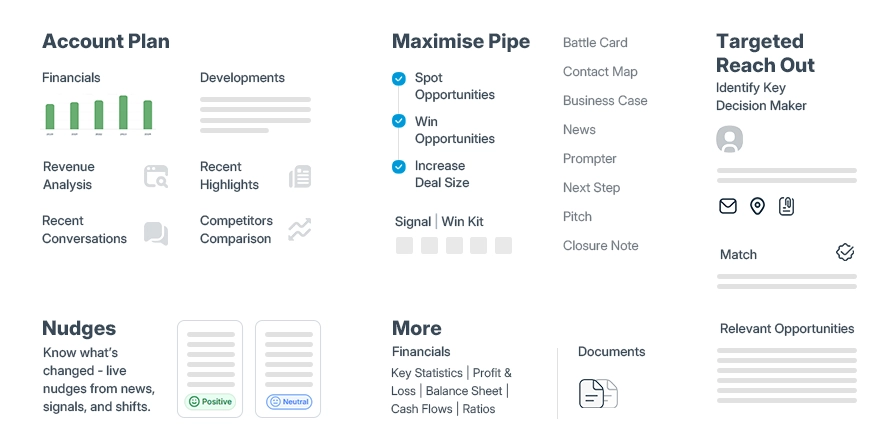
The "Spot Opportunities" Agent
While competitors wait for a lead to fill out a form, our Spot Opportunities Agent is scanning the horizon. It identifies:
-
Latent Use Cases: New applications for your product based on shifting industry trends.
-
Client-of-Client Signals: Predicting your prospect's needs based on their customers' demands.
-
Ecosystem Shifts: Alerting you when a partner or competitor makes a move that opens a door for you.
The "Targeted Reach-Out" Agent
Knowing who to call is half the battle; knowing what to say is the rest. Our agent doesn't give you a generic template. It crafts hyper-personalized messaging based on the specific signal.
-
Instead of: "Can I have 15 minutes to show you our logistics software?"
-
SalesPlay Script: "I saw your competitor just opened a facility in Vietnam. Based on current supply chain bottlenecks in that region, you’ll likely face compliance delays. We can solve that before it impacts your Q3 shipments."
Ready to turn your Rep
INTO BEST PERFORMER ?
Implementing Revenue Intelligence 2.0: A Strategic Roadmap
Moving to this model requires a cultural shift as much as a technological one. Here is how forward-thinking sales leaders are making the transition:
Phase 1: Audit Your Blind Spots
Look at your "Closed-Lost" deals from the last year. How many were lost because of external factors you missed (e.g., "Budget frozen due to merger," "Competitor had a better specific feature")? This is your "Intelligence Gap."
Phase 2: Define Your Signals
What actually drives your sales?
-
If you sell office furniture, your signals are New Leases and Hiring Sprees.
-
If you sell cybersecurity, your signals are Regulatory Fines and CTO Changes.
-
Configure SalesPlay to listen for these specific triggers.
Phase 3: Enable the "Market-First" Motion
Train your reps to start every day not by looking at their task list, but by looking at their Signal Feed. The first hour of the day should be spent reacting to the market's overnight moves.
Conclusion: See the Wave Before It Crashes
The era of relying solely on intuition and internal CRM data is ending. In a volatile global economy, the "Internal Truth" is simply not enough. You cannot drive a car by only looking at the speedometer; you must look at the road.
Revenue Intelligence 2.0 is that view of the road. It requires a marriage of internal execution data and external market signals. It demands the ability to see the wave before it crashes.
With SalesPlay, you possess the only tool powered by the intelligence of MarketsandMarkets. You don't just watch the market—you anticipate it, you understand it, and you win it.
Frequently Asked Questions (FAQs) on Revenue Intelligence 2.0
1. What is the fundamental difference between Revenue Intelligence (RI) 1.0 and RI 2.0?
The fundamental difference lies in the data source and focus. RI 1.0 focuses on internal execution data (CRM notes, call recordings, emails) and aims for sales efficiency. It tells you what happened inside your pipeline. RI 2.0 fuses that internal data with external market-level signals (regulatory changes, M&A activity, funding rounds) to drive sales effectiveness. It tells you what is happening outside your pipeline to identify true intent and urgency.
2. What are "market-level signals" and why are they crucial?
Market-level signals are external, quantifiable data points that indicate a prospective customer's high propensity to buy or a change in their strategic direction. They are crucial because they allow sales teams to intercept the B2B buyer journey in the 83% of the time when the buyer is researching independently. These signals provide the critical "Why Now?" context needed for hyper-relevant outreach.
3. How does relying solely on CRM data (RI 1.0) become a "trap"?
Relying solely on CRM data creates an "echo chamber." The CRM only contains information that your sales team has logged or gathered through direct interaction. It is blind to major external events—like budget cuts, leadership changes, or competitive launches—that occur outside your funnel, leading to inaccurate forecasting and wasted time chasing "zombie deals" with zero market urgency.
4. What are examples of the three main types of market-level signals?
The three main types of signals are:
-
Macro-Economic/Regulatory: A new environmental regulation affecting a specific manufacturing sector.
-
Corporate Strategy (M&A/Funding): A company announcing a Series B funding round or acquiring a key competitor.
-
Technographic Shifts: A prospect uninstalling a legacy software solution and actively posting job listings for "Cloud Migration Specialists."
5. How does AI process market data to generate these signals?
AI utilizes Natural Language Processing (NLP) to turn massive amounts of unstructured data (news articles, patent filings, earnings reports) into actionable intelligence. The AI identifies key entities, determines the sentiment and category of the event (e.g., "Expansion" vs. "Litigation"), and then maps that event to your ideal customer profile (ICP) to generate a High Propensity Opportunity alert.
6. How does SalesPlay leverage the MarketsandMarkets connection?
SalesPlay's advantage stems from its foundation on MarketsandMarkets data. While generic RI tools scrape the public web, SalesPlay leverages MnM's deep, proprietary market research and industry reports, providing an unparalleled understanding of market structure and strategic shifts. This allows SalesPlay's AI Agents to identify latent use cases and client-of-client signals that others miss.
7. What is the measurable impact of implementing Revenue Intelligence 2.0?
Organizations implementing RI 2.0 see significant measurable improvements, including:
-
Up to 35% higher win rates due to contextual relevance.
-
20-30% shorter sales cycles by engaging prospects when they have an active, urgent need.
-
A reduction in forecasting error rates by 30-50%.
Ready to upgrade your Intelligence?
Would you like me to generate a sample "Signal-Based Outreach Sequence" for one of your specific target personas to demonstrate the power of context?
Get Your Demo Now