Automotive Lighting Market

Automotive Lighting Market for ICE & Electric Vehicle, by Technology (Halogen, LED, Xenon/HlD), Position, and Application (Front, Rear, Side, Interior), Adaptive Lighting, Electric Vehicle, Two-wheeler Position Type, and Region - Global Forecast to 2033




OVERVIEW
Source: Secondary Research, Interviews with Experts, MarketsandMarkets Analysis
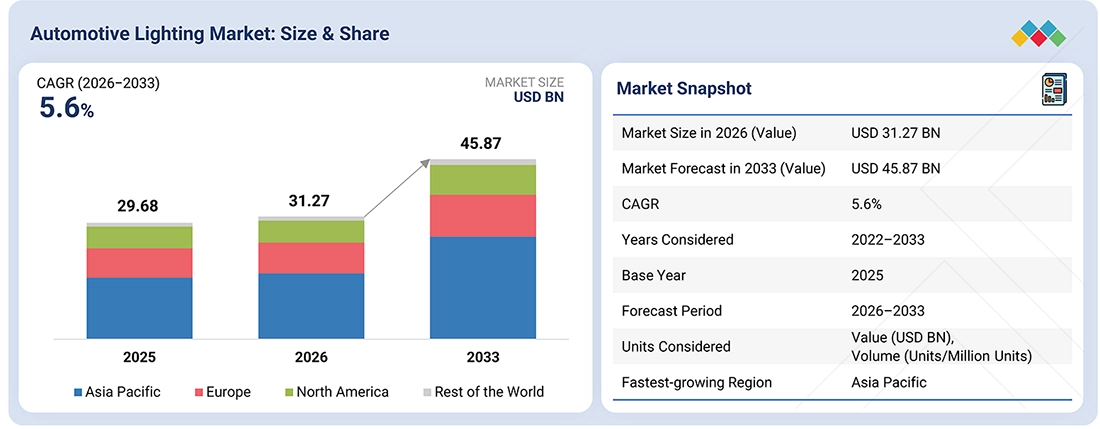
The global automotive lighting market is projected to grow from USD 31.27 billion in 2026 and is expected to reach USD 45.87 billion by 2033, at a CAGR of 5.6% during the forecast period (2026 to 2033). Market growth is primarily driven by increasing vehicle production, rising adoption of LED and advanced lighting technologies, growing vehicle electrification, and increasing focus on road safety and visibility. The adoption of adaptive driving beam systems, high-resolution LED, pixel-based lighting, and intelligent exterior lighting is enabling improved visibility, safety, and vehicle design flexibility. The increasing integration of lighting with ADAS, connected vehicle systems, and software-defined vehicle architectures is creating demand for electronically controlled and software-enabled lighting functions. In parallel, growing demand for energy-efficient lighting, personalized vehicle design, and advanced interior and exterior lighting is increasing lighting content per vehicle across passenger and commercial vehicles.
KEY TAKEAWAYS
-
AUTOMOTIVE LIGHTING MARKET, BY REGIONThe Asia Pacific region, in terms of value, is projected to account for the largest share of the global automotive lighting market in 2026.
-
BY TECHNOLOGYBy technology, LED is expected to record a CAGR of 5.4% from 2026 to 2033.
-
BY VEHICLE TYPEBy vehicle type, passenger cars are likely to register a CAGR of 4.0%, while trucks are expected to be the fastest-growing segment, with a CAGR of 4.6% during the forecast period.
-
BY APPLICATIONBy application, exterior lighting is projected to account for the largest share of the automotive lighting market, registering a CAGR of 3.9% during the forecast period.
-
COMPETITIVE LANDSCAPE - KEY PLAYERSMajor market players continue to adopt both organic and inorganic growth strategies, including product launches, electrification initiatives, strategic partnerships, acquisitions, technology development, and regional expansion. Key players include Koito Manufacturing Co., Ltd. (Japan), Valeo SA (France), Marelli Holdings Co., Ltd (Japan), HELLA GmbH & Co. KGaA (Germany) and Stanley Electric Co., Ltd (Japan).
-
COMPETITIVE LANDSCAPE - STARTUP/SME PLAYERSThe automotive lighting market includes several smaller and emerging players focusing on specialized lighting technologies, optical solutions, semiconductor based lighting, and customized automotive lighting systems. Companies such as Keboda Technology Corp., Seoul Semiconductor Co., Ltd., Zizala Lichtsysteme GmbH, and Lumax Industries are strengthening their positions through technology development, advanced lighting solutions, manufacturing expansion, and partnerships with automotive OEMs. These players contribute to market competition by addressing growing demand for LED, intelligent, high resolution, and energy efficient automotive lighting solutions.
In the automotive lighting market, demand is closely linked to global ICE vehicle production and increasing adoption of electric vehicles. It is combined with the stringent vehicle safety regulations, growing ADAS features, and demand for differentiated vehicle design. Across passenger cars, commercial vehicles, and electric vehicles, OEMs are adopting LED, adaptive driving beam, high-definition pixel, and intelligent lighting systems equipped with advanced optical modules, electronic control units, sensors, and software-based functions to improve visibility, safety, energy efficiency, and vehicle styling. Future growth is expected to be supported by continued transition from conventional lighting to LED and high-resolution systems, expansion of adaptive and connected lighting technologies, increasing integration of lighting with ADAS and vehicle electronics, growing demand for thin and lightweight lighting architectures, and investments in electronically controlled, software-defined lighting solutions.
TRENDS & DISRUPTIONS IMPACTING CUSTOMERS' CUSTOMERS
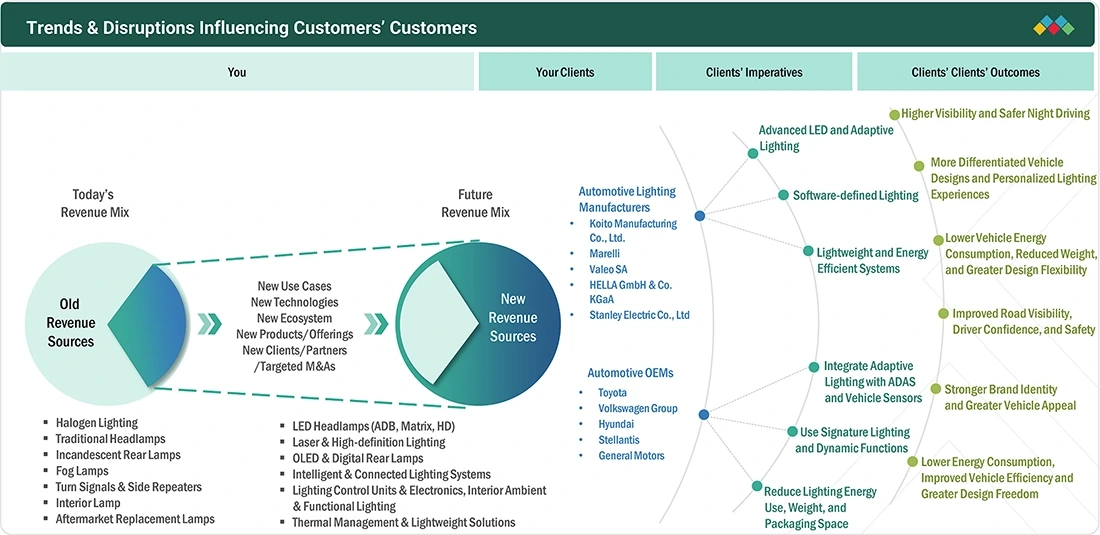
Automotive lighting is moving toward intelligent, electronically controlled and design-oriented systems, with LED penetration continuing to increase and lighting content per vehicle rising through functions such as adaptive driving beam, dynamic beam control and electronically controlled light signatures. Matrix LED and OLED technologies are gaining traction primarily in premium and upper segment vehicles, where individually controlled light sources support adaptive beam functions, customized signatures, and new exterior communication features, rather than being widespread across mainstream vehicles. At the same time, lighting is becoming more closely integrated with vehicle electronics and sensing systems, allowing headlights to respond to road conditions, vehicle dynamics, and surrounding traffic, while rear and exterior lighting is increasingly being used for brand differentiation and communication with other road users.
Source: Secondary Research, Interviews with Experts, MarketsandMarkets Analysis
MARKET DYNAMICS

Level
-
Transition toward software-defined vehicles

-
Stricter automotive lighting regulations


Level
-
Delayed commercialization of next-generation lighting technologies due to long vehicle development cycles

-
Limited adoption of premium lighting solutions due to proliferation of low-cost aftermarket LED retrofits


Level
-
Recurring revenue creation with software-defined and feature-on-demand lighting solutions

-
Growing trend of intelligent exterior lighting for autonomous mobility and V2X communication


Level
-
Managing thermal performance and durability of high-performance lighting systems

-
Integration of AI and software-driven capabilities in adaptive lighting systems

Source: Secondary Research, Interviews with Experts, MarketsandMarkets Analysis
Driver: Transition toward software-defined vehicles
The transition toward software-defined vehicles is driving growth of the automotive lighting market as OEMs increasingly integrate lighting systems with vehicle electronics, ADAS, connectivity, and centralized computing architectures. Advanced lighting systems are evolving beyond illumination and signaling to support adaptive beam control, dynamic vehicle signatures, road projection, and vehicle-to-environment communication. Software-controlled LEDs, high-definition pixel lighting, and programmable exterior lighting enable automakers to introduce new functions through software updates, improve vehicle personalization, and integrate lighting with broader vehicle operating systems, creating additional demand for intelligent and electronically controlled lighting solutions.
Restraint: Delayed commercialization of next-generation lighting technologies due to long vehicle development cycles
Despite increasing demand for advanced lighting technologies, long vehicle development cycles remain a key restraint on market growth. High-definition adaptive lighting, OLED, laser projection, and software-controlled systems require extensive optical, electronic, thermal, software, and vehicle-level validation before entering mass production. In addition, lighting technologies must comply with regional homologation and safety requirements, requiring significant testing and engineering resources. These lengthy development and validation processes can delay commercialization, particularly for emerging technologies, while increasing development costs and limiting the speed at which OEMs can introduce next-generation lighting functions across vehicle platforms.
Opportunity: Recurring revenue creation with software-defined and feature-on-demand lighting solutions
The increasing adoption of software-defined and feature-on-demand lighting presents a significant growth opportunity for the automotive lighting market. Programmable lighting architectures allow OEMs to activate or upgrade functions such as adaptive beam patterns, personalized light signatures, dynamic animations, and advanced projection features through software. As vehicles become connected and electronically upgradeable, lighting manufacturers can develop modular hardware and software platforms that support additional functions throughout the vehicle lifecycle. This creates opportunities for recurring software revenue, premium feature packages, remote upgrades, and differentiated lighting experiences while enabling OEMs to increase the value generated from installed lighting hardware.
Challenge: Managing thermal performance and durability of high-performance lighting systems
Managing thermal performance and durability remains a key challenge for high-performance automotive lighting systems. Advanced LED, laser, matrix, and high-definition lighting modules generate heat within increasingly compact lamp packages, requiring efficient heat dissipation, thermal interfaces, and optimized optical and electronic architectures. Excessive temperatures can reduce LED performance, accelerate component degradation, and affect optical output and system reliability. Manufacturers must, therefore, balance higher light intensity and pixel density with packaging constraints, energy efficiency, environmental exposure, and long vehicle lifecycles, while maintaining consistent performance under varying temperature, vibration, moisture, and operating conditions.
AUTOMOTIVE LIGHTING MARKET: COMMERCIAL USE CASES ACROSS INDUSTRIES
| COMPANY | USE CASE DESCRIPTION | BENEFITS |
|---|---|---|
 |
Provides "Signal Road Projection" headlamps for the Toyota Corolla Cross, projecting a V-shaped light signal onto the road in synchronization with the turn indicator to communicate the vehicle’s intended movement to pedestrians and nearby drivers. The system uses one LED and two lenses in a compact unit. | Improves vehicle visibility and movement recognition at intersections and during turns, helping surrounding road users understand the vehicle’s intention earlier and supporting preventive safety. |
 |
Provides ultra-thin ThinBilite headlamps and RGB front fascia lighting for the Lynk & Co Z10, incorporating 224 RGB LEDs and 256 lighting colors into the front fascia of a production vehicle. | Enables stronger exterior design differentiation and personalization, while the 15 mm ThinBilite headlamp supports more compact front end packaging and greater styling flexibility. |
 |
Provides Digital OLED 2.0 rear lighting for the Audi Q6 e tron, using 60 individually controllable OLED segments connected through a domain architecture. The system supports multiple digital light signatures and communication functions. | Enables personalized rear lighting, dynamic light communication, and improved interaction with surrounding road users, while allowing the rear lamp to function as an exterior display. |
 |
Provides SSL HD high resolution matrix headlamps for the Zeekr 8X, with approximately 25,000 individually controllable LED pixels per headlamp. The system provides adaptive lighting and can project lane guidance and warning information onto the road. | Improves active lighting functionality and driver guidance through precise road projections while reducing installation space by up to 75%, supporting lower packaging requirements and greater vehicle design freedom. |
 |
Provides granular surface emitting rear lamps that use a high lumen LED socket and specially designed light guide to produce uniform, high brightness illumination. The technology has already been adopted in mass produced vehicles. | Improves rear lamp visibility for following vehicles, with Stanley verification tests showing approximately two seconds earlier recognition compared to its previous models, supporting earlier driver response, and improved rear-end collision avoidance potential. |
Logos and trademarks shown above are the property of their respective owners. Their use here is for informational and illustrative purposes only.
MARKET ECOSYSTEM
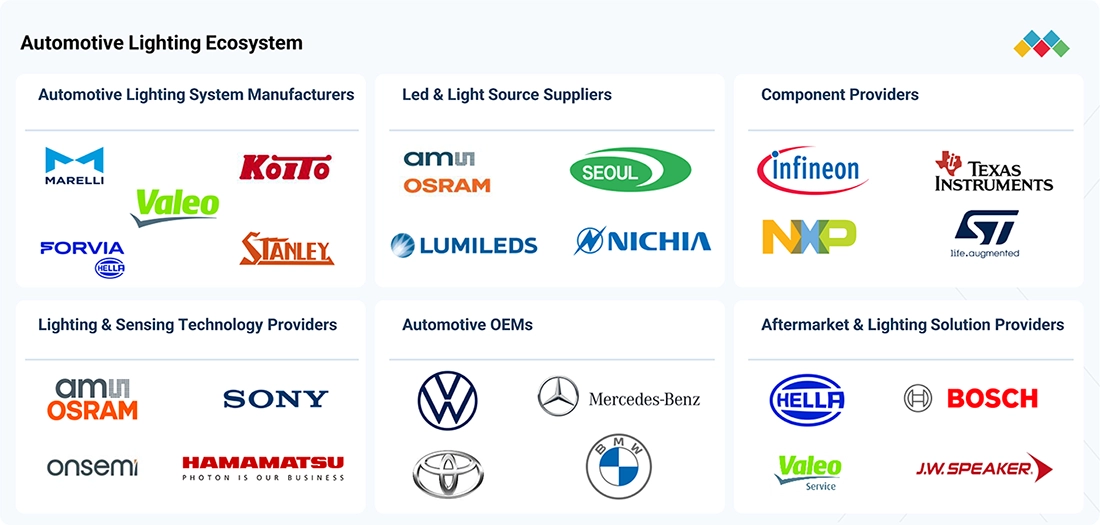
The automotive lighting ecosystem comprises automotive lighting system manufacturers, LED and light source suppliers, component providers, lighting and sensing technology providers, automotive OEMs, and aftermarket and lighting solution providers. Market demand is driven by increasing vehicle production, vehicle electrification, stringent lighting and safety regulations, and growing adoption of advanced lighting architectures. The supply chain is supported by LED and laser technologies, semiconductor and electronic components, optical and sensing technologies, adaptive lighting systems, and intelligent control solutions that enhance vehicle visibility, safety, energy efficiency, and design flexibility. Collaboration among lighting manufacturers, technology suppliers, automotive OEMs, and aftermarket providers is accelerating the transition toward LED, adaptive driving beam, high-definition, OLED, connected, and software-controlled lighting systems, enabling improved road illumination, differentiated vehicle design, lower energy consumption, and advanced vehicle functionality across global automotive markets.
Logos and trademarks shown above are the property of their respective owners. Their use here is for informational and illustrative purposes only.
MARKET SEGMENTS
Source: Secondary Research, Interviews with Experts, MarketsandMarkets Analysis
BY TECHNOLOGY
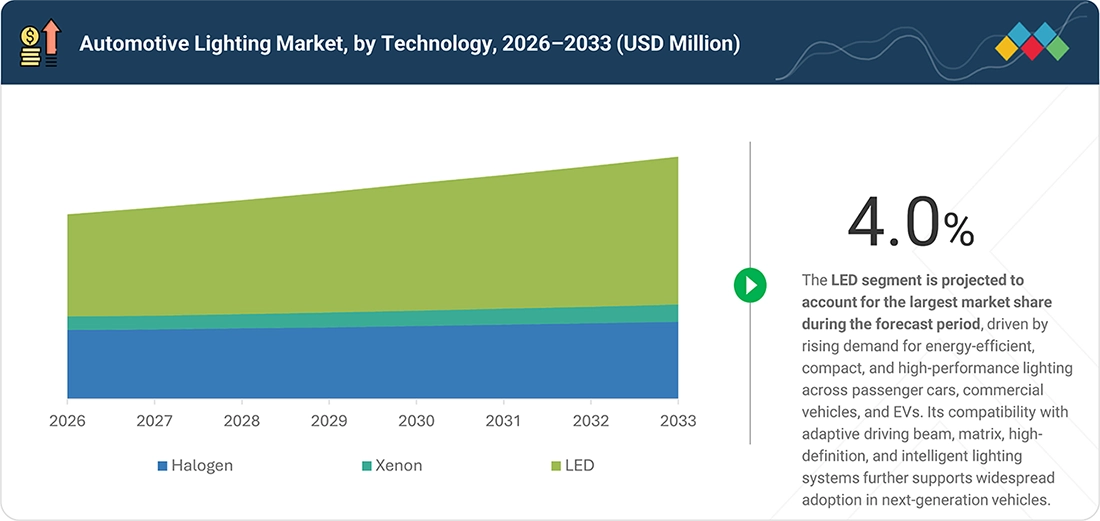
LED lighting accounts for the largest market share in the automotive lighting market, driven by its higher energy efficiency, longer operating life, compact packaging, and compatibility with advanced lighting architectures. LED systems are increasingly adopted across passenger cars, commercial vehicles, and electric vehicles, supporting applications such as headlamps, daytime running lights, rear lamps, and adaptive lighting systems. Their ability to support matrix, high-definition, and electronically controlled lighting functions makes LED the preferred technology for modern vehicle platforms and increasingly replaces conventional halogen and xenon systems.
BY VEHICLE TYPE
Passenger cars hold the largest share of the automotive lighting market because they account for the largest vehicle production base globally, supported by substantial ICE and EV volumes. In 2025, ICE vehicles represented 77.1% and EVs 22.9% of total vehicle production, creating demand for lighting across both powertrain types, while the global passenger car production base remained substantially larger than commercial vehicle production. Passenger cars also have a higher number of lighting applications per vehicle, including headlamps, DRLs, position lamps, turn signals, tail lamps, stop lamps, reverse lamps and interior lighting, with advanced models adding adaptive, matrix and high-definition systems. ADAS adoption and safety regulations also vary by region, vehicle body type and price segment, creating different lighting requirements, while regulations such as UNECE Regulation No. 123 specifically address adaptive front lighting systems. OEMs are, therefore, using passenger cars across regions and price segments to introduce and demonstrate new lighting technologies, from LED and adaptive systems to digitally controlled and communication-capable lighting. Together, the larger production base, broader lighting content, EV penetration, regulatory requirements and OEM technology deployment support passenger cars as the largest automotive lighting application.
BY APPLICATION
Exterior lighting maintains the dominant position in the automotive lighting market, supported by its essential role in road illumination, signaling, vehicle visibility, and regulatory compliance. Exterior systems include headlamps, daytime running lights, fog lamps, tail lamps, and side lighting, with increasing adoption of LED, adaptive, high-definition, and connected lighting technologies. The integration of exterior lighting with ADAS, vehicle electronics, and communication functions is creating additional demand for intelligent lighting systems, while automakers are increasingly using exterior illumination for vehicle styling, brand identity, and improved nighttime driving safety.
EV, BY TECHNOLOGY
EVs are projected to record the fastest growth in automotive lighting as their adoption is expanding across different regional price and technology segments, creating new lighting content opportunities. China is driving high volume through increasingly price-competitive EVs, while India remains an emerging, more cost-sensitive EV market. Europe has a stronger mix of higher specification EVs, while North America continues to have a predominantly large car and SUV-oriented EV portfolio, creating greater scope for higher lighting content. This variation in vehicle positioning and regional requirements influences the number of lighting applications and technology content per EV, from efficient core lighting in cost-sensitive models to more electronically controlled functions in higher specification vehicles. Looking ahead, EV-specific electrical architectures, greater ADAS and sensor integration, software-controlled functions and vehicle communication networks will allow lighting to interact with multiple vehicle systems and support functions that can be updated or managed through software. Therefore, expanding EV volumes across both value-focused and higher-specification markets, combined with rising electronic and software content, is expected to drive faster growth in automotive lighting demand.
REGION
Asia Pacific is likely to be the fastest-growing market for automotive lighting
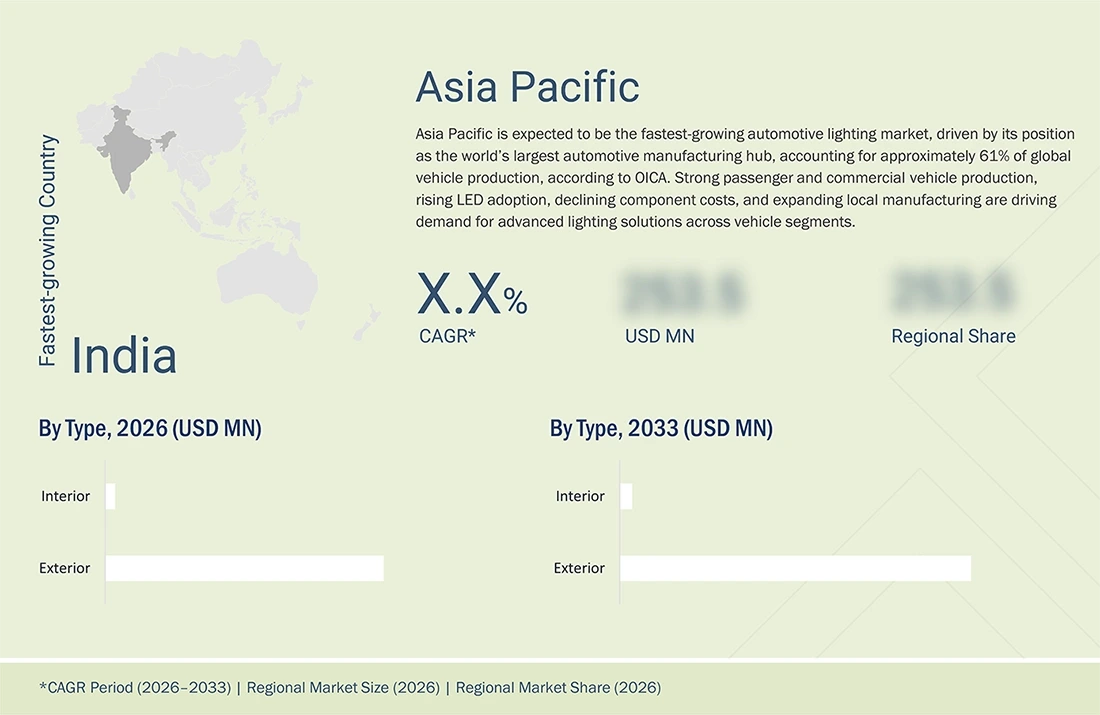
Asia Pacific is expected to be the fastest-growing automotive lighting market, supported by its position as the world’s largest automotive manufacturing hub, accounting for approximately 61% of global vehicle production, according to OICA. China, Japan, India, and South Korea account for substantial passenger vehicle production across economy, mid-range, and premium segments, creating diverse lighting demand. Declining component costs and expanding local manufacturing are accelerating the adoption of LED headlamps, DRLs, ambient lighting, ORVM lighting, and ADAS-linked lighting functions across vehicle segments. Strong commercial vehicle production in China, India, Japan, and Southeast Asia further supports demand for headlamps, signal lamps, rear lamps, and LED-based systems, reinforcing Asia Pacific’s growth prospects.
AUTOMOTIVE LIGHTING MARKET: COMPANY EVALUATION MATRIX
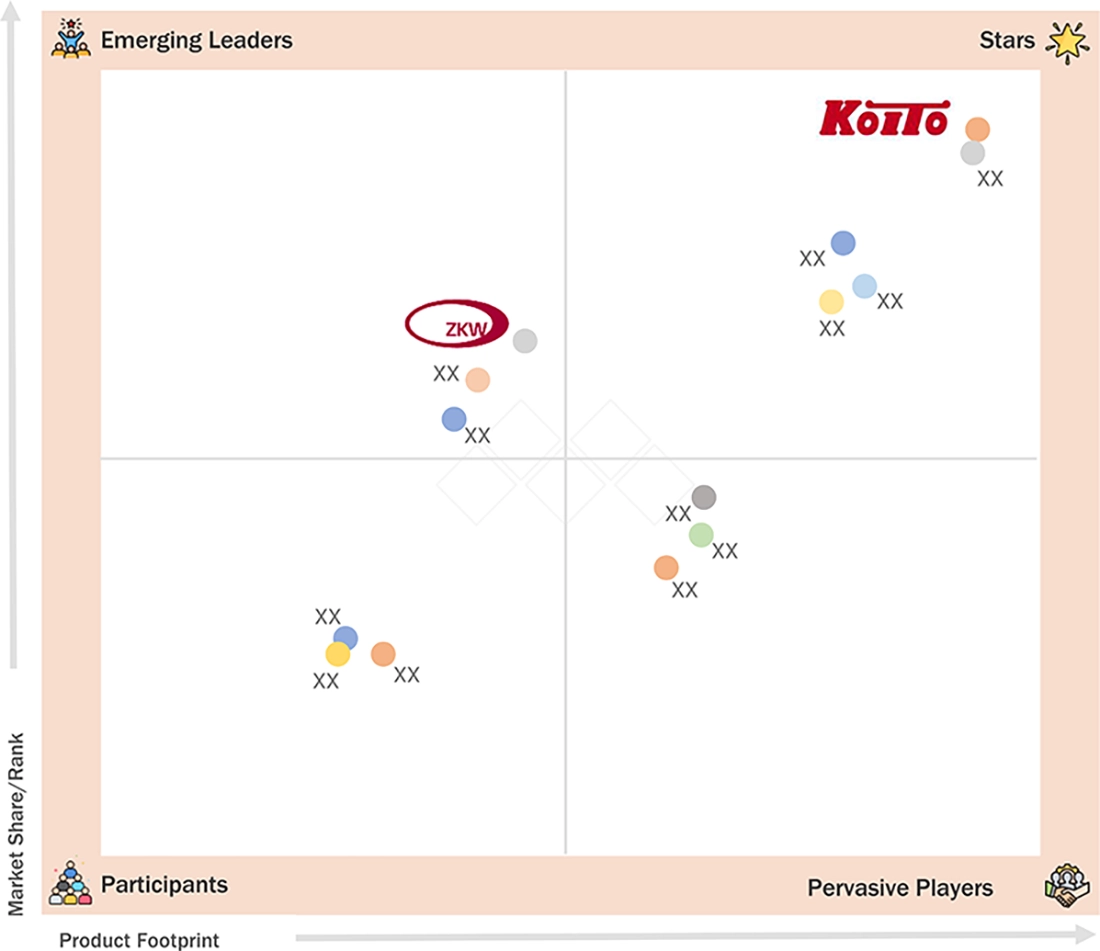
In the automotive lighting market matrix, Koito Manufacturing (Star) leads with a broad portfolio of LED, adaptive driving beam, high-definition and advanced optical lighting systems, supported by extensive OEM relationships, global manufacturing capabilities, and continued investment in next-generation lighting technologies. ZKW Group (Emerging Leader) is strengthening its position through premium LED and laser headlamps, compact optical modules and advanced lighting system integration, supported by its technology relationship with LG Electronics and strong presence across premium vehicle programs.
Source: Secondary Research, Interviews with Experts, MarketsandMarkets Analysis
KEY MARKET PLAYERS
- Koito Manufacturing Co., Ltd. (Japan)
- Marelli Holdings Co., Ltd. (Japan)
- Valeo SA (France)
- HELLA GmbH & Co. KGaA (Germany)
- Stanley Electric Co., Ltd (Japan)
- OSRAM GMBH (Germany)
- CONTINENTAL AG (Germany)
- HYUNDAI MOBIS (South Korea)
MARKET SCOPE
| REPORT METRIC | DETAILS |
|---|---|
| Market Size in 2026 (Value) | USD 31.27 Billion |
| Market Forecast in 2033 (Value) | USD 45.87 Billion |
| Growth Rate | CAGR of 5.6% from 2026-2033 |
| Years Considered | 2022-2033 |
| Base Year | 2025 |
| Forecast Period | 2026-2033 |
| Units Considered | Value (USD Billion), Volume (Million Units and Units) |
| Report Coverage | Revenue forecast, company ranking, competitive landscape, growth factors, and trends |
| Segments Covered | Automotive Lighting Market, By Technology, Application, Vehicle Type; Adaptive Lighting Market, By Type; Electric Vehicle Lighting Market, By Vehicle Type, Technology, Application; Two-wheeler Lighting Market, By Position; Automotive Lighting Market, By Region |
| Regions Covered | Asia Pacific, Europe, North America, and Rest of the World |
WHAT IS IN IT FOR YOU: AUTOMOTIVE LIGHTING MARKET REPORT CONTENT GUIDE
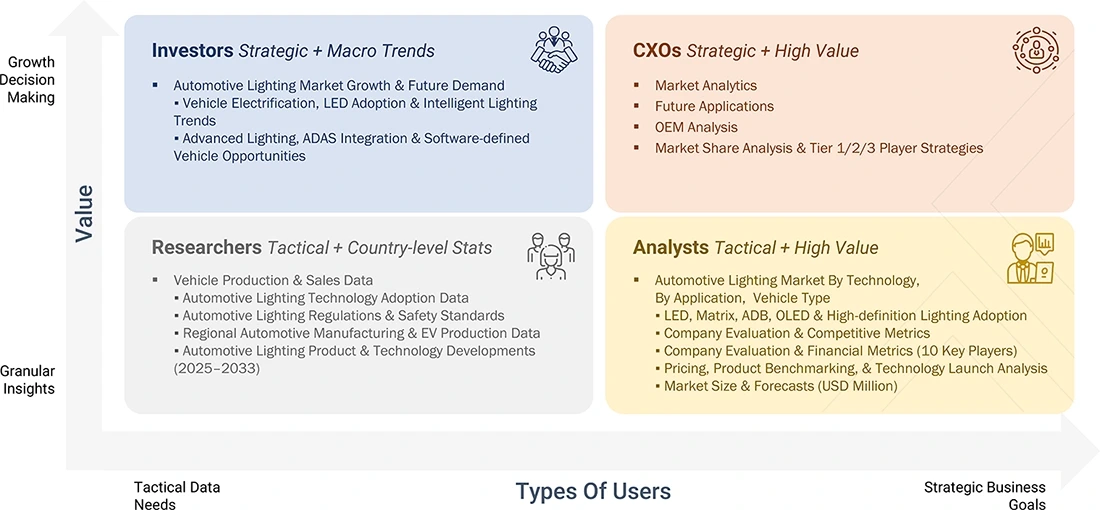
DELIVERED CUSTOMIZATIONS
We have successfully delivered the following deep-dive customizations:
| CLIENT REQUEST | CUSTOMIZATION DELIVERED | VALUE ADDS |
|---|---|---|
| Lighting technology assessment | Assessed automotive lighting portfolios across LED headlamps, adaptive lighting, rear lamps, interior lighting, lighting electronics and software controlled functions, comparing technology adoption and application penetration. |
|
| ADAS integrated lighting | Assessed integration of lighting with cameras, sensors, and ADAS functions, including adaptive beam control, glare free high beam, road illumination and visual alerts. | Helps prioritize lighting applications that improve visibility, safety, and interaction with ADAS functions |
| Software controlled lighting | Evaluated dynamic signatures, programmable lighting functions, lighting communication and integration with centralized vehicle architectures and software defined vehicles. | Supports technology roadmap planning and identifies opportunities for software-enabled personalization and new lighting functions |
| Application and segment opportunities | Assessed lighting adoption across passenger cars, LCVs, trucks and buses, covering LED, DRLs, ambient lighting, functional lighting and electronically controlled systems across regions and price segments. | Helps prioritize high-potential applications, align product development with vehicle requirements, and identify regional expansion opportunities |
RECENT DEVELOPMENTS
- April 2026 : Valeo and RESRG Automotive extended their strategic partnership for illuminated exterior surfaces. The expanded agreement covers illuminated front panels, as well as grilles, bumpers, spoilers, tailgates, and rocker panels. The partnership also expands into China, supporting Valeo's strategy of integrating lighting into vehicle exterior surfaces for styling, personalization, and communication.
- April 2026 : Marelli expanded its advanced lighting portfolio at Auto China 2026 with a production-ready Thin Corner-to-Corner Headlamp, Flat Lit Surface digital rear lighting, and 25 K- and 40 K-pixel MicroLED technologies. The portfolio expansion strengthens Marelli's capabilities in high-resolution ADB, digital rear lighting, personalization, vehicle communication, and software-defined lighting.
- March 2026 : FORVIA HELLA introduced Galaxy Diamond Matrix Headlamps for the Zeekr 8X, featuring approximately 25,000 individually controllable LED pixels per headlamp. The SSL | HD-based system delivers high-resolution adaptive lighting, enhanced energy efficiency, and intelligent light-based communication functions.
- January 2026 : Stanley Electric agreed to acquire Iwasaki Electric, a company based in Tokyo, for a total value of JPY 70.29 billion (approximately USD 456 million). This acquisition will enhance Stanley Electric's capabilities in lighting and electronics, as well as expand its product range and customer base. Once the transaction is completed, it will strengthen the company's competitive position in the market.
Table of Contents
 Exclusive indicates content/data unique to MarketsandMarkets and not available with any competitors.
Methodology
This research study involves the extensive use of secondary sources, such as company annual reports/presentations, industry association publications, industry magazine articles, directories, technical handbooks, World Economic Outlook, technical articles, and databases, to identify and collect information on the automotive lighting market. In-depth interviews have been conducted with various primary respondents, including key industry participants, subject-matter experts, C-level executives of key market players (Lighting Manufacturers, Tier 2 Suppliers, and OEMs), and industry consultants, among other experts, to obtain and verify critical qualitative and quantitative information and assess market prospects.
Secondary Research
In the secondary research process, various secondary sources have been used to identify and collect information relevant to an extensive commercial study of the automotive lighting market. These sources include company annual reports and presentations, press releases, and industry association publications such as those from the American Lighting Association (ALA), Canadian Automobile Association (CAA), China Association of Automobile Manufacturers (CAAM), European Automotive Lighting Association (EALA), International Forum on Automotive Lighting (IFAL), Automotive Component Manufacturers Association of India (ACMA), and European Automobile Manufacturers Association (EAAMA), among others. Additionally, secondary research has been conducted to understand the average number of various lights by vehicle type, historical vehicle production, and sales of new vehicles.
Primary Research
Extensive primary research has been conducted after developing an understanding of the global automotive lighting market through secondary research. Several primary interviews have been conducted with market experts from both the demand side, including OEMs, and the supply side, including automotive lighting manufacturers and distributors, across four major regions, namely, North America, Europe, Asia Pacific, and Rest of the World (RoW). Approximately 25% and 75% of the primary interviews have been conducted with demand and supply side participants, respectively. Primary data has been collected through questionnaires, emails, and telephone interviews. Interviews have been conducted with professionals across different organizational functions, including sales, operations, and technical support, to provide a well-rounded perspective for the report.
Primary interviews have been conducted to gather insights such as ICE vehicle production and electric vehicle sales forecast, automotive lighting market forecast and penetration rate, future technology trends, and upcoming technologies in the automotive lighting industry. Data triangulation has been done with the information gathered from secondary research. Stakeholders from the demand and supply side have been interviewed to understand their views on the points mentioned above.
Breakdown of Primaries

Note: Tiers of companies are based on the supply chain of the automotive lighting market; companies’ revenues have not been considered.
To know about the assumptions considered for the study, download the pdf brochure
Market Size Estimation
A detailed market estimation approach has been followed to estimate and validate the value and volume of the automotive lighting market and other dependent submarkets, as mentioned below:
- The bottom-up and top-down approaches have been used to estimate and validate the size of the Automotive Lighting Market. For the bottom up approach, vehicle production data by country and vehicle type is obtained from secondary sources, automotive associations at country level, followed by identification of lighting applications installed across each vehicle type (passenger cars, light commercial vehicles, trucks, and buses), such as front lighting (headlights, fog lights, DRL, indicators), rear light (tail light, CHMSL, brake light, indicators, license plate, reverse lamps), side lights (side lights, ORVM), interior lights (dashboard, glove box, reading light, dome light, rear view mirror interior light). Vehicle production is multiplied by the number of lighting units installed per vehicle and the applicable penetration of each lighting application and technology to estimate lighting volumes. For instance, passenger vehicle production is multiplied by the number of headlights per vehicle and LED headlamp penetration to estimate the LED headlamp volume, which is then multiplied by the corresponding ASP to derive the technology market value. The average selling price is calculated based on company websites, secondary sources, and associations. The calculations are performed at the country level and aggregated across vehicle types, lighting applications, and technologies to estimate the overall automotive lighting market.
- The market size has been derived using parameters such as vehicle production and sales, vehicle type mix, average number of lighting units installed per vehicle, lighting technology penetration, and corresponding application penetration across the countries considered under the scope.
- Key players in the automotive lighting market have been identified through secondary research, and their global market shares and rankings have been determined through primary and secondary research.
- The research methodology included the study of annual and quarterly financial reports, regulatory filings of major market players, company presentations, press releases, and interviews with industry experts to gain detailed market insights.
- All major penetration rates, percentage shares, splits, and breakdowns for the Automotive Lighting Market have been determined through secondary sources and verified through primary sources.
- All key macro indicators affecting the revenue growth of the market segments and subsegments have been accounted for, reviewed in detail, verified through primary research, and analyzed to obtain validated and qualitative data
Automotive Lighting Market : Top-Down and Bottom-Up Approach

Data Triangulation
After arriving at the overall market size, the market has been split into several segments and sub-segments—using the market size estimation processes as explained above. Data triangulation and market breakdown procedures have been employed to complete the overall market engineering process and determine the exact statistics of each market segment and subsegment. The data has been triangulated by studying various factors and trends.
Market Definition
Automotive lighting: An automotive lighting system consists of various lights and signaling devices that are fitted on the front, rear, side, and interior of the vehicle. These lights perform the basic function of providing illumination to the driver to drive safely in the dark. They may be used to enhance the visibility of an automobile, illuminate the interior, and act as a warning system for other vehicles. Automotive lighting is critical for the safety of vehicles and pedestrians on the road. It warns pedestrians of the vehicle’s presence through exterior lighting.
Adaptive lighting: Adaptive lighting is an active safety feature that operates automatically according to changes in external factors. It is designed to make driving at night or in low-light conditions safer by increasing visibility for and of the host vehicle. The adaptive feature is applied to front headlights, rear brake lights, and hazard lights with technological variants.
Key Stakeholders
- Automotive lighting manufacturers and suppliers
- Automobile OEMs
- Automotive component manufacturers and raw material suppliers
- Traders and distributors of automotive lighting systems
- Automobile organizations/associations and government bodies
- Automotive software manufacturers and providers
- Authorized service centers and independent aftermarket service providers)
Report Objectives
- To define, describe, and forecast the size of the automotive lighting market in terms of value (USD million) and volume (million units & units) for the following segments and subsegments:
- Application {exterior (headlights, fog lights, daytime running lights (DRL), taillights, center high mount stop lamp (CHMSL), and sidelights), and interior (dashboard, glove box, reading lights, and dome lights)}
- Technology (halogen, xenon/HID, LED, OLED, Matrix LED, LASER))
- Vehicle type (passenger car, light commercial vehicles, trucks, and buses)
- Electric & Hybrid vehicle lighting market, vehicle type (BEV, PHEV)
- Electric & Hybrid vehicle lighting market, technology (halogen, xenon/HID, and light emitting diode (LED))
- Electric & hybrid vehicle lighting market, application (interior lighting and exterior lighting)
- Two-wheeler automotive lighting market, by position (front, rear, and side)
- Automotive adaptive lighting market, by type (front adaptive lighting (auto on/off, high beam assist, bending/cornering lights, and headlight leveling), rear adaptive lighting, and ambient lighting)
- Region [Asia Pacific, Europe, North America, and Rest of the World]
- To provide detailed information about the major factors influencing the growth of the market (drivers, restraints, opportunities, and challenges)
- To strategically analyze the market and provide the average selling price (ASP) analysis and patent analysis
- To evaluate opportunities in the market for stakeholders and provide details of the competitive landscape for market leaders.
- To evaluate the dynamics of competitors in the automotive lighting market and distinguish them into stars, emerging leaders, pervasive players, and participants.
- To understand the dynamics of startups/SMEs prevalent in the market ecosystem of the ambient lighting market and distinguish them into progressive companies, responsive companies, dynamic companies, and starting blocks.
- To analyze the recent new developments, expansion strategies, collaborations, partnerships, joint ventures, mergers & acquisitions, and other activities carried out by key players in the automotive lighting market.
- To study the following with respect to the market
-
- Impact of EU-FTA trade deal on automotive & transportation industry
- Impact of Israel-Iran war on automotive & transportation industry
- OEM lighting strategy
- Scenario analysis for LED, OLED, and Micro LED adoption
- Technology readiness assessment
- OEM adoption roadmap
- Future profit pools
- Technology analysis
Available customizations:
Along with the given market data, MarketsandMarkets offers customizations in accordance with a company’s specific needs. The following customization options are available:
The following customization options are available for the report:
- ADAPTIVE MODULE MARKET, BY FUNCTION AND COUNTRY
Auto On/Off Function
Bending/Cornering
High Beam Assist
Headlight Levelling
- TWO-WHEELER AUTOMOTIVE LIGHTING MARKET, BY VEHICLE TYPE
Motorcycle
Scooter/Moped
(Note: Countries included in the study: China, India, Japan, South Korea, Thailand, Germany, UK, France, Spain, Italy, US, Canada, Mexico, Brazil, Russia.
- Detailed analysis and profiling of additional market players (Up to 5)


Personalize This Research
- Triangulate with your Own Data
- Get Data as per your Format and Definition
- Gain a Deeper Dive on a Specific Application, Geography, Customer or Competitor
- Any level of Personalization
Let Us Help You
- What are the Known and Unknown Adjacencies Impacting the Automotive Lighting Market
- What will your New Revenue Sources be?
- Who will be your Top Customer; what will make them switch?
- Defend your Market Share or Win Competitors
- Get a Scorecard for Target Partners

Custom Market Research Services
We Will Customise The Research For You, In Case The Report Listed Above Does Not Meet With Your Requirements
Get 10% Free CustomisationTESTIMONIALS

JIM NAAS
PRODUCT DIRECTOR, WEASLER
Weasler Engineering, a CentroMotion organization
Global Provider of Industrial Actuation & Control Solutionswww.weasler.com
Our organization was interested in learning more about the attractiveness of a particular market space. We contacted MarketsandMarkets to help us based on previous positive experiences we had with them. The results did not disappoint! We discussed our objectives with them, and the team at MarketsandMarkets developed and executed a proposal that met our needs precisely. We were very impressed by their level of expertise, the quality of the analysis and their insightful recommendations. We would not hesitate in working with them again in the future.

Matt Kardel,
Vice President
Aptiv,
A global technology company that develops safer, greener and more connected solutions.www.aptiv.com
We contracted with
MarketsandMarkets to evaluate the value chain and potential go-to-market partners related to our
interest in the Fleet Management space. The team successfully completed the work on time and at the
pricing agreed. MarketsandMarkets listened and understood our objectives and collaborated well with
us to help us get the visibility we needed to make an investment.
We have subsequently used
MarketsandMarkets again related to Smart Cities to good results.
- China Automotive Lighting Market
- Japan Automotive Lighting Market
- South Korea Automotive Lighting Market
- India Automotive Lighting Market
- Germany Automotive Lighting Market
- France Automotive Lighting Market
- Spain Automotive Lighting Market
- UK Automotive Lighting Market
- Canada Automotive Lighting Market
- Mexico Automotive Lighting Market
- US Automotive Lighting Market
- Brazil Automotive Lighting Market
- Iran Automotive Lighting Market
- Rest Of Europe Automotive Lighting Market
- Rest Of Asia Pacific Automotive Lighting Market
Growth opportunities and latent adjacency in Automotive Lighting Market




User
Nov, 2019
We were wondering if the report has historical yearly market sizes from 2010 to the current year (e.g. market sizes for total automotive lighting and LED lighting for 2010, 2011, 2012...2016)?.
User
Nov, 2019
I am looking for a automotive lighting market analysis for my MMBA thesis. Thanks for any support..
User
Nov, 2019
I am looking for a reliable source of clear and conclusive quantitative data. Your report above seems to contain what I need, but also many other items of information that I certainly do not need. Main topics of interest:- Car Interior Lighting Market size and growth - Car Interior technologies and their relative importance over time - Main players (designers and makers of car interior lighting solutions in terms of market share). Supply chain of car interior lighting (for the most common applications/functions). I was wondering if you could offer a customised report with this information and if so, under what conditions. Please contact my by email, phone is not preferred due to frequent traveling and meetings. Thank you in advance!.
User
Nov, 2019
We are a supplier to the Automotive Lighting Industry and I am interested to see if this report is specific with trends by manufacture and or information on Tier 2 suppliers. .
User
Nov, 2019
Current status and future outlook of the car lighting market, including a split between different technologies: LED, halogen, Xenon. Ideally also a split by brand (which brand will use which technology).
User
Nov, 2019
Understand the automotive light market specifically for India with Global Trends in Automotive Lighting.
User
Nov, 2019
Hi would require this today for preparation for an interview with Osram Market size in UK and growth area for automotive lighting and online platform how to target.
User
Nov, 2019
1/In which form is the report delivered? 2/Can we also get the raw data in form a database excel? 3/For passenger car would it be possible to have an analyzis by vehicle segments (A, B, C, D, .....)?.
User
Nov, 2019
Automotive front lighting technologies, specifically penetration rates of LEDs going forward (e.g. by 2018, 2023, etc.).
User
Nov, 2019
Before ordering the report, I would like to get the sample for evaluation. Thanks in advance, Best regards,.