CNG Tanks Market

CNG Tanks Market by Tank Type (Type 1, Type 2, Type 3, Type 4), Material Type (Metal, Glass Fiber, Carbon Fiber), Vehicle Type (Light-Duty, Medium-Duty, Heavy-Duty), Application (Fuel Tanks, Transportation Tanks) and Region - Global Forecast to 2031




OVERVIEW
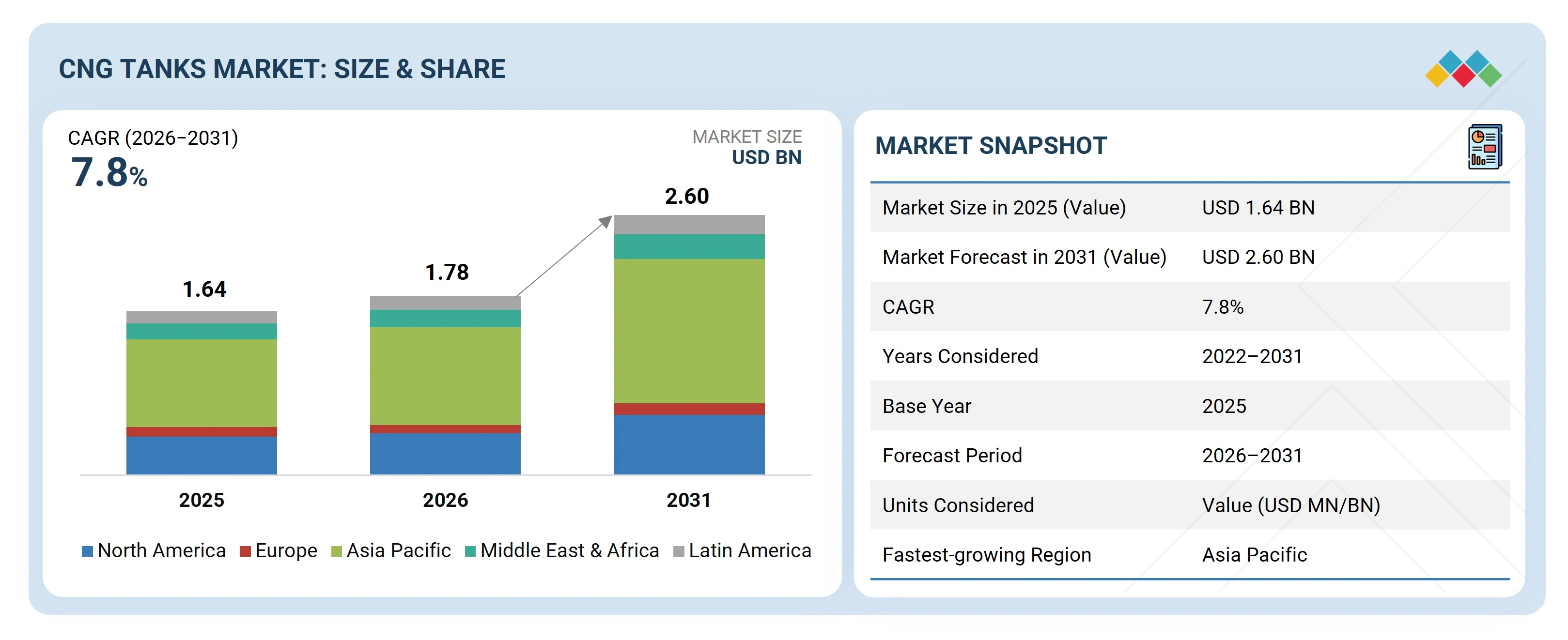
Source: Secondary Research, Interviews with Experts, MarketsandMarkets Analysis
The CNG Tanks market is projected to reach USD 2.60 billion in 2031 from USD 1.78 billion in 2026, at a CAGR of 7.8%. CNG tanks are in increasing demand due to a marked shift toward the use of Compressed Natural Gas, which is cheaper and environmentally friendly. Increasing concerns about the global environment, improvements in tank construction, and the demand for cost-effective fuel in transportation and industrial applications are driving the market. Governments are adopting strategies that include measures to limit the emission of harmful pollutants and improve the use of environmentally sustainable fuels. Thus, CNG tanks have high demand, which is leading to the augmented growth of the market and inventive evolution.
KEY TAKEAWAYS
-
By RegionAsia Pacific dominated the CNG tanks market with a share of 53.4% in terms of value in 2025.
-
By Tank TypeBy tank type, the Type 4 segment is projected to grow at the highest CAGR (12.2%) during the forecast period.
-
By Material TypeBy material type, the metal segment dominated the CNG tanks market with a share of 75.1% in terms of value in 2025.
-
By ApplicationBy application, the fuel tank segment accounted for the largest share in the CNG tanks market.
-
By Vehicle TypeBy vehicle type, the Heavy-duty Vehicle (HDV) segment is projected to register the highest CAGR of 10.0% in the CNG tanks market.
-
Competitive Landscape - Key PlayersWorthington Enterprises (US), Everest Kanto Cylinders (India), Luxfer Gas Cylinders (UK), Hexagon Composite ASA (Norway), and CIMC Enric Holding Limited (China) are star players in the CNG tanks market, given their broad industry coverage and strong operational & financial strength.
-
Competitive Landscape - StartupsGalileo Technologies, Steelhead Composites, Anhui Clean Energy, Jay Fe Cylinders, and Kioshi Compresion have distinguished themselves among startups and SMEs due to their well-developed marketing channels and extensive funding to build their product portfolios.
The global transition to cleaner fuel alternatives together with the increasing use of natural gas vehicles (NGVs) is the main reason for the CNG tank market expansion. Modern CNG storage systems use advanced materials to create Type III and Type IV cylinders from high-strength steel and high-performance carbon fiber composites. The materials deliver essential pressure resistance together with needed durability. They also enhance strength-to-weight ratios which serve as a critical factor for both vehicle payload capacity and fuel economy.The demand for lightweight storage solutions arises from the ongoing growth of commercial fleets which include heavy-duty trucks and public transit buses that need high-capacity tanks for extended driving distances while maintaining their structural strength. The market is experiencing substantial expansion in both Asia Pacific and North America because government incentives and refueling infrastructure expansion together with new automated filament winding process development enable greater production capacity.
TRENDS & DISRUPTIONS IMPACTING CUSTOMERS' CUSTOMERS
Changes in customer trends or disruptions impact consumers’ businesses. These shifts impact the revenues of end users. Consequently, the revenue impact on end users is expected to affect the revenues of CNG tank suppliers, which, in turn, impacts the revenues of CNG tank manufacturers.

Source: Secondary Research, Interviews with Experts, MarketsandMarkets Analysis
MARKET DYNAMICS

Level
-
Increasing use of CNG Tanks in automotive industry

-
Favorable Government policies for promotion of CNG vehicles and infrastructure


Level
-
Scarcity of CNG refueling stations in emerging economies

-
High cost of CNG tanks and regulatory approvals


Level
-
Emergence of light weight composite material based CNG cylinders

-
Increasing support from government for Bio-CNG


Level
-
Impact of fluctuating oil prices on the CNG tanks market

-
Development of electric cars and competition from other alternative fuel

Source: Secondary Research, Interviews with Experts, MarketsandMarkets Analysis
Driver: Favorable Government policies for promotion of CNG vehicles and infrastructure
Government policies, especially the approval of favorable policies regarding the development of the market in the use of CNG-fueled vehicles and increase in the availability of CNG tanks, dramatically stimulates the growth of the market. As a result, governments across the globe are implementing policies and incentives to tackle emission discharge and enable better air quality, which is a direct driver of the consumption of cleaner fuels such as CNG. Subsidizing consumer purchases of CNG vehicles, tax credits for investments in CNG fueling stations, and low emission standards are some of the measures that have compelled consumers and businesses to shift toward the use of CNG vehicles.
Restraint: Scarcity of CNG refueling stations in emerging economies
The lack of CNG refueling stations also acts as a restraint for the CNG tanks market in emerging economies. This has remained a challenge for the use of CNG vehicles in many developing regions as the facility of refueling has not been as well developed as that for gasoline-run vehicles, thus, limiting the demand for CNG tanks. As much as there has been increased use and talk of CNG as a clean fuel, there is limited and often inaccessible refueling infrastructure, which deters both, the consumer and the fleet owner from purchasing vehicles that run on CNG. This infrastructure gap is common as significant capital is required to start the business, and complexities arise from siting refueling stations, especially in the developing world.
Opportunity: Increasing support from government for Bio-CNG
Pressure from governments to fund bio-CNG provides the CNG tanks market with significant opportunities for development. Bio-CNG is made from waste material, food waste products, and organic waste material, such as agricultural residues. Governments around the world are waking up to the importance of bio-CNG as an environmentally friendly fuel and as an important economic driver and are implementing measures to encourage the adoption of the fuel. These measures comprise grants for bio-CNG liquefied production stations, tax credits for bio-CNG vehicles, and grants for advancements in the bio-CNG technology. Therefore, there is an increasing requirement for CNG tanks that are compatible with bio-CNG, given that these can be different from standard CNG tanks.
Challenge:Development of electric cars and competition from other alternative fuel
The fast growth in the demand for electric vehicles and increasing pressures from alternative fuels are major threats to the CNG tanks market. As the technological design of EVs changes, with specialization in battery life, charging provisions, enhanced engineering of vehicles and cars are gradually turning into financially positive initiatives that minimize emissions of polluting gases. The trend is further boosted by government incentives as well as significant investments in charging infrastructure for EVs, which reduces focus on CNG vehicles. The availability of other types of AFVs encompassing other cleaner energies, such as hydrogen and biofuels, which further diversifies the conventional CNG tanks market share.
CNG TANKS MARKET: COMMERCIAL USE CASES ACROSS INDUSTRIES
| COMPANY | USE CASE DESCRIPTION | BENEFITS |
|---|---|---|
 |
Uses CNG tanks (Type 1 & Type 4) in passenger vehicles, buses, and commercial fleets | Lower emissions, reduced fuel cost, compliance with emission norms, and improved fleet economics |
 |
Integrates factory-fitted CNG cylinders in small passenger vehicles | Cost-efficient mobility, reduced carbon footprint, and high fuel efficiency |
 |
Uses lightweight composite CNG tanks in passenger and fleet vehicles | Weight reduction, improved vehicle range, and enhanced safety |
Logos and trademarks shown above are the property of their respective owners. Their use here is for informational and illustrative purposes only.
MARKET ECOSYSTEM
The ecosystem of the CNG tanks market comprises a structured network of raw material suppliers, cylinder manufacturers, component providers, automotive OEMs, and infrastructure developers collaborating to expand the alternative fuel landscape. At the foundational level, material suppliers like Toray Industries and Owens Corning provide the high-strength steel, aluminum, and advanced carbon fiber resins required for the varying pressure demands of Type 1 through Type 4 cylinders. These materials are processed by specialized manufacturers such as Hexagon Composites, Luxfer Gas Cylinders, and Worthington Enterprises, who utilize precision engineering and filament winding to produce safe, high-pressure storage vessels.

Logos and trademarks shown above are the property of their respective owners. Their use here is for informational and illustrative purposes only.
MARKET SEGMENTS

Source: Secondary Research, Interviews with Experts, MarketsandMarkets Analysis
CNG Tanks Market, By Tank Type
Type 1 CNG tanks account for the largest market share of the CNG tanks market, in terms of volume and value. This is attributed to their construction, which uses only metal, providing high durability, resistance, and stability for very high-pressure storage and other operating conditions. Their reliability and proven record have made them popular in the car industry as well as for other industrial uses. The simpler process of creation and the general trend toward lower-cost production of Type 1 tanks have helped maintain high demand in both quantity and monetary value. Type 1 tanks, being relatively cheaper, have a high demand compared to the more specialized advanced composite tanks
CNG Tanks Market, By Material Type
The market for carbon fiber CNG tanks is projected to grow at the highest CAGR in the CNG tanks market compared to metal and glass fiber tanks due to factors prompted by the efficiency, weight, and performance of CNG tanks. Carbon fiber tanks are much lighter and stronger than conventional composite tanks and are installed with improved safety and performance features. The low weight is by far the most influential factor, which adds up to higher fuel efficiency and increased range for vehicles, and therefore, carbon fiber tanks are uniquely suitable for automotive and commercial use. Furthermore, the non-corrosiveness and high pressure of carbon fiber also adds to its popularity in a market that is in constant search of a material that can result in high performance and efficiency
CNG Tanks Market, By Application
The fuel tanks application dominated the CNG tanks market due to the fact that they have a major contribution compared to transportation tanks in penetration in CNG-run vehicles. The automotive market also necessarily requires vehicles equipped with CNG fuel tanks to store and provide compressed natural gas, which is a primary factor for the growth of CNG-based automobiles. The high number of fuel tank applications is attributed to the fact that fuel tanks are the key enablers of CNG technology for practically all forms of mass transportation, including cars, buses, trucks, etc. These tanks are required to be of superior quality in terms of safety and performance and should enable performing under various conditions.
CNG Tanks Market, By Vehicle Type
Light-duty vehicles (LDV) held the largest share in the CNG tanks market due to the increasing utilization of compressed natural gas as a more efficient and environmentally friendly fuel. As a way of conforming to stringent pollution measures and also as a result of cheaper fuel costs of natural gas, an increasing number of vehicles, which may be automobiles or small trucks, are being fitted with CNG tanks. The large numbers of light-duty vehicles in urban and suburban areas invariably leads to the high demand for CNG tanks, especially those designed and developed for use in these regions. The largely favorable prospects for the use of CNG in light-duty cars are further boosted by advancements in technology and the expansion of refueling outlets.
REGION
Asia Pacific to be fastest-growing market for CNG tanks during forecast period
Asia Pacific is the fastest-growing market for CNG tanks, highlighting significant developments and their crucial impact on the international market. This leadership is attributed to the region's growing urban population, rapid economic development, and rising concerns about environmental pollution. The most notable pioneer in this regard is India, which has committed large amounts to CNG cars and related infrastructure to meet mandatory emission standards and address severe air quality problems. Demand is enhanced by the mass production of automobiles, especially in Asia Pacific, together with policies that encourage the use of CNG. There is increasing business and industrial activity in the region, which also drives high demand for CNG tanks. These factors combine to strengthen the position of Asia Pacific as the leading region in the evolution of CNG tanks, locally and globally

CNG TANKS MARKET: COMPANY EVALUATION MATRIX
In the global CNG tanks market, Worthington Industries (Star) leads with a dominant market share and an extensive global footprint, driven by its vertically integrated manufacturing and strategic focus on a diverse portfolio of Type I through Type IV cylinders for heavy-duty transit and industrial applications. On the other hand, Quantum Fuel Systems LLC (Emerging Leader) is rapidly gaining visibility, leveraging its expertise in high-performance Type IV composite technology and integrated fuel systems to provide lighter, higher-capacity storage solutions for the next generation of Class 8 trucks and virtual pipeline trailers.

Source: Secondary Research, Interviews with Experts, MarketsandMarkets Analysis
KEY MARKET PLAYERS
- Worthington Enterprises (US)
- Luxfer Group (UK)
- Hexagon Composite ASA (Norway)
- Everest Kanto Cylinder (India)
- CIMC Enric (China)
- Time Technoplast (India)
- Faber Industries SPA (Italy)
- Composite Advanced Technologies (US)
- Quantam Fuel System LLC (US)
- Rama Cylinders Pvt Ltd (India)
- Beijing Tianhai Industry Co. Ltd (China)
- Lianyungang Zhongfu Lianzhong Composites Group Co., Ltd. (China)
- Luxi New Energy Equipment (China)
- Sinocleansky (China)
- Jay Fe Cylinders Ltd (India)
MARKET SCOPE
| REPORT METRIC | DETAILS |
|---|---|
| Market Size, 2025 (Value) | USD 1.64 Billion |
| Market Size, 2031 (Value) | USD 2.60 Billion |
| Growth Rate | CAGR of 7.8% from 2026 to 2031 |
| Years Considered | 2022–2031 |
| Base Year | 2025 |
| Forecast Period | 2026–2031 |
| Units Considered | Value (USD Million/Billion) |
| Report Coverage | Revenue Forecast, Company Ranking, Competitive Landscape, Growth Factors, and Trends |
| Segments Covered |
|
| Regions Covered | North America, Asia Pacific, Europe, Latin America, Middle East & Africa |
WHAT IS IN IT FOR YOU: CNG TANKS MARKET REPORT CONTENT GUIDE

DELIVERED CUSTOMIZATIONS
We have successfully delivered the following deep-dive customizations:
| CLIENT REQUEST | CUSTOMIZATION DELIVERED | VALUE ADDS |
|---|---|---|
| Raw Material Suppliers (Carbon Fiber, Glass Fiber, Aluminum, Steel, Polymer Liners – HDPE/PA) |
|
|
| CNG Tank Manufacturers (Type I–IV Pressure Vessel Producers) |
|
|
| Automotive OEMs & Integrators (Passenger Vehicles, Buses, Trucks) |
|
|
| End-use Segments (Public Transport, Fleet Operators, Industrial Gas Storage) |
|
|
RECENT DEVELOPMENTS
- March 2026 : Time Technoplast has secured an order worth about ?115.56 crore (USD 12.27 million) from a PSU for Type-IV composite CNG cylinders used as mobile storage cascades in CGD networks, and the company says it will execute the order within one year
- July 2025 : Hexagon Composites acquired SES Composites to strengthens its European footprint in compressed natural gas and alternative-fuels systems.
- April 2025 : Quantum Fuel Systems launched the Q-Cab 190, a next-generation back-of-cab CNG fuel storage system for heavy-duty trucks, at the 2025 ACT Expo. It delivers 190 diesel gallon equivalent capacity and uses advanced Type 4 tanks with safety and serviceability features such as a quick-removal cover, visual pressure indicators, and thermal pressure relief devices.
Table of Contents
 Exclusive indicates content/data unique to MarketsandMarkets and not available with any competitors.
Methodology
The study involves two major activities in estimating the current market size for the CNG tanks market. Exhaustive secondary research was done to collect information on the market, peer market, and parent market. The next step was to validate these findings, assumptions, and sizing with industry experts across the value chain through primary research. Both top-down and bottom-up approaches were employed to estimate the complete market size. Afterward, data triangulation was used to estimate the market size for segments and subsegments.
Secondary Research
Secondary sources referred to for this research study include financial statements of companies offering CNG tanks and information from various trade, business, and professional associations. Secondary research has been used to obtain critical information on the industry’s value chain, the total pool of key players, market classification, and segmentation by industry trends, down to the bottom-most level and regional markets. Secondary data were collected and analyzed to determine the overall size of the CNG tanks market, which was validated by primary respondents.
Primary Research
Extensive primary research was conducted after obtaining information regarding the CNG tanks market scenario through secondary research. Several primary interviews were conducted with market experts from both the demand and supply sides across major countries of North America, Europe, Asia Pacific, the Middle East & Africa, and Latin America. Primary data was collected through questionnaires, emails, and telephonic interviews. The primary sources from the supply side included various industry experts, such as Chief X Officers (CXOs), Vice Presidents (VPs), Directors from business development, marketing, product development/innovation teams, and related key executives from CNG tanks industry vendors; system integrators; component providers; distributors; and key opinion leaders.
Primary interviews were conducted to gather insights, including market statistics, revenue data from products and services, market breakdowns, market size estimates, market forecasting, and data triangulation. Primary research also helped in understanding the various trends related to tank type, material type, vehicle type, application, and region.
Stakeholders from the demand side, such as CIOs, CTOs, CSOs, and installation teams of the customers/end users who are using CNG tanks, were interviewed to understand the buyer’s perspective on the suppliers, products, component providers, and their current usage of CNG tanks and future outlook of their business, which will affect the overall market.

To know about the assumptions considered for the study, download the pdf brochure
Market Size Estimation
The research methodology used to estimate the size of the CNG tanks market includes the following details. Market sizing was conducted from the demand side. The market was upsized to accommodate procurements and modernizations of CNG tanks across different applications at the regional level. Such procurements provide information on the demand aspects of the CNG tanks industry for each application. For each application, all possible segments of the CNG tanks market were integrated and mapped.

Data Triangulation
After arriving at the overall size from the market size estimation process explained above, the total market was split into several segments and subsegments. The data triangulation and market breakdown procedures explained below were implemented, where applicable, to complete the overall market engineering process and derive the exact statistics for various market segments and subsegments. The data was triangulated by examining various factors and trends on both the demand and supply sides. In addition, the market size was validated using both top-down and bottom-up approaches.
Market Definition
Homewood Disposals defines CNG as an eco-friendly alternative to gasoline made by compressing natural gas (methane) to less than 1% of its volume. CNG fuel is safer than gasoline and diesel as it is non-toxic and does not contaminate groundwater. This natural gas is the same as that used daily to cook and even dry clothes in a dryer. The use of CNG fuel is rising in both commercial and non-commercial vehicles. The tanks used to store CNG for commercial and non-commercial vehicles, along with transportation vehicles, are considered in this report on CNG tanks.
Key Stakeholders
- CNG tanks manufacturers
- Raw material manufacturers
- Government and research organizations
- R&D institutions
- National and local government organizations
- Institutional investors
- CNG tanks suppliers
- End-users
Report Objectives
- To define, describe, and forecast the CNG tanks market size in terms of volume and value
- To provide detailed information regarding the key factors, such as drivers, restraints, opportunities, and challenges influencing market growth
- To analyze and project the global CNG tanks market by tank type, material type, vehicle type, application, and region
- To forecast the market size concerning five main regions (along with country-level data), namely, North America, Europe, Asia Pacific, the Middle East & Africa, and Latin America, and analyze the significant region-specific trends
- To strategically analyze micromarkets with respect to individual growth trends, prospects, and contributions of the submarkets to the overall market
- To analyze the market opportunities and the competitive landscape for stakeholders and market leaders
- To assess recent market developments and competitive strategies, such as agreements, contracts, acquisitions, and product developments/product launches, to draw the competitive landscape
- To strategically profile the key market players and comprehensively analyze their core competencies
Available customizations:
MarketsandMarkets offers the following customizations for this market report:
- Additional country-level analysis of the CNG tanks market
Product Analysis
- Product matrix, which provides a detailed comparison of the product portfolio of each company’s market


Personalize This Research
- Triangulate with your Own Data
- Get Data as per your Format and Definition
- Gain a Deeper Dive on a Specific Application, Geography, Customer or Competitor
- Any level of Personalization
Let Us Help You
- What are the Known and Unknown Adjacencies Impacting the CNG Tanks Market
- What will your New Revenue Sources be?
- Who will be your Top Customer; what will make them switch?
- Defend your Market Share or Win Competitors
- Get a Scorecard for Target Partners

Custom Market Research Services
We Will Customise The Research For You, In Case The Report Listed Above Does Not Meet With Your Requirements
Get 10% Free CustomisationTESTIMONIALS
We at Nissan Chemicals Corporation have been clients of MarketsandMarkets for more than a year now. We recently consulted MarketsandMarkets for a study, the team at MarketsandMarkets was extremely professional and organized. The business insights were very detailed and aligned well with our expectations that really helped us formulate the Business Plans and device new strategies for development themes. MarketsandMarkets offers a unique combination of expertise and dedicated engagement model. Their research findings have helped us in designing our Pricing Strategy which will make it easier for us to predict the future sales and profits for the next ten years. We look forward to working with MarketsandMarkets in the future.
VP of Strategy & New Business Development
Leading Specialty Chemical Company
The MarketsandMarkets Engagement Model, composed of both the Knowledge Store and advisory custom research, has greatly helped us in understanding our markets and making strategic decisions. The Knowledge Store is a fast way to allow everyone in our organization to understand more about most any market they are interested in. The ability to then get custom research done and get answers to specific strategic questions and market insight has been spectacular. The Markets and Markets team feel more like colleagues than vendors and their services have helped us change our culture where statements of things like growth opportunities and competitive position are always backed by industry research.

Rich Gibson,
Director, Corporate Strategy
Milliken & Company,
Leading Industrial Manufacturer of specialty chemical, floor covering, performance and protective textile materials, and healthcaremilliken.com
MarketsandMarkets is a trusted resource that helps us to better understand markets that are near-adjacencies-whether its technology, value chain or geography. Their Knowledge Store platform provides a dashboard of markets and their characteristics which is easy to use and saves us time.
Adam Shaw,
Market Development and Strategy Manager
AdvanSix Inc. USA,
An American Leader in Chemicalswww.advansix.com
The Knowledge Store from MarketsandMarkets is a valuable tool which has helped my team acquire greater insight in to the end markets that our business serves. This has enabled us to help our company build stronger strategies throughout our planning process.
TOSHIO KINOSHITA
Senior Chif Consultion Research & Consulting Division
Mitsubishi Chemical Research Corporation,
Leading Manufacturer of Chemical Productswww.mitsubishichem-res.co.jp/en/

We recently engaged with MarketsandMarkets for a study, the team not only clearly understood our business objectives but was also extremely professional in the way they handled the entire project. The study was efficiently conducted in a phase-wise manner, and the engagement model furnished us with high-quality business insights that far exceeded our expectations at each phase. We were especially happy that MarketsandMarkets could provide us with both, an English as well as a Japanese version of the study. A special thanks to the Analyst Team and Client Services Team, whose fluency in Japanese enhanced our comfort level, as we could converse with them in our preferred language.
Independent entrepreneurs
Arrow Precision
We approached MarketsandMarkets for study on Proppants Market, and their work exceeded our expectations. The study conducted was comprehensive and enabled us to view the market through the various dimensions. In addition, the team was extraordinarily responsive throughout the process and resolved our queries on time. I strongly recommend MarketsandMarkets and will certainly consider them for additional market assessments we will need in the future.
Global engineering company, Japan
Deputy Manager,
Strategic Planning OfficeThe high-quality insights shared by the MarketsandMarkets team helped us understand the pharmaceutical plant designers in a specific geography. It also captured the risks that we may likely face in communicating with our potential partners. The study would enable us identify partners, which would impact our future growth.
- China CNG Tanks Market
- India CNG Tanks Market
- Thailand CNG Tanks Market
- Italy CNG Tanks Market
- Germany CNG Tanks Market
- Russia CNG Tanks Market
- France CNG Tanks Market
- UK CNG Tanks Market
- Canada CNG Tanks Market
- US CNG Tanks Market
- Pakistan CNG Tanks Market
- Brazil CNG Tanks Market
- Argentina CNG Tanks Market
- Saudi Arabia CNG Tanks Market
- Iran CNG Tanks Market
- Armenia CNG Tanks Market
- Rest Of Europe CNG Tanks Market
- Rest Of Asia Pacific CNG Tanks Market
- GCC Countries CNG Tanks Market
- –Rest Of GCC Countries CNG Tanks Market






Growth opportunities and latent adjacency in CNG Tanks Market