Context Rich System Market by Component (Sensors, Mobile Processor, Bluetooth Low Energy Device, Software), Device Type (Smartphone, Tablet, Desktop/Laptop, Satellite Navigation System, Biometrics) - Global Forecast to 2035


Context Rich System Market Summary
The global Context Rich System Market is gaining momentum as organizations move from traditional digital applications toward intelligent systems capable of understanding users, environments, intent, behavior, location, and real-time conditions. The market is estimated at approximately USD 2.0 - 2.5 Billion in 2025 and is projected to reach nearly USD 11.0 - 12.5 Billion by 2035, registering a CAGR of around 16% - 17.0% during the forecast period.
Context rich systems combine data from smartphones, sensors, cameras, biometrics, location services, connected devices, enterprise platforms, and other digital sources to provide more personalized and situation-aware experiences. The increasing adoption of artificial intelligence (AI), machine learning, Internet of Things (IoT), edge computing, cloud computing, natural language processing, computer vision, and automation is transforming these systems from rule-based applications into adaptive platforms capable of making context-sensitive decisions. Demand is expanding across healthcare, transportation, financial services, e-commerce, marketing, retail, manufacturing, security, and consumer technology.
The market is also benefiting from the rapid growth of connected devices and digital services. Modern users increasingly expect applications to understand their preferences and circumstances without requiring repeated manual input. For enterprises, context-aware technologies can improve customer engagement, automate workflows, strengthen security, optimize operations, and support real-time decision-making. As AI models become more capable of combining structured and unstructured data, context rich systems are expected to become an important foundation for intelligent digital experiences through 2035.
Key Market Trends & Insights
North America remains a leading regional market because of its advanced cloud infrastructure, high smartphone and IoT penetration, mature AI ecosystem, and concentration of technology companies. The US has particularly strong adoption across e-commerce, advertising, financial services, healthcare, cybersecurity, and enterprise software.
Asia Pacific is emerging as a high-growth region. China, Japan, South Korea, and India are expanding investments in AI, IoT, 5G, smart devices, digital payments, connected transportation, and intelligent enterprise platforms.
Hardware components remain important because context-rich experiences depend on smartphones, tablets, sensors, biometric devices, navigation systems, cameras, and connected endpoints. However, software and analytics are gaining strategic importance as enterprises seek to convert raw contextual data into actionable intelligence.
AI-powered personalization is becoming a major market trend. AI systems can combine location, behavior, transaction history, device information, environmental conditions, and user preferences to deliver context-sensitive recommendations and automated actions.
Edge computing and real-time processing are becoming increasingly important for applications where low latency is essential. Processing contextual data closer to the source can improve responsiveness while reducing dependence on centralized cloud infrastructure.
Another important trend is the growing use of privacy-preserving technologies. As context rich systems process increasingly sensitive personal and behavioral data, organizations are investing in consent management, encryption, anonymization, federated learning, access controls, and responsible AI practices.
Market Size & Forecast
-
Base Year Market Size (2025): USD 2.0 - 2.5 Billion
-
Forecast Market Value (2035): USD 11.0 - 12.5 Billion
-
CAGR (2025–2035): 16% - 17.0%
-
Key Growth Factors: AI adoption, IoT proliferation, smartphone penetration, personalized digital services, cloud computing, connected devices, and enterprise automation.
-
Technology Drivers: Machine learning, computer vision, natural language processing, edge computing, location intelligence, biometrics, cloud analytics, and 5G connectivity.
-
Market Opportunity: Increasing demand for systems that can interpret user intent and environmental conditions in real time is expected to create opportunities across consumer and enterprise applications.
Context Rich System Market Top 10 key takeaway
-
The Context Rich System Market is moving toward intelligent, adaptive, and personalized digital experiences.
-
The global market is estimated at approximately USD 2.5 billion in 2025.
-
The market could approach USD 12.5 billion by 2035 under the current growth outlook.
-
AI and machine learning are becoming core technologies for contextual decision-making.
-
North America remains a major market because of its mature technology ecosystem.
-
Asia Pacific is expected to record strong growth through 2035.
-
Smartphones, tablets, navigation systems, and biometric devices remain important endpoints.
-
Healthcare, transportation, BFSI, e-commerce, and marketing are major application areas.
-
Edge computing is improving real-time contextual intelligence and reducing latency.
-
Data privacy, cybersecurity, interoperability, and responsible AI will remain critical market considerations.
Product Insights
The Context Rich System Market encompasses a combination of hardware, software, connected devices, sensors, data platforms, and services that enable applications to understand and respond to context. Hardware represents a significant component because smartphones, tablets, laptops, satellite navigation systems, biometric devices, cameras, and IoT endpoints provide the underlying data required for contextual intelligence.
Smartphones remain particularly important because they combine GPS, cameras, microphones, accelerometers, biometric capabilities, connectivity, and computing power in a single device. These capabilities allow mobile applications to understand location, movement, user behavior, and interaction patterns. Tablets and laptops also support context-aware applications in enterprise, healthcare, education, and transportation.
Satellite navigation systems represent another important product category. Context-aware navigation can incorporate traffic conditions, weather, road closures, user preferences, historical travel patterns, and real-time location information to improve route recommendations.
Biometric systems are gaining importance as organizations seek more secure and personalized authentication. Fingerprint recognition, facial recognition, voice recognition, and behavioral biometrics can add contextual information to security decisions. In banking and financial services, for example, a transaction can be evaluated using device information, location, transaction behavior, and biometric signals.
The software side of the market is becoming increasingly valuable. Context engines, AI models, analytics platforms, recommendation systems, and decision engines can convert raw data into meaningful actions. Generative AI is expected to strengthen this trend by enabling systems to interpret more complex user requests and contextual information.
Technology / Component Insights
The technological foundation of context rich systems consists of sensors, connectivity modules, data-processing platforms, AI algorithms, cloud infrastructure, edge computing, analytics software, and user-interface technologies. Sensors provide environmental and behavioral data, while connectivity technologies transfer information between devices and platforms.
AI and machine learning are central to the market because contextual systems must identify patterns within large volumes of heterogeneous data. Machine learning models can analyze historical behavior to predict user preferences, identify anomalies, and recommend actions. Natural language processing allows systems to understand conversational requests, while computer vision provides information about physical surroundings.
IoT is expanding the amount of contextual data available to applications. Connected appliances, industrial machines, vehicles, wearable devices, smart buildings, and infrastructure can continuously generate information about their status and environment. Context-rich platforms can combine these data streams to support automated decision-making.
Cloud computing provides the scalability required to store and analyze large datasets. Cloud-based platforms can aggregate information from millions of connected devices and apply advanced analytics across multiple data sources. However, cloud-only processing may introduce latency and privacy concerns, encouraging greater use of edge computing.
Edge AI enables contextual processing closer to users and connected devices. This is particularly important in transportation, industrial automation, healthcare monitoring, security, and smart-device applications where immediate responses may be required.
5G connectivity is also supporting the development of context-rich systems by enabling faster communication among connected devices. Higher bandwidth and lower latency can support real-time applications involving video analytics, location intelligence, autonomous systems, and immersive digital experiences.
Future technology development will increasingly focus on multimodal AI, privacy-preserving machine learning, digital twins, federated learning, AI agents, sensor fusion, and context-aware automation.
Application Insights
The Context Rich System Market has applications across multiple industries, with e-commerce and marketing representing an important demand center. Companies use contextual information to personalize product recommendations, promotions, advertisements, pricing, and customer interactions.
Transportation is another major application. Navigation systems can combine location, traffic, weather, road conditions, historical patterns, and user preferences to provide intelligent routing. Connected vehicles can further expand context awareness by incorporating information from cameras, radar, vehicle sensors, and roadside infrastructure.
In healthcare, contextual systems can support remote monitoring, patient engagement, clinical decision support, personalized treatment, and hospital workflow optimization. Wearable devices can continuously collect information about activity, vital signs, sleep patterns, and other parameters, creating opportunities for context-aware healthcare applications.
The BFSI sector is increasingly using contextual information for fraud detection, identity verification, risk assessment, and personalized financial services. Contextual authentication can evaluate device characteristics, location, transaction history, and behavioral patterns to identify potentially fraudulent activity.
Retailers are using context-rich technologies to improve customer experiences through location-based offers, personalized recommendations, smart stores, and digital customer engagement. Manufacturing and logistics companies can use context-aware systems to optimize equipment monitoring, inventory, worker workflows, and supply chain decisions.
Future opportunities are likely to emerge from AI agents, connected vehicles, smart cities, industrial IoT, digital healthcare, personalized financial services, and intelligent retail environments.
Regional Insights
North America is a leading market for context rich systems, supported by high levels of digital adoption, strong cloud infrastructure, advanced AI capabilities, and a large installed base of smartphones and connected devices. The United States accounts for a substantial share of regional demand, with applications spanning e-commerce, BFSI, healthcare, transportation, advertising, cybersecurity, and enterprise software.
Europe is characterized by strong demand for privacy-conscious contextual technologies. The region's automotive, healthcare, industrial, financial, and retail industries are developing applications that use real-time data while complying with increasingly stringent data protection requirements. Germany, France, and the UK are particularly important markets.
Asia Pacific is expected to record rapid growth as China, Japan, India, South Korea, and Southeast Asian economies expand investments in 5G, AI, smart devices, digital payments, connected transportation, and IoT. China is particularly significant because of its large consumer electronics market, manufacturing ecosystem, and domestic digital platforms.
-
North America remains a leading regional market.
-
Asia Pacific is expected to demonstrate strong growth through 2035.
-
The US is a major national market for context-aware applications.
-
Europe emphasizes privacy, security, and responsible use of contextual data.
-
China, Japan, South Korea, and India are major Asia Pacific opportunity markets.
Country-Specific Market Trends
China (CAGR: approximately 19.0%) is expected to remain a major growth market due to extensive smartphone adoption, 5G deployment, e-commerce activity, smart-city programs, connected vehicles, and AI investments. Domestic technology companies are developing context-aware services across retail, payments, navigation, and consumer applications.
Japan (CAGR: approximately 17.0%) benefits from its mature electronics, robotics, automotive, healthcare, and IoT industries. Context rich systems are increasingly relevant for intelligent transportation, healthcare monitoring, smart manufacturing, and personalized consumer services.
United States (CAGR: approximately 16.0%) remains one of the largest national markets. Strong investment in AI, cloud computing, enterprise software, advertising technology, healthcare IT, cybersecurity, and connected devices supports broad adoption.
Canada (CAGR: approximately 15.0%) is expected to benefit from investments in AI research, healthcare digitization, smart infrastructure, and connected services. Government-backed technology initiatives and a growing AI ecosystem support long-term market development.
Mexico (CAGR: approximately 16.0%) offers emerging opportunities through digital commerce, manufacturing, logistics, financial technology, and connected transportation. Increasing smartphone penetration and enterprise digitalization are expected to support adoption.
Germany (CAGR: approximately 15.0%) represents an important European market because of its automotive and industrial sectors. Context-aware systems can support connected vehicles, intelligent factories, predictive maintenance, and personalized industrial workflows.
France (CAGR: approximately 15.0%) is expected to see adoption across transportation, healthcare, retail, financial services, and smart-city applications. Public-sector digitalization and private investment in AI and connected technologies are supporting market development.
-
China is positioned as a major Asia Pacific growth market.
-
Japan's automotive, robotics, and electronics sectors support adoption.
-
The United States remains a leading national market.
-
Germany provides strong opportunities across automotive and industrial applications.
-
France is expanding contextual technology adoption across services and infrastructure.
Key Context Rich System Company Insights
The competitive landscape includes global technology companies, cloud providers, enterprise software companies, AI specialists, mobile technology companies, and contextual analytics providers. Major companies associated with the market include Apple, Google, Amazon, Microsoft, Baidu, IBM, Securonix, DS-IQ, Flytxt, and InMobi.
Google has built context-aware capabilities across search, Maps, Android, and digital assistants, using location and behavioral data to personalize user experiences. Amazon uses contextual intelligence extensively in e-commerce, recommendations, advertising, and Alexa-enabled services. Apple integrates contextual capabilities across mobile devices, location services, voice interfaces, and ecosystem applications.
Microsoft is expanding contextual intelligence through cloud computing, enterprise AI, productivity platforms, and intelligent applications. Baidu focuses heavily on AI, search, mapping, and intelligent digital services in China. IBM and other enterprise technology companies are developing analytics and AI platforms that can support context-aware business applications.
Competition is increasingly shifting from basic data collection toward real-time inference, multimodal AI, personalization, privacy management, and automated decision-making.
-
Technology leaders are integrating context awareness into broader AI platforms.
-
AI and machine learning are becoming major competitive differentiators.
-
Cloud and edge infrastructure are supporting scalable contextual applications.
-
Companies are emphasizing personalization across consumer and enterprise services.
-
Privacy, security, and responsible AI are becoming important product strategies.
Recent Developments
The market is experiencing rapid development around AI-powered context awareness, particularly as generative AI and multimodal models become capable of interpreting text, images, voice, location, and behavioral information simultaneously. This is enabling more sophisticated digital assistants and enterprise applications that can respond based on a broader understanding of user circumstances.
The growing deployment of IoT and edge AI is another major development. Connected devices can now collect and analyze contextual information locally, enabling faster responses for industrial, transportation, healthcare, and smart-building applications.
The industry is also moving toward privacy-aware contextual computing. Organizations are increasingly evaluating data minimization, consent management, encryption, federated learning, and local processing to balance personalization with privacy and regulatory requirements.
Market Segmentation
The Context Rich System Market can be segmented by component, device, technology, application, and region. By component, the market includes hardware, sensors, connectivity components, software, analytics platforms, and services. Hardware remains important because smartphones, tablets, laptops, navigation systems, biometric devices, and IoT endpoints provide the contextual inputs required by intelligent applications.
By device, the market includes smartphones, tablets, desktops and laptops, satellite navigation systems, biometric systems, and other connected devices. Smartphones represent a particularly important category because they integrate multiple sensors and connectivity capabilities into a single platform.
By application, the market spans transportation, healthcare, financial services, e-commerce and marketing, retail, enterprise applications, security, and other industries. E-commerce and marketing benefit from personalized recommendations, while healthcare and transportation are gaining importance as connected devices become more capable.
By region, the market covers North America, Europe, Asia Pacific, South America, and the Middle East & Africa. North America remains a leading market, while Asia Pacific offers substantial growth opportunities.
-
Hardware and sensor technologies remain foundational market components.
-
Smartphones are among the most important contextual computing endpoints.
-
E-commerce and marketing are significant application areas.
-
Healthcare, transportation, and BFSI offer expanding opportunities.
-
North America leads while Asia Pacific presents strong long-term growth potential.
The Context Rich System Market is evolving into a critical layer of intelligent digital infrastructure by enabling applications to understand not only what users request but also where they are, what they are doing, what they may need, and what is happening around them. With the market estimated at approximately USD 2.0 - 2.5 Billion in 2025 and projected to reach around USD 11.0 - 12.5 Billion by 2035, the long-term opportunity remains substantial.
AI will be the central technology shaping the next stage of market development. Traditional context-aware applications typically relied on predefined rules and limited data inputs. Modern AI systems can process multiple data types simultaneously and make more sophisticated inferences. This creates opportunities for digital assistants, intelligent recommendation engines, automated security systems, personalized healthcare platforms, and adaptive enterprise applications.
IoT and edge computing will further expand the market by generating continuous streams of contextual information. Connected vehicles, industrial equipment, wearable devices, smart buildings, and consumer electronics can provide real-time information that enables systems to react dynamically.
However, privacy and cybersecurity will remain important considerations. Context rich systems often depend on highly sensitive information, including location, behavior, biometrics, and personal preferences. Companies that can provide personalization while maintaining strong data governance and transparent consent mechanisms will be better positioned for sustainable growth.
Through 2035, the strategic value of context-rich technology will extend beyond personalization. Organizations will increasingly use contextual intelligence to automate decisions, optimize operations, improve customer experiences, enhance security, and build AI-native products. The convergence of AI, IoT, cloud computing, edge intelligence, 5G, biometrics, and advanced analytics is therefore expected to make context rich systems an increasingly important component of the global digital economy.
FAQs
1. What is the current size of the Context Rich System Market?
The Context Rich System Market is estimated at approximately USD 2.0 - 2.5 Billion in 2025 under a 2025–2035 market definition.
2. What is the growth rate of the Context Rich System Market?
The market is expected to grow at approximately 16% - 17.0% CAGR from 2025 to 2035, with the market potentially reaching approximately USD 11.0 - 12.5 Billion by 2035.
3. What are the key drivers of the Context Rich System Market?
Major drivers include AI and machine learning, IoT adoption, smartphone penetration, 5G connectivity, cloud computing, edge computing, personalized digital experiences, connected devices, and enterprise automation.
4. Which region leads the Context Rich System Market?
North America is a leading regional market because of its mature AI and cloud ecosystem, high digital adoption, strong technology industry, and extensive use of contextual applications.
5. Who are the key companies in the Context Rich System Market?
Key companies include Apple, Google, Amazon, Microsoft, Baidu, IBM, Securonix, DS-IQ, Flytxt, and InMobi, with additional participants across cloud computing, AI, mobile technologies, analytics, and enterprise software.
 Exclusive indicates content/data unique to MarketsandMarkets and not available with any competitors.
Table of Contents
1 Introduction (Page No. - 13)
1.1 Objectives of the Study
1.2 Market Definition
1.3 Study Scope
1.3.1 Markets Covered
1.3.2 Years Considered for the Study
1.4 Currency
1.5 Stakeholders
2 Research Methodology (Page No. - 16)
2.1 Research Data
2.1.1 Secondary Data
2.1.1.1 Key Data From Secondary Sources
2.1.2 Primary Data
2.1.2.1 Key Data From Primary Sources
2.1.2.2 Key Industry Insights
2.1.2.3 Breakdown of Primaries
2.2 Market Size Estimation
2.2.1 Bottom-Up Approach
2.2.2 Top-Down Approach
2.3 Market Breakdown & Data Triangulation
2.4 Research Assumptions and Limitations
2.4.1 Assumptions
2.4.2 Limitations
3 Executive Summary (Page No. - 25)
4 Premium Insights (Page No. - 30)
4.1 Context Rich System Market, 2015–2020 (USD Billion)
4.2 Market, By Device
4.3 Context Rich System Market in APAC
4.4 APAC Expected to Emerge as the Fastest-Growing Market Between 2015 and 2020
4.5 Market: Market Share of Two Major Applications in 2014
4.6 Market: Developed vs Developing Markets
4.7 Market: E-Commerce & Marketing and Finance, Banking, and Insurance Sectors (2020)
5 Market Overview (Page No. - 34)
5.1 Introduction
5.2 Market Segmentation
5.2.1 The Context-Rich System Market, By Component
5.2.2 The Market, By Device
5.2.3 The Market, By Application
5.2.4 The Market, By Geography
5.3 History and Evolution of Context-Rich Systems
5.4 Market Dynamics
5.4.1 Drivers
5.4.1.1 Highly Secure Gateway for Users and Activities in Organizations
5.4.1.2 The Demand for the Internet of Things (Iot)
5.4.1.3 User Preference Toward Context-Rich Systems and Applications
5.4.2 Restraints
5.4.2.1 Users’ Privacy Issues and Information Overload
5.4.2.2 Limited Information Or Unexplored Functionalities By Users
5.4.3 Opportunities
5.4.3.1 High Demand of Mobile Computing
5.4.3.2 Increases Safety Parameters By Detecting the Drowsiness Level of A Driver
5.4.4 Challenges
5.4.4.1 Less Flexibility With Regards to A User’s Perception
6 Industry Trends (Page No. - 44)
6.1 Introduction
6.2 Value Chain Analysis
6.3 Industry Analysis
6.4 Porter’s Five Forces Model
6.4.1 Intensity of Competitive Rivalry
6.4.2 Threat of Substitutes
6.4.3 Bargaining Power of Buyers
6.4.4 Bargaining Power of Suppliers
6.4.5 Threat of New Entrants
7 Context-Rich System, By Technology (Page No. - 53)
7.1 Introduction
7.2 Ubiquitous Computing (Pervasive Computing)
7.2.1 Nanotechnology
7.2.2 Rfid Technology
7.3 Mobile Computing
8 Market, By Component (Page No. - 56)
8.1 Introduction
8.2 Hardware Component
8.2.1 Sensors
8.2.1.1 Pressure/Temperature Sensors
8.2.1.2 Image Sensor
8.2.1.3 Audio Sensor
8.2.1.4 Accelerometer
8.2.1.5 Gyroscope
8.2.1.6 Global Positioning System (GPS)
8.2.2 Mobile Processor
8.2.3 Bluetooth Low Energy Chip (Bluetooth Le Or Ble)
8.3 Software Component
9 Market, By Device (Page No. - 63)
9.1 Introduction
9.2 Smartphones
9.3 Tablets
9.4 Desktops/Laptops
9.5 Satellite Navigation System (Satnav)
9.6 Biometrics
10 Context-Rich System Market, By Vertical (Page No. - 70)
10.1 Introduction
10.2 Healthcare
10.3 Ecommerce and Marketing
10.4 Finance, Banking, and Insurance
10.5 Tourism and Hospitality
10.6 Transportation
10.7 Gaming
11 Context-Rich System Market, By Geography (Page No. - 94)
11.1 Introduction
11.2 North America
11.2.1 U.S.
11.2.2 Canada
11.2.3 Mexico
11.3 Europe
11.3.1 U.K.
11.3.2 Germany
11.3.3 France
11.3.4 Rest of Europe
11.4 Asia-Pacific (APAC)
11.4.1 China
11.4.2 India
11.4.3 South Korea
11.4.4 Japan
11.4.5 Rest of APAC
11.5 Rest of the World (RoW)
11.5.1 Middle East & Africa
11.5.2 Latin America
12 Competitive Landscape (Page No. - 119)
12.1 Overview
12.2 Market Ranking for Top Five Players in Context Rich System Market
12.3 Competitive Scenario
12.4 New Product & Technology Launches and Developments
12.5 Mergers & Acquisitions
12.6 Partnerships/Joint Ventures
12.7 Expansions
12.8 Others
13 Company Profile (Page No. - 127)
(Overview, Products and Services, Financials, Strategy & Development)*
13.1 Amazon.Com, Inc.
13.2 Google Inc.
13.3 Microsoft Corporation
13.4 Apple Inc.
13.5 Baidu, Inc.
13.6 Igate Corporation
13.7 Ds-Iq, Inc.
13.8 Flytxt
13.9 Securonix
13.10 Inmobi
*Details on Overview, Products and Services, Financials, Strategy & Development Might Not Be Captured in Case of Unlisted Companies.
14 Appendix (Page No. - 150)
14.1 Insights of Industry Experts
14.2 Discussion Guide
14.3 Introducing RT: Real Time Market Intelligence
14.4 Available Customizations
14.5 Related Reports
List of Tables (80 Tables)
Table 1 The Demand of Context-Rich Systems Will Be Led By Applications in the Iot Architecture for Providing Contextual Information
Table 2 Customer’s Privacy Issues and Less Internet Accessibility are Major Restraints for the Growth of Context-Rich System
Table 3 The Advancement of Mobile Computing Systems is Based on Pervasive Computing Platforms
Table 4 Challenges for Context-Rich System is Mainly Less Flexibility With User’s Perception
Table 5 Key Industry Trends in the Context-Rich System Market
Table 6 Porter’s Five Forces Analysis: Intensity of Rivalry Would Have Maximum Impact on the Overall Market
Table 7 Global Context-Rich System Market Size, By Component, 2013–2020 (USD Million)
Table 8 Global Market Size, By Hardware, 2013–2020 (USD Million)
Table 9 Global Market Size, By Device Type, 2013–2020 (USD Million)
Table 10 Global Market for Smartphones, By Vertical, 2013–2020 (USD Million)
Table 11 Global Market for Tablets, By Vertical, 2013–2020 (USD Million)
Table 12 Global Context-Rich System Desktop/Laptop Market Size, By Vertical, 2013–2020 (USD Million)
Table 13 Global Context-Rich System Satellite Navigation System Market Size, By Vertical, 2013–2020 (USD Million)
Table 14 Global Context-Rich System Biometrics System Market Size, By Vertical, 2013–2020 (USD Million)
Table 15 Global Context-Rich System Market Size, By Vertical, 2013–2020 (USD Million)
Table 16 Global Market Size for Healthcare Vertical, By Device, 2013–2020 (USD Million)
Table 17 Global Market Size for Healthcare Vertical, By Region, 2013–2020 (USD Million)
Table 18 North America: Market Size for Healthcare Sector, By Country, 2013–2020 (USD Million)
Table 19 Europe: Context-Rich System Market Size for Healthcare Sector, By Country, 2013–2020 (USD Million)
Table 20 APAC: Market Size for Healthcare Sector, By Country, 2013–2020 (USD Million)
Table 21 RoW: Market Size for Healthcare Sector, By Country, 2013–2020 (USD Million)
Table 22 Global Market Size for E-Commerce and Marketing Vertical , By Device, 2013–2020 (USD Million)
Table 23 Global Context-Rich System Market Size for E-Commerce and Marketing Vertical, By Region, 2013–2020 (USD Million)
Table 24 North America: Market Size for E-Commerce and Marketing Vertical , By Country, 2013–2020 (USD Million)
Table 25 Europe: Market Size for E-Commerce and Marketing Vertical , By Country, 2013–2020 (USD Million)
Table 26 APAC: Market Size for E-Commerce and Marketing Vertical , By Country, 2013–2020 (USD Million)
Table 27 RoW: Market Size for E-Commerce and Marketing Vertical , By Country, 2013–2020 (USD Million)
Table 28 Global Context-Rich System Market Size for Financial, Banking and Insurance Vertical, By Device, 2013–2020 (USD Million)
Table 29 Global Market Size for Financial, Banking and Insurance Vertical, By Region, 2013–2020 (USD Million)
Table 30 North America: Market Size for Financial, Banking and Insurance Vertical, By Country, 2013–2020 (USD Million)
Table 31 Europe: Market Size for Financial, Banking and Insurance Vertical, By Country, 2013–2020 (USD Million)
Table 32 APAC: Context-Rich System Market Size for Financial, Banking and Insurance Vertical, By Country, 2013–2020 (USD Million)
Table 33 RoW: Market Size for Financial, Banking and Insurance Vertical, By Country, 2013–2020 (USD Million)
Table 34 Global Market Size for Tourism and Hospitality Vertical, By Device, 2013–2020 (USD Million)
Table 35 Global Context-Rich System Market Size for Tourism and Hospitality Vertical, By Region, 2013–2020 (USD Million)
Table 36 North America: Market Size for Tourism and Hospitality Vertical, By Country, 2013–2020 (USD Million)
Table 37 Europe: Market Size for Tourism and Hospitality Vertical, By Country, 2013–2020 (USD Million)
Table 38 APAC: Market Size for Tourism and Hospitality Vertical, By Country, 2013–2020 (USD Million)
Table 39 RoW: Market Size for Tourism and Hospitality Vertical, By Country, 2013–2020 (USD Million)
Table 40 Global Context-Rich System Market Size for Transportation Vertical, By Device Type, 2013–2020 (USD Million)
Table 41 Global Market Size for Transportation Vertical, By Region, 2013–2020 (USD Million)
Table 42 North America: Market Size for Transportation Vertical, By Country, 2013–2020 (USD Million)
Table 43 Europe: Market Size for Transportation Vertical, By Country, 2013–2020 (USD Million)
Table 44 APAC: Market Size for Transportation Vertical, By Country, 2013–2020 (USD Million)
Table 45 RoW: Market Size for Transportation Sector, By Country, 2013–2020(USD Million)
Table 46 Global Market Size for Gaming Vertical, By Device, 2013–2020 (USD Million)
Table 47 Global Market Size for Gaming Vertical, By Region, 2013–2020 (USD Million)
Table 48 North America: Market Size for Gaming Vertical, By Country, 2013–2020 (USD Million)
Table 49 Europe: Context-Rich System Market Size for Gaming Vertical, By Country, 2013–2020 (USD Million)
Table 50 APAC: Market Size for Gaming Vertical, By Country, 2013–2020 (USD Million)
Table 51 RoW: Market Size for Gaming Vertical, By Country, 2013–2020 (USD Million)
Table 52 Global Context-Rich System Market Size , By Region, 2013–2020 (USD Million)
Table 53 North America: Market, By Vertical, 2013–2020 (USD Million)
Table 54 North America: Market, By Country, 2013–2020 (USD Million)
Table 55 U.S.: Context-Rich System Market, By Vertical, 2013–2020 (USD Million)
Table 56 Canada: Market, By Vertical, 2013–2020 (USD Million)
Table 57 Mexico: Market, By Vertical, 2013–2020 (USD Million)
Table 58 Europe: Market, By Vertical, 2013–2020 (USD Million)
Table 59 Europe: Market, By Country, 2013–2020 (USD Million)
Table 60 U.K.: Market, By Vertical, 2013–2020 (USD Million)
Table 61 Germany: Market, By Vertical, 2013–2020 (USD Million)
Table 62 France: Market, By Vertical, 2013–2020 (USD Million)
Table 63 Rest of Europe: Market, By Vertical, 2013–2020 (USD Million)
Table 64 APAC: Market, By Vertical, 2013–2020 (USD Million)
Table 65 APAC: Market, By Country, 2013–2020 (USD Million)
Table 66 China: Market, By Vertical, 2013–2020 (USD Million)
Table 67 India: Market, By Vertical, 2013–2020 (USD Million)
Table 68 South Korea: Market, By Vertical, 2013–2020 (USD Million)
Table 69 Japan: Market, By Vertical, 2013–2020 (USD Million)
Table 70 Rest of APAC: Market, By Application, 2013–2020 (USD Million)
Table 71 RoW: Market, By Vertical, 2013–2020 (USD Million)
Table 72 Rest of the World: Market, By Country, 2013–2020 (USD Million)
Table 73 Middle East & Africa: Market, By Vertical, 2013–2020 (USD Million)
Table 74 Latin America: Market, By Vertical, 2013–2020 (USD Million)
Table 75 The Top Five Players in the Context-Richsystem Market, 2014
Table 76 New Product & Technology Launches and Developments, 2012–2015
Table 77 Mergers & Acquisitions, 2012–2015
Table 78 Partnerships/Joint Ventures, 2012–2015
Table 79 Expansions, 2012–2015
Table 80 Others, 2012–2015
List of Figures (53 Figures)
Figure 1 Market Covered: Context-Rich System Market
Figure 2 Global Market: Research Design
Figure 3 Market Size Estimation Methodology: Bottom-Up Approach
Figure 4 Market Size Estimation Methodology: Top-Down Approach
Figure 5 Data Triangulation
Figure 6 Assumptions of the Research Study
Figure 7 Limitations of the Study
Figure 8 Context-Rich System Market Expected to Have A Large Market Size in 2020.
Figure 9 Software Component has High Growth Rate Compared to Hardware Component
Figure 10 Context-Rich System Market, By Hardware, 2013-2020
Figure 11 Comparsion Between Market Size of Devices Used Context Rich Applications in 2014 and 2020
Figure 12 E-Commerce to Witness the Highest Growth Between 2015 and 2020
Figure 13 North America Held the Largest Market Share in 2014
Figure 14 Attractive Market Opportunities for Context Rich Systems
Figure 15 Smartphones Accounted for the Largest Market Share in 2014
Figure 16 Application in the Tourism and Hospitality Sector Accounted for the Largest Market Share in APAC, in 2014
Figure 17 China and Japan Estimated to Emerge as Fast-Growing Market By 2020
Figure 18 Applciation in the Finance, Banking, and Insurance Sector Accounted for the Largest Share in the North Americamarket in 2014
Figure 19 China Expected to Grow Faster Than Other Developed Countries
Figure 20 E-Commerce & Marketing and Finance, Banking, and Insurance Sectors to Have A Promising Future in North America
Figure 21 The Context-Rich System Market Segmentation: By Geography
Figure 22 Evolution of Context-Rich Systems
Figure 23 High Demand of Context-Aware Applications Using Contextual Information of Users in Various Sectors
Figure 24 Value Chain Analysis (2015): Major Value is Added During Research & Product Development and Manufacturing Stages
Figure 25 Porter’s Five Forces Analysis (2014)
Figure 26 Context-Rich System Market: Porter’s Five Forces Analysis
Figure 27 Context Rich System Market: Intensity of Competitive Rivalry
Figure 28 Market: Threat of Substitutes
Figure 29 Market: Bargaining Power of Buyers
Figure 30 Market: Bargaining Power of Suppliers
Figure 31 Context Rich System Market: Threat of New Entrants
Figure 32 Computing Technologies Used in Context-Rich Systems
Figure 33 Context-Rich System Market: Software Component vs Hardware Component (2014 vs 2020)
Figure 34 Market, By Device (2014 vs 2020)
Figure 35 Geographic Snapshot: North America Expected to Register the Highest Growth Rate During the Forecast Period
Figure 36 U.S. Estimated to Lead the Market Between 2015 and 2020
Figure 37 North America: Context-Rich System Market Overview: 2014
Figure 38 European Market overview: 2014
Figure 39 APAC: Market Overview: 2014
Figure 40 Companies Adopted Product and Technology Innovation as the Key Growth Strategy Between 2012 & 2015
Figure 41 Market Evaluation Framework— New Product & Technology Launches Fueled the Growth Between 2012 and 2014
Figure 42 Battle for Market Share: New Product Launches Was the Key Strategy
Figure 43 Amazon.Com, Inc. : Company Snapshot
Figure 44 Amazon .Com, Inc.: SWOT Analysis
Figure 45 Google Inc.: Company Snapshot
Figure 46 Google Inc.: SWOT Analysis
Figure 47 Microsoft Corporation: Company Snapshot
Figure 48 Microsoft Corporation : SWOT Analysis
Figure 49 Apple Inc.: Company Snapshot
Figure 50 Apple Inc.: SWOT Analysis
Figure 51 Baidu, Inc.: Company Snapshot
Figure 52 Baidu Inc.: SWOT Analysis
Figure 53 Igate Corporation: Company Snapshot
To estimate the size of the context-rich system market, top-down and bottom-up approaches have been considered. This research study involves an extensive usage of secondary sources, directories, and databases (such as, Factiva and OneSource) to identify and collect information useful for technical, market-oriented, and commercial aspects of context-rich systems. The points below explain the research methodology applied:
- This entire research methodology includes the study of annual and financial reports of top players, presentations, press releases, journals, paid databases, and interviews with industry experts.
- Opportunities in the market have been analyzed for stakeholders by identifying high-growth segments in the global context-rich system market
- Competitive developments such as joint ventures, mergers & acquisitions, new product developments, and research & development in the global context-rich system market have been analyzed
- All the percentage splits and segment breakdown of the market is based on secondary and primary research.
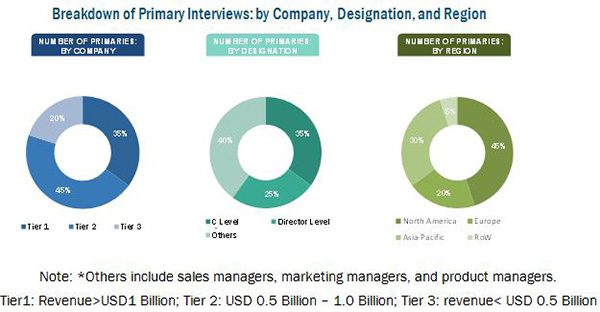
The figure below shows the breakdown of primaries on the basis of companies, designations, and regions, conducted during the research study.
To know about the assumptions considered for the study, download the pdf brochure
The study answers several questions for the target audiences, primarily which market segments to focus in the next two to five years for prioritizing efforts and investments.
Market Ecosystem:
This report provides valuable insights regarding the ecosystem of this market such as product and application developers, OEMs, system integrators, middleware and firmware providers, suppliers and distributors, cloud-based service providers, mobile network providers, software developers, mobile sensors providers, mobile manufacturers, and standardization & testing firms. This study answers several questions for stakeholders, primarily which market segments to focus on in the next two to five years for prioritizing the efforts and investments.
The Target Audience:
- Context-rich system and application developers
- Software providers
- Research organizations and consulting companies
- Associations, forums, and alliances related to context-rich systems
- Investors
- Key players
Scope of the Report:
This research report categorizes the global context-rich system market based on components, devices, verticals, and geography.
On the basis of components
-
Hardware component
-
Sensors
- Pressure/Temperature Sensor
- Audio Sensor
- Image Sensor
- Accelerometer
- Gyroscope
- Global Positioning System (GPS)
- Mobile Processors
- Bluetooth Low Energy chip
-
Sensors
- Software component
On the basis of devices
- Smartphone
- Tablet
- Deskto/Laptop
- Satellite Navigation System (SatNav)
- Biometrics
On the basis of verticals
- Healthcare Industry
- E-commerce and Marketing
- Financial, Banking and Insurance
- Tourism and Hospitality
- Transportation
- Gaming
On the basis of geography
-
North America
- U.S.
- Canada
- Mexico
-
Europe
- Germany
- France
- U.K.
- Rest of Europe
-
APAC
- China
- Japan
- India
- South Korea
- Rest of APAC
-
RoW
- Middle East and Africa
- Latin America
Available Customizations:
With the given market data, MarketsandMarkets offers customizations as per a company’s specific needs. The following customization options are available for the report:
Company Information
Detailed analysis and profiling of additional market players (up to five)












Growth opportunities and latent adjacency in Context Rich System Market
What are the key technologies used for context rich systems ? Do we have update data for 2024 and 2025?