FinFET Technology Market by Technology (22nm, 20nm, 16nm, 14nm, 10nm, 7nm), Product (CPU, SoC, FPGA, GPU, MCU, Network Processor), End-User (Smartphones, Computers & Tablets, Wearables, High-End Networks, Automotive) - Global Forecast to 2035


FinFET Technology Market Summary
The global FinFET Technology Market is undergoing sustained expansion as semiconductor manufacturers, foundries, and integrated device manufacturers continue to demand transistor architectures capable of delivering higher performance, lower leakage current, and improved energy efficiency. The market is estimated at approximately USD 50 - 52 Billion in 2025 and is projected to reach nearly USD 200 - 204 Billion by 2035, registering a CAGR of around 13% - 15% during the forecast period.
FinFET, or Fin Field-Effect Transistor, technology represents an important evolution from conventional planar transistor architectures. Its three-dimensional structure provides better electrostatic control of the transistor channel, helping semiconductor manufacturers reduce leakage and improve switching performance as transistor dimensions shrink. Although gate-all-around (GAA) architectures are increasingly being adopted at the most advanced nodes, FinFET remains highly relevant across established and advanced semiconductor processes, particularly for processors, system-on-chip (SoC) devices, graphics processors, networking components, automotive electronics, and IoT devices.
The growing deployment of artificial intelligence (AI), high-performance computing (HPC), cloud data centers, 5G infrastructure, connected vehicles, smartphones, and industrial IoT is increasing demand for energy-efficient semiconductor devices. AI workloads require significant processing capacity while data centers face increasing power and thermal constraints. FinFET-based designs can provide a useful balance between performance, power consumption, transistor density, and manufacturing maturity.
Digital transformation is also expanding the addressable market. Smart factories, autonomous systems, edge computing, connected medical devices, robotics, and intelligent consumer electronics require increasingly capable semiconductor components. As chip designers seek to optimize performance-per-watt and extend the commercial life of mature advanced nodes, FinFET technology is expected to remain strategically relevant through 2035.
Key Market Trends & Insights
Asia Pacific leads the global FinFET Technology Market. The region benefits from a dense semiconductor manufacturing ecosystem encompassing foundries, integrated device manufacturers, semiconductor equipment suppliers, OSAT companies, and electronics manufacturers. China, Taiwan, South Korea, and Japan remain particularly important to the semiconductor supply chain.
Advanced-node semiconductor demand is the principal growth catalyst. AI accelerators, CPUs, GPUs, networking processors, smartphones, and automotive computing platforms require high transistor density and efficient power management. FinFET technology became an important solution for these requirements as conventional planar CMOS architectures encountered scaling limitations.
14nm and related mature FinFET nodes remain commercially important. While attention frequently centers on leading-edge 5nm, 4nm, and 3nm technologies, mature FinFET processes continue to support automotive, industrial, networking, consumer, and embedded applications where cost, yield, reliability, and long product lifecycles are more important than absolute transistor density.
AI and automation are influencing semiconductor design. AI-assisted electronic design automation (EDA) is increasingly being used for placement, routing, verification, power optimization, and design-space exploration. These capabilities can help engineering teams manage the complexity associated with FinFET layouts and advanced process technologies.
Automotive electronics are creating new demand. Advanced driver-assistance systems (ADAS), electric vehicles, vehicle networking, infotainment, battery-management systems, and autonomous-driving platforms require processors with high computing performance and stringent power and reliability requirements.
FinFET is increasingly positioned alongside GAA rather than simply replacing planar CMOS. GAA technology is gaining importance at leading-edge nodes, but FinFET continues to offer strong economics and manufacturing maturity for numerous applications. This creates a differentiated market opportunity across process generations rather than a single technology trajectory.
Market Size & Forecast
-
Base Year Market Size (2025): USD 50 - 52 Billion
-
Forecast Market Value (2035): USD 200 - 204 Billion
-
CAGR (2025–2035): 13% - 15%
-
Primary Growth Drivers: AI, HPC, 5G, automotive electronics, IoT, smartphones, data centers, and advanced semiconductor manufacturing.
-
Major Technology Drivers: 3D transistor architecture, advanced lithography, EUV, process optimization, AI-assisted EDA, and advanced packaging.
-
Key Opportunity: Continued demand for high-performance, energy-efficient semiconductor devices across consumer, automotive, industrial, communications, and computing applications.
FinFET Technology Market Top 10 key takeaway
-
The global FinFET Technology Market is estimated at approximately USD 52 billion in 2025.
-
The market is projected to reach nearly USD 204 billion by 2035.
-
FinFET technology is expected to expand at approximately 15% CAGR during the forecast period.
-
Asia Pacific remains the dominant regional market.
-
AI and high-performance computing are major demand generators for advanced FinFET-based processors.
-
14nm and other mature FinFET nodes remain important for cost-sensitive and long-lifecycle applications.
-
Smartphones, CPUs, GPUs, SoCs, networking devices, and automotive electronics are major application areas.
-
AI-assisted EDA and automation are improving FinFET chip design and optimization.
-
Automotive and industrial semiconductor demand is creating additional opportunities beyond consumer electronics.
-
GAA technology will gain share at leading-edge nodes, but FinFET is expected to remain commercially significant across multiple process generations.
Product Insights
The product landscape of the FinFET Technology Market is closely connected to the semiconductor devices manufactured using FinFET transistor architectures. System-on-chip (SoC) devices and CPUs represent major product categories because they require a combination of high processing performance, transistor density, and energy efficiency. FinFET architecture enables designers to achieve stronger control of transistor channels while reducing leakage compared with conventional planar designs.
CPUs remain an important segment across personal computers, servers, enterprise systems, embedded devices, and cloud infrastructure. As data-intensive workloads increase, processors must deliver greater computational capacity without proportional increases in power consumption. FinFET-based process technologies have supported this transition by enabling higher transistor density and improved performance-per-watt.
GPUs and AI accelerators are another important growth category. AI workloads involve highly parallel calculations and require large numbers of processing elements. While the semiconductor industry is transitioning toward increasingly specialized architectures, FinFET-based manufacturing remains relevant for many processors and accelerator designs. AI-driven demand for data-center computing is therefore supporting continued investment in advanced semiconductor process technologies.
SoCs are particularly important in smartphones, tablets, wearables, networking equipment, automotive electronics, and IoT devices. Their integration of CPUs, GPUs, connectivity, memory interfaces, security functions, and specialized accelerators allows manufacturers to provide sophisticated capabilities within compact power envelopes.
Emerging product opportunities include automotive computing platforms, edge-AI processors, networking chips, industrial controllers, and specialized accelerators. These products increasingly integrate AI capabilities, connectivity, security, and real-time processing, creating demand for semiconductor technologies that can combine performance with efficient power management.
Technology / Component Insights
The technology foundation of the FinFET Technology Market extends beyond transistor geometry. Advanced lithography, deposition, etching, metrology, materials engineering, process control, EDA software, and semiconductor manufacturing automation all influence the ability of manufacturers to achieve reliable FinFET production.
FinFET's principal advantage comes from its three-dimensional fin structure, which provides greater gate control over the conducting channel than planar transistor designs. This improves electrostatic behavior and helps reduce leakage as transistor dimensions become smaller. Such characteristics made FinFET a critical technology for semiconductor nodes that pushed beyond the limitations of conventional planar CMOS.
EUV lithography has become increasingly important for advanced semiconductor manufacturing. By enabling the patterning of increasingly complex structures, EUV can reduce reliance on multiple patterning steps at advanced nodes. FinFET process development also requires precise control of fin dimensions, gate structures, contacts, interconnects, and materials.
AI is becoming increasingly relevant to semiconductor process development. Machine learning can analyze process data, identify manufacturing anomalies, optimize process parameters, and support predictive maintenance of fabrication equipment. In semiconductor design, AI-assisted EDA tools can explore numerous design alternatives and optimize power, timing, area, and routing.
IoT and edge computing are also influencing FinFET requirements. Edge devices require efficient processors that can perform local inference and analytics without constantly transferring data to centralized cloud infrastructure. This creates demand for chips that provide adequate computational performance within strict thermal and battery constraints.
Automation is becoming essential as semiconductor manufacturing becomes more complex. Automated wafer handling, process monitoring, defect inspection, statistical process control, and digital manufacturing systems help improve yield and consistency. Future innovation will increasingly combine FinFET process technology with AI-based manufacturing analytics, advanced packaging, chiplets, and heterogeneous integration.
At the same time, the transition toward gate-all-around (GAA) transistor architectures represents an important technology trend. Several advanced semiconductor roadmaps have moved beyond FinFET at the leading edge, meaning future FinFET growth will increasingly depend on mature advanced nodes and applications where its manufacturing ecosystem remains economically attractive.
Application Insights
The consumer electronics sector remains a major application area for FinFET technology. Smartphones, tablets, laptops, gaming systems, and wearable devices require processors that combine high computational capability with low energy consumption. FinFET-based SoCs have supported this evolution by enabling higher integration and performance within compact devices.
The IT and telecommunications sector is another important demand center. Data centers, networking equipment, 5G infrastructure, enterprise servers, and cloud platforms require processors and networking devices capable of handling rapidly increasing data volumes. AI workloads are further increasing the computational intensity of data-center infrastructure.
Automotive electronics represents one of the most promising long-term applications. Modern vehicles increasingly incorporate multiple electronic control units, advanced infotainment platforms, connectivity systems, ADAS processors, digital cockpits, and autonomous-driving technologies. Electric vehicles also require sophisticated power-management, battery-management, connectivity, and computing systems.
Industrial applications are expanding as manufacturers adopt smart factories, robotics, machine vision, predictive maintenance, and industrial IoT. FinFET-based processors can support local analytics and AI inference in environments where low latency and energy efficiency are important.
The market also has opportunities in high-end networking, aerospace and defense electronics, healthcare devices, industrial automation, and edge computing. As intelligent systems become more distributed, semiconductor demand will increasingly move from centralized computing platforms toward connected edge devices.
Regional Insights
Asia Pacific is the leading regional market for FinFET technology, supported by its semiconductor manufacturing concentration and extensive electronics production base. Taiwan remains a critical center for advanced foundry manufacturing, while South Korea has major strengths in semiconductors and consumer electronics. Japan maintains strong capabilities in semiconductor materials, equipment, automotive electronics, and industrial technology. China continues to expand domestic semiconductor capacity and technology development.
North America remains strategically important because of its leadership in chip design, AI computing, cloud infrastructure, EDA software, and semiconductor research. The United States also continues to encourage domestic semiconductor manufacturing through industrial policy and investment incentives. Demand from AI data centers and high-performance computing is strengthening the regional market.
Europe has a strong position in automotive and industrial semiconductor applications. Germany, France, the Netherlands, and other European markets benefit from automotive electronics, industrial automation, semiconductor equipment, and research capabilities. European investment is increasingly focused on strengthening regional semiconductor resilience and supporting advanced manufacturing.
Asia Pacific's manufacturing density provides an important competitive advantage, while North America benefits from semiconductor design leadership and Europe from automotive and industrial specialization. These complementary strengths are shaping the global FinFET ecosystem.
-
Asia Pacific remains the leading regional FinFET Technology Market.
-
North America benefits from AI, cloud computing, and advanced chip-design capabilities.
-
Europe has strong demand from automotive and industrial applications.
-
Taiwan and South Korea remain strategically important semiconductor manufacturing centers.
-
China, Japan, and India offer substantial long-term semiconductor growth opportunities.
Country-Specific Market Trends
China (CAGR: approximately 18%) is expected to remain one of the fastest-growing national markets for FinFET technology. Domestic semiconductor investment, automotive electronics, smartphones, networking equipment, AI computing, and industrial automation are driving demand. China is also expanding local semiconductor manufacturing and design capabilities to strengthen supply-chain resilience.
Japan (CAGR: approximately 14%) benefits from its strong automotive, robotics, industrial electronics, semiconductor materials, and equipment industries. Demand for advanced processors and embedded computing is increasing as Japanese manufacturers invest in smart factories, connected vehicles, and automation.
United States (CAGR: approximately 14%) remains a major market because of its strong semiconductor design ecosystem, AI infrastructure, cloud computing industry, defense electronics, and advanced computing requirements. Government incentives supporting domestic semiconductor manufacturing are also encouraging new investments in fabrication and packaging.
Canada (CAGR: approximately 12%) offers opportunities in semiconductor research, telecommunications, automotive technologies, AI, and specialized electronics. Its growing technology ecosystem and research capabilities support demand for advanced semiconductor design.
Mexico (CAGR: approximately 13%) is becoming increasingly important in electronics manufacturing and automotive production. Nearshoring trends and expanding automotive electronics manufacturing can create additional demand for semiconductor components and advanced chips.
Germany (CAGR: approximately 13%) remains one of Europe's most important semiconductor markets due to automotive manufacturing, industrial automation, robotics, and power electronics. Demand for ADAS, connected vehicles, industrial controllers, and smart manufacturing is expected to support FinFET-related semiconductor applications.
France (CAGR: approximately 12%) has opportunities across automotive electronics, telecommunications, aerospace, industrial systems, and semiconductor research. Public and private investments in strategic semiconductor capabilities are supporting long-term technology development.
-
China is expected to record strong growth through semiconductor localization and AI demand.
-
Japan benefits from automotive, robotics, and industrial electronics.
-
The US remains a major center for advanced chip design and AI computing.
-
Germany is a key European market for automotive and industrial semiconductors.
-
Mexico is gaining importance through electronics and automotive manufacturing expansion.
Key FinFET Technology Company Insights
The competitive ecosystem includes semiconductor manufacturers, foundries, integrated device manufacturers, EDA companies, and technology suppliers. Key companies associated with the broader FinFET ecosystem include Intel, Taiwan Semiconductor Manufacturing Company (TSMC), Samsung Electronics, GlobalFoundries, United Microelectronics Corporation (UMC), Synopsys, Cadence Design Systems, and Arm.
Intel played a historically important role in commercializing FinFET transistor technology and continues to invest in advanced process technologies and manufacturing. TSMC has been a major foundry provider for FinFET-based advanced nodes and supports a broad ecosystem of fabless semiconductor companies.
Samsung Electronics has developed both FinFET and GAA process technologies as part of its advanced foundry roadmap. The company's strategy increasingly focuses on serving AI, HPC, mobile, automotive, and high-performance applications.
GlobalFoundries and UMC maintain strong positions in mature and specialty semiconductor manufacturing, where FinFET technologies can support applications that prioritize performance, cost, reliability, and long product lifecycles.
EDA companies such as Synopsys and Cadence Design Systems play an enabling role by providing tools for transistor-level design, verification, simulation, physical implementation, and increasingly AI-assisted design optimization. Their technologies help chip designers manage the complexity of FinFET architectures and advanced process nodes.
-
Semiconductor foundries are investing in process maturity and advanced-node capabilities.
-
AI and HPC are influencing product and process roadmaps.
-
EDA providers are incorporating AI and automation into chip-design workflows.
-
Foundries are balancing advanced FinFET technologies with GAA and specialty processes.
-
Automotive and industrial applications are encouraging longer-term investment in reliable process platforms.
Recent Developments
The semiconductor industry is increasingly combining AI-assisted EDA with advanced FinFET design flows. Machine learning can accelerate physical design optimization, identify potential timing and power bottlenecks, and explore complex design configurations more efficiently than conventional approaches.
Another important development is the continued expansion of advanced semiconductor manufacturing capacity in the US, Europe, and Asia. Government incentives and supply-chain diversification programs are encouraging foundries and integrated device manufacturers to establish or expand regional manufacturing capabilities.
The industry is also moving toward a more diversified transistor architecture landscape. While GAA technology is increasingly deployed at leading-edge nodes, FinFET remains important for mature advanced nodes, automotive electronics, networking, IoT, and other applications where manufacturing maturity and cost efficiency are critical.
Market Segmentation
The FinFET Technology Market can be segmented by type, process node, product, application, end use, and region. By technology type, the market includes bulk FinFET and silicon-on-insulator (SOI) FinFET approaches. By process node, commercially relevant categories include 22nm, 20nm, 16/14nm, 10nm, 7nm, and other advanced nodes. The appropriate node depends heavily on application requirements, performance targets, manufacturing economics, and product lifecycle.
By product, the market includes CPUs, GPUs, SoCs, microcontroller units, field-programmable gate arrays, and other semiconductor devices. CPUs and SoCs account for substantial demand because they are widely deployed across computing, consumer electronics, automotive, networking, and embedded applications.
By application, the market spans smartphones, computers and tablets, wearables, automotive systems, high-end networks, data centers, industrial electronics, and IoT devices. Automotive and AI-related computing applications are expected to become increasingly important growth areas.
Regionally, the market is divided into North America, Europe, Asia Pacific, Latin America, and the Middle East & Africa, with Asia Pacific maintaining a leading position due to its manufacturing infrastructure and electronics ecosystem.
-
14nm and other mature advanced FinFET nodes remain commercially important.
-
CPUs, GPUs, and SoCs represent major product categories.
-
Smartphones and computing remain significant applications.
-
Automotive, AI, networking, and IoT are expanding opportunity areas.
-
Asia Pacific remains the leading regional market.
The FinFET Technology Market is positioned for continued growth as the semiconductor industry responds to rising demand for computational performance, energy efficiency, connectivity, and intelligent electronics.
AI will remain one of the most important forces shaping the market. AI training and inference require increasingly powerful processors, GPUs, networking devices, and edge accelerators. These applications place strong emphasis on performance-per-watt, making transistor architecture and semiconductor process technology strategically important.
The role of IoT, 5G, automation, robotics, and connected vehicles will also expand the opportunity landscape. These applications require large numbers of processors operating under different performance, cost, thermal, and reliability constraints. FinFET technologies can remain attractive where advanced performance is needed without requiring the absolute complexity of the newest GAA processes.
At the manufacturing level, AI-driven process optimization, automation, advanced lithography, metrology, and predictive maintenance will help semiconductor companies improve yield and control costs. The convergence of advanced manufacturing and intelligent software is likely to become an important competitive factor.
The transition to GAA should not be interpreted as an immediate end to FinFET. Instead, the semiconductor market is likely to develop a multi-architecture ecosystem in which GAA dominates selected leading-edge applications while FinFET continues to serve mature advanced nodes and high-volume products. Automotive, industrial, networking, IoT, consumer, and embedded applications can sustain demand for FinFET-based semiconductor manufacturing.
Through 2035, companies that effectively balance process-node selection, manufacturing economics, AI-driven design, energy efficiency, supply-chain resilience, and application-specific requirements will be better positioned to capture opportunities in the evolving semiconductor industry. FinFET technology is therefore expected to remain an important bridge between established CMOS manufacturing and the industry's next generation of transistor architectures.
FAQs
1. What is the current size of the FinFET Technology Market?
The global FinFET Technology Market is estimated at approximately USD 50 - 52 Billion in 2025.
2. What is the growth rate of the FinFET Technology Market?
The market is expected to grow at approximately 13% - 15% CAGR from 2025 to 2035, supported by AI, high-performance computing, automotive electronics, IoT, smartphones, networking, and advanced semiconductor applications.
3. What are the key drivers of the FinFET Technology Market?
Key drivers include AI and HPC demand, advanced-node semiconductor adoption, 5G infrastructure, smartphones, automotive electronics, connected devices, IoT, data centers, edge computing, and the need for improved performance-per-watt.
4. Which region leads the FinFET Technology Market?
Asia Pacific is the leading regional market, supported by its semiconductor manufacturing ecosystem, foundry capacity, electronics production, and strong demand from China, Taiwan, South Korea, and Japan.
5. Who are the key companies in the FinFET Technology Market?
Major companies across the FinFET ecosystem include Intel, TSMC, Samsung Electronics, GlobalFoundries, UMC, Synopsys, Cadence Design Systems, and Arm. These companies participate across semiconductor manufacturing, chip design, process technology, and EDA infrastructure.
 Exclusive indicates content/data unique to MarketsandMarkets and not available with any competitors.
Table of Contents
1 Introduction (Page No. - 14)
1.1 Objectives of the Study
1.2 Market Definition
1.3 Study Scope
1.3.1 Markets Covered
1.3.2 Years Considered for the Study
1.4 Currency
1.5 Market Stakeholders
2 Research Methodology (Page No. - 17)
2.1 Research Data
2.1.1 Secondary Data
2.1.1.1 Key Data From Secondary Sources
2.1.2 Primary Data
2.1.2.1 Key Data From Primary Sources
2.1.2.2 Key Industry Insights
2.1.2.3 Breakdown of Primaries
2.2 Market Size Estimation
2.2.1 Bottom-Up Approach
2.2.2 Top-Down Approach
2.2.3 Market Share Estimation
2.3 Market Breakdown and Data Triangulation
2.4 Research Assumptions
2.4.1 Assumptions
3 Executive Summary (Page No. - 26)
4 Premium Insights (Page No. - 30)
4.1 Attractive Opportunities in the Global FinFET Technology Market
4.2 Market, By Product, 2016–2022
4.3 Market, By Technology, 2016–2022
4.4 Market Size, By End User, 2016–2022
4.5 Market, By Geography
4.6 Life Cycle Analysis, By Geography, 2015
5 Market Overview (Page No. - 34)
5.1 Introduction
5.2 Market Evolution
5.3 Market Segmentation
5.3.1 Market, By Technology
5.3.2 Market, By Product
5.3.3 Market, By End User
5.3.4 Geographic Analysis
5.4 Market Dynamics
5.4.1 Drivers
5.4.1.1 Improved Performance With A Lower Current Leakage Than the Bulk Technology
5.4.1.2 Growing Mobile and Consumer Electronics Market
5.4.2 Restraints
5.4.2.1 Complexity in FinFET Design Process
5.4.3 Opportunities
5.4.3.1 Growing Ic Industry to Pave New Growth Avenues
5.4.4 Challenges
5.4.4.1 Lower Wafer Cost and Gate Cost of FD-SOI
6 Industry Trends (Page No. - 43)
6.1 Ntroduction
6.2 Value Chain Analysis
6.3 Porter’s Five Forces Analysis
6.3.1 Threat of New Entrants
6.3.2 Threat of Substitutes
6.3.3 Bargaining Power of Suppliers
6.3.4 Bargaining Power of Buyers
6.3.5 Intensity of Competitive Rivalry
7 FinFET Technology Market, By Technology (Page No. - 50)
7.1 Introduction
7.2 22nm
7.3 20nm
7.4 16nm
7.5 14nm
7.6 10nm
7.7 7nm
8 FinFET Technology Market, By Product (Page No. - 57)
8.1 Introduction
8.2 CPU
8.3 SOC
8.4 FPGA
8.5 GPU
8.6 MCU
8.7 Network Processors
9 FinFET Technology Market, By End User (Page No. - 85)
9.1 Introduction
9.2 Smartphones
9.3 Computers and Tablets
9.4 Wearables
9.5 High-End Networks
9.6 Automotive
10 Geographical Analysis (Page No. - 92)
10.1 Introduction
10.2 North America (U.S., And Others)
10.3 Europe (Germany, France And Others)
10.4 Asia-Pacific (APAC) (South Korea, China, Taiwan and Others)
10.5 Rest of the World (Middle East, Africa, and Others)
11 Competitive Landscape (Page No. - 103)
11.1 Introduction
11.2 Market Ranking Analysis, 2015
11.3 Competitive Situations and Trends
11.3.1 Collaborations
11.3.2 Acquisitions, Joint Ventures, and Partnerships
11.3.3 New Product Launches
11.3.4 Others
12 Company Profiles (Page No. - 109)
(Overview, Products and Services, Financials, Strategy & Development)*
12.1 Introduction
12.2 Taiwan Semiconductor Manufacturing Company Limited (TSMC Ltd.)
12.3 Samsung Electronics Corporation, Ltd.
12.4 Globalfoundries
12.5 Intel Corporation
12.6 United Microelectronics Corporation
12.7 Qualcomm Incorporated
12.8 Mediatek, Inc.
12.9 Arm Holdings PLC.
12.10 Semiconductor Manufacturing International Corp.
12.11 Xilinx Inc.
*Details on Overview, Products and Services, Financials, Strategy & Development Might Not Be Captured in Case of Unlisted Companies
13 Appendix (Page No. - 138)
13.1 Insights of Industry Experts
13.2 Discussion Guide
13.3 Introducing Rt: Real-Time Market Intelligence
13.4 Available Customizations
13.5 Related Reports
List of Tables (69 Tables)
Table 1 Analysis of Market Drivers
Table 2 Analysis of Market Restraints
Table 3 Analysis of Market Opportunities
Table 4 Analysis of Market Challenges
Table 5 Market Size, By Technology, 2014–2022 (USD Million)
Table 6 Market Size for 22nm, By Product, 2014–2022 (USD Million)
Table 7 Market Size for 20nm, By Product, 2014–2022 (USD Million)
Table 8 Market Size for 16nm, By Product, 2014–2022 (USD Million)
Table 9 Market Size for 14nm, By Product, 2014–2022 (USD Million)
Table 10 Market Size for 10nm, By Product, 2014–2022 (USD Million)
Table 11 Market Size for 7nm, By Product, 2014–2022 (USD Million)
Table 12 Market Size, By Product, 2014–2022 (USD Million)
Table 13 CPU : FinFET Technology Market Size, By End User, 2014–2022 (USD Million)
Table 14 Market Size, for CPU, By Region, 2013 - 2022 (USD Million)
Table 15 CPU: FinFET Technology Market Size for Smartphones, By Region, 2014–2022 (USD Million)
Table 16 CPU: Market Size for Computers and Tablets, By Region, 2014 - 2022 (USD Million)
Table 17 CPU: Market Size for Wearables, By Region, 2014 - 2022 (USD Million)
Table 18 CPU: Market Size for High-End Networks, By Region, 2014 - 2022 (USD Million)
Table 19 CPU: Market Size for Automotive, By Region, 2014 - 2022 (USD Million)
Table 20 SOC: FinFET Technology Market Size, By End User, 2014–2022 (USD Million)
Table 21 Market Size, for SOC, By Region, 2013 - 2022 (USD Million)
Table 22 SOC: FinFET Technology Market Size, for Smartphones, By Region, 2014 - 2022 (USD Million)
Table 23 SOC: Market Size for Computers and Tablets, By Region, 2014–2022 (USD Million)
Table 24 SOC : Market Size for Wearables, By Region, 2014 - 2022 (USD Million)
Table 25 SOC: Market Size for High-End Networks, By Region, 2014–2022 (USD Million)
Table 26 SOC: Market Size for Automotive, By Region, 2014 - 2022 (USD Million)
Table 27 FPGA: FinFET Technology Market Size, By End User, 2014–2022 (USD Million)
Table 28 FPGA: Market Size for Smartphones, By Region, 2014–2022 (USD Million)
Table 29 FPGA: Market Size for Computers and Tablets, By Region, 2014–2022 (USD Million)
Table 30 FPGA: Market Size for Wearables, By Region, 2014 - 2022 (USD Million)
Table 31 FPGA: Market Size for High-End Networks, By Region, 2014 - 2022 (USD Million)
Table 32 FPGA: Market Size for Automotive, By Region, 2014 - 2022 (USD Million)
Table 33 GPU : Market Size, By End User, 2014–2022 (USD Million)
Table 34 GPU : Market Size for Smartphones, By Region, 2014–2022 (USD Million)
Table 35 GPU : Market Size for Computers and Tablets, By Region, 2014–2022 (USD Million)
Table 36 GPU : Market Size for Wearables, By Region, 2014–2022 (USD Million)
Table 37 GPU: Market Size for High End Networks, By Region, 2014 - 2022 (USD Million)
Table 38 GPU: Market Size for Automotive, By Region, 2014–2022 (USD Million)
Table 39 MCU : FinFET Technology Market Size By End User, 2014–2022 (USD Million)
Table 40 MCU: Market Size for Smartphones, By Region, 2014–2022 (USD Million)
Table 41 MCU: Market Size for Computers and Tablets, By Region, 2014–2022 (USD Million)
Table 42 MCU: Market Size for Wearables, By Region, 2014–2022 (USD Million)
Table 43 MCU: Market Size for High-End Networks, By Region, 2014–2022 (USD Million)
Table 44 MCU: Market Size for Automotive, By Region, 2014–2022 (USD Million)
Table 45 Network Processors: Market Size, By End User, 2014–2022 (USD Million)
Table 46 Network Processors: Market Size for Smartphones, By Region, 2014–2022 (USD Million)
Table 47 Network Processors: Market Size for Computers and Tablets, By Region, 2014–2022 (USD Million)
Table 48 Network Processors: Market Size for Wearables, By Region, 2014–2022 (USD Million)
Table 49 Network Processors: Market Size for High-End Networks, By Region, 2014–2022 (USD Million)
Table 50 Network Processors: FinFET Technology Market Size for Automotive, By Region, 2014–2022 (USD Million)
Table 51 Market Size, By End User, 2014–2022 (USD Million)
Table 52 Market Size for Smartphones, By Region, 2014–2022 (USD Million)
Table 53 Market Size for Computers and Tablets, By Region, 2014–2022 (USD Million)
Table 54 Market Size for Wearables, By Region, 2014–2022 (USD Million)
Table 55 Market Size for High-End Networks, By Region, 2014–2022 (USD Million)
Table 56 Market Size for Automotive, By Region, 2014–2022 (USD Million)
Table 57 Market Size, By Region, 2014–2022 (USD Million)
Table 58 North America: Market Size, By End User, 2014–2022 (USD Million)
Table 59 North America: Market Size, By Product, 2014–2022 (USD Million)
Table 60 Europe: Market Size, By End User, 2014–2022 (USD Million)
Table 61 Europe: Market Size, By Product, 2014–2022 (USD Million)
Table 62 APAC: Market Size, By End User, 2014–2022 (USD Million)
Table 63 APAC: Market Size, By Product, 2014–2022 (USD Million)
Table 64 Row: Market Size, By End User, 2014–2022 (USD Million)
Table 65 Row: Market Size, By Product, 2014–2022 (USD Million)
Table 66 Most Significant Collaborations in the Market, 2012–2015
Table 67 Most Significant Acquisitions, Joint Ventures, and Partnerships in the Market, 2013–2015
Table 68 Most Significant New Product Launches in the Market, 2014–2015
Table 69 Most Significant Other Strategies in the Market, 2014–2015
List of Figures (74 Figures)
Figure 1 FinFET Market Segmentation
Figure 2 The Market: Research Design
Figure 3 Process Flow of Market Size Estimation
Figure 4 Market Size Estimation Methodology: Bottom-Up Approach
Figure 5 Market Size Estimation Methodology: Top-Down Approach
Figure 6 Market Breakdown & Data Triangulation
Figure 7 Assumptions of the Research Study
Figure 8 Market Size, By Type, 2016–2022
Figure 9 CPUs to Hold the Largest Market Size in 2016, While the GPU to Grow at the Highest Rate During 2016–2022
Figure 10 Smartphones to Hold the Largest Market in 2016
Figure 11 North America Had the Largest Market in 2015, While That in APAC Would Grow at the Highest Rate During the Forcast Period
Figure 12 Miniaturization of Semiconductor Devices With Increased Performance and Reduced Size Would Spur the Market Growth From 2015 to 2022
Figure 13 The Market for GPUS Likely to Grow at the Highest Rate During the Forecast Period
Figure 14 Market for the 7nm Technology to Grow at A High Rate During the Forecast Period
Figure 15 Smartphones to Hold the Largest Market Size in 2016, While the Wearables Market Likely to Grow at the Highest Rate During the Forecast Period
Figure 16 Market in APAC Expected to Grow at the Highest Rate During Forecast Period
Figure 17 Market in APAC Was in the Growth Phase in 2015
Figure 18 Evolution of FinFET Technology
Figure 19 Market, By Geography
Figure 20 Market: Drivers, Restraints, Opportunities, and Challenges
Figure 21 Wafer Cost (300mm) (FinFET vs FD-SOI)
Figure 22 Gate Cost (300mm) (FinFET vs FD-SOI)
Figure 23 Value Chain Analysis: Maximum Value is Added During Design Service and Fabrication Stages
Figure 24 Porter’s Five Forces Analysis, 2015
Figure 25 Porter’s Five Forces Analysis, 2015
Figure 26 Market: Threat of New Entrants
Figure 27 Maket: Threat of Substiutes
Figure 28 Market: Bargaining Power of Suppliers
Figure 29 Market: Bargaining Power of Buyers
Figure 30 Market: Intensity of Competitive Rivalry
Figure 31 Market, By Technology
Figure 32 Market for the 22nm to Be the Largest in 2016
Figure 33 Market for GPUS to Grow at the Highest Rate During the Forecast Period
Figure 34 Market for GPUS to Grow at the Highest Rate During the Forecast Period
Figure 35 Market, By Product
Figure 36 Market for GPUS Expected to Grow at the Highest Rate During the Forecast Period
Figure 37 Market for FinFET Technology in CPUs for Smartphones Expected Grow at the Highest Rate During the Forecast Period
Figure 38 Market for FinFET Technology in CPUs for Computers and Tablets in APAC Expected Grow at the Highest Rate During the Forecast Period
Figure 39 Market for the FinFET Technology in SOCs for Smartphones in APAC Expected Grow at the Highest Rate During the Forecast Period
Figure 40 Market for the FinFET Technology in SOCs for Wearables in North America Expected to Grow at the Highest Rate During the Forecast Period
Figure 41 Market for the FinFET Technology in FPGAs for Wearables Expected to Grow at the Highest Rate During the Forecast Period
Figure 42 Market the for FinFET Technology in FPGAs for Computers and Tablets Expected to Grow at the Highest Rate in APAC During the Forecast Period
Figure 43 Market for FinFET Technology in FPGA for High End Networks is Expected Grow at the Highest Rate in APAC During the Forecast Period
Figure 44 Market for FinFET Technology in GPU for Wearables is Expected to Grow at the Highest Rate During the Forecast Period
Figure 45 Market for GPUS in Wearables Expected to Grow at the Highest CAGR in North America During the Forecast Period
Figure 46 Market for FinFET Technology in MCUs for Automotive to Grow at the Highest CAGR During the Forecast Period
Figure 47 Market for FinFET Technology in MCUs for Computers and Tablets Expected to Grow at the Highest Rate in Asia-Pacific During the Forecast Period
Figure 48 Market for FinFET Technology in Network Processors for Computers and Tablets Expected to Grow at the Highest Rate During the Forecast Period
Figure 49 Market for FinFET Technology in Network Processors for Wearables Expected to Grow at the Highest CAGR in North America During the Forecast Period
Figure 50 Market, By End Users
Figure 51 Market for Wearables to Grow at the Highest Rate During the Forecast Period
Figure 52 Geographic Snapshot, 2016–2022
Figure 53 APAC Expected to Witness Highest Growth During the Forecast Period
Figure 54 North America: Market Snapshot
Figure 55 Europe: Market Snapshot
Figure 56 APAC: Market Snapshot
Figure 57 Companies Adopted Collaborations as the Key Growth Strategy Between 2012 and 2015
Figure 58 Market Evaluation Framework
Figure 59 Battle for Market Share: Collaboration Was the Key Strategy
Figure 60 Geographic Revenue Mix of Top Four Market Players
Figure 61 TSMC Ltd.: Company Snapshot
Figure 62 TSMC Ltd.: SWOT Analysis
Figure 63 Samsung Electronics Corporation: Company Snapshot
Figure 64 Samsung Electronics Corporation: SWOT Analysis
Figure 65 Globalfoundries, Inc.: SWOT Analysis
Figure 66 Intel Corporation: Company Snapshot
Figure 67 Intel Corporation: SWOT Analysis
Figure 68 United Microelectronics Corporation: Company Snapshot
Figure 69 United Microelectronics Corporation: SWOT Analysis
Figure 70 Qualcomm Incorporated.: Company Snapshot
Figure 71 Mediatek,Inc.: Business Overview
Figure 72 Arm Holdings PLC.: Business Overview
Figure 73 SMIC: Business Overview
Figure 74 Xilinx Inc.: Business Overview
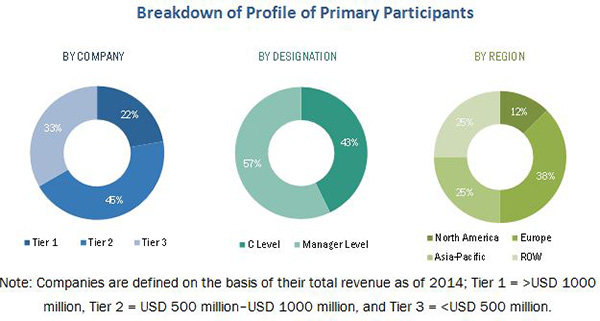
The research methodology used to estimate and forecast the FinFET technology market begins with capturing data on key vendor revenues through the secondary research. Vendor offerings are also taken into consideration to determine the market segmentation. The bottom-up procedure was employed to arrive at the overall size of the global market from the revenue of key players. After arriving at the overall market size, the total market was split into several segments and subsegments, which were then verified through primary research by conducting extensive interviews with key people such as CEOs, VPs, directors, and executives. Data triangulation and market breakdown procedures were employed to complete the overall market engineering process and arrive at the exact statistics for all segments and subsegments. The breakdown of profiles of primary interviews is depicted in the below figure:
To know about the assumptions considered for the study, download the pdf brochure
The key players in the market include Intel (U.S.), TSMC, Ltd. (Taiwan), Samsung (South Korea), and GlobalFoundries (U.S.), among others. These players have adopted various strategies such as partnerships, agreements, contracts, mergers & acquisitions, and new product developments to achieve growth in the global FinFET technology market.
Key Target audience
- Wafer Manufacturers
- Raw Material and Manufacturing Equipment Suppliers
- Chip Manufacturers
- System Integrators
- Device Manufacturers
- Foundry Players
- Distributors and Retailers
- Research Organizations
- Technology Standard Organizations, Forums, Alliances, and Associations
- Technology Investors
Scope of the Report
The research report segments the FinFET technology market to following subsegments:
By Technology:
- 22nm
- 20nm
- 16nm
- 14nm
- 10nm
- 7nm
By Product:
- CPU
- SoC
- FPGA
- GPU
- MCU
- Network Processor
By End User:
- Smartphones
- Computers and Tablets
- Wearables
- High-End Networks
- Automotive
By Region:
- North America
- Europe
- Asia-Pacific
- Rest of the World
Available Customizations
With the given market data, MarketsandMarkets offers customizations as per the company’s specific needs. The following customization options are available for the report:
Geographic Analysis
- Further breakdown of the North America FinFET technology market
- Further breakdown of the Europe FinFET technology market
- Further breakdown of the APAC FinFET technology market
- Further breakdown of the RoW FinFET technology market
Company Information
- Detailed analysis and profiling of additional market players












Growth opportunities and latent adjacency in FinFET Technology Market