Loyalty Management Market

Loyalty Management Market by Offering (Solutions [Platform-based Loyalty Management, API-based Loyalty Management] and Services), Program Type, Application, Business Model, and Vertical (BFSI, Aviation, Automobile, Media, Retail & Consumer Goods, Hospitality) - Global Forecast to 2032


OVERVIEW
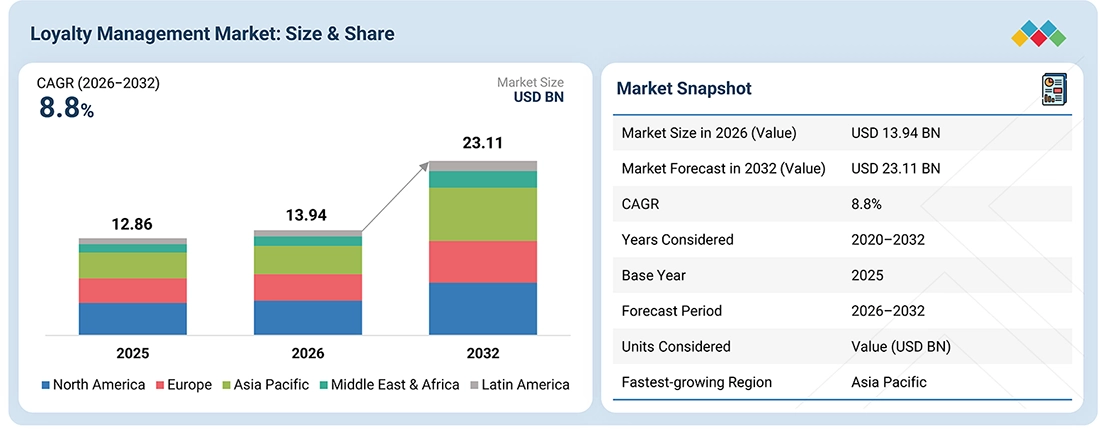
Source: Secondary Research, Interviews with Experts, MarketsandMarkets Analysis
The loyalty management market is projected to grow from USD 13.94 billion in 2026 to USD 23.11 billion by 2032, at a CAGR of 8.8% during the forecast period. Market growth is supported by the increasing integration of loyalty programs with digital commerce, payment, CRM, and customer engagement platforms. As businesses expand customer interactions across physical and digital channels, loyalty solutions are increasingly being used to coordinate rewards, memberships, promotions, and engagement activities across these touchpoints. The growing adoption of AI, cloud-based platforms, and API-enabled architectures is further enabling businesses to build more flexible loyalty programs and respond to changing customer expectations.
KEY TAKEAWAYS
-
By RegionThe Asia Pacific market is projected to grow at the highest rate from 2026 to 2032
-
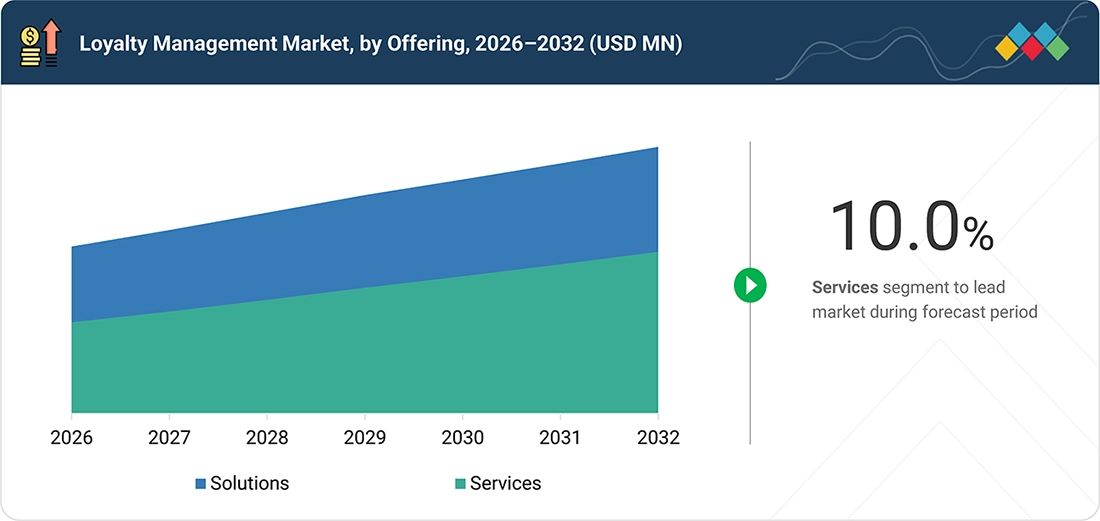
By OfferingThe services segment is expected to register a higher CAGR (10.0%) than the solutions segment during the forecast period.
-
By Program TypeThe point-based program segment is expected to hold the largest market share during the forecast period.
-
By VerticalThe BFSI segment is estimated to account for the largest market share during the forecast period.
-
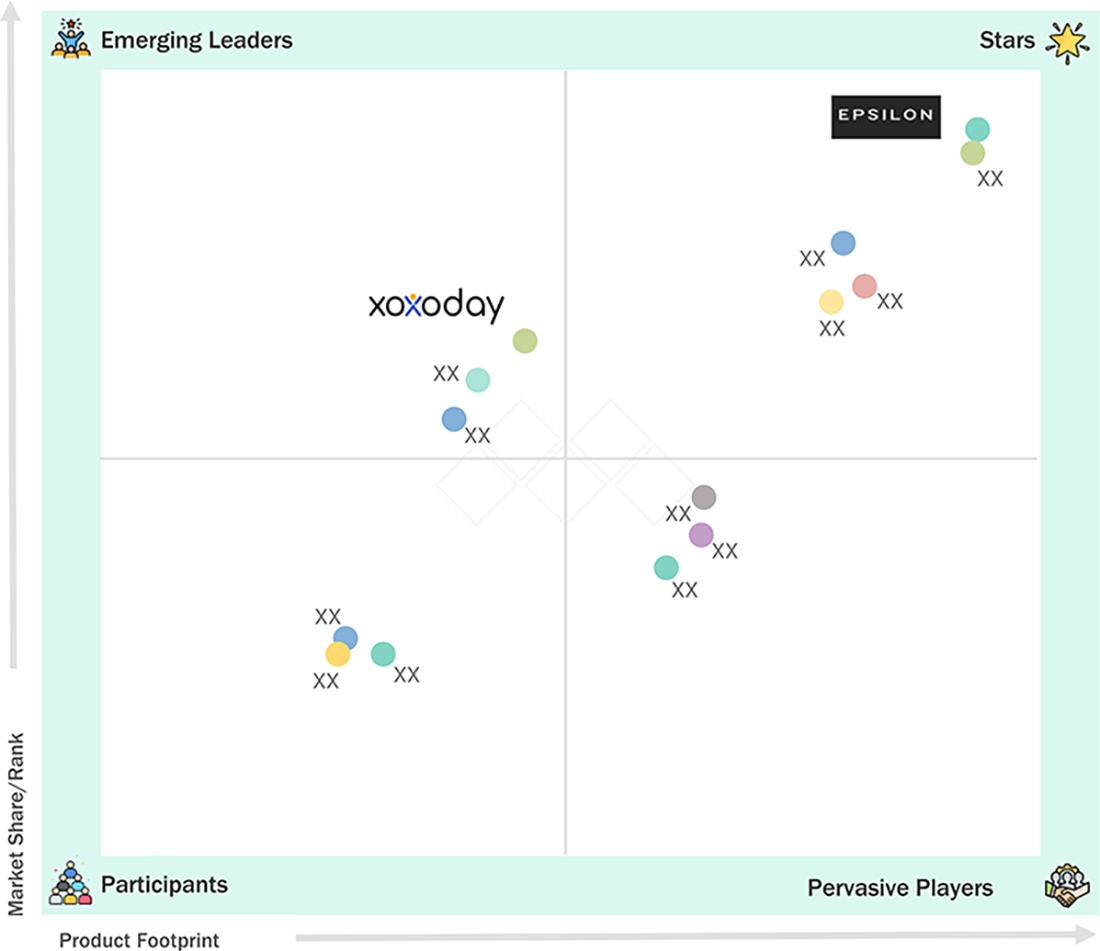
Competitive Landscape - Key PlayersCompanies such as Epsilon (US), Oracle (US), Comarch (Poland), Bond Brand Loyalty (Canada), Merkle (US), and Capillary (Singapore) were identified as some of the star players in the loyalty management market, given their strong market share and product footprint.
-
Competitive Landscape - Startups/SMEsCompanies such as Ebbo (US), Preferred Patron (US), Loopy Loyalty (China), Paystone (UK), LoyLogic (Switzerland), and Ascenda (Singapore) have distinguished themselves among startups and SMEs by securing strong footholds in specialized niche areas, underscoring their potential as emerging market leaders.
The loyalty management market is evolving as businesses move from conventional reward programs toward broader customer engagement ecosystems. Loyalty platforms are increasingly being connected with CRM, e-commerce, POS, mobile, and payment environments, allowing brands to incorporate loyalty into everyday customer interactions. The growing adoption of subscription-based, experiential, and omnichannel loyalty models is also encouraging businesses to diversify their program structures beyond traditional points and discounts. At the same time, AI and advanced analytics are enabling businesses to evaluate member behavior, refine reward strategies, and improve the relevance of customer interactions. These developments are creating demand for flexible loyalty management solutions that can support different program models and scale across markets and customer segments.
TRENDS & DISRUPTIONS IMPACTING CUSTOMERS' CUSTOMERS
The impact on loyalty management vendors stems from changing customer engagement models and technological advancements. Vendors serve enterprises across retail, BFSI, travel, and telecom, whose end consumers interact with loyalty programs across multiple channels. Trends like AI-driven personalization, omnichannel engagement, and data integration are reshaping loyalty strategies, boosting customer retention and satisfaction. As enterprises prioritize automation and analytics-led loyalty initiatives, demand for intelligent loyalty management platforms continues to grow.
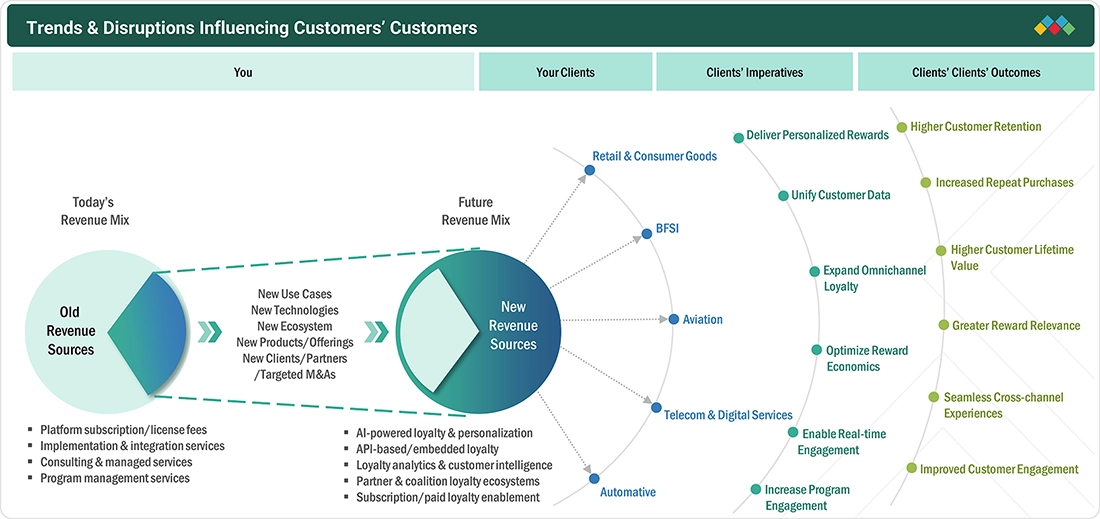
Source: Secondary Research, Interviews with Experts, MarketsandMarkets Analysis
MARKET DYNAMICS

Level
-
Shift Toward Loyalty as Enterprise Customer Engagement Layer

-
Increasing Demand for Real-time Loyalty Program Management


Level
-
High Program Implementation and Operating Costs

-
Complexity of Managing Multi-brand and Multi-program Ecosystems


Level
-
Expansion of Embedded and Partner-based Loyalty Ecosystems

-
Growth of Experiential and Paid Loyalty Models


Level
-
Growing Loyalty Fraud and Reward Abuse

-
Balancing Reward Value With Program Economics

Source: Secondary Research, Interviews with Experts, MarketsandMarkets Analysis
Driver: Shift Toward Loyalty as Enterprise Customer Engagement Layer
Loyalty management is increasingly moving beyond standalone points and rewards programs to become part of the broader customer engagement infrastructure. Businesses are integrating loyalty capabilities with CRM, e-commerce, POS, payment, marketing, and customer data environments to connect member activity with wider customer journeys. This allows loyalty teams to manage member profiles, rewards, tiers, campaigns, referrals, and engagement from connected platforms rather than separate systems. The ability to use loyalty data across multiple customer touchpoints is encouraging businesses to invest in platforms that can support broader engagement strategies. Current loyalty platforms increasingly combine member management, engagement, rewards, and analytics within a single operating environment.
Restraint: High Program Implementation and Operating Costs
Implementing and operating large-scale loyalty programs can require significant investment in technology, integration, reward fulfillment, program administration, and ongoing member engagement. Businesses may need to connect loyalty platforms with multiple enterprise systems while also maintaining reward catalogs, points ledgers, member records, and partner relationships. Costs can increase further when programs operate across several countries, currencies, brands, and customer segments. Smaller organizations may therefore find it difficult to justify comprehensive loyalty infrastructure, particularly when the expected return from the program is difficult to measure during the initial stages.
Opportunity: Expansion of Embedded and Partner-based Loyalty Ecosystems
The integration of loyalty capabilities directly into e-commerce, payment, mobile, and partner platforms is creating new opportunities for market participants. Rather than requiring customers to interact with a separate loyalty application, businesses can embed earning, redemption, rewards, and member benefits directly into existing customer journeys. Partner-based and coalition programs can further expand the number of locations and services where members can earn or redeem benefits. This creates opportunities for loyalty vendors to provide APIs, reward infrastructure, partner management, and settlement capabilities that support interconnected loyalty ecosystems. Xoxoday, for example, currently offers omnichannel and partner-oriented loyalty capabilities alongside API-based reward infrastructure.
Challenge: Growing Loyalty Fraud and Reward Abuse
The increasing monetary value and flexibility of loyalty rewards are creating greater exposure to fraudulent activity. Businesses may face risks from account takeover, duplicate transactions, artificial referrals, manipulated claims, unauthorized point transfers, and abnormal redemption behavior. The challenge becomes more complex when loyalty programs operate across multiple channels and partner networks. Vendors are therefore incorporating anomaly detection, fraud controls, approval workflows, transaction monitoring, and audit trails into loyalty platforms. Xoxoday's current platform, for example, includes anomaly detection, fraud prevention, and audit capabilities as part of its loyalty infrastructure.
LOYALTY MANAGEMENT MARKET: COMMERCIAL USE CASES ACROSS INDUSTRIES
| COMPANY | USE CASE DESCRIPTION | BENEFITS |
|---|---|---|
 |
Spin Premia, a retail coalition in Latin America, uses Loyalty Juggernaut’s GRAVTY platform to connect loyalty engagement across a large multi-brand retail ecosystem. The platform supports real-time member engagement and loyalty interactions across participating stores, helping transform loyalty into a broader revenue and customer-engagement engine. | 554% growth in loyalty-driven revenue over 3 years | 147% increase in average ticket size | 46% monthly active users | 1B+ loyalty-influenced engagements annually | 33,000 stores connected |
 |
Multiplan, a Brazilian operator of premium shopping malls, used Salesforce Loyalty Management to consolidate loyalty activities across its mall ecosystem. The platform enabled the company to manage multiple loyalty program configurations, tiers, rules, and benefits centrally across its portfolio of malls and participating retailers. | USD 1 billion in sales captured through the loyalty program in 2025 | Loyalty sales represented 20% of total store sales | Platinum members spent 37× more than entry-level members during the holiday period |
 |
A global energy brand partnered with Epsilon to consolidate multiple loyalty and rewards programs into a unified customer experience. Epsilon used data cleansing, customer-data unification, segmentation, and personalized engagement to help the brand improve loyalty across customer touchpoints and support growth across markets. | 21% increase in total loyalty volume | 15% YoY growth in member transactions | Unified customer data and personalized journeys across multiple loyalty programs |
Logos and trademarks shown above are the property of their respective owners. Their use here is for informational and illustrative purposes only.
MARKET ECOSYSTEM
The loyalty management market ecosystem thrives on a collaborative network of platform providers offering tailored reward solutions and technology firms delivering advanced analytics and AI capabilities. Financial institutions enhance transaction integration, while regulatory bodies ensure compliance and data security. This synergy fosters innovative customer retention strategies across industries.
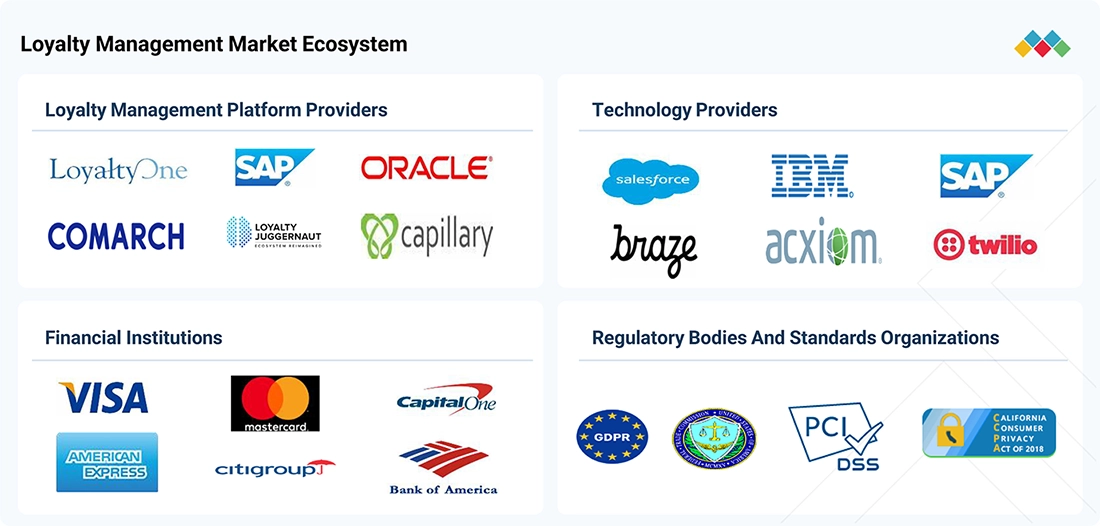
Logos and trademarks shown above are the property of their respective owners. Their use here is for informational and illustrative purposes only.
MARKET SEGMENTS
Source: Secondary Research, Interviews with Experts, MarketsandMarkets Analysis
Loyalty Management Market, By Solution
API-based loyalty management solutions are expected to register a higher CAGR during the forecast period. These solutions allow businesses to integrate loyalty capabilities directly into existing digital environments, including ecommerce platforms, mobile applications, CRM systems, POS systems, and partner ecosystems. Their modular architecture enables businesses to introduce specific capabilities such as rewards, points management, tiering, referrals, or gamification without replacing their broader technology infrastructure. The flexibility of API-based solutions is particularly relevant for organizations operating across multiple channels and markets, where loyalty programs need to adapt quickly to changing business requirements and customer journeys.
Loyalty Management Market, By Program Type
Points-based loyalty programs are expected to account for the largest market share during the forecast period. Their established operating model allows businesses to reward customers based on purchases, engagement, referrals, and other predefined activities while providing flexibility in setting earning and redemption rules. Points can also be combined with tiers, gamification, personalized offers, and partner rewards to expand program engagement. Their familiarity among customers and adaptability across retail, hospitality, travel, BFSI, and other consumer-facing industries continue to support their widespread use, even as businesses introduce experiential and subscription-based elements alongside traditional points structures.
Loyalty Management Market, By Application
The customer lifecycle management segment is expected to account for the largest market share during the forecast period. Businesses are increasingly using loyalty capabilities across multiple stages of the customer relationship, including acquisition, onboarding, activation, repeat purchases, retention, and re-engagement. Loyalty programs can be linked with customer milestones and behavioral triggers to deliver relevant rewards at different stages of the relationship. Integration with CRM, marketing automation, and customer analytics systems further enables businesses to coordinate loyalty activities with broader customer engagement strategies, supporting continued use of loyalty management across the customer lifecycle.
REGION
Asia Pacific to be fastest-growing region in global loyalty market during forecast period
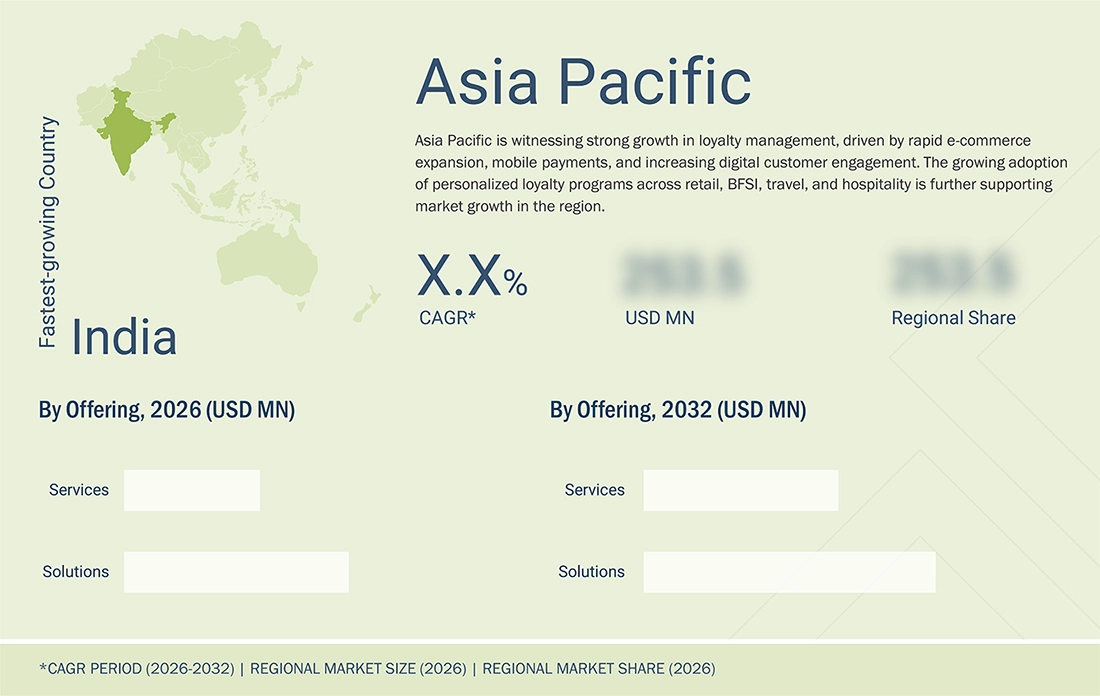
The Asia Pacific loyalty management market is expected to register the highest CAGR during the forecast period, supported by expanding digital commerce, mobile payments, and growing customer engagement across digital channels. Businesses across the region are increasingly integrating loyalty programs with ecommerce, mobile applications, and digital payment ecosystems to encourage repeat purchases and strengthen customer engagement. The presence of diverse and rapidly evolving consumer markets is also encouraging businesses to adopt flexible loyalty models, including personalized rewards, subscription programs, and partner-based benefits. These developments are creating opportunities for loyalty management vendors across retail, BFSI, travel, hospitality, and consumer goods industries
LOYALTY MANAGEMENT MARKET: COMPANY EVALUATION MATRIX
In the loyalty management market matrix, Epsilon (Star) combines a broad product footprint with strong capabilities in loyalty, customer data, personalization, and AI-driven decisioning. Xoxoday (Emerging Leader) offers a modular loyalty platform covering customer and channel loyalty, rewards, gamification, referrals, and omnichannel engagement. Its expanding capabilities across loyalty infrastructure and reward fulfillment strengthen its presence across diverse loyalty use cases
Source: Secondary Research, Interviews with Experts, MarketsandMarkets Analysis
KEY MARKET PLAYERS
- Epsilon (US)
- Oracle (US)
- Comarch (Poland)
- Bond Brand Loyalty (Canada)
- Merkle (US)
- Capillary (Singapore)
- Jakala (Italy)
- Kobie (US)
- Xoxoday (US)
- Maritz Motivation (US)
- Zeta Global (US)
- Salesforce (US)
- Punchh (US)
- Ebbo (US)
- Preferred Patron (US)
- Loopy Loyalty (China)
- Paystone (UK)
- LoyLogic (Switzerland)
- Ascenda (Singapore)
- Loyalty Juggernaut (US)
- Gratifii (Australia)
- SAP SE (Germany)
MARKET SCOPE
| REPORT METRIC | DETAILS |
|---|---|
| Market Size in 2025 (Value) | USD 12.86 Billion |
| Market Size in 2026 (Value) | USD 13.94 Billion |
| Market Forecast in 2032 (Value) | USD 23.11 Billion |
| Growth Rate | CAGR of 8.8% from 2026 to 2032 |
| Years Considered | 2020-2032 |
| Base Year | 2025 |
| Forecast Period | 2026-2032 |
| Units Considered | Value (USD Million/Billion) |
| Report Coverage | Revenue forecast, company ranking, competitive landscape, growth factors, and trends |
| Segments Covered | By Offering, Program Type, Application, Business Model, Vertical, Region |
| Regions Covered | North America, Asia Pacific, Europe, South America, Middle East & Africa |
WHAT IS IN IT FOR YOU: LOYALTY MANAGEMENT MARKET REPORT CONTENT GUIDE
DELIVERED CUSTOMIZATIONS
We have successfully delivered the following deep-dive customizations:
| CLIENT REQUEST | CUSTOMIZATION DELIVERED | VALUE ADDS |
|---|---|---|
| Leading Service Provider (US) |
|
|
| Company Information | Detailed analysis and profiling of additional market players (up to 5) |
|
RECENT DEVELOPMENTS
- April 2026 : Comarch and Sway Outcomes partnered to connect loyalty strategy with technology execution. The collaboration combines Comarch’s enterprise loyalty management platform with Sway’s Customer Engagement Accelerator and strategic methodology, covering customer-engagement assessment, business-case development, loyalty strategy and roadmap design, technology selection, platform implementation, and program operations. The partnership targets retail, food and beverage, travel, financial services, and telecommunications markets across the UK, Europe, North America, and the Middle East.
- March 2026 : Bond and Affina partnered to expand loyalty intelligence and merchant-funded rewards. The collaboration integrates Affina’s card-linked and affiliate loyalty engine with Bond’s intelligence ecosystem, including Synapze XI and Wallet IQ, to provide cross-brand spending insights, merchant-funded reward opportunities, personalized targeting, and expanded earning opportunities.
- February 2026 : Capillary Technologies acquired SessionM from Mastercard, strengthening its enterprise customer loyalty and engagement capabilities. SessionM brings customer engagement and loyalty technology, along with a global customer base spanning retailers, airlines, and CPG brands. The acquisition is intended to combine complementary loyalty technologies and expand Capillary’s enterprise loyalty platform and global reach.
- October 2025 : Comarch entered into a strategic partnership with Panda, a Saudi Arabian retailer, to develop and operate a new loyalty management system. The Comarch-powered platform is designed to support hyper-personalized customer engagement and meaningful rewards across Panda’s customer base, forming part of the retailer’s digital transformation strategy and strengthening customer loyalty and brand affinity.
- October 2025 : Merkle partnered with Airship and Salesforce Marketing Cloud to create a mobile-first loyalty accelerator solution. The collaboration combines Salesforce Loyalty Management for loyalty earning and redemption, Airship for personalized real-time mobile engagement, and Merkle for loyalty strategy, data, and journey orchestration. The solution enables brands to design and execute loyalty programs across apps, web, mobile wallets, push notifications, RCS, and in-store experiences, with real-time bidirectional integration with Salesforce Marketing Cloud.
Table of Contents
 Exclusive indicates content/data unique to MarketsandMarkets and not available with any competitors.
Methodology
This research study involved the extensive use of secondary sources, directories, and databases, such as Dun & Bradstreet (D&B) Hoovers and Bloomberg BusinessWeek, to identify and collect information useful for a technical, market-oriented, and commercial study of the loyalty management market. The primary sources were mainly industry experts from the core and related industries and preferred suppliers, manufacturers, distributors, service providers, technology developers, alliances, and organizations related to all segments of the value chain of this market. In-depth interviews were conducted with various primary respondents, including key industry participants, subject matter experts, C-level executives of key market players, and industry consultants, to obtain and verify critical qualitative and quantitative information.
Secondary Research
The market size of companies offering loyalty management worldwide was arrived at based on secondary data available through paid and unpaid sources. It was also determined by analyzing the product portfolio of major companies and rating them based on their performance and quality. In the secondary research process, various secondary sources were referred to identify and collect information for the study. The secondary sources included annual reports, press releases, and investor presentations of companies; white papers, journals, and certified publications; and articles from recognized authors, directories, and databases.
Secondary research was mainly used to obtain key information about the industry’s value chain and supply chain and to identify key players through various solutions and services, market classification and segmentation according to offerings of major players, industry trends related to technologies, applications, and regions, and key developments from both market-oriented and technology-oriented perspectives.
Primary Research
In the primary research process, various primary sources from the supply and demand sides were interviewed to obtain qualitative and quantitative information on the market. The primary sources from the supply side included various industry experts, including Chief Experience Officers (CXOs); Vice Presidents (VPs); directors from business development, marketing, and product development/innovation teams; related key executives from loyalty management solution vendors, professional service providers, and industry associations; and key opinion leaders.
Primary interviews were conducted to gather insights, such as market statistics, revenue data collected from solutions and services, market breakdowns, market size estimations, market forecasts, and data triangulation. Primary research also helped in understanding various trends related to technologies, applications, deployments, and regions. Stakeholders from the demand side, such as Chief Information Officers (CIOs), Chief Technology Officers (CTOs), Chief Strategy Officers (CSOs), and end users using loyalty management solutions, were interviewed to understand the buyer’s perspective on suppliers, products, service providers, and their current usage of loyalty management solutions, which would impact the overall loyalty management market.
Breakdown of Primaries:

Note: Tier 1 companies’ revenue is more than USD 1 billion; Tier 2 companies’ revenue ranges between USD 500 million and USD 1 billion; and Tier 3 companies’ revenue ranges between USD 100 million and USD 500 million. Other designations include sales managers, marketing managers, and product managers.
To know about the assumptions considered for the study, download the pdf brochure
Market Size Estimation
Multiple approaches were adopted to estimate and forecast the size of the loyalty management market. The first approach involves estimating market size by summing up the revenue generated by companies through the sale of loyalty management offerings.
Top-down and bottom-up approaches were used to estimate and validate the total size of the loyalty management market. These methods were also extensively used to estimate the size of various market segments. The research methodology used to evaluate the market size is listed below.
- Key players in the market were identified through extensive secondary research.
- In terms of value, the industry’s supply chain and market size were determined through primary and secondary research processes.
- All percentage shares, splits, and breakups were determined using secondary sources and verified through primary sources.
Loyalty Management Market: Top-Down and Bottom-Up Approach

Data Triangulation
After determining the overall market size, the loyalty management market was divided into several segments and subsegments. A data triangulation procedure was used to complete the overall market engineering process and arrive at the exact statistics for all segments and subsegments, wherever applicable. The data was triangulated by studying various factors and trends from the demand and supply sides. Along with data triangulation and market breakdown, the market size was validated by the top-down and bottom-up approaches.
Market Definition
Loyalty management is a series of activities to acquire, engage, and retain stakeholders to strengthen relationships with customers and other stakeholders. Loyalty programs are designed to provide an interactive environment between a business organization, its customers, employees, and channel partners (distributors and resellers). Loyalty Management is an end-to-end solution that helps create intelligent, personalized engagements that increase customer loyalty. Loyalty management software allows users to design, build, launch, manage, and analyze various types of loyalty programs.
Key Stakeholders
- Sytem Integrators
- Value-added Resellers
- Cloud Service Providers
- Software Developers
- Application Developers
- Customer Loyalty Solution Vendors
- Channel Loyalty Solution Vendors
- Customer Analytics Solution Vendors
- Distributors and Resellers of Loyalty Management Solutions
Report Objectives
- To determine and forecast the loyalty management market by offering (solutions and services), program type, application, business model, vertical, and region
- To forecast the size of the market segments for North America, Europe, Asia Pacific, Latin America, and the Middle East & Africa
- To provide detailed information about the major factors (drivers, restraints, opportunities, and challenges) influencing the growth of the market
- To analyze each submarket concerning individual growth trends, prospects, and contributions to the overall market
- To analyze the opportunities in the market for stakeholders by identifying the high-growth segments of the market
- To profile the key market players; provide a comparative analysis based on business overviews, regional presence, product offerings, business strategies, and key financials; and illustrate the market’s competitive landscape
- To track and analyze competitive developments in the market, such as mergers and acquisitions, product developments, partnerships and collaborations, and research and development (R&D) activities
Available customizations:
With the given market data, MarketsandMarkets offers customizations to meet the company’s specific needs. The following customization options are available for the report:
Country-wise information
- Analysis for additional countries (up to five)
Company Information
- Detailed analysis and profiling of additional market players (up to 5)
Key Questions Addressed by the Report
What is the definition of the loyalty management market?
Loyalty management refers to the strategic process of attracting, retaining, and nurturing customer relationships through various programs, incentives, and personalized interactions. Its primary goal is to foster long-term engagement and repeat business by recognizing, rewarding, and understanding customer behavior. This process involves collecting customer data, analyzing preferences, segmenting customers, and delivering tailored offers, experiences, and communications that encourage ongoing support.
What is the market size of the loyalty management market?
The loyalty management market is projected to grow from USD 12.89 billion in 2025 to USD 20.36 billion by 2030 at a CAGR of 9.6% from 2025 to 2030.
What are the major drivers of the loyalty management market?
The major drivers of the loyalty management market include a growing focus on reducing customer churn rates, the integration of gamification into loyalty programs, companies strategically investing in loyalty programs amid recession and inflation, the emergence of loyalty management mobile applications, the demand for advanced solutions to monitor customer scores and enhance customer engagement, and the rising adoption of an omnichannel customer loyalty strategy.
Who are the key players operating in the loyalty management market?
The key players profiled in the loyalty management market include Epsilon (US), Oracle (US), Comarch (Poland), Bond Brand Loyalty (Canada), Merkle (US), Capillary (Singapore), Jakala (Italy), Kobie (US), Giift Management (Singapore), Maritz Motivation (US), Cheetah Digital (US), Collinson (UK), AIR MILES Loyalty (Canada), Punchh (US), Ebbo (US), Preferred Patron (US), Loopy Loyalty (China), Paystone (UK), LoyLogic (Switzerland), Ascenda (Singapore), Loyalty Juggernaut (US), Gratifii (Australia), SAP SE (Germany), Annex Cloud (US), Apex Loyalty (US), Sumup (UK), Kangaroo (Canada), Smile.io (Canada), SessionM (US), LoyaltyLion (UK), Yotpo (US), SailPlay (US), Phaedon (US), and Zinrelo (US).
What are the key technological trends prevailing in the loyalty management market?
The loyalty management market is increasingly driven by AI and hyper-personalization, leveraging data analytics to deliver tailored offers and experiences. There is a strong shift toward omnichannel integration and mobile-first strategies, ensuring seamless customer engagement across all touchpoints. Additionally, gamification and experiential rewards are gaining prominence to foster deeper, more engaging customer relationships beyond mere transactions benefits.


Personalize This Research
- Triangulate with your Own Data
- Get Data as per your Format and Definition
- Gain a Deeper Dive on a Specific Application, Geography, Customer or Competitor
- Any level of Personalization
Let Us Help You
- What are the Known and Unknown Adjacencies Impacting the Loyalty Management Market
- What will your New Revenue Sources be?
- Who will be your Top Customer; what will make them switch?
- Defend your Market Share or Win Competitors
- Get a Scorecard for Target Partners

Custom Market Research Services
We Will Customise The Research For You, In Case The Report Listed Above Does Not Meet With Your Requirements
Get 10% Free CustomisationTESTIMONIALS
- Canada Loyalty Management Market
- US Loyalty Management Market
- UK Loyalty Management Market
- Germany Loyalty Management Market
- China Loyalty Management Market
- Japan Loyalty Management Market
- Brazil Loyalty Management Market
- Mexico Loyalty Management Market
- France Loyalty Management Market
- Italy Loyalty Management Market
- Nordic Countries Loyalty Management Market
- Rest Of Europe Loyalty Management Market
- Spain Loyalty Management Market
- India Loyalty Management Market
- Rest Of Asia Pacific Loyalty Management Market
- South Korea Loyalty Management Market
- Southeast Asia Loyalty Management Market
- Rest Of Latin America Loyalty Management Market
- GCC Countries Loyalty Management Market
- South Africa Loyalty Management Market



Growth opportunities and latent adjacency in Loyalty Management Market