



Smart Lighting Market Size, Share & Growth Trends
Report Code
SE 2506
Published in
Oct, 2026, By MarketsandMarkets™
Smart Lighting Market Size, Share, Growth & Trends by Lights and Luminaire, Lighting Controls, LED Drivers and Ballasts, Sensors, Switches, Gateways, Dimmers, Relay Units, DALI, Power over Ethernet (PoE), Power Line Communications (PLC) and Zigbee - Global Forecast to 2032

USD 20.50 BN
MARKET SIZE, 2032

CAGR 10.9%
(2026-2032)

290
REPORT PAGES

160
MARKET TABLES
SMART LIGHTING MARKET OVERVIEW
According to Marketsandmarkets, the global smart lighting market size is projected to grow from USD 11.00 billion in 2026 to USD 20.50 billion by 2032, growing at a CAGR of 10.9% from 2026 to 2032. The market is witnessing steady growth due to increasing investments in connected buildings, smart cities, energy-efficient infrastructure, and IoT-enabled lighting systems across commercial, residential, industrial, healthcare, retail, and outdoor applications. The growing demand for automated lighting control, real-time monitoring, energy optimization, occupant comfort, and intelligent building management is accelerating the deployment of smart lighting solutions. Signify’s connected lighting portfolio, for example, combines LED lighting, IoT platforms, and embedded sensor networks, while Acuity Brands offers networked wired and wireless controls, occupancy and daylight sensors, and connected luminaires.
REPORT SCOPE
| REPORT METRIC | DETAILS |
|---|---|
| Market Size in 2025 (Value) | USD 9.86 Billion |
| Market Forecast in 2026 (Value) | USD 11.00 Billion |
| Market Forecast in 2032 (Value) | USD 20.50 Billion |
| Growth Rate | CAGR of 10.9% from 2026 to 2032 |
| Years Considered | 2022–2032 |
| Base Year | 2025 |
| Forecast Period | 2026–2032 |
| Units Considered | Value (USD Million/Billion), Volume (Million Units) |
| Report Coverage | Revenue Forecast, Company Ranking, Competitive Landscape, Growth Factors, and Trends |
| Top Companies |
|
| Growth Drivers |
|
| Segments Covered |
|
| Regions Covered | North America, Europe, Asia Pacific, Rest of the World |
KEY TAKEAWAYS
-
BY REGIONBy region, Europe dominated the smart lighting market with a share of ~39.3%, in terms of value, in 2025.
-
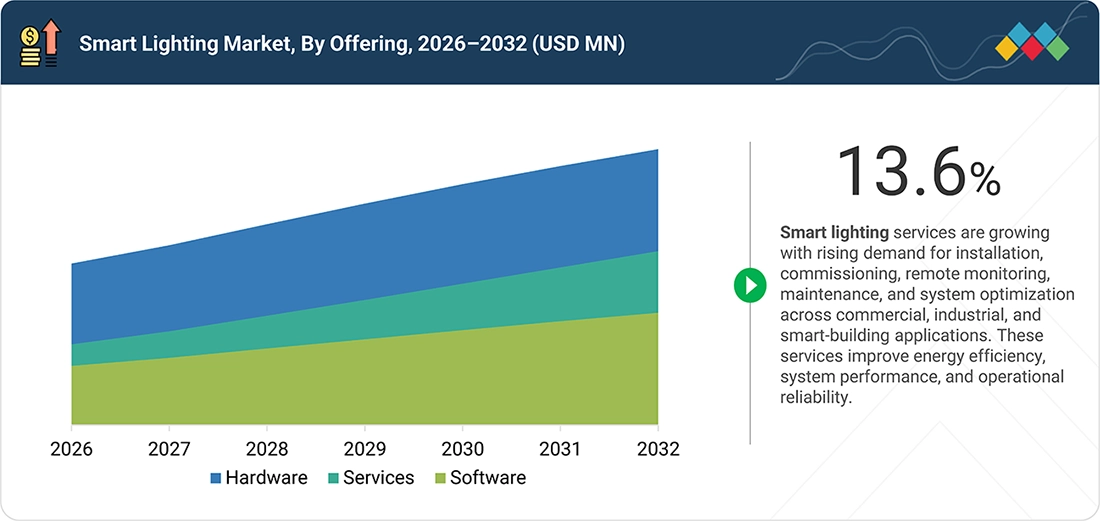
BY OFFERINGBy offering, the services segment is expected to record a CAGR of 13.6% during the forecast period.
-
BY COMMUNICATION TECHNOLOGYBy communication technology, the wireless segment is expected to exhibit a CAGR of 12.8% during the forecast period.
-
BY DISTRIBUTION CHANNELBy distribution channel, the online sales segment is expected to register a high growth rate during the forecast period.
-
BY END-USE APPLICATIONBy end-use application, the indoor segment is expected to lead the market during the forecast period.
-
COMPETITIVE LANDSCAPE (KEY PLAYERS)Signify Holding, Legrand, Acuity Brands, Zumtobel Group, and Panasonic Holdings are key players in the smart lighting market due to their broad portfolios of connected luminaires, lighting controls, sensors, IoT platforms, and building-automation solutions. Their offerings support commercial, residential, industrial, healthcare, retail, hospitality, and outdoor applications, with a focus on energy efficiency, automated control, connectivity, and intelligent building management.
-
COMPETITIVE LANDSCAPE (STARTUPS/SMES)Casambi Technologies and Silvair have developed specialized positions in smart lighting through wireless and Bluetooth-based lighting-control technologies.
The smart lighting industry is expected to grow significantly as businesses, municipalities, and consumers increase investments in connected buildings, smart cities, energy-efficient infrastructure, and IoT-enabled lighting across commercial, residential, industrial, healthcare, retail, and outdoor applications. The market is further driven by rising demand for automated lighting control, real-time monitoring, energy optimization, occupant comfort, and intelligent building management. Product innovations and strategic developments by key players such as Signify, Legrand, Acuity Brands, Zumtobel, and Panasonic, including advancements in connected luminaires, occupancy and daylight sensors, wireless controls, IoT platforms, and cloud-based lighting-management systems, are further strengthening adoption across smart-building and smart-city applications. Signify’s Interact platform, for instance, provides centralized real-time control, monitoring, and optimization of connected lighting across buildings and cities.
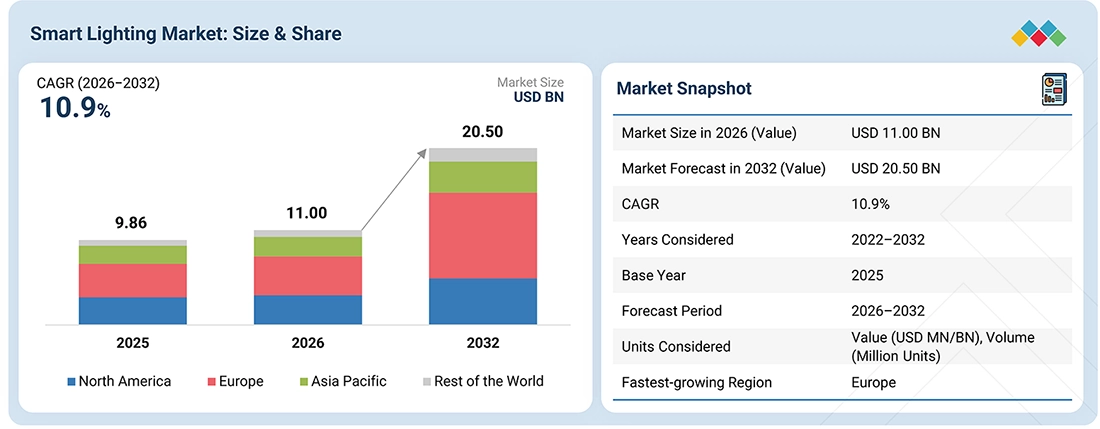
Source: Secondary Research, Interviews with Experts, MarketsandMarkets Analysis
TRENDS & DISRUPTIONS IMPACTING CUSTOMERS' CUSTOMERS
IoT-enabled lighting, occupancy and daylight sensing, wireless connectivity, and intelligent lighting controls are transforming commercial buildings, smart cities, residential spaces, industrial facilities, healthcare, and retail applications. These innovations enable automated illumination, real-time monitoring, energy optimization, flexible lighting control, improved occupant comfort, and lower operating costs. Advancements in LED technology, connected luminaires, AI-driven controls, cloud-based lighting management, and interoperability with building management systems are improving system intelligence, scalability, and integration. As building owners, facility managers, municipalities, and residential users increasingly adopt smart lighting for energy efficiency, automation, and connected infrastructure, these technologies are supporting the transition from conventional lighting toward intelligent, data-driven lighting environments. The integration of lighting with IoT platforms, sensors, smart-city infrastructure, and building automation is further expanding the application scope and supporting sustained growth of the global smart lighting market. grandviewresearch.com
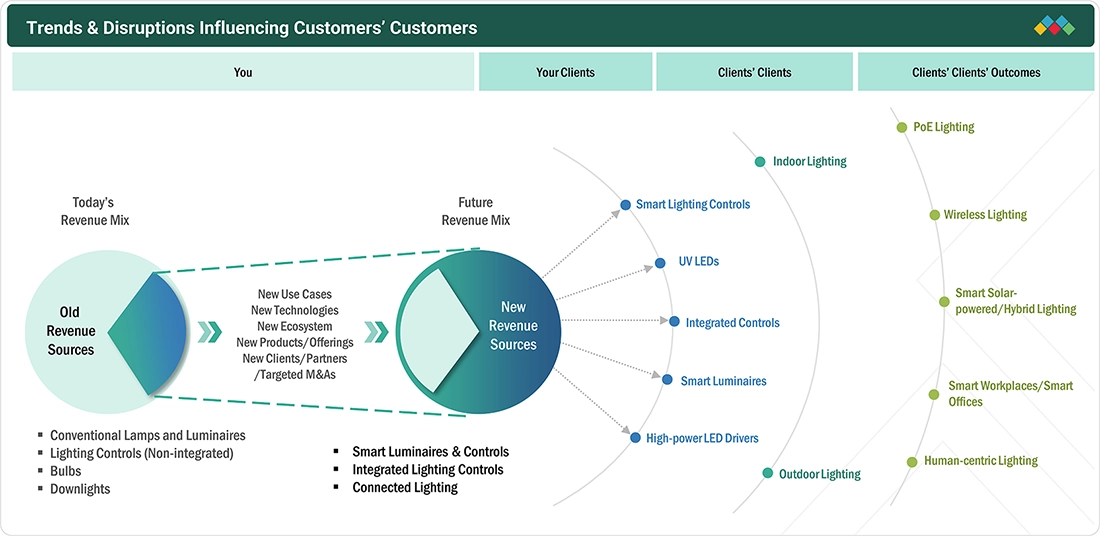
Source: Secondary Research, Interviews with Experts, MarketsandMarkets Analysis
MARKET DYNAMICS

Drivers
Impact
Level
Level
-
Rising smart city initiatives globally

-
Advancements in AI and edge computing technologies


RESTRAINTS
Impact
Level
Level
-
Cybersecurity concerns associated with internet-connected lighting systems

-
Difficulties associated with retrofitting of traditional lighting infrastructure


OPPORTUNITIES
Impact
Level
Level
-
Development of solar-powered and hybrid smart lighting solutions

-
Emerging smart office and smart retail trends


CHALLENGES
Impact
Level
Level
-
High upfront costs of equipment and accessories

-
Interoperability and compatibility issues

Source: Secondary Research, Interviews with Experts, MarketsandMarkets Analysis
Driver: Rising smart city initiatives globally
Smart city initiatives are progressing worldwide, creating substantial opportunities for technology firms, service providers, utility companies, and consultants. Smart lighting has emerged as a fundamental component of smart cities, focusing on optimizing electricity consumption and promoting energy efficiency.
Restraint: Cybersecurity concerns associated with internet-connected lighting systems
The integration of internet-connected systems into smart lighting introduces significant security risks, which can restrain the market’s growth. As smart lighting solutions rely on internet connectivity and IoT infrastructure, they are vulnerable to potential cyberattacks, data breaches, and unauthorized access.
Opportunity: Development of solar-powered and hybrid smart lighting solutions
The advancement of solar-powered and hybrid smart lighting presents a significant opportunity to improve energy efficiency, reduce carbon emissions, and provide sustainable illumination solutions, particularly in areas with unreliable electricity access. These systems can operate independently of the traditional power grid by harnessing solar energy, offering environmental and economic benefits.
Challenge:High upfront costs of equipment and accessories
One key constraint in the smart lighting market is the high initial cost associated with equipment and accessories, which can hinder widespread adoption, particularly in cost-sensitive sectors. Smart lighting systems typically require advanced components such as IoT-enabled LED luminaires, sensors, control modules, wireless connectivity solutions, and centralized management software.
SMART LIGHTING MARKET SIZE, SHARE & GROWTH TRENDS FORECAST TO 2032: COMMERCIAL USE CASES ACROSS INDUSTRIES
| COMPANY | USE CASE DESCRIPTION | BENEFITS |
|---|---|---|
 |
Signify offers smart and connected lighting solutions through its Interact platform, combining LED luminaires, occupancy sensors, daylight sensors, and connected controls for offices, industrial facilities, healthcare, retail, and outdoor applications. Its solutions enable automated lighting adjustment, zoning, scheduling, and remote monitoring based on occupancy and environmental conditions. | Enables intelligent and energy-efficient lighting control | Reduces energy consumption and operational costs | Supports remote monitoring and automated lighting management | Improves occupant comfort and safety |
 |
Legrand provides connected lighting control solutions incorporating sensors, switches, dimmers, and building-control technologies. These solutions are used across commercial buildings, residential spaces, healthcare, education, and industrial facilities to automate lighting based on occupancy, daylight, and user requirements. | Provides automated and flexible lighting control | Supports energy-efficiency and sustainability objectives | Enhances occupant comfort and convenience | Enables integration with building management systems |
 |
Acuity Brands offers intelligent lighting and control solutions through platforms such as nLight, incorporating occupancy sensors, photocells, controllers, switches, dimmers, and connected luminaires. The solutions support indoor and outdoor applications and can scale from individual rooms to entire buildings and campuses. | Enables smart and adaptive lighting control | Reduces energy consumption and installation requirements | Supports real-time monitoring and building optimization | Improves operational efficiency and occupant experience |
 |
Zumtobel provides connected architectural lighting solutions combining LED luminaires with lighting controls, sensors, and digital management technologies. Its solutions are designed for offices, healthcare, education, retail, industrial facilities, and public spaces, supporting adaptive and human-centric lighting environments. | Provides flexible and high-quality lighting environments | Supports energy-efficient and sustainable buildings | Enhances occupant well-being and productivity | Enables connected and automated lighting management |
 |
Panasonic provides LED lighting and connected lighting solutions incorporating smart luminaires, sensors, and control technologies for offices, factories, warehouses, retail facilities, and public spaces. These solutions support automated lighting control, energy management, and efficient operation across different environments. | Enables efficient and reliable lighting control | Reduces energy consumption and operating costs | Supports safer and more comfortable environments | Facilitates smart-building and energy-management applications |
Logos and trademarks shown above are the property of their respective owners. Their use here is for informational and illustrative purposes only.
MARKET ECOSYSTEM
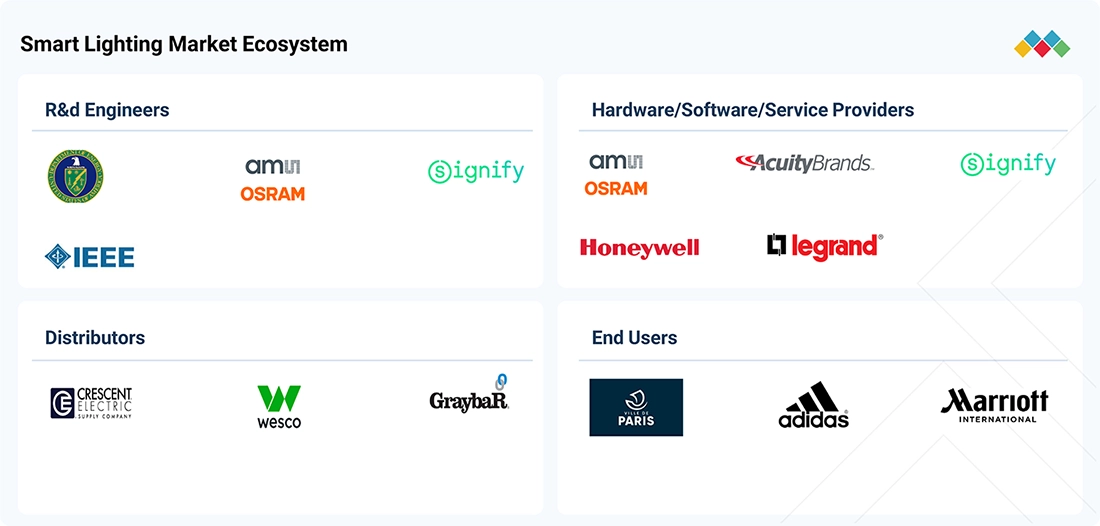
The smart lighting ecosystem comprises lighting component suppliers, smart lighting manufacturers, control-system providers, system integrators, distributors, and end users. Companies such as Signify, Legrand, Acuity Brands, Zumtobel, and Panasonic provide connected luminaires, LED systems, sensors, controllers, and lighting-management platforms for commercial, residential, industrial, healthcare, retail, and outdoor applications. Building owners, facility managers, municipalities, and other end users drive demand for smart lighting for energy efficiency, automation, safety, comfort, and connected-building management.
Logos and trademarks shown above are the property of their respective owners. Their use here is for informational and illustrative purposes only.
MARKET SEGMENTS
Source: Secondary Research, Interviews with Experts, MarketsandMarkets Analysis
Smart Lighting Market, by Offering
Services are expected to witness strong growth, driven by increasing demand for installation, commissioning, system integration, remote monitoring, maintenance, and lighting optimization. These services support efficient deployment and ongoing management of smart lighting systems across commercial, industrial, residential, and smart-city applications, while improving energy efficiency, system reliability, and operational performance.
Smart Lighting Market, by Communication Technology
Wired communication is expected to account for a significant market share due to its reliable connectivity, stable data transmission, and low latency. Its integration with building management systems, centralized lighting controls, and automated monitoring is driving adoption across commercial, industrial, residential, and smart-building applications.
Smart Lighting Market, by Distribution Channel
Offline sales are expected to maintain a significant position due to the need for product consultation, installation support, and physical evaluation of smart lighting solutions. Retail stores, electrical distributors, specialty lighting outlets, and authorized dealers support purchasing across residential, commercial, and industrial applications, particularly where customers require guidance on product selection and system compatibility.
Smart Lighting Market, by End-use Application
Indoor applications are expected to account for a significant share due to the growing adoption of smart lighting in offices, homes, retail stores, healthcare facilities, hospitality spaces, and industrial buildings. Connected luminaires, occupancy sensors, automated controls, and energy-management systems enable efficient lighting, enhanced comfort, flexible control, and reduced energy consumption across indoor environments.
REGION
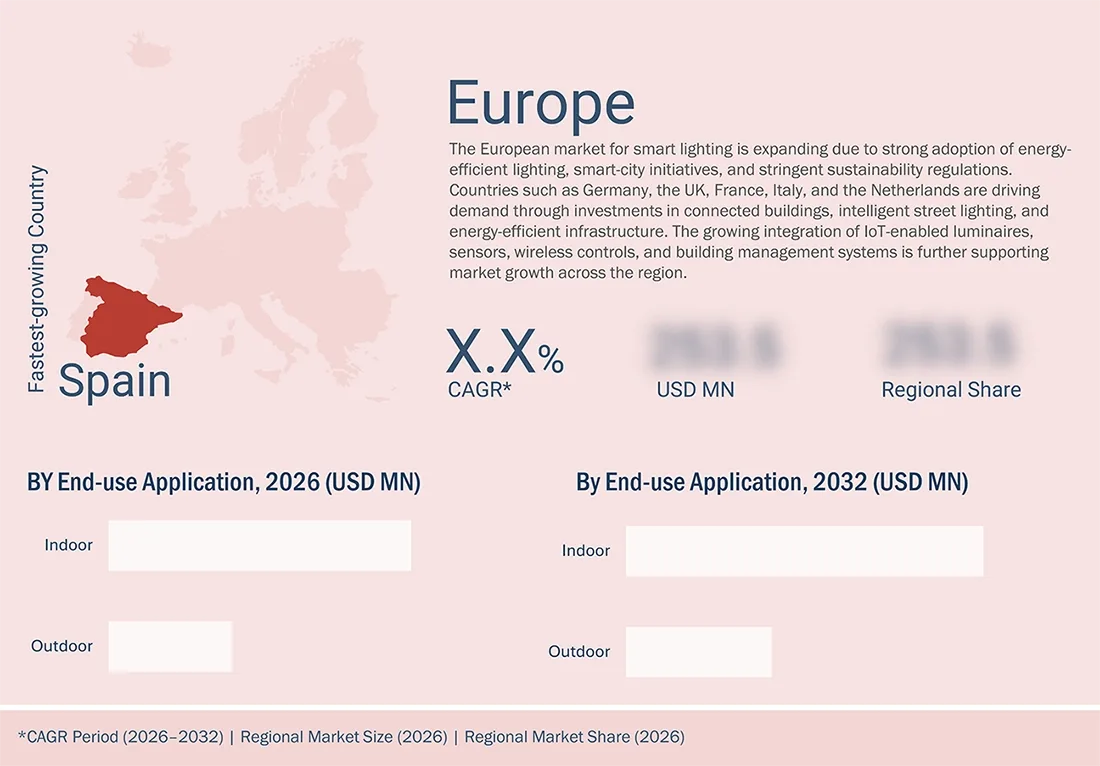
Europe to be fastest-growing region in smart lighting market during forecast period
Europe’s smart lighting market is growing due to increasing adoption of energy-efficient lighting, smart buildings, connected infrastructure, and IoT-enabled lighting systems. Germany, the UK, France, Italy, and the Netherlands are driving demand through investments in building modernization, smart-city projects, and energy-efficiency initiatives. The increasing deployment of connected LED luminaires, sensors, automated controls, and lighting-management systems across commercial, industrial, residential, and outdoor applications is further supporting market growth in the region.
SMART LIGHTING MARKET SIZE, SHARE & GROWTH TRENDS FORECAST TO 2032: COMPANY EVALUATION MATRIX
In the smart lighting market matrix, Signify (Star) strengthens its position through its broad portfolio of connected lighting solutions, including Interact IoT-enabled lighting, smart luminaires, occupancy and daylight sensors, and centralized lighting-management systems. Its solutions support real-time monitoring, automated control, adaptive dimming, energy optimization, and integration with building and city-management systems across commercial, industrial, healthcare, retail, hospitality, and outdoor applications. Honeywell (Emerging Leader) is strengthening its position through its connected-building and smart-lighting capabilities, including integration of connected lighting, occupancy monitoring, environmental sensing, and building-management technologies. Its collaboration with Signify combines smart lighting with Honeywell’s building solutions to support occupant experience, energy management, and intelligent building operations.
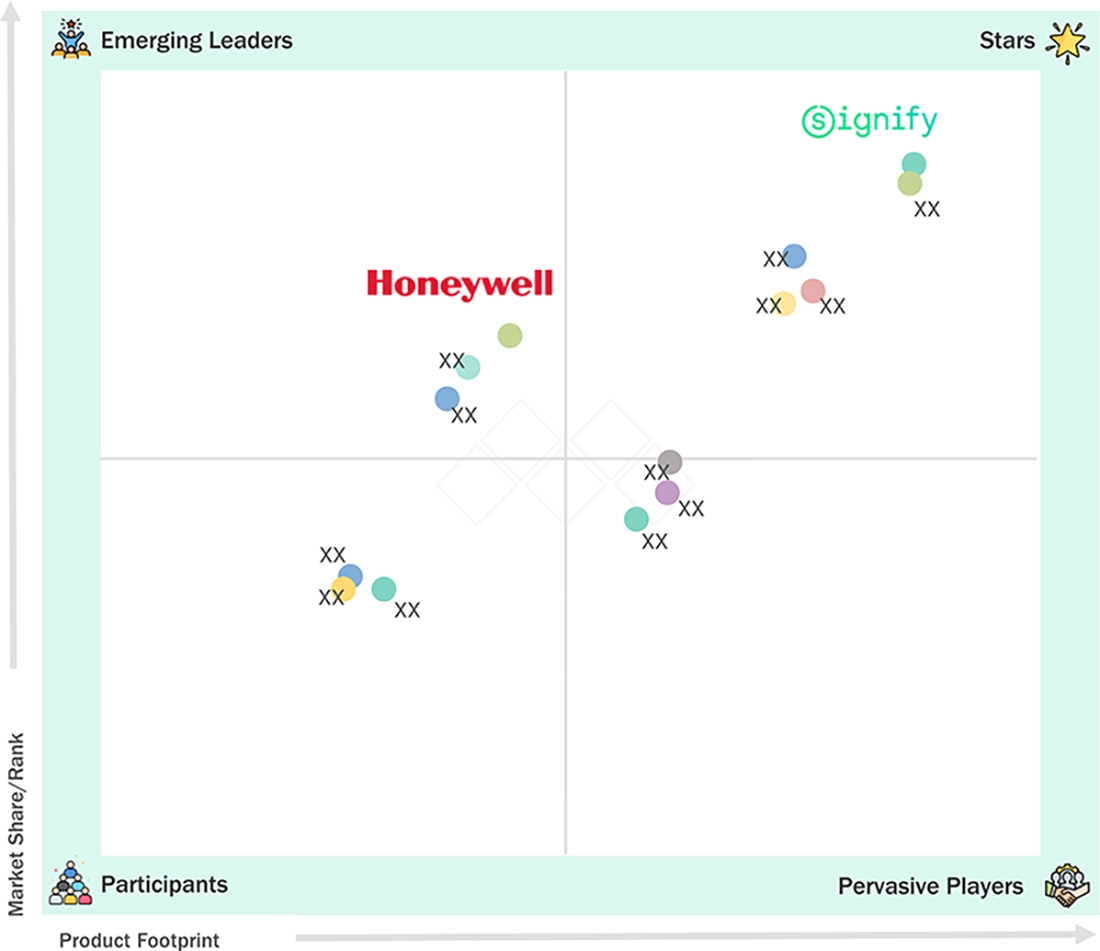
Source: Secondary Research, Interviews with Experts, MarketsandMarkets Analysis
KEY MARKET PLAYERS - TOP SMART LIGHTING COMPANIES
- Signify Holding (Netherlands)
- Legrand (France)
- Acuity Brands, Inc. (US)
- ams-OSRAM AG (Austria)
- Honeywell International Inc. (US)
- Wipro Lighting (India)
- Zumtobel Group (Austria)
- Lutron Electronics Co., Inc (US)
- IDEAL Industries, Inc. (US)
- LEDVANCE GmbH (Germany)
WHAT IS IN IT FOR YOU: SMART LIGHTING MARKET SIZE, SHARE & GROWTH TRENDS FORECAST TO 2032 REPORT CONTENT GUIDE
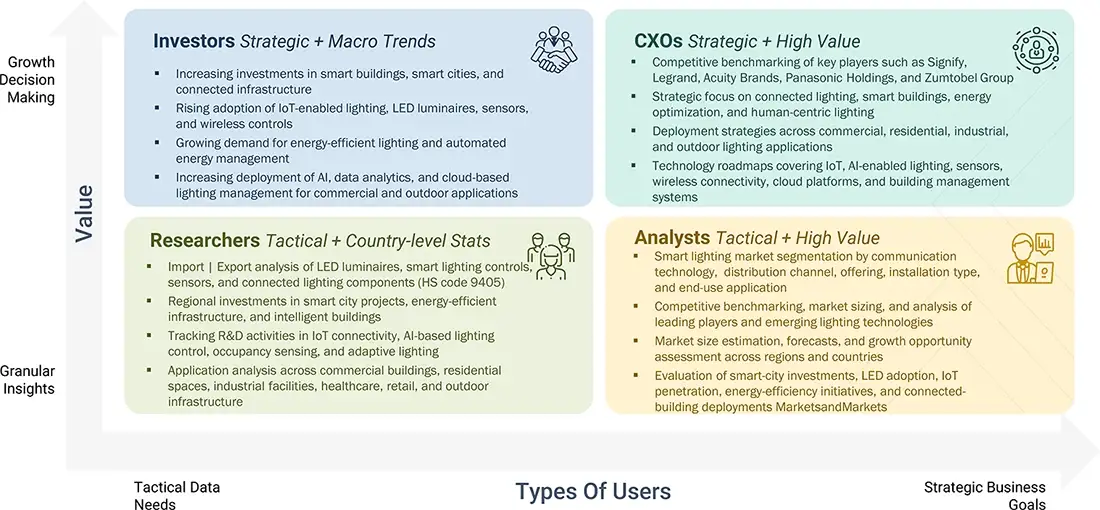
DELIVERED CUSTOMIZATIONS
We have successfully delivered the following deep-dive customizations:
| CLIENT REQUEST | CUSTOMIZATION DELIVERED | VALUE ADDS |
|---|---|---|
| Smart Lighting Manufacturer |
|
|
| Lighting Technology Supplier |
|
|
| Building Automation / System Integrator |
|
|
| Commercial & Industrial Enterprise |
|
|
| Private Equity / Investment Firm |
|
|
RECENT DEVELOPMENTS IN SMART LIGHTING
- September 2026 : Panasonic announced new color-adjustment functions for its professional imaging systems, addressing increasingly complex lighting environments involving LED walls, live events, studios, and virtual production. The functions are scheduled for firmware release in November 2026.
- August 2026 : Acuity Brands announced that six lighting and control solutions were selected for the 2026 IES Progress Report, including the SensorSwitch TLS Twist-to-Lock Sensor and several LED lighting products from Eureka, Gotham, Hydrel, and Lithonia Lighting.
- June 2026 : Signify expanded its professional lighting portfolio with additional outdoor specification luminaires, including sports, road, solar, tunnel, and flood lighting, while strengthening its connected and energy-efficient professional lighting portfolio.
- April 2026 : At Light + Building 2026, Zumtobel introduced four lighting highlights: LERIMA, MATRIX, CIELUMA Move, and an expanded PANOS III range. MATRIX focuses on real-time, task-based lighting, while the broader portfolio emphasizes adaptive and context-aware lighting.
- March 2026 : Signify launched next-generation Interact solutions for intelligent buildings and cities, including centralized real-time lighting control, Interact EasyConnect for outdoor lighting, city-wide remote management, and traffic- and weather-adaptive lighting.
Table of Contents
 Exclusive indicates content/data unique to MarketsandMarkets and not available with any competitors.
TITLE
PAGE NO
1
INTRODUCTION
15
2
EXECUTIVE SUMMARY
3
PREMIUM INSIGHTS
4
MARKET OVERVIEW
Maps the market evolution with focus on trend catalysts, risk factors, and growth opportunities across segments.
4.1
INTRODUCTION
4.2
MARKET DYNAMICS
4.2.1
DRIVERS
4.2.2
RESTRAINTS
4.2.3
OPPORTUNITIES
4.2.4
CHALLENGES
4.3
INTERCONNECTED MARKETS AND CROSS-SECTOR OPPORTUNITIES
4.4
STRATEGIC MOVES BY TIER-1/2/3 PLAYERS
5
INDUSTRY TRENDS
Presents a concise view of industry direction, strategic priorities, and key indicators influencing market momentum.
5.1
PORTER’S FIVE FORCES ANALYSIS
5.2
MACROECONOMIC OUTLOOK
5.2.1
INTRODUCTION
5.2.2
GDP TRENDS AND FORECAST
5.2.3
TRENDS IN GLOBAL MANUFACTURING INDUSTRY
5.2.4
TRENDS IN GLOBAL AUTOMOTIVE INDUSTRY
5.3
VALUE CHAIN ANALYSIS
5.4
ECOSYSTEM ANALYSIS
5.5
PRICING ANALYSIS
5.5.1
AVERAGE SELLING PRICE TREND OF OFFERINGS, BY KEY PLAYER (2022–2025)
5.5.2
AVERAGE SELLING PRICE TREND, BY REGION (2022–2025)
5.6
TRADE ANALYSIS
5.6.1
IMPORT SCENARIO (HS CODE 9405)
5.6.2
EXPORT SCENARIO (HS CODE 9405)
5.7
KEY CONFERENCES AND EVENTS, 2026–2027
5.8
TRENDS/DISRUPTIONS IMPACTING CUSTOMER BUSINESS
5.9
INVESTMENT AND FUNDING SCENARIO
5.10
CASE STUDY ANALYSIS
5.11
IMPACT OF 2025 US TARIFF – SMART LIGHTING MARKET
5.11.1
INTRODUCTION
5.11.2
KEY TARIFF RATES
5.11.3
PRICE IMPACT ANALYSIS
5.11.4
IMPACT ON COUNTRIES/REGIONS
5.11.5
IMPACT ON VERTICALS
6
TECHNOLOGICAL ADVANCEMENTS, AI-DRIVEN IMPACT, PATENTS, AND INNOVATIONS
6.1
KEY EMERGING TECHNOLOGIES
6.2
COMPLEMENTARY TECHNOLOGIES
6.3
ADJACENT TECHNOLOGIES
6.4
TECHNOLOGY ROADMAP
6.5
PATENT ANALYSIS
6.6
IMPACT OF AI ON SMART LIGHTING MARKET
6.6.1
TOP USE CASES AND MARKET POTENTIAL
6.6.2
BEST PRACTICES FOLLOWED BY PLAYERS IN SMART LIGHTING MARKET
6.6.3
CASE STUDIES RELATED TO AI IMPLEMENTATION IN SMART LIGHTING MARKET
6.6.4
INTERCONNECTED/ADJACENT ECOSYSTEM AND IMPACT ON MARKET PLAYERS
6.6.5
CLIENTS’ READINESS TO ADOPT AI IN SMART LIGHTING MARKET
7
REGULATORY LANDSCAPE
7.1
REGIONAL REGULATIONS AND COMPLIANCE
7.1.1
REGULATORY BODIES, GOVERNMENT AGENCIES, AND OTHER ORGANIZATIONS
7.1.2
INDUSTRY STANDARDS
8
CUSTOMER LANDSCAPE AND BUYER BEHAVIOR
8.1
DECISION-MAKING PROCESS
8.2
KEY STAKEHOLDERS INVOLVED IN BUYING PROCESS AND THEIR EVALUATION CRITERIA
8.2.1
KEY STAKEHOLDERS IN BUYING PROCESS
8.2.2
BUYING CRITERIA
8.3
ADOPTION BARRIERS AND INTERNAL CHALLENGES
8.4
UNMET NEEDS OF VARIOUS VERTICALS
9
SMART LIGHTING MARKET, BY INSTALLATION TYPE
Market Size, Volume & Forecast – USD Million
9.1
INTRODUCTION
9.2
NEW INSTALLATIONS
9.3
RETROFIT INSTALLATIONS
10
SMART LIGHTING MARKET, BY OFFERING (MARKET SIZE & FORECAST TO 2032, USD MILLION AND MILLION UNITS)
10.1
INTRODUCTION
10.2
HARDWARE
10.2.1
LIGHTS AND LUMINAIRES
10.2.2
LIGHTING CONTROLS
10.2.3
LED DRIVERS AND BALLASTS
10.2.4
SENSORS
10.2.5
SWITCHES
10.2.6
DIMMERS
10.2.7
RELAY UNITS
10.2.8
GATEWAYS
10.3
SOFTWARE
10.4
SERVICES
10.4.1
PRE-INSTALLATION SERVICES
10.4.2
POST-INSTALLATION SERVICES
11
SMART LIGHTING MARKET, BY COMMUNICATION TECHNOLOGY (MARKET SIZE & FORECAST TO 2032, USD MILLION)
11.1
INTRODUCTION
11.2
WIRED
11.2.1
DALI
11.2.2
POWER OVER ETHERNET (POE)
11.2.3
POWER LINE COMMUNICATIONS (PLC)
11.2.4
WIRED HYBRID PROTOCOLS
11.3
WIRELESS
11.3.1
ZIGBEE
11.3.2
WI-FI
11.3.3
BLUETOOTH LOW ENERGY (BLE)
11.3.4
ENOCEAN
11.3.5
6LOWPAN
11.3.6
WIRELESS HYBRID PROTOCOLS
12
SMART LIGHTING MARKET, BY DISTRIBUTION CHANNEL (MARKET SIZE & FORECAST TO 2032, USD MILLION)
12.1
INTRODUCTION
12.2
ONLINE RETAIL
12.3
OFFLINE RETAIL
13
SMART LIGHTING MARKET, BY END-USE APPLICATION (MARKET SIZE & FORECAST TO 2032, USD MILLION)
13.1
INTRODUCTION
13.2
INDOOR
13.2.1
COMMERCIAL
13.2.2
RESIDENTIAL
13.2.3
INDUSTRIAL
13.2.4
OTHERS
13.3
OUTDOOR
13.3.1
HIGHWAYS AND ROADWAYS LIGHTING
13.3.2
ARCHITECTURAL LIGHTING
13.3.3
LIGHTING FOR PUBLIC PLACES
14
SMART LIGHTING MARKET, BY REGION (MARKET SIZE & FORECAST TO 2032, USD MILLION)
14.1
INTRODUCTION
14.2
NORTH AMERICA
14.2.1
US
14.2.2
CANADA
14.2.3
MEXICO
14.3
EUROPE
14.3.1
UK
14.3.2
GERMANY
14.3.3
FRANCE
14.3.4
SPAIN
14.3.5
ITALY
14.3.6
REST OF EUROPE
14.4
ASIA PACIFIC
14.4.1
CHINA
14.4.2
JAPAN
14.4.3
INDIA
14.4.4
AUSTRALIA
14.4.5
REST OF ASIA PACIFIC
14.5
REST OF THE WORLD
14.5.1
MIDDLE EAST & AFRICA
14.5.1.1
GCC COUNTRIES
14.5.1.2
REST OF MIDDLE EAST & AFRICA
14.5.2
SOUTH AMERICA
15
COMPETITIVE LANDSCAPE
15.1
OVERVIEW
15.2
KEY PLAYER COMPETITIVE STRATEGIES/RIGHT TO WIN, 2024–2026
15.3
REVENUE ANALYSIS, 2021–2025
15.4
MARKET SHARE ANALYSIS,
15.5
BRAND/PRODUCT COMPARISON
15.6
COMPANY EVALUATION MATRIX: KEY PLAYERS,
15.6.1
STARS
15.6.2
EMERGING LEADERS
15.6.3
PERVASIVE PLAYERS
15.6.4
PARTICIPANTS
15.6.5
COMPANY FOOTPRINT: KEY PLAYERS,
15.6.5.1
COMPANY FOOTPRINT
15.6.5.2
REGION FOOTPRINT
15.6.5.3
OFFERING FOOTPRINT
15.6.5.4
INSTALLATION TYPE FOOTPRINT
15.6.5.5
COMMUNICATION TECHNOLOGY FOOTPRINT
15.6.5.6
DISTRIBUTION CHANNEL FOOTPRINT
15.6.5.7
END-USE APPLICATION FOOTPRINT
15.7
COMPANY EVALUATION MATRIX: STARTUPS/SMES,
15.7.1
PROGRESSIVE COMPANIES
15.7.2
RESPONSIVE COMPANIES
15.7.3
DYNAMIC COMPANIES
15.7.4
STARTING BLOCKS
15.7.5
COMPETITIVE BENCHMARKING: STARTUPS/SMES,
15.7.5.1
DETAILED LIST OF KEY STARTUPS/SMES
15.7.5.2
COMPETITIVE BENCHMARKING OF KEY STARTUPS/SMES
15.8
COMPANY VALUATION AND FINANCIAL METRICS
15.9
COMPETITIVE SCENARIO
15.9.1
PRODUCT LAUNCHES
15.9.2
DEALS
15.9.3
EXPANSIONS
16
COMPANY PROFILES
16.1
INTRODUCTION
16.1.1
KEY PLAYERS
16.1.1.1
SIGNIFY HOLDING
16.1.1.2
LEGRAND
16.1.1.3
ACUITY BRANDS, INC.
16.1.1.4
AMS-OSRAM AG
16.1.1.5
HONEYWELL INTERNATIONAL INC.
16.1.1.6
WIPRO LIGHTING
16.1.1.7
ZUMTOBEL GROUP
16.1.1.8
LUTRON ELECTRONICS CO., INC
16.1.1.9
IDEAL INDUSTRIES, INC.
16.1.1.10
LEDVANCE GMBH
16.1.2
OTHER PLAYERS
16.1.2.1
HLI SOLUTIONS, INC. (CURRENT)
16.1.2.2
SAVANT SYSTEMS, INC
16.1.2.3
INTER IKEA SYSTEMS B.V.
16.1.2.4
DIALIGHT
16.1.2.5
SCHNEIDER ELECTRIC
16.1.2.6
ABB
16.1.2.7
LIGHTWAVE
16.1.2.8
RAB LIGHTING INC.
16.1.2.9
SYNAPSE WIRELESS, INC.
16.1.2.10
PANASONIC CORPORATION
16.1.2.11
LEVITON MANUFACTURING CO., INC.
16.1.2.12
SYSKA
16.1.2.13
BUILDING ROBOTICS INC. (BRI), A SIEMENS COMPANY
16.1.2.14
HELVAR
16.1.2.15
LITEX
16.1.2.16
NANOLEAF
16.1.2.17
SENGLED USA
16.1.2.18
TVILIGHT PROJECTS B.V.
17
RESEARCH METHODOLOGY
17.1
RESEARCH DATA
17.1.1
SECONDARY DATA
17.1.1.1
KEY DATA FROM SECONDARY SOURCES
17.1.1.2
LIST OF KEY SECONDARY SOURCES
17.1.2
PRIMARY DATA
17.1.2.1
KEY DATA FROM PRIMARY SOURCES
17.1.2.2
KEY PRIMARY PARTICIPANTS
17.1.2.3
BREAKDOWN OF PRIMARY INTERVIEWS
17.1.2.4
KEY INDUSTRY INSIGHTS
17.2
MARKET SIZE ESTIMATION
17.2.1
BOTTOM-UP APPROACH
17.2.2
TOP-DOWN APPROACH
17.2.3
MARKET SIZE CALCULATION FOR BASE YEAR
17.3
MARKET FORECAST APPROACH
17.3.1
SUPPLY SIDE
17.3.2
DEMAND SIDE
17.4
DATA TRIANGULATION
17.5
FACTOR ANALYSIS
17.6
RESEARCH ASSUMPTIONS
17.7
RESEARCH LIMITATIONS
17.8
RISK ASSESSMENT
18
APPENDIX
18.1
DISCUSSION GUIDE
18.2
KNOWLEDGESTORE: MARKETSANDMARKETS’ SUBSCRIPTION PORTAL
18.3
CUSTOMIZATION OPTIONS
18.4
RELATED REPORTS
18.5
AUTHOR DETAILS
Methodology
This study involved four major activities in estimating the current size of the smart lighting market. Extensive secondary research was conducted to gather information on the smart lighting ecosystem, including lighting manufacturers, LED technology providers, sensor suppliers, lighting-control companies, system integrators, distributors, building automation providers, and end users. This was followed by primary research with industry stakeholders across the value chain, including smart lighting manufacturers, technology providers, component suppliers, distributors, system integrators, building owners, and facility managers, to validate assumptions and market sizing. Both top-down and bottom-up approaches were used to estimate the overall market size. Market breakdowns and data triangulation techniques were then applied to determine the size of individual segments and subsegments by offering, communication technology, distribution channel, end-use application, and region. Secondary and primary sources were jointly used to support a comprehensive, technical, commercial, and competitive analysis of the global smart lighting market.
Secondary Research
Various secondary sources were referred to during the secondary research process to identify and collect information relevant to the smart lighting market. These sources included annual reports, company presentations, press releases, product catalogs, technical datasheets, patents, technical publications, company websites, trade directories, and government databases. Secondary research was conducted to obtain key insights into the market’s supply chain, value chain, competitive landscape, and segmentation by offering, communication technology, distribution channel, end-use application, and region. It also helped assess industry trends, adoption of smart lighting across commercial, residential, industrial, healthcare, retail, hospitality, and outdoor applications, and developments in LED lighting, connected luminaires, occupancy and daylight sensors, wired and wireless controls, IoT platforms, and lighting-management systems. The collected information was further analyzed to estimate the overall market size and validate market assumptions, which were subsequently refined through primary research with industry experts and key stakeholders.
Primary Research
Extensive primary research was conducted after gaining knowledge about the current scenario of the smart lighting market through secondary research. Several primary interviews were conducted with experts from the demand and supply sides across four major regions: North America, Europe, Asia Pacific, and RoW. This primary data was collected through questionnaires, emails, and telephonic interviews.

Note: The three tiers of the companies are defined based on their total revenue in 2025: Tier 1 - revenue greater than or equal to USD 1 billion; Tier 2 - revenue between USD 100 million and USD 1 billion; and Tier 3 revenue less than or equal to USD 100 million. Other designations include sales managers, marketing managers, and product managers.
To know about the assumptions considered for the study, download the pdf brochure
Market Size Estimation
Both top-down and bottom-up approaches were used to estimate and validate the total size of the smart lighting market. These methods were also used extensively to estimate the size of various subsegments in the market. The following research methodology was used to estimate the market size:
- Major players in the smart lighting market and related markets were identified through extensive secondary research.
- The industry’s value chain and market size in terms of value and volume were determined through primary and secondary research processes.
- All percentage shares, splits, and segment-level breakdowns were determined using secondary sources and verified through primary research and data triangulation.

Data Triangulation
After arriving at the overall size of the smart lighting market through the market size estimation process, the total market was divided into relevant segments and subsegments. Data triangulation and market breakdown procedures were applied, wherever applicable, to complete the market engineering process and derive statistics for each segment and subsegment. The data were triangulated by evaluating factors and trends from the demand and supply sides, including technology adoption, product offerings, communication technologies, application requirements, smart-building investments, energy-efficiency initiatives, and regional trends. The analysis considered key smart lighting technologies such as LED lighting, connected luminaires, occupancy and daylight sensors, wired and wireless controls, IoT platforms, and lighting-management systems, along with hardware and services, distribution channels, and indoor and outdoor applications. Along with this, the market size was validated using top-down and bottom-up approaches to ensure consistency across the overall market and individual segments.
Market Definition
Smart lighting refers to lighting systems that combine LED luminaires, sensors, controllers, communication technologies, and software to enable automated, connected, and intelligent control of illumination. Smart lighting systems can detect occupancy, daylight, environmental conditions, and user preferences and adjust lighting levels, color, scheduling, and operation accordingly. These solutions can incorporate wireless or wired connectivity, occupancy and daylight sensing, dimming, and centralized or cloud-based lighting management across indoor and outdoor environments.
Smart lighting plays an important role across commercial and residential buildings, industrial facilities, healthcare, retail, hospitality, and outdoor infrastructure. These solutions enable energy management, automated lighting control, remote monitoring, occupant comfort, safety, and operational efficiency. Smart lighting systems are commonly integrated into offices, homes, factories, warehouses, hospitals, hotels, retail spaces, streets, and smart-city infrastructure. A typical smart lighting system may consist of LED luminaires, drivers, sensors, switches or controllers, communication interfaces, gateways, and lighting-management software, with its configuration varying according to the application, connectivity technology, control requirements, and operating environment.
Key Stakeholders
- Raw material and component suppliers
- Communication network providers
- Smart lighting device manufacturers
- Original equipment manufacturers
- Semiconductor component suppliers
- Analysts and strategic business planners
- Venture capitalists and start-ups
- Research laboratories and intellectual property (IP) companies
- Technology standards organizations, forums, alliances, and associations
- Hardware vendors
- Software integrators
- Smart lighting solutions-related service providers
- End users
- Government bodies such as regulatory authorities and policymakers
Report Objectives
- To define, estimate, and forecast the smart lighting market based on offering (hardware, software, and services), communication technology (wired and wireless), end-use application (indoor and outdoor), distribution channel (online retail and offline retail), and installation type (new installations and retrofit installations)
- To estimate and project the market size, in terms of value, for various segments with respect to four regions: North America, Europe, Asia Pacific, and the Rest of the World (ROW)
- To describe and forecast the market size, in terms of volume, by offering
- To provide detailed insights regarding drivers, restraints, opportunities, and challenges influencing the growth of the market
- To analyze emerging applications and standards in the market
- To examine manufacturers of smart lighting products, their strategies, production plans, and the overall supply chain, including material and component suppliers
- To strategically analyze the micromarkets with respect to individual growth trends, prospects, and contributions to the overall market
- To analyze the market opportunities for stakeholders and provide a comprehensive competitive landscape analysis
- To provide a detailed overview of the smart lighting value chain and ecosystem
- To provide a detailed overview of the impact of AI/Gen AI on the market
- To provide information about the key technology trends, trade analysis, and patents related to the market
- To benchmark the market players using the proprietary company evaluation matrix framework, which analyzes them on various parameters within the broad categories of market ranking/share and product portfolio
- To analyze competitive developments, such as partnerships, acquisitions, agreements, collaborations, and product launches
- To strategically profile key players and analyze their market share, ranking, and core competencies
Available customizations:
With the given market data, MarketsandMarkets offers customizations according to the company’s specific needs. The following customization options are available for the report:
Company Information:
- Detailed analysis and profiling of additional market players (up to 5)
Key Questions Addressed by the Report
What is the global smart lighting market size and forecast?
The MarketsandMarkets report states that the global smart lighting market is projected to grow from USD 11.00 billion in 2026 to USD 20.50 billion by 2032.
What is the expected CAGR of the smart lighting market?
The smart lighting market is projected to register a CAGR of 10.9% from 2026 to 2032, reflecting increased adoption of connected lighting, smart buildings, and energy-efficient infrastructure.
What are the major growth drivers of the smart lighting market?
Key drivers include global smart city initiatives, demand for energy-efficient lighting, wider LED adoption, IoT-enabled controls, and advances in AI and edge computing that support automated lighting management.
What are the key trends shaping the smart lighting industry?
Important trends include connected LED luminaires, wireless lighting controls, AI-enabled adaptive lighting, occupancy and daylight sensing, centralized monitoring, and integration with smart-building management platforms.
Which companies are major players in the smart lighting market?
Key companies identified in the report include Signify Holding, Legrand, Acuity Brands, ams-OSRAM AG, Honeywell International, Wipro Lighting, Zumtobel Group, Lutron Electronics, IDEAL Industries, and LEDVANCE.
Which region held the largest share of the smart lighting market?
Europe held the largest regional share in 2025, accounting for approximately 39.3% of the market by value, according to the report.
Which region is expected to grow fastest in the smart lighting market?
Asia Pacific is identified in the report's market analysis as a high-growth region, supported by urbanization, smart-city investments, energy-efficiency initiatives, and adoption of connected lighting in countries such as China and India.
Which segment is expected to grow fastest by offering?
The services segment is expected to record strong growth as customers require installation, commissioning, system integration, remote monitoring, maintenance, and lighting optimization.
What communication technology is gaining traction in smart lighting?
Wireless communication is expected to grow quickly because it can support flexible installation and connected control across buildings and outdoor infrastructure. The report highlights wireless technologies alongside wired solutions.
What does the Smart Lighting Market report analyze?
The report covers market sizing and forecasts, offering, installation type, communication technology, distribution channel, indoor and outdoor applications, regional performance, competitive landscape, company profiles, growth drivers, trends, opportuniti
Fact checked
Personalize This Research
- Triangulate with your Own Data
- Get Data as per your Format and Definition
- Gain a Deeper Dive on a Specific Application, Geography, Customer or Competitor
- Any level of Personalization
Let Us Help You
- What are the Known and Unknown Adjacencies Impacting the Smart Lighting Market
- What will your New Revenue Sources be?
- Who will be your Top Customer; what will make them switch?
- Defend your Market Share or Win Competitors
- Get a Scorecard for Target Partners

Custom Market Research Services
We Will Customise The Research For You, In Case The Report Listed Above Does Not Meet With Your Requirements
Get 10% Free CustomisationTESTIMONIALS

Tetsuya Ohhira
Business Development Manager-Technology Business
Nikon Corporation,
Leading Japanese MNC specializing in optics and imaging productswww.nikon.com
MarketsandMarkets™ response
is quick. Their attitude is flexible and positive. Analyst Insights are globally considered and
significant. Client Services quickly respond to our inquiry and demand. Their wide range of global
surveys help us make our strategic plan.
We hope Knowledge Store will be easier to search
for a report.
VP - Marketing & Business Development
Leading Provider of Process Control Solutions
We engaged with MarketsandMarkets on a study to perform an analysis and recommend a Go-To-Market strategy for metrology and process control in the semiconductor market. The study was tailored to our targets and needs with well-defined milestones. Our overall experience with the MarketsandMarkets team was very good throughout the project in all aspects including the analysis methodologies used, the quality and depth of primary and secondary data sets, the professionalism and flexibility of the team and the ability to meet the target schedule and milestones. We want to thank MarketsandMarkets team for a job well done.
- US Smart Lighting Market
- Canada Smart Lighting Market
- Mexico Smart Lighting Market
- Germany Smart Lighting Market
- France Smart Lighting Market
- UK Smart Lighting Market
- Italy Smart Lighting Market
- Spain Smart Lighting Market
- Netherlands Smart Lighting Market
- China Smart Lighting Market
- Japan Smart Lighting Market
- India Smart Lighting Market
- South Korea Smart Lighting Market
- Brazil Smart Lighting Market
- Argentina Smart Lighting Market
Growth opportunities and latent adjacency in Smart Lighting Market




Adam
Apr, 2026
What are the differences between wired and wireless communication technologies in smart lighting?.
John
Apr, 2026
Which end-use applications (residential, commercial, industrial) dominate the smart lighting market?.
Porter
Apr, 2026
What are the major challenges (cost, cybersecurity, interoperability) facing smart lighting adoption?.
User
Sep, 2019
I am very much interested in understanding market revenue and forecast in terms of $ and #units for smart lighting broken down by segments (commercial, industrial, outdoor, residential), and by lighting technology (LED, CFL, HID, etc). Is this information available as a part of this report? .
Zhang
Jul, 2022
I am developing a wireless smart lighting switch for home usage and want to sell it around the world out of china. I would like to know where in the world could that kind of products be best sold to, the market size right now, and the possible prospect, especially for Europe. It’s not in a hurry, no strict timeline, It’s a new tech of controlling any light anywhere using any device connected to the lighting device wirelessly. It’s not decided for the exact market budget including information taking. Only after the product had been developed successfully..
User
Sep, 2019
I'm wireless controller manufacturersand hence, looking specifically into wirelessly connected light bulbs. Do you have any information about this? Also, is the report contain market share analysis of varoius lighting controls manufacturers by region? .
User
Sep, 2019
I am currently a student at the University of Texas. I am researching the smart lighting industry. My group and I have to do a presentation on the market and how it will be affected with in the near future. I feel this article would be very helpful and would like to read it for some more specific details. I am specifically looking forward the market projections for US by region/states for smart lighitng space. Could you share such infomration? If yes, at what cost?.
User
Nov, 2019
My company is the distributors of smart lighting product lines. I am researching about smart lighting market. I am specifically looking for market information about Southeast Asia and Africa Markets. Is your study include detailed information for these 2 regions? If it is not readily available how much time will you need for this?.
Denis
Jun, 2025
Let’s keep the conversation going—I’m really interested in hearing your ideas..
User
Mar, 2019
I’m a researcher and analysing smart lightning market in Sweden, Russia and Denmark, compare the demands in them. I am also looking for the market drivers and barrieers within these countries. I feel that your report will be the greatest source of information for me to prepare! Does your report has information about these countries? at what price? .