Motion Sensor Market by Motion Technology (IR, Ultrasonic, Microwave, Dual Technology, & Tomographic), Application (Consumer Electronics, Automotive, Aerospace & Defense, Healthcare, & Industrial), and Geography - Global Forecast to 2025-2036


Motion Sensor Market Summary
The global Motion Sensor Market is experiencing significant expansion as industries increasingly adopt intelligent sensing technologies to support automation, security, smart infrastructure, and connected device ecosystems. Valued at approximately USD 8 billion in 2025, the market is projected to reach nearly USD 22 billion by 2036, growing at a CAGR of 9.5% during 2025–2036. Motion sensors have become an essential component in a wide range of applications, including consumer electronics, automotive systems, industrial automation, healthcare devices, smart homes, and security solutions. Their ability to detect movement, occupancy, acceleration, vibration, and positioning enables enhanced operational efficiency, safety, and user experience across multiple industries.
The growing adoption of Artificial Intelligence (AI), Internet of Things (IoT), edge computing, cloud connectivity, and industrial automation technologies is transforming the motion sensing landscape. AI-powered motion detection systems can differentiate between human activity, objects, and environmental changes, improving accuracy and reducing false alarms. Furthermore, the rise of smart cities, autonomous vehicles, wearable devices, and Industry 4.0 initiatives is creating substantial demand for advanced motion sensing technologies. As businesses prioritize digital transformation and intelligent automation, the Motion Sensor Market is expected to maintain strong growth momentum through 2036.
Key Market Trends & Insights
- North America remains the leading regional market due to widespread adoption of smart technologies and advanced security systems.
- Asia Pacific is projected to witness the fastest growth driven by rapid industrialization and expanding electronics manufacturing.
- Passive Infrared (PIR) sensors continue to dominate the product landscape.
- AI-powered motion analytics and intelligent occupancy detection are emerging technology trends.
- Motion sensors are increasingly integrated into smart home and building automation platforms.
- Industrial IoT and predictive maintenance applications are driving enterprise demand.
Market Size & Forecast
- Base Year Market Size (2025): USD 8 Billion
- Forecast Market Value (2036): USD 22 Billion
- CAGR (2025–2036): 9.5%
- Growth Factors: Rising adoption of smart devices, increasing demand for security systems, expansion of IoT ecosystems, growth in industrial automation, and advancements in AI-powered sensing technologies.
Motion Sensor Market Top 10 key takeaway
- Motion sensors are becoming critical components of smart and connected ecosystems.
- PIR sensors remain the dominant product segment globally.
- Smart home applications continue to generate substantial market demand.
- AI integration is improving detection accuracy and reducing false alarms.
- Industrial automation is creating new growth opportunities.
- Asia Pacific is expected to record the fastest market growth.
- Automotive safety and autonomous driving systems are increasing sensor adoption.
- Healthcare monitoring applications are expanding rapidly.
- Cloud-connected sensing platforms are enhancing operational visibility.
- Smart city initiatives are accelerating deployment worldwide.
Product Insights
Passive Infrared (PIR) sensors currently account for the largest share of the Motion Sensor Market. These sensors detect changes in infrared radiation emitted by objects and individuals, making them highly effective for security systems, lighting controls, occupancy monitoring, and smart home applications. Their affordability, reliability, and energy efficiency have contributed significantly to widespread adoption across residential, commercial, and industrial environments.
PIR sensors dominate the market because they offer an ideal balance between performance and cost. They require minimal maintenance and provide accurate motion detection in a variety of operating conditions. The growing deployment of smart lighting systems, automated doors, surveillance solutions, and energy management systems continues to strengthen demand for PIR-based solutions.
Microwave motion sensors represent another important product category. These sensors utilize radio frequency signals to detect movement and offer greater sensitivity than traditional PIR sensors. Their ability to function effectively through walls, glass, and other non-metallic materials makes them attractive for advanced security applications.
Ultrasonic sensors and dual-technology motion sensors are also gaining popularity, particularly in industrial automation, smart buildings, and healthcare environments. Dual-technology systems combine PIR and microwave sensing capabilities to improve detection accuracy and reduce false triggers.
Emerging product categories include AI-enabled motion sensors, edge-processing sensors, wearable motion detection devices, and low-power MEMS-based sensors designed for next-generation IoT ecosystems.
Motion Sensing Technology and Component Insights
The Motion Sensor Market is driven by continuous advancements in sensing technologies, microelectromechanical systems (MEMS), wireless communication platforms, artificial intelligence, and cloud-based analytics solutions. MEMS technology has revolutionized motion sensing by enabling the development of compact, highly accurate, and energy-efficient sensors suitable for a wide range of applications.
Artificial intelligence is playing an increasingly important role in modern motion sensing systems. AI-powered algorithms analyze motion patterns, identify behavioral trends, distinguish between different movement types, and improve detection accuracy. These capabilities are particularly valuable in security monitoring, healthcare diagnostics, and industrial automation applications.
The integration of IoT connectivity enables motion sensors to function as intelligent nodes within larger connected ecosystems. Motion data can be transmitted in real time to cloud platforms, enabling centralized monitoring, remote management, and predictive analytics. Smart homes, smart buildings, and industrial facilities increasingly rely on IoT-enabled motion sensors to optimize energy consumption and improve operational efficiency.
Automation technologies are also driving adoption across manufacturing environments. Motion sensors integrated into robotics systems, automated production lines, and predictive maintenance platforms enhance operational performance while reducing downtime and labor costs. In smart factories, motion sensors support machine monitoring, worker safety, and process optimization initiatives.
Future innovations are expected to focus on AI-driven contextual awareness, ultra-low-power sensing architectures, edge intelligence, sensor fusion technologies, and integration with digital twin platforms. These advancements will further expand the capabilities and applications of motion sensing solutions.
Application Insights
Security and surveillance remain the largest application segment within the Motion Sensor Market. Motion sensors are extensively deployed in residential security systems, commercial buildings, industrial facilities, and public infrastructure to detect unauthorized access and trigger alarms. Increasing concerns regarding safety and asset protection continue to support demand for advanced motion detection technologies.
Smart home applications represent another major growth area. Motion sensors are widely used in intelligent lighting systems, automated climate control, occupancy monitoring, and connected appliances. As consumers increasingly adopt smart home technologies, demand for integrated motion sensing solutions continues to rise.
The automotive sector is becoming an important contributor to market growth. Motion sensors support advanced driver assistance systems (ADAS), collision avoidance technologies, occupant detection systems, and autonomous vehicle platforms. Automotive manufacturers are investing heavily in sensor technologies to enhance safety, comfort, and automation capabilities.
Industrial automation applications are also experiencing significant growth. Motion sensors facilitate equipment monitoring, robotic navigation, worker safety management, and predictive maintenance programs. The increasing implementation of Industry 4.0 initiatives is accelerating deployment across manufacturing environments.
Healthcare applications, including patient monitoring, elderly care systems, rehabilitation devices, and wearable technologies, present substantial future growth opportunities. Motion sensors provide valuable data for healthcare providers while improving patient outcomes and operational efficiency.
Regional Insights
North America currently leads the global Motion Sensor Market due to widespread adoption of smart homes, advanced security systems, industrial automation technologies, and connected devices. The presence of major technology companies, strong investments in IoT infrastructure, and growing demand for AI-powered sensing solutions continue to drive regional growth. The United States remains the largest contributor to market revenue, supported by strong demand from consumer electronics, automotive, and industrial sectors.
Europe represents a mature and technologically advanced market characterized by increasing investments in smart buildings, industrial automation, and energy efficiency initiatives. Countries such as Germany, France, and the United Kingdom are actively deploying motion sensing technologies across manufacturing facilities, transportation systems, and public infrastructure projects.
Asia Pacific is expected to register the fastest growth rate during the forecast period. Rapid urbanization, expanding electronics manufacturing industries, increasing smart city investments, and growing adoption of consumer electronics are driving demand. China, Japan, South Korea, and India are emerging as key markets due to their strong manufacturing capabilities and digital transformation initiatives.
Latin America and the Middle East & Africa are gradually increasing adoption of motion sensing technologies, particularly in security, infrastructure, and industrial applications.
Regional Insights Summary
- North America leads global market revenue.
- Asia Pacific is projected to achieve the highest CAGR.
- Europe benefits from industrial automation investments.
- Smart city projects are driving regional adoption.
- Consumer electronics remain a major demand contributor.
Country-Specific Market Trends
The United States remains the largest national market, expected to grow at a CAGR of approximately 9.0% through 2036. The country's strong smart home ecosystem, advanced security infrastructure, and rapid adoption of AI-powered automation technologies continue to support market expansion.
Canada is witnessing increasing deployment of motion sensors across smart buildings, healthcare facilities, and industrial environments. Government initiatives supporting energy efficiency and smart infrastructure development are creating favorable market conditions.
Mexico continues to expand its industrial automation capabilities, particularly within manufacturing and automotive sectors. Increasing investments in factory modernization are supporting sensor adoption.
China is projected to achieve a CAGR exceeding 11.5% through 2036. As a global electronics manufacturing hub, China benefits from strong domestic demand and extensive production capabilities. Government-led smart city initiatives further accelerate market growth.
Japan remains a leader in robotics, consumer electronics, and advanced automation technologies. Motion sensors play a critical role in robotic systems, healthcare devices, and industrial automation platforms.
Germany continues to drive European demand through Industry 4.0 initiatives and smart manufacturing investments. Motion sensing technologies are widely deployed across automotive, industrial, and commercial sectors.
France is experiencing growing adoption of smart building technologies, intelligent transportation systems, and energy management solutions that increasingly rely on advanced motion sensors.
Country-Level Insights Summary
- China demonstrates the strongest growth potential.
- The United States remains the largest market globally.
- Germany leads industrial automation adoption in Europe.
- Japan excels in robotics and automation applications.
- Canada benefits from smart infrastructure investments.
Key Motion Sensor Market Company Insights
The Motion Sensor Market is highly competitive, with leading manufacturers focusing on technological innovation, AI integration, and strategic partnerships to strengthen their market positions. Companies are investing heavily in advanced MEMS technologies, intelligent sensing platforms, and cloud-connected solutions to meet evolving customer requirements.
Major market participants include Bosch Sensortec GmbH, Honeywell International Inc., Analog Devices Inc., STMicroelectronics N.V., Murata Manufacturing Co., Ltd., Panasonic Corporation, NXP Semiconductors N.V., Texas Instruments Incorporated, Infineon Technologies AG, and TE Connectivity Ltd.
These companies continue to expand their product portfolios through innovation in AI-powered sensing, edge computing, wireless connectivity, and low-power sensor architectures. Strategic collaborations with automotive manufacturers, smart home solution providers, and industrial automation companies are further driving market growth.
Company Strategy Highlights
- Development of AI-enabled motion sensing platforms.
- Expansion of low-power MEMS sensor technologies.
- Investment in cloud-connected and IoT-enabled solutions.
- Strategic partnerships with automation and smart home providers.
- Focus on automotive and industrial applications.
Recent Developments
In 2025, several sensor manufacturers introduced next-generation AI-powered motion detection platforms capable of distinguishing between human movement, pets, vehicles, and environmental activity, significantly reducing false alarm rates.
Major semiconductor companies launched advanced MEMS motion sensors designed for wearable devices and industrial IoT applications, offering improved energy efficiency and higher sensing accuracy.
Several technology providers announced partnerships with smart building companies to integrate cloud-based motion analytics and occupancy monitoring capabilities into intelligent facility management platforms.
Market Segmentation
The Motion Sensor Market is segmented by product, technology, application, and region. By product, the market includes passive infrared (PIR) sensors, microwave sensors, ultrasonic sensors, dual-technology sensors, and MEMS-based motion sensors. PIR sensors continue to dominate due to their widespread use in security and automation applications.
Based on technology and components, the market encompasses MEMS technology, AI-enabled sensing platforms, wireless communication modules, edge processing units, and cloud analytics systems. MEMS technology remains the foundation of modern motion sensing solutions due to its compact design and cost efficiency.
By application, the market serves security and surveillance, smart homes, automotive systems, industrial automation, healthcare, consumer electronics, and smart city infrastructure. Security and surveillance remain the largest revenue-generating segment.
Geographically, the market spans North America, Europe, Asia Pacific, Latin America, and the Middle East & Africa. North America currently leads the market, while Asia Pacific is expected to witness the fastest growth through 2036.
Segmentation Highlights
- PIR sensors dominate product adoption.
- MEMS technology remains the leading technology platform.
- Security and surveillance represent the largest application segment.
- North America leads global market revenue.
- Asia Pacific offers the strongest growth opportunities.
Conclusion
The global Motion Sensor Market is poised for robust growth through 2036, driven by the rapid expansion of smart technologies, industrial automation, AI-powered analytics, and connected device ecosystems. Motion sensors are becoming increasingly important across residential, commercial, industrial, automotive, and healthcare environments, enabling greater efficiency, safety, and operational intelligence.
The integration of artificial intelligence, IoT connectivity, edge computing, and cloud analytics will continue to enhance sensor capabilities and create new opportunities across emerging applications. As smart cities, autonomous systems, digital infrastructure, and Industry 4.0 initiatives gain momentum, motion sensors will remain a foundational technology supporting the next generation of intelligent and connected environments.
FAQs
1. What is the current size of the Motion Sensor Market?
The global Motion Sensor Market was valued at approximately USD 8 billion in 2025.
2. What is the expected growth rate of the Motion Sensor Market?
The market is projected to grow at a CAGR of 9.5% during 2025–2036.
3. What are the key drivers of market growth?
Key drivers include increasing adoption of smart devices, AI-powered automation, IoT expansion, industrial automation initiatives, smart city projects, and growing demand for advanced security systems.
4. Which region leads the Motion Sensor Market?
North America currently leads the market due to strong adoption of smart technologies, automation solutions, and advanced security infrastructure.
5. Who are the key companies operating in the market?
Major companies include Bosch Sensortec GmbH, Honeywell International Inc., Analog Devices Inc., STMicroelectronics N.V., Murata Manufacturing Co., Ltd., Panasonic Corporation, NXP Semiconductors N.V., Texas Instruments Incorporated, Infineon Technologies AG, and TE Connectivity Ltd.
 Exclusive indicates content/data unique to MarketsandMarkets and not available with any competitors.
Table of Contents
1 Introduction
1.1 Study Objectives
1.2 Market Definition
1.3 Scope Of The Study
1.3.1 Markets Covered
1.3.2 Geographic Scope
1.3.3 Years Considered For The Study
1.4 Currency
1.5 Limitations
1.6 Stakeholders
2 Research Methodology
2.1 Introduction
2.1.1 Secondary And Primary Research
2.1.1.1 Key Industry Insights
2.1.2 Secondary Data
2.1.2.1 List Of Major Secondary Sources
2.1.2.2 Key Data From Secondary Sources
2.1.3 Primary Data
2.1.3.1 Primary Interviews With Experts
2.1.3.2 Breakdown Of Primaries
2.1.3.3 Key Data From Primary Sources
2.2 Market Size Estimation
2.2.1 Bottom-Up Approach
2.2.2 Top-Down Approach
2.3 Market Breakdown And Data Triangulation
2.4 Research Assumptions
3 Executive Summary
4 Premium Insights
4.1 Attractive Opportunities In Motion Sensor Market
4.2 Motion Sensor Market, By Motion Technology
4.3 Motion Sensor Market, By Embedded Sensor
4.4 Motion Sensor Market, By Function
4.5 Motion Sensor Market, By Application
4.6 Motion Sensor Market, By Geography
5 Market Overview
5.1 Introduction
5.2 Market Dynamics
5.2.1 Drivers
5.2.1.1 Growing Demand Of Smartphones, Tablets, And Notebooks
5.2.1.2 Advancement In Micro-Electro-Mechanical Systems (Mems)
5.2.1.3 Rapidly Growing Interactive Motion Gaming Industry
5.2.2 Restraints
5.2.2.1 Availability Of Alternatives In Low Cost
5.2.2.2 Limitations Of Accelerometer
5.2.3 Opportunities
5.2.3.1 Growing Application In Consumer Electronic Industry
5.2.4 Challenges
5.2.4.1 Technological Concerns
5.3 Value Chain Analysis
5.4 Porter’s Five Forces Analysis
5.4.1 Intensity Of Competitive Rivalry
5.4.2 Threat Of Substitutes
5.4.3 Bargaining Power Of Buyers
5.4.4 Bargaining Power Of Suppliers
5.4.5 Threat Of New Entrants
6 Motion Sensor Market, By Motion Technology
6.1 Introduction
6.2 Active
6.2.1 Ultrasonic Sensor
6.2.2 Microwave Sensor
6.2.3 Tomographic Sensor
6.3 Passive
6.3.1 Infrared Motion Sensor
6.3.2 Dual Or Hybrid Technology
6.4 Other Motion Sensor Technology (Temperature, Vibration, Area Reflective And Others)
7 Motion Sensor Market, By Embedded Sensor
7.1 Mems Accelerometer
7.2 Mems Gyroscope
7.3 Mems Magnetometer
7.4 Sensor Combos
8 Motion Sensor Market, By Function
8.1 Fully−Automatic
8.2 Semi−Automatic
9 Motion Sensor Market, By Application
9.1 Introduction
9.2 Consumer Electronics
9.2.1 Smartphones
9.2.2 Tablets
9.2.3 Gaming Consoles
9.2.4 Gaming Ar & Vr Applications
9.2.5 Wearable Devices
9.2.6 Others
9.3 Automotive Application
9.3.1 Airbag Deployment System
9.3.2 Advanced Driver Assistance System (Adas)
9.3.3 Suspension & Levelling
9.3.4 Vibration Monitoring
9.3.5 Electronic Stability Control
9.4 Industrial Application
9.4.1 Fire Alarms & Smoke Detectors
9.4.2 Lighting Controls (Outdoor/Indoor)
9.4.3 Service Robotics
9.4.4 Automation (Doors, Elevators, Lighting, And Others)
9.4.5 Others (Lane Assistance, Access & Parking)
9.5 Healthcare
9.5.1 Fall Detection
9.5.2 Wellness And Fitness Tracking
9.5.3 Clinical Monitoring
9.5.4 Others
9.6 Commercial
9.6.1 Automation (Doors, Lighting, Elevators And Others)
9.6.2 Security & Surveillance
9.6.3 Others (Lane Assistance, Access & Parking)
9.7 Residential
9.7.1 Security & Surveillance
9.7.2 Home Automation
9.7.3 Safety
9.7.4 Hvac
9.8 Aerospace & Defense
9.9 Others
10 Geographic Analysis
10.1 Introduction
10.2 North America
10.2.1 Us
10.2.2 Canada
10.2.3 Mexico
10.3 Europe
10.3.1 Germany
10.3.2 Uk
10.3.3 France
10.3.4 Russia
10.3.5 Rest Of Europe
10.4 Asia Pacific
10.4.1 China
10.4.2 India
10.4.3 Japan
10.4.4 South Korea
10.4.5 Rest Of Asia Pacific
10.5 Rest Of The World
10.5.1 South America
10.5.2 Middle East And Africa
11 Competitve Landscape
11.1 Market Ranking Analysis: Motion Sensor Market
11.2 Competitive Leadership Mapping
11.2.1 Visionary Leaders
11.2.2 Dynamic Differentiators
11.2.3 Innovators
11.2.4 Emerging Companies
11.3 Competitive Benchmarking
11.3.1 Strength Of Product Portfolio (25 Companies)
11.3.2 Business Strategy Excellence (25) Companies
11.4 Competitive Scenario
11.4.1 Expansions
11.4.2 Product Launches And Developments
11.4.3 Acquisitions
11.4.4 Partnerships, Collaborations, Alliances, And Joint Ventures
12 Company Profiles
12.1 Key Players
12.1.1 Stmicroelectronics
12.1.2 Murata Manufacturing Co. Ltd.
12.1.3 Honeywell International, Inc.
12.1.4 Freescale Semiconductor, Ltd.
12.1.5 Analog Devices, Inc
12.1.6 Microchip Technology, Inc.
12.1.7 Invensense, Inc.
12.1.8 Bosch Sensortec Gmbh
12.1.9 Memsic Inc.
12.1.10 Kionix Inc.
12.2 Other Key Players
12.2.1 Panasonic
12.2.2 NXP
12.2.3 Colibrys SA
12.2.4 Sensinova
12.2.5 Fibar Group S.A.
12.2.6 Vernier Software & Technology, Llc.
12.2.7 Climax Technology Co., Ltd.
12.2.8 Adt
12.2.9 Theben
12.2.10 D-Link
13 Appendix
13.1 Insights Of Industry Experts
13.2 Knowledge Store: Marketsandmarkets’ Subscription Portal
13.3 Available Customizations
13.4 Related Reports
13.5 Author Details
Note1: This TOC Is Tentative And Is Subject To Change As The Study Progresses.
List Of Tables (108 Tables)
Table 1 Porter’s Five Forces Analysis With Their Weightage Impact
Table 2 Motion Sensor Market, By Motion Technology, 2016–2025 (USD Million)
Table 3 Motion Sensor Market, By Motion Technology, 2016–2025 (Million Units)
Table 4 Motion Sensor Market For Infrared, By Embedded Sensor, 2016–2025 (USD Million)
Table 5 Motion Sensor Market For Infrared, By Application, 2016–2025 (USD Million)
Table 6 Motion Sensor Market For Infrared, By Region, 2016–2025 (USD Million)
Table 7 Motion Sensor Market For Infrared, By Function, 2016–2025 (USD Million)
Table 8 Motion Sensor Market For Ultrasonic, By Embedded Sensor, 2016–2025 (USD Million)
Table 9 Motion Sensor Market For Ultrasonic, By Application, 2016–2025 (USD Million)
Table 10 Motion Sensor Market For Ultrasonic, By Region, 2016–2025 (USD Million)
Table 11 Motion Sensor Market For Ultrasonic, By Function, 2016–2025 (USD Million)
Table 12 Motion Sensor Market For Microwave, By Embedded Sensor, 2016–2025 (USD Million)
Table 13 Motion Sensor Market For Microwave, By Application, 2016–2025 (USD Million)
Table 14 Motion Sensor Market For Microwave, By Region, 2016–2025 (USD Million)
Table 15 Motion Sensor Market For Microwave, By Function, 2016–2025 (USD Million)
Table 16 Motion Sensor Market For Dual Technology, By Embedded Sensor, 2016–2025 (USD Million)
Table 17 Motion Sensor Market For Dual Technology, By Application, 2016–2025 (USD Million)
Table 18 Motion Sensor Market For Dual Technology, By Region, 2016–2025 (USD Million)
Table 19 Motion Sensor Market For Dual Technology, By Function, 2016–2025 (USD Million)
Table 20 Motion Sensor Market For Tomographic Motion Technology, By Embedded Sensor, 2016–2025 (USD Million)
Table 21 Motion Sensor Market For Tomographic Motion Technology, By Application, 2016–2025 (USD Million)
Table 22 Motion Sensor Market For Tomographic Motion Technology, By Region, 2016–2025 (USD Million)
Table 23 Motion Sensor Market For Tomographic Motion Technology, By Function, 2016–2025 (USD Million)
Table 24 Motion Sensor Market For Other Motion Technologies, By Embedded Sensor, 2016–2025 (USD Million)
Table 25 Motion Sensor Market For Other Motion Technologies, By Application, 2016–2025 (USD Million)
Table 26 Motion Sensor Market For Other Motion Technologies, By Region, 2016–2025 (USD Million)
Table 27 Motion Sensor Market For Other Motion Technologies, By Function, 2016–2025 (USD Million)
Table 28 Motion Sensor Market, By Embedded Sensor, 2016–2025 (USD Million)
Table 29 Motion Sensor Market, By Embedded Sensor, 2016–2025 (Million Units)
Table 30 Motion Sensor Market For Mems Accelerometers, By Motion Technology, 2016–2025 (USD Million)
Table 31 Motion Sensor Market For Mems Accelerometers, By Region, 2016–2025 (USD Million)
Table 32 Motion Sensor Market For Mems Accelerometers, By Application, 2016–2025 (USD Million)
Table 33 Motion Sensor Market For Mems Gyroscopes, By Motion Technology, 2016–2025 (USD Million)
Table 34 Motion Sensor Market For Mems Gyroscopes, By Region, 2016–2025 (USD Million)
Table 34 Motion Sensor Market For Mems Gyroscopes, By Application, 2016–2025 (USD Million)
Table 36 Motion Sensor Market For Mems Magnetometers, By Motion Technology, 2016–2025 (USD Million)
Table 37 Motion Sensor Market For Mems Magnetometers, By Region, 2016–2025 (USD Million)
Table 38 Motion Sensor Market For Mems Magnetometers, By Application, 2016–2025 (USD Million)
Table 39 Motion Sensor Market For Sensor Combos, By Motion Technology, 2016–2025 (USD Million)
Table 40 Motion Sensor Market For Sensor Combos, By Region, 2016–2025 (USD Million)
Table 41 Motion Sensor Market For Sensor Combos, By Application, 2016–2025 (USD Million)
Table 42 Motion Sensor Market, By Function, 2016–2025 (USD Million)
Table 43 Motion Sensor Market For Fully−Automatic, By Motion Technology, 2016–2025 (USD Million)
Table 44 Motion Sensor Market For Fully−Automatic, By Application, 2016–2025 (USD Million)
Table 45 Motion Sensor Market For Semi-Automatic, By Motion Technology, 2016–2025 (USD Million)
Table 46 Motion Sensor Market For Semi−Automatic, By Application, 2016–2025 (USD Million)
Table 47 Motion Sensor Market, By Application, 2016–2025 (USD Million)
Table 48 Motion Sensor Market, By Application, 2016–2025 (Million Units)
Table 49 Motion Sensor Market For Consumer Electronics Applications, By Motion Technology, 2016–2025 (USD Million)
Table 50 Motion Sensor Market For Consumer Electronics Applications, By Region, 2016–2025 (USD Million)
Table 51 Motion Sensor Market For Consumer Electronics Applications, By Function, 2016–2025 (USD Million)
Table 52 Motion Sensor Market For Consumer Electronics Applications, By Embedded Sensor, 2016–2025 (USD Million)
Table 53 Motion Sensor Market, By Consumer Electronics Applications, 2016–2025 (USD Million)
Table 54 Motion Sensor Market For Automotive Applications, By Motion Technology, 2016–2025 (USD Million)
Table 55 Motion Sensor Market For Automotive Applications, By Region, 2016–2025 (USD Million)
Table 56 Motion Sensor Market For Automotive Applications, By Function, 2016–2025 (USD Million)
Table 57 Motion Sensor Market For Automotive Applications, By Embedded Sensor, 2016–2025 (USD Million)
Table 58 Motion Sensor Market, By Automotive Application, 2016–2025 (USD Million)
Table 59 Motion Sensor Market For Aerospace & Defense, By Motion Technology, 2016–2025 (USD Million)
Table 60 Motion Sensor Market For Aerospace & Defense, By Region, 2016–2025 (USD Million)
Table 61 Motion Sensor Market For Aerospace & Defense Applications, By Function, 2016–2025 (USD Million)
Table 62 Motion Sensor Market For Aerospace & Defense Applications, By Embedded Sensor, 2016–2025 (USD Million)
Table 63 Motion Sensor Market For Healthcare Applications, By Motion Technology, 2016–2025 (USD Million)
Table 64 Motion Sensor Market For Healthcare, By Region, 2016–2025 (USD Million)
Table 65 Motion Sensor Market For Healthcare Applications, By Function, 2016–2025 (USD Million)
Table 66 Motion Sensor Market For Healthcare Applications, By Embedded Sensor, 2016–2025 (USD Million)
Table 67 Motion Sensor Market For Healthcare Applications, 2016–2025 (USD Million)
Table 68 Motion Sensor Market For Industrial Applications, By Motion Technology, 2016–2025 (USD Million)
Table 69 Motion Sensor Market For Industrial Applications, By Region, 2016–2025 (USD Million)
Table 70 Motion Sensor Market For Industrial Applications, By Function, 2016–2025 (USD Million)
Table 71 Motion Sensor Market For Industrial Applications, By Embedded Sensor, 2016–2025 (USD Million)
Table 72 Motion Sensor Market, By Industrial Application, 2016–2025 (USD Million)
Table 73 Motion Sensor Market For Commercial Applications, By Motion Technology, 2016–2025 (USD Million)
Table 74 Motion Sensor Market For Commercial Applications, By Region, 2016–2025 (USD Million)
Table 75 Motion Sensor Market For Commercial Applications, By Function, 2016–2025 (USD Million)
Table 76 Motion Sensor Market For Commecrial Applications, By Embedded Sensor, 2016–2025 (USD Million)
Table 77 Motion Sensor Market, By Commercial Application, 2016–2025 (USD Million)
Table 78 Motion Sensor Market For Residential Applications, By Motion Technology, 2016–2025 (USD Million)
Table 79 Motion Sensor Market For Residential Applications, By Region, 2016–2025 (USD Million)
Table 80 Motion Sensor Market For Residential Applications, By Function, 2016–2025 (USD Million)
Table 81 Motion Sensor Market For Residential Applications, By Embedded Sensor, 2016–2025 (USD Million)
Table 82 Motion Sensor Market, By Residential Application, 2016–2025 (USD Million)
Table 83 Motion Sensor Market For Other Applications, By Motion Technology, 2016–2025 (USD Million)
Table 84 Motion Sensor Market For Other Applications, By Region, 2016–2025 (USD Million)
Table 85 Motion Sensor Market For Other Applications, By Function, 2016–2025 (USD Million)
Table 86 Motion Sensor Market For Other Applications, By Embedded Sensor, 2016–2025 (USD Million)
Table 87 Motion Sensor Market, By Region, 2016–2025 (USD Million)
Table 88 Motion Sensor Market, By Region, 2016–2025 (Million Units)
Table 89 Motion Sensor Market In North America, By Motion Technology, 2016–2025 (USD Million)
Table 90 Motion Sensor Market In North America, By Application, 2016–2025 (USD Million)
Table 91 Motion Sensor Market In North America, By Country, 2016–2025 (USD Million)
Table 92 Motion Sensor Market In North America, By Country, 2016–2025 (Million Units)
Table 93 Motion Sensor Market In Europe, By Motion Technology, 2016–2025 (USD Million)
Table 94 Motion Sensor Market In Europe, By Application, 2016–2025 (USD Million)
Table 95 Motion Sensor Market In Europe, By Country, 2016–2025 (USD Million)
Table 96 Motion Sensor Market In Europe, By Country, 2016–2025 (Million Units)
Table 97 Motion Sensor Market In APAC, By Motion Technology, 2016–2025 (USD Million)
Table 98 Motion Sensor Market In APAC, By Application, 2016–2025 (USD Million)
Table 99 Motion Sensor Market In APAC, By Country, 2016–2025 (USD Million)
Table 100 Motion Sensor Market In APAC,By Country, 2016–2025 (Million Units)
Table 101 Motion Sensor Market In Row, By Motion Technology, 2016–2025 (USD Million)
Table 102 Motion Sensor Market In Row, By Application, 2016–2025 (USD Million)
Table 103 Motion Sensor Market In Row, By Country, 2016–2025 (USD Million)
Table 104 Motion Sensor Market In Row, By Country, 2016–2025 (Million Units)
Table 105 Top 5 Players In Motion Sensor Market, 2018
Table 106 Product Launches In Motion Sensor Market
Table 107 Acquisition And Expansion In Motion Sensor Market
Table 108 Collaboration And Partnership In Motion Sensor Market
The study involved 4 major activities in estimating the current size of the motion sensor market. Exhaustive secondary research was done to collect information on the market, peer market, and parent market. The next step was to validate these findings, assumptions, and sizing with industry experts across value chain through primary research. Both top-down and bottom-up approaches were employed to estimate the complete market size. After that, market breakdown and data triangulation methods were used to estimate the market size of segments and subsegments.
Secondary Research
The research methodology used to estimate and forecast the market begins with capturing data on revenues of key vendors in the market through secondary research. This study incorporates the use of extensive secondary sources, directories, and databases such as Hoovers, Bloomberg Businessweek, Factiva, and OneSource to identify and collect information useful for the technical, market-oriented, and commercial study of market. Vendor offerings have also been considered to determine the market segmentation. This entire research methodology includes the study of annual and financial reports of top players, presentations, press releases, journals, paid databases, trade directories, regulatory bodies, and safety standard organizations.
Primary Research
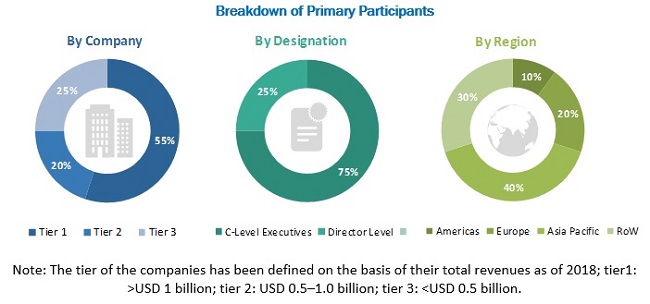
The motion sensor market comprises several stakeholders, such as vendors of motion sensor; research and development (R&D) organizations; technology, service, and solution providers; intellectual property (IP) core and licensing providers; solutions providers, and system integrators in the supply chain. The supply side is characterized by advancements in motion sensors, their end users, and their growing number of applications. Various primary sources from both the supply and demand sides of the market were interviewed to obtain qualitative and quantitative information. Following is the breakdown of primary respondents.
To know about the assumptions considered for the study, download the pdf brochure
Market Size Estimation
Both top-down and bottom-up approaches have been used to estimate and validate the total size of the motion sensor market. These methods have also been used extensively to estimate the size of various market subsegments. The research methodology used to estimate the market size includes:
- Key players in major end user segments and markets were identified through extensive secondary research.
- The industry’s supply chain and market size, in terms of value, were determined through primary and secondary research processes.
- All percentage shares, splits, and breakdowns were determined using secondary sources and verified through primary sources.
Data Triangulation
After arriving at the overall market size using the estimation processes as explained above—the market was split into several segments and subsegments. To complete the overall market engineering process and arrive at the exact statistics of each market segment and subsegment, data triangulation and market breakdown procedures were employed, wherever applicable. The data was triangulated by studying various factors and trends from both the demand and supply sides in the areas of motion sensor.
Research Objective
- To describe and forecast the market, in terms of value and volume, by motion technology and application
- To describe and forecast market, in terms of value and volume, by region—North America, Europe, Asia Pacific (APAC), and Rest of the World (RoW)
- To provide detailed information regarding major factors influencing market growth (drivers, restraints, opportunities, and challenges)
- To use the Porter’s five forces model to gauge the entry barriers to market, along with the value chain analysis to study each elemental block of the market
- To strategically analyze the micromarkets with regard to individual growth trends, prospects, and contributions to the overall market
- To analyze opportunities in market for stakeholders and the details of competitive leadership mapping for leaders in the market
- To analyze competitive developments such as expansion, mergers and acquisitions, and product launches, along with research and development (R&D) in market
- To profile key players and comprehensively analyze their market positions in terms of ranking and core competencies, along with detailing the competitive landscape for market leaders
Available Customizations:
Along with the market data, MarketsandMarkets offers customizations according to a company’s specific needs. The following customization options are available for the report:
Company Information
- Detailed analysis and profiling of additional market players (Up to 5)
Critical Questions
- What are new end-user areas being explored by the motion sensor solution providers?
- Which are the key players in the market, and how intense is the competition?












Growth opportunities and latent adjacency in Motion Sensor Market
Looking for market data on motion sensors for industrial, automotive and aerospace markets.
I want a complete analysis of motion sensor market includes margin, current market competition , consumer segment , and product positioning. What would be the future of this market, if I will start this business. ....please help me.
To understand in detail the motion sensor market in the following: - major players in the market - major industries and markets and their respective sizes, their main technology used, and why - main users, which industries they are in, and geographical locations - types of uses, environment, application of the sensors
I am researcher and conducting an industry analysis on motion sensors. We have a Ohio University's purchased databases that do not provide the necessary information to complete my analysis. It would be extremely beneficial if I could receive a free sample for better understanding.