
Automated Guided Vehicle (AGV) Market Size, Share & Growth

Automated Guided Vehicle (AGV) Market by Type (Tow Vehicles, Unit Load Carriers, Pallet Trucks, Assembly Line Vehicles, Forklift Trucks, AGCs, Hybrid AGVs), Navigation Technology (Laser, Magnetic, Inductive, Optical Tape, Vision) - Global Forecast to 2032




AUTOMATED GUIDED VEHICLE MARKET OVERVIEW
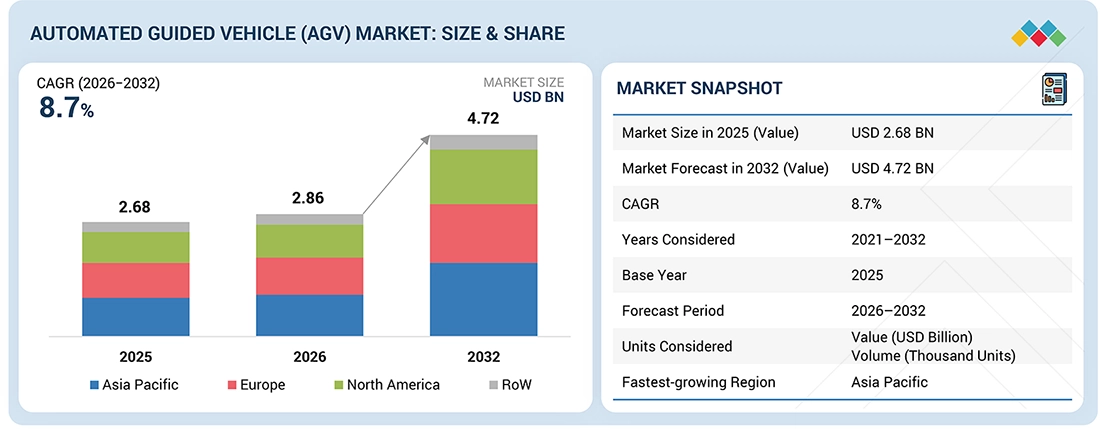
Source: Secondary Research, Interviews with Experts, MarketsandMarkets Analysis
The global automated guided vehicle market is expected to be valued at USD 2.68 billion in 2025 and is projected to reach USD 4.72 billion by 2032, registering a CAGR of 8.7%. The growth of the global automated guided vehicle industry is driven by increasing adoption of automation across manufacturing, warehousing, logistics, and e-commerce industries. Rising labor costs, the need for efficient material handling, and the shift toward smart factories and warehouse automation are accelerating AGV deployments. Continuous advancements in navigation technologies, fleet management software, and system integration capabilities are further supporting market expansion.
AUTOMATED GUIDED VEHICLE MARKET KEY TAKEAWAYS
-
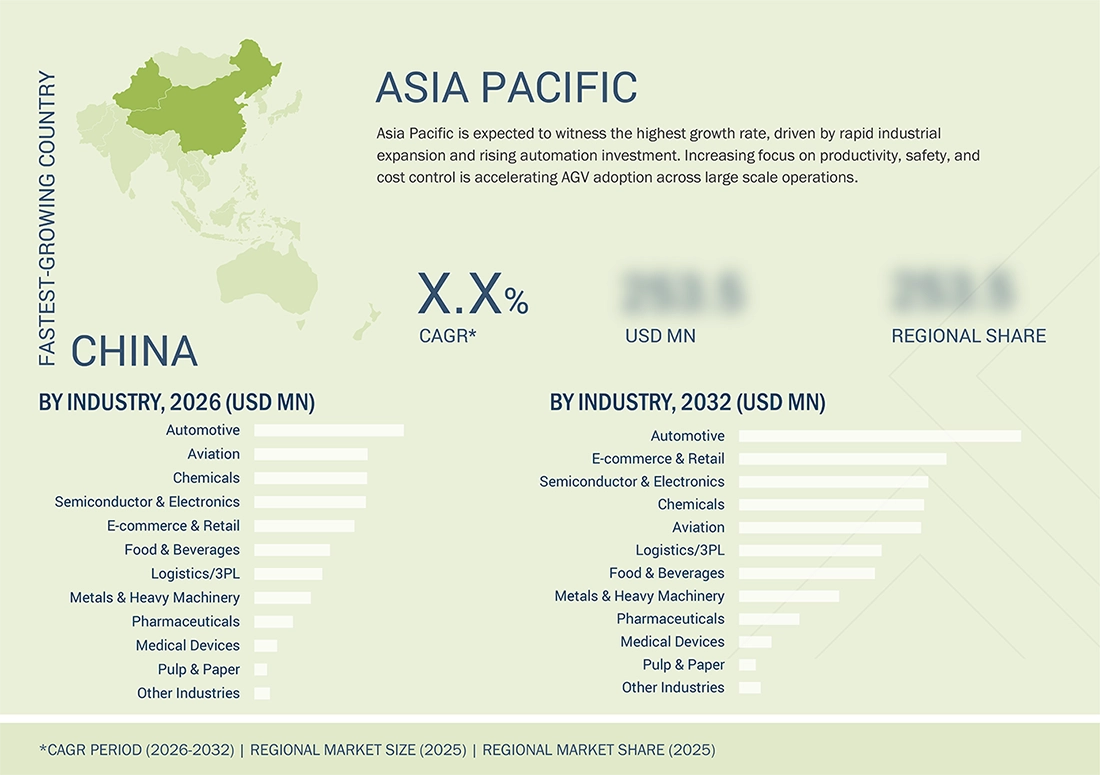
BY REGIONAsia Pacific is expected to dominate the automated guided vehicle market, with a share of 33.8% in 2025.
-
BY PAYLOAD CAPACITYBy payload, the medium duty AGVs segment is expected to register the highest CAGR of 9.6% during the forecast period.
-
BY INDUSTRYThe logistics/3PL segment is expected to register the highest CAGR of 11.6% during the forecast period.
-
COMPETITIVE LANDSCAPE (KEY PLAYERS)Daifuku Co., Ltd., JBT, and KION Group AG are identified as star players in the automated guided vehicle companies due to their strong market share and extensive product footprint.
-
COMPETITIVE LANDSCAPE (STARTUPS/SMES)E80 Group and NEURA Mobile Robots GmbH, among others, have distinguished themselves among startups and SMEs by securing strong footholds in specialized niche areas, underscoring their potential as emerging market leaders in the automated guided vehicle market.
The automated guided vehicle (AGV) market is positioned for strong growth as organizations expand the deployment of AGVs across production floors, warehouses, and distribution operations. Rising demand for consistent material movement, higher throughput, and reduced manual dependency is accelerating the adoption of AGV systems that support optimized routing, traffic control, task scheduling, and real-time operational visibility. Improvements in navigation technologies, fleet coordination software, battery performance, and system integration are enhancing reliability, scalability, and overall system efficiency. As automation investment intensifies to control operating costs and stabilize material flows, AGVs are emerging as a core component of connected, high-efficiency material handling environments.
TRENDS & DISRUPTIONS IMPACTING CUSTOMERS' CUSTOMERS
The figure highlights the structural shift underway in the automated guided vehicle (AGV) market, where revenue is progressively moving away from conventional material handling equipment toward automated and intelligent mobility solutions. As automation adoption accelerates, AGVs and adjacent technologies such as AMRs, AS/RS, and robotic forklifts are becoming central to modern intralogistics strategies. Growth is being driven by rising demand from e-commerce, automotive, food & beverage, chemicals, healthcare, and semiconductor manufacturing, where flexible, scalable material flow is critical. This shift is closely tied to the broader transition toward Logistics 4.0, cloud-based warehouse management systems, warehouse automation, and smart supply chain management, positioning AGVs as a key enabler of future revenue expansion in the automated material handling ecosystem.
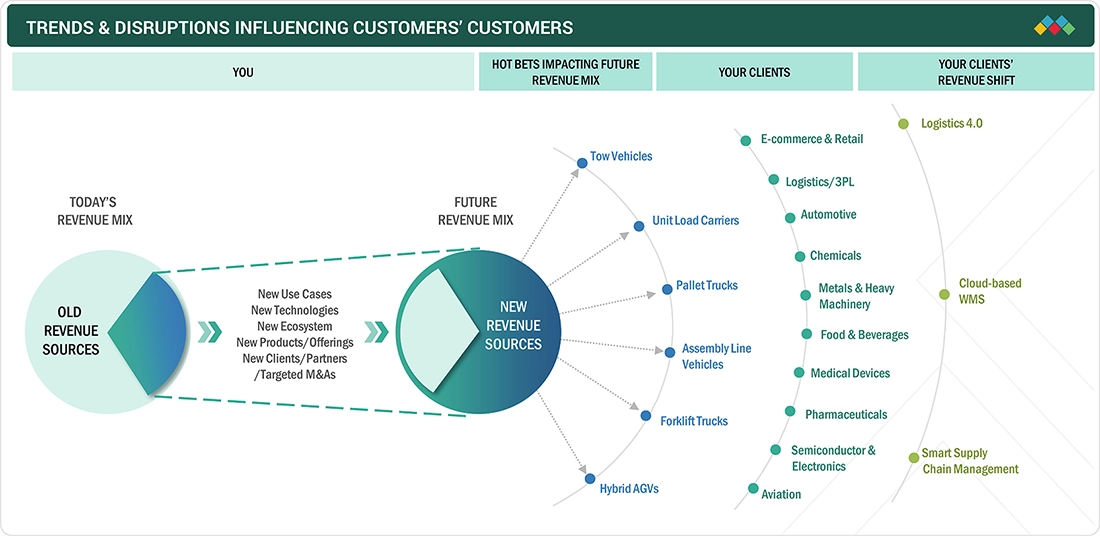
Source: Secondary Research, Interviews with Experts, MarketsandMarkets Analysis
AUTOMATED GUIDED VEHICLE MARKET DYNAMICS

Level
-
Rising demand for automation solutions in various industries

-
Increasing focus on enhancing workplace safety


Level
-
High installation, maintenance, and switching costs

-
Growing preference for mobile robots over AGVs


Level
-
Growing implementation of Industry 4.0 technologies in warehousing sector

-
Increasing focus on industrial automation by SMEs


Level
-
Low labor costs restricting adoption in emerging economies

-
Technical challenges and downtime in operations

Source: Secondary Research, Interviews with Experts, MarketsandMarkets Analysis
Driver: Rising demand for automation solutions in various industries
Increasing pressure to improve operational efficiency, safety, and throughput is driving AGV adoption across manufacturing, warehousing, logistics, automotive, food & beverage, and e-commerce sectors. Companies are deploying AGVs to reduce labor dependency, minimize errors, and enable continuous material flow in high-volume and time-sensitive operations.
Restraint: High installation, maintenance, and switching costs
The initial capital investment required for AGV systems, including vehicles, infrastructure, software integration, and safety systems, can be high, particularly for small and mid-sized enterprises. In addition, ongoing maintenance costs and the complexity of switching from legacy material handling systems can slow adoption in cost-sensitive environments.
Opportunity: Growing implementation of Industry 4.0 technologies in warehousing sector
The adoption of Industry 4.0 technologies such as IoT-enabled warehouses, cloud-based WMS, AI-driven fleet management, and smart factories is creating strong opportunities for AGV deployment. Integration of AGVs with digital warehouse platforms enables real-time tracking, dynamic routing, and scalable automation, accelerating market growth.
Challenge: Low labor costs restricting adoption in emerging economies
In regions where labor remains relatively inexpensive, the cost-benefit justification for AGV deployment is less compelling. This slows adoption as manual material handling continues to be economically viable, delaying automation investments despite long-term efficiency and safety advantages.
AUTOMATED GUIDED VEHICLE (AGV) MARKET SIZE, SHARE AND TRENDS: COMMERCIAL USE CASES ACROSS INDUSTRIES
| COMPANY | USE CASE DESCRIPTION | BENEFITS |
|---|---|---|
 |
Deploys automated guided vehicles across automotive plants, e-commerce warehouses, airport baggage handling systems, and manufacturing for material transport and order fulfillment | Improves material flow efficiency, reduces manual labor, enhances throughput in logistics and industrial operations |
 |
Provides AGVs and autonomous mobile robots for warehouse automation, distribution centers, and manufacturing supply chain environments | Enables flexible routing, increases picking accuracy, lowers operational costs, and adapts quickly to dynamic warehouse layouts |
 |
Implements AGV systems for internal logistics automation, production supply movement, and warehouse operations in food & beverage, retail, and manufacturing | Enhances inventory handling efficiency, improves space utilization, increases safety, and supports just-in-time workflows |
Logos and trademarks shown above are the property of their respective owners. Their use here is for informational and illustrative purposes only.
AUTOMATED GUIDED VEHICLE MARKET ECOSYSTEM
The automated guided vehicle (AGV) market ecosystem comprises component and raw material suppliers, software and system integrators, AGV manufacturers, and end users, working together to enable end-to-end intralogistics automation. Component providers supply batteries, drives, sensors, and control systems, while software and service providers deliver fleet management, navigation, and integration with warehouse and manufacturing systems. AGV vendors combine these capabilities to deliver turnkey solutions that are widely adopted by logistics, automotive, manufacturing, and e-commerce end users, driving scalable and efficient material handling operations.
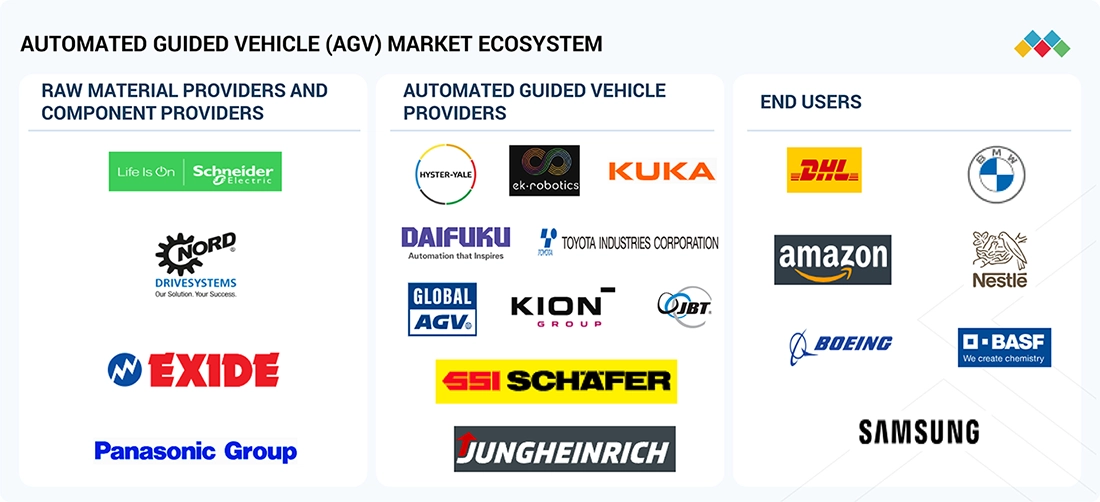
Logos and trademarks shown above are the property of their respective owners. Their use here is for informational and illustrative purposes only.
AUTOMATED GUIDED VEHICLE MARKET SEGMENTS
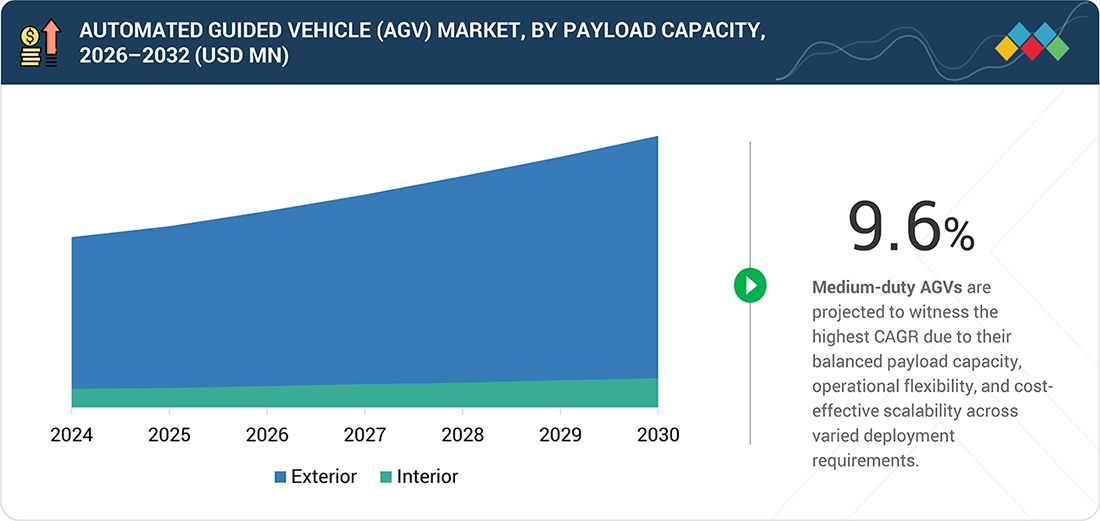
Source: Secondary Research, Interviews with Experts, MarketsandMarkets Analysis
Automated Guided Vehicle (AGV) Market, by Payload Capacity
The medium-duty AGVs segment is expected to record the highest CAGR in the overall AGV market, by payload capacity, due to their versatility across a wide range of warehouse and manufacturing applications, including pallet handling, line feeding, and internal logistics. They offer an optimal balance between payload capability, cost, and flexibility, making them suitable for both SMEs and large enterprises. Rapid growth of e-commerce fulfillment centers, automotive plants, and food & beverage facilities, along with increased deployments by providers such as Daifuku, KION Group, and Toyota Material Handling, is accelerating the adoption of medium-duty AGVs.
Automated Guided Vehicle (AGV) Market, by Industry
The automotive industry is expected to hold the highest market share in the automated guided vehicle (AGV) market due to its high-volume, repetitive material handling requirements and strong focus on automation and just-in-time manufacturing. Automotive OEMs and Tier-1 suppliers extensively deploy AGVs for line feeding, body shop logistics, powertrain assembly, and finished vehicle movement to improve efficiency and reduce labor dependency.
Automated Guided Vehicle (AGV) Market, by Navigation Technology
Laser guidance is expected to hold the highest market share in the automated guided vehicle (AGV) market due to its high navigation accuracy, reliability, and flexibility in complex indoor environments. It enables precise positioning without physical tracks, supports easy layout changes, and is widely adopted across automotive, warehouse, and manufacturing facilities, with strong deployments by AGV providers such as Daifuku, KION Group, and Jungheinrich.
AUTOMATED GUIDED VEHICLE MARKET REGION
Asia Pacific to be fastest-growing region in automated guided vehicle (AGV) market during forecast period
Asia Pacific is expected to be the fastest-growing region in the automated guided vehicle (AGV) market due to rapid industrialization, expanding manufacturing bases, and strong growth in e-commerce and warehouse automation across China, Japan, South Korea, and India. Rising labor costs, workforce shortages, and aggressive adoption of smart factory and Industry 4.0 initiatives are accelerating AGV deployments. In addition, strong regional players such as Daifuku, Toyota Material Handling, and Murata Machinery, along with government-backed automation programs, are further supporting high growth across the region.
AUTOMATED GUIDED VEHICLE (AGV) MARKET SIZE, SHARE AND TRENDS: COMPANY EVALUATION MATRIX
In the automated guided vehicle (AGV) market matrix, Daifuku Co., Ltd. (Star) leads with a comprehensive AGV ecosystem that combines robust vehicle platforms, advanced fleet control software, and deep system engineering expertise for large-scale material handling operations. Its strength lies in delivering highly reliable, high-throughput AGV deployments with precise traffic management, seamless integration with warehouse and manufacturing control systems, and proven execution across complex, mission-critical environments. Jungheinrich AG (Emerging Leader) is gaining momentum by expanding its AGV portfolio and strengthening software-driven fleet management capabilities focused on flexibility, modular deployment, and efficient navigation. Continuous enhancements in digital control platforms, energy management, and interoperability are supporting wider AGV adoption and reinforcing Jungheinrich’s upward movement toward the leaders’ quadrant.
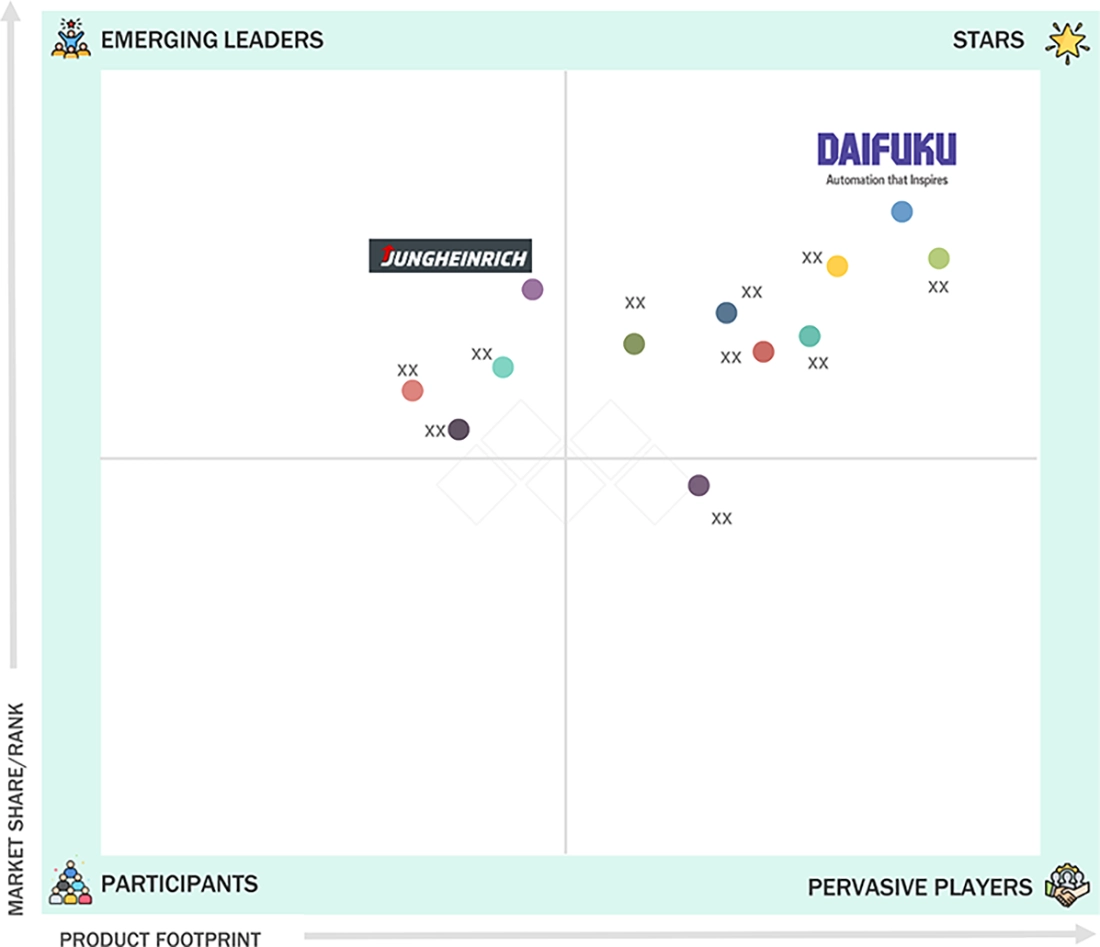
Source: Secondary Research, Interviews with Experts, MarketsandMarkets Analysis
AUTOMATED GUIDED VEHICLE MARKET KEY PLAYERS
- Daifuku Co., Ltd.
- JBT
- TOYOTA INDUSTRIES CORPORATION
- KION GROUP AG
- KUKA SE & Co. KGaA
- Scott
- SSI SCHAEFER
- Hyster-Yale, Inc.
- Jungheinrich AG
- MEIDENSHA CORPORATION
AUTOMATED GUIDED VEHICLE MARKET SCOPE
| REPORT METRIC | DETAILS |
|---|---|
| Market Size in 2025 (Value) | USD 2.68 Billion |
| Market Forecast in 2032 (Value) | USD 4.72 Billion |
| Growth Rate | CAGR of 8.7% from 2025–2032 |
| Years Considered | 2021–2032 |
| Base Year | 2025 |
| Forecast Period | 2026–2032 |
| Units Considered | Value (USD Billion), Volume (Thousand Units) |
| Report Coverage | Revenue Forecast, Company Ranking, Competitive Landscape, Growth Factors, and Trends |
| Segments Covered |
|
| Regions Covered | North America, Europe, Asia Pacific, and RoW |
WHAT IS IN IT FOR YOU: AUTOMATED GUIDED VEHICLE (AGV) MARKET SIZE, SHARE AND TRENDS REPORT CONTENT GUIDE
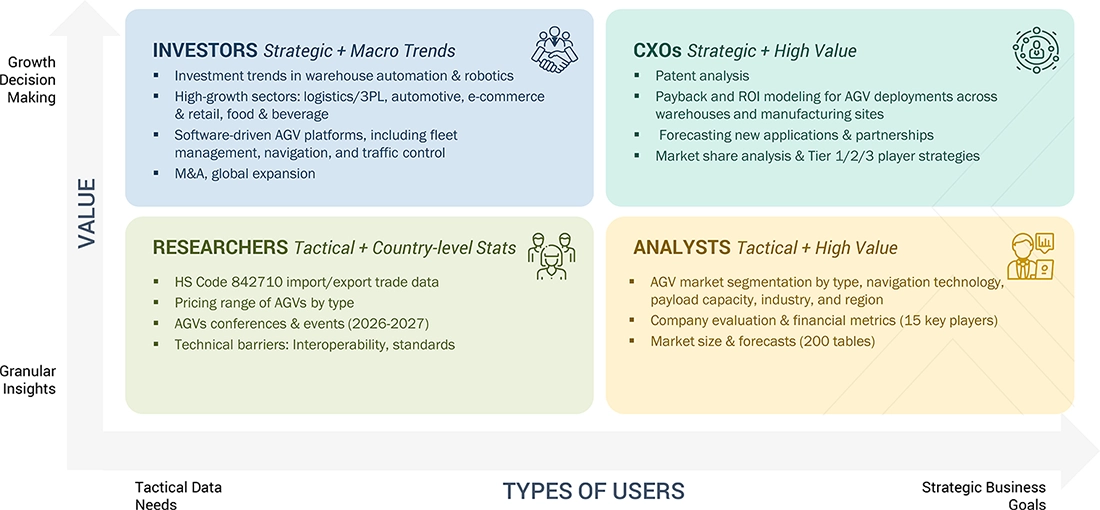
DELIVERED CUSTOMIZATIONS
We have successfully delivered the following deep-dive customizations:
| CLIENT REQUEST | CUSTOMIZATION DELIVERED | VALUE ADDS |
|---|---|---|
| AGV Solution Provider | Mapping AGV deployments across automotive, e-commerce, manufacturing, warehouse, airport, logistics | Benchmarking unit load, pallet, tow, forklift AGVs |
| AGV Hardware Manufacturer |
|
Benchmarking laser, vision, magnetic, natural navigation technologies |
| Software & Fleet Management Provider | Assessment of AGV fleet management and control software | Benchmarking traffic control, AI-based routing, warehouse, and MES/WMS integration |
RECENT DEVELOPMENTS
- November 2025 : Daifuku showcased advanced AGV and intralogistics solutions at ProMat 2025, highlighting next-generation laser-guided AGVs and smart factory automation for automotive and warehouse applications.
- March 2025 : SSI Schaefer presented scalable AGV-integrated intralogistics and warehouse automation solutions at LogiMAT 2025, focusing on modular AGV fleets and software-driven orchestration.
Table of Contents
 Exclusive indicates content/data unique to MarketsandMarkets and not available with any competitors.
Methodology
The study involved four major activities in estimating the current size of the automated guided vehicle market. Exhaustive secondary research has been done to collect information on the market, peer market, and parent market. To validate these findings, assumptions, and sizing with industry experts across the value chain through primary research has been the next step. Both top-down and bottom-up approaches have been employed to estimate the complete market size. After that, market breakdown and data triangulation methods have been used to estimate the market size of segments and subsegments. Two sources of information—secondary and primary—have been used to identify and collect information for an extensive technical and commercial study of the automated guided vehicle market.
Secondary Research
Various secondary sources have been referred to in the secondary research process to identify and collect information important for this study. The secondary sources include annual reports, press releases, and investor presentations of companies; white papers; journals and certified publications; and articles from recognized authors, websites, directories, and databases. Secondary research has been conducted to obtain key information about the industry’s supply chain, the market’s value chain, the total pool of key players, market segmentation according to the industry trends (to the bottom-most level), regional markets, and key developments from market- and technology-oriented perspectives. The secondary data has been collected and analyzed to determine the overall market size, further validated by primary research.
Primary Research
Extensive primary research was conducted after gaining knowledge about the current scenario of the automated guided vehicle market through secondary research. Several primary interviews were conducted with experts from the demand and supply sides across four major regions—North America, Europe, Asia Pacific and RoW. This primary data was collected through questionnaires, emails, and telephonic interviews.
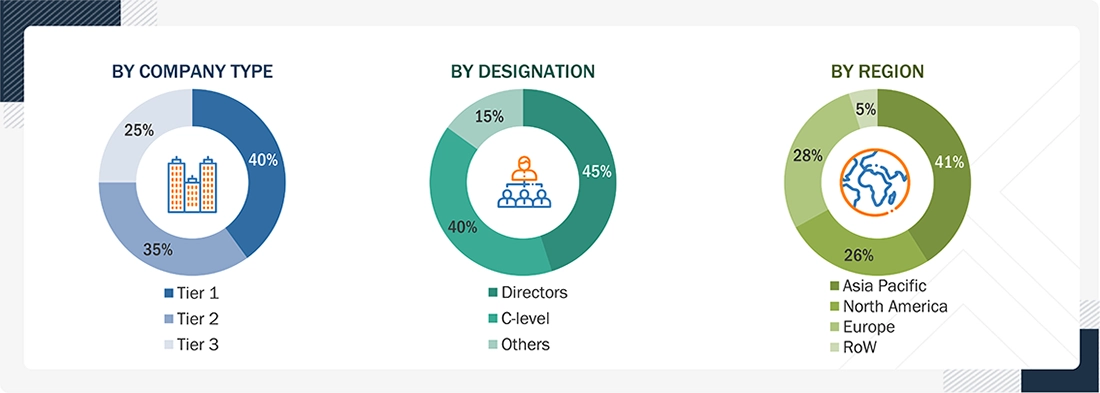
Note: The three tiers of the companies are defined based on their total revenue in 2023: Tier 1 - revenue greater than or equal to USD 1 billion; Tier 2 - revenue between USD 100 million and USD 1 billion; and Tier 3 revenue less than or equal to USD 100 million. Other designations include sales managers, marketing managers, and product managers.
To know about the assumptions considered for the study, download the pdf brochure
Market Size Estimation
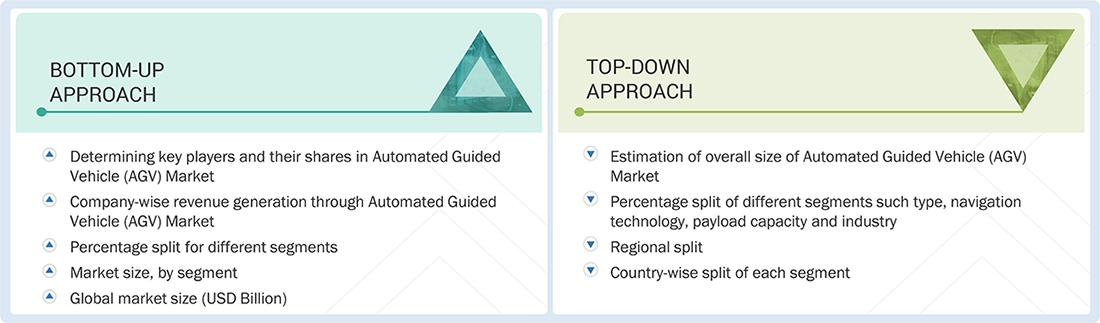
Both top-down and bottom-up approaches have been used to estimate and validate the total size of the automated guided vehicle market. These methods have also been used extensively to estimate the size of various subsegments in the market. The following research methodology has been used to estimate the market size:
- Major players in the industry and markets have been identified through extensive secondary research.
- The industry’s value chain and market size (in terms of value) have been determined through primary and secondary research processes.
- All percentage shares, splits, and breakdowns have been determined using secondary sources and verified through primary sources.
Automated Guided Vehicle (AGV) Market : Top-Down and Bottom-Up Approach
Data Triangulation
After arriving at the overall size of the automated guided vehicle market from the market size estimation process explained above, the total market has been split into several segments and subsegments. Data triangulation and market breakdown procedures have been employed, wherever applicable, to complete the overall market engineering process and arrive at the exact statistics for all segments and subsegments of the market. The data has been triangulated by studying various factors and trends from both the demand and supply sides. Along with this, the market size has been validated using both top-down and bottom-up approaches.
Market Definition
The Automated Guided Vehicle (AGV) market encompasses the design, manufacturing, and distribution of vehicles that operate autonomously to transport materials and goods within industrial, commercial, and logistics environments. These vehicles include various types such as tow vehicles, unit load carriers, pallet trucks, assembly line vehicles, forklift AGVs, and others, each utilizing advanced technologies like laser navigation, magnetic guidance, and vision-based systems to ensure efficient operation. With the rise of Industry 4.0, increasing adoption of automation across industries, and a growing emphasis on enhancing operational efficiency and workplace safety, the AGV market has become a pivotal component of modern material handling and supply chain management systems.
Key Stakeholders
- AGV manufacturers
- End users
- Government bodies, venture capitalists, and private equity firms
- Manufacturers of sensors, microcontrollers, RFID modems, and related accessories
- Material handling associations
- Professional service/solution providers
- Research institutions and organizations
- Standards organizations and regulatory authorities related to the material handling industry
Report Objectives
- To define, describe, and forecast the automated guided vehicle market, in terms of value, by type, navigation technology, industry, and region.
- To forecast the market size, in terms of value, by region—North America, Europe, Asia Pacific, and the Rest of the World.
- To provide detailed information regarding the major factors influencing the growth of the market, namely, drivers, restraints, opportunities, and challenges.
- To strategically analyze micromarkets with respect to individual growth trends, prospects, and contributions to the total market.
- To analyze the probable impact of the recession on the market in the future.
- To study the complete value chain of the automated guided vehicle ecosystem, along with market trends and use cases.
- To analyze opportunities in the market for stakeholders by identifying high-growth segments of the market.
- To strategically profile key players and comprehensively analyze their core competencies along with detailing the competitive landscape for market leaders.
- To analyze competitive developments such as product launches, acquisitions, partnerships, and expansions in the automated guided vehicle market.
- To benchmark market players using the company evaluation quadrant, which analyzes players based on various parameters within broad business categories and product strategies.
Available Customizations
With the given market data, MarketsandMarkets offers customizations according to the company’s specific needs. The following customization options are available for the report:
Company Information:
- Detailed analysis and profiling of additional market players (up to 5)
Key Questions Addressed by the Report
What is the projected market value of the Automated Guided Vehicle market?
The Automated Guided Vehicle market is projected to reach a significant market value by the forecast period, driven by increasing demand for automation in material handling and logistics operations.
Which region is expected to dominate the Automated Guided Vehicle market?
Asia Pacific is expected to dominate the Automated Guided Vehicle market due to rapid industrialization and growing adoption of automation in manufacturing and warehousing sectors.
What are the key segments of the Automated Guided Vehicle market?
The market is segmented by type, navigation technology, application, end-use industry, and region, with unit load carriers, laser guidance, and warehousing applications accounting for a major share.
Who are the major key players in the Automated Guided Vehicle market?
Major key players in the Automated Guided Vehicle market include Daifuku Co., Ltd., KION Group AG, Toyota Industries Corporation, Jungheinrich AG, and Hyster-Yale Materials Handling, Inc.
What factors are driving the growth of the Automated Guided Vehicle market?
The growth of the Automated Guided Vehicle market is driven by rising labor costs, increasing need for efficient supply chain operations, advancements in navigation technologies, and growing adoption of Industry 4.0 solutions.
Need a Tailored Report?
Customize this report to your needs
Get 10% FREE Customization
Customize This ReportPersonalize This Research
- Triangulate with your Own Data
- Get Data as per your Format and Definition
- Gain a Deeper Dive on a Specific Application, Geography, Customer or Competitor
- Any level of Personalization
Let Us Help You
- What are the Known and Unknown Adjacencies Impacting the Automated Guided Vehicle (AGV) Market
- What will your New Revenue Sources be?
- Who will be your Top Customer; what will make them switch?
- Defend your Market Share or Win Competitors
- Get a Scorecard for Target Partners

Custom Market Research Services
We Will Customise The Research For You, In Case The Report Listed Above Does Not Meet With Your Requirements
Get 10% Free CustomisationTESTIMONIALS

Tetsuya Ohhira
Business Development Manager-Technology Business
Nikon Corporation,
Leading Japanese MNC specializing in optics and imaging productswww.nikon.com
MarketsandMarkets™ response
is quick. Their attitude is flexible and positive. Analyst Insights are globally considered and
significant. Client Services quickly respond to our inquiry and demand. Their wide range of global
surveys help us make our strategic plan.
We hope Knowledge Store will be easier to search
for a report.
VP - Marketing & Business Development
Leading Provider of Process Control Solutions
We engaged with MarketsandMarkets on a study to perform an analysis and recommend a Go-To-Market strategy for metrology and process control in the semiconductor market. The study was tailored to our targets and needs with well-defined milestones. Our overall experience with the MarketsandMarkets team was very good throughout the project in all aspects including the analysis methodologies used, the quality and depth of primary and secondary data sets, the professionalism and flexibility of the team and the ability to meet the target schedule and milestones. We want to thank MarketsandMarkets team for a job well done.
Growth opportunities and latent adjacency in Automated Guided Vehicle (AGV) Market

Still Researching the
Automated Guided Vehicle (AGV) Ecosystem?
See the competitors, opportunity evaluation, and growth signals shaping it - Instantly!
Generate 15+ consulting-grade strategic intelligence outputs - from competitor analysis to board-ready strategy decks, tailored to your Automated Guided Vehicle (AGV) growth question.




Richard
Apr, 2026
Are rising labor costs the biggest factor behind AGV adoption, or is efficiency the real driver?.
Charles
Apr, 2026
Why do you think medium-duty AGVs are seeing the fastest growth compared to other payload categories?.