
Cloud Storage Market

Cloud Storage Market by Storage Type (File Storage, Object Storage, Block Storage), Service (Training & Consulting, Integration & Implementation, Support & Maintenance), Application (Backup & Recovery, Data Archiving) – Global Forecast to 2031




OVERVIEW
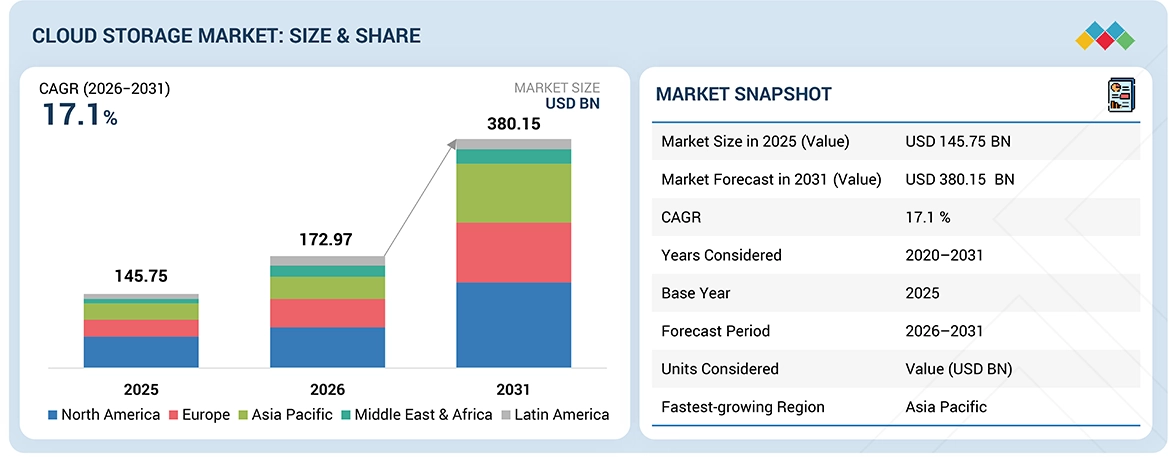
Source: Secondary Research, Interviews with Experts, MarketsandMarkets Analysis
The cloud storage market is projected to grow from USD 172.97 billion in 2026 to USD 380.15 billion by 2031, at a CAGR of 17.1%. Growth is driven by rising enterprise data volumes, increasing AI and analytics workloads, and expanding cloud-native application deployments. Organizations are adopting scalable cloud storage platforms to support data-intensive AI models, hybrid cloud environments, and secure long-term data management.
KEY TAKEAWAYS
-
By RegionAsia Pacific is projected to register the highest CAGR of 21.9% during the forecast period.
-
By OfferingThe services segment is projected to exhibit a significant CAGR of 20.2% during the forecast period.
-
By Storage TypeThe object storage segment is projected to witness the highest CAGR of 19.1% during the forecast period.
-
By Organization SizeThe SMEs segment is expected to exhibit a higher growth rate than the large enterprises segment during the forecast period.
-
By Deployment ModelThe hybrid cloud segment is expected to witness the fastest growth during the forecast period.
-
By VerticalThe retail and consumer goods segment is expected to experience the highest growth rate during the forecast period.
-
Competitive Landscape – Large ProvidersMicrosoft, AWS, and Google Cloud lead with global cloud infrastructure and large-scale storage platforms.
-
Competitive Landscape – Emerging ProvidersHitachi Vantara, Fujitsu, and Dropbox gain traction with hybrid storage and enterprise data management solutions.
The cloud storage market is experiencing rapid change due to the increase in AI workloads, the rising volume of data, and business migration to cloud-native architectures. Companies are expanding their use of object and distributed storage for analytics, AI training datasets, and real-time digital services. Providers are adapting by developing high-performance, scalable storage platforms; improved data governance capabilities; and advanced security features to support hybrid and multi-cloud data scenarios.
TRENDS & DISRUPTIONS IMPACTING CUSTOMERS' CUSTOMERS
AI-driven data growth from large language models, enterprise analytics platforms, and AI training workloads is significantly increasing demand for high-capacity cloud storage infrastructure. Organizations are adopting object storage, tiered storage architectures, and automated lifecycle management to manage expanding unstructured data. Growing multi-cloud adoption, data sovereignty regulations, and real-time analytics workloads are pushing providers to build scalable, secure, and geographically distributed cloud storage platforms.
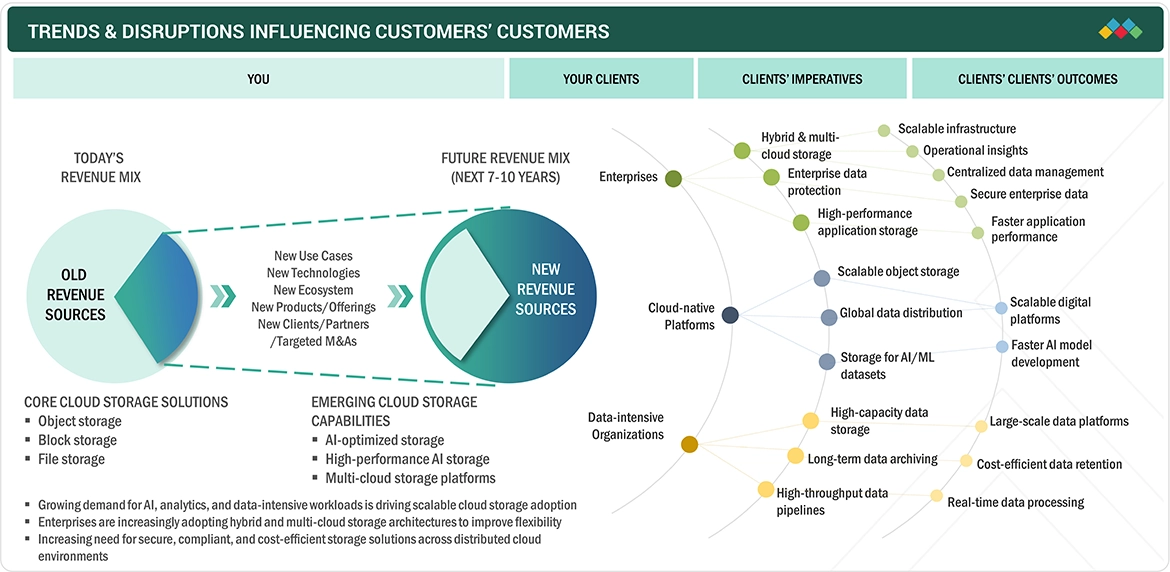
Source: Secondary Research, Interviews with Experts, MarketsandMarkets Analysis
MARKET DYNAMICS

Level
-
Rapid growth of AI workloads, and enterprise data generation

-
Expansion of hybrid and multi-cloud environments


Level
-
Rising long-term cloud storage costs and vendor lock-in risks

-
Limited data portability within proprietary cloud storage ecosystems


Level
-
Expansion of AI-optimized and sovereign cloud storage infrastructure

-
Growing demand for sovereign and regionally compliant cloud storage, driven by data localization regulations


Level
-
Managing distributed storage performance across hybrid and multi-cloud environments

-
Managing exponential growth of unstructured enterprise data while maintaining storage efficiency and cost control

Source: Secondary Research, Interviews with Experts, MarketsandMarkets Analysis
Driver – Rapid growth of AI workloads and enterprise data generation
Rapid growth in AI models, enterprise analytics platforms, and digital services is driving exponential increases in data generation across industries. Organizations are expanding cloud storage deployments to support large-scale datasets, AI training workloads, and real-time analytics pipelines. As enterprises shift toward cloud-native architectures, demand for scalable object storage and distributed storage platforms is accelerating globally.
Restraint – Rising long-term cloud storage costs and vendor lock-in risks
Despite strong adoption, rising long-term storage costs and vendor lock-in concerns remain significant restraints. Large enterprises managing petabytes of data face increasing expenses related to high-performance storage tiers, long-term retention policies, and multi-cloud data transfers. These financial considerations are pushing organizations to carefully evaluate storage optimization strategies and hybrid deployment models.
Opportunity – Expansion of AI-optimized and sovereign cloud storage infrastructure
Growing regulatory focus on data sovereignty and regional data governance is creating major opportunities for cloud storage providers. Governments and enterprises increasingly require storage infrastructure that ensures data residency within specific geographic jurisdictions. As a result, providers are investing in sovereign cloud storage architectures and regionally compliant data infrastructure to support regulated industries.
Challenge – Managing distributed storage performance across hybrid and multi-cloud environments
Managing storage infrastructure across hybrid and multi-cloud environments presents operational complexity. Enterprises must ensure consistent performance, data availability, and governance across distributed storage systems supporting AI workloads and global applications. Vendors are responding by developing unified storage management platforms that improve workload portability, performance optimization, and long-term storage efficiency.
CLOUD STORAGE MARKET: COMMERCIAL USE CASES ACROSS INDUSTRIES
| COMPANY | USE CASE DESCRIPTION | BENEFITS |
|---|---|---|
 |
Birdz adopted Google Cloud Storage to manage high volumes of smart water meter sensor data and create scalable cloud-based analytics pipelines. This new approach has resulted in increased operational analytics efficiency and timely delivery of operational reports to Birdz customers. | Improved performance and reduced infrastructure costs compared to legacy storage systems. Cloud storage enabled scalable analytics pipelines, faster processing times, and improved ability to deliver timely operational reports to customers. |
 |
TerrAvion has implemented Amazon S3 as its cloud-based storage/processing solution for its high-resolution aerial maps of farms. This has enabled TerrAvion to store a vast amount of farm images and provide subscription-based crop intelligence service to farmers. | Overall, the implementation of this solution has resulted in significant cost savings in the maintenance of TerrAvion's current infrastructure, as well as improvements in their storage solutions for scaling and retaining field images. Also, through the use of this solution, TerrAvion has been able to take advantage of many different ways of managing their very large quantities of imagery data and allow them to provide much quicker access to crop intelligence for their agricultural clients. |
 |
Coffee County, Alabama, changed from standard tape-based backups to using the IBM Cloud for its backup solution. The use of the IBM Power Platform has allowed for innovative means of automating daily backup processes, reducing human error in the backup process, and modernizing the disaster recovery process for County Government Data. | Automated Cloud Backups have eliminated the need to manually handle tapes and reduced operational risk, thus allowing for restoring full data sets from Cloud Backups in hours versus days when recovering from a disaster. |
Logos and trademarks shown above are the property of their respective owners. Their use here is for informational and illustrative purposes only.
MARKET ECOSYSTEM
Four major participants within the cloud storage system are solution providers that create storage-based cloud solutions, service providers who supply managed service solutions, distributors who facilitate technology through a distribution channel, and system integrators that install and integrate enterprise-level cloud storage technologies.
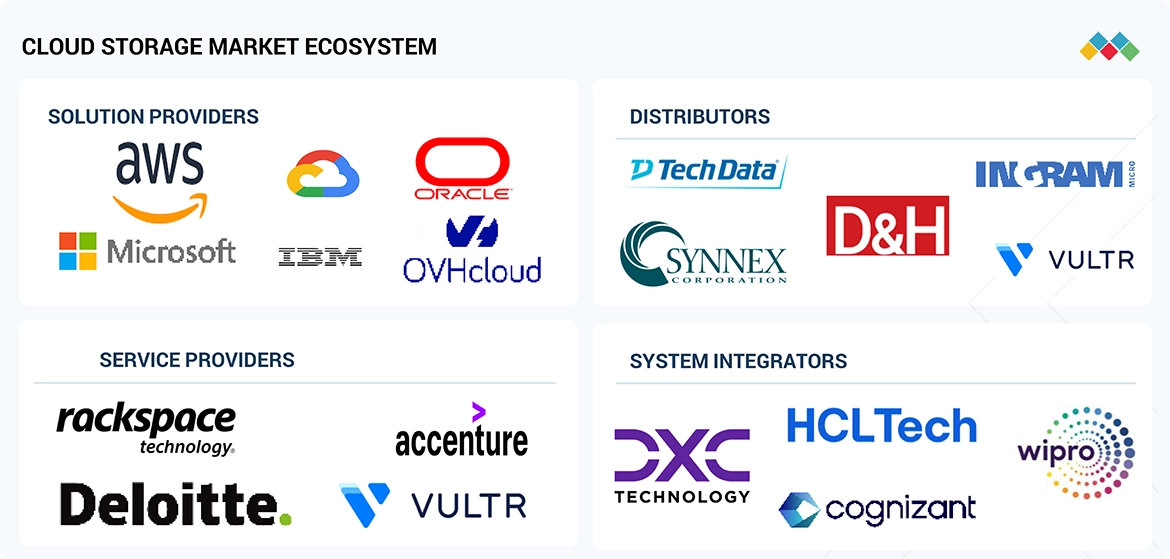
Logos and trademarks shown above are the property of their respective owners. Their use here is for informational and illustrative purposes only.
MARKET SEGMENTS
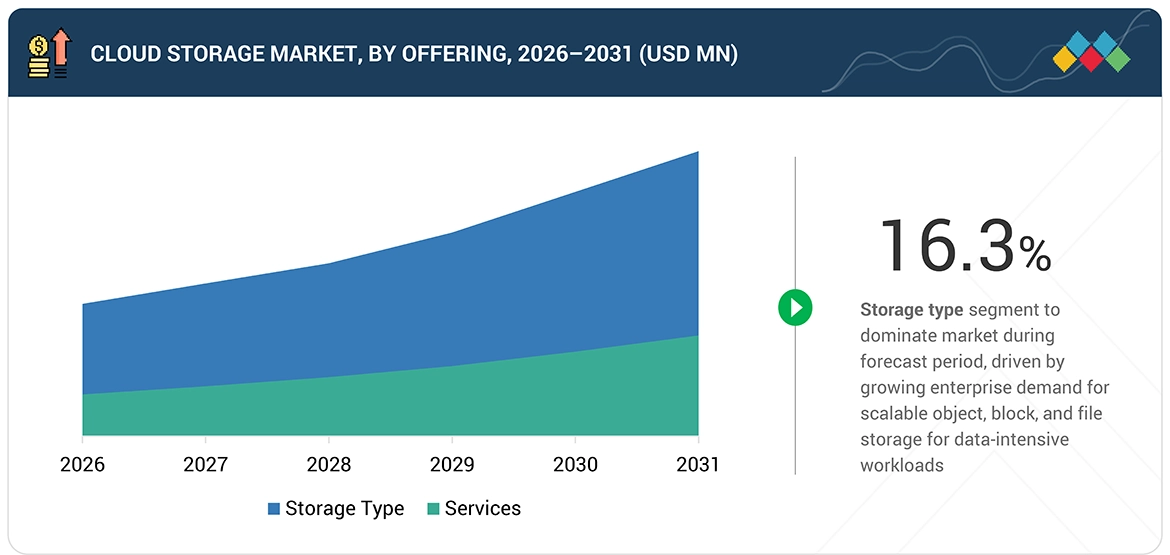
Source: Secondary Research, Interviews with Experts, MarketsandMarkets Analysis
By Offering
Enterprises require scalable storage platforms to manage rapidly growing volumes of structured and unstructured data generated by AI, analytics, and digital services. Cloud storage enables elastic capacity, centralized data access, and cost-efficient infrastructure, making it a core component of modern enterprise data architectures.
By Storage Type
File storage continues to dominate because most enterprise applications produce file-based data that can be utilized for collaboration, content management, analytics, and application hosting. With cloud-based file systems, it is possible to have a shared access point for multiple users, providing scalability and an individualized workflow to enterprise platforms while supporting distributed teams and other data-intensive operational processes.
By Organization Size
Large enterprises generate massive data volumes from global operations, analytics systems, and AI applications. These organizations invest heavily in scalable cloud storage infrastructure to support digital transformation initiatives, manage multi-cloud environments, and maintain strong governance, compliance, and high availability for business-critical data.
By Deployment Model
Most organizations are adopting the public cloud due to its ability to provide scalable and on-demand storage infrastructure, allowing for rapid data growth and cloud-native application architectures. Public cloud offerings enable organizations to access global availability, have lower costs, and easily integrate the use of analytics and AI services into their enterprise cloud storage deployment.
By Vertical
BFSI leads in adoption due to the continuous generation of transaction data, regulatory records, and digital banking information. Financial institutions rely on cloud storage to support compliance archiving, disaster recovery, fraud analytics, and secure management of large financial datasets across modern digital banking platforms.
REGION
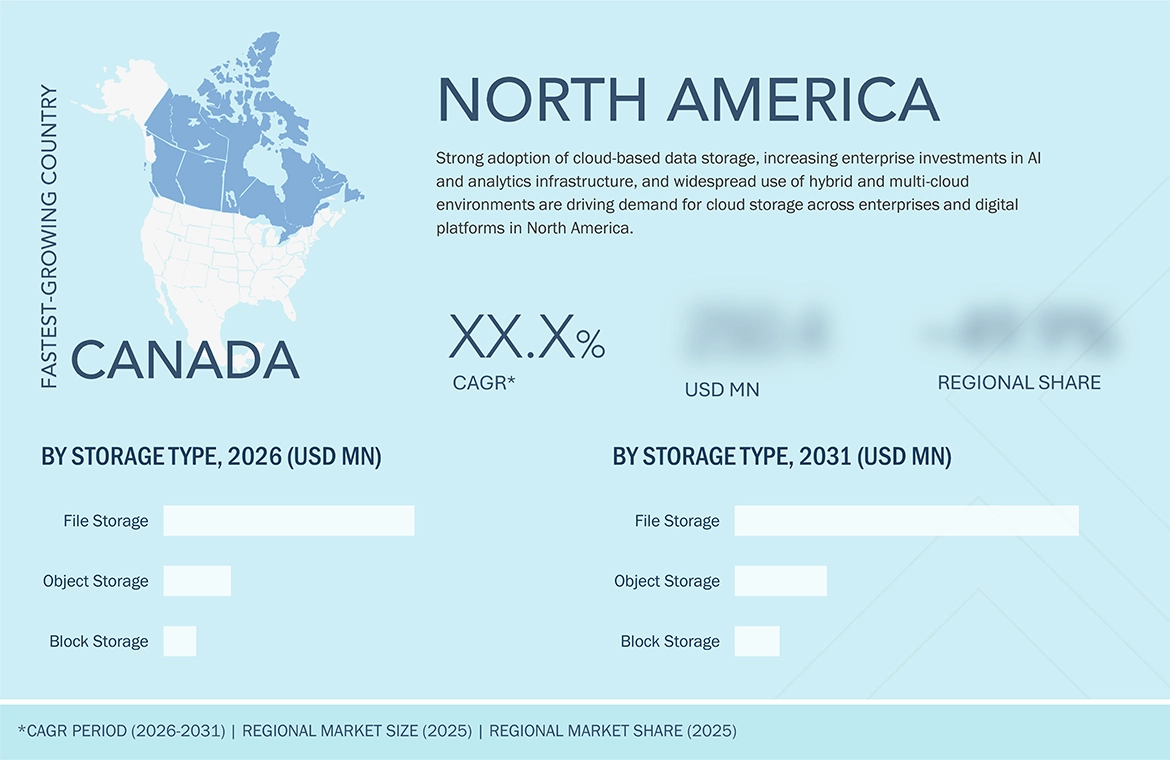
Asia Pacific to be fastest-growing region in global cloud storage market during forecast period
Asia Pacific is projected to be the fastest-growing market for cloud storage, driven by digital transformation, advances in cloud infrastructure, and the use of AI and data-intensive applications. Key factors driving the demand for scalable cloud storage platforms in this region include growing investments in hyper-scale data center projects, rising enterprise cloud migration, and increasing data generation throughout China, Japan, India, and South and Southeast Asia.
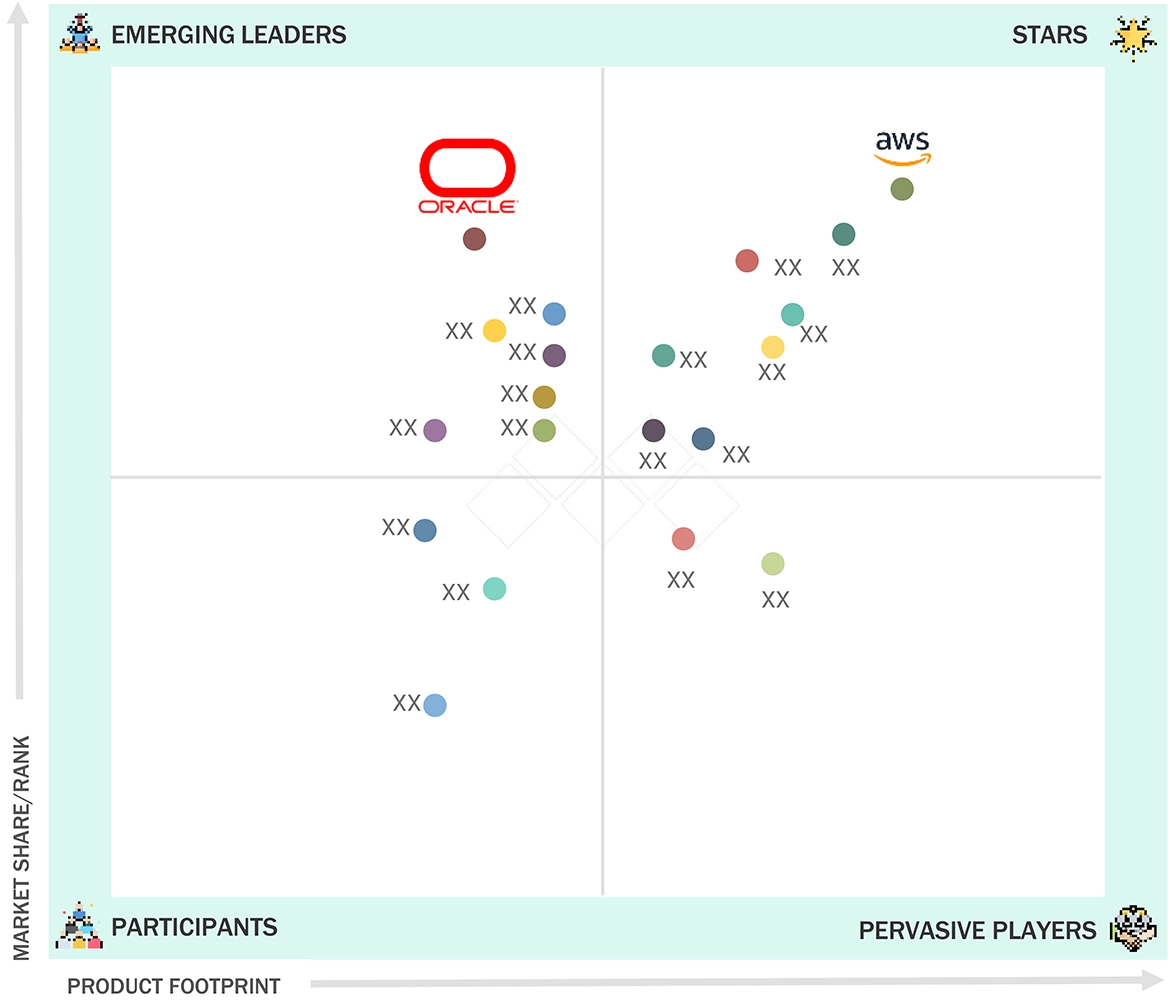
CLOUD STORAGE MARKET: COMPANY EVALUATION MATRIX
The Company Evaluation Matrix places AWS in the Stars quadrant due to its strong global cloud infrastructure and extensive storage portfolio. Oracle appears in the Emerging Leaders quadrant as it expands enterprise cloud storage capabilities.
Source: Secondary Research, Interviews with Experts, MarketsandMarkets Analysis
KEY MARKET PLAYERS
- Amazon Web Services (US)
- IBM (US)
- Google (US)
- Microsoft (US)
- Alibaba Cloud (China)
- Oracle (US)
- Rackspace Technology (US)
- Hewlett Packard Enterprise (US)
- Dell Technologies (US)
- Huawei (China)
- Dropbox (US)
- Box (US)
- Tencent Cloud (China)
- Fujitsu (Japan)
- Broadcom (US)
- NetApp (US)
- Hitachi Vantara (US)
- Scality (France)
- Citrix (US)
- UpCloud (Finland)
- DigitalOcean (US)
- Vultr (US)
- MinIO (US)
- Zadara (US)
- pCloud (Switzerland)
- Wasabi Technologies (US)
- Sync.com (Canada)
- Degoo (Sweden)
MARKET SCOPE
| REPORT METRIC | DETAILS |
|---|---|
| Market Size in 2025 (Value) | USD 145.75 Billion |
| Market Forecast in 2031 (Value) | USD 380.15 Billion |
| Growth Rate | 17.1% |
| Years Considered | 2020–2031 |
| Base Year | 2025 |
| Forecast Period | 2026–2031 |
| Units Considered | Value (USD Billion) |
| Report Coverage | Revenue forecast, company ranking, competitive landscape, growth factors, and trends |
| Segments Covered |
|
| Regions Covered | North America, Europe, Asia Pacific, Middle East & Africa, Latin America |
WHAT IS IN IT FOR YOU: CLOUD STORAGE MARKET REPORT CONTENT GUIDE
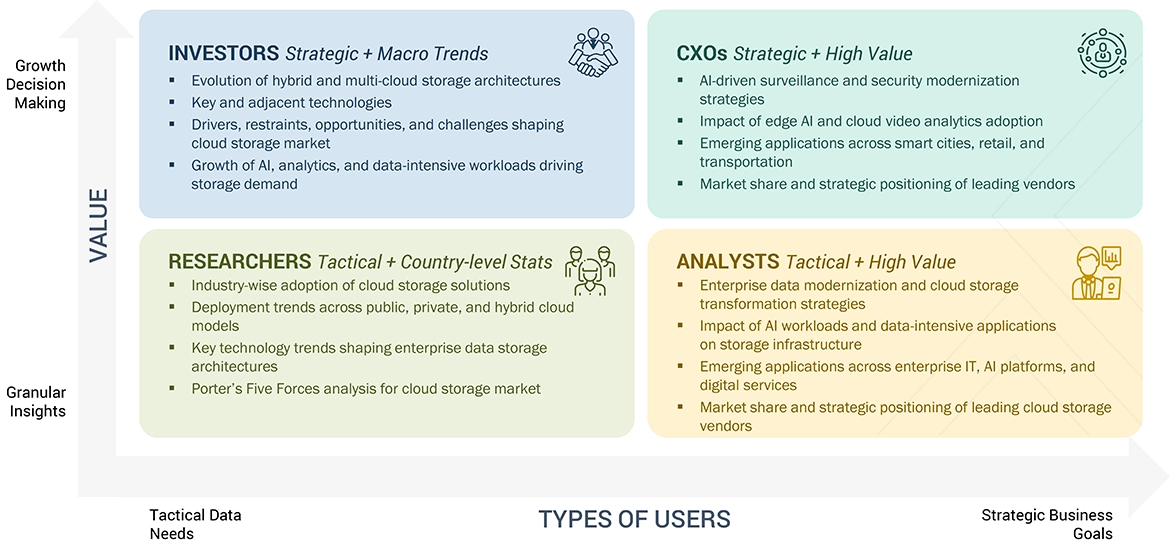
DELIVERED CUSTOMIZATIONS
We have successfully delivered the following deep-dive customizations:
| CLIENT REQUEST | CUSTOMIZATION DELIVERED | VALUE ADDS |
|---|---|---|
| Global Enterprises (BFSI, Healthcare, Manufacturing) | Assessment of cloud storage providers based on scalability, security, data governance, and integration with enterprise analytics and AI workloads. Evaluation of pricing models, storage tiers, and lifecycle policies for large-scale enterprise environments. | Support cost-efficient and scalable cloud storage provider selection |
| Telecom Operators (5G, Edge and Data Platforms) | Profiling of cloud storage providers supporting telecom data platforms with benchmarking of storage performance, latency, and availability. Evaluation of provider readiness for edge storage and real-time analytics workloads. | Enable informed investments for 5G data infrastructure and edge storage |
| Digital Media and Content Platforms (Streaming, Gaming, OTT) | Market sizing of cloud storage supporting large-scale media storage and global content delivery platforms. Mapping provider capabilities for object storage scalability, high-throughput storage, and distributed data access. | Identify high-growth cloud storage opportunities in digital content platforms |
RECENT DEVELOPMENTS
- March 2026 : The Google Cloud Platform (GCP) introduced new capabilities to identify objects that are publicly available, giving users the ability to analyze their objects' metadata using BigQuery ObjectRef functions. Using this functionality, enterprises can audit their exposure to external access, identify sensitive data on a large scale, and strengthen their governance, security posture, and compliance throughout their cloud storage enterprise environments.
- January 2026 : Microsoft announced its latest Azure Storage innovations designed to support AI-based workloads and enterprise-scale applications. Microsoft is enhancing Azure Storage to deliver greater throughput and scalability, along with more efficient storage architectures with respect to long models during training and inference, as well as cloud-based native applications that require very high-performance data infrastructures.
- December 2025 : Amazon Web Services (AWS) introduced performance enhancements to Amazon S3 Vectors, enabling storage to scale up to two billion vectors per index and supporting up to 20 trillion vectors per bucket. The update improves query performance by up to three times and supports larger object sizes to meet increasing enterprise AI data storage demands.
Table of Contents
 Exclusive indicates content/data unique to MarketsandMarkets and not available with any competitors.
Methodology
The study covered four main actions to estimate the current market size of the cloud storage market. We conducted a significant amount of secondary research to gather data on the market, the competing market, and the parent market. The following stage involved conducting primary research to confirm these conclusions' hypotheses and sizing with industry experts throughout the value chain. A combination of top-down and bottom-up methods was used to assess the overall market size. We then estimated the market sizes of the leading Cloud Storage segments using the market breakup and data triangulation techniques.
Secondary Research
A wide range of secondary sources, directories, and databases were employed in this research project, including product demos, vendor data sheets, D&B Hoovers, DiscoverOrg, Factiva, Vendor Surveys, Cloud Computing Association (CCA), Asia Cloud Computing Association, and The Software Alliance. We referred to sources to locate and gather important data for this technical, commercial, and market-focused analysis of the cloud storage market.
Primary Research
Several industry experts from the core and related industries and providers of preferred software, hardware manufacturers, distributors, service providers, technology developers, alliances, and organisations connected to every link in the industry value chain were the primary sources of information. Key industry participants, subject-matter experts, C-level executives of major market players, and industry consultants were among the primary respondents with whom in-depth interviews were conducted to gather and validate crucial qualitative and quantitative data and evaluate the market's potential.
To obtain information, we conducted primary interviews on market statistics, the most recent trends that are upending the industry, newly implemented use cases, data on revenue generated by goods and services, market segmentation, market size estimations, market forecasts, and data triangulation. Understanding different technological developments, segmentation types, industry trends, and geographical areas was also aided by primary research. To understand the buyer's perspective on suppliers, products, service providers, and their current use of services, which would affect the overall Cloud Storage market, demand-side stakeholders, such as Chief Executive Officers (CEOs), Chief Information Officers (CIOs), Chief Technology Officers (CTOs), Vice Presidents (VPs), and Chief Security Officers (CSOs), as well as the installation teams of governments/end users using cloud storage, and digital initiatives project teams, were interviewed.
Market Size Estimation
We employed top-down and bottom-up methodologies to estimate and forecast the Cloud Storage market and other associated submarkets. Using the revenues and product offerings of the major market players, the bottom-up approach assisted in determining the overall market size. This research ascertained and validated the precise value of the total parent market size through data triangulation techniques and primary interview validation. Using percentage splits of the market segments, we were able to estimate the size of other specific markets using the overall market size via the top-down approach.
The bottom-up approach identified the trend of Cloud Storage adoption among industry verticals in critical countries that contribute the most to the market. The adoption trend of cloud storage and varying cases of use concerning their business segments were identified and extrapolated for cross-validation. We gave weightage to the use cases identified in different solution areas for the calculation. We prepared an exhaustive list of all vendors offering Cloud Storage. We estimated the revenue contribution of all vendors in the market through annual reports, press releases, funding, investor presentations, paid databases, and primary interviews. We evaluated each vendor based on its service offerings across verticals. We extrapolated the aggregate of all companies' revenue to reach the overall market size. Each subsegment was studied and analyzed for its market size and regional penetration. We determined the region split through primary and secondary sources based on these numbers.
The top-down approach prepared an exhaustive list of all vendors in the Cloud Storage market. We estimated the revenue contribution of all vendors in the market through their annual reports, press releases, funding, investor presentations, paid databases, and primary interviews. We estimated the market size from revenues generated by vendors from different Cloud Storage offerings. Using secondary and primary sources, we located additional vendors and the income produced by each service type, which we then aggregated to calculate the market size. Additionally, the procedure included a regional penetration analysis of the cloud storage market. The investigation was utilized to ascertain and validate the precise values of the market sizes for Cloud Storage and its sectors, using the data triangulation process and primary data validation. The main procedure to gather essential insights was conducting in-depth interviews with CEOs, CTOs, CIOs, VPs, directors, and marketing executives. To confirm, we further triangulated market numbers using the current MarketsandMarkets repository.
To know about the assumptions considered for the study, Request for Free Sample Report
Data Triangulation
The market was divided into several segments and subsegments using the previously described market size estimation procedures once the overall market size was determined. When required, market breakdown and data triangulation procedures were employed to complete the market engineering process and specify the exact figures for every market segment and subsegment. The data was triangulated by examining several variables and patterns from government entities' supply and demand sides.
Market Definition
Considering the views of various sources and associations on Cloud Storage, MarketsandMarkets defines Cloud Storage as "a cloud computing service model that allows end-users to store and access the data through the internet from various distributed and connected resources. Enterprises use cloud storage solutions to store, manage, and maintain enterprise data while leveraging cloud benefits, such as simplified accessibility, reliability, rapid deployment, secured data protection, and reduced infrastructure costs. Companies provide cloud storage solutions with three basic underlying architectures: object storage, block storage, and file storage".
Key Stakeholders
- Cloud storage providers
- Information Technology (IT) infrastructure equipment providers
- Cloud storage component providers
- System Integrators (SIs)
- Support service providers
- Consulting service providers
- Managed service providers
- Cloud Service Providers (CSPs)
Report Objectives
- To define, describe, and forecast the global Cloud Storage market based on offering, use case, deployment model, organization size, vertical, and region.
- To forecast the market size of the five major regional segments: North America, Europe, Asia Pacific, Middle East & Africa, and Latin America
- To strategically analyze the market subsegments for individual growth trends, prospects, and contributions to the total market
- To provide detailed information related to the major factors influencing the growth of the market (drivers, restraints, opportunities, and challenges)
- To strategically analyze macro and micro-markets for growth trends, prospects, and their contributions to the overall market
- To analyze industry trends, patents and innovations, and pricing data related to the Cloud Storage market.
- To analyze the opportunities in the market for stakeholders and provide details of the competitive landscape for major players.
- To profile key players in the market and comprehensively analyze their market share/ranking and core competencies
- To track and analyze competitive developments, such as mergers & acquisitions, product developments, and partnerships & collaborations in the market.
Note 1. Micromarkets are defined as the further segments and subsegments of the market included in the report.
Note 2. The companies' Core competencies are captured in terms of their key developments and essential strategies to sustain their position in the market.
Available Customizations
With the given market data, MarketsandMarkets offers customizations per the company's specific needs. The following customization options are available for the report:
Product Analysis
- The product matrix provides a detailed comparison of the product portfolio of each company.
Geographic Analysis
- Further breakup of the Asia Pacific market into countries contributing 75% to the regional market size
- Further breakup of the North American market into countries contributing 75% to the regional market size
- Further breakup of the Latin American market into countries contributing 75% to the regional market size
- Further breakup of the Middle Eastern & African market into countries contributing 75% to the regional market size
- Further breakup of the European market into countries contributing 75% to the regional market size
Company Information
- Detailed analysis and profiling of additional market players (up to 5)
Need a Tailored Report?
Customize this report to your needs
Get 10% FREE Customization
Customize This ReportPersonalize This Research
- Triangulate with your Own Data
- Get Data as per your Format and Definition
- Gain a Deeper Dive on a Specific Application, Geography, Customer or Competitor
- Any level of Personalization
Let Us Help You
- What are the Known and Unknown Adjacencies Impacting the Cloud Storage Market
- What will your New Revenue Sources be?
- Who will be your Top Customer; what will make them switch?
- Defend your Market Share or Win Competitors
- Get a Scorecard for Target Partners

Custom Market Research Services
We Will Customise The Research For You, In Case The Report Listed Above Does Not Meet With Your Requirements
Get 10% Free CustomisationTESTIMONIALS
Growth opportunities and latent adjacency in Cloud Storage Market

Still Researching the
Cloud Storage Ecosystem?
See the competitors, opportunity evaluation, and growth signals shaping it - Instantly!
Generate 15+ consulting-grade strategic intelligence outputs - from competitor analysis to board-ready strategy decks, tailored to your Cloud Storage growth question.






Derrick
Apr, 2026
The mix of public, private, and hybrid cloud storage models makes the market quite dynamic, especially for enterprises with different compliance and security requirements..
Martin
Apr, 2026
While adoption is accelerating, managing security and compliance in cloud storage environments still seems like a major consideration for enterprises..