Best Sales Automation Software for Growing Teams: 2025 Reviews
August 28, 2025

Sales reps dedicate just 28% of their week to actual selling. The right sales automation software can save the other 72% that gets lost in admin work, data entry and time-consuming follow-ups.
The numbers tell an interesting story. Companies that exceed their revenue targets point to their sales tech stack as the key driver, with 61% crediting these tools for their soaring wins. Modern sales automation and AI tools change team performance dramatically. Companies that make use of these technologies see 10-20% higher ROI and 20% fewer human errors. A typical sales professional saves 5 hours each week by automating routine work.
This piece will show you the best sales automation solutions for growing teams in 2025. You'll learn how to pick systems that deliver real results and grow with your business - from AI-powered prospecting to multi-channel platforms. The global sales automation market will jump from $7.80 billion in 2019 to $16.00 billion by 2025. Your team's future success depends on choosing the right tools today.
The sales scene in 2025 looks like a pressure cooker where old methods just don't work anymore. Sales automation isn't just giving companies an edge—they can't survive without it.
Ready to turn your Rep
INTO BEST PERFORMER ?
B2B sales teams face tough challenges in 2025. Only a third of representatives hit their targets regularly, and the gap keeps growing in any discipline. About 65% of sales reps don't stick to their company's sales process, which leads to missed chances.
Poor data makes everything harder:
Sales reps skip logging 27% of key customer interactions in CRM systems
Companies rarely get their forecasts right - just 25% stay within 5% of target
Sales forecasts miss the mark by over 10% for 48% of businesses
Buyers today want everything right now. They expect quick answers and great service—and they'll walk if they don't get it. The ever-changing economy makes buyers take longer to decide, which drags out sales cycles that already take too long.
Sales productivity problems run deeper than most leaders realize. Even the best sales automation tools promise efficient processes, yet teams still get stuck doing paperwork.
Here's a reality check: sales reps spend just 28-30% of their time selling. They waste the other two-thirds on admin work instead of making money. About 70% of their day goes to paperwork, following up, and tasks that don't bring in revenue.
Email alone eats up huge chunks of time. People check their inbox 30 times every hour and spend nearly 28 hours weekly writing and answering emails. Looking for prospects, typing data, and chasing leads can eat up 60% of a salesperson's time.
Money slips away fast. A rep who closes $100,000 yearly loses about $595 each week on admin work - that's 31% of their time. On top of that, it turns out automating behind-the-scenes tasks could free up 20% of a sales team's time, leading to big gains in productivity.
Speed rules today's market. In spite of that, Harvard University found that 25% of deals take over 7 months to close. This slow pace hurts companies financially. Slow, manual contract work costs firms 9% of their yearly revenue.
Small delays add up to big losses. Just one day's delay costs companies $80,000 on average. Contract bottlenecks alone make up 18% of the enterprise sales cycle.
Quick responses make all the difference. Data shows that reaching out within 5 minutes makes prospects 10 times more likely to buy. Sales reps who respond this fast are 21 times more likely to qualify their prospects.
The best sales automation tools tackle these problems by:
Moving leads automatically to speed up contact
Setting up reliable follow-up sequences that catch every chance
Using smart systems to focus on the best deals first
Digital channels will handle 80% of B2B sales by 2025. Teams without strong sales automation tools won't keep up with competitors who offer faster, tailored experiences throughout the buyer's trip.
Manual sales processes might look simple on the surface, but they pack a hefty hidden price tag. Time waste is just the beginning. These outdated methods quietly eat away at revenue, hurt team performance, and create problems that get worse over time. Companies lose a shocking 20-30% of yearly revenue because of inefficient manual processes. Let's get into the three costliest problems that come with sticking to manual sales workflows.
The sales graveyard is full of promising leads that slipped away. Here's a reality check: 44% of sales reps give up after just one follow-up, but 80% of successful sales need at least five follow-ups. This gap creates huge losses that many sales leaders don't even see.
The numbers paint a stark picture:
Companies miss out on 20-80% of potential leads due to poor follow-up systems
A five-minute response time makes you 21 times more likely to qualify leads compared to a 30-minute delay
A business with a $2,000 average deal size and 10% close rate could lose $600,000 each year through spotty follow-up
The funny part? Most missed follow-ups aren't on purpose—they're victims of messy manual processes. InsideSales discovered that 77% of inbound leads never get any response. Manual tracking systems just can't keep up with today's fast-paced sales world.

Human data handling always brings errors that quietly hurt sales performance. Manual data entry has about a 1% error rate. This might seem tiny until these mistakes snowball throughout your operations.
Bad data costs the U.S. economy over $3 trillion yearly, and businesses might lose up to 25% of revenue due to poor data quality. Even worse, fixing just one data error can cost more than $100 if it goes unnoticed.
These issues come from human mistakes, weak validation checks, and inconsistent data entry rules. B2B data naturally goes bad at 25-30% each year. Teams that rely on manual updates end up working with old, unreliable information.
Money isn't the only cost. Data problems shake people's faith in your systems. Decision-makers start doubting the numbers, reports become unreliable, and automation projects don't deliver results. Sales and marketing teams fall out of sync, which leads to duplicate outreach or missed chances.
Nobody grows up wanting to be a data entry clerk—yet many sales pros say that's their daily job. This paperwork overload hits team spirit and performance hard. Studies show 66% of sales reps don't spend enough time selling because they're stuck with administrative work.
The damage runs deep. About 90% of B2B sales reps now show signs of burnout, with paperwork being a big reason why. Reps who feel trapped by rigid manual processes are 34% less likely to hit their targets and 44% more likely to look for new jobs.
Sales automation fixes this morale problem head-on. Teams using automation tools say 76% of reps feel less stressed when freed from boring admin tasks. Reps who spend less time pushing paper report 22% higher job satisfaction, which helps companies cut employee turnover by 15%.
Great sales automation software doesn't just boost efficiency—it changes the game for sales teams by killing these expensive manual tasks. Growing teams that pick the right automation platform before these hidden costs pile up can accelerate growth instead of getting stuck in place.
Sales pipelines face hidden bottlenecks that eat away at revenue potential. Promising deals often stall and vanish. Sales automation tools tackle these chokepoints head-on and transform slow pipelines into fast-moving revenue generators. Companies that adopted these tools early saw efficiency gains of 10-15% and sales growth potential up to 10%.
The right sales automation software matches new leads with sales representatives instantly. This eliminates dangerous delays between customer interest and first contact. Quick response makes a huge difference. Companies that reach out to leads within five minutes are 21 times more likely to qualify them compared to those who wait just 30 minutes more.
Automated routing prevents leads from getting lost in general inboxes or going to unavailable reps. The system distributes leads based on territory rules, rep expertise, or AI-predicted close rates. Harvard Business Review reports that companies using automated routing are 400% more likely to qualify leads than those using manual methods.
Manual processes create serious problems. InsideSales found that 57.1% of first contacts happened more than a week after the original inquiry. This delay caused conversion rates to drop by 8x. Good lead routing systems show clear results. Companies with strong automated distribution see 9.5% annual revenue increases while those without only reach 3.4%.
STOP CHASING PROSPECTS
START CLOSING DEALS!!
Stagnant deals create another major pipeline bottleneck. Opportunities often die quietly without proper follow-up. AI sales tools identify risky deals automatically and trigger needed responses.
Automated systems flag opportunities that show no activity for 14 days. They send alerts through Slack or email to the right team members. Sales managers and reps can fix potential issues before opportunities turn cold. Chatbots help by re-engaging stuck prospects without extra human effort.
Automated follow-ups play a crucial role throughout the sales funnel. Systems send tailored emails based on specific actions like email opens or clicks. This approach keeps engagement steady while sales teams focus on closing deals. Buyers get instant responses and self-service options even after hours, which creates a better customer experience.
Old forecasting methods fall short because they rely on incomplete or outdated data. Sales automation solutions change this by analyzing pipeline data continuously for accurate, current insights.
These platforms look at detailed data to spot winning strategies, new trends, and areas that need work. They provide practical insights that help grow the pipeline. The results speak for themselves. AI-driven processes can improve efficiency by 45% and speed up decisions by 30%.
AI watches pipeline activity and market conditions constantly, unlike static forecasts that quickly become obsolete. Sales leaders can spot and fix bottlenecks before revenue takes a hit. Automated dashboards track key metrics daily, weekly, or monthly to show where deals get stuck.
AI goes further by analyzing individual deals to find the best combination of factors that improve sales. These advanced tools look at buyer power, category intent, account surge, and penetration rates. They uncover insights that manual methods often miss. The technology gets better over time as AI models learn from new data, making predictions more reliable with each deal.
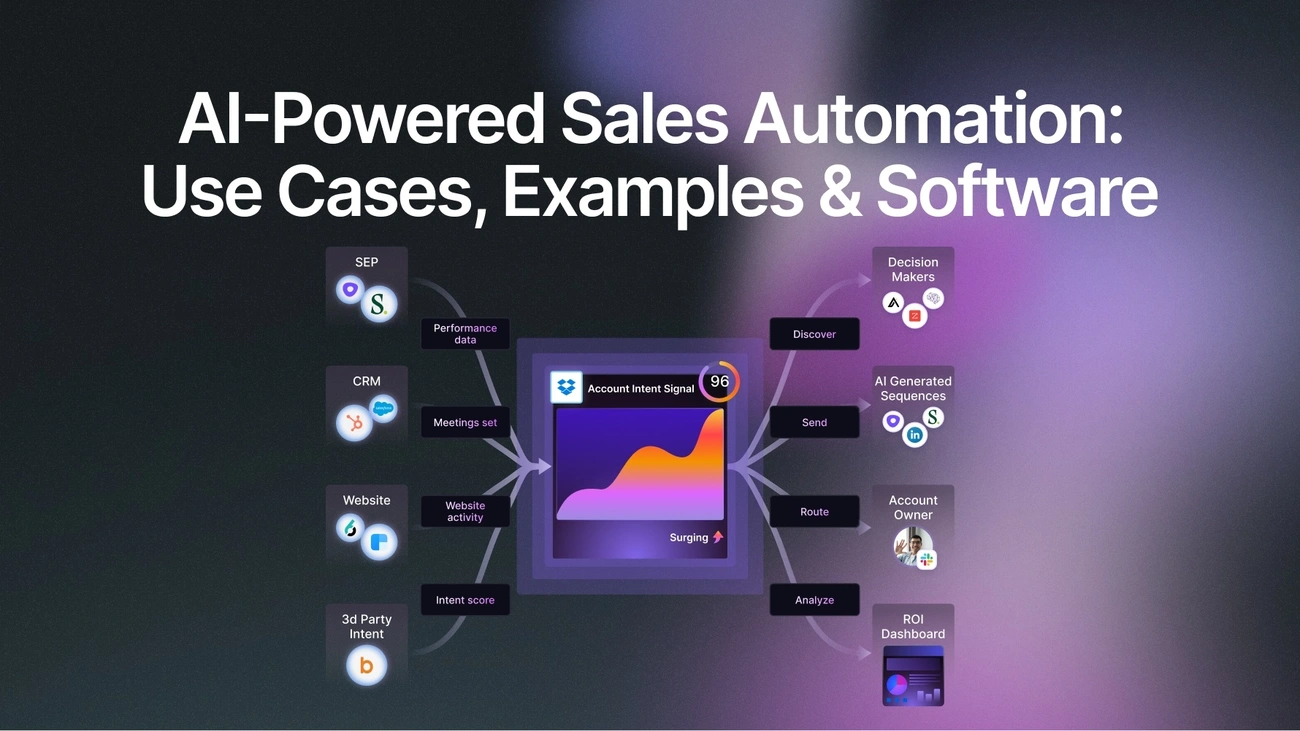
Image Source: Warmly AI
Modern sales automation in 2025 relies on three powerful technologies. These technologies help sales teams spot opportunities, predict outcomes, and connect with prospects. The best sales automation software uses these foundations to deliver better efficiency and results that teams can measure.
AI-driven lead scoring has changed the game for sales teams. About 98% say it helps them prioritize leads better. Traditional manual scoring depends on guesswork. But AI systems can analyze big data sets from CRM records, behavior patterns, and customer interactions to predict which leads will likely convert.
The technology looks at these key data points:
Demographic data (age, job title, company size)
Behavioral data (website visits, content downloads)
Firmographic data (company industry, revenue)
Engagement data (webinar attendance, resource downloads)
AI's real power lies in spotting patterns that link to successful conversions. Teams that use AI lead scoring see 9-20% more marketing conversions and 13-31% less customer churn. Top CRM platforms now use anonymous data to train AI models. This makes sophisticated lead scoring available to teams of all sizes, even those without much internal data.
Predictive analytics has changed how sales teams forecast results and handle their pipelines. Old forecasting methods relied on gut feelings, which left room for errors. AI-powered predictive analytics takes a different approach. It studies historical data, current pipeline trends, and market factors to remove bias and minimize guesswork.
This technology finds patterns in sales data that would overwhelm manual methods. Companies can now predict their pipeline with up to 90% accuracy. This marks huge progress since all but one of these sales teams typically hit 75% forecast accuracy.
These sales automation solutions stand out by offering:
Forecast confidence with probability-weighted ranges
Deal-level probability scores for every opportunity
Velocity decay alerts when deals slow down
Forbes Insights reports that 86% of executives who used predictive marketing for two years or more saw better returns on investment. The global market for predictive analytics will grow from USD 3.49 billion in 2016 to USD 10.95 billion by 2022.
Make Every Rep Speak
Like Your Top 1%
Modern sales automation tools rely heavily on multi-channel orchestration. This technology coordinates outreach through email, phone, social media, and other channels. Professional attention spans have become fragmented. Meeting prospects where they spend time creates a competitive edge.
Multi-channel orchestration blends consistency with personalization across channels. Tools track email opens and link clicks. Sales teams can then fine-tune future messages based on live engagement data. Businesses adapt their sequences to prospect behavior while keeping messages consistent across touchpoints.
Numbers prove the value. McKinsey shows that sales automation helps reps spend 15-20% more time selling and close more deals. Sales orchestration platforms now come with AI engines that spot patterns, flag churn risks, and trigger next steps on their own. They can route high-priority follow-ups or alert account executives about stalled opportunities.
The best AI sales tools blend these three core technologies into smart systems that keep learning and improving. This makes them more valuable as time passes.
Sales technology offers a huge landscape of options that might feel daunting to navigate. We analyzed hundreds of platforms and identified the best sales automation software that delivers real results for growing teams. These eight solutions combine AI power with easy-to-use interfaces to speed up your sales process.
SalesPlay is the world's first AI Sales intelligence platform that transforms sales execution speed and precision through its revolutionary suite of 7 AI Agents. Unlike competitors offering fragmented data, SalesPlay delivers pitch-ready opportunity ecosystems—hyper-personalized sales kits, mapped buying centers, and conversion-ready outreach sequences that eliminate 80% of manual work while consistently closing deals others can't identify.
Built on exclusive MarketsandMarkets intelligence and thousands of premium data sources, and exclusive vendor partnerships, the platform creates a competitive moat that drives 3x productivity gains by enabling every rep to execute with the precision of your organization's elite performers.
Dealfront excels as the leading Pipeline Generation platform for B2B revenue teams looking to discover hidden opportunities. The platform's AI features help teams qualify leads faster, find decision-makers right away, and detect real buying signals before competitors.
Dealfront's AI Company Insights gives you quick understanding of any business—their market offering and technologies—without spending hours on research. The AI Contacts feature discovers relevant decision-makers even when job titles don't match standard filters. This proves particularly useful in cross-functional selling scenarios.
A company that used Dealfront saw their customer research time drop by 90%, saving hundreds of hours each month. Book Demo Now to learn how Dealfront can revolutionize your lead qualification process.
Salesforce Sales Cloud stands as the #1 trusted AI CRM for sales and gives teams a complete foundation for revenue growth through sales force automation. Teams close deals faster with guided selling and AI-powered deal insights.
The Einstein AI engine works as an intelligent assistant right inside Salesforce CRM. It spots the most promising leads and alerts teams about deals that might slip away. Teams already using Salesforce ecosystem find this native integration an easy first step into AI.
HubSpot Sales Hub has grown into a powerful AI-guided selling tool. Sales representatives can spot valuable opportunities and know the best steps to close more deals. The platform makes every customer interaction smarter with automatic handling of time-consuming details.
HubSpot's AI Meeting Assistant makes preparation easy by gathering data from CRM, including sales history and call logs. Representatives start each day with organized tasks while guided actions provide context to work efficiently.
Apollo.io brings together sales intelligence and engagement in one powerful platform with over 200 million contacts in its database. The AI engine analyzes data live, scores prospects, and suggests the best outreach methods.
Users love how Apollo saves hours of manual research through smart lead scoring and personalization. Small teams can access advanced AI sales features through a freemium model.
Outreach serves as the only complete sales solution trusted by sales, marketing, revenue operations, and customer success teams. Teams make evidence-based decisions and take winning actions with its AI tools.
Outreach's Kaia conversation intelligence helps representatives answer prospect questions during live meetings. The system creates action items from calls and tailors follow-up messages based on previous buyer interactions.
Salesloft's Revenue Orchestration Platform uses specialized AI to help customer-facing teams focus on what matters most, from initial contact to growth and renewal. The platform adapts constantly to buyer behavior through its flexible data model.
Salesloft changes the game by connecting signals from your entire revenue tech stack and buyer's trip. The platform recently added five new AI features that help teams build better pipeline, reduce manual tasks, and close deals more predictably.
Gong.io changes sales performance by turning unstructured conversation data into useful insights. The system studies every interaction using conversational AI, machine learning, and natural language processing.
Teams using Gong have seen their revenue grow by 21% while customer ratings improved by 48%. The platform helps with coaching and pipeline management by finding patterns that lead to successful deals.
Clari shows revenue teams exactly how their business performs to improve processes, identify pipeline risks and opportunities, predict accurately, and work efficiently. The platform combines data from every tech tool into one reliable source.
Companies using Clari achieve impressive results, with 95% forecast accuracy. Operations teams can present revenue data confidently to sales leaders, changing how organizations handle their pipeline.
Your sales process needs careful planning when you implement new sales automation software. Gartner reports that generative AI-powered conversational interfaces will handle 60% of B2B seller work by 2028, up from less than 5% in 2023. This rapid change makes a strategic adoption approach vital.
You should avoid automating too many tasks at once. A step-by-step approach works better, even with enough resources. Here's where to begin:
Pick specific repetitive tasks ready for automation like data entry, lead scoring, and email sequences
Choose tech-savvy members of your sales team to test the new system
Look at your current sales processes to find areas where automation would help most
This systematic approach creates success stories that help spread adoption throughout your company. You can minimize disruption while proving the effectiveness of your chosen sales automation solution before full deployment.
Your SDRs work 9–5
AI Sales works 24/7!!
Many workers worry machines will replace their jobs, making automation a sensitive topic. Your team needs proper training to implement it well:
Address job security concerns by clearly showing the benefits and workflow improvements
Give hands-on training sessions, tutorials, and ongoing support
Show how automation helps build better relationships instead of replacing them
Get regular feedback to improve the automation process
Companies face a big challenge - 75% expect employees to streamline processes through automation, but only 8% give proper training. Book Demo Now with your vendor to ensure they include complete onboarding support in their implementation package.
Your sales automation platform must work smoothly with your CRM and other core systems. Good integration makes implementation easier:
Check if it works with your current CRM so data moves freely between systems
Clean your existing data before connecting systems
Create workflows that connect automated and manual tasks naturally
Target key connection points like lead generation, follow-up sequences, and customer handoffs
Use detailed analytics after implementation to track productivity, efficiency, and ROI. This helps you adjust and ensure your AI sales tools deliver results.
The right performance indicators show how your sales automation solution creates real business value. Your team needs to measure results consistently after implementation to prove ROI and optimize the system.
Precise metrics help verify the effects of sales automation tools. Note that these fundamental KPIs matter most:
Lead conversion rate: Automation can boost this by up to 30% through faster response times
Cost per lead (CPL): Companies report CPL reductions of up to 50% after automation implementation
Customer acquisition cost (CAC): Automation typically reduces CAC by approximately 25%
Sales cycle length: AI tools can shorten sales cycles by up to 22%
Revenue per rep: Teams using automation report monthly increases from USD 42,000 to USD 78,000 on average
Team productivity improvements deserve a closer look. Sales representatives save roughly 20% of their time that would go to non-customer-facing activities when using automation. This leads to better job satisfaction, as 76% of representatives feel less stressed when tedious admin tasks disappear.
Sales processes move faster across industries with automation. Organizations with minimal manual work complete cycles in just two days, while semi-automated processes take eight days.
Your progress needs regular comparison against industry standards. Studies show companies with automated sales order processing work 80% faster than their competitors. This speed advantage helps them deliver orders several days earlier.
Real-life success stories highlight substantial returns:
An advanced-industries company's automated bid process cut proposal time from three weeks to two hours and lifted revenue by 5%
Companies see 10% revenue growth and 10-15% efficiency gains with automation
Automation implementation delivers an average ROI multiplier of 3.2x
Marketing automation creates positive ROI for 74% of companies, with 44% seeing returns within six months
Regular measurement of these key indicators proves how your best sales automation software investment drives measurable business results.
AI has altered the map of sales, and buying the latest tools won't guarantee your market advantage. Companies that will succeed in 2025 need a smart plan to blend AI into their sales operations for the long haul.
Top sales teams don't "set and forget" their sales automation platform. They create feedback loops and review cycles to fine-tune their AI systems. Companies that fine-tune their sales strategies see boosted productivity and revenue growth. Here's how to get the most from your investment:
Set clear goals and KPIs before starting any AI project
Keep data clean and accurate for the best AI results
Run regular reviews to assess what works and what doesn't
Advanced technology hasn't replaced the human element in building real relationships. Jeff Bezos made a great point when he said that whatever technological development brings, customers will always value tailored attention. The best strategy uses AI sales tools to manage routine work while keeping human connections where they count.
Book Demo Now to learn how leading platforms help teams find the sweet spot between efficiency and personal connection.
Business leaders have concerns - 71% believe AI needs stronger governance to be trustworthy. Sales automation now sits at the heart of operations, so ethical considerations must come first. Companies ready for the future are taking these steps:
Running ethical assessments for new AI features
Creating clear data governance rules
Checking regularly to prevent algorithmic bias
Following GDPR rules and strict data protection steps
Companies like Salesforce lead the way with dedicated ethics offices, making "Ethics by Design" central to how they build products.
Sales automation has moved from a competitive advantage to a necessity for teams who want to thrive in 2025. The numbers tell the story - sales representatives spend only 28% of their time selling, and companies lose 20-30% of annual revenue to inefficient manual processes. Automation provides a clear solution.
The best sales automation platforms fix critical pipeline bottlenecks through faster lead routing, consistent participation, and better forecasting. It also frees your sales team from administrative work so they can focus on what matters most - building relationships and closing deals.
AI-driven technologies are the foundations of working sales automation, from intelligent lead scoring to predictive analytics and multi-channel orchestration. Teams looking for measurable results must choose the right tools from options like Dealfront, Salesforce Sales Cloud, or HubSpot Sales Hub.
A successful sales automation strategy needs careful implementation. Your team should start with a pilot program, train everyone well, and ensure smooth integration with existing tools. Track key performance indicators like lead conversion rates, sales cycle length, and revenue per rep to measure your return on investment.
Teams that find the perfect balance between automation efficiency and human connection will own the future. AI can handle routine tasks and provide valuable insights, but your sales representatives create the authentic relationships that end up driving long-term business success.
Sales automation software is more than a technological upgrade - it revolutionizes how growing teams operate. Teams that welcome these tools today set themselves up for green practices tomorrow while their competitors struggle with outdated, inefficient processes. You shouldn't ask whether you can afford to implement sales automation – but whether you can afford not to.
Sales automation has evolved from a nice-to-have to an absolute necessity for growing teams in 2025, with companies reporting 10-20% ROI increases while reducing human errors by 20%.
• Sales reps waste 72% of their time on admin tasks - Only 28% is spent actually selling, creating massive productivity gaps that automation directly addresses.
• Speed kills deals - respond within 5 minutes or lose - Prospects are 21x more likely to convert with immediate response versus waiting just 30 minutes.
• Manual processes cost 20-30% of annual revenue - Hidden costs from missed follow-ups, data errors, and low morale silently drain business performance.
• AI-powered lead scoring improves conversions by 9-20% - Modern platforms analyze behavioral patterns and predict which prospects will actually buy.
• Start small with pilot programs for smooth adoption - Implement gradually with tech-savvy team members to build success stories before full deployment.
The most successful sales teams in 2025 will be those that strategically balance automation efficiency with authentic human relationships, using AI to handle routine tasks while preserving personal connections where they matter most for closing deals.
Sales automation software in 2025 offers numerous benefits, including increased productivity by freeing up to 72% of sales reps' time from administrative tasks, faster lead response times leading to 21x higher qualification rates, and potential revenue increases of 10-20% through improved efficiency and reduced human errors.
AI-driven lead scoring analyzes vast datasets including CRM records, behavioral patterns, and customer interactions to accurately predict which leads are most likely to convert. This technology has been shown to improve marketing conversions by 9-20% and decrease customer churn rates by 13-31%.
When implementing sales automation, teams should start with a pilot program focusing on specific repetitive tasks, provide comprehensive training to address concerns and ensure proper usage, and integrate the new tools seamlessly with existing CRM and other key systems. It's also crucial to continuously evaluate performance using precise analytics.
The ideal approach uses AI sales tools to handle routine tasks while preserving human connections for relationship building. Sales teams should leverage automation for data entry, lead scoring, and email sequences, while focusing human efforts on personalized communication, complex problem-solving, and closing deals.
Important KPIs for measuring sales automation ROI include lead conversion rate (which can increase by up to 30%), cost per lead (potential 50% reduction), customer acquisition cost (typical 25% reduction), sales cycle length (can shorten by up to 22%), and revenue per rep (average increases from $42,000 to $78,000 monthly).


Category: Uncategorized Tags: ai, AIOps, Artificial Intelligence, cloud, cloud platform, Cybersecurity, Information and Communications Technology , VR