Most sales leaders already know their tools aren’t keeping pace with how enterprise buying actually happens. Intent data tells you someone downloaded a whitepaper. Contact databases give you names and emails. CRMs track what your team already knows. None of these show you where real opportunities exist inside accounts that matter.
The question isn’t whether you need better tools. It’s whether the tools you’re evaluating understand what enterprise selling requires: knowing what changed inside an account, why it matters to your offering, who needs to be involved, and what to do next.
Why Traditional Sales Intelligence Falls Short
Revenue teams work with an odd collection of disconnected systems. One tool tracks website visits. Another manages contacts. A third monitors news. Salesforce holds opportunity data. Somewhere between all of these, sellers are supposed to figure out where to spend their time.
This creates predictable problems. Sellers research the same accounts repeatedly because context lives in someone’s head, not in a system. New team members spend weeks ramping up on accounts that existing reps already understand. Pipeline reviews turn into guessing games about which deals are real and which are wishful thinking.
The root issue is structural. Most sales intelligence platforms were built to solve point problems: find contacts, track intent signals, enrich data, monitor news. They were not designed to answer the question every seller faces every morning: where should I focus today, and why?
The Intent Data Problem
Intent data became popular because it promised to identify accounts showing interest. If someone from a target company read articles about your product category, that was supposed to mean something.
In practice, intent data creates more noise than signal. You get alerts about accounts you’re already talking to. You get flagged for generic research that has nothing to do with buying. You get signals from individual contributors who have no budget authority. Most critically, you get interest without context. Knowing someone researched “sales automation” tells you almost nothing about whether they have budget, what problem they’re trying to solve, or who else needs to be involved.
Intent data measures activity. It doesn’t identify opportunities.
The Contact Database Problem
Contact databases solve a different problem: they give you names and emails. This matters when you need to find people. It doesn’t help when you need to understand what to say to them or why they should care.
Sellers end up with hundreds of contacts per account and no clear sense of priority. Who matters for this specific opportunity? What changed in their business that creates urgency? What have we already discussed with them? Contact databases don’t answer these questions because they weren’t designed to.
The result is generic outreach at scale. Sellers spray messages across buying committees hoping something resonates. Response rates stay low. Pipeline quality suffers. The team burns through contacts without creating real conversations.
What Account Intelligence Actually Means
Account intelligence is not a better version of intent data. It’s a different approach to the same underlying goal: helping sellers know where to focus and what to do.
An account intelligence platform watches what’s changing inside target accounts. It connects those changes to your offerings. It surfaces opportunities based on business movement, not anonymous browsing behavior. It tells you who needs to be involved and provides the context to have a real conversation.
This matters because enterprise deals don’t start with someone filling out a form. They start with a budget reallocation, a strategic initiative, a leadership change, a regulatory requirement, or a performance gap. These are the signals that predict buying. Everything else is noise.
Watching Accounts, Not Just Tracking Activity
Most intelligence platforms are reactive. They wait for a signal—a website visit, a content download, a job change—and then alert you. By design, they only see what people choose to share through digital exhaust.
Account intelligence platforms work differently. They continuously monitor business developments across accounts you care about. Financial results. Leadership announcements. Strategic shifts. Regulatory changes. Technology investments. Market positioning. These signals exist whether or not someone visits your website.
When something changes that aligns with what you sell, you see it immediately. Not as a generic alert, but as a specific opportunity with context: why this matters, what it connects to, and who should be involved.
Connecting Signals to Opportunities
Signals alone don’t create pipeline. You need someone—usually a seller or sales engineer—to translate a business development into a relevant opportunity. This is where most intelligence platforms stop. They give you the signal and expect you to figure out the rest.
Effective account intelligence connects the dots automatically. A company announces a digital transformation initiative. The platform recognizes this aligns with your automation offering. It identifies the budget holder, the implementation team, and the executive sponsor. It drafts the initial value proposition. It suggests next steps.
The seller still drives the deal. But they start ten steps ahead, with full context and a clear path forward.
How Revenue Teams Evaluate Account Intelligence Platforms
Buying decisions in this category tend to follow a pattern. Teams start by trying to fix obvious gaps—better contact data, more intent signals, cleaner enrichment. They buy point solutions. Six months later, they realize they’ve created a more complex version of the same problem.
The teams that get this right ask different questions upfront. They focus less on feature lists and more on workflow outcomes.
Does This Replace Guesswork or Just Add Data?
Most sales tools add information without reducing uncertainty. You get more signals, more contacts, more dashboards. You still don’t know which deals are real or where to spend your time.
A real account intelligence platform removes guesswork. It tells you which opportunities are worth pursuing and why. It ranks them by relevance. It shows you what changed and what that means for your offering. Sellers spend less time wondering and more time executing.
If a tool makes you smarter but not faster, it’s not solving the right problem.
Does This Work with How We Actually Sell?
Enterprise sales happens across weeks or months. Multiple stakeholders. Competing priorities. Deals stall not because sellers are bad at their jobs, but because they lose context as situations evolve.
The best account intelligence platforms maintain context as deals progress. When something changes inside an account—new executive, revised budget, competitive pressure—the platform updates automatically. Sellers see what shifted and how it affects their opportunity. They adjust their approach without starting over.
This is especially critical for teams selling into large accounts with multiple deals running simultaneously. You need a system that tracks not just what you’re selling, but what’s happening in the account that might impact every deal.
Can New Sellers Ramp Without Tribal Knowledge?
In most sales organizations, the best performers have something intangible: they understand their accounts deeply. They know the history, the politics, the priorities. This knowledge rarely lives in a system. It lives in their heads.
When those sellers leave or move to new accounts, that knowledge disappears. New sellers start from scratch. Ramp time stretches from weeks to months.
Account intelligence platforms solve this by making institutional knowledge systematic. Everything that matters about an account—history, relationships, opportunities, context—lives in one place. New team members get instant access to what took others months to learn.
This changes hiring, territory planning, and team scalability. You can add sellers without losing momentum.
Why Integrated Platforms Beat Tool Stacks
The alternative to an account intelligence platform is building your own stack. Buy intent data from one vendor. Get contacts from another. Pull in news from a third. Stitch it together with Salesforce and hope your team can make sense of it.
This approach creates three problems that compound over time.
Integration Tax
Every new tool requires setup, integration, training, and maintenance. RevOps spends weeks configuring systems that sellers will only use sporadically. Data flows break. Fields don’t map correctly. What looked simple in the demo becomes a support nightmare in production.
More importantly, integrations create delays. A signal appears in one tool. Someone needs to manually check another tool for context. By the time the seller sees the full picture, the moment has passed.
Integrated platforms eliminate this tax. Signals, context, contacts, and guidance exist in one system. Changes propagate automatically. Sellers see everything that matters without switching tabs.
Context Loss
Point solutions optimize for their specific function. Intent tools maximize signal coverage. Contact databases maximize reach. News monitors maximize volume. None of them optimize for decision-making.
When information lives in separate systems, context gets lost in translation. A seller sees an intent signal but doesn’t know the account history. They find a contact but don’t know which opportunity matters to that person. They read a news alert but can’t connect it to active deals.
Integrated platforms preserve context by design. Signals connect to accounts. Accounts connect to opportunities. Opportunities connect to contacts. Contacts connect to messaging. Everything ties together because it was built to work as a system, not a collection of features.
Workflow Fragmentation
Tool stacks force sellers to invent their own workflows. Check intent data in the morning. Research accounts in one tab. Find contacts in another. Draft outreach in email. Log activity in Salesforce. Somewhere in this process, they’re supposed to be selling.
Integrated platforms define clear workflows. You start with accounts. You identify opportunities. You find the right contacts. You get suggested messaging. You execute. The platform guides the process instead of requiring sellers to orchestrate multiple tools.
This matters more as teams scale. With five sellers, you can rely on individual hustle. With fifty, you need consistent execution. The system needs to encode best practices, not assume everyone will figure it out.
How SalesPlay Approaches Account Intelligence
SalesPlay was built around a specific insight: enterprise sellers don’t need more data. They need clarity about where to focus and what to do next.
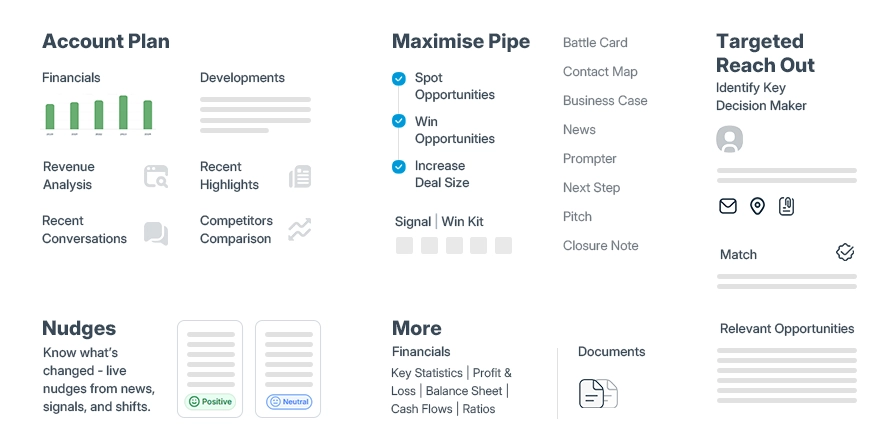
The platform continuously watches accounts connected through Salesforce. It tracks business changes across multiple sources. It connects those changes to opportunities and people. It tells sellers where to act, who to engage, and how.
This happens through a system of specialized agents that work together to deliver revenue intelligence.
Account Intelligence Agent
This agent maintains a complete, current view of every target account. Five-year revenue history. Financial context. Key business developments. Recent conversations. Signals tied to opportunity relevance.
It behaves like a living account plan that updates as the account moves. Sellers get full context in minutes, not hours. New team members ramp immediately. No one wastes time researching what the system already knows.
Spot Opportunities Agent
This agent identifies where you can sell based on what’s changing inside accounts. It categorizes opportunities by relevance. For each one, it explains why the opportunity exists, what triggered it, which offering fits, and who needs to be involved.
Sellers review the context and decide whether to pursue. If they choose to move forward, the opportunity flows into the next stage with all context intact.
Win Opportunities Agent
This agent converts opportunities into execution-ready deals. It provides battle cards, talking points, elevator pitches, and next-step guidance. Contacts are already attached. Messaging is drafted. Sellers can review, adjust, and execute without starting from scratch.
Spot Contacts Agent
This agent starts from a known person and shows what opportunities matter to them. You see their role, contact details, and LinkedIn. You see which opportunities align with their function. You get battle cards and messaging specific to those opportunities.
This becomes especially useful when you already have relationships and want to expand your footprint within an account.
Auto-Nurture Agent
This agent creates personalized email campaigns tied to specific opportunities. You select opportunities, contacts, and campaign timing. The platform drafts every email, personalizes by opportunity and individual, and runs the campaign after approval.
Sellers stay relevant without manually writing everything.
Meeting Prep Agent
This agent generates a one-page prep document for any meeting. Opportunity summary. Attendee context. Conversation starters. Smart questions. Suggested next steps.
No rushed prep. No unfocused meetings. No missed follow-ups.
Signals Agent
This agent surfaces news and developments tied to accounts. It filters noise and highlights what creates a reason to engage.
Together, these agents create a system where sellers always know where to focus, what matters, and what to do next. This integrated approach to sales automation removes the fragmentation that slows most teams down.
What Changes When You Work This Way
Teams using account intelligence platforms describe similar shifts in how they operate.
Pipeline Creation Becomes Proactive
Most sellers wait for inbound interest or work through cold outreach. Both approaches are reactive. You respond to who raises their hand or you guess who might care.
Account intelligence makes pipeline creation proactive. You see opportunities before they become obvious. You engage based on business triggers, not arbitrary cadences. You start conversations when timing is right, not when you happen to remember to follow up.
This changes pipeline quality. You’re not chasing weak intent signals. You’re pursuing opportunities grounded in real business need.
Deal Progression Becomes Predictable
Deals stall when context disappears. Someone new joins the buying committee. Priorities shift. Budget gets reallocated. Sellers scramble to understand what changed and how to adjust.
With continuous account monitoring, changes surface automatically. You see what shifted. You understand what it means. You adapt without losing momentum.
Pipeline reviews become easier. Deals are grounded in current reality, not outdated assumptions. Forecasts improve because you’re tracking actual progress, not optimistic guesses.
Teams Execute Consistently
In most sales organizations, performance varies wildly. Top performers have instincts and relationships that average performers lack. You can’t easily replicate what makes them successful.
Account intelligence platforms encode best practices into the system. Everyone sees the same opportunities. Everyone gets the same context. Everyone receives guided next steps. Performance becomes more consistent because the system eliminates advantages based purely on tenure or tribal knowledge.
Leaders Get Control
Sales leaders spend too much time in the weeds—coaching on accounts, correcting prioritization, reviewing whether deals are real. This is necessary when teams lack shared context.
When the system maintains that context automatically, leaders can focus on strategy instead of tactics. They see which accounts are moving. They spot where teams need support. They adjust coverage without micromanaging execution.
Making the Platform Decision
Choosing an account intelligence platform matters more than most tool decisions because it affects your entire go-to-market motion. Get it right, and you accelerate pipeline creation, improve win rates, and scale execution. Get it wrong, and you’ve added complexity without solving the underlying problem.
The teams that make good decisions focus on three areas.
Start with Workflow, Not Features
Feature comparisons are seductive because they feel objective. This platform has more intent sources. That one has better enrichment. The other integrates with more tools.
None of this matters if the platform doesn’t fit how your team sells. Map your actual workflow first. Where do sellers spend time today? What creates confusion? What forces context switching? What causes deals to stall?
Then evaluate platforms against those workflows. Does this make account research faster? Does this reduce guesswork about where to focus? Does this preserve context as deals progress?
The best platform isn’t the one with the longest feature list. It’s the one that removes the most friction from how you already work.
Test with Real Accounts
Demos are theater. Vendors show polished examples with perfect data and obvious opportunities. Your accounts won’t look like that.
Insist on testing with your actual target accounts. Connect your Salesforce instance. Let the platform ingest your data. See what opportunities it surfaces. Evaluate whether the context is useful and whether the guidance is actionable.
Pay attention to edge cases. What happens with accounts where you already have multiple deals? How does it handle complex buying committees? Can it adapt when your offerings change?
Real-world performance matters more than controlled demos.
Involve Frontline Sellers Early
Platform decisions are usually made by revenue leaders or RevOps teams. This makes sense—they understand strategy and they control budget. But they don’t live in the tools every day.
Frontline sellers will tell you immediately whether something is useful. They’ll spot workflow problems that leaders miss. They’ll identify where the platform creates work instead of removing it.
Run pilots with a small group of sellers before committing. Give them real accounts and real goals. See whether they actually use the platform or whether it becomes another ignored tool.
If your best sellers don’t find it valuable, the platform won’t deliver results at scale.
What This Means for Revenue Teams
Enterprise selling is not getting easier. Buying committees are larger. Sales cycles are longer. Budgets are scrutinized more carefully. Sellers who rely on activity and persistence alone will fall further behind.
The teams that win will be the ones who know more about their accounts, move faster on opportunities, and execute with precision. That requires systems designed for clarity and control, not just data collection.
Account intelligence platforms represent a different approach to sales technology. They don’t just give you information. They tell you what to do with it. They reduce the gap between knowing something matters and acting on it.
For revenue leaders evaluating platforms, the question is not whether you need better tools. It’s whether the tools you’re considering actually solve the problems that matter: where to focus, what to say, and how to win.
If a platform can answer those questions consistently, it will change how your team sells. Everything else is incremental improvement on a broken workflow.
Ready to see how account intelligence works in practice? Start a Trial and experience the difference for yourself.