Nurturing Leads After the First Sales Conversation
February 20, 2026
The first sales conversation is the easy part. A buyer takes the meeting. They engage. There is signal. Then the seller sends a follow-up email that starts with “Great to connect today” — and the deal quietly stalls.
This is the central failure of enterprise deal follow-up strategy: sellers leave the meeting with energy and no clear structure for what happens next. They send a generic recap. They wait. They follow up again two weeks later. The buyer has moved on internally. The window closes.
The issue is not seller motivation. It is the absence of a systematic, signal-aware approach to post-meeting lead nurture. Most sales organizations treat nurture as a communication problem — solved by better email templates or longer sequences. It is not. It is an intelligence problem.
Post-meeting lead nurture is the structured process of maintaining deal relevance and advancing buyer intent between sales conversations — tied directly to changes inside the buyer’s account, not to a seller’s calendar reminder.
The gap between a first conversation and a qualified opportunity is where most pipeline is lost. Understanding why — and what closes that gap — is the strategic question every revenue leader should be asking.
Each of these failures is not a people problem. It is a structural one. And it compounds: stalled deals create false pipeline, which distorts forecasting, which erodes leadership confidence, which leads to more pressure on sellers who are already working without enough signal.
Reactive follow-up is what most enterprise sales teams run today. A seller meets a buyer. Something triggers a reminder. The seller sends a message. The message is usually not wrong — but it is rarely well-timed, rarely specific to what is happening in the account, and rarely connected to a buying center beyond the person the seller already knows.
Signal-based post-meeting nurture replaces this model entirely.
Signal-based post-meeting nurture is a deal follow-up strategy where every outreach touchpoint is triggered or informed by a real change inside the buyer’s account — a leadership shift, a budget signal, a strategic initiative, an earnings statement, or a change in organizational priorities — rather than a fixed-interval sequence.
The difference is not semantic. In reactive follow-up, the seller is guessing. In signal-based nurture, the seller is responding. One feels like outreach. The other feels like advice.
| Dimension | Reactive Follow-Up | Signal-Based Nurture |
|---|---|---|
| Trigger | Calendar reminder or gut instinct | Real account event or business change |
| Message relevance | Generic or template-driven | Tied to specific opportunity context |
| Timing | Fixed intervals (e.g., Day 3, Day 7) | Dynamic — when the signal warrants it |
| Stakeholder coverage | Primary contact only | Mapped buying centers and contacts |
| Data source | CRM notes + seller memory | Continuous account intelligence |
| Seller effort per deal | High (manual research, writing) | Low (drafted, contextualized, ready) |
| Scalability across accounts | Limited by seller capacity | Scales with account count |
The table above is not a product comparison. It is a description of two fundamentally different operating models. Revenue leaders who have adopted signal-based approaches report that it changes not just follow-up quality, but deal velocity, stakeholder coverage, and seller confidence.
Post-meeting nurture is not a soft skill. It is a revenue lever. Measuring its impact requires looking at four interconnected deal metrics: sales cycle length, opportunity progression rate, multi-threading success, and account expansion velocity.
Reducing average sales cycle length by compressing post-meeting dead time has a disproportionate impact on deal velocity. Every week of unnecessary dormancy is compounded across every deal in the pipeline.
The post-meeting period is where most sales cycle inflation occurs. A deal that could progress in 30 days stretches to 60 because the seller could not find a relevant reason to re-engage. Signal-based nurture provides that reason — tied to something real happening in the account — compressing unnecessary wait time.
Most CRM pipelines are populated with deals that have not meaningfully progressed in 30, 60, or 90 days. These are not bad opportunities — they are opportunities without context. When sellers have clear account intelligence and drafted next-step messaging, progression rate increases because the barrier to the next action is lower.
Single-threaded deals are fragile. The moment the primary contact changes role, goes on leave, or loses internal support, the deal stalls. Multi-threading requires knowing who else to engage, what matters to them, and what angle to use. Find Contacts workflows in SalesPlay surface buying centers mapped to specific opportunities, with messaging tailored to each stakeholder’s function.
Post-meeting nurture is not only relevant to new logos. In existing accounts, every conversation creates a moment to expand footprint. Sellers who monitor account changes continuously — using Account Intelligence workflows — can identify expansion signals before they become explicit RFPs. That is structural pipeline creation, not reactive hunting.
Figures are directional benchmarks based on enterprise sales research. Individual results vary by market, deal complexity, and team structure.
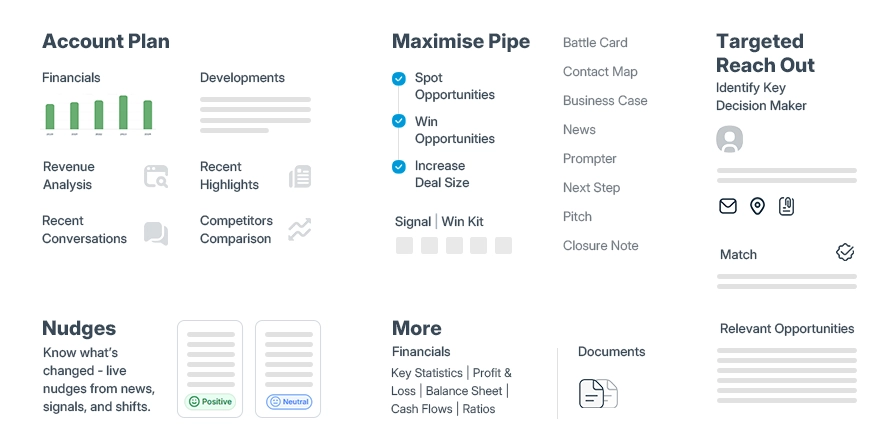
SalesPlay is not a nurture tool bolted onto a CRM. It is a revenue intelligence co-pilot that watches what is happening inside target accounts and tells sellers where to act, who to engage, and how.
Post-meeting nurture in SalesPlay is not a standalone feature. It is the natural outcome of how the platform works: accounts are continuously monitored, opportunities are tied to real signals, contacts are mapped to buying centers, and outreach is drafted automatically. The seller’s job is to review, approve, and engage.
SalesPlay continuously watches Salesforce-connected target accounts, tracks multi-source changes, connects business movement to opportunities and people, and tells sellers where to act — without requiring sellers to build this picture manually.
This is not a theoretical workflow. Every step described above corresponds to a specific agent inside SalesPlay. Sellers do not need to jump across tools, manually research accounts, or write emails from scratch. The platform carries the work.
Post-meeting nurture ends at the next meeting. That meeting should not begin with a seller trying to reconstruct context from email threads and CRM notes. The Meeting Prep Agent generates a one-page briefing for any scheduled meeting — opportunity summary, attendee context, relevant conversation starters, smart questions, and suggested next steps. Sellers walk in prepared. The loop closes cleanly.
Revenue leaders evaluating deal follow-up strategy often ask: “We already have a CRM. Why do we need SalesPlay?” The answer is simple: a CRM records what has happened. SalesPlay watches what is changing.
CRM-dependent follow-up requires sellers to maintain data quality, build sequences manually, and rely on their own memory or research to make outreach relevant. SalesPlay removes those dependencies.
| Capability | CRM-Based Workflow | SEP / Sequencing Tool | SalesPlay |
|---|---|---|---|
| Continuous account monitoring | No | No | Yes |
| Signal-triggered follow-up | No | No | Yes |
| Opportunity identification | No | No | Yes |
| Contact-to-opportunity mapping | Manual | Partial | Yes |
| Auto-drafted nurture emails | No | Templates only | Personalized drafts |
| Meeting prep generation | No | No | Yes |
| Battle cards per opportunity | No | No | Yes |
| Financial & revenue history | Manual entry | No | Yes (5-year) |
| New seller ramp support | No | No | Instant context |
The table above is not a criticism of CRMs or sequencing tools. Those systems solve different problems. A CRM is the system of record. A SEP automates volume. SalesPlay is the layer that tells sellers what to do, who to talk to, and what to say — based on what is actually happening inside accounts.
Enterprise account executives manage dozens of active opportunities. Each opportunity may involve multiple stakeholders across different buying centers. Writing personalized, signal-aware follow-up for every contact, after every meeting, across every deal is not a question of effort — it is a question of capacity.
Manual post-meeting nurture has a ceiling. At some point, sellers triage: they focus on the deals most likely to close and let the rest drift. This creates pipeline blind spots, abandoned expansion opportunities, and inconsistent deal quality across the team.
The Auto-Nurture Agent in SalesPlay removes the ceiling. Sellers select opportunities and contacts, choose the number of touches and timing, and the platform drafts every email — personalized to the opportunity context and the individual’s role. Each message is distinct. The campaign runs automatically after seller approval. No sequence builders. No template libraries. No writing from scratch.
SalesPlay does not replace the seller. It removes the preparation burden so sellers can spend their time on judgment, relationships, and closing — not research, writing, and logistics.
Post-meeting nurture does not exist in isolation. It is one stage in a connected workflow. Understanding how SalesPlay supports the full chain — from account discovery through deal close — shows why individual agents deliver more value together than separately.
Each stage feeds the next. Account research informs which opportunities to pursue. Opportunity mapping identifies which contacts to engage. Contact mapping informs what nurture messages to send. Nurture leads to the next meeting. Meeting prep ensures that meeting converts.
This is not a disconnected stack of features. It is a single, continuous workflow that runs across the account life cycle — reducing the friction between every stage of the deal.
Revenue operations leaders evaluating account research automation software will find that SalesPlay collapses what would otherwise require three or four separate tools into one connected workflow, with Salesforce as the system of record beneath it.
Post-meeting lead nurture is the structured process of keeping deal momentum alive between sales conversations. It involves timely, relevant follow-up tied to the specific context of the buyer’s situation, business signals, and stated priorities. In enterprise sales, ineffective post-meeting nurture is one of the leading causes of stalled pipeline.
Signal-based post-meeting nurture is an approach where follow-up communications are triggered by real changes inside the buyer’s account — leadership movements, budget cycles, strategic announcements, or initiative launches — rather than a fixed time-based cadence. It ensures every touchpoint is relevant to what is happening in the account right now.
A CRM records what has happened. SalesPlay watches what is changing. CRM-based follow-up relies on sellers manually logging activity and setting reminders. SalesPlay continuously monitors account signals, detects relevant changes, surfaces the right contacts, and drafts follow-up messaging tied to those signals — without requiring sellers to build sequences manually.
The most effective tools combine account intelligence, contact mapping, and automated outreach generation. SalesPlay integrates these through its Account Intelligence, Win Opportunities, Meeting Prep, and Auto-Nurture agents — enabling sellers to move from a first meeting to a structured, personalized nurture campaign in minutes, without jumping between platforms.
Through the Auto-Nurture Agent, sellers select target opportunities and contacts, set the number of touches and timing, and SalesPlay drafts every email in the sequence — personalized by opportunity context and individual contact. Each message is unique. The campaign runs automatically after seller approval, with no manual writing required.
Multi-threading is the practice of engaging multiple stakeholders within a buying account simultaneously. In post-meeting nurture, it means not relying on a single contact to carry the deal internally. SalesPlay surfaces buying centers and associated contacts for each opportunity, so sellers can run parallel conversations without losing context across stakeholders.
SalesPlay watches your target accounts continuously, surfaces the right opportunities, maps the right contacts, and drafts every follow-up message — so your team can focus on closing, not preparation.


Category: Uncategorized Tags: ai, AIOps, Artificial Intelligence, cloud, cloud platform, Cybersecurity, Information and Communications Technology , VR