Sales Intelligence Software vs Platform: Which Do You Need?
August 21, 2025
Sales Intelligence has become a game-changer for modern sales teams looking to boost their performance and close more deals. Yet, many sales professionals face a crucial dilemma: should you invest in a sales intelligence software or a full-fledged platform? The difference isn't just semantic—it can significantly impact your team's efficiency and your company's bottom line.
I've seen countless sales teams struggle with this decision, often because they don't fully understand what sets these two options apart. Sales intelligence software typically offers specialized features focused on specific tasks, while sales intelligence platforms provide an all-in-one solution with broader capabilities. However, the best choice depends entirely on your unique business needs, team size, and growth plans. Throughout this article, I'll break down exactly what each option offers, when to choose one over the other, and how to make sure you're investing in the right solution for your sales strategy.
Sales intelligence software serves as a specialized toolkit that equips sales professionals with crucial data for making informed decisions throughout the sales cycle. Unlike comprehensive platforms, these tools focus on specific tasks like finding prospects' contact information or enriching lead data. According to Gartner, sales intelligence encompasses "the information that salespeople use to make informed decisions in the selling cycle", making these standalone tools essential for modern sales operations.
Sales intelligence software primarily functions as a specialized solution aimed at specific sales tasks rather than offering an all-encompassing system. These tools excel at gathering and verifying prospect information from various online sources. They collect data from publicly available information, websites, social media platforms like LinkedIn, and directories. Many tools leverage AI and pattern recognition to identify common email formats within company domains, providing verified contact details that salespeople can use immediately.
For instance, Hunter uses proprietary technology and artificial intelligence to find, verify, and enrich contact details. Similarly, RocketReach offers verified contact data with 90-98% deliverability on verified emails. These standalone tools are designed to solve particular pain points in the sales process without requiring extensive setup or integration work.
The advantage of these specialized tools is their ability to deliver immediate value. Sales reps can identify relevant leads based on their ideal customer profile, find the right person to contact from a company name or website, and verify email addresses without needing a full account setup. This plug-and-play approach makes them particularly valuable for smaller teams or specific use cases.
Ready to turn your Rep
INTO BEST PERFORMER ?
The most popular sales intelligence software products share several core features that define their utility in the sales stack:
Email finders and verifiers: Tools like Hunter, RocketReach, and Clearbit allow users to discover and verify professional email addresses with high accuracy. Hunter verifies lists to ensure deliverability, while RocketReach claims 90-98% deliverability on verified emails. These tools eliminate guesswork in prospecting, saving valuable time for sales teams.
Chrome extensions: Many sales intelligence tools offer browser extensions that transform regular web browsing into active prospecting. For example, Persana's Chrome extension enables quick prospecting directly on LinkedIn and Gmail with verified contact information. Likewise, HubSpot's Sales Extension turns Gmail inboxes into prospecting command centers with features like email tracking, automated logging, and meeting scheduling.
CRM integration: Almost all leading sales intelligence software integrates with popular CRM systems. As noted by Saleshandy, most extensions sync with CRMs like HubSpot, Zoho, and Salesforce. This integration enables seamless data flow between prospecting activities and customer relationship management. For instance, Salesloft allows users to log activity in real-time, sync customer data, and streamline contact management across multiple CRM platforms including Salesforce, Microsoft Dynamics 365, HubSpot, and Zoho.
Data enrichment capabilities: Beyond basic contact information, modern sales intelligence tools provide enriched data about prospects. RocketReach, for example, offers technographics and intent data insights to help sales teams prospect better and customize outreach.
Compliance features: With increasing privacy regulations, many tools now emphasize compliance. Cognism, for instance, checks contact data against Do Not Call lists in 13 countries, ensuring that outreach remains within legal boundaries.
The primary difference between sales intelligence software and platforms lies in their scope and deployment. Software tools typically address specific needs with minimal setup, making them ideal for teams seeking immediate solutions to particular challenges in their sales process. As organizations grow, they may consider transitioning to more comprehensive platforms that combine multiple capabilities under one roof.
Unlike single-function tools, sales intelligence platforms function as complete ecosystems that bring multiple sales capabilities together under one unified system. These platforms represent the evolution of sales technology from basic data providers to sophisticated intelligence hubs that power entire go-to-market strategies.
A sales intelligence platform collects, processes, and analyzes data from numerous sources to provide sales teams with actionable insights. Whereas standalone software focuses on specific tasks, platforms offer integrated modules working in harmony to support the entire sales journey.
Sales intelligence platforms emerged as a distinct technology category in the early 2000s, initially focusing primarily on company and contact data provision with limited analytical capabilities. Since then, they have evolved significantly, moving beyond simple data access to become central command centers for sales operations.
Modern platforms include several interconnected modules that enhance different aspects of the sales process:
Data enrichment - Automatically updates and completes contact and company information
Prospecting tools - Discovers new, high-intent leads based on specific criteria
Intent signals - Identifies real-time buying intent and technology usage patterns
Workflow automation - Streamlines outreach and follow-up sequences to engage prospects at scale
Analytics dashboards - Provides custom views showing key performance metrics
This modular structure gives sales teams the flexibility to access different capabilities as needed, yet benefit from the seamless data flow between components. As Clay.com notes, "These platforms streamline the prospecting workflow by automating research and lead qualification".
ZoomInfo Sales exemplifies this integrated approach, building on "the industry's most comprehensive, high-quality B2B data foundation" to provide "a suite of tools designed to streamline every stage of the sales process". Their platform includes automated workflows, targeted email outreach, and conversation intelligence all working together.
At their core, sales intelligence platforms unify three critical elements: data collection, analytical processing, and automated action. This integration creates a powerful system that's greater than the sum of its parts.
The data aggregation capabilities of these platforms are impressive - they collect and integrate information from thousands of sources including company websites, news outlets, social platforms, financial databases, job boards, technology signals, and intent data providers. Yet this information would be overwhelming without the analytical layer that transforms it into usable intelligence.
Modern platforms leverage artificial intelligence, machine learning, and natural language processing to identify patterns, opportunities, and relevant intelligence that would be impossible to detect through manual research. These advanced analytics turn raw information into actionable insights that help sales teams identify opportunities, engage prospects effectively, and make better decisions.
Additionally, these platforms deliver intelligence directly within sales workflows and existing tools like CRM, email platforms, and meeting applications. This contextual delivery ensures insights are available exactly when and where they create maximum value.
A key strength of modern sales platforms is their ability to seamlessly connect with your existing tech stack. This ensures data flows smoothly into your CRM and other essential tools, eliminating manual data entry, preventing information silos, and creating a single source of truth for your entire go-to-market team.
This integration creates a centralized platform that not just sales and marketing but also customer support and product teams rely on to manage cohesive customer interactions. Such a collaborative platform is essential to the sales and marketing alignment that drives conversions.
Ultimately, sales intelligence platforms allow your salespeople to pursue the strongest opportunities at the right time, maximizing the impact of every sales and marketing dollar. By providing predictive prospecting capabilities, these platforms combine advanced prospect data with real-time buying signals so business development teams can connect with the right buyer at the right time.

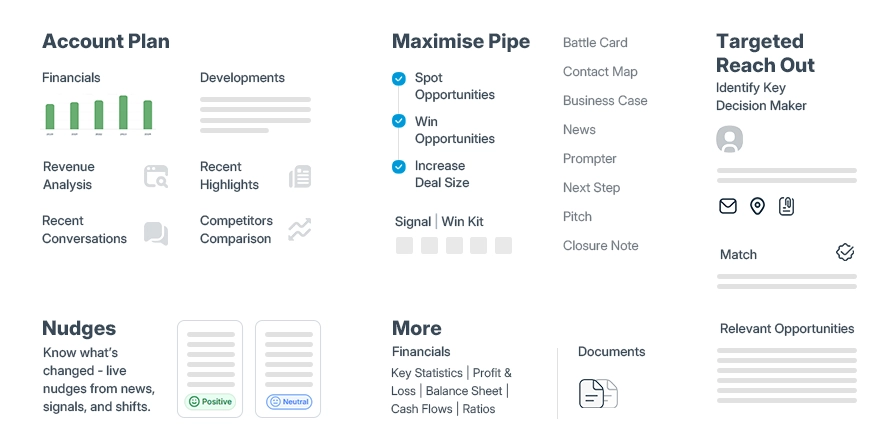
The fundamental contrast between sales intelligence software and platforms goes far beyond simple terminology. These solutions differ significantly in their architecture, implementation requirements, and capabilities—distinctions that directly impact their suitability for different business scenarios.
Sales intelligence software typically addresses specific pain points in the sales process with focused solutions. These standalone tools excel at specialized tasks like email finding, contact verification, or lead scoring. They follow a "do one thing well" philosophy, offering depth rather than breadth in functionality.
In contrast, sales intelligence platforms operate as integrated ecosystems combining multiple capabilities under one roof. Unlike single-function tools, platforms merge data collection, analysis, enrichment, and sales automation in a unified system. This integration creates significant advantages—sales teams can move seamlessly from discovering prospects to engaging them without switching between different applications.
The difference becomes evident when examining workflow efficiency. Software tools might require sales reps to export data from one system and import it into another, whereas platforms maintain data continuity throughout the entire sales process. Furthermore, platforms typically offer customization options that adapt to specific industry needs or company workflows, making them more versatile as business requirements evolve.
Implementation complexity represents another major distinction between these solutions. Sales intelligence software generally follows a plug-and-play model with minimal setup requirements. Most offer browser extensions or simple web interfaces that sales reps can begin using immediately, often requiring little more than an email login.
As noted by one source, "Sales intelligence tools automate repetitive tasks, streamlining the entire sales process" . Their quick implementation makes them ideal for teams seeking immediate productivity gains without extensive IT involvement.
Platforms, on the other hand, typically require enterprise-level deployment with more extensive configuration. The setup process may involve:
CRM integration and data synchronization
User permission structures and role-based access
Workflow customization and automation rules
Custom reporting dashboards
API connections with existing tech stack
This complexity stems from platforms' broader capabilities and deeper integration with business systems. Consequently, platform implementation often demands dedicated resources and a structured onboarding process, making it a more significant investment upfront.
The most profound difference between software and platforms lies in their approach to data management. Sales intelligence software typically focuses on specific data types or sources, whether that's contact information, company details, or technographic data. Though effective within their niche, these tools may have limitations in data depth or breadth.
Sales intelligence platforms, meanwhile, aggregate and process information from thousands of sources, creating a more robust foundation for decision-making. As one industry analysis explains, "Sales intelligence takes a different approach, focusing on collecting external data and insights to make informed decisions throughout the sales process".
The contrast extends to data enrichment—how these solutions enhance existing information. Software tools typically offer basic enrichment like adding missing contact details or company information. Platforms provide more sophisticated enrichment capabilities, including:
AI-powered analytics that score leads in real time
Intent data capturing buying signals across digital channels
Predictive insights identifying prospects most likely to convert
Behavioral analysis tracking engagement across touchpoints
Automatic data verification and cleansing
These advanced capabilities enable platforms to transform raw information into actionable intelligence, moving beyond simple data collection to insight generation. Nevertheless, this sophistication comes with increased complexity and cost, reinforcing why the choice between software and platform should align with specific business needs rather than following a one-size-fits-all approach.
Choosing between sales intelligence software and platforms depends primarily on your organization's size, goals, and available resources. This decision shapes your team's efficiency and ultimately affects your bottom line.
STOP CHASING PROSPECTS
START CLOSING DEALS!!
Small teams and startups often benefit most from focused sales intelligence software solutions that address specific needs without overwhelming complexity. For early-stage companies, Apollo.io consistently stands out for its flexibility and automation capabilities. It offers substantial value even with its free plan, providing access to key features without requiring immediate financial commitment. This allows smaller teams to test the platform thoroughly before upgrading.
Budget-conscious organizations frequently gravitate toward tools like ListKit, which ranks highly for affordability and accuracy in the small business category. As a specialized lead generation system, it provides access to verified emails only, significantly reducing bounce rates and improving connection quality with prospects.
For startups, the primary advantages of choosing software over platforms include:
Faster implementation - Get up and running without extensive setup
Lower initial investment - Pay only for the specific functionality you need
Simpler learning curve - Train team members quickly on focused tools
Immediate ROI - See results faster with tools addressing specific pain points
Moreover, small teams often find standalone tools more adaptable to their evolving needs. As one sales professional notes, "Work smarter, not harder: The best teams use intelligence to focus on high-value prospects, not just dial down a list". AI-driven tools can boost win rates by 35-50%, making them particularly valuable for resource-constrained teams.
Enterprise sales organizations typically require comprehensive sales intelligence platforms that can handle complex workflows and large data volumes. These teams benefit from integrated systems that connect various sales functions and provide consistent data across departments.
ZoomInfo stands as a leader in enterprise sales intelligence, with its massive data foundation helping sales teams improve prospecting abilities and stimulate pipeline growth. The platform's extensive capabilities make it suitable for organizations with complex sales operations spanning multiple regions or industries.
Enterprise teams should consider platforms instead of software when they need:
Unified data access across large sales organizations
Advanced analytics for forecasting and territory planning
Seamless integration with existing enterprise tech stacks
Standardized processes across multiple sales teams
Scalable architecture to accommodate growth
Companies using Persana, essentially a platform approach, see a 95% increase in qualified leads, making it especially valuable when quality leads matter more than quantity. This illustrates how platforms can deliver organization-wide impact that standalone tools might struggle to achieve.
Beyond company size, industry requirements often dictate whether software or platforms make more sense. Certain sectors have unique needs that influence this decision.
In retail, popular sales intelligence services like Seamless.AI are frequently mentioned for their real-time enrichment and outreach capabilities. These tools deliver reliable, real-time data collection through simple interfaces, making them particularly valuable in fast-moving consumer markets.
For companies targeting European markets, Cognism excels with its premium B2B data, becoming the preferred sales intelligence tool for organizations focusing on EMEA regions. Its emphasis on GDPR compliance ensures that outreach remains within legal boundaries, a critical consideration for companies operating under strict privacy regulations.
Apollo stands out as a complete sales intelligence platform with its massive database of 275 million contacts and 60 million companies, smoothly combining prospecting, engagement, and automation features. This makes it ideal for industries requiring broad market coverage.
Finally, HubSpot Sales Hub combines CRM functionality with powerful automation tools, creating an all-in-one solution for sales teams. This integration makes it particularly suitable for industries where marketing and sales alignment is crucial.
Ultimately, the right choice depends on your specific context. As industry experts advise: "Match tool to need: There's no universal winner. Big databases like ZoomInfo or Cognism are great for volume, while tools like Thunderbit or LeadIQ excel at custom, fast prospecting". Your industry, growth stage, and team structure should guide this critical decision.
The concrete difference between sales intelligence software and platforms becomes most apparent when examining their specific features. Let's compare how these solutions stack up across four critical capabilities that impact sales performance.
Lead scoring functionality varies dramatically between standalone tools and integrated platforms. Sales intelligence software typically offers basic scoring based on configurable rules that rank prospects according to their purchase probability. These tools help identify which leads are worth targeting and automatically prioritize existing lists based on preset parameters.
In contrast, platforms deliver more sophisticated scoring capabilities. AI-powered sales intelligence platforms apply machine learning algorithms to analyze historical data, identifying patterns that indicate a lead's likelihood of converting. This advanced approach enables sales teams to focus on promising opportunities with greater precision.
According to recent research, companies using advanced sales analytics are 2.5 times more likely to exceed their sales targets. This advantage stems from platforms' ability to process vast datasets and generate nuanced scoring models that simple software tools cannot match.
Both software and platforms offer notification systems, yet their depth and implementation differ substantially. Sales intelligence software typically provides basic alert functions that notify users about important market events. These alerts are often limited to specific triggers without extensive customization options.
Platforms, on the other hand, deliver more contextual alerts integrated into broader workflows. For instance, when Saber identifies a company announcing a cloud migration project, it alerts the assigned representative, identifies key stakeholders, analyzes their LinkedIn activity, and generates personalized messaging—all automatically. This comprehensive approach creates immediate actionable intelligence rather than simple notifications.
The difference is evident in how 6sense monitors anonymous content consumption across 5,000+ B2B websites, aggregating signals to predict buying intent before prospects even fill out forms. Such capability goes far beyond what standalone tools can offer.
Make Every Rep Speak
Like Your Top 1%
Predictive capabilities represent perhaps the starkest contrast between software and platforms. While basic software might offer simple forecasting tools, platforms leverage AI for sophisticated predictive insights:
Platforms use machine learning to analyze millions of data points, identifying which activities typically precede purchase decisions
Advanced platforms can future-proof predictions with claimed 98% accuracy
AI-powered analytics bring forecasting to an entirely new level, helping teams predict pipeline outcomes and adjust resource allocation accordingly
The impact of these advanced capabilities is substantial—companies using AI sales tools report a 60% reduction in sales cycles and a 55% increase in conversion rates. This dramatic improvement highlights why organizations requiring precise forecasting often gravitate toward platforms despite their higher investment requirements.
Data quality represents the foundation of sales intelligence, and the approaches to enrichment vary significantly between software and platforms:
Standalone software typically focuses on basic data enrichment—ensuring prospect information is correct and up-to-date. These tools excel at specific tasks like finding email addresses or verifying contact details but often lack depth in enrichment capabilities.
Conversely, platforms offer multi-dimensional enrichment. Saber, for example, scans public documents like SEC filings, earnings calls, and news to extract business priorities and initiatives with complete source attribution. Upon identifying priorities such as "reducing cloud costs by 30%," it provides exact quotes and source links.
The enrichment gap is quantifiable—a Salesforce study found businesses using advanced data enrichment tools experience a 28% increase in sales productivity and a 25% rise in marketing ROI. This improvement stems from platforms' ability to create comprehensive customer profiles by integrating various data points.
Ultimately, the feature differences between software and platforms reflect their fundamental design philosophy: software tools solve specific problems efficiently, while platforms deliver integrated capabilities that transform how sales teams operate.
The true power of any sales tool lies in how seamlessly it connects with your existing tech stack. Even the most powerful sales intelligence solution becomes a data silo if it can't communicate with your other essential systems. Let's examine how both software and platforms handle integration with critical business tools.
Most sales intelligence tools prioritize CRM integration, yet the depth of these connections varies considerably. In the context of Sales Intelligence vs CRM vs Revenue Intelligence, sales intelligence software typically offers basic synchronization with popular CRMs, while platforms provide a more advanced two-way data flow.
For Salesforce users, Sales Cloud creates a unified customer profile on a single platform where AI and automation are built in and designed to scale as organizations grow. This tight integration ensures that sales intelligence flows directly into your primary customer database.
HubSpot users benefit from Sales Hub's integration capabilities that boost CRM efficiency and help teams close deals faster. The Slack-HubSpot integration transforms how teams communicate about deals by pushing key data into daily conversations, saving hours each week on internal updates.
For Apollo.io users, the HubSpot integration process is straightforward:
Navigate to Settings > Integrations > HubSpot
Click Connect next to HubSpot
Log into your HubSpot account
Adjust integration settings to specify which data flows between systems
Through this connection, you can choose exactly which data elements—contacts, email addresses, tasks, notes, phone numbers, and calls—move between platforms.
Sales intelligence becomes particularly valuable when it connects with marketing automation tools. Marketo Engage exemplifies this approach with its scalable architecture that easily connects to other applications and data sources.
When evaluating sales intelligence tools, integration with your existing tech stack ensures smooth workflow and data consistency. This matters specifically because disconnected systems often lead to errors and inefficiencies in your sales and marketing processes.
The HubSpot ecosystem demonstrates the advantage of platform approaches, as its Sales Hub blends perfectly with other HubSpot Hubs to create a unified system for marketing, sales, and service teams. In fact, integration with existing tools is so crucial that experts recommend asking vendors for a list of supported integrations and testing these during trial periods.
Effective sales intelligence tools must integrate with your communication channels. Tools that sync with email marketing platforms let you track valuable metrics like open rates and click-through rates to identify high-performing strategies.
LinkedIn integration has become nearly essential, as tools like LinkedIn Sales Navigator help sales professionals build relationships with buyers at scale. Gong, specifically, integrates with LinkedIn Sales Navigator so sales teams can maintain close relationships with prospects in the virtual selling environment.
The Zoom-HubSpot integration similarly connects video meetings to your CRM, building a complete picture of customer interactions. Sales teams can schedule, host, and document meetings directly from HubSpot, creating a single source of truth for all customer communications.
Gmail and Outlook integrations transform your inbox into a sales dashboard by bringing CRM functionality directly into your email experience. This eliminates the need to switch between platforms, allowing teams to log and track every conversation while maintaining their current workflow.
Ultimately, the most effective sales intelligence solution is one that fits seamlessly into your existing workflow rather than forcing you to adapt to new systems.
Your SDRs work 9–5
AI Sales works 24/7!!
Financial investment often determines the final choice between sales intelligence options. From flexible credits to enterprise contracts, pricing structures vary dramatically across the market.
Most sales intelligence solutions offer tiered pricing based on features and usage. Software tools primarily use credit-based systems, where each action (like revealing an email or phone number) costs specific credits. For instance, email reveals typically cost 1 credit while phone numbers require 10 credits. This approach gives teams flexibility to allocate resources strategically.
Platforms generally employ subscription-based models with broader access. ZoomInfo's enterprise contracts often exceed $30,000 annually, whereas standalone tools like Hunter or Seamless.AI start at $49-99 per user monthly. This substantial price gap reflects the difference in capabilities and scope.
Several providers offer free trials or limited free tiers—Apollo provides a free version with 50 credits, allowing teams to test functionality before committing financially.
As businesses expand, their sales intelligence needs evolve rapidly. Scalable solutions allow seamless growth without compromising performance or functionality. Before investing, choose platforms with flexible pricing structures that can accommodate increasing data and user requirements.
Cognism exemplifies scalable pricing with packages that include unlimited company and contact data views without charging credits for viewing or exporting. This approach prevents unexpected costs as usage increases.
Many platforms offer unlimited team members on shared accounts—Persana's structure allows all paid plans to include unlimited users, making it economical for growing organizations.
Quality support dramatically affects tool adoption and success. Effective customer support streamlines the onboarding process, ensuring users quickly grasp platform functionalities. Look for providers offering:
Dedicated account managers providing tailored guidance
Comprehensive training sessions and video tutorials
24/7 customer assistance channels
SalesIntel stands out by assigning dedicated account managers who offer strategic advice beyond technical support. Additionally, check review sites like G2 and Capterra for current customer experiences—these often reveal support quality more accurately than vendor claims.
Making the right choice between sales intelligence software and platforms requires methodical analysis of your specific business circumstances.
First, evaluate your organization's size and sales processes. Document specific workflow issues and growth goals that your chosen solution should address. Small teams with straightforward sales processes often benefit from focused software tools, yet as team size increases, platforms typically offer better scalability. Consider whether your sales team needs basic prospecting capabilities or requires complex workflow automation across departments.
Above all, ensure compatibility with your existing technology stack. The right tool must connect seamlessly with your CRM and other essential systems. Before selecting any solution, verify its integration with platforms like Salesforce, HubSpot, and Zoho. During vendor evaluation, request a list of supported integrations and test these connections during trial periods.
Think beyond the initial price tag. Include implementation, training, and customization expenses in your calculations. Some providers charge per user, certainly others base pricing on database size or features. For measuring ROI, track specific metrics like:
Reduced research time per lead
Improved contact accuracy
Shorter sales cycles
Growth in average deal size
Altogether, your decision should align with long-term business objectives rather than short-term cost considerations.
Selecting between sales intelligence software and platforms ultimately comes down to understanding your specific business requirements. Throughout this article, we've seen how standalone software tools excel at specialized tasks like email finding and contact verification, making them perfect for small teams seeking quick wins without heavy investment. Conversely, platforms offer wide-ranging capabilities that unite data collection, analytics, and automation under one roof—certainly a better fit for larger enterprises with complex sales processes.
Team size stands out as a critical factor in this decision. Startups and small teams often benefit from focused tools like Apollo.io or ListKit that address specific pain points without overwhelming complexity or cost. Meanwhile, enterprise organizations typically need the extensive capabilities of platforms like ZoomInfo or Persana to manage large data volumes and coordinate multiple sales teams.
Feature differences between these options are significant. Software tools generally provide basic functionality in areas like lead scoring and data enrichment, while platforms deliver AI-powered analytics, sophisticated enrichment, and predictive capabilities that can transform sales operations. This advanced functionality explains why platforms command higher prices yet often deliver better long-term ROI for growing organizations.
Integration capabilities should factor heavily into your decision. Even the most powerful sales intelligence tool becomes a liability if it creates data silos. Therefore, you must verify compatibility with your existing CRM, email systems, and marketing automation tools before making any purchase.
Budget considerations matter, but they shouldn't overshadow strategic objectives. Sales intelligence software typically offers more affordable entry points with credit-based or per-user pricing, whereas platforms generally require substantial annual commitments. However, this higher investment often pays dividends through improved efficiency, better data quality, and accelerated sales cycles.
As you evaluate options, focus on your specific sales challenges rather than getting caught up in feature comparisons. The right solution aligns with your current needs while providing room to grow as your business evolves. Though platforms offer more capabilities, they aren't automatically better than specialized software—each has its place depending on your unique circumstances.
Sales intelligence has undoubtedly transformed how modern sales teams operate. Whether you choose software or a platform, the goal remains the same: equipping your team with the right information at the right time to close more deals efficiently. After all, the best sales intelligence solution isn't necessarily the one with the most features—it's the one that best enables your team to achieve its specific goals.
A. Sales intelligence software typically focuses on specific tasks like email finding or contact verification, while platforms offer integrated systems with multiple modules covering data enrichment, analytics, and automation in one place.
A. Consider your team size and sales process complexity. Small teams or startups often benefit from focused software tools, while larger enterprises with complex sales processes typically require the comprehensive capabilities of platforms.
A. Generally, yes. Platforms usually have higher upfront costs and annual commitments, while software tools often offer more affordable entry points with credit-based or per-user pricing. However, platforms may provide better long-term ROI for growing organizations.
A. Integration is crucial. The best solution should seamlessly connect with your existing CRM, email systems, and marketing automation tools. Always verify compatibility and test integrations during trial periods before making a purchase.
A. Look for features that address your specific needs, such as lead scoring, real-time alerts, data enrichment, and predictive analytics. Also, consider scalability, customer support quality, and pricing structure to ensure the tool can grow with your business.

Category: Uncategorized Tags: ai, AIOps, Artificial Intelligence, cloud, cloud platform, Cybersecurity, Information and Communications Technology , VR