SalesPlay vs 6sense: Which AI Sales Intelligence Platform Reigns Supreme?
December 17, 2025
In an era where artificial intelligence has fundamentally transformed B2B sales and marketing, choosing the right sales intelligence platform can determine whether your organization thrives or merely survives. With the global AI sales market projected to reach $8.2 billion by 2028, growing at a compound annual growth rate of 28.3%, businesses face a critical decision: which platform will deliver the competitive edge they desperately need?
Today's revenue teams are drowning in data but starving for actionable insights. The difference between closing deals and losing opportunities often comes down to one crucial factor: having the right intelligence at precisely the right moment. This comprehensive analysis dissects two industry leaders—SalesPlay and 6sense—examining their unique strengths, differentiating capabilities, and real-world performance to help you make an informed decision that could reshape your organization's revenue trajectory.
The evolution of sales technology has progressed from simple contact databases to sophisticated AI-powered platforms that predict buyer behavior, identify hidden opportunities, and orchestrate personalized engagement at scale. According to recent research from MarketsandMarkets, organizations implementing AI-driven sales intelligence solutions report an average 37% increase in sales productivity and a 42% improvement in lead conversion rates.
Modern sales intelligence platforms leverage machine learning algorithms, natural language processing, and predictive analytics to transform vast quantities of disparate data into strategic advantages. These platforms analyze millions of data points across websites, social media channels, news sources, financial reports, and behavioral signals to identify prospects displaying buying intent before competitors even know those prospects exist.
Percentage of high-performing sales teams using AI-powered intelligence platforms, compared to just 28% of underperforming teams
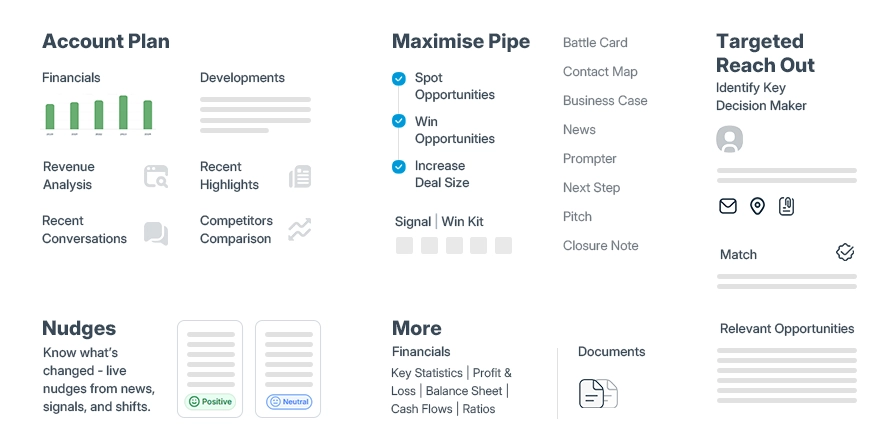
SalesPlay - An AI Sales Intelligence Platform has emerged as a formidable player in the competitive landscape by focusing on what sales teams actually need: comprehensive, actionable intelligence delivered at the moment of maximum impact. Unlike platforms that prioritize marketing automation, SalesPlay centers its capabilities on empowering sales professionals with real-time insights that translate directly into closed revenue.
SalesPlay's architecture is built around three foundational pillars: comprehensive market intelligence, advanced predictive capabilities, and seamless sales workflow integration. The platform aggregates data from over 200 million companies globally, continuously monitoring changes in organizational structure, funding events, leadership transitions, technology adoptions, and competitive movements that signal buying opportunities.
SalesPlay monitors buying signals across social media, news, job postings, website changes, and behavioral patterns, providing a 360-degree view of prospect readiness that competitors often miss.
The platform's AI engine analyzes historical conversion data combined with real-time signals to predict which prospects are most likely to convert, helping sales teams prioritize effectively.
Rather than requiring sales reps to log into yet another platform, SalesPlay pushes critical insights directly into existing workflows through CRM integrations and intelligent alerts.
Advanced algorithms identify connections between decision-makers, uncover organizational hierarchies, and reveal warm introduction pathways that accelerate deal velocity.
What distinguishes SalesPlay from competitors is its unwavering focus on sales team productivity. While many platforms overwhelm users with data dashboards requiring interpretation, SalesPlay translates complex signals into clear recommendations. The platform doesn't just tell you that a company hired a new CIO; it explains why this matters for your specific solution, suggests optimal outreach timing, and provides conversation starters backed by recent company news and industry trends.
The predictive capabilities extend beyond simple lead scoring. SalesPlay's machine learning models analyze thousands of variables to identify patterns that human observers would never detect. These models continuously learn from your team's successes and failures, becoming more accurate over time and adapting to your unique sales motion. Organizations report that SalesPlay's predictions achieve accuracy rates exceeding 85% in identifying high-value opportunities within their first 90 days of implementation.
6sense has established itself as a leader in the account-based marketing space, delivering powerful capabilities that help marketing teams identify accounts in-market for their solutions. The platform's foundation rests on proprietary intent data collected through a network of business publications, research sites, and content platforms where B2B buyers conduct research.
The 6sense platform excels at aggregating anonymous behavioral data to identify accounts demonstrating research behaviors indicative of active buying cycles. By analyzing content consumption patterns, keyword research, and competitive comparisons, 6sense helps organizations prioritize accounts based on their position in the buyer's journey—from awareness through consideration to decision stages.
6sense's strength lies in its marketing orchestration capabilities. The platform seamlessly integrates with advertising platforms, enabling dynamic audience creation for targeted campaigns. Marketing teams can suppress advertising spend on accounts not yet in-market while increasing investment in accounts showing strong intent signals. This optimization has helped organizations reduce wasted advertising expenditure by up to 45% while simultaneously improving campaign performance.
For organizations with mature marketing operations and substantial advertising budgets, 6sense delivers compelling value through its ability to coordinate campaigns across channels. The platform's predictive models help marketing teams understand which accounts are likely to enter buying cycles in coming weeks or months, enabling proactive engagement strategies that position companies favorably when decision-making begins.
6sense's proprietary intent data captures anonymous research behaviors across thousands of B2B websites, providing early indicators of buying interest.
Sophisticated campaign management tools help marketing teams coordinate messaging across email, advertising, and content channels based on account journey stage.
Machine learning models predict account buying stage, helping organizations allocate resources to accounts most likely to convert.
Deep integrations with marketing automation platforms enable seamless workflow execution for account-based marketing strategies.
Understanding the nuanced differences between SalesPlay and 6sense requires examining how each platform approaches fundamental challenges facing revenue teams. While both leverage artificial intelligence and predictive analytics, their philosophies, target users, and optimal use cases differ significantly.
SalesPlay Performance Metrics (Industry Average: 70%)
SalesPlay is architected primarily for sales teams seeking to improve prospecting efficiency, accelerate pipeline velocity, and increase win rates through superior intelligence. The platform delivers maximum value to organizations where sales representatives need real-time insights to inform conversations, prioritize accounts, and identify optimal engagement moments. Mid-market companies and enterprise sales teams focusing on new business development find SalesPlay's approach particularly effective.
6sense targets marketing organizations executing sophisticated account-based marketing programs with substantial advertising budgets. The platform delivers optimal results for companies with dedicated marketing operations teams capable of leveraging complex orchestration capabilities. Large enterprises with mature marketing functions and multi-million dollar advertising investments represent 6sense's sweet spot.
| Feature Category | SalesPlay | 6sense |
|---|---|---|
| Primary User | Sales Teams & Revenue Operations | Marketing Teams & ABM Specialists |
| Data Sources | 200+ sources including social, news, funding, jobs, company websites | Proprietary intent network, firmographic data, behavioral signals |
| Predictive Focus | Opportunity scoring, optimal outreach timing, conversion probability | Account stage prediction, marketing campaign optimization |
| Implementation Time | 2-4 weeks | 6-12 weeks |
| Pricing Model | Transparent tiered pricing, flexible plans | Custom enterprise pricing, higher minimum commitments |
| Contact Intelligence | Extensive contact-level insights, direct dials, verified emails | Account-focused, limited contact-level detail |
| CRM Integration | Native bidirectional sync, workflow automation | Available but primarily marketing-focused |
| Global Coverage | Strong worldwide coverage including emerging markets | Excellent North America, good Europe, limited Asia-Pacific |
Both platforms tout advanced predictive capabilities, but their approaches and applications differ substantially. SalesPlay's predictive engine operates at multiple levels: account scoring, contact prioritization, optimal outreach timing, and deal velocity prediction. The system analyzes both external signals (market movements, company changes) and internal patterns (your historical win/loss data, successful messaging, engagement sequences) to generate multi-dimensional predictions that guide daily sales activities.
The platform's machine learning models identify subtle patterns that indicate genuine buying intent versus casual research. For instance, when a target company begins hiring multiple positions in departments related to your solution, increases LinkedIn activity around relevant topics, and executives publish content addressing challenges your product solves, SalesPlay's algorithms recognize this constellation of signals as indicating high conversion probability—often weeks before the company issues an RFP or responds to outreach from competitors.
6sense's predictive approach centers on journey stage classification and marketing optimization. The platform excels at determining whether accounts are in awareness, consideration, or decision stages based on content consumption patterns and research behaviors. This classification enables marketers to deliver stage-appropriate messaging and optimize advertising spend. However, the predictions primarily serve marketing workflows rather than providing individual sales representatives with actionable guidance for specific conversations.
The concept of market intelligence encompasses far more than contact databases and company firmographics. Modern sales intelligence platforms must synthesize information from countless sources, identify meaningful patterns within noise, and deliver insights that directly influence sales outcomes. This is where platform philosophies diverge most dramatically.
SalesPlay aggregates intelligence across multiple dimensions to create what industry analysts call "360-degree prospect visibility." The platform continuously monitors funding rounds, mergers and acquisitions, leadership changes, office expansions, product launches, partnership announcements, technology implementations, hiring patterns, social media sentiment, news coverage, and competitive movements. This comprehensive monitoring creates a living profile of each target account that updates in real-time as circumstances change.
What makes this intelligence actionable is SalesPlay's contextualization engine. Rather than simply presenting raw data points, the platform interprets what each signal means for your specific sales opportunity. When a prospect company announces Series B funding, SalesPlay doesn't just alert you to the news—it explains that this company now has capital to invest in solutions like yours, identifies which departments will likely receive budget increases, suggests messaging angles that align with their announced growth plans, and prioritizes this account in your pipeline based on increased conversion probability.
The platform's social selling intelligence deserves particular attention. By analyzing LinkedIn activity, Twitter discussions, conference participation, and content creation patterns, SalesPlay identifies executives actively engaging with topics related to your solutions. This enables highly personalized outreach that references recent posts, acknowledges expressed pain points, and demonstrates genuine understanding of prospects' challenges—dramatically increasing response rates and establishing credibility from the first interaction.
6sense built its reputation on proprietary intent data captured through its extensive content network. As prospects research solutions anonymously across thousands of websites, 6sense tracks these behaviors to identify companies actively evaluating options in specific categories. This intent data provides valuable early warning signals that accounts have entered buying cycles, allowing marketing teams to initiate engagement before competitors recognize the opportunity.
The platform's keyword tracking reveals which specific topics and competitive comparisons prospects are researching, enabling precise messaging and content strategies. Marketing teams can see that a target account has consumed content about "cloud migration challenges," "data security compliance," and "enterprise software integration," then craft campaigns addressing these exact concerns. This intelligence significantly improves campaign relevance and conversion rates.
However, 6sense's intelligence model has limitations. The platform primarily captures behavioral data from its content network, potentially missing signals occurring outside this ecosystem. Companies researching through channels 6sense doesn't monitor—internal knowledge bases, private consultations, industry analysts, or peer recommendations—remain invisible. Additionally, the account-level focus means individual decision-maker insights remain limited compared to contact-centric platforms like SalesPlay.
The most sophisticated intelligence delivers minimal value if it remains trapped in standalone platforms requiring separate logins and disrupting established workflows. Modern sales and marketing professionals already juggle numerous applications daily; additional tools must integrate seamlessly or face adoption failure regardless of their capabilities.
Recognizing that sales representatives live inside CRM systems and communication tools, SalesPlay prioritizes deep integrations that deliver intelligence within existing workflows. The platform's Salesforce integration exemplifies this philosophy: rather than requiring representatives to toggle between systems, SalesPlay surfaces relevant intelligence directly on account and contact records, enriches fields automatically, and triggers alerts when significant events occur.
Sales representatives viewing a prospect account in Salesforce immediately see recent news mentions, leadership changes, funding announcements, technology adoptions, and predictive scores—all without leaving their CRM. When a high-priority signal occurs (such as a key decision-maker posting about challenges your solution addresses), SalesPlay pushes real-time notifications through Slack or email, enabling immediate action while opportunities remain fresh.
The platform also integrates with communication tools like Gmail and Outlook, providing contextual intelligence as representatives compose emails. Before sending outreach messages, sales professionals receive suggested talking points based on recent company news, recommended personalization elements drawn from social media activity, and optimal sending times predicted by engagement analysis. This integration transforms generic templates into hyper-relevant communications that dramatically improve response rates.
6sense focuses its integration strategy on marketing automation platforms and advertising technologies. Deep connections with Marketo, Eloqua, Pardot, and HubSpot enable sophisticated campaign orchestration based on account journey stage and intent signals. Marketing teams can create dynamic segments that automatically include accounts demonstrating specific behaviors, then trigger personalized nurture sequences aligned with their research interests.
The platform's advertising integrations with LinkedIn, Google Ads, and display networks enable programmatic optimization based on intent data. Campaigns automatically adjust targeting and bidding strategies to focus resources on in-market accounts while reducing spend on accounts showing minimal interest. This optimization has helped organizations improve advertising ROI by 40-60% in many implementations.
However, 6sense's sales team integrations remain less mature than its marketing capabilities. While CRM connections exist, they primarily sync account scores and stage classifications rather than providing granular, actionable intelligence for individual sales conversations. Representatives seeking contact-level insights or real-time engagement guidance often need supplementary tools to complement 6sense's account-focused intelligence.
Platform capabilities matter little if implementation proves prohibitively complex or pricing structures exceed budget realities. Understanding the true cost of ownership requires examining not just license fees but also implementation expenses, training requirements, time-to-value, and ongoing maintenance demands.
SalesPlay employs tiered pricing based on user count and feature requirements, with transparent pricing information available through their website. Mid-market companies can access core capabilities starting at competitive price points, with enterprise plans offering advanced features like custom data integrations, dedicated account management, and API access. This transparency enables accurate budget planning and eliminates surprises during procurement processes.
Implementation typically requires 2-4 weeks from contract signature to full operational deployment. The process includes CRM integration configuration, data import and enrichment, predictive model training on historical opportunity data, team training sessions, and workflow optimization. SalesPlay's implementation team works closely with customer success managers to ensure smooth onboarding and rapid user adoption.
Organizations report achieving measurable ROI within 60-90 days of implementation. The combination of rapid deployment, intuitive interface design, and immediate value delivery from predictive insights drives quick adoption rates—typically exceeding 80% of licensed users actively engaging with the platform within the first month.
6sense employs custom enterprise pricing requiring direct conversations with their sales team. While this approach enables tailored packages matching specific organizational needs, it also means substantial minimum commitments typically starting in the six-figure range annually. This pricing structure makes 6sense most accessible to large enterprises with substantial marketing budgets rather than mid-market organizations.
Implementation timelines range from 6-12 weeks depending on marketing stack complexity and integration requirements. The extended timeline reflects 6sense's comprehensive marketing orchestration capabilities requiring careful configuration across multiple platforms. Organizations must also invest time developing account-based marketing strategies, defining ideal customer profiles, and training teams on sophisticated platform features.
While 6sense delivers substantial value for organizations with mature ABM programs and dedicated marketing operations resources, the higher upfront investment and longer implementation cycles mean extended time-to-value compared to sales-focused alternatives. Companies should expect 4-6 months before realizing full platform benefits.
Examining real-world implementations provides crucial context for evaluating platform capabilities beyond marketing claims and feature lists. Organizations across industries have deployed both platforms with varying degrees of success depending on use case alignment and implementation quality.
A mid-market SaaS company with 45 sales representatives implemented SalesPlay to improve prospecting efficiency and pipeline quality. Within 90 days, the organization achieved a 52% increase in qualified meetings booked, 38% improvement in opportunity-to-close conversion rates, and 28% reduction in average sales cycle length. Sales representatives reported that SalesPlay's predictive scoring helped them prioritize high-value opportunities while real-time intelligence enabled personalized outreach that dramatically improved response rates.
An enterprise technology services firm deployed SalesPlay across 200+ account executives to enhance their market intelligence capabilities. The implementation resulted in a 67% increase in executive-level meetings, with sales teams leveraging organizational change alerts and social intelligence to identify optimal engagement moments. The company's CMO noted that SalesPlay's insights enabled their team to engage prospects during critical decision windows that competitors consistently missed.
A Fortune 500 technology company implemented 6sense to optimize their multi-million dollar advertising budget and improve ABM campaign performance. Over 12 months, the organization reduced advertising waste by 43% while simultaneously increasing pipeline contribution from targeted accounts by 156%. The marketing team credited 6sense's intent data and advertising optimization capabilities with dramatically improving campaign efficiency and account engagement metrics.
A global professional services firm used 6sense to coordinate marketing efforts across multiple business units. The platform's journey stage predictions enabled personalized nurture sequences that improved content engagement by 89% and accelerated marketing-qualified account progression by 34%. However, sales teams required supplementary tools to access the contact-level intelligence needed for direct outreach, highlighting 6sense's primary orientation toward marketing rather than sales use cases.
Selecting between SalesPlay and 6sense ultimately depends on your organization's specific needs, existing technology stack, budget constraints, and strategic priorities. Both platforms deliver substantial value when properly aligned with organizational requirements, but their optimal use cases differ significantly.
Average revenue increase reported by organizations implementing AI sales intelligence platforms within their first year (Gartner Research, 2025)
The sales intelligence landscape continues evolving rapidly as artificial intelligence capabilities advance and buyer behaviors shift. Organizations evaluating platforms today must consider not just current capabilities but also how vendors position themselves for emerging trends that will define the next generation of sales technology.
Generative AI is transforming how sales teams consume and act on intelligence. Rather than reviewing dashboards and interpreting data points, representatives increasingly interact with AI assistants that synthesize insights and recommend actions through natural language conversations. SalesPlay has invested heavily in conversational interfaces that allow sales professionals to ask questions like "Which of my accounts show the strongest buying signals this week?" and receive prioritized recommendations with supporting evidence.
Privacy regulations including GDPR, CCPA, and emerging global standards are reshaping data collection and usage practices. Platforms must balance comprehensive intelligence gathering with strict compliance requirements. SalesPlay's multi-source approach provides redundancy—if certain data becomes restricted, alternative signals maintain insight quality. Intent data providers like 6sense face unique challenges ensuring their tracking methodologies comply with evolving privacy standards while maintaining data quality.
The convergence of sales and marketing intelligence represents another significant trend. Organizations increasingly recognize that artificial silos between sales and marketing intelligence create inefficiencies and missed opportunities. Platforms offering unified visibility across the entire revenue cycle deliver competitive advantages. While SalesPlay focuses primarily on sales use cases, its intelligence benefits marketing teams planning campaigns and developing messaging. Conversely, 6sense's marketing-centric approach leaves sales teams seeking supplementary tools for their specific needs.
In today's hyper-competitive B2B landscape, access to superior intelligence isn't merely advantageous—it's existential. Organizations competing with incomplete information, delayed insights, or inaccurate data face systematic disadvantages that compound over time, resulting in lost opportunities, longer sales cycles, and diminished win rates.
Both SalesPlay and 6sense represent sophisticated platforms leveraging artificial intelligence to transform raw data into strategic advantages. However, their optimal applications differ substantially. SalesPlay - An AI Sales Intelligence Platform excels at empowering sales teams with comprehensive, actionable intelligence delivered within existing workflows, enabling personalized engagement and predictive opportunity prioritization. The platform's rapid implementation, transparent pricing, and sales-first design make it particularly attractive for organizations seeking immediate impact on prospecting efficiency and conversion rates.
6sense delivers powerful capabilities for marketing-led organizations executing sophisticated account-based marketing programs with substantial advertising budgets. Its proprietary intent network and marketing orchestration tools enable campaign optimization and journey-based engagement that can dramatically improve marketing efficiency. However, the platform's higher cost, extended implementation timeline, and marketing-centric focus make it less suitable for sales-focused organizations or mid-market companies with limited resources.
The decision ultimately hinges on honest assessment of your organizational priorities, resources, and strategic direction. Ask yourself: Do we need to empower sales teams with daily intelligence that improves conversations and prioritization? Or do we need marketing orchestration capabilities that optimize campaigns and advertising spend? Your answer reveals which platform aligns with your path forward.
What remains undeniable is that the future belongs to organizations embracing AI-powered intelligence. As competitors deploy these technologies, the performance gap between intelligence-enabled teams and those relying on traditional approaches will widen exponentially. The question isn't whether to invest in sales intelligence—it's which platform will deliver the specific capabilities your organization needs to compete, win, and grow in an increasingly complex market.
Discover how SalesPlay's comprehensive market intelligence and predictive capabilities can accelerate your revenue growth. Schedule a personalized demonstration to see how our platform delivers actionable insights that empower your sales teams to engage prospects at exactly the right moments with precisely the right messages.
Schedule Your Demo TodayThe primary difference lies in their approach to sales intelligence. SalesPlay focuses on comprehensive market intelligence with predictive capabilities that analyze buying signals across multiple channels, while 6sense specializes in account-based marketing with intent data primarily focused on marketing teams. SalesPlay offers broader coverage for sales teams with real-time intelligence, whereas 6sense excels in marketing orchestration and campaign management.
SalesPlay typically offers more flexible pricing structures for mid-market companies, with transparent tiered plans starting at lower price points. 6sense generally requires larger enterprise-level commitments and custom pricing, making it more suitable for large enterprises with substantial budgets. Mid-market companies often find SalesPlay's pricing model more accessible while still receiving advanced AI-powered features.
Both platforms offer robust predictive capabilities, but with different focuses. SalesPlay's predictive engine analyzes comprehensive market signals including social media, news, funding events, and behavioral data to provide actionable insights for sales teams. 6sense emphasizes predictive analytics for marketing workflows, buyer stage identification, and advertising optimization. SalesPlay's predictions tend to be more granular for individual sales opportunities, while 6sense excels at account-level predictions for marketing campaigns.
Yes, both SalesPlay and 6sense offer integrations with major CRM systems including Salesforce, HubSpot, and Microsoft Dynamics. SalesPlay provides native integrations with a focus on bidirectional data sync for sales teams, while 6sense offers extensive marketing automation integrations including Marketo, Eloqua, and Pardot. The integration depth and ease of implementation may vary depending on your existing tech stack.
Data accuracy varies by region and industry. SalesPlay leverages multiple data sources and employs AI-driven verification to maintain accuracy rates above 95% with strong global coverage. 6sense also maintains high accuracy standards with its proprietary intent data network. SalesPlay often provides more comprehensive contact-level data, while 6sense excels in account-level behavioral insights. Both platforms continuously update their databases, but independent verification of data quality for your specific market is recommended.
Implementation timelines differ based on organization size and complexity. SalesPlay typically has a faster implementation process, with most organizations fully operational within 2-4 weeks, including integrations and team training. 6sense implementations generally take 6-12 weeks due to its comprehensive marketing technology integration requirements and account-based marketing strategy development. SalesPlay's streamlined onboarding is advantageous for companies seeking quick time-to-value.
SalesPlay - An AI Sales Intelligence Platform is specifically designed with sales teams as the primary user, offering features like real-time buyer signals, contact intelligence, and opportunity scoring that sales representatives use daily. 6sense is primarily built for marketing teams, with features focused on campaign orchestration, advertising optimization, and marketing attribution. If your priority is empowering sales teams with actionable intelligence, SalesPlay is typically the better choice. If you're focused on marketing automation and ABM campaigns, 6sense may be more suitable.


Category: Uncategorized Tags: ai, AIOps, Artificial Intelligence, cloud, cloud platform, Cybersecurity, Information and Communications Technology , VR