Are AI SDRs about to completely transform how we think about sales development? I believe we're at the threshold of a revolution that will redefine what's possible in sales outreach and conversion.


AI SDRs Close More
Faster. Smarter.
Experience the SalesPlay advantage and boost your pipeline now.
Experience the Platform
The sales landscape is rapidly changing, with agentic SDR technology now capable of tasks that once required extensive human intervention. AI sales tools have evolved beyond simple automation, offering intelligent decision-making capabilities that significantly enhance productivity. Additionally, the modern AI sales assistant can analyze prospect behavior, personalize communications, and prioritize leads with remarkable accuracy.
Throughout this article, I'll explore how integrating artificial intelligence into your sales development process can drive exponential growth, overcome traditional limitations, and create more meaningful prospect interactions. From real-time lead scoring to conversational intelligence, you'll discover the specific capabilities that make AI-powered sales development truly transformative.
As we look toward 2025, the question isn't whether to adopt these technologies but how quickly you can implement them to stay ahead of competitors who are already making the shift.
Why Traditional SDR Workflows Limit Growth
Traditional SDR workflows represent a bottleneck that prevents companies from achieving their growth potential. The current sales development approach suffers from fundamental limitations that restrict productivity, reduce conversion rates, and inflate customer acquisition costs. Let me examine why these traditional methods are failing to meet the demands of today's sales environment.
Manual lead qualification and response delays
The traditional approach to lead qualification creates a sluggish, inconsistent process that hemorrhages opportunities. Most SDRs struggle with strategic lead prioritization despite understanding its importance. Their qualification decisions are inherently susceptible to individual biases, varying levels of experience, and simple fatigue. What one SDR perceives as a "hot" lead might be dismissed as lukewarm by another.
This inconsistency appears throughout the qualification process:
-
Different SDRs interpret scoring criteria differently
-
Personal biases influence scoring decisions
-
Checking various data points delays response times
-
Qualification criteria are applied inconsistently
These issues directly impact conversion rates. The average lead response time is a staggering 47 hours, yet engaging with leads within five minutes can boost conversion rates by 400%. Without automated alerts and intelligent prioritization, high-value prospects easily slip through the cracks or receive follow-up too late, allowing competitors with more agile systems to capture these opportunities.
Low personalization in high-volume outreach
Despite the critical importance of personalization, traditional SDR workflows make it nearly impossible to deliver tailored communications at scale. Generic outreach is as unwelcome as junk mail—quickly discarded and forgotten. Moreover, superficial personalization (merely inserting a recipient's name) no longer impresses prospects.
Effective personalization requires understanding the prospect's challenges and business context. However, manually researching and personalizing messages for hundreds or thousands of prospects is time-prohibitive. Consequently, many SDRs resort to "spray and pray" tactics, prioritizing volume over quality.
Some teams attempt to balance personalization and volume, with experts suggesting that "15% personalization is the best mix of time vs value". Nevertheless, without technological assistance, creating truly resonant messages at scale remains elusive. This leads to avoidance behavior from prospects who instinctively dismiss impersonal sales pitches.
Inefficient use of SDR time and resources
Perhaps the most alarming limitation is how traditional workflows waste valuable SDR time and company resources. Sales development representatives spend up to 70% of their time on non-selling tasks. Specifically, SDRs dedicate 30-40% of their working hours to prospecting, and 37% of their workday navigating through platforms like LinkedIn, ZoomInfo, Facebook, and prospect websites.
This represents a substantial financial drain. For an SDR earning $60,000 annually, approximately $22,200 is spent on research time alone. For a team of ten SDRs, this escalates to $222,000 annually—excluding additional expenses like per-seat costs for tools such as Sales Navigator or ZoomInfo.
Furthermore, the constant context-switching between tasks severely impacts productivity:
-
Updating CRM records after each interaction
-
Logging call notes and email summaries
-
Scheduling follow-up tasks
-
Coordinating with marketing for additional information
This fragmentation not only slows down response management but increases the risk of human error in data entry and follow-up scheduling. When SDRs switch attention between multiple tasks, they can lose up to 20% of their productive time with just two simultaneous tasks, and up to 40% when juggling three tasks.
Companies recognize the cost of these inefficiencies. Those implementing automation report a 10-15% boost in productivity. Furthermore, 73% of salespeople using AI tools say they've significantly improved productivity by automating manual tasks and speeding up decision-making.
In contrast, organizations using AI in their sales pipelines witness a 20% increase in pipeline volume and a 30% improvement in lead conversion rates. These figures clearly illustrate why traditional SDR workflows fundamentally limit growth potential and why AI-powered alternatives have become essential for competitive advantage.

Spot Pipeline BeforeYour Competitors Even Know It Exists
The Shift from Automation to Optimization in 2025
The sales industry is experiencing a pivotal transformation in 2025 as organizations move beyond basic automation to embrace AI-powered optimization. According to recent data, AI adoption in sales has surged from 39% to 81% in just two years, signaling a fundamental shift in how companies approach sales development.
AI adoption trends in sales development
At this point, AI has become mainstream in sales operations, with 78% of respondents reporting their organizations use AI in at least one business function, up from 55% a year earlier. Particularly in sales development, half of go-to-market employees are now using AI to support their roles at least once a week.
The IT function has seen the largest increase in AI adoption, jumping from 27% to 36% in just six months. This indicates a growing technical foundation to support advanced AI sales tools across organizations. Likewise, generative AI has gained significant traction, with 71% of respondents stating their organizations regularly use it in at least one business function.
Chatbots and generative AI applications like ChatGPT currently lead adoption rates, primarily because of their user-friendly interfaces and immediate impact on customer interactions. As a result, sales teams can quickly enhance prospect communications, answer queries, and generate personalized content at scale.
From task automation to strategic decision-making
In 2025, the focus has clearly shifted from simple task automation to strategic optimization through AI systems that can create, reason, and act independently. This represents a fundamental evolution from AI as a "tool" to AI as the "operating system" for entire sales organizations.
The impact of this shift is substantial:
-
Teams using AI at least weekly report 78% shorter deal cycles and 70% larger deal sizes
-
AI users report 47% increased productivity, saving an average of 12 hours weekly
-
76% of teams using AI weekly report improved win rates
-
79% of frequent AI users say it has made their teams more profitable
During this transition, AI-driven analytics is transforming sales forecasting into a data science. Leading firms are improving forecast accuracy by up to 35%, with advanced platforms achieving up to 96% accuracy. This allows for intelligent lead prioritization and strategic resource allocation based on concrete data rather than instinct.
Essentially, AI SDRs now handle more sophisticated tasks beyond basic automation. They synthesize customer profiles to create tailored discussion scripts, personalize emails, and deliver context-aware follow-ups. This offloads top-of-funnel prospecting, allowing human sellers to concentrate on high-impact conversations with qualified leads.
Market growth of AI sales assistant platforms
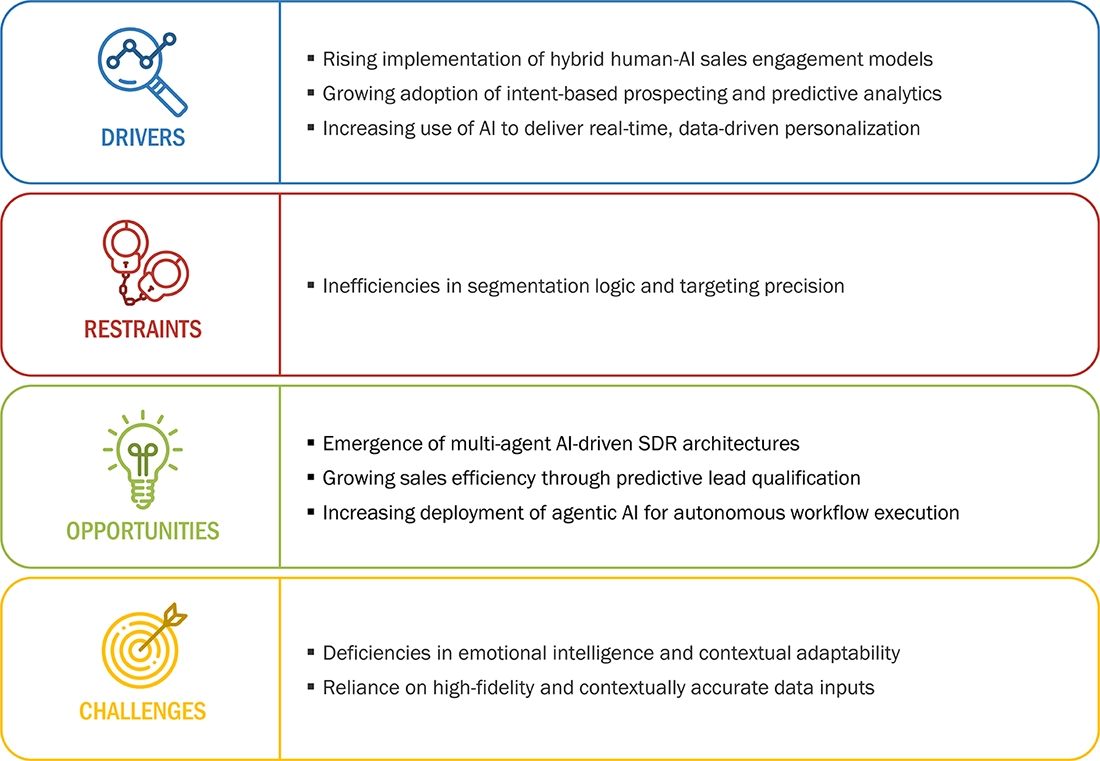
The market data clearly demonstrates the business world's commitment to AI sales technology. The global AI Sales Assistant Software Market is projected to grow from USD 3.14 billion in 2025 to USD 19.65 billion by 2034, expanding at a compound annual growth rate (CAGR) of 23.16%. Alternatively, another market analysis estimates the market will increase by USD 9.09 billion between 2024 and 2029, at a CAGR of 27.6%.
In terms of deployment options, the cloud-based segment accounted for approximately 60% of AI Sales Assistant Software Market revenue in 2023. This dominance stems from the increasing adoption of cloud-based solutions by businesses of all sizes, offering advantages in scalability, flexibility, and cost-effectiveness.
On the whole, this market growth is driven by the imperative for enhanced sales productivity and efficiency. Companies are increasingly integrating generative AI and conversational interfaces to streamline sales processes and improve customer engagement. Furthermore, roughly 60% of SMEs plan to invest in AI sales assistant software over the next two years, indicating that adoption is spreading beyond large enterprises to smaller organizations.
Despite this rapid expansion, challenges remain in data privacy, security, and regulatory compliance. With increasing AI use in sales, growing concerns exist over the collection, storage, and use of customer data. Organizations must ensure robust data protection policies to mitigate risks and maintain customer trust while navigating evolving regulations.
Ready to turn your Rep
INTO BEST PERFORMER ?
Core Capabilities of Agentic AI in SDR Workflows
Agentic AI fundamentally transforms SDR operations through autonomous systems that operate without constant human intervention. These intelligent agents work independently across your sales tech stack, making decisions and executing tasks that previously required manual effort. Let's examine the three core capabilities that make AI SDRs 10x more effective than their traditional counterparts.
Real-time lead scoring using behavioral signals
Autonomous AI agents continuously process vast data streams in real-time, providing actionable insights that enable smarter decisions about which prospects deserve attention first. Unlike traditional lead scoring methods that rely on static data, AI-powered systems dynamically assess and rank leads based on a broader range of data points and more complex patterns.
These systems track specific behaviors that indicate buying intent:
-
Website engagement (pricing page visits, product feature exploration)
-
Content consumption patterns (case studies, whitepapers)
-
Email and marketing campaign interactions
-
Competitor research activities on review sites
Indeed, the power of AI lead scoring comes from its ability to learn continuously. As more leads enter the system and their outcomes are tracked, the model adjusts its predictions, making it more accurate over time. For instance, companies using intent data have reported a 300% increase in conversion rates and a 50% reduction in sales cycle time.
Intent-based prioritization with firmographic data
In essence, intent data represents signals that a company or individual is actively researching solutions like yours. AI SDRs excel at identifying these signals across the web—from search behaviors to content consumption patterns—and combining them with firmographic data for precise targeting.
The most effective AI systems create scoring tiers based on intent signals. For example:
-
Scores 80-100: Companies showing significant purchase likelihood, requiring immediate sales outreach
-
Scores 60-79: Prospects with increased purchase likelihood, suitable for targeted marketing
-
Scores 40-59: Accounts showing modest signals, requiring nurturing through email and content
-
Scores 0-39: Companies without meaningful intent signals, needing awareness-building
Notably, agentic AI doesn't just capture leads—it autonomously nurtures, qualifies, and re-prioritizes them through contextual, multi-channel engagement. Furthermore, when a high-priority account visits your pricing page and downloads an industry-specific case study, AI can trigger an automated workflow that alerts the account owner and generates a tailored email sequence referencing their specific interests.
STOP CHASING PROSPECTS
START CLOSING DEALS!!
Predictive engagement modeling for outreach timing
AI sales assistants shine in determining not just who to contact but when to reach out. Through analysis of historical interaction data, predictive models identify optimal engagement windows—times when prospects are most likely to respond positively.
First thing to remember is that predictive analytics enables deeper personalization by forecasting user behaviors based on previous interactions and preferences. Subsequently, AI SDRs can determine when leads are most receptive to communication based on past engagement patterns, creating a data-driven approach to timing.
Coupled with machine learning models that predict future customer behavior, AI sales tools can foresee which prospects are ready to engage. For example, Genesys Predictive Engagement analyzes visitors' behaviors on websites, predicts the outcomes they're trying to achieve, and personalizes engagements to help them reach those outcomes.
In the light of this capability, an AI SDR might detect that a prospect has opened multiple marketing emails without responding. It can then autonomously craft a personalized follow-up email, schedule a call, and reroute the lead to a higher-priority queue without human intervention. Over time, machine learning continues to adjust and improve the engagement model as it interacts with more prospects.
The impact of these capabilities is substantial. Organizations implementing these advanced AI systems report a 20% increase in pipeline volume and a 30% improvement in lead conversion rates compared to traditional workflows.
Conversational Intelligence and Sentiment Analysis
Modern sales conversations contain valuable data that AI systems can now analyze and interpret in real-time. Through natural language processing (NLP) and sentiment analysis, AI SDRs have gained abilities that go far beyond basic automation or lead scoring—they can understand the nuances of human communication.
NLP-based objection handling and tone detection
NLP technology enables AI sales tools to recognize objection patterns and suggest effective responses based on psychological principles. Through analyzing thousands of successful sales conversations, these systems identify which responses work best for specific objection types.
Pattern interruption stands out as a powerful NLP technique for handling objections. When prospects expect a standard response, AI can suggest an unexpected approach that breaks the conversation pattern and reengages the prospect. This helps SDRs avoid predictable scripts that prospects have grown immune to.
Successful objection handling also requires emotional intelligence. AI systems can now analyze tone, pace, and emotional cues from both the salesperson and prospect. If a buyer sounds hesitant, the system flags it as a soft "no" or suggests follow-up phrasing to reconnect with them. This capability helps SDRs:
-
Maintain neutrality instead of artificial enthusiasm when facing objections
-
Avoid making objections about themselves personally
-
Reframe objections by offering counterexamples
-
Focus on the underlying cause rather than surface-level objections
Live coaching during SDR-prospect interactions
Real-time AI sales coaching has emerged as a game-changer for SDR teams. Instead of waiting for end-of-day reviews or monthly training sessions, SDRs now receive instant insights during live calls. This immediate feedback allows them to adjust messaging and tone while still engaged with prospects.
Practically speaking, AI can offer immediate feedback based on conversation context. For instance, if an SDR misses an opportunity to ask a key qualification question, the embedded AI technology alerts them in real-time, suggesting the right time to follow up. Advanced AI coaching systems can even:
-
Identify filler words and unclear phrasing during calls
-
Flag missed buying signals that human SDRs might overlook
-
Generate or modify scripts in real-time based on prospect responses
-
Suggest appropriate follow-up questions to specific objections
The value of this approach is substantial—SDRs no longer need to switch between multiple tabs from CRM to other tools. Additionally, the AI engine continuously analyzes conversation patterns to highlight weak areas as they occur.
Sentiment scoring for qualification accuracy
Sentiment analysis takes qualification beyond binary yes/no decisions. Through NLP, AI sales assistants can detect subtle emotional signals in prospect responses, creating a more nuanced view of prospect interest and intent.
Custom GPTs now allow sales reps to generate or modify scripts based on prospect sentiment. If a buyer raises pricing concerns early, the AI can suggest changing direction to keep the conversation productive. Similarly, the system can detect when prospects need more information versus when they're ready for next steps.
From a qualification standpoint, sentiment scoring allows for more accurate pipeline forecasting. By analyzing emotional cues alongside factual responses, AI SDRs can determine whether an apparently positive response contains hidden hesitations that might derail the sale later.
Overall, these conversational intelligence capabilities transform how SDRs interact with prospects. The technology doesn't replace human judgment but augments it with data-driven insights that would otherwise remain invisible, ultimately creating more productive conversations and higher conversion rates.

Stop Chasing Leads—
Let AI Do the Heavy Lifting
Discover how SalesPlay empowers SDRs to focus on high-value opportunities.
View Interactive Demo
Automated Personalization at Scale
Personalization stands as the cornerstone of effective sales development, yet scaling this approach has traditionally been impossible without substantial resources. Today's AI SDRs solve this fundamental problem by analyzing vast datasets and automating customized outreach that resonates with individual prospects.
Behavioral segmentation for message targeting
AI sales tools now divide prospects into precise segments based not just on who they are, but on specific actions they take. This approach generates 58% of all revenue for companies implementing behavioral segmentation, with some marketers reporting a 760% increase in revenue from segmented campaigns.
Effective AI-powered behavioral segmentation analyzes:
-
Purchase and usage patterns to identify varying trends
-
Timing and occasion-based engagement to determine optimal contact moments
-
Benefits sought by different customer groups
-
Loyalty levels and engagement frequency
This granular understanding enables AI SDRs to match messaging directly to prospect needs. An advanced AI system identifies your most engaged users, improves messaging accuracy, and refines personalized experiences—ultimately building stronger brand loyalty. Additionally, behavioral segmentation allows sales teams to separate high-intent prospects from casual browsers, focusing resources where they'll generate the greatest return.
Dynamic content generation using AI variables
AI variables represent a breakthrough in creating truly personalized communications at scale. Unlike static template placeholders, AI variables enable SDR systems to actively generate context-aware content based on prospect data and behaviors.
The key benefits of AI variable-driven content include:
Contextual understanding: Variables provide critical context to language models, helping them generate coherent, relevant responses tailored to specific prospects. For instance, AI SDRs can automatically detect qualified leads and send personalized videos that reference specific actions like webinar attendance or content downloads.
Efficiency improvements: Rather than writing multiple variations of outreach messages, AI variables streamline interactions by automatically filling specific details for each prospect. This capability ensures every interaction remains timely and impactful, regardless of volume.
Through this approach, AI SDRs draft cold emails and outreach messages based on real-time engagement insights, ensuring messaging remains relevant across thousands of prospects simultaneously. The technology continuously analyzes engagement patterns to improve email deliverability, subject line performance, and overall campaign effectiveness.
Channel preference detection for outreach
Among the most valuable capabilities of AI-powered sales systems is their ability to identify which communication channels work best for individual prospects. By collecting and analyzing data on customer preferences, AI SDRs can determine optimal outreach strategies for each potential buyer.
Primarily, cross-channel analytics help uncover trends in prospect behavior, identifying which platforms generate the highest engagement, conversion, and revenue. As Morgan J. Ingram notes, "Your sales data will tell you what's working and what's not," allowing teams to double down on successful channels.
Rather than using the same approach for every prospect, AI sales tools analyze response patterns across email, LinkedIn, phone calls, and chat to create a unified communication strategy. The system adapts by recognizing and prioritizing channels where individual prospects demonstrate the highest responsiveness.
Finally, this capability bridges the gap between email platforms and conversational marketing, ensuring a seamless experience as prospects move across channels. Some advanced systems even create intelligent meeting routing based on prospect characteristics and availability, further optimizing the sales process.
Cross-Channel Attribution and Journey Analytics
Effective tracking of customer interactions is no longer optional for sales teams. With research showing that only 16% of marketing tech stacks allow for accurate measurement of multi-channel initiatives, AI SDRs now offer unprecedented visibility into complex buyer journeys.
Tracking multi-touch engagement across platforms
Traditional attribution models that credit only the first or last interaction fail to capture the complete picture. Multi-touch attribution analyzes all touchpoints that contribute to a conversion, rather than attributing success to a single interaction. This approach connects early awareness efforts with final conversion drivers, revealing how different funnel stages work together.
AI SDRs excel at gathering and centralizing data from various channels:
-
Email engagement metrics
-
Social media interactions
-
Website behavior and content consumption
-
Phone and chat conversations
Primarily, this unified data view empowers sales teams to understand campaign effectiveness throughout the entire funnel. Without cross-channel attribution, measuring performance becomes a guessing game—investing resources without valuable insights about what truly resonates with prospects.
Your SDRs work 9–5
AI Sales works 24/7!!
AI-driven insights into buyer journey stages
AI sales tools transform raw interaction data into actionable journey insights. Since customers rarely buy on their first visit, understanding the role each touchpoint plays in creating a customer is critical.
Machine learning models analyze behavioral patterns to identify:
-
Which touchpoints generate initial awareness
-
What content drives consideration
-
Which interactions trigger purchase decisions
Throughout the buyer journey, AI identifies decision-makers within accounts, flags high-intent activity, and uses dynamic lead scores to direct SDRs where they'll be most effective. This analytical approach allows sales teams to respond quickly, engaging relevant buyers at precisely the right time.
For instance, upstream data from social media becomes even more valuable when analyzed alongside downstream metrics like registrations and sales from CRM platforms. This connected view offers insights into which channel combinations drive the highest conversion rates and how different segments interact across channels.
Optimizing SDR actions based on attribution data
Until now, limited attribution visibility has forced SDRs to make decisions based on incomplete information. AI changes this by using attribution data to suggest next best actions.
The impact is substantial. By implementing cross-channel attribution, teams can:
-
Allocate more budget to the most effective channels (those with highest ROI)
-
Develop targeted content based on what works at each journey stage
-
Identify and eliminate friction points in cross-channel journeys
-
Determine which touchpoint sequences optimize acquisition costs
Evidently, this approach supports long-term engagement through automated follow-ups, post-sale satisfaction tracking, and revealing upsell opportunities. Regular communication between sales and marketing teams helps bridge the gap between attribution data and action.
In practice, AI-powered attribution requires both technology and process changes. Weekly sales-marketing standups enable teams to share insights on lead quality and conversion trends. Joint strategy sessions allow SDRs, AEs, and marketing to refine outreach sequences based on attribution insights. The result is a data-driven approach to pipeline building that maximizes conversion opportunities.
Implementing AI SDR Systems in Existing Workflows
Successfully implementing AI SDR systems requires a thoughtful approach to existing infrastructure, careful integration, and strategic balance with human touchpoints. Proper implementation transforms a promising technology into a powerful growth driver for your sales organization.
Assessment of current SDR tech stack
Before adding AI SDRs to your workflow, conduct a thorough audit of your existing sales technology. Initially, document your entire sales development process from prospect identification through qualification and handoff. This mapping exercise should include key activities, tools currently used, pain points, and time spent on manual versus automated tasks.
Next, compile a complete inventory of all sales tools in use, including:
-
Name and vendor of each tool
-
Primary function and capabilities
-
Monthly/annual cost
-
Number of licenses/seats
-
Contract renewal dates
-
Integration points with other systems
Research shows that 97% of respondents in the sales and marketing industry use at least one digital selling tool, with the average falling between four and ten tools per sales tech stack. Examine your current stack for overlapping functionality, data silos, and manual transfer points that could be streamlined with AI implementation.
Integration with CRM and marketing automation
Your AI SDR should integrate seamlessly with your CRM, ABM platform, and data tools. The most successful AI SDR implementations feel like part of your system, not something hastily added afterward. Make sure your AI tool connects with:
-
Your CRM for synchronized lead data
-
Your ABM platform for key account prioritization
-
Your enrichment tools for accurate personalization
AI-powered automation in CRM helps organizations extract deeper insights into customer behavior, needs, and preferences. Through proper integration, AI keeps customer data clean and accurate by automating step-by-step processes such as data entry, cleaning, and enrichment.
Balancing automation with human touchpoints
Implementing AI pivots your sales workflow, automating tasks while boosting overall efficiency. Yet finding the right balance between AI and human interaction remains crucial. An AI SDR without human oversight could create robotic interactions, potentially harming client relationships.
Begin by identifying specific areas where AI SDRs can improve current processes. Common areas include sales prospecting, lead qualification, personalized outreach, and analytics. For optimal results, create a balanced mix where AI handles routine tasks while human SDRs provide personal touches where they matter most.
As you implement AI SDR systems, consider starting small: begin with two or three reps using a new AI tool, or limit deployment of a fully autonomous AI SDR to a single instance. Analyze initial performance and address issues before scaling to your entire team. This methodical approach ensures you can prove success and scale intentionally rather than attempting to automate your entire funnel overnight.
Make Every Rep Speak
Like Your Top 1%
Preparing SDR Teams for AI-Augmented Selling
Successful AI integration depends more on people than technology. Currently, 83% of sales organizations using AI grew revenue, making proper team preparation crucial for maximizing these tools.
Training SDRs to interpret AI insights
Training must focus on developing practical skills rather than theoretical knowledge. Effective programs emphasize:
-
Prompt engineering for tailoring AI-generated messaging
-
Understanding AI capabilities and limitations
-
Monitoring deliverability and engagement metrics
-
Continuously optimizing AI workflows
Hands-on experience proves vital, with the most successful teams implementing shadow modes where SDRs experiment with AI-generated drafts alongside real-time feedback.
Overcoming resistance to AI adoption
Given that 59% of sales reps worry about AI threatening their jobs, transparent communication becomes essential. Effective strategies include:
First, frame AI as a career advancement tool, not a replacement. Show how automation creates paths to higher-value work. Invest in skill development for new responsibilities, then celebrate successful role transitions.
Open Q&A sessions with leadership build trust and demonstrate that everyone's input matters.
New roles: AI operations and analytics leads
As SDRs reclaim approximately 40% of their workweek, new specialized positions emerge. The next chapter of roles will function more like a launchpad, with teams evolving from "human spreadsheets" to skilled relationship builders.
Organizations should prioritize upskilling in data analysis, content creation, and strategic account management to stay competitive as 75% of sales organizations adopt AI-powered tools by 2025.
Conclusion
Throughout this article, I've highlighted how AI SDRs represent a fundamental transformation in sales development. The future of sales lies not merely in doing more with the same methods, but rather in completely reimagining how we approach prospect engagement, qualification, and conversion.
AI SDRs address the critical limitations of traditional workflows. Gone are the days of manual lead qualification, generic outreach, and scattered SDR focus. Instead, we now witness intelligent systems that autonomously score leads, prioritize based on intent, and engage prospects at optimal times with personalized messaging.
Certainly, the transition to AI-powered sales extends beyond basic automation. This shift toward strategic optimization allows sales teams to make data-driven decisions rather than relying on gut instinct. The market growth numbers tell a compelling story – businesses recognize the competitive advantage of implementing these systems now.
AI sales assistants excel at understanding prospect behavior through conversational intelligence and sentiment analysis. They detect subtle cues, offer real-time coaching, and generate tailored messaging that connects authentically with each prospect. Additionally, they provide the much-needed ability to scale personalization across thousands of interactions simultaneously.
The impact on attribution and analytics should not be overlooked. AI SDRs finally solve the persistent challenge of tracking complex, multi-touch buyer journeys across channels. This gives sales leaders clarity about which approaches truly drive conversions.
Successful implementation demands thoughtful integration with existing systems and careful balance between automation and human touchpoints. Teams must prepare for this new paradigm through targeted training and evolution of roles toward higher-value activities.
The bottom line remains clear: AI SDRs will create 10x growth for organizations that adopt them strategically. Those who wait risk falling behind as competitors gain efficiency, insight, and conversion advantages. The question facing sales leaders today isn't whether to implement AI SDRs, but how quickly and effectively they can do so to secure their competitive position for 2025 and beyond.
Frequently Asked Questions (FAQs)
Q1. How can AI SDRs improve sales productivity?
A. AI SDRs can significantly boost sales productivity by automating manual tasks, providing real-time lead scoring, and offering personalized outreach at scale. They save SDRs up to 40% of their workweek, allowing them to focus on high-value activities and strategic decision-making.
Q2. What are the key capabilities of AI-powered sales assistants?
A. AI-powered sales assistants offer real-time lead scoring using behavioral signals, intent-based prioritization with firmographic data, and predictive engagement modeling for optimal outreach timing. They also provide conversational intelligence, sentiment analysis, and automated personalization at scale.
Q3. How does AI impact the sales development process?
A. AI transforms the sales development process by enabling more accurate lead qualification, personalized messaging at scale, and data-driven decision-making. It also provides cross-channel attribution and journey analytics, helping teams understand the entire buyer journey and optimize their strategies accordingly.
Q4. What challenges might organizations face when implementing AI SDR systems?
A. Organizations may face challenges such as integrating AI systems with existing CRM and marketing automation tools, balancing automation with human touchpoints, and overcoming resistance to AI adoption among team members. Proper training and change management are crucial for successful implementation.
Q5. How can sales teams prepare for AI-augmented selling?
A. Sales teams can prepare for AI-augmented selling by training SDRs to interpret AI insights, framing AI as a career advancement tool rather than a job threat, and creating new roles such as AI operations and analytics leads. Upskilling in data analysis, content creation, and strategic account management is also essential for staying competitive in the AI-driven sales landscape.