The Role of Account Signals in Modern Pipeline Creation
February 16, 2026
Most enterprise pipeline doesn't come from cold outreach. It comes from knowing where opportunity exists inside accounts that already matter to you. Account signals make that knowledge systematic, not accidental.
Sales teams waste time on the wrong accounts. They guess at timing. They rely on intuition to decide where to focus. Pipeline generation becomes unpredictable because sellers can't see what's changing inside their territories until it's too late.
Account signals solve this. They track business movement inside target accounts and connect it to buying potential. Revenue teams that use signals don't wait for inbound interest. They create pipeline from changes already happening in accounts they care about.
An account signal is an observable change inside a target account that indicates opportunity or timing. Signals are not subjective. They are measurable. They happen whether or not you're paying attention.
Examples of account signals include:
These signals matter because they create budget, urgency, or priority for specific initiatives. A company expanding into a new region needs infrastructure. A new CFO often reevaluates vendor relationships. A regulatory change forces compliance investment.
The signal itself is neutral. Its value comes from connecting it to what you sell.
Traditional pipeline creation breaks at scale because it relies on three methods: inbound leads from marketing, cold outbound to ICP-fit accounts, or expansion inside existing customers. Each has limits.
You wait for prospects to find you. Timing is out of your control. By the time someone requests a demo, they've likely talked to competitors. You're responding to demand, not creating it.
You contact accounts because they match a profile, not because they have a reason to buy. Response rates stay low. Sellers burn time on accounts with no active need. Scale requires more headcount, not better targeting.
You sell more to existing customers, but only if you know what's changing inside their organization. Most sellers don't. They rely on quarterly business reviews or renewal conversations. Opportunities get missed because no one was watching.
The common problem: all three approaches are either reactive or based on incomplete information. None of them systematically identify where opportunity exists before it becomes obvious.
Watch how SalesPlay connects business movement inside your target accounts to real opportunities—before competitors see them.
Request your DemoSignal-based pipeline generation reverses the model. Instead of starting from leads or ICP lists, you start from accounts you already care about. Then you watch what's changing inside them.
The process works in four steps:
Account intelligence systems track target accounts across multiple sources—financial filings, news, earnings calls, leadership changes, technology signals, and organizational updates. This happens automatically, not manually.
Not every change matters. A new CMO at a target account might be relevant if you sell marketing technology. It's irrelevant if you sell procurement software. Systems that operationalize signals filter noise and surface only what connects to your offerings.
Signals become opportunities when they indicate buying potential. If a company announces a digital transformation initiative and you sell cloud infrastructure, that signal points to an opportunity. The system connects the business movement to what you can sell.
Knowing an opportunity exists isn't enough. Sellers need to know who to contact, what to say, and how to position value. Signal-based systems provide context, talking points, and next-step guidance tied directly to the signal.
This isn't prospecting based on fit. It's prospecting based on movement. You reach out because something changed, not because someone downloaded a whitepaper.
Not all signals carry the same weight. Some create immediate urgency. Others indicate long-term potential. Revenue teams prioritize signals based on their connection to buying behavior.
Revenue growth, profit margin changes, cash flow movements, and capital allocation shifts all indicate budget availability and investment priorities. A company reporting strong earnings and expanding R&D spend has different buying capacity than one cutting costs.
New executives bring new priorities. A new CIO often means technology reevaluation. A new head of sales might change go-to-market tools. Headcount expansion signals growth. Restructuring signals efficiency focus.
Market expansion, product launches, and competitive repositioning create downstream needs. If a company is entering a new geography, they need local infrastructure, compliance tools, and regional support capabilities.
Technology adoption creates ecosystem opportunities. If a company adopts Salesforce, they need integrations. If they migrate to AWS, they need cloud-native tools. Technology decisions are public and create predictable follow-on needs.
Mergers, acquisitions, funding rounds, and regulatory changes force action. These signals have hard deadlines. Companies must respond. This creates urgency that sellers can leverage if they're paying attention.
The most effective signal-driven approaches combine multiple signal types. A single signal might be weak. Three signals together—a new CFO, recent funding, and announced cloud migration—indicate strong buying potential.
SalesPlay maps account signals to your specific offerings. See how revenue teams prioritize signals that create real pipeline.
Book a DemoSales teams often confuse account signals with intent data. They're different.
| Dimension | Intent Data | Account Signals |
|---|---|---|
| What it tracks | Online research behavior | Business movement inside accounts |
| When it appears | When buyers start looking | Before buyers start looking |
| Coverage | Accounts showing digital footprint | All target accounts |
| Timing advantage | Reactive—you're late | Proactive—you're early |
| Competitive context | Everyone sees the same intent spike | You see the change first |
Intent data tells you when someone is in-market. Account signals tell you when a market is being created. Both have value. But for enterprise sales, signals provide earlier visibility.
Most enterprise deals don't start with Google searches. They start with internal strategy shifts, budget reallocations, or leadership changes. By the time intent data appears, the buyer has often shortlisted vendors.
Some sales teams attempt manual signal tracking. Sellers monitor LinkedIn, subscribe to news alerts, and review earnings calls for key accounts. This works for small account lists. It breaks at scale.
The problems with manual approaches:
Operationalizing signals requires automation. Systems need to watch accounts continuously, filter signals by relevance, and surface opportunities in real time. This isn't about replacing sellers. It's about giving them visibility they can't maintain manually.
Seeing a signal doesn't create pipeline. Acting on it does. The gap between signal awareness and execution is where most signal-based approaches fail.
Revenue teams need three things to convert signals into pipeline:
What does this signal mean for this account? A new CFO might indicate cost-cutting focus or investment appetite depending on the company's financial position. Context determines how you approach the opportunity.
Which of your offerings connect to this signal? A digital transformation announcement could create opportunities across infrastructure, security, analytics, and operations tools. Sellers need to know which products fit.
Who should you contact? What should you say? What materials support your positioning? Signal-to-opportunity systems answer these questions. Without guidance, signals become interesting facts that don't drive action.
This is where revenue intelligence platforms add value beyond basic signal detection. They don't just tell you what changed. They tell you what to do about it.
Individual sellers can track signals manually for their top accounts. Teams need systems. Operationalizing signals means making them a standard part of how the entire sales organization works.
This requires four components:
Signals need to flow into the system sellers already use. If account intelligence lives in a separate platform, it doesn't get used. Integration means signals appear in Salesforce, tied to the right accounts and opportunities.
Teams need shared definitions of what signals matter and why. A signal taxonomy maps business changes to opportunity types. This creates consistency. Everyone knows which signals indicate buying potential for which products.
When a relevant signal appears, what happens next? Does it create a task? Update an account record? Trigger a notification? Automated workflows ensure signals don't get lost in daily noise.
Sellers need training on how to use signals in conversations. What does a good signal-based outreach look like? How do you reference a signal without sounding robotic? Enablement turns signal awareness into conversational skill.
Without operationalization, signals become another data source that sellers check occasionally. With it, they become the primary input for pipeline creation.
Revenue leaders evaluating signal-based approaches need metrics that tie to pipeline outcomes, not activity volume.
Key metrics include:
The goal isn't to replace all other pipeline sources. It's to increase the percentage of pipeline that comes from informed targeting rather than volume outreach.
Teams using signals effectively see 30-40% of new pipeline attributed to signal-based prospecting within six months. This doesn't mean other methods stop working. It means sellers spend more time on accounts with real buying potential.
Account signals are not universal solutions. They work best for specific sales motions.
Signals are most valuable when:
Signals are less valuable when:
Signal-based pipeline generation requires follow-through. If your team sees signals but doesn't have time to act on them, the system creates noise, not value.
Shifting to signal-based pipeline creation doesn't happen overnight. Revenue leaders need a phased approach.
Start by documenting which business changes indicate buying potential for your offerings. Work backward from closed-won deals. What was happening inside those accounts before they bought? That's your signal taxonomy.
Don't try to track signals across your entire TAM immediately. Start with strategic accounts. Get the process working at small scale before expanding coverage.
Integrate signal detection with your CRM and sales workflow. When a signal appears, what happens? Who gets notified? What context do they receive? Build the execution layer before scaling signal coverage.
Track which signals convert to pipeline. Refine your taxonomy based on results. Not all signals carry equal weight. Double down on what drives outcomes.
Once the process works for strategic accounts, expand coverage. Add more account tiers. Increase signal types. Make signal-based prospecting the default approach, not a special initiative.
This takes 6-12 months to fully operationalize. Teams that rush deployment without proper taxonomy and workflow design end up with signal fatigue—too much data, no clear action.
Watch a live demo of how SalesPlay connects account signals directly to opportunities inside your target accounts.
Book a DemoSalesPlay is built around continuous account monitoring and signal-to-opportunity conversion. It doesn't just detect signals. It connects them to execution.
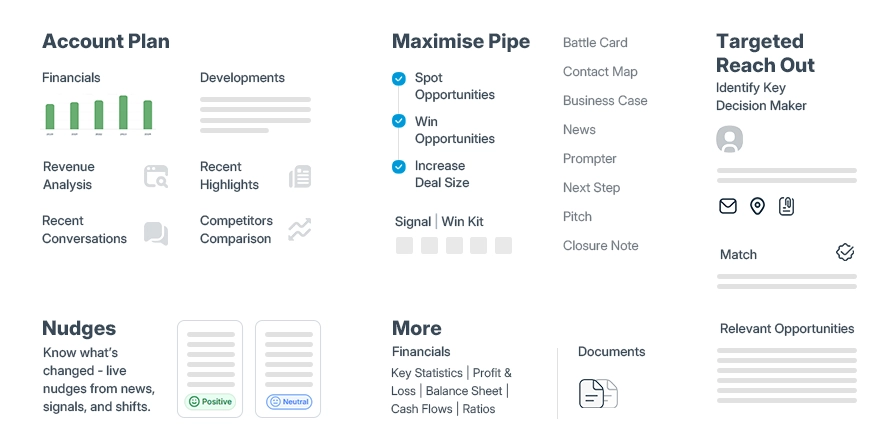
The platform works through integrated agents that handle different parts of the signal-based pipeline process:
Watches all Salesforce-connected target accounts continuously. Tracks financial data, business developments, and organizational changes. Consolidates signals in one view so sellers don't jump between tools.
Identifies opportunities inside accounts based on signals. Shows why each opportunity exists, which signals triggered it, and which product offering fits. Ranks opportunities by relevance so sellers know where to focus first.
Surfaces relevant news and developments tied to accounts. Filters noise. Highlights what creates a reason to engage. Sellers see what changed without monitoring dozens of sources manually.
Together, these agents make signal-based pipeline generation systematic. Sellers don't need to research accounts manually. They see where opportunity exists, why it matters, and who to contact—all in one system.
Enterprise pipeline creation doesn't need to depend on inbound timing or cold outreach volume. Account signals provide a third path—one based on observable business movement inside accounts you already care about.
Teams that operationalize signals don't wait for buyers to show intent. They see opportunity before it becomes obvious. They reach out with context and timing. They create pipeline from changes already happening in their territories.
This requires systems, not just seller discipline. Manual signal tracking breaks at scale. Revenue intelligence platforms that connect signals to opportunities and provide execution guidance make signal-based prospecting repeatable across entire teams.
The shift from reactive lead generation to proactive signal-based pipeline creation is happening now. Revenue leaders who operationalize it first gain visibility their competitors don't have.
That visibility creates pipeline. Pipeline creates predictability. Predictability creates control.
Book a 30-minute demo to see how SalesPlay connects account signals to opportunities in your target accounts.
Book Your DemoAccount signals are observable changes inside target accounts that indicate buying potential or opportunity timing. These include financial results, leadership changes, strategic initiatives, organizational restructuring, budget movements, technology adoption, and business developments. Unlike intent data, account signals track what is actually changing inside an account, not what someone searched for online.
Intent data tracks online research behavior and shows who might be in-market for a solution. Account signals track business movement inside accounts and reveal where opportunities exist based on what is changing. Intent data is reactive—it tells you when someone is already looking. Account signals are proactive—they show you where to sell before the buyer starts shopping. Most enterprise deals don't start with intent signals. They start with business changes that create budget, priority, or urgency.
Traditional lead generation treats every account the same and waits for inbound interest. Signal-based pipeline generation starts from accounts you already care about and identifies where opportunity exists inside them right now. This works because most enterprise pipeline doesn't come from net-new leads—it comes from existing relationships, strategic accounts, and whitespace inside current customers. Signals tell you where to focus before competitors see the opportunity.
The most valuable account signals for pipeline creation include: revenue growth or decline (5-year trends, quarterly changes), financial events (earnings calls, SEC filings, funding rounds), organizational changes (new executives, restructuring, headcount changes), strategic announcements (new initiatives, market expansion, product launches), technology adoption (new systems, digital transformation), regulatory changes affecting the account, and competitive movement (wins, losses, market position changes). The key is connecting these signals to your specific offering and determining which ones create urgency or budget for what you sell.
Operationalizing account signals requires three components: continuous account monitoring connected to your CRM, signal-to-opportunity mapping that shows which signals indicate buying potential for your offerings, and guided execution that tells sellers what to do when a signal appears. Without operationalization, signals become noise. Sales teams need systems that watch accounts automatically, surface relevant signals, connect them to opportunities, and provide next-step guidance. This moves signal-based selling from an individual best practice to a team capability.
Account signals don't replace outbound—they make it precise. Instead of cold outreach based on firmographic fit, signal-based outbound starts from real business movement. You're contacting accounts because something changed, not because they match your ICP. This increases response rates, shortens sales cycles, and improves deal quality. Teams still do outbound. They just have a reason to reach out beyond 'we sell this, you might need it.'
Account-based marketing selects target accounts and runs coordinated campaigns to create demand. Signal-based pipeline generation identifies where opportunity already exists inside those accounts. ABM answers 'who should we focus on?' Signals answer 'what can we sell them right now?' The approaches are complementary. ABM creates account awareness and engagement. Signals create timing and specificity. Together, they allow sales teams to focus on the right accounts with the right message at the right time.
Manual signal tracking requires sellers to monitor news, check LinkedIn, review earnings calls, and research accounts before every outreach. This works for small account lists but breaks at scale. Automated signal tracking continuously watches all target accounts, consolidates changes across multiple sources, filters noise, connects signals to relevant opportunities, and surfaces only what matters. Manual approaches create inconsistency and coverage gaps. Automation makes signal-based selling systematic and repeatable across the entire team.
Teams typically see initial pipeline from signal-based prospecting within 30-60 days of implementation. Full operationalization—where signal-based opportunities represent 30-40% of new pipeline—takes 6-12 months. The timeline depends on signal taxonomy quality, CRM integration depth, and team adoption. Early results come from high-priority accounts with strong signals. Sustained results require workflow integration and consistent execution across the sales organization.
ROI shows up in three areas: increased pipeline from existing territories without adding headcount, higher win rates on signal-based opportunities versus cold outbound (typically 15-25% higher), and shorter sales cycles because timing is better. The investment includes platform costs, integration effort, and team training. Most revenue teams see positive ROI within two quarters as signal-based pipeline begins converting to revenue. The bigger impact is strategic—you're creating pipeline from informed targeting rather than volume outreach.


Category: Uncategorized Tags: ai, AIOps, Artificial Intelligence, cloud, cloud platform, Cybersecurity, Information and Communications Technology , VR