Why Traditional Pipeline Generation Breaks at Scale
February 13, 2026
Pipeline generation that worked at $10M ARR fails at $50M. Here's what breaks, why it matters, and what actually needs to change.
You hired your first ten sellers, hit $10M ARR, and pipeline generation felt manageable. Your VP of Sales knew every account. Sellers collaborated naturally. Opportunities appeared because someone remembered a conversation.
Then you scaled.
Now you have 50 sellers, 500 target accounts, three product lines, and pipeline generation that feels like chaos. Sellers are busy but quota attainment is inconsistent. Big accounts sit idle for months. Opportunities surface too late or not at all.
The processes that worked before don't just slow down. They collapse.
This isn't about effort. Your team is working harder than ever. This is about structure. Pipeline generation at $50M+ ARR requires fundamentally different systems than pipeline generation at $10M ARR.
Most revenue leaders don't realize this until they're already underwater.
Early-stage pipeline generation succeeds on proximity and context.
Your VP of Sales personally knows the top 50 accounts. They can tell you which companies are expanding, who just got promoted, and which deals are about to close. Weekly sales meetings cover every deal. Territory assignments are simple. Everyone operates from shared tribal knowledge.
Sellers research accounts manually, but it's manageable because they only track 20-30 accounts each. They remember who they talked to last week. They recognize when an account goes quiet. They coordinate coverage because they sit near each other.
This works because the coordination overhead is low.
When you have 10 sellers and 100 target accounts, maintaining context is human-scale. Leadership can spot gaps. Sellers can react quickly. Pipeline generation feels organic.
Then you add sellers. Then territories. Then product lines. Then the system breaks.
At 500 target accounts, no single person knows what's happening everywhere. Your VP of Sales can't track coverage across territories. Sellers can't monitor hundreds of accounts for changes. Important accounts sit untouched for months because everyone assumed someone else was handling them.
You discover coverage gaps only when deals don't materialize. By then, competitors have been engaging for quarters.
When sellers managed 20 accounts, spending an hour researching each one was reasonable. At 50+ accounts per seller, manual research consumes entire weeks. Sellers can't keep up. Account knowledge becomes stale within days. Context disappears.
They start guessing where to focus instead of knowing.
Without continuous account monitoring, sellers only learn about changes when prospects tell them. A CFO replacement happened three months ago. A new initiative launched last quarter. Budget just shifted.
You're always late. Competitors already engaged while you were researching other accounts.
Sellers can't research every opportunity deeply, so they pursue everything that looks remotely plausible. Pipeline fills with low-probability deals. Forecast accuracy collapses. Win rates drop because teams are chasing opportunities that were never real.
Activity increases. Results don't.
New sellers need to build context on hundreds of accounts. There's no central source of truth. They spend months learning what experienced sellers already know. Ramp time extends. Territory productivity suffers.
The tribal knowledge that worked early becomes the bottleneck at scale.
The Hidden Cost: Most revenue leaders see these as execution problems. They hire more sellers, add more tools, and push for more activity. The real problem isn't execution. It's that account intelligence collapsed and nobody built a system to replace it.
Your CRM tells you what happened, not what's happening or what should happen next. It's a record system, not an intelligence system.
At scale, this distinction matters. Sellers spend more time updating fields than selling. Data goes stale within days. The CRM can't tell you which 20 accounts to prioritize this week or why an opportunity exists right now in a specific account.
It's a database, not a co-pilot.
Sales engagement platforms help you send more emails faster. They don't tell you who needs those emails or why.
At scale, this creates spray-and-pray outreach across hundreds of accounts. Response rates drop. Buyers receive generic messages. Real opportunities get buried under activity metrics that don't convert.
You're optimizing execution speed without fixing opportunity identification. You're making the wrong work more efficient.
Intent data tells you an account is researching your category. It doesn't tell you why that matters to your specific offering, which stakeholder cares, or what to say.
At enterprise scale, generic intent creates noise. Sellers get flooded with signals that don't convert. They stop trusting the data. Intent becomes another tool they ignore because it doesn't connect to actual selling moments.
Contact databases solve for "who." They don't solve for "why now" or "what's changed."
You can find the VP of Sales at any target account. You can't tell from a contact database whether that VP is dealing with quota pressure, team expansion, or budget cuts. Without that context, outreach becomes guesswork.
| Tool Category | What It Solves | What It Misses at Scale |
|---|---|---|
| CRM | Record keeping, history | What's happening now, where to act next |
| Sales Engagement | Execution speed | Opportunity identification, message relevance |
| Intent Data | Category-level signals | Account-specific context, stakeholder mapping |
| Contact Data | Who to reach | Why it matters now, what's changed |
| Revenue Intelligence | Account changes, opportunity context, execution guidance | — |
Pipeline generation at scale isn't about working harder. It's about maintaining context across hundreds of accounts simultaneously.
When you were smaller, context lived in people's heads. Your VP knew the accounts. Sellers remembered conversations. Coordination happened naturally.
At scale, context must live in systems.
This means:
Revenue leaders who solve this don't add more tools. They replace fragmented systems with revenue intelligence platforms that make context automatic.
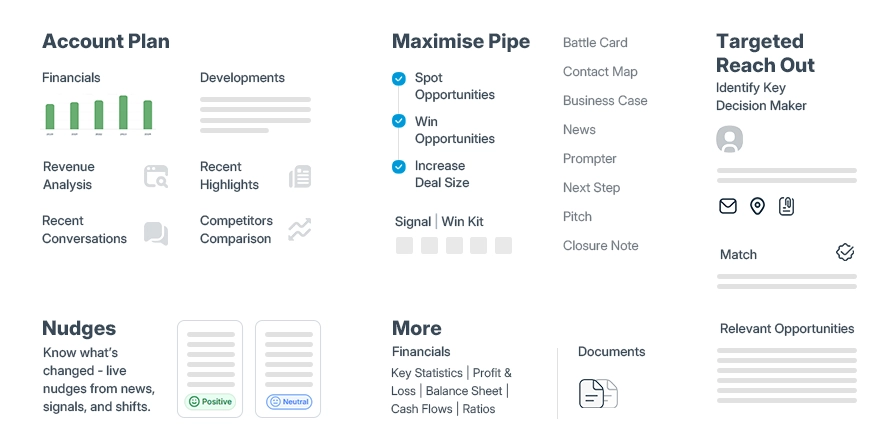
Revenue intelligence platforms solve a specific problem: they maintain account context at scale and connect that context to selling opportunities.
Here's what changes operationally:
Instead of sellers manually checking accounts, the platform watches for changes. Financial movements. Leadership transitions. Strategic initiatives. Market positioning shifts.
When something changes that creates a selling opportunity, the platform surfaces it. Sellers don't research hundreds of accounts. They respond to what matters.
Traditional pipeline generation waits for intent signals or inbound interest. Revenue intelligence identifies opportunities based on account movements that align with your offerings.
A company expanding into new regions. A CFO focused on cost optimization. A product team building new infrastructure.
These create opportunities before the account starts evaluating vendors. You engage early, not late.
At scale, the biggest problem isn't lack of activity. It's lack of clarity. Sellers have too many accounts and no system to prioritize them.
Revenue intelligence platforms rank opportunities by relevance. Sellers see which accounts matter this week and why. Coverage becomes visible. Gaps become obvious.
Focus replaces guesswork.
New sellers don't spend months building tribal knowledge. They get full account context immediately. Experienced sellers don't lose track of what's happening across their portfolio.
Everyone operates from the same intelligence, updated continuously.
Traditional tools separate opportunity identification from execution. Revenue intelligence connects them.
When an opportunity surfaces, sellers see the relevant contacts, the business context, the value proposition that matters, and the next steps to take. They don't start from scratch on every deal.
This is what pipeline generation using account signals actually looks like in practice.
Your team has 400 target accounts. Coverage is inconsistent. Sellers spend Mondays researching accounts manually. Deal quality varies wildly by rep. New hires take 6+ months to ramp. Your VP of Sales can't answer "which accounts are we actively working this quarter?" without pulling reports.
Pipeline exists, but it's reactive. You're chasing what comes to you instead of creating what matters.
The platform watches all 400 accounts continuously. It identifies 40 opportunities this week based on actual account movements. Sellers know exactly where to focus Monday morning. New hires get full context on day one. Your VP sees coverage across the entire portfolio in real-time.
Pipeline generation becomes proactive. You know where to sell before the account does.
The Shift: Teams move from "we need to generate more pipeline" to "we need to identify the right opportunities faster." This is the difference between volume and intelligence. At scale, intelligence wins.
Revenue leaders recognize these problems, but they delay fixing them. Why?
They think it's an execution problem, not a systems problem.
They hire more sellers. They add more training. They increase activity targets. None of this fixes the core issue: context collapsed and manual processes can't maintain it at scale.
By the time they realize this, they've spent quarters underwater. Quota attainment is inconsistent. Pipeline quality is declining. Competitors are engaging accounts faster.
The real cost isn't the missed quarter. It's the compound effect of delayed action. Every month without proper account intelligence means more coverage gaps, more missed opportunities, and more sellers operating blind.
Fixing pipeline generation at scale requires three shifts:
Stop asking sellers to manually track hundreds of accounts. Deploy systems that monitor accounts continuously and surface changes that matter.
This isn't about saving time. It's about making coverage possible at scale.
More activity doesn't create better pipeline. Better targeting does. Focus on identifying fewer, higher-probability opportunities instead of pursuing everything.
Revenue intelligence helps teams say no to noise so they can focus on signal.
Opportunity identification is worthless if sellers don't know what to do next. The platform should provide context, contacts, messaging, and guidance - not just alerts.
This is what separates revenue intelligence from intent data. Intent says "something is happening." Intelligence says "here's what to do about it."
When evaluating how to fix pipeline generation at scale, revenue leaders typically consider several approaches. Here's how they compare:
| Approach | Core Focus | Strengths | Limitations at Scale |
|---|---|---|---|
| Add More Sellers | Coverage through headcount | Increases activity capacity | Doesn't solve context or prioritization; ramp time compounds the problem |
| Sales Engagement Platforms | Execution efficiency | Automates outreach sequences | Optimizes execution without fixing opportunity identification; creates spray-and-pray at scale |
| Intent Data + ABM | Category-level signals | Shows research activity | Generic signals without account-specific context; high noise-to-signal ratio |
| Revenue Intelligence | Account context + opportunity identification | Continuous monitoring, prioritized opportunities, execution guidance | Requires changing how teams work, not just adding a tool |
Teams often try the first three approaches before adopting revenue intelligence. The pattern is predictable: add sellers (helps temporarily), add engagement tools (increases activity but not results), add intent data (creates more noise).
Eventually, they realize the problem isn't execution capacity or signal volume. It's maintaining intelligent context across hundreds of accounts simultaneously.
That's what separates revenue intelligence platforms like SalesPlay from intent-based tools like 6sense, or engagement platforms like SalesLoft.
Revenue leaders ask: "When should we move from traditional pipeline generation to revenue intelligence?"
The answer depends on where breakage is occurring:
You're still early if:
You're approaching the breaking point if:
You're past the breaking point if:
Most teams wait until they're past the breaking point. The cost is measured in missed quarters and lost market position.
The teams that win recognize the pattern early and change systems before performance collapses.
When pipeline generation works at scale, it doesn't look like more activity. It looks like more focus.
Sellers start Monday knowing exactly which accounts matter this week and why. They don't guess. They don't research for hours. They act on intelligence that's already contextualized.
Opportunities surface before competitors know they exist. Engagement happens when it matters, not three months late. Coverage is visible across the entire portfolio.
New sellers ramp in weeks instead of months because context is systematic, not tribal. Deal quality improves because teams pursue fewer, better-qualified opportunities.
This is what pipeline generation at scale actually requires: continuous intelligence, clear prioritization, and immediate context.
Teams that build this don't just generate more pipeline. They generate pipeline that converts.
The Reality: Pipeline generation at $50M+ ARR will never look like it did at $10M ARR. The question isn't whether to change your systems. The question is whether you change them before or after your competitors do.
Pipeline generation becomes harder at scale because the manual processes that worked at smaller sizes collapse under complexity. At $10M ARR, a VP of Sales can personally know every account and direct sellers where to focus. At $50M+ ARR, you have hundreds of target accounts, multiple product lines, constantly changing stakeholders, and sellers operating independently across territories. The coordination overhead becomes exponential, not linear.
Account coverage breaks first. Sales teams lose visibility into what's happening across their account portfolio. Sellers can't track changes in hundreds of accounts manually. Opportunities get missed because no one knew the account was moving. Deal timing becomes reactive instead of proactive. Teams start guessing where to focus instead of knowing.
CRMs are record systems, not intelligence systems. They store what happened, not what's happening or what should happen next. At scale, sellers spend more time updating CRM fields than selling. Data becomes stale within days. Territory coverage becomes invisible. The CRM can't tell you which 20 accounts to prioritize this week or why an opportunity exists right now.
Pipeline generation tools focus on lead volume - more contacts, more sequences, more activity. Revenue intelligence platforms focus on opportunity quality - where to sell, why now, and how to execute. At scale, volume without intelligence creates noise. Revenue intelligence connects account changes to selling opportunities and gives sellers the context to act immediately.
Account intelligence continuously watches target accounts for business changes, financial movements, and buying signals. Instead of sellers manually researching hundreds of accounts, the platform surfaces what matters. It identifies opportunities based on real account movements, not generic intent data. Sellers know where to focus, who to contact, and what to say - without jumping between tools or losing context. Learn more about generating pipeline from existing accounts.
Sales engagement platforms solve for execution speed, not opportunity identification. They help you send more emails faster, but they don't tell you who needs those emails or why. At scale, this creates spray-and-pray outreach across hundreds of accounts. Response rates drop. Buyers get generic messages. Real opportunities get buried under activity metrics that don't convert.
Stop measuring activity volume. Start measuring opportunity quality and account coverage. Track: pipeline from existing accounts vs. net new, time from signal to engagement, percentage of target accounts with active coverage, conversion rate from identified opportunity to qualified pipeline, and average deal size by opportunity source. These metrics reveal whether you're generating real pipeline or just activity.
Fixing the process is faster than most leaders expect - usually 30-60 days to operational impact. The challenge isn't implementation; it's changing how sellers work. Revenue intelligence platforms can identify opportunities immediately. The real timeline is training teams to trust signals over guesswork, prioritize quality over volume, and operate from a single source of truth instead of fragmented tools.
Watch how SalesPlay continuously monitors target accounts, identifies opportunities before they're obvious, and gives sellers the context to act immediately.


Category: Uncategorized Tags: ai, AIOps, Artificial Intelligence, cloud, cloud platform, Cybersecurity, Information and Communications Technology , VR