Propulsion Systems Market by type (Air Breathing Engines, Non-Air Breathing Engines, Electric Propulsion Engines), Application (Aircraft, Spacecraft, Missiles, Unmanned Aerial Vehicles), and Region - Global Forecast to 2035


Propulsion Systems Market
Propulsion Systems Market Summary
The global Propulsion Systems Market is estimated to reach approximately USD 320.50 billion in 2025 and is projected to grow to USD 610.80 billion by 2035, registering a CAGR of 6.7% during the forecast period. The market is expanding steadily due to rising demand across aerospace, defense, automotive, marine, and space sectors, where propulsion systems are critical for mobility, efficiency, and performance. Increasing investments in next-generation aircraft, electric vehicles, naval modernization, and space exploration programs are driving demand for advanced propulsion technologies. The integration of artificial intelligence (AI), Internet of Things (IoT), and automation is transforming propulsion systems into intelligent platforms capable of predictive maintenance, performance optimization, and energy efficiency. Digital transformation, combined with the shift toward electrification and hybrid propulsion technologies, is significantly accelerating market growth globally.
Key Market Trends & Insights
The Propulsion Systems Market is undergoing a significant transformation as industries focus on efficiency, sustainability, and advanced performance. North America leads the market due to its strong aerospace and defense ecosystem, technological innovation, and presence of major manufacturers. Asia Pacific is the fastest-growing region, driven by expanding automotive production, rising air travel demand, and increasing investments in space and defense programs.
Conventional propulsion systems, including internal combustion engines and gas turbines, continue to dominate the market due to their widespread use. However, electric and hybrid propulsion systems are emerging as key growth segments, particularly in automotive and aerospace applications.
Emerging trends include electrification, hydrogen-based propulsion, and integration of digital technologies. AI and automation are enhancing system efficiency, enabling predictive maintenance, and optimizing fuel consumption. IoT-enabled systems are improving connectivity and real-time monitoring, supporting advanced operational capabilities.
Market Size & Forecast
-
Base year market size (2025): USD 320.50 billion
-
Forecast value by 2035: USD 610.80 billion
-
CAGR (2025–2035): 6.7%
-
Growth is driven by increasing demand for energy-efficient propulsion systems, advancements in electric and hybrid technologies, integration of AI and IoT, and expansion of aerospace and automotive sectors
Propulsion Systems Market Top 10 key takeaway
-
The market is expected to nearly double by 2035
-
Conventional propulsion systems dominate the market
-
Electric and hybrid systems are the fastest-growing segments
-
North America leads with strong aerospace and defense presence
-
Asia Pacific is the fastest-growing region globally
-
AI-driven predictive maintenance is improving system reliability
-
IoT integration enables real-time monitoring and optimization
-
Hydrogen propulsion is emerging as a future trend
-
Automotive and aerospace sectors are key growth drivers
-
Continuous innovation is intensifying market competition
Product Insights
Conventional propulsion systems, including internal combustion engines and gas turbines, represent the leading product segment in the Propulsion Systems Market. These systems are widely used across automotive, aerospace, and marine industries due to their proven reliability, high power output, and established infrastructure.
Electric propulsion systems are gaining significant traction, particularly in the automotive sector, where the shift toward electric vehicles (EVs) is accelerating. In aerospace, electric and hybrid propulsion technologies are being explored to reduce emissions and improve efficiency.
Hybrid propulsion systems are emerging as a transitional solution, combining conventional engines with electric components to enhance performance and reduce fuel consumption. AI integration is enabling advanced control systems, optimizing performance, and enhancing system efficiency.
Technology / Component Insights (Rename based on keyword if needed)
Technological advancements are at the core of the Propulsion Systems Market, with innovations in power generation, energy storage, and system integration driving significant improvements. Key technologies include gas turbines, electric motors, fuel cells, and hybrid systems.
AI is playing a transformative role by enabling predictive maintenance, real-time performance optimization, and fault detection. Machine learning algorithms are used to analyze operational data, improve efficiency, and reduce downtime. IoT integration is facilitating seamless communication between propulsion systems and control units, enabling real-time monitoring and diagnostics.
Cloud-based platforms are supporting data analytics and system management, enabling centralized control and optimization. Automation technologies are improving manufacturing processes and system efficiency. Future innovation trends include hydrogen propulsion, advanced battery technologies, and integration with renewable energy sources.
Application Insights
The automotive sector dominates the Propulsion Systems Market, driven by the high volume of vehicle production and the increasing adoption of electric and hybrid vehicles. Propulsion systems are a critical component of vehicle performance, efficiency, and emissions reduction.
The aerospace sector is another significant application area, with propulsion systems being used in commercial aircraft, military aircraft, and spacecraft. The demand for fuel-efficient and environmentally friendly propulsion systems is driving innovation in this segment.
Marine and defense applications also contribute to market growth, with propulsion systems being used in naval vessels, submarines, and defense platforms. Future opportunities lie in space exploration and the development of advanced propulsion technologies for next-generation vehicles.
Regional Insights
North America leads the Propulsion Systems Market, supported by its strong aerospace and automotive industries, advanced technological capabilities, and significant investments in research and development. The region continues to adopt next-generation propulsion technologies.
Europe is experiencing steady growth, driven by stringent emission regulations, focus on sustainability, and advancements in electric and hybrid propulsion systems. Countries in this region are investing in green technologies and innovation.
Asia Pacific is the fastest-growing region, fueled by expanding automotive production, increasing air travel demand, and rising investments in defense and space programs. Countries such as China, India, and Japan are key contributors to regional growth.
-
North America dominates due to strong industrial base
-
Europe shows steady growth with sustainability initiatives
-
Asia Pacific is the fastest-growing region globally
-
Rising demand for electric vehicles is driving growth
-
Technological advancements are accelerating adoption
[Country]-Specific Market Trends
In Asia Pacific, China is witnessing a CAGR of approximately 7.8%, driven by its leadership in electric vehicle production and investments in aerospace and defense. Japan is also experiencing steady growth, supported by technological innovation and strong automotive industry.
In North America, the United States remains the largest market, with a CAGR of around 6.5%, driven by continuous investment in aerospace, defense, and automotive sectors. Canada and Mexico are also contributing to market growth through manufacturing and supply chain development.
In Europe, Germany and France are key markets, with CAGRs of approximately 6.4% and 6.3%, respectively. These countries are focusing on advancing electric mobility and aerospace technologies.
-
China leads growth in Asia Pacific with EV adoption
-
Japan focuses on innovation and advanced technologies
-
The United States dominates the global market
-
Germany and France drive growth in Europe
-
Government policies are key growth drivers
Key Propulsion Systems Market Company Insights
The Propulsion Systems Market is highly competitive, with leading players focusing on innovation, sustainability, and advanced technologies. Companies such as General Electric, Rolls-Royce Holdings, Pratt & Whitney, Safran, Cummins, and MTU Aero Engines are actively shaping the market landscape.
These companies are investing heavily in research and development to introduce advanced propulsion systems with improved efficiency, reduced emissions, and enhanced performance. AI integration, electrification, and hybrid technologies are key focus areas.
Strategic partnerships with OEMs, governments, and technology providers are enabling these companies to expand their market presence and accelerate innovation. The focus on sustainability and clean energy solutions is shaping competitive strategies.
-
Companies are investing in electric and hybrid propulsion
-
Strategic partnerships are enhancing market reach
-
Focus on sustainability is increasing
-
R&D investments are driving innovation
-
Global expansion strategies are strengthening market presence
Recent Developments
Recent developments in the Propulsion Systems Market highlight the growing emphasis on electrification and digital transformation. Several companies have introduced advanced electric propulsion systems and hybrid engines designed to improve efficiency and reduce emissions.
In addition, partnerships between aerospace companies and technology providers are enabling the integration of AI and IoT-based solutions, improving system performance and reliability. Governments are also increasing investments in clean energy propulsion technologies.
Market Segmentation
The Propulsion Systems Market is segmented based on product, technology/component, application, and region. By product, the market includes conventional propulsion systems, electric propulsion systems, and hybrid propulsion systems, with conventional systems dominating due to their widespread use.
In terms of technology, the market encompasses gas turbines, electric motors, fuel cells, AI-enabled systems, and IoT-integrated platforms. These technologies are driving improvements in performance, efficiency, and connectivity.
Applications are categorized into automotive, aerospace, marine, defense, and space. Regionally, the market is divided into North America, Europe, Asia Pacific, and the rest of the world.
-
Conventional propulsion systems dominate the product segment
-
Electric and hybrid technologies are driving innovation
-
Automotive represents the largest application segment
-
Aerospace and defense show strong growth potential
-
Asia Pacific is emerging as a key growth region
Conclusion
The Propulsion Systems Market is poised for strong growth through 2035, driven by increasing demand for energy-efficient and sustainable propulsion technologies. The integration of AI, IoT, and automation is transforming propulsion systems into intelligent platforms capable of delivering real-time insights and enhancing operational efficiency.
As industries continue to prioritize sustainability and performance, the adoption of electric, hybrid, and hydrogen propulsion systems will accelerate. Companies that invest in innovation and align their strategies with emerging trends will be well-positioned to capitalize on future opportunities. The market’s growth trajectory underscores its critical role in shaping the future of mobility and transportation.
FAQs
1. What is the current market size of the Propulsion Systems Market?
The market size is estimated at USD 320.50 billion in 2025.
2. What is the expected growth rate of the market?
The market is projected to grow at a CAGR of 6.7% from 2025 to 2035.
3. What are the key drivers of market growth?
Key drivers include increasing demand for energy-efficient systems, advancements in electric propulsion, and integration of AI and IoT.
4. Which region leads the Propulsion Systems Market?
North America is the leading region due to its strong aerospace and automotive industries.
5. Who are the major players in the market?
Major players include General Electric, Rolls-Royce Holdings, Pratt & Whitney, Safran, Cummins, and MTU Aero Engines.
 Exclusive indicates content/data unique to MarketsandMarkets and not available with any competitors.
Table of Contents
1 Introduction (Page No. - 17)
1.1 Objectives of the Study
1.2 Market Definition
1.3 Study Scope
1.3.1 Markets Covered
1.3.2 Years Considered for the Study
1.4 Currency & Pricing
1.5 Distribution Channel Participants
1.6 Limitations
1.7 Market Stakeholders
2 Research Methodology (Page No. - 21)
2.1 Research Data
2.1.1 Secondary Data
2.1.1.1 Key Data From Secondary Sources
2.1.2 Primary Data
2.1.2.1 Key Data From Secondary Sources
2.1.2.2 Breakdown of Primaries
2.1.2.3 Key Industry Insights
2.2 Factor Analysis
2.2.1 Introduction
2.2.2 Demand Side Indicators
2.2.2.1 Increase in Defense Spending and Rise in the Number of Military Modernization Programs
2.2.2.2 Rising Demand for Unmanned Systems
2.2.3 Supply Side Indicators
2.2.3.1 Increase in Research & Development Activities
2.3 Market Size Estimation
2.3.1 Bottom-Up Approach
2.3.2 Top-Down Approach
2.4 Market Breakdown and Data Triangulation
2.5 Assumptions
3 Executive Summary (Page No. - 33)
4 Premium Insights (Page No. - 37)
4.1 Attractive Market Oppportunities in the Market
4.2 Propulsion Systems Market, By Application
4.3 Market in Missiles Application, By Region
4.4 Non-Air Breathing Propulsion Systems Market, By Subtype
4.5 Market Share vs Growth Rate, By Region
4.6 Life Cycle Analysis, By Region
5 Market Overview (Page No. - 41)
5.1 Introduction
5.2 Market Segmentation
5.2.1 Propulsion Systems Market, By Type
5.2.2 Market, By Application
5.3 Market Dynamics
5.3.1 Drivers
5.3.1.1 Increasing Commercial Application of Propulsion Systems
5.3.1.2 High Efficiency Offered By Propulsion Systems and Technological Advancements
5.3.1.3 Increasing Space Expeditions
5.3.1.4 Increasing Need for Long Range Missiles
5.3.2 Restraints
5.3.2.1 Declining Defense Budgets of Advanced Economies
5.3.2.2 Strict Airspace Regulations
5.3.3 Opportunities
5.3.3.1 Increasing Research & Development Activities
5.3.3.2 Increasing Defense Expenditures of Emerging Economies
5.3.4 Challenges
5.3.4.1 High Costs Involved in the Development of New Technologies
5.3.4.2 Lack of Knowledge Transfer Platforms
6 Industry Trends (Page No. - 50)
6.1 Introduction
6.2 Supply Chain
6.3 Value Chain
6.4 Technological Trends
6.4.1 Increasing Use of Gas Turbines & Jet Propulsions
6.4.1.1 Innovations and Patent Registrations of Gas Turbines
6.4.2 Innovations in Ramjet & Scramjet Propulsions
6.4.2.1 Innovations and Patent Registrations of Ramjet Engines
6.4.3 Innovations in Non-Air Breathing Propulsions
6.4.3.1 Innovations in Propulsions for Rockets and Missiles
6.4.3.2 Innovations and Patent Registrations for Rockets and Missiles
6.4.3.3 Innovations in Space Propulsion
6.4.3.4 Innovations and Patent Registrations in Space Propulsions
6.4.4 Innovations in Electric Propulsions
6.4.4.1 Innovations in Electric Propulsions for Uavs
6.4.4.2 Innovations and Patent Registrations in Electric Propulsions for Uavs
6.4.4.3 Innovations in Electric Propulsions for Spacecraft:
6.4.4.4 Innovations and Patent Registrations in Electric Propulsions for Spacecraft:
7 Propulsion Systems Market, By Type (Page No. - 58)
7.1 Introduction
7.2 Air-Breathing Engines
7.2.1 Ramjet & Scramjet
7.2.2 Gas Turbine & Jet Engine
7.2.3 Internal Combustion
7.3 Non-Air Breathing Engines
7.3.1 Solid Propulsion
7.3.2 Liquid Propulsion
7.3.3 Hybrid
7.4 Electric Propulsion Engines
8 Propulsion Systems Market, By Application (Page No. - 67)
8.1 Introduction
8.2 Aircraft
8.3 Spacecraft
8.4 Missiles
8.5 Unmanned Aerial Vehicles
9 Regional Analysis (Page No. - 76)
9.1 Introduction
9.2 North America
9.2.1 By Type
9.2.2 By Application
9.2.3 By Country
9.2.3.1 U.S.
9.2.3.1.1 By Type
9.2.3.1.2 By Application
9.2.3.2 Canada
9.2.3.2.1 By Type
9.2.3.2.2 By Application
9.3 Europe
9.3.1 By Type
9.3.2 By Application
9.3.3 By Country
9.3.3.1 U.K.
9.3.3.1.1 By Type
9.3.3.1.2 By Application
9.3.3.2 Russia
9.3.3.2.1 By Type
9.3.3.2.2 By Application
9.3.3.3 France
9.3.3.3.1 By Type
9.3.3.3.2 By Application
9.3.3.4 Germany
9.3.3.4.1 By Type
9.3.3.4.2 By Application
9.3.3.5 Rest of Europe
9.3.3.5.1 By Type
9.3.3.5.2 By Application
9.4 Asia-Pacific
9.4.1 By Type
9.4.2 By Application
9.4.3 By Country
9.4.3.1 China
9.4.3.1.1 By Type
9.4.3.1.2 By Application
9.4.3.2 India
9.4.3.2.1 By Type
9.4.3.2.2 By Application
9.4.3.3 South Korea
9.4.3.3.1 By Type
9.4.3.3.2 By Application
9.4.3.4 Japan
9.4.3.4.1 By Type
9.4.3.4.2 By Application
9.4.3.5 Rest of Asia-Pacific
9.4.3.5.1 By Type
9.4.3.5.2 By Application
9.5 Middle East
9.5.1 By Type
9.5.2 By Application
9.5.3 By Country
9.5.3.1 Israel
9.5.3.1.1 By Type
9.5.3.1.2 By Application
9.5.3.2 Turkey
9.5.3.2.1 By Type
9.5.3.2.2 By Application
9.5.3.3 Rest of Middle East
9.5.3.3.1 By Type
9.5.3.4 By Application
9.6 Rest of the World
9.6.1 By Type
9.6.2 By Application
9.6.3 By Country
9.6.3.1 Brazil
9.6.3.1.1 By Type
9.6.3.1.2 By Application
9.6.3.2 South Africa
9.6.3.2.1 By Type
9.6.3.2.2 By Application
10 Competitive Landscape (Page No. - 113)
10.1 Overview
10.2 Market Share Analysis, By Key Players
10.3 Brand Analysis
10.4 Competitive Situations & Trends
10.4.1 Contracts
10.4.2 New Product Launches
10.4.3 Acquisitions & Joint Venture
10.4.4 Agreements & Partnerships
11 Company Profile (Page No. - 128)
(Overview, Products and Services, Financials, Strategy & Development)*
11.1 Introduction
11.2 Financial Highlights
11.3 General Electric Co.
11.4 United Technologies Corporation
11.5 Rolls-Royce Holdings PLC.
11.6 Safran S.A
11.7 Honeywell International Inc.
11.8 Northrop Grumman Corporation
11.9 The Raytheon Company
11.10 Aerojet Rocketdyne Holdings, Inc.
11.11 Orbital ATK
11.12 Lockheed Martin Corporation
11.13 GKN Aerospace
11.14 3W International GmbH
*Details on Overview, Products and Services, Financials, Strategy & Development Might Not Be Captured in Case of Unlisted Companies.
12 Appendix (Page No. - 169)
12.1 Discussion Guide
12.2 Knowledge Store: Marketsandmarkets’ Subscription Portal
12.3 Introducing RT: Real Time Market Intelligence
12.4 Available Customizations
12.5 Related Reports
List of Tables (77 Tables)
Table 1 Propulsion Systems Market, By Type
Table 2 Market, By Application
Table 3 Market, By Region
Table 4 Military Expenditure of Advanced Economies, 2011-2015 (USD Billion)
Table 5 Military Expenditures of Emerging Economies, 2011-2015 (USD Billion)
Table 6 Channels for Knowledge Transfer
Table 7 Process of Knowledge Transfer
Table 8 Tools to Measure Effective Knowledge Transfer
Table 9 Innovations and Patent Registrations
Table 10 Propulsion Systems Market Size, By Type, 2015-2021 (USD Billion)
Table 11 Air-Breathing: Propulsion Systems Market Size, By Subtype, 2015-2021 (USD Billion)
Table 12 Air-Breathing: Market Size, By Region, 2015-2021 (USD Billion)
Table 13 Non-Air Breathing: Market Size, By Subtype, 2015-2021 (USD Billion)
Table 14 Non-Air Breathing: Market Size, By Region, 2015-2021 (USD Billion)
Table 15 Electric Propulison: Market Size, By Region, 2015-2021 (USD Billion)
Table 16 Propulsion Systems Market Size, By Application, 2015-2021 (USD Billion)
Table 17 Aircraft: Market Size, By Type, 2015-2021 (USD Billion)
Table 18 Aircraft: Market Size, By Region, 2015-2021 (USD Billion)
Table 19 Spacecraft: Market Size, By Type, 2015-2021 (USD Billion)
Table 20 Spacecraft: Market Size, By Region, 2015-2021 (USD Billion)
Table 21 Missiles: Market Size, By Type, 2015-2021 (USD Billion)
Table 22 Missiles: Market Size, By Region, 2015-2021 (USD Billion)
Table 23 Unmanned Aerial Vehicles: Propulsion Systems Market Size, By Region, 2015-2021 (USD Billion)
Table 24 Market Size, By Region, 2015-2021 (USD Billion)
Table 25 North America: Market Size, By Type, 2015-2021 (USD Billion)
Table 26 North America: Propulsion Systems Market Size, By Application, 2015-2021 (USD Billion)
Table 27 North America: Market Size, By Country, 2015-2021 (USD Billion)
Table 28 U.S.: Propulsion Systems Market Size, By Type, 2015-2021 (USD Billion)
Table 29 U.S.: Market Size, By Application, 2015-2021 (USD Billion)
Table 30 Canada: Propulsion Systems Market Size, By Type, 2015-2021 (USD Billion)
Table 31 Canada: Market Size, By Application, 2015-2021 (USD Billion)
Table 32 Europe: Propulsion Systems Market Size, By Type, 2015-2021 (USD Billion)
Table 33 Europe: Market Size, By Application, 2015-2021 (USD Billion)
Table 34 Europe: Market Size, By Country, 2015-2021 (USD Billion)
Table 35 U.K.: Market Size, By Type, 2015-2021 (USD Billion)
Table 36 U.K.: Market Size, By Application, 2015-2021 (USD Billion)
Table 37 Russia: Propulsion Systems Market Size, By Type, 2015-2021 (USD Billion)
Table 38 Russia: Market Size, By Application, 2015-2021 (USD Billion)
Table 39 France: Market Size, By Type, 2015-2021 (USD Billion)
Table 40 France: Propulsion Systems Market Size, By Application, 2015-2021 (USD Billion)
Table 41 Germany: Market Size, By Type, 2015-2021 (USD Billion)
Table 42 Germany: Market Size, By Application, 2015-2021 (USD Billion)
Table 43 Rest of Europe: Market Size, By Type, 2015-2021 (USD Billion)
Table 44 Rest of Europe: Market Size, By Application, 2015-2021 (USD Billion)
Table 45 Asia-Pacific: Market Size, By Type, 2015-2021 (USD Billion)
Table 46 Asia-Pacific: Market Size, By Application, 2015-2021 (USD Billion)
Table 47 Asia-Pacific: Market Size, By Country, 2015-2021 (USD Billion)
Table 48 China: Market Size, By Type, 2015-2021 (USD Billion)
Table 49 China: Market Size, By Application, 2015-2021 (USD Billion)
Table 50 India: Propulsion Systems Market Size, By Type, 2015-2021 (USD Billion)
Table 51 India: Market Size, By Application, 2015-2021 (USD Billion)
Table 52 South Korea: Market Size, By Type, 2015-2021 (USD Billion)
Table 53 South Korea: Market Size, By Application, 2015-2021 (USD Billion)
Table 54 Japan: Propulsion Systems Market Size, By Type, 2015-2021 (USD Billion)
Table 55 Japan: Market Size, By Application, 2015-2021 (USD Billion)
Table 56 Rest of Asia-Pacific: Propulsion Systems Market Size, By Type, 2015-2021 (USD Billion)
Table 57 Rest of Asia-Pacific: Market Size, By Application, 2015-2021 (USD Billion)
Table 58 Middle East: Propulsion Systems Market Size, By Type, 2015-2021 (USD Billion)
Table 59 Middle East: Market Size, By Application, 2015-2021 (USD Billion)
Table 60 Middle East: Market Size, By Country, 2015-2021 (USD Billion)
Table 61 Israel: Market Size, By Type, 2015-2021 (USD Billion)
Table 62 Israel: Market Size, By Application, 2015-2021 (USD Billion)
Table 63 Turkey: Propulsion Systems Market Size, By Type, 2015-2021 (USD Billion)
Table 64 Turkey: Market Size, By Application, 2015-2021 (USD Billion)
Table 65 Rest of Middle East: Propulsion Systems Market Size, By Type, 2015-2021 (USD Billion)
Table 66 Rest of Middle East: Market Size, By Application, 2015-2021 (USD Billion)
Table 67 Rest of the World: Market, By Type, 2015-2021 (USD Billion)
Table 68 Rest of the World: Propulsion Systems Market Size, By Application, 2015-2021 (USD Billion)
Table 69 Rest of the World: Market, By Country, 2015-2021 (USD Billion)
Table 70 Brazil: Market Size, By Type, 2015-2021 (USD Billion)
Table 71 Brazil: Market Size, By Application, 2015-2021 (USD Billion)
Table 72 South Africa: Propulsion Systems Market, By Type, 2015-2021 (USD Billion)
Table 73 South Africa: Market, By Application, 2015-2021 (USD Billion)
Table 74 Contracts, April 2014- September 2016
Table 75 New Product Launches, May 2015- April 2015
Table 76 Acquisitions & Joint Venture, May 2014- July 2016
Table 77 Agreements & Partnerships, July 2012-August 2016
List of Figures (59 Figures)
Figure 1 Propulsion Systems: Markets Covered
Figure 2 Report Flow
Figure 3 Research Design:Propulsion Systems
Figure 4 Breakdown of Primary Interviews: By Company Type, Designation, and Region
Figure 5 Top 15 Countries With the Highest Military Spending in 2015 (USD Billion)
Figure 6 Estimated Funding for Unmanned Systems By the U.S. Department of Defense (Dod) Between 2014 and 2018
Figure 7 Market Size Estimation Methodology: Bottom-Up Approach
Figure 8 Market Size Estimation Methodology: Top-Down Approach
Figure 9 Market Breakdown and Data Triangulation
Figure 10 Market, By Type, 2016 & 2021 (USD Billion)
Figure 11 Aircraft Application Segment Projected to Lead the Market Between 2016 and 2021
Figure 12 Asia-Pacific Propulsion Systems Market Projected to Grow at the Highest CAGR During the Forecast Period
Figure 13 Contracts Dominated as the Key Growth Strategy From April, 2014 to September, 2016
Figure 14 Increase in Defense Budgets Drives the Demand for Market
Figure 15 Aircraft Application Segment Projected to Lead the Market During the Forecast Period
Figure 16 Asia-Pacific Propulsion Systems Market in Missiles Application Projected to Grow at the Highest CAGR During the Forecast Period
Figure 17 Liquid Propulsion Segment Projected to Grow at the Highest CAGR During the Forecast Period
Figure 18 Europe Propulsion Systems Market Estimated to Capture Significant Share in 2016
Figure 19 Asia-Pacific Propulsion Systems Market Projected to Grow at the Highest CAGR Between 2016 and 2021
Figure 20 Increasing Commercial Application of Propulsion Systems Expected to Drive the Market During the Forecast Period
Figure 21 Maximum Value Addition Acheived During the Supply of Engine Parts
Figure 22 Maximum Value Addition is During Manufacturing Stage
Figure 23 Top Ten Jet Engines ,1938-2015
Figure 24 Electric Propulsion Segment Projected to Grow at the Highest CAGR Between 2016 and 2021
Figure 25 Gas Turbine & Jet Engine Subsegment Projected to Lead the Air-Breathing Propulsion Systems Market
Figure 26 Hybrid Propulsion Subsegment Anticipated to Account for the Largest Market Share in 2016
Figure 27 Unmanned Aerial Vehicles Segment Projected to Grow at the Highest CAGR During the Forecast Period
Figure 28 Commercial Aircraft Deliveries, 2014-2021 (Units)
Figure 29 Rocket Propulsion Systems Expected to Capture the Largest Market Share in 2016 and 2021
Figure 30 Unmanned Aerial Vehicles to Grow Aggresively Between 2015 and 2035
Figure 31 Market: Regional Snapshot
Figure 32 India, Brazil, and China Expected to Be the Emerging Hot Spots in Market
Figure 33 U.S. Estimated to Lead the North America Propulsion Systems Market in 2016
Figure 34 France Estimated to Lead the Europe Propulsion Systems Market in 2016
Figure 35 Market in China Projected to Grow at the Highest CAGR During the Forecast Period
Figure 36 Israel Projected to Lead the Middle East Propulsion Systems Market in 2016
Figure 37 Market in Brazil Expected to Grow at the Highest CAGR During the Forecast Period
Figure 38 Companies Adopted Agreements & Partnerships as the Key Growth Strategy Between July 2012 and September 2016
Figure 39 Market Share Analysis, 2015
Figure 40 Brand Analysis: Market
Figure 41 Contracts has Been the Most Aggressive Strategy Adopted By the Key Players of the Propulsion Systems Market
Figure 42 Agreements Emerging as A Significant Strategy Adopted By the Players in Propulsion Systems Market
Figure 43 Geographic Revenue Mix of Top 5 Market Players (2015)
Figure 44 Financial Highlights of Top Five Market Players
Figure 45 General Electric Co.: Company Snapshot
Figure 46 General Electric Company: SWOT Analysis
Figure 47 United Technologies Corporation: Company Snapshot
Figure 48 United Technologies Corporation: SWOT Analysis
Figure 49 Rolls-Royce Holding PLC.: Company Snapshot
Figure 50 Rolls-Royce Holdings PLC: SWOT Analysis
Figure 51 Safran S.A: Company Snapshot
Figure 52 Safran S.A: SWOT Analysis
Figure 53 Honeywell International Inc.: Company Snapshot
Figure 54 Honeywell International Inc.: SWOT Analysis
Figure 55 Northrop Grumman Corporation: Company Snapshot
Figure 56 The Raytheon Company: Company Snapshot
Figure 57 Aerojet Rocketdyne Holdings, Inc.: Company Snapshot
Figure 58 Orbital ATK: Company Snapshot
Figure 59 Lockheed Martin Corporation: Company Snapshot
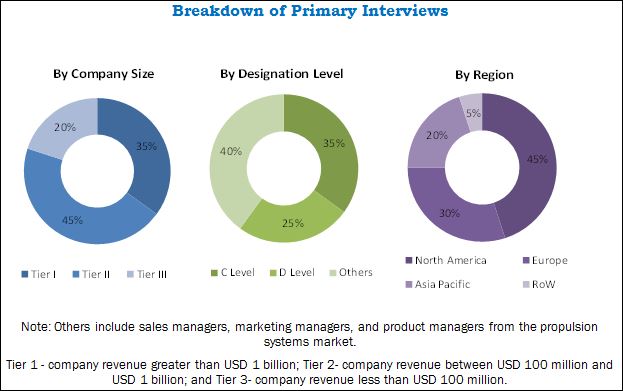
The research methodology used to estimate and forecast the propulsion systems market included study of data and revenues of the key players in the market through secondary resources, such as annual reports, Yahoo Finance, Federal Aviation Admiration (FAA), International Civil Aviation Organization (ICAO), International Air Transport Association (IATA), and Stockholm International Peace Research Institute (SIPRI). Bottom-up procedure was employed to arrive at the overall size of the market from the revenue of the key players in this market. After arriving at the overall market size, the market was split into several segments and subsegments, which were then verified through primary research by conducting extensive interviews of the key industry experts, such as CEOs, vice presidents, directors, and executives, among others. These data triangulation and market breakdown procedures were employed to complete the overall market engineering process and arrive at exact statistics for all segments and subsegments. Breakdown of profiles of primaries is depicted in the figure given below:
To know about the assumptions considered for the study, download the pdf brochure
Market Ecosystem
The ecosystem of the propulsion systems market comprises type and application. The propulsion systems value chain includes raw material manufacturers, such as Safran S.A. (France), Rolls-Royce Holdings plc. (U.K.), and General Electric Company (U.S.), among others. The key players operating in the propulsion systems market include United Technologies Corporation (U.S.), 3W International GmbH (Germany), Orbital ATK Inc. (U.S.), Aerojet Rocketdyne Holdings, Inc. (U.S.), and Honeywell International Inc. (U.S.), among others. Acquisitions and new product launches are the major strategies adopted by the key players operational in the propulsions systems market to strengthen their position in the market.
This report aims at helping manufacturers, suppliers, and distributors of propulsion systems, as well as manufacturers of sub-components to identify hot revenue pockets in the market.
Target Audience for this Report
- Propulsion System Manufacturers
- Original Equipment Manufacturers (OEMs)
- Sub-Component Manufacturers
- Technological Support Providers
- Government and Certification Bodies
- Aircraft Manufacturer Associations
- Manufacturers of Unmanned Aerial Vehicles and Drones
“This study answers several questions for stakeholders, primarily, which market segments to focus on during the next two to five years to prioritize their efforts and investments in the propulsion systems market.”
Scope of the Report:
Propulsion Systems Market, By Type
-
Air-Breathing
- Gas Turbines & Jet Engines
- Ramjets & Scramjets
- Internal Combustion
-
Non-Air Breathing
- Solid Propulsion
- Liquid Propulsion
- Hybrid Propulsion
- Electric Propulsion
Propulsion Systems Market, By Application
- Missiles
- Aircraft
- Spacecraft
- Unnamed Aerial Vehicles
Propulsion Systems Market, By Region
- North America
- Europe
- Asia-Pacific
- Middle East
- Rest of the World
Available Customizations
Along with market data, MarketsandMarkets offers customizations as per specific needs of companies. The following customization options are available for this report:
-
Geographic Analysis
- Further breakdown of the rest of the world propulsion systems market
-
Company Information
- Detailed analysis and profiling of additional market players (up to 5)
- Additional Segmentation











Growth opportunities and latent adjacency in Propulsion Systems Market