China Semiconductor Industry – Expansion Plans Analysis and Trends (Government Policies and Guidelines, Import and Export Impact on Trade Partners, Key Concepts, Case Study, Key Strategies Adopted, Future Plans, and Recommendation to Players) - 2035


China Semiconductor Industry Market Summary
The China Semiconductor Industry is entering a strategically important growth phase as semiconductor demand increasingly intersects with artificial intelligence (AI), connected devices, electric vehicles (EVs), industrial automation, cloud computing, and digital infrastructure. Based on current industry estimates and the broad range of semiconductor activities included in market definitions, the China Semiconductor Industry was valued at approximately USD 170–190 billion in 2024 and is estimated to reach around USD 185–215 billion in 2025. By 2035, the market could expand to approximately USD 350–410 billion, representing an estimated 7.0%–8.5% CAGR during the long-term forecast period.
Growth is being supported by China's enormous electronics manufacturing base, rising domestic semiconductor consumption, AI infrastructure investment, automotive electrification, 5G and IoT deployment, smart factories, robotics, and the localization of semiconductor manufacturing. At the same time, government-backed investment is encouraging development across integrated-circuit design, fabrication, packaging and testing, semiconductor materials, manufacturing equipment, and electronic design automation. The strategic emphasis on supply-chain resilience has become particularly important as restrictions on advanced semiconductor technologies accelerate domestic innovation and substitution.
Key Market Trends & Insights
AI is becoming a major semiconductor demand catalyst. The rapid deployment of generative AI, large language models, AI servers, edge AI, autonomous systems, and intelligent industrial equipment is increasing demand for processors, memory, accelerators, networking components, power semiconductors, and advanced packaging. Globally, semiconductor sales reached approximately USD 791.7 billion in 2025, with logic and memory among the fastest-growing categories, highlighting the scale of AI-related demand.
China remains one of the world's most strategically significant semiconductor markets. The country combines a huge electronics manufacturing ecosystem with substantial domestic demand from smartphones, computing, EVs, industrial equipment, telecommunications, and consumer electronics.
Mature-node manufacturing remains a major strength. Although advanced-node technologies remain a strategic priority, established process nodes are critical for automotive electronics, industrial controllers, power management, connectivity, sensors, microcontrollers, and IoT devices. China's foundry expansion is therefore not limited to leading-edge chips.
AI and automation are transforming semiconductor manufacturing itself. Semiconductor manufacturers increasingly use AI-based process monitoring, predictive maintenance, automated inspection, digital twins, machine learning-based yield optimization, and intelligent factory systems to improve throughput and reduce manufacturing variability.
Asia Pacific represents the fastest-growing strategic ecosystem. China, Japan, South Korea, Taiwan, and other Asian economies form an interconnected semiconductor manufacturing and electronics supply chain. For China, strengthening domestic capabilities across equipment, materials, memory, foundries, and packaging remains a central growth opportunity.
Localization is reshaping competitive strategies. Chinese companies are increasingly developing domestic alternatives for semiconductor equipment, materials, memory, processors, and manufacturing technologies. Recent developments also show greater emphasis on domestic intellectual-property protection and semiconductor design capabilities.
Market Size & Forecast
- Base year market size: Approximately USD 185–215 billion in 2025, based on a triangulation of China semiconductor market estimates and regional semiconductor sales data.
- Forecast value by 2035: Approximately USD 350–410 billion.
- Estimated CAGR: Approximately 7.0%–8.5% during the long-term forecast period.
- Growth factors: AI computing, memory demand, EV semiconductor adoption, industrial automation, IoT connectivity, 5G/6G infrastructure, domestic manufacturing, and semiconductor supply-chain localization.
- Long-term outlook: Advanced packaging, AI accelerators, power semiconductors, sensors, memory, foundry services, and semiconductor equipment are expected to create some of the strongest opportunities.
China Semiconductor Industry Market Top 10 key takeaway
- China's semiconductor industry is projected to maintain approximately 7.0%–8.5% long-term CAGR through 2035.
- The market could reach approximately USD 350–410 billion by 2035.
- AI accelerators, processors, memory, networking chips, and advanced packaging will become increasingly important.
- Automotive electronics and EVs will remain major semiconductor demand generators.
- Mature-node manufacturing represents a significant opportunity for domestic foundries.
- IoT, 5G, robotics, and industrial automation are expanding semiconductor consumption.
- Semiconductor equipment and materials localization is becoming strategically important.
- Memory technologies are emerging as a critical area of domestic capability development.
- Government policies and investment funds continue to influence semiconductor supply-chain development.
- Competition will increasingly center on technology, yield, cost, ecosystem integration, and supply-chain resilience.
Product Insights
The logic and processing segment represents one of the most strategically important product categories within the China Semiconductor Industry. Processors, microcontrollers, application-specific integrated circuits, AI accelerators, and system-on-chip devices are increasingly required across smartphones, data centers, industrial automation, automotive systems, telecommunications infrastructure, and intelligent consumer electronics. Globally, logic products generated approximately USD 301.9 billion in sales in 2025, making logic the largest semiconductor product category.
Memory is another high-potential product category. DRAM, NAND, and emerging high-bandwidth memory technologies are becoming increasingly important as AI workloads require greater data movement and memory bandwidth. China's memory ecosystem is expanding, with companies such as CXMT and YMTC strengthening domestic capabilities. Recent reporting indicates that CXMT has increased its position in global DRAM, demonstrating the growing competitiveness of China's memory industry.
Power semiconductors, discrete devices, sensors, MEMS, analog components, RF chips, and optoelectronic devices are also expected to benefit from EV adoption, industrial automation, renewable energy systems, robotics, and IoT deployment. These segments are particularly important because many applications do not require the smallest process node but instead prioritize reliability, power efficiency, cost, and manufacturing scale.
Technology / Component Insights
Semiconductor technology in China is moving toward a more integrated ecosystem covering chip design, wafer fabrication, packaging, testing, materials, and equipment. Advanced process technologies remain an important strategic objective, while mature and specialty nodes provide significant commercial opportunities across automotive, industrial, power, connectivity, and consumer applications.
AI is influencing both semiconductor products and manufacturing processes. AI-based electronic design automation can accelerate chip verification, design optimization, and layout analysis, while machine learning can identify manufacturing anomalies and optimize process parameters. Smart factories increasingly combine IoT sensors, edge computing, industrial networks, robotics, and AI analytics to monitor production equipment in real time.
Advanced packaging is expected to become increasingly important as conventional transistor scaling becomes more expensive. Chiplets, 2.5D and 3D packaging, high-bandwidth interconnects, heterogeneous integration, and advanced thermal management can enable greater computing performance without depending entirely on smaller process nodes.
China is also accelerating development of semiconductor manufacturing equipment and materials. Domestic equipment manufacturers are expanding in areas such as etching, deposition, cleaning, and other fabrication processes. Industry developments indicate that Chinese equipment companies are gaining relevance as semiconductor manufacturers seek greater supply-chain resilience.
Application Insights
Consumer electronics and communications remain major semiconductor applications because China has an extensive smartphone, computer, networking, display, and electronics manufacturing ecosystem. Semiconductor demand is increasingly shifting from conventional mobile processors toward AI-enabled devices, edge computing, connectivity, and intelligent consumer products.
Automotive applications represent another major growth engine. EVs, autonomous driving, advanced driver-assistance systems, battery management systems, power electronics, infotainment, connectivity, and vehicle networking require substantially more semiconductor content per vehicle. China's large EV manufacturing ecosystem therefore creates significant demand for microcontrollers, power semiconductors, sensors, processors, and connectivity chips.
Industrial automation is likely to become an increasingly important opportunity through 2035. Smart factories require sensors, controllers, industrial communication chips, machine-vision processors, motor-control devices, robotics components, and edge AI processors. The convergence of AI, IoT, robotics, and cloud platforms is creating a semiconductor-intensive industrial environment.
Data centers and AI infrastructure represent a particularly high-value opportunity. AI servers require high-performance processors, accelerators, memory, networking silicon, power-management components, and advanced cooling-related electronics. As AI computing expands, demand for domestic alternatives across this value chain is expected to remain strong.
Regional Insights
North America remains a leader in semiconductor innovation, chip design, AI computing, and semiconductor intellectual property, supported by strong technology companies, research institutions, venture investment, and advanced computing ecosystems. The United States continues to influence global semiconductor technology through processor architecture, AI accelerators, semiconductor software, manufacturing technology, and equipment.
Europe maintains important capabilities in automotive electronics, industrial semiconductors, power electronics, sensors, and semiconductor equipment. Germany and France are particularly important to automotive and industrial applications.
Asia Pacific is expected to remain the fastest-growing strategic semiconductor region, supported by China's manufacturing scale, Taiwan's foundry ecosystem, South Korea's memory leadership, Japan's semiconductor materials and equipment capabilities, and growing semiconductor investment across Southeast Asia and India.
- North America: Strongest position in semiconductor design, AI processors, software, and high-performance computing.
- Europe: Strong automotive, industrial, power semiconductor, and equipment ecosystem.
- Asia Pacific: Fastest-growing semiconductor manufacturing and consumption ecosystem.
- China: Major demand center with rapidly expanding domestic semiconductor capabilities.
- Regional outlook: Supply-chain diversification will increase investment across multiple Asian economies.
China-Specific Market Trends
China is the central market in this analysis and remains the dominant semiconductor ecosystem within the domestic country scope. Within Asia Pacific, China is expected to record approximately 7.0%–8.5% CAGR through 2035, while Japan could achieve approximately 4.5%–6.5% CAGR as demand develops around automotive, industrial, power, sensors, and semiconductor materials.
In North America, the United States is expected to maintain approximately 6.0%–8.0% CAGR, supported by AI infrastructure, semiconductor manufacturing investment, defense electronics, and data centers. Canada could grow at approximately 4.5%–6.5% CAGR, supported by semiconductor research, photonics, AI, and specialized electronics, while Mexico could achieve approximately 5.5%–7.5% CAGR as electronics and automotive manufacturing expand.
In Europe, Germany is positioned for approximately 5.5%–7.0% CAGR, supported by automotive electrification and industrial automation, while France could register approximately 5.0%–6.8% CAGR through semiconductor investment, aerospace, defense, automotive, and digital infrastructure.
China's government remains an important factor in semiconductor development through industrial policy, financing, tax incentives, infrastructure development, and support for domestic technology capabilities. China's long-standing policy objective has been to strengthen domestic capabilities across the semiconductor value chain, including design, manufacturing, equipment, materials, packaging, and testing.
- China: Strongest domestic semiconductor demand and localization momentum.
- Japan: Key supplier of semiconductor materials, equipment, sensors, and automotive technologies.
- United States: Strong leadership in AI chips, chip design, semiconductor equipment, and software.
- Germany: Major opportunity from automotive semiconductors and industrial automation.
- France: Growth supported by aerospace, defense, automotive, and advanced electronics.
Key China Semiconductor Industry Company Insights
The competitive landscape includes SMIC, Hua Hong Semiconductor, CXMT, YMTC, Huawei, NAURA, AMEC, JCET, Will Semiconductor, and Cambricon. These companies represent different portions of the semiconductor value chain, ranging from foundry and memory manufacturing to chip design, equipment, packaging, and AI processors.
SMIC remains strategically important for domestic foundry capacity and advanced manufacturing. Hua Hong Semiconductor is strengthening its position in specialty and mature-node manufacturing while expanding technological capabilities. CXMT is becoming increasingly important in memory, particularly DRAM, while YMTC focuses on NAND flash technologies.
Huawei continues to influence China's semiconductor ecosystem through chip design, AI computing, telecommunications, and vertically integrated technology development. Equipment manufacturers such as NAURA and AMEC are strategically important because domestic equipment availability can reduce dependence on overseas suppliers.
Packaging companies such as JCET benefit from rising chip complexity and the growing importance of advanced packaging. AI-chip developers such as Cambricon are positioned to benefit from demand for domestic AI computing solutions.
- Foundries are prioritizing capacity expansion, yield improvement, and specialty processes.
- Memory manufacturers are increasing investment in DRAM and NAND capabilities.
- AI-chip companies are developing domestic accelerators for data centers and edge applications.
- Equipment companies are expanding domestic alternatives for semiconductor fabrication.
- Packaging companies are investing in advanced packaging and heterogeneous integration.
Recent Developments
China's semiconductor landscape has experienced several important developments that could influence the market through 2035. First, Hua Hong's manufacturing ecosystem has advanced toward 7-nanometer process capabilities, a development that could broaden China's domestic ability to manufacture advanced chips and support AI-related applications.
Second, China's memory sector is gaining international attention. CXMT has increased its global DRAM presence, while demand from AI and data-center applications is creating opportunities for higher-performance memory products. Recent industry reporting has highlighted growing interest in Chinese memory chips from international electronics companies.
Third, domestic semiconductor equipment is becoming more strategically important. Chinese equipment manufacturers such as AMEC and NAURA are gaining attention as chipmakers seek greater local sourcing and resilience against potential export-control restrictions.
Market Segmentation
The China Semiconductor Industry can be segmented by product, technology/component, application, and region. By product, the market includes microprocessors, memory, sensors and MEMS, optoelectronics, analog/RF/mixed-signal devices, discrete semiconductors, and other integrated circuits. By technology and component, the ecosystem includes semiconductor manufacturing processes, fabrication equipment, semiconductor materials, packaging and testing, advanced packaging, and design technologies. By application, major areas include consumer electronics, automotive, industrial automation, communications, data centers, healthcare, aerospace and defense, and other electronics. By region, domestic activity is concentrated across major manufacturing and technology clusters in East China, North China, South China, Central China, and other emerging industrial regions. Independent market research similarly identifies sensors/MEMS, microprocessors, optoelectronics, memory, analog/RF/mixed signal, and discrete devices as important product categories.
- By Product: Memory, processors, sensors, analog/RF, discrete, and optoelectronics.
- By Technology/Component: Foundry, fabrication equipment, materials, packaging, testing, and advanced packaging.
- By Application: Consumer electronics, automotive, industrial, communications, AI/data centers, and healthcare.
- By Region: East China, North China, South China, Central China, and other emerging clusters.
- High-growth areas: AI chips, memory, power semiconductors, advanced packaging, sensors, and semiconductor equipment.
Conclusion
The China Semiconductor Industry is moving from a primarily demand-driven market toward a broader technology and supply-chain ecosystem. Between 2025 and 2035, the industry is expected to benefit from sustained AI adoption, IoT deployment, EV production, industrial automation, robotics, cloud computing, smart manufacturing, and digital transformation. The market could expand from approximately USD 185–215 billion in 2025 to USD 350–410 billion by 2035, implying a long-term CAGR of approximately 7.0%–8.5%.
AI will be particularly influential because it increases semiconductor requirements across processors, memory, networking, power management, sensors, and advanced packaging. At the same time, AI is improving semiconductor manufacturing through predictive maintenance, intelligent inspection, automated process control, digital twins, and machine-learning-based yield optimization.
The strategic importance of the China Semiconductor Industry will therefore extend beyond market growth. Semiconductor localization, technology sovereignty, supply-chain resilience, advanced packaging, domestic equipment, and AI computing capabilities are likely to shape competitive positioning throughout the next decade. Companies that successfully combine manufacturing scale with AI-enabled design, automation, cost efficiency, and technological innovation will be better positioned to capture opportunities through 2035.
FAQs
1. What is the current market size of the China Semiconductor Industry?
The China Semiconductor Industry is estimated at approximately USD 185–215 billion in 2025, depending on the market definition and semiconductor activities included.
2. What is the expected growth rate of the China Semiconductor Industry?
The China Semiconductor Industry is projected to grow at approximately 7.0%–8.5% CAGR through 2035. Growth will be supported by AI, IoT, automotive electronics, industrial automation, 5G/6G infrastructure, data centers, and domestic semiconductor manufacturing.
3. What are the key drivers of China's semiconductor industry?
Major drivers include AI computing, EVs, smart manufacturing, IoT, cloud infrastructure, telecommunications, consumer electronics, robotics, domestic supply-chain localization, and government-supported semiconductor investment.
4. Which region is leading the semiconductor industry?
North America remains a leader in semiconductor design, AI computing, intellectual property, and advanced technology, while Asia Pacific is the fastest-growing strategic manufacturing and consumption region. China is one of the world's largest semiconductor markets and is rapidly expanding domestic capabilities across the value chain.
5. Who are the key companies in the China Semiconductor Industry?
Major companies include SMIC, Hua Hong Semiconductor, CXMT, YMTC, Huawei, NAURA, AMEC, JCET, Will Semiconductor, and Cambricon. Their strategies span foundry manufacturing, memory, AI processors, semiconductor equipment, packaging, sensors, and other semiconductor technologies.
To speak to our analyst for a discussion on the above findings, click Speak to Analyst
 Exclusive indicates content/data unique to MarketsandMarkets and not available with any competitors.
Table of Contents
1 Introduction (Page No. - 12)
1.1 Objectives of the Study
1.2 Market Definition
1.3 Study Scope
1.3.1 Markets Covered
1.3.2 Years Considered for the Study
1.4 Currency
1.5 Market Stakeholders
2 Research Methodology (Page No. - 15)
2.1 Research Data
2.1.1 Secondary Data
2.1.1.1 Key Data From Secondary Sources
2.1.2 Primary Data
2.1.2.1 Key Data From Primary Sources
2.1.2.2 Key Industry Insights
2.1.2.3 Breakdown of Primaries
2.2 Market Size Estimation
2.2.1 Bottom-Up Approach
2.2.2 Top-Down Approach
2.3 Market Breakdown and Data Triangulation
2.4 Research Assumptions
3 Executive Summary (Page No. - 24)
4 Premium Insights (Page No. - 29)
4.1 Attractive Market Opportunities in Chiina Semiconductor Industry
4.2 China Semiconductor IC Industry, By Sector
4.3 List of Key Players in the Semiconductor Industry
4.3.1 Global Semiconductor Players
4.3.2 China Semiconductor Players
4.4 List of Favorable Plans for the Semiconductor Industry By the Government of China
4.4.1 Key Government Action Plans for China Semiconductor Industry
4.4.2 Other Government Regulations for China Semiconductor Industry
5 China Semiconductor Industry: Expansion Roadmap (Page No. - 34)
5.1 Policies and Guidelines Impacting the China Semiconductor Industry
5.1.1 China 12th Five–Year Plan
5.1.2 China 13th Five–Year Plan
5.1.3 Made in China 2025
5.1.4 National Semiconductor Industry Development Guidelines
5.1.5 Foreign Investment Industrial Guidance Catalogue, 2015
5.1.6 Others
5.2 Import and Export Impact on Neighboring Countries and Key Trade Partners
5.2.1 U.S.
5.2.2 Taiwan
5.2.3 Japan
5.2.4 South Korea
5.2.5 India
5.3 Key Concepts
5.3.1 IoT
5.3.2 5G, 4.5G, and LTE
5.3.3 Big Data
5.3.4 Cloud Computing
6 Market Overview (Page No. - 51)
6.1 Introduction
6.2 Industry Evolution
6.3 Market Segmentation
6.3.1 China Semiconductor Industry, By Component
6.3.2 China Semiconductor Market, By End User
6.4 Industry Dynamics
6.4.1 Drivers
6.4.1.1 Growing demand for semiconductors from major end-use verticals
6.4.1.2 Favorable government initiatives
6.4.2 Restraints
6.4.2.1 Increasing labor cost
6.4.2.2 Huge financial investment required for establishing a manufacturing base
6.4.3 Opportunities
6.4.3.1 Investment from foreign players
6.4.3.2 New emerging technological concepts
6.4.4 Challenges
6.4.4.1 IP Security Issue
6.4.4.2 Lack of advanced manufacturing capacities
7 Industry Trends (Page No. - 63)
7.1 Introduction
7.2 China Semiconductor Industry: Value Chain Analysis
7.3 Porter’s Five Forces Analysis
7.3.1 Threat of New Entrants
7.3.2 Threat of Substitutes
7.3.3 Bargaining Power of Suppliers
7.3.4 Bargaining Power of Buyers
7.3.5 Competitive Rivalry
7.4 China Semiconductor Industry PESTEL Analysis
7.4.1 Introduction
7.4.2 Political Factors
7.4.3 Economic Factors
7.4.4 Social Factors
7.4.5 Technological Factors
7.4.6 Environmental Factors
7.4.7 Legal Factors
7.4.8 Conclusion
8 China Semiconductor Industry Segments (Page No. - 79)
8.1 Introduction
8.2 China Semiconductor Market
8.2.1 Data Processing
8.2.2 Communications
8.2.3 Consumer Electronics
8.2.4 Automotive
8.2.5 Industrial
8.3 China Semiconductor Industry
8.3.1 IC Industry
8.3.1.1 IC Testing and Packaging
8.3.1.2 IC Manufacturing
8.3.1.3 IC Design
8.3.2 O-S-D Industry
9 Competitive Landscape (Page No. - 86)
9.1 Overview
9.2 Market Share Analysis
9.3 Competitive Scenario
9.3.1 Mergers & Acquisitions
9.3.2 Expansions and Investments
9.3.3 Alliances, Partnerships, and Joint Ventures
9.3.4 Agreements, Collaborations, and Contracts
10 Company Profiles (Page No. - 97)
(Business overview and financials, Products offered, Recent expansions, Future plans, Importers’ and exporters’ profile, and MnM view)*
10.1 Introduction
10.2 Global Players
10.2.1 Intel Corp.
10.2.2 Samsung Electronics Co., Ltd.
10.2.3 SK Hynix Inc.
10.2.4 Qualcomm Inc.
10.2.5 Micron Technology Inc.
10.3 Domestic Players
10.3.1 Hisilicon Technologies Co., Ltd.
10.3.2 Semiconductor Manufacturing International Corp. (SMIC)
10.3.3 Tianjin Zhonghuan Semiconductor Co., Ltd.
10.3.4 Jiangsu Changjiang Electronics Technology Co., Ltd. (JCET)
10.3.5 Spreadtrum Communications Inc.
*Details on financials might not be captured in case of unlisted companies
11 Conclusion (Page No. - 138)
11.1 Introduction
11.2 Case Study
11.2.1 Recommendation to Global Players
11.2.2 Recommendation to Domestic Players
12 Appendix (Page No. - 145)
12.1 Insights of Industry Experts
12.2 Discussion Guide
12.3 Knowledge Store: Marketsandmarkets’ Subscription Portal
12.4 Introducing RT: Real-Time Market Intelligence
12.5 Available Customizations
12.6 Related Reports
List of Tables (26 Tables)
Table 1 List of Top 20 Global Semiconductor Players
Table 2 Comparison of Targets Set and Achieved for the 12th Five-Year Plan
Table 3 13th Five-Year Plan Targets
Table 4 China's 2014 National IC Guideline Targets for Its Chip Industry
Table 5 Manufacturing Sectors Encouraged in Computer, Communication, and Other Electronic Equipment Manufacturing Segment
Table 6 U.S. Economic Factors Snapshot (2011–2015)
Table 7 Taiwan Economic Factors Snapshot (2011–2015)
Table 8 Japan Economic Factors Snapshot (2011–2015)
Table 9 South Korea Economic Factors Snapshot (2011–2015)
Table 10 India Economic Factors Snapshot (2011–2015)
Table 11 Porter’s Five Forces Analysis With Their Weightage Impact
Table 12 China: Country Snapshot
Table 13 Political Background of China (2015)
Table 14 Comparison of Economic Factors of China for 2013, 2014, and 2015
Table 15 Demographics of China (2015)
Table 16 Analysis of Technological Influence on China (2015)
Table 17 Analysis of Environment of China
Table 18 Global Semiconductor Industry Size, 2011–2020 (USD Billion)
Table 19 China Semiconductor Market, By End User, 2011–2020 (USD Billion)
Table 20 China Semiconductor Industry, By Component, 2011–2020 (USD Billion)
Table 21 China Semiconductor IC Industry, By Player Type, 2011–2020 (USD Billion)
Table 22 China Semiconductor IC Industry, By Sector, 2011–2020 (USD Billion)
Table 23 Mergers & Acquisitions in the China Semiconductor Market (January 2015–June 2016)
Table 24 Expansions and Investments in China Semiconductor Market (January 2015–June 2016)
Table 25 Alliances, Partnerships, and Joint Ventures in China Semiconductor Market (January 2015–June 2016)
Table 26 Agreements, Collaborations, and Contracts in China Semiconductor Market (January 2015–June 2016)
List of Figures (57 Figures)
Figure 1 China Semiconductor Industry: Research Design
Figure 2 Process Flow of Market Size Estimation
Figure 3 Market Size Estimation Methodology: Bottom-Up Approach
Figure 4 Market Size Estimation Methodology: Top-Down Approach
Figure 5 Data Triangulation
Figure 6 China Semiconductor Industry to Grow at A Higher Rate Than China Semiconductor Market During the Forecast Period
Figure 7 Global IC Manufacturers Expected to Hold the Largest Size of the China Semiconductor Industry Throughout the Forecast Period
Figure 8 China Semiconductor Industry, By Component and Sector, in 2016
Figure 9 China Semiconductor Market for Consumer Segment to Grow at the Highest Rate During the Forecast Period
Figure 10 Government Offerings in Terms of Incentives and Standards Expected to Attract Foreign and Domestic Players to the China Semiconductor Industry
Figure 11 IC Pacakaging & Testing to Dominate the China Semiconductor Industry During the Forecast Period
Figure 12 China IC's Fund Structure
Figure 13 Comparison Between Semiconductor Imports By China From Key Trade Countries, Between 2011 and 2015
Figure 14 Comparison Between Semiconductor Exports By China to Key Trade Countries, Between 2011 and 2015
Figure 15 Evolution of the Semiconductor Industry in China
Figure 16 Favorable Government Initiatives to Drive the Semiconductor Industry in China
Figure 17 Increasing Consumption of Semiconductors in the Consumer Sector in China (2014–2020)
Figure 18 Increasing Consumption of Semiconductors in the Communication Sector in China (2014–2020)
Figure 19 Increasing Consumption of Semiconductors in the Automotive Sector in China (2014–2020)
Figure 20 Increasing Consumption of Semiconductors in the Data Processing Sector in China (2014–2020)
Figure 21 Average Yearly Wages in the Manufacturing Sector in China (2008–2014)
Figure 22 Value Chain Analysis: Testing & Packaging Sector Contributes the Major Value in the China Semiconductor Industry
Figure 23 Porter’s Five Force Model for China Semiconductor Industry, 2016
Figure 24 Porter’s Five Forces Analysis
Figure 25 Medium Impact of Threat of New Entrants Because of Favorable Government Regulations
Figure 26 Low Impact of the Threat of Substitutes Due to Lack of Viable Alternatives
Figure 27 Low Impact of Bargaining Power of Suppliers Due to High Supplier Concentration
Figure 28 High Impact of Buyers’ Bargaining Power Owing to Price Sensitivity and Buyer Concentration vs Industry
Figure 29 High Degree of Competitive Rivalry in the Industry Because of High Industry Growth Rate
Figure 30 Semiconductor Industry Snapshot (2011–2020)
Figure 31 Data Processing Segment is the Major End User of Semiconductors in China During the Forecast Period
Figure 32 IC Holds Almost Two-Thirds of the Total Semiconductor Industry in China
Figure 33 Global Players Hold a Major Share of the China IC Industry
Figure 34 IC Design is the Fastest-Growing Sector of the China Semiconductor IC Industry
Figure 35 China Semiconductor Industry Global Players Adopted Mergers & Acquisition as the Key Growth Strategy Between January 2015 and June 2016
Figure 36 Industry Domestic Players Adopted Mergers and Acquisition as the Key Growth Strategy Between January 2015 and June 2016
Figure 37 Share of Top 5 Players in the China Semiconductor Industry, in 2015
Figure 38 China Semiconductor Market Evaluation Framework
Figure 39 Battle for the Market Share
Figure 40 Geographic Revenue Mix of Top 5 Semiconductor Manufacturers of China
Figure 41 Intel Corp.: Company Snapshot
Figure 42 Samsung Electronics Co., Ltd.: Company Snapshot
Figure 43 SK Hynix Inc.: Company Snapshot
Figure 44 Qualcomm Inc.: Company Snapshot
Figure 45 Micron Technology Inc. :Company Snapshot
Figure 46 Hisilicon Technologies Co., Ltd.: Company Snapshot
Figure 47 Semiconductor Manufacturing International Corp.: Company Snapshot
Figure 48 Tianjin Zhonghuan Semiconductor Co., Ltd.: Company Snapshot
Figure 49 Jiangsu Changjiang Electronics Technology Co., Ltd.: Company Snapshot
Figure 50 Industry Growth Analysis
Figure 51 China Semiconductor IC Industry Growth Analysis
Figure 52 China Semiconductor O-S-D Industry Growth Analysis
Figure 53 China Semiconductor IC Design Industry Growth Analysis
Figure 54 China Semiconductor IC Manufacturing Industry Growth Analysis
Figure 55 China Semiconductor IC Packaging and Testisng Industry Growth Analysis
Figure 56 Global Players in the China Semiconductor IC Industry
Figure 57 Domestic Players in the China Semiconductor IC Industry
Research Methodology:
This research involves the use of secondary sources, directories, and databases such as Hoovers, Bloomberg Businessweek, Factiva, and OneSource to identify and collect information useful for the extensive technical, market-oriented, and commercial study of the China semiconductor industry. Primary sources mainly comprise several industry experts from the core and related industries, along with preferred suppliers, manufacturers, distributors, service providers, reimbursement providers, technology developers, alliances, standards, and certification organizations related to various parts of the value chain of the industry. In-depth interviews have been conducted with various primary respondents, such as key industry participants, subject matter experts (SMEs), C-level executives of key players, and industry consultants, to obtain and verify critical qualitative and quantitative information as well as to assess prospects. The breakdown of the profiles of primaries has been depicted in the figure below:
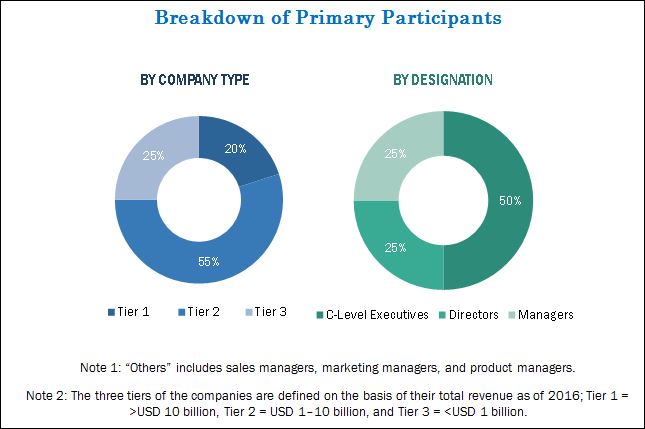
To know about the assumptions considered for the study, download the pdf brochure
In 2015, the China semiconductor industry was dominated by SK Hynix Inc. (South Korea), HiSilicon Technologies Co., Ltd. (China), Semiconductor Manufacturing International Corp. (SMIC) (China), Samsung Electronics Co., Ltd. (South Korea), and Micron Technology Inc. (US).
Key Target Audience:
- Semiconductor wafer and raw material suppliers
- Semiconductor design providers
- Semiconductor fabless and foundry players
- Packaging and testing players
- Integrated device manufacturers (IDMs)
- Electronic design automation (EDA) vendor
- OEMs
- Technology, service, and solution providers
- Suppliers and distributors
- Intellectual property (IP) core and licensing providers
- System integrators and device manufacturers
- Middleware providers
- Government and other regulatory bodies
- Technology investors
- Research institutes and organizations
- Market research and consulting firms
Scope of the Report:
In this research report, the China semiconductor industry is segmented as follows:
China Semiconductor Market, by End User
- Data Processing
- Communications
- Consumer
- Automotive
- Industrial
China Semiconductor Industry, by Component
-
IC
- IC Design
- IC Manufacturing
- IC Packaging and Testing
- O-S-D
Available Customizations:
With the given market data, MarketsandMarkets offers customizations according to the company’s specific needs. The following customization options are available for the report:
Company Information
Detailed analysis and profiling of additional market players on the basis of various blocks of the value chain













Growth opportunities and latent adjacency in China Semiconductor Industry
I am writing a thesis on the international impacts of China's semiconductor industry. I believe, this report would be instrumental to improving my background knowledge and research outcomes.
China Semiconductor Industry: Expansion Plans Analysis and Trends (Government Policies and Guidelines), Import and Export Impact on Trade Partners, Key Concepts, Case Study, Key Strategies Adopted, Future Plans, and Recommendation to Players are included in this study?