Deep Learning Market by Offering (Hardware, Software, and Services), Application (Image Recognition, Signal Recognition, Data Mining), End-User Industry (Security, Marketing, Healthcare, Fintech, Automotive, Law), and Geography Forecast To (2025 - 2035)


Deep Learning Market Overview (2025-2035)
The global deep learning market was valued at USD 25.40 billion in 2024 and is estimated to reach USD 506.75 billion by 2035, at a CAGR of 31.7% between 2025 and 2035.
The Deep Learning Market is poised for robust growth between 2025 and 2035, driven by increasing adoption of artificial intelligence technologies across industries and the growing need for advanced data analytics. Deep learning models, which simulate human neural networks, are enabling organizations to achieve greater accuracy and efficiency in pattern recognition, predictive modeling, and decision-making processes. The expanding use of deep learning in security, healthcare, marketing, and automotive applications is expected to significantly accelerate market expansion throughout the forecast period.
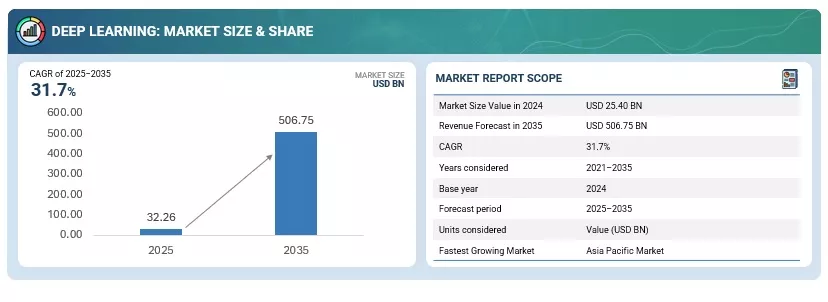
Deep learning technology is experiencing significant growth due to advancements in data center capabilities and high computing power. Its ability to perform tasks autonomously, without human intervention, is a key driver. Additionally, the widespread adoption of cloud-based technology across diverse industries is further accelerating the expansion of the deep learning industry.
Get More Information on Market | Download PDF Sample :
https://www.marketsandmarkets.com/pdfdownloadNewNew.asp?id=107369271
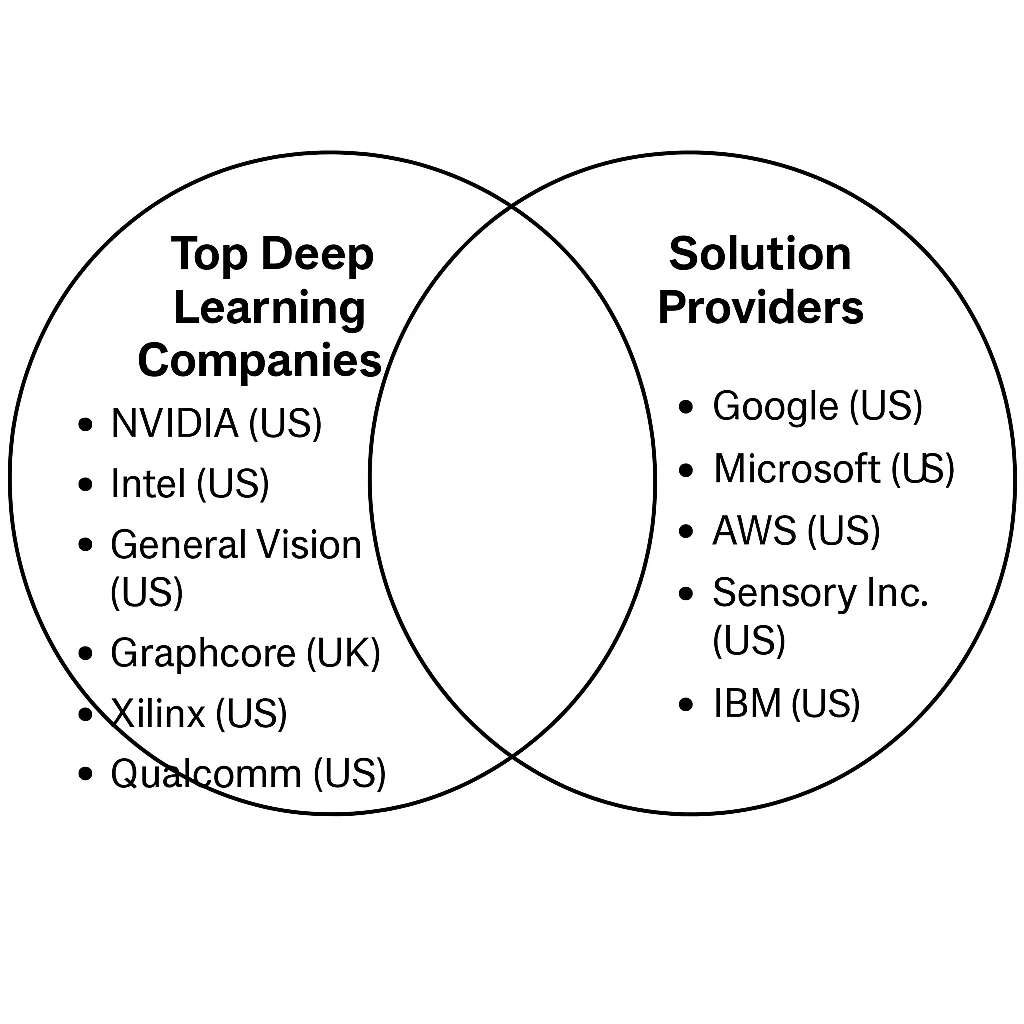
Top deep learning Companies:
- NVIDIA (US),
- Intel (US),
- General Vision (US),
- Graphcore (UK),
- Xilinx (US),
- Qualcomm (US);
Solution Providers Such as
- Google (US),
- Microsoft (US),
- AWS (US),
- Sensory Inc. (US),
- IBM (US).
The deep learning key hardware manufacturers are
- Samsung Electronics (South Korea),
- Micron Technology (US), and
- Mellanox Technologies (Israel).
Deep learning technology has seen significant growth thanks to advancements in neural network architecture, training algorithms, and GPU technology. The rise of robots, IoT, cybersecurity, industrial automation, and machine vision has generated vast amounts of data across various sectors. This data is crucial for training deep learning algorithms, which are increasingly used for diagnostics and testing purposes.
AI applications such as image and speech recognition have been transformed by deep learning, a subset of machine learning (ML). The increasing interest in machine learning can be attributed to its capacity to automate predictive analytics. Deep learning is being used by businesses more and more to improve sales workflows, streamline operations, and boost product development. Furthermore, new neural networks are increasingly employed for tasks like text translation and picture classification, and improvements in machine learning approaches have increased model accuracy.
By Offering
Hardware:
The hardware segment continues to play a crucial role in powering complex deep learning models. The demand for GPUs, ASICs, and high-performance computing systems is increasing as enterprises require faster processing and greater scalability for training deep neural networks. Cloud-based hardware infrastructure and edge computing are also gaining prominence, allowing real-time analytics and reduced latency in data-intensive environments.
Software:
Software forms the backbone of deep learning implementation, with frameworks such as TensorFlow, PyTorch, and Keras driving innovation. The growing availability of open-source software and customized development environments is accelerating adoption among developers and enterprises. Software solutions are increasingly being integrated with cloud platforms, providing greater flexibility and scalability for AI-based workflows.
Services:
The services segment includes consulting, integration, deployment, and maintenance services that support the seamless adoption of deep learning technologies. Managed service providers are helping enterprises reduce operational costs while enabling faster model deployment. With businesses striving to leverage AI capabilities, demand for professional and managed services is expected to rise significantly during the forecast period.
By Application
Image Recognition:
Image recognition remains the leading application area for deep learning, particularly in security surveillance, medical imaging, autonomous vehicles, and retail analytics. The ability to identify objects, patterns, and anomalies from images and videos with high precision continues to drive adoption in both enterprise and government sectors.
Signal Recognition:
Signal recognition applications are expanding across telecommunications, defense, and financial services. Deep learning algorithms are being used to analyze speech, sound, and sensor data to detect patterns and optimize real-time responses. The growing use of IoT-enabled devices and 5G networks is expected to further strengthen this segment’s growth trajectory.
Data Mining:
Data mining powered by deep learning is enabling organizations to extract actionable insights from large volumes of structured and unstructured data. From sentiment analysis and fraud detection to predictive maintenance and market forecasting, deep learning-based data mining is transforming how businesses make strategic decisions. The increasing volume of enterprise data will continue to fuel advancements in this application segment.
By End-User Industry
Security:
Deep learning technologies are redefining the security landscape by improving facial recognition, intrusion detection, and threat intelligence systems. Organizations are adopting AI-driven video analytics and biometric solutions to enhance situational awareness and automate incident response.
Marketing:
In marketing, deep learning algorithms are enabling more accurate customer segmentation, recommendation systems, and campaign optimization. Businesses are using AI-powered analytics to predict consumer behavior and personalize interactions, leading to improved engagement and ROI.
Healthcare:
Healthcare is emerging as a key adopter of deep learning, with applications in medical image analysis, diagnostics, drug discovery, and patient monitoring. AI models are being deployed to detect diseases at earlier stages, streamline clinical workflows, and enhance treatment accuracy.
Fintech:
In the financial sector, deep learning is driving innovations in fraud detection, risk assessment, algorithmic trading, and credit scoring. The ability to process complex data sets in real time is transforming the way financial institutions manage security and regulatory compliance.
Automotive:
The automotive industry is leveraging deep learning for autonomous driving, driver assistance systems, and predictive maintenance. AI-powered sensors and computer vision technologies are improving safety, navigation, and vehicle performance.
Law:
In the legal industry, deep learning is supporting predictive analytics, contract analysis, and case outcome prediction. Legal tech firms are using AI to automate document review and streamline e-discovery, helping professionals manage large-scale information more efficiently.
By Geography
North America:
North America dominates the global deep learning market, supported by strong investment in AI research, a high concentration of technology firms, and early adoption across industries such as healthcare and automotive. The United States remains a leader in innovation, with universities and enterprises driving R&D efforts.
Europe:
Europe is witnessing steady growth, with countries like the United Kingdom, Germany, and France adopting deep learning for manufacturing automation, healthcare advancement, and smart city initiatives. Data privacy regulations such as GDPR are influencing the region’s AI strategy and shaping deployment frameworks.
Asia Pacific:
Asia Pacific is expected to register the highest growth rate during the forecast period. Rapid digital transformation in China, India, Japan, and South Korea, combined with government-led AI initiatives, is fueling adoption across financial, manufacturing, and retail sectors.
Rest of the World:
The Middle East, Africa, and Latin America are gradually embracing deep learning applications in security, energy, and infrastructure. Growing investment in digital infrastructure and AI-driven modernization programs is expected to unlock new opportunities in these emerging regions.
Study Objectives
- To define, describe, segment, and forecast the market, in terms of value, by offering, application, end-user industry, and geography
- To define, describe, segment, and forecast the market, in terms of volume, by offering in deep learning
- To forecast the market size for various segments with respect to 4 main regions - North America, Europe, Asia Pacific (APAC), and Rest of the World (RoW)
- To provide detailed information regarding the major factors (drivers, restraints, opportunities, and challenges) influencing the growth of the deep learning market
- To strategically analyze the micromarkets with respect to individual growth trends, prospects, and contributions to the total market
- To analyze opportunities in the market for stakeholders and detail the competitive landscape for market players of deep learning
- To strategically profile key players and comprehensively analyze their market rankings and core competencies
- To analyze competitive developments such as new product developments/product launches, partnerships, agreements, collaborations, and research and development (R&D) activities in the deep learning market
To estimate the size of the deep learning market, top-down and bottom-up approaches are followed in the study. The entire research methodology includes the study of annual and financial reports, presentations, and press releases of the top players of deep learning; white papers such as The Zettabyte Era: Trends and Analytics by Cisco Systems (US), Big Data (Artificial Intelligence) by EU Business Innovation Industry, The New Wave of Artificial Intelligence by Evry A/S (Norway), AI Meets Big Data by Umbel (US), and Methods and Applications by Li Deng and Dong Yu; and interviews with industry experts in deep learning. The overall market size is used in the top-down procedure to estimate the sizes of other individual markets via percentage splits from secondary and primary research for deep learning market.
Target Audience
- Chipset manufacturers
- Cloud service providers
- Commercial banks
- Deep learning/machine learning solution providers
- Device manufacturers
- DL platform providers
- Investors and venture capitalists
- Manufacturers and people implementing AI technology
- Raw material and manufacturing equipment suppliers
- Research organizations, universities, and consulting companies
- Semiconductor companies
- System integrators
- Technology investors
- Technology providers
Deep Learning Market Scope
By Offering
-
Hardware
-
Processor
- GPU
- FPGA
- CPU
- Others (TPU, DPU, VPU, BPU, and IPU)
- Memory
- Network
-
Processor
-
Software
- Solution (Software Framework/SDK)
- Platform/API
-
Services
- Installation
- Training
- Support & Maintenance
Deep Learning Market, by Application
- Image Recognition
- Signal Recognition
- Data Mining
- Others (Recommender System and Drug Discovery)
Market, by End-User Industry
-
Healthcare
- Patient Data & Risk Analysis
- Lifestyle Management & Monitoring
- Precision Medicine
- Inpatient Care & Hospital Management
- Medical Imaging & Diagnostics
- Drug Discovery
- Virtual Assistant
- Wearables
- Research
-
Manufacturing
- Material Movement
- Predictive Maintenance and Machinery Inspection
- Production Planning
- Field Services
- Reclamation
- Quality Control
-
Automotive
- Autonomous Driving
- Human–Machine Interface
- Semiautonomous Driving
-
Agriculture
- Precision Farming
- Livestock Monitoring
- Drone Analytics
- Agricultural Robots
- Others
-
Retail
- Product Recommendation and Planning
- Customer Relationship Management
- Visual Search
- Virtual Assistant
- Price Optimization
- Payment Services Management
- Supply Chain Management and Demand Planning
- Others
-
Security
- Identity and Access Management
- Risk and Compliance Management
- Encryption
- Data Loss Prevention
- Unified Threat Management
- Antivirus/Antimalware
- Intrusion Detection/Prevention Systems
- Others (Firewall, Distributed Denial-of-Service (DDoS), Disaster Recovery)
-
Human Resources
- Virtual Assistant
- Sentiment Analysis
- Scheduling Group Meetings and Interviews
- Personalized Learning and Development
- Applicant Tracking & Assessment
- Employee Engagement
- Resume Analysis
-
Marketing
- Social Media Advertising
- Search Advertising
- Dynamic Pricing
- Virtual Assistant
- Content Curation
- Sales & Marketing Automation
- Analytics Platform
- Others (Website Design and Emotion Measurement)
-
Law
- eDiscovery
- Legal Research
- Contract Analysis
- Case Prediction
- Compliance
- Others (Intellectual Property, e-Billing, Knowledge Management)
-
Fintech
- Virtual Assistant
- Business Analytics & Reporting
- Customer Behavior Analytics
- Others (Market Research, Advertising, Market Campaign)
By Geography
-
North America
- US
- Canada
- Mexico
-
Europe
- UK
- Germany
- France
- Italy
- Spain
- Rest of Europe
-
APAC
- China
- Japan
- South Korea
- India
- Rest of APAC
-
RoW
- Middle East and Africa
- South America
Available Customizations
With the given market data, MarketsandMarkets offers customizations according to the company’s specific needs. The following customization options are available for the deep learning report:
Geographic Analysis
- Country-wise breakdown of various geographies, including North America, Europe, APAC, and RoW
- Market segmentation of various end-user industries into application segments
- Comprehensive coverage of regulations followed in each region (North America, APAC, Europe, and RoW)
Company Information
- Detailed analysis and profiling of additional market players (up to 5)
The key restraining factors for this market are increasing complexity in hardware due to complex algorithm used in deep learning technology; and the lack of technical expertise and absence of standards and protocols.
Leading deep learning market players have adopted both organic and inorganic growth strategies to maintain strong foothold in the market. Collaborations, product launches, new product developments, and partnerships have been deep learning key growth strategies adopted by the leading players such as NVIDIA, IBM, Intel, Google, and Microsoft. Intel shipped the industry’s first silicon for neural network processor, Intel Nervana Neural Network Processor (NNP). Using Intel Nervana technology, end-user companies will be able to develop entirely new classes of AI applications that maximize the amount of data processed and enable customers to find greater insights transforming their businesses by deep learning.
To speak to our analyst for a discussion on the above findings, click Speak to Analyst
FAQ
1. What is Deep Learning?
Answer:
Deep learning is a subset of artificial intelligence that uses neural networks with multiple layers to analyze complex data patterns and make predictions or decisions.
2. What drives the growth of the Deep Learning Market?
Answer:
Rising adoption of AI-based solutions, growth in big data analytics, and advancements in computing power are key market drivers.
3. Which industries are major users of Deep Learning technology?
Answer:
Deep learning is widely used in automotive, healthcare, finance, retail, manufacturing, and IT & telecommunications.
4. What are the key applications of Deep Learning?
Answer:
Major applications include image recognition, natural language processing, speech recognition, autonomous driving, and predictive analytics.
5. What challenges does the Deep Learning Market face?
Answer:
High computational costs, data privacy issues, and a shortage of skilled professionals are major challenges.
 Exclusive indicates content/data unique to MarketsandMarkets and not available with any competitors.
Table of Contents
1 Introduction (Page No. - 18)
1.1 Study Objectives
1.2 Definition
1.3 Study Scope
1.3.1 Markets Covered
1.3.2 Years Considered for This Study
1.4 Currency
1.5 Stakeholders
2 Research Methodology (Page No. - 21)
2.1 Research Data
2.1.1 Secondary and Primary Research
2.1.1.1 Key Industry Insights
2.1.2 Secondary Data
2.1.2.1 Major Secondary Sources
2.1.2.2 Secondary Sources
2.1.3 Primary Data
2.1.3.1 Primary Interviews With Experts
2.1.3.2 Breakdown of Primaries
2.1.3.3 Primary Sources
2.2 Market Size Estimation
2.2.1 Bottom-Up Approach
2.2.1.1 Approach for Capturing Market Share By Bottom-Up Analysis (Demand Side)
2.2.2 Top-Down Approach
2.2.2.1 Approach for Capturing Market Share By Top-Down Analysis (Supply Side)
2.3 Market Breakdown and Data Triangulation
2.4 Research Assumptions
3 Executive Summary (Page No. - 31)
4 Premium Insights (Page No. - 37)
4.1 Attractive Opportunities in Market
4.2 Deep Learning Market, By Offering
4.3 Market, By Hardware
4.4 Market in APAC, By End-User Industry and Country
4.5 Market, By Country
5 Market Overview (Page No. - 41)
5.1 Introduction
5.2 Market Dynamics
5.2.1 Drivers
5.2.1.1 Improving Computing Power and Declining Hardware Cost
5.2.1.2 Increasing Adoption of Cloud-Based Technology
5.2.1.3 Deep Learning Usage in Big Data Analytics
5.2.1.4 Growing AI Adoption in Customer-Centric Services
5.2.2 Restraints
5.2.2.1 Increasing Complexity in Hardware Due to Complex Algorithm Used in Technology
5.2.2.2 Lack of Technical Expertise and Absence of Standards and Protocols
5.2.3 Opportunities
5.2.3.1 Presence of Limited Structured Data to Increase Demand for Deep Learning Solutions
5.2.3.2 Cumulative Spending in Healthcare, Travel, Tourism, and Hospitality Industries
5.2.4 Challenges
5.2.4.1 Lack of Flexibility and Multitasking
5.2.4.2 Deployment of Dl for Applications Such as NLP in Regional Dialects
5.3 Value Chain Analysis
5.4 Some of the Prominent Ml Libraries (Software Frameworks)
6 Deep Learning Market, By Offering (Page No. - 49)
6.1 Introduction
6.2 Hardware
6.2.1 Processor
6.2.2 Memory
6.2.3 Network
6.3 Software
6.3.1 Solution (Software Framework/SDK)
6.3.2 Platform/API
6.4 Services
6.4.1 Installation
6.4.2 Training
6.4.3 Support & Maintenance
7 Market, By Application (Page No. - 62)
7.1 Introduction
7.2 Image Recognition
7.3 Signal Recognition
7.4 Data Mining
7.5 Others (Recommender System and Drug Discovery)
8 Market, By End-User Industry (Page No. - 69)
8.1 Introduction
8.2 Healthcare
8.2.1 Patient Data & Risk Analysis
8.2.2 Lifestyle Management & Monitoring
8.2.3 Precision Medicine
8.2.4 Inpatient Care & Hospital Management
8.2.5 Medical Imaging & Diagnostics
8.2.6 Drug Discovery
8.2.7 Virtual Assistant
8.2.8 Wearables
8.2.9 Research
8.3 Manufacturing
8.3.1 Material Movement
8.3.2 Predictive Maintenance and Machinery Inspection
8.3.3 Production Planning
8.3.4 Field Services
8.3.5 Reclamation
8.3.6 Quality Control
8.4 Automotive
8.4.1 Autonomous Driving
8.4.2 Human–Machine Interface
8.4.3 Semiautonomous Driving
8.5 Agriculture
8.5.1 Precision Farming
8.5.2 Livestock Monitoring
8.5.3 Drone Analytics
8.5.4 Agricultural Robots
8.5.5 Others
8.6 Retail
8.6.1 Product Recommendation and Planning
8.6.2 Customer Relationship Management
8.6.3 Visual Search
8.6.4 Virtual Assistant
8.6.5 Price Optimization
8.6.6 Payment Services Management
8.6.7 Supply Chain Management and Demand Planning
8.6.8 Others
8.7 Security
8.7.1 Identity and Access Management (IAM)
8.7.2 Risk and Compliance Management
8.7.3 Encryption
8.7.4 Data Loss Prevention
8.7.5 Unified Threat Management
8.7.6 Antivirus/Antimalware
8.7.7 Intrusion Detection/Prevention Systems
8.7.8 Others
8.8 Human Resources
8.8.1 Virtual Assistant
8.8.2 Sentiment Analysis
8.8.3 Scheduling Group Meetings and Interviews
8.8.4 Personalized Learning and Development
8.8.5 Applicant Tracking & Assessment
8.8.6 Employee Engagement
8.8.7 Resume Analysis
8.9 Marketing
8.9.1 Social Media Advertising
8.9.2 Search Advertising
8.9.3 Dynamic Pricing
8.9.4 Virtual Assistant
8.9.5 Content Curation
8.9.6 Sales & Marketing Automation
8.9.7 Analytics Platform
8.9.8 Others
8.10 Law
8.10.1 Ediscovery
8.10.2 Legal Research
8.10.3 Contract Analysis
8.10.4 Case Prediction
8.10.5 Compliance
8.10.6 Others
8.11 Fintech
8.11.1 Virtual Assistant
8.11.2 Business Analytics and Reporting
8.11.3 Customer Behavior Analytics
8.11.4 Others
9 Geographic Analysis (Page No. - 109)
9.1 Introduction
9.2 North America
9.2.1 US
9.2.2 Canada
9.2.3 Mexico
9.3 Europe
9.3.1 UK
9.3.2 Germany
9.3.3 France
9.3.4 Italy
9.3.5 Spain
9.3.6 Rest of Europe
9.4 APAC
9.4.1 China
9.4.2 Japan
9.4.3 South Korea
9.4.4 India
9.4.5 Rest of APAC
9.5 RoW
9.5.1 Middle East and Africa
9.5.2 South America
10 Competitive Landscape (Page No. - 138)
10.1 Overview
10.2 Ranking Analysis: Deep Learning Market
10.3 Competitive Situation and Trend
10.3.1 New Product Developments and Launches
10.3.2 Collaborations and Partnerships
10.3.3 Acquisitions
10.3.4 Others
11 Company Profiles (Page No. - 154)
(Business Overview, Products Offered, Recent Developments, SWOT Analysis, and MnM View)*
*Details on Business Overview, Products Offered, Recent Developments, SWOT Analysis, and MnM View might not be captured in case of unlisted companies.
11.1 Key Players
11.1.1 Amazon Web Services (AWS)
11.1.2 Google
11.1.3 IBM
11.1.4 Intel
11.1.5 Micron Technology
11.1.6 Microsoft
11.1.7 Nvidia
11.1.8 Qualcomm
11.1.9 Samsung Electronics
11.1.10 Sensory Inc.
11.1.11 Skymind
11.1.12 Xilinx
11.2 Other Companies
11.2.1 AMD
11.2.2 General Vision
11.2.3 Graphcore
11.2.4 Mellanox Technologies
11.2.5 Huawei Technologies
11.2.6 Fujitsu
11.2.7 Baidu
11.2.8 Mythic
11.2.9 Adapteva, Inc.
11.2.10 Koniku
11.2.11 Tenstorrent
*Details on Business Overview, Products Offered, Recent Developments, SWOT Analysis, and MnM View Might Not Be Captured in Case of Unlisted Companies.
12 Appendix (Page No. - 200)
12.1 Insights of Industry Experts
12.2 Discussion Guide
12.3 Knowledge Store: Marketsandmarkets’ Subscription Portal
12.4 Introducing RT: Real-Time Market Intelligence
12.5 Available Customizations
12.6 Related Reports
12.7 Author Details
List of Tables (68 Tables)
Table 1 Price Comparison: AI Chipsets (Leading Companies)
Table 2 Companies Offering Cloud Services for Deep/Machine Learning
Table 3 Machine Learning Libraries By Various Market Players (2015–2017)
Table 4 Market, By Offering, 2015–2023 (USD Million)
Table 5 Industry Players in Market, 2017
Table 6 Market, By Hardware, 2015–2023 (USD Million)
Table 7 Market, By Processor, 2015–2023 (USD Million)
Table 8 Market, By Processor, 2015–2023 (Thousand Units)
Table 9 Hardware Market, By Application, 2015–2023 (USD Million)
Table 10 Hardware Market, By End-User Industry, 2015–2023 (USD Million)
Table 11 Market, By Software, 2015–2023 (USD Million)
Table 12 Software Market, By Application, 2015–2023 (USD Million)
Table 13 Software Market, By End-User Industry, 2015–2023 (USD Million)
Table 14 Market, By Service, 2015–2023 (USD Million)
Table 15 Service Market, By Application, 2015–2023 (USD Million)
Table 16 Market, By End-User Industry, 2015–2023 (USD Million)
Table 17 Market, By Application, 2015–2023 (USD Million)
Table 18 Market for Image Recognition, By Offering, 2015–2023 (USD Million)
Table 19 Market for Signal Recognition, By Offering, 2015–2023 (USD Million)
Table 20 Market for Data Mining, By Offering, 2015–2023 (USD Million)
Table 21 Market for Others, By Offering, 2015–2023 (USD Million)
Table 22 Market, By End-User Industry, 2015–2023 (USD Million)
Table 23 Market for Healthcare, By Offering, 2015–2023 (USD Million)
Table 24 Market for Healthcare, By Application, 2015–2023 (USD Million)
Table 25 Market for Manufacturing, By Offering, 2015–2023 (USD Million)
Table 26 Market for Manufacturing, By Application, 2015–2023 (USD Million)
Table 27 Market for Automotive, By Offering, 2015–2023 (USD Million)
Table 28 Market for Automotive, By Application, 2015–2023 (USD Million)
Table 29 Market for Agriculture, By Offering, 2015–2023 (USD Million)
Table 30 Industry for Agriculture, By Application, 2015–2023 (USD Million)
Table 31 Market for Retail, By Offering, 2015–2023 (USD Million)
Table 32 Industry for Retail, By Application, 2015–2023 (USD Million)
Table 33 Industry for Security, By Offering, 2015–2023 (USD Million)
Table 34 Market for Security, By Application, 2015–2023 (USD Million)
Table 35 Market for HR, By Offering, 2015–2023 (USD Million)
Table 36 Industry for HR, By Application, 2015–2023 (USD Million)
Table 37 Market for Marketing, By Offering, 2015–2023 (USD Million)
Table 38 Market for Marketing, By Application, 2015–2023 (USD Million)
Table 39 Market for Law, By Offering, 2015–2023 (USD Million)
Table 40 Industry for Law, By Application, 2015–2023 (USD Million)
Table 41 Market for Fintech, By Offering, 2015–2023 (USD Million)
Table 42 Industry for Fintech, By Application, 2015–2023 (USD Million)
Table 43 Market, By Region, 2015–2023 (USD Million)
Table 44 Market in North America, By Country, 2015–2023 (USD Million)
Table 45 Industry in US, By End-User Industry, 2015–2023 (USD Million)
Table 46 Market in Canada, By End-User Industry, 2015–2023 (USD Million)
Table 47 Industry in Mexico, By End-User Industry, 2015–2023 (USD Million)
Table 48 Market in Europe, By Country, 2015–2023 (USD Million)
Table 49 Industry in UK, By End-User Industry, 2015–2023 (USD Million)
Table 50 Market in Germany, By End-User Industry, 2015–2023 (USD Million)
Table 51 Market in France, By End-User Industry, 2015–2023 (USD Million)
Table 52 Market in Italy, By End-User Industry, 2015–2023 (USD Million)
Table 53 Market in Spain, By End-User Industry, 2015–2023 (USD Million)
Table 54 Market in Rest of Europe, By End-User Industry, 2015–2023 (USD Million)
Table 55 Industry in APAC, By Country, 2015–2023 (USD Million)
Table 56 Market in China, By End-User Industry, 2015–2023 (USD Million)
Table 57 Market in Japan, By End-User Industry, 2015–2023 (USD Million)
Table 58 Market in South Korea, By End-User Industry, 2015–2023 (USD Million)
Table 59 Market in India, By End-User Industry, 2015–2023 (USD Million)
Table 60 Market in Rest of APAC, By End-User Industry, 2015–2023 (USD Million)
Table 61 Market in RoW, By Region, 2015–2023 (USD Million)
Table 62 Market in Middle East and Africa, By End-User Industry, 2015–2023 (USD Million)
Table 63 Market in South America, By End-User Industry, 2015–2023 (USD Million)
Table 64 Ranking of Key Companies in Market (2017)
Table 65 New Product Developments and Launches (2015–2017)
Table 66 Collaborations and Partnerships (2015–2017)
Table 67 Acquisitions (2015–2017)
Table 68 Others (2015–2017)
List of Figures (52 Figures)
Figure 1 Market Segmentation
Figure 2 Market: Research Design
Figure 3 Market Size Estimation Methodology: Bottom-Up Approach
Figure 4 Market Size Estimation Methodology: Top-Down Approach
Figure 5 Data Triangulation
Figure 6 Market, By Offering, 2018 vs 2023 (USD Billion)
Figure 7 Market, By Processor, 2015–2023 (USD Billion)
Figure 8 Market, By Application, 2018 vs 2023 (USD Billion)
Figure 9 Market, By End-User Industry, 2018 vs 2023
Figure 10 Market, By Region, 2018
Figure 11 Improving Computing Power and Declining Hardware Cost Driving Market
Figure 12 Software to Hold Largest Size of Market By 2023
Figure 13 Processor to Hold Largest Share of Market By 2023
Figure 14 China Expected to Hold Largest Share of Market in APAC in 2018
Figure 15 Market in China to Grow at Highest CAGR During Forecast Period
Figure 16 Increasing Adoption of Cloud-Based Technology and Usage in Big Data Analytics Driving Market
Figure 17 Value Chain Analysis: Major Value Added During Manufacturing and Testing Phases
Figure 18 Market, By Offering
Figure 19 Processor Market for Others to Grow at Highest CAGR During Forecast Period
Figure 20 Software Market for Data Mining to Grow at Highest CAGR During Forecast Period
Figure 21 Image Recognition to Hold Major Share of Market Between 2018 and 2023
Figure 22 Market (Others) for Services to Grow at Highest CAGR During Forecast Period
Figure 23 Market for Manufacturing to Grow at Highest CAGR During Forecast Period
Figure 24 Predictive Maintenance and Machinery Inspection to Hold Largest Size of Market for Manufacturing During Forecast Period
Figure 25 Software to Hold Largest Share of Market for Automotive During Forecast Period
Figure 26 Precision Farming to Hold Largest Size of Market for Agriculture During Forecast Period
Figure 27 Antivirus/Antimalware to Hold Largest Size of Market for Security By 2023
Figure 28 Market (HR) for Applicant Tracking & Assessment to Grow at Highest CAGR During Forecast Period
Figure 29 Search Advertising to Hold Largest Share of Market for Marketing During Forecast Period
Figure 30 Market (Fintech) for Virtual Assistant to Grow at Highest CAGR Between 2018 and 2023
Figure 31 Market Geographic Snapshot (2018–2023)
Figure 32 Market in APAC to Grow at Highest CAGR From 2018 to 2023
Figure 33 Market Snapshot: North America
Figure 34 Healthcare to Hold Largest Size of Market in Mexico By 2023
Figure 35 Market Snapshot: Europe
Figure 36 Healthcare to Hold Largest Size of French Market By 2023
Figure 37 Market Snapshot: APAC
Figure 38 Marketing to Hold Largest Size of Market in China By 2023
Figure 39 Market Snapshot: RoW
Figure 40 Security to Hold Largest Share of Market in Middle East & Africa By 2023
Figure 41 Companies Adopted Collaboration as Key Growth Strategy Between 2015 and 2017
Figure 42 New Product Developments–Key Strategy Adopted By Players Between 2015 and 2017
Figure 43 AWS: Company Snapshot
Figure 44 Google: Company Snapshot
Figure 45 IBM: Company Snapshot
Figure 46 Intel: Company Snapshot
Figure 47 Micron Technology: Company Snapshot
Figure 48 Microsoft: Company Snapshot
Figure 49 Nvidia: Company Snapshot
Figure 50 Qualcomm Technologies: Company Snapshot
Figure 51 Samsung Electronics: Company Snapshot
Figure 52 Xilinx: Company Snapshot













Growth opportunities and latent adjacency in Deep Learning Market
I am working on hardware development for deep learning. I want to understand deep learning hardware market.
I want to understand the scope of deep learning market. I am looking for deep learning algorithms market.
I am interested in an in-depth market study of deep learning. Please let me know if future market trends, vendor analysis, buyer trends are available in the report.
I want to understand the scope of deep learning market. Can you provide more details on deep learning market?
I am looking for information on Computer Vision, Deep Learning, Reinforcement Learning, Convolutional Neural Network, Recurrent Neural Network, Long Short Term memory.
Can you please explain the definitions of machine learning and deep learning and how do you differentiate machine learning from deep learning?
I am looking for information on deep learning platforms and algorithms. Is this covered in Deep learning market report?
I am looking for industry wise uses cases of AI. Can you provide more details from investment perspective?