



Large Format Printer Market Size, Share & Trends
Report Code
SE 2735
Published in
Jul, 2025, By MarketsandMarkets™
Large Format Printer Market Size, Share & Trends by Offering, Connectivity (Wired, Wireless), Technology (Ink-based, Toner-based), Printing Material, Print Width, Ink Type ( UV-Cured, Aqueous, Solvent, Latex, Dye Sublimation - Global Forecast to 2030

USD 10.36 BN
MARKET SIZE, 2030

CAGR 5.5%
(2025-2030)

300
REPORT PAGES

230
MARKET TABLES
LARGE FORMAT PRINTER MARKET SIZE, SHARE & TRENDS
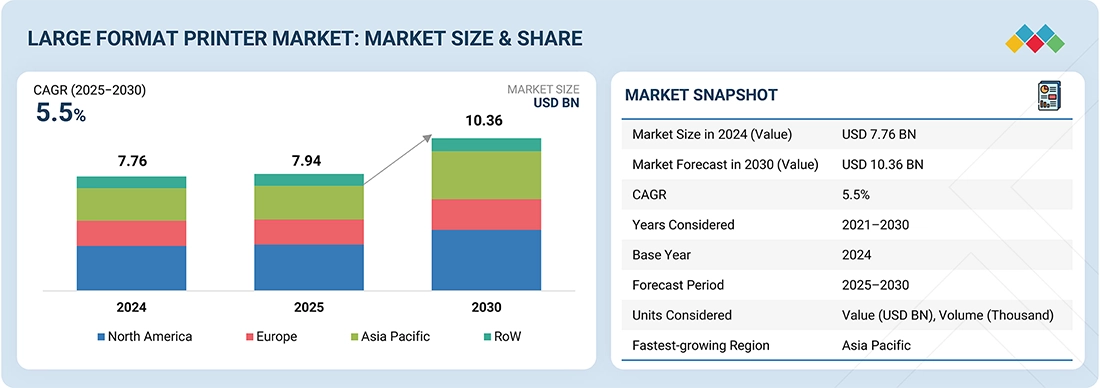
According to Marketsandmarkets, The global large format printer market size was valued at USD 7.94 billion in 2025 and is projected to reach USD 10.36 billion by 2030, growing at a CAGR of 5.5%. from 2025 to 2030. The expansion is driven by increasing demand for high-quality, customizable, and eco-friendly printing in advertising, textiles, packaging, and industrial sectors.
MARKET SNAPSHOT TABLE
| REPORT METRIC | DETAILS |
|---|---|
| Market Size in 2025 (Value) | USD 7.94 Billion |
| Market Forecast in 2030 (Value) | USD 10.36 Billion |
| Growth Rate | CAGR of 5.5% from 2025-2030 |
| Years Considered | 2021-2030 |
| Base Year | 2024 |
| Forecast Period | 2025-2030 |
| Units Considered | Value (USD Million/Billion), Volume (Thousands) |
| Report Coverage | Revenue forecast, company ranking, competitive landscape, growth factors, and trends |
| Top Companies |
|
| Growth Drivers |
|
| Segments Covered |
|
| Regions Covered | North America, Asia Pacific, Europe, South America, RoW |
Market Size & Forecast
• 2025 Market Size: USD 7.94 Billion
• 2030 Projected Market Size: USD 10.36 Billion
• CAGR (2025-2030): 5.5%
• Wireless connectivity : Highest CAGR
• North American : Fastest growth rate
KEY TAKEAWAYS
- The North American large format printer market share is dominating the market with a 39.3% revenue share in 2024
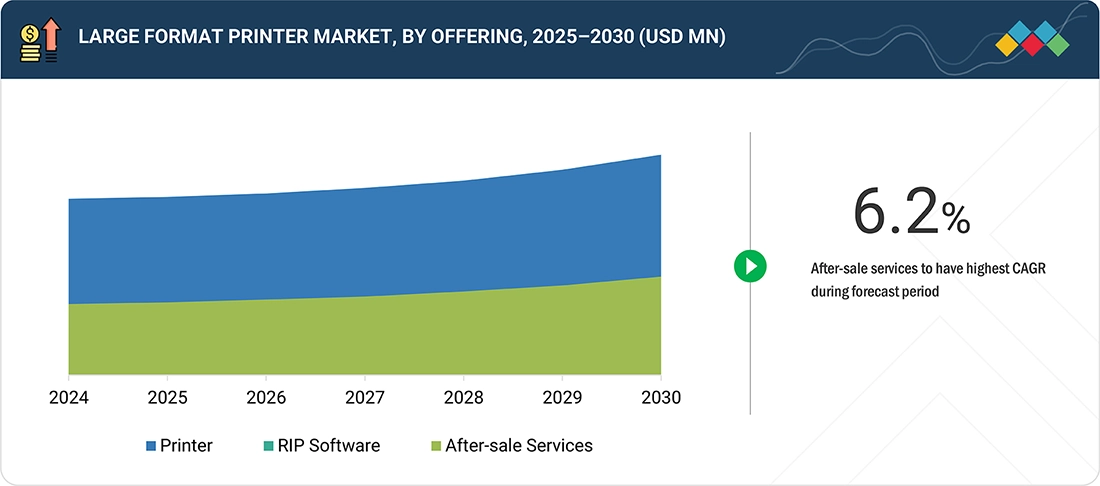
- By offering, after-sales services in the offering segment are expected to grow the fastest during the forecast period
- By connectivity, wireless connectivity is projected to have the highest CAGR of 5.7% during the forecast period
- By technology, ink-based technology is expected to dominate the large format printer market with a market share of 91.5% in 2025
- By application, décor application is expected to grow at the highest growth rate of 12.3% from 2025 to 2030
- HP, Canon, and Epson were identified as some of the star players in the large format printer market (global), given their strong market share and product footprint.
- Shenzhen Runtianzhi Digital Equipment Co., Ltd and Mutoh, among others, have distinguished themselves among startups and SMEs by securing strong footholds in specialized.
The large format printer industry is experiencing steady growth due to rising demand for high-quality, versatile, and eco-friendly printing solutions across the advertising, textiles, packaging, and industrial sectors. New advancements, including strategic partnerships between printer manufacturers and ink or substrate suppliers, investments in sustainable inks and energy-efficient printing systems, and innovations in high-speed, high-resolution, and multifunctional printers, are transforming the industry landscape.The Wide Format Printing Market is expanding as businesses increasingly adopt large-format printing for advertising, signage, banners, vehicle graphics, retail displays, textiles, and décor applications. Growth is supported by advancements in digital inkjet printing, eco-friendly inks, faster printing technologies, and customized on-demand production. Rising demand for high-quality visual communication, short-run printing, and personalized graphics is encouraging commercial printers, retailers, and advertising agencies to invest in advanced wide-format printing equipment.
The Large Format Printer Market size is expanding steadily as businesses across advertising, textile printing, and construction increasingly demand high-quality large-scale printing solutions. Growing adoption of advanced printing technologies, including UV-curable inks and eco-solvent printing, is accelerating Large Format Printer Market growth across commercial and industrial sectors. Companies are focusing on innovation and product differentiation to strengthen their Large Format Printer Market share, while improving printing speed, resolution, and efficiency. At the same time, evolving Large Format Printers Market trends such as customization, sustainable printing materials, and digital textile printing are transforming how organizations approach large-scale visual communication.
The Large Format Printer industry continues to evolve as demand rises for high-impact graphics, signage, and architectural printing. Businesses in retail, advertising, and packaging are investing in advanced printing systems to enhance branding and customer engagement, which further supports Large Format Printer Market growth globally. Increasing competition among manufacturers is driving technological advancements, enabling companies to capture a larger Large Format Printer Market share through innovative features and cost-efficient solutions. As adoption expands across emerging markets and new applications, the Large Format Printer Market size is expected to increase significantly, supported by ongoing innovation and changing Large Format Printer Market trends in digital printing technologies.
Source: Secondary Research, Interviews with Experts, MarketsandMarkets Analysis
TRENDS & DISRUPTIONS IMPACTING CUSTOMERS' CUSTOMERS
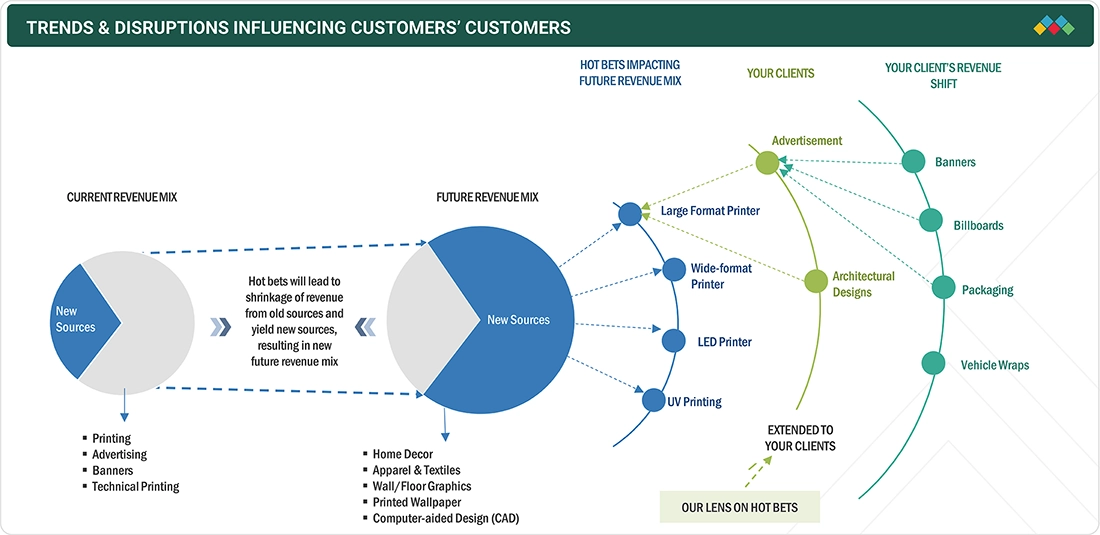
The large format printer market is evolving through new technologies, affecting applications in signage & advertising, apparel & textiles, CAD & technical printing, and décor. Emerging trends generate new revenue sources, decrease reliance on traditional segments, and push clients to adapt strategies for customizable, high-quality, and efficient printing solutions The Large Format Printer Market Trends are being driven by rising demand for high-quality, customizable, and eco-friendly printing across advertising, textiles, packaging, retail, and décor. Key Large Format Printers Market Trends include the growing adoption of UV-cured, latex, and sustainable inks, wireless connectivity, digital textile printing, automation, and customized visual graphics.
The Large Format Printer Industry is expanding into home furnishing, interior décor, vehicle wraps, and in-plant printing, creating new opportunities for manufacturers and print service providers. The Large Format Printer Industry is also evolving through innovations in high-speed, high-resolution, and multifunctional printing systems, supporting greater efficiency and flexibility across commercial and industrial applications..
Source: Secondary Research, Interviews with Experts, MarketsandMarkets Analysis
LARGE FORMAT PRINTER MARKET DYNAMICS

Drivers
Impact
Level
Level
-
Increasing demand for lightweight and fuel-efficient aircraft.

-
Substantial surge in outdoor advertising


RESTRAINTS
Impact
Level
Level
-
Requirement for high initial investment


OPPORTUNITIES
Impact
Level
Level
-
Growing adoption of large format printers in home furnishing, decor, and vehicle wrap applications

-
Rising use of large format printers in in-plant operations


CHALLENGES
Impact
Level
Level
-
High preference for digital advertising over conventional advertising techniques

Source: Secondary Research, Interviews with Experts, MarketsandMarkets Analysis
Driver: Increased use of large format printers by textile, e-commerce, and retail companies
Large format printers help businesses in textiles, e-commerce, retail, and packaging produce customized, high-quality visuals. They improve branding through apparel, signage, packaging, and digital campaigns by providing fast turnaround times, cost savings, eco-friendly inks, and flexible designs, boosting customer engagement, setting products apart, and increasing sales in competitive markets.
Restraint: Requirement for high initial investment
The installation and operation of large format printers involve a high initial cost, which remains the main barrier to their adoption. They require various specialized substrates like vinyl, wood, magnetic sheets, and photo paper, increasing ongoing expenses. Their annual electricity consumption also tends to be high, raising long-term costs. The technical complexity of large format printers and the need for high-resolution, true-color, and clear prints further increase maintenance requirements and expenses. Additionally, different inks designed for durability, UV resistance, and accurate colors are essential for professional-grade output but often come at a premium. Despite manufacturers releasing more affordable models, the ongoing costs for consumables, service, and power still pose hurdles for many customers. Therefore, the high initial investment and consistently high operational costs are key issues that can limit the widespread use of large format printers among certain user groups and emerging markets.
Opportunity: Growing adoption of large format printers in home furnishing, decor, and vehicle wrap applications
Large format printers are quickly becoming popular in the décor industry because they can produce high-quality, vibrant images on various media. They are commonly used for personalized wallpapers, wall stickers, canvas art, vehicle wraps, as well as floor plans and interior design concepts. Offering efficiency, clarity, and perfect sizing, these printers support creative and decorative projects, with vehicle wraps providing affordable mobile advertising options and boosting market growth.
Challenge: High preference for digital advertising over conventional advertising techniques
The increasing adoption of digital technology will continue to influence the demand for large format printers. Rising demand for digital signage, digital billboards, and electronic media is driving a slowdown in the demand for traditional advertising methods. Digital signage, the leading segment within the out-of-home advertising market, encompasses various formats such as backlit digital displays, interactive LCDs, and digital point-of-sale displays. This medium is increasingly used for diverse functions, including disseminating public information, promoting restaurant menus, expanding brand visibility, and shaping consumer behavior. One key advantage of digital signage is its flexibility; advertisements can be easily modified. Dynamic digital displays can be updated in real time, managed centrally, and support interactive and immersive advertising campaigns. In contrast, traditional banners, posters, flyers, and brochures incur higher recurring costs and only convey static information. Their non-interactive nature makes them less effective in today’s fast-paced marketing environment. Consequently, the expanding trend toward digital advertising primarily challenges players in the large format printers market, especially within signage and promotional graphics segments.
Large Format Printer Market: COMMERCIAL USE CASES ACROSS INDUSTRIES
| COMPANY | USE CASE DESCRIPTION | BENEFITS |
|---|---|---|
 |
OK To Colour, a UK-based print services provider, upgraded its operations with the Canon Colorado M3W printer developed by Canon Inc. (Japan) and supplied by CMYUK (UK). The roll-to-roll UVgel printer offered automation, low maintenance, and consistent high-quality output, helping the company enhance production speed and meet increasing market demand efficiently. | The Canon Colorado M3W improved OK To Colour’s workflow efficiency, reduced turnaround times, and delivered superior print quality with accurate color and sharp graphics. Its reliable, low-maintenance design minimized downtime, enabling the company to handle larger volumes confidently. This investment enhanced OK To Colour’s service capabilities and positioned it for sustainable growth. |
 |
Simpsons Printing, facing increased demand for large-format banners, struggled with high outsourcing costs and limited control over production schedules. To bring production in-house and improve operational efficiency, the company adopted the Fujifilm Acuity Prime LED flatbed printer, made by Fujifilm Holdings Corporation (Japan). This printer offered advanced substrate handling, reliable printheads, and durable ink technology, allowing Simpsons Printing to handle high-volume orders and support long-term growth in the competitive large-format printing market. | The adoption of the Fujifilm Acuity Prime enabled Simpsons Printing to cut outsourcing costs while expanding its service offerings. The printer’s versatility supported higher production rates and handled a broader range of substrates. Reliable performance and advanced technology improved operational control, efficiency, and print quality, positioning the company for sustainable growth and increased competitiveness. |
 |
Wedneshurx Commercial and Car Ltd (WCC), a UK-based print and signage company, aimed to expand into the vehicle graphics segment to meet growing demand for high-quality, durable, and visually striking wraps. To achieve this, WCC invested in the Mimaki JV300-160plus, an advanced large-format eco-solvent printer developed by Mimaki Engineering Co., Ltd. (Japan). The printer enabled in-house production, consistent results across various materials, and faster turnaround, supporting WCC’s strategic growth in the automotive and signage markets. | The Mimaki JV300-160plus helped WCC cut outsourcing costs, speed up turnaround times, and produce high-quality, vibrant prints for vehicle graphics. It enabled the launch of a dedicated vehicle graphics division, expanded service offerings, attracted new clients, and boosted the company’s competitiveness in the signage and automotive graphics market. The investment improved operational control and positioned WCC for sustainable growth. |
Logos and trademarks shown above are the property of their respective owners. Their use here is for informational and illustrative purposes only.
LARGE FORMAT PRINTER MARKET ECOSYSTEM
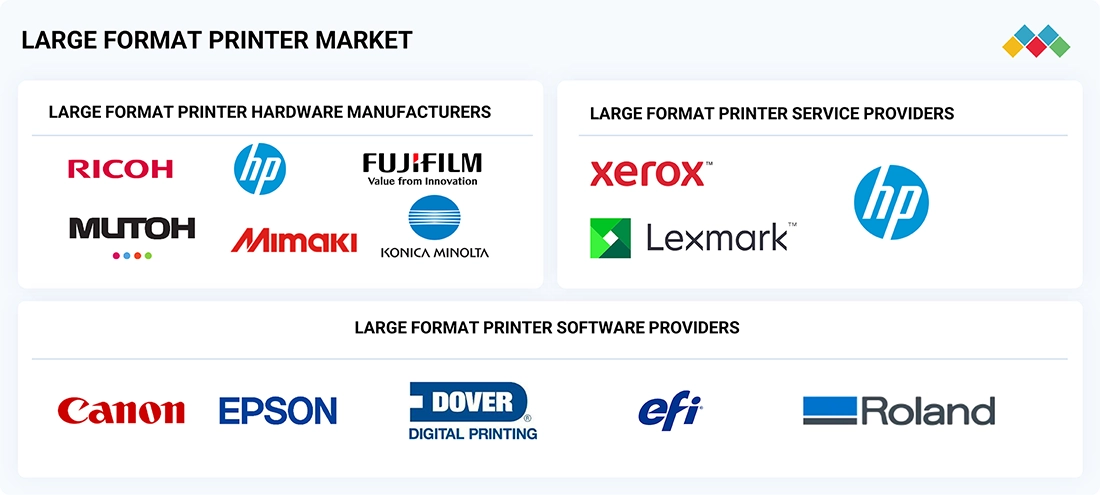
The large-format printer ecosystem includes hardware manufacturers like Ricoh, HP Development Company, L.P., and Fujifilm Holdings Corporation, software providers such as Canon Inc. and Seiko Epson Corporation, and service providers including Xerox Corporation and Lexmark International, Inc. Together, they promote innovation, improve operational efficiency, and drive adoption across advertising, textiles, packaging, retail, and décor applications
Wide Format Printing Market
The Wide Format Printing Market is witnessing steady growth as businesses increasingly adopt high-quality, large-scale graphics for advertising, retail displays, signage, décor, exhibitions, and branding applications. Advances in digital printing, UV-curable inks, eco-solvent technologies, automation, and variable-data printing are improving productivity, color accuracy, and media flexibility. The Wide Format Printing Market is also benefiting from growing demand for customized graphics, sustainable printing solutions, and on-demand production across commercial and industrial applications. Integration of cloud-based workflows, AI-enabled print management, and automated finishing technologies is further supporting the evolution of the Wide Format Printing Market, enabling faster turnaround times, reduced material waste, and cost-efficient large-format printing.
The Large Format Printers Market is witnessing steady growth as businesses increasingly adopt high-quality digital printing solutions for advertising, signage, textile printing, packaging, and décor applications. Rising demand for customized graphics, vibrant visual displays, and short-run printing is encouraging the adoption of inkjet, UV, solvent, and latex-based large format printers. Advancements in automation, eco-friendly inks, and cloud-connected printing workflows are further improving productivity and reducing operational costs. In addition, the integration of AI-enabled print management and digital technologies is expected to create new opportunities for the Large Format Printers Market across commercial, industrial, and retail applications.
Logos and trademarks shown above are the property of their respective owners. Their use here is for informational and illustrative purposes only.
LARGE FORMAT PRINTER MARKET SEGMENTS
Source: Secondary Research, Interviews with Experts, MarketsandMarkets Analysis
Large Format Printer Market, By Offering
As of 2024, printers hold the largest share of the large format printer market and are expected to maintain their dominance through 2025 due to their high resolution, versatility, and efficiency. Widely used across advertising, textiles, packaging, and décor applications, these printers provide reliable performance, quick turnaround times, and compatibility with various substrates. Technological advancements in inkjet and UV printing further improve print quality, speed, and eco-friendliness, reinforcing printers’ leading position in the market.
Large Format Printer Market, By Connectivity
As of 2024, wired connectivity dominates the large format printer market and is expected to stay in control through 2025 because of its reliability, steady data transfer, and compatibility with current IT systems. Widely used in advertising, textiles, packaging, and industrial sectors, wired connectivity ensures continuous operation, high-speed performance, and secure workflow management. Ongoing improvements in network integration and hybrid connectivity solutions further strengthen its position in the market.
Large Format Printer Market, By Technology
Ink-based printing technology maintains the largest market share within the large format printer sector and is projected to sustain its dominance through 2025 owing to its versatility, high-resolution output, and cost-efficiency. Extensively utilized in advertising, textiles, packaging, and interior décor, ink-based techniques accommodate a variety of substrates, enable rapid production, and promote environmentally sustainable printing practices. Continuous advancements in ink formulations and printing mechanisms further enhance efficiency, precision, and market penetration.
Large Format Printer Market, By Print Width
Printers with a 60-72" print width are projected to have the highest CAGR during the forecast period, fueled by rising demand for large-format applications in advertising, signage, textiles, and industrial printing. These wide-format printers enable high-efficiency production, superior image quality, and versatility across various media, supporting customization and faster turnaround times for commercial and industrial customers.
Large Format Printer Market, By Ink Type
UV-cured inks are projected to register the highest CAGR during the forecast period, driven by their fast-drying properties, durability, and compatibility with diverse substrates. Widely used across advertising, signage, packaging, and décor applications, UV-cured inks enable high-resolution, vibrant, and scratch-resistant prints, supporting sustainable and efficient large format printing solutions.
Large Format Printer Market, By Application
The décor application segment is forecasted to have the highest CAGR during the forecast period, driven by increasing demand for customized wallpapers, wall graphics, vehicle wraps, canvas art, and interior design solutions. Large format printers enable vibrant, high-resolution, and durable prints, supporting creative, personalized, and visually striking décor across residential, commercial, and retail spaces.
REGION
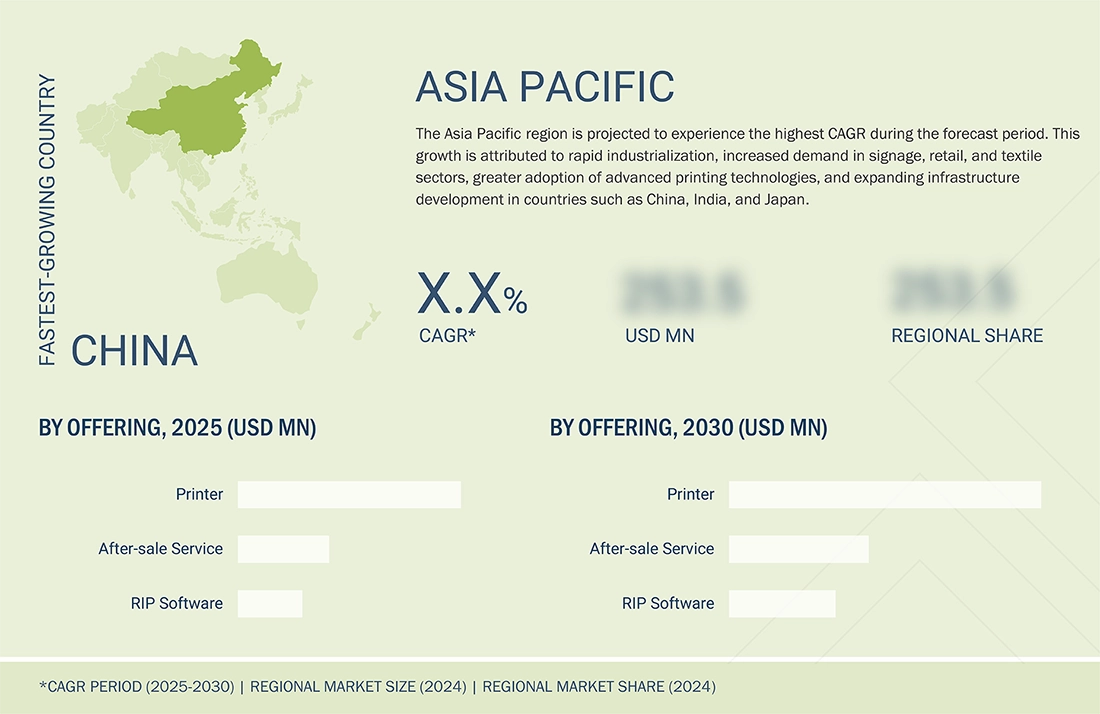
Asia Pacific to be fastest-growing region in global large format printer market during forecast period
The Asia Pacific large format printers market is anticipated to attain the highest compound annual growth rate (CAGR) throughout the forecast period, driven by rapid expansion in the advertising, retail, textiles, and packaging industries. Prominent manufacturers in China, Japan, and India are implementing advanced inkjet, ultraviolet (UV), and printing technologies to fulfill the escalating demand for high-resolution, customizable, and environmentally sustainable printing solutions. Additionally, the growth of e-commerce, urbanization, and the increasing adoption of digital signage are further propelling market expansion in the region.
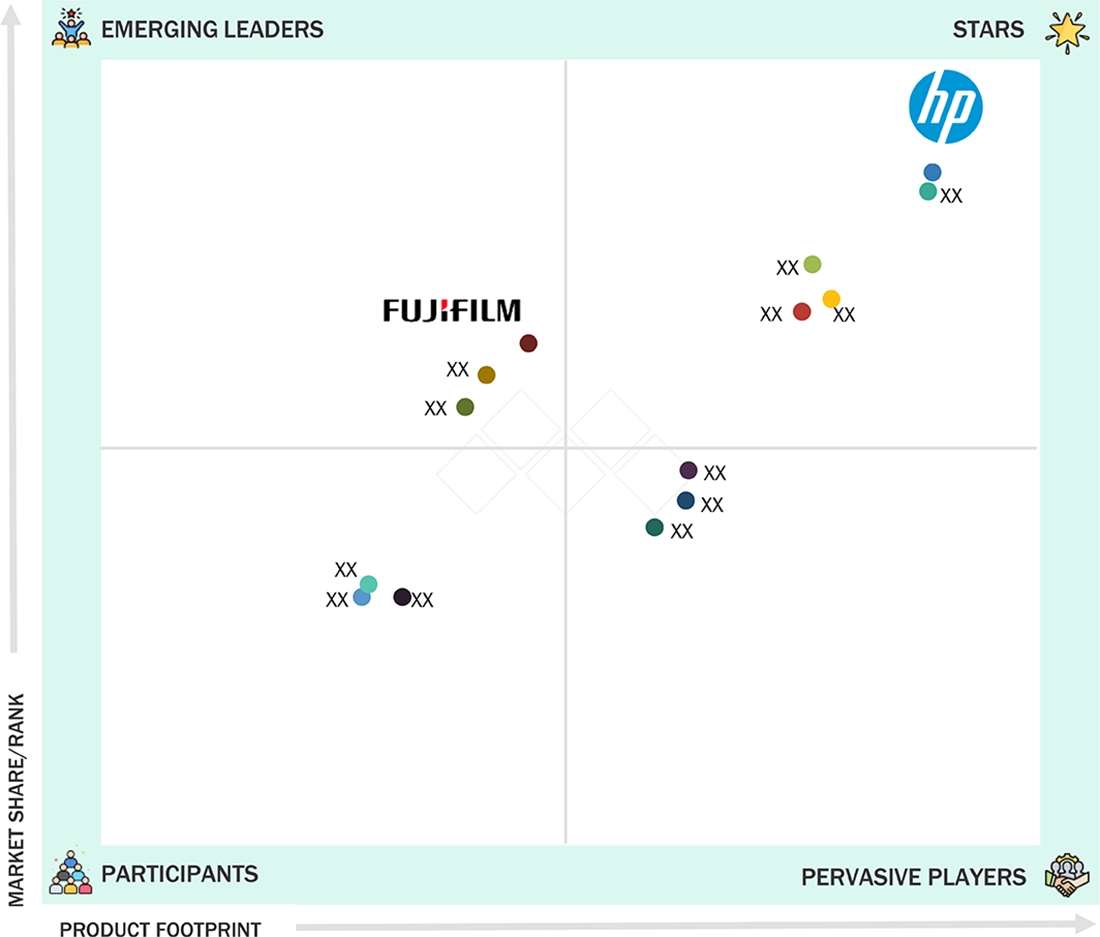
Large Format Printer Market: COMPANY EVALUATION MATRIX
In the large-format printer companies matrix, HP Development Company, L.P. (Star) leads with a strong market share and extensive product lineup, driven by its high-performance printers widely adopted in advertising, textiles, packaging, and décor applications. Fujifilm Holdings Corporation (Emerging Leader) is gaining recognition with its advanced printing technologies and specialized solutions, strengthening its position through innovation and niche offerings. While HP dominates through scale and a diverse portfolio, Fujifilm shows significant potential to move into the emerging leaders' quadrant as demand for high-resolution, versatile, and eco-friendly printing solutions continues to grow.
Source: Secondary Research, Interviews with Experts, MarketsandMarkets Analysis
KEY MARKET PLAYERS
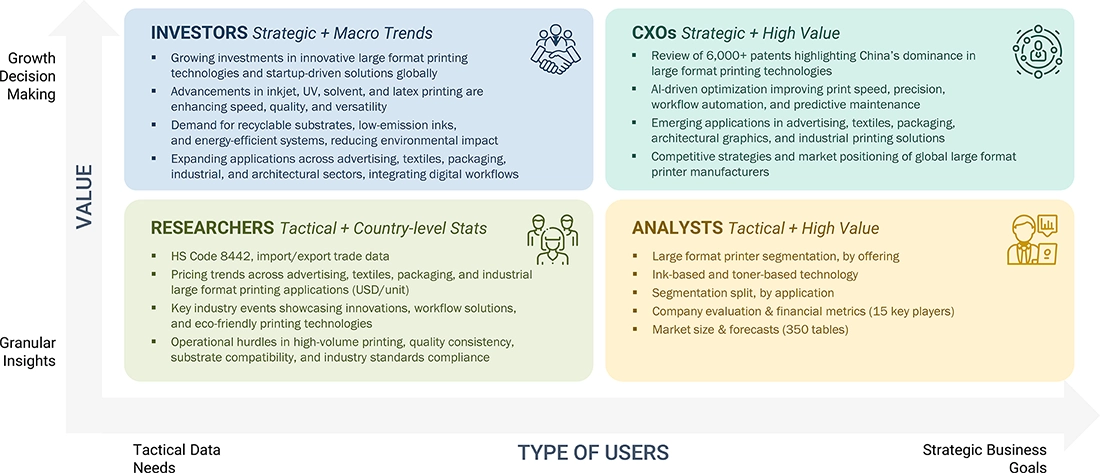
WHAT IS IN IT FOR YOU: Large Format Printer Market REPORT CONTENT GUIDE
DELIVERED CUSTOMIZATIONS
We have successfully delivered the following deep-dive customizations:
| CLIENT REQUEST | CUSTOMIZATION DELIVERED | VALUE ADDS |
|---|---|---|
| Advertising Agency |
|
|
| Textiles & Apparel Brand |
|
|
| Packaging Manufacturer |
|
|
| Retail & E-Commerce Client |
|
|
RECENT DEVELOPMENTS
- September 2026: Canon Inc. (Japan) launched eight new imagePROGRAF TM Series models, comprising six large-format printers and two large-format multifunction printers. The new models use five-colour pigment ink, while the TM-5610M and TM-5510M add built-in large-format scanners for copying and digitising drawings, posters and signage.
- November 2025: Seiko Epson Corporation (Japan) made the SureColor S7170 64-inch solvent printer available through authorised professional imaging resellers. The new large-format printer uses Epson's latest-generation printhead to deliver faster printing and is designed for applications including indoor and outdoor signs, banners, stickers and vehicle wraps.
- October 2025: HP Development Company, L.P. (US) launched the HP DesignJet T870 Printer for architecture, engineering and construction applications. The 24-inch large-format printer supports multi-size printing through an integrated input tray and combines pigment-based HP Flex Tech Inks with HP Click Print solutions, while HP also expanded its Build Workspace with AI-powered vectorization and mobile scanning capabilities.
- January 2025 : Canon Inc. introduced large-format printers, the Image PROGRAF TZ-5320 and the TX Series (TX-5420/5320/5220), with enhanced color brilliance with improved magenta ink and a high printing speed of up to 4 pages per minute. These models also feature environmentally friendly functionalities, consuming less energy and using eco-friendly packaging.
- June 2024 : Brother Industries, Ltd. partnered with ColorBase to launch the WF1-L640 Launching Profiles Program, which offers Brother WF1-L640 latex wide-format printer users direct access to 96 high-quality images across 48 premium print materials. This partnership simplifies color application, resulting in plug-and-print processing that enhances efficiency and quality printing.
Table of Contents
 Exclusive indicates content/data unique to MarketsandMarkets and not available with any competitors.
TITLE
PAGE NO
1
INTRODUCTION
25
2
RESEARCH METHODOLOGY
30
3
EXECUTIVE SUMMARY
43
4
PREMIUM INSIGHTS
48
5
MARKET OVERVIEW
Large format printers revolutionize textile and retail sectors, despite high costs and digital ad competition.
50
5.1
INTRODUCTION
5.2
MARKET DYNAMICS
5.2.1
DRIVERS
5.2.1.1
INCREASED USE OF LARGE FORMAT PRINTERS BY TEXTILE, E-COMMERCE, AND RETAIL COMPANIES
5.2.1.2
SUBSTANTIAL SURGE IN OUTDOOR ADVERTISING
5.2.1.3
HIGH ADOPTION OF UV-CURABLE INKS IN OUTDOOR ADVERTISING, CAD, AND TECHNICAL PRINTING APPLICATIONS
5.2.2
RESTRAINTS
5.2.2.1
REQUIREMENT FOR HIGH INITIAL INVESTMENT
5.2.3
OPPORTUNITIES
5.2.3.1
GROWING ADOPTION OF LARGE FORMAT PRINTERS IN HOME FURNISHING, DECOR, AND VEHICLE WRAP APPLICATIONS
5.2.3.2
RISING USE OF LARGE FORMAT PRINTERS IN IN-PLANT OPERATIONS
5.2.3.3
INCREASE IN FOCUS ON MANUFACTURING BUDGET-FRIENDLY PRINTERS WITH ADVANCED FEATURES
5.2.4
CHALLENGES
5.2.4.1
HIGH PREFERENCE FOR DIGITAL ADVERTISING OVER CONVENTIONAL ADVERTISING TECHNIQUES
5.3
TRENDS/DISRUPTIONS IMPACTING CUSTOMERS’ BUSINESSES
5.4
PRICING ANALYSIS
5.4.1
AVERAGE SELLING PRICE TREND, BY REGION
5.4.2
AVERAGE SELLING PRICE TREND OF TECHNOLOGY, BY KEY PLAYERS
5.5
SUPPLY CHAIN ANALYSIS
5.6
ECOSYSTEM ANALYSIS
5.7
TECHNOLOGY ANALYSIS
5.7.1
KEY TECHNOLOGIES
5.7.1.1
DYE-SUBLIMATION INKS
5.7.1.2
UV-CURABLE INKS
5.7.2
COMPLEMENTARY TECHNOLOGIES
5.7.2.1
LASER PRINTING
5.7.3
ADJACENT TECHNOLOGIES
5.7.3.1
ORGANIC INKS
5.8
PATENT ANALYSIS
5.9
TRADE ANALYSIS
5.9.1
EXPORT SCENARIO
5.9.2
IMPORT SCENARIO
5.10
KEY CONFERENCES AND EVENTS
5.11
CASE STUDY ANALYSIS
5.11.1
BOOSTING PRODUCTIVITY AND PRECISION: OK TO COLOUR STREAMLINES OPERATIONS WITH CANON COLORADO M3W
5.11.2
DRIVING GROWTH THROUGH IN-HOUSE INNOVATION: SIMPSONS PRINTING ADOPTS FUJIFILM ACUITY PRIME
5.11.3
ACCELERATING BUSINESS GROWTH: WCC EXPANDS WITH MIMAKI JV300-160PLUS FOR VEHICLE GRAPHICS
5.12
TARIFFS AND REGULATORY LANDSCAPE
5.12.1
TARIFF DATA
5.12.2
REGULATORY BODIES, GOVERNMENT AGENCIES, AND OTHER ORGANIZATIONS
5.12.2.1
KEY REGULATIONS
5.13
PORTER’S FIVE FORCES ANALYSIS
5.13.1
THREAT OF NEW ENTRANTS
5.13.2
THREAT OF SUBSTITUTES
5.13.3
BARGAINING POWER OF SUPPLIERS
5.13.4
BARGAINING POWER OF BUYERS
5.13.5
INTENSITY OF COMPETITIVE RIVALRY
5.14
KEY STAKEHOLDERS AND BUYING CRITERIA
5.14.1
KEY STAKEHOLDERS IN BUYING PROCESS
5.14.2
BUYING CRITERIA
5.15
IMPACT OF ARTIFICIAL INTELLIGENCE ON LARGE FORMAT PRINTER MARKET
5.15.1
INTRODUCTION
5.16
IMPACT OF 2025 US TARIFF - LARGE FORMAT PRINTER MARKET
5.16.1
INTRODUCTION
5.16.2
KEY TARIFF RATES
5.16.3
PRICE IMPACT ANALYSIS
5.16.4
IMPACT OF COUNTRY/REGION
5.16.4.1
US
5.16.4.2
EUROPE
5.16.4.3
ASIA PACIFIC
5.16.5
IMPACT ON APPLICATION
6
LARGE FORMAT PRINTER MARKET, BY OFFERING
Market Size & Growth Rate Forecast Analysis to 2030 in USD Million | 8 Data Tables
84
6.1
INTRODUCTION
6.2
PRINTERS
6.2.1
INCREASED DEMAND FOR PRINTERS TO PRINT BANNERS, POSTERS, WALLPAPERS, AND CONSTRUCTION PLANS TO DRIVE MARKET
6.3
RIP SOFTWARE
6.3.1
CAPACITY TO SIMULTANEOUSLY PROCESS MULTIPLE JOBS IN POOL TO BOOST DEMAND FOR RIP SOFTWARE
6.4
AFTER-SALES SERVICES
6.4.1
NECESSITY TO MAINTAIN PERFORMANCE OF LARGE FORMAT PRINTERS TO BOOST DEMAND FOR AFTER-SALES SERVICES
7
LARGE FORMAT PRINTER MARKET, BY CONNECTIVITY
Market Size & Growth Rate Forecast Analysis to 2030 in USD Million | 6 Data Tables
91
7.1
INTRODUCTION
7.2
WIRED
7.2.1
RISING AWARENESS ABOUT STABILITY AND RELIABILITY OF WIRED PRINTERS TO PROPEL MARKET
7.3
WIRELESS
7.3.1
INCREASE IN USE OF FLEXIBLE AND LOW-COST WIRELESS PRINTERS TO CONTRIBUTE TO SEGMENTAL GROWTH
8
LARGE FORMAT PRINTER MARKET, BY PRINTING MATERIAL
Market Size & Growth Rate Forecast Analysis
96
8.1
INTRODUCTION
8.2
POROUS MATERIALS
8.2.1
USE OF POROUS MATERIALS WITH HIGH ABSORPTION CAPACITY TO ACCELERATE SEGMENTAL GROWTH
8.3
NON-POROUS MATERIALS
8.3.1
ADOPTION OF NON-POROUS MATERIALS WITH UV INK ADHESION AND CURING CAPABILITIES TO DRIVE MARKET
8.3.2
SYNTHETIC PAPERS
8.3.2.1
POLYESTER (PET) SYNTHETIC PAPERS
8.3.2.2
POLYPROPYLENE (PP) SYNTHETIC PAPERS
8.3.2.3
VINYL SYNTHETIC PAPERS
8.3.2.4
BIAXIALLY ORIENTED POLYPROPYLENE (BOPP) SYNTHETIC PAPERS
8.3.2.5
HIGH-DENSITY POLYETHYLENE (HDPE) SYNTHETIC PAPERS
8.3.3
OTHER NON-POROUS SYNTHETIC PAPERS
9
LARGE FORMAT PRINTER MARKET, BY TECHNOLOGY
Market Size & Growth Rate Forecast Analysis to 2030 in USD Million and Units | 8 Data Tables
100
9.1
INTRODUCTION
9.2
INK-BASED (INKJET)
9.2.1
RISE IN EMPHASIS ON DEVELOPING ENVIRONMENT-FRIENDLY AND HIGH-QUALITY INKS TO FUEL SEGMENTAL GROWTH
9.2.1.1
THERMAL INKJET PRINTING
9.2.1.2
PIEZO CRYSTAL-BASED INKJET PRINTING
9.2.1.3
ELECTROSTATIC INKJET PRINTING
9.2.1.4
MEMS-BASED INKJET PRINTING
9.3
TONER-BASED (LASER)
9.3.1
SHIFTING PREFERENCE TOWARD WATER- AND SMUDGE-RESISTANT PRINTERS TO BOOST SEGMENTAL GROWTH
10
LARGE FORMAT PRINTER MARKET, BY PRINT WIDTH
Market Size & Growth Rate Forecast Analysis to 2030 in USD Million | 14 Data Tables
106
10.1
INTRODUCTION
10.2
17–24”
10.2.1
GARMENT PRINTING AND OFFICE APPLICATIONS TO SUPPORT SEGMENTAL GROWTH
10.3
24–36”
10.3.1
GROWING TREND OF CUSTOMIZED APPAREL WITH THRIVING FASHION INDUSTRY TO CONTRIBUTE TO MARKET GROWTH
10.4
36–44”
10.4.1
TEXTILES, SIGNAGE, BLUEPRINT APPLICATIONS TO BOOST DEMAND FOR PRINTERS WITH PRINT WIDTHS RANGING FROM 36–44 INCHES
10.5
44–60”
10.5.1
POSTERS, ARCHITECTURAL DRAWINGS, AND GIS APPLICATIONS TO DRIVE SEGMENTAL GROWTH
10.6
60–72”
10.6.1
BANNERS, LARGE VEHICLE GRAPHICS, AND ADVERTISEMENT APPLICATIONS TO SUPPORT SEGMENTAL GROWTH
10.7
72” AND ABOVE
10.7.1
CAPABILITY TO PRODUCE EXCEPTIONALLY LARGE AND VISUALLY IMPACTFUL PRINTS TO DRIVE DEMAND
11
LARGE FORMAT PRINTER MARKET, BY INK TYPE
Market Size & Growth Rate Forecast Analysis to 2030 in USD Million | 2 Data Tables
114
11.1
INTRODUCTION
11.2
AQUEOUS
11.2.1
CAPABILITY TO PROVIDE EXCELLENT IMAGE QUALITY AT LOW COST TO DRIVE DEMAND
11.3
SOLVENT
11.3.1
NEED FOR VIBRANT COLORS IN OUTDOOR ADVERTISING APPLICATIONS TO FUEL DEMAND
11.4
UV-CURED
11.4.1
HIGH DURABILITY AND FAST CURING TIME TO DRIVE ADOPTION
11.5
LATEX
11.5.1
CAPACITY TO PRODUCE TOP-NOTCH PRINTS ON DIVERSE SURFACES TO DRIVE DEMAND IN ADVERTISING APPLICATIONS
11.6
DYE SUBLIMATION
11.6.1
GROWING USE TO PRINT IMAGES ON POLYESTER-BASED TEXTILES TO FUEL MARKET GROWTH
12
LARGE FORMAT PRINTER MARKET, BY APPLICATION
Market Size & Growth Rate Forecast Analysis to 2030 in USD Million | 10 Data Tables
120
12.1
INTRODUCTION
12.2
APPAREL & TEXTILE
12.2.1
RISING DEMAND FOR CUSTOMIZED APPAREL AND TEXTILES TO CREATE NEED FOR EFFICIENT PRINTING SOLUTIONS
12.3
SIGNAGE & ADVERTISING
12.3.1
INCREASING USE OF BANNERS, BILLBOARDS, POSTERS, AND DISPLAYS TO DRIVE MARKET
12.4
DECOR
12.4.1
GROWING DEMAND FOR LARGE-SCALE DECORATIVE PIECES SUCH AS WALL ART TO SUPPORT SEGMENTAL GROWTH
12.5
CAD & TECHNICAL PRINTING
12.5.1
NEED FOR PRECISION IN CAD & CAM APPLICATIONS TO DRIVE MARKET
13
LARGE FORMAT PRINTER MARKET, BY REGION
Comprehensive coverage of 10 Regions with country-level deep-dive of 13 Countries | 80 Data Tables.
129
13.1
INTRODUCTION
13.2
NORTH AMERICA
13.2.1
NORTH AMERICA: MACROECONOMIC OUTLOOK
13.2.2
US
13.2.2.1
INCREASING DEMAND FOR LARGE FORMAT PRINTERS FROM PACKAGING AND TEXTILES INDUSTRIES TO FOSTER MARKET GROWTH
13.2.3
CANADA
13.2.3.1
RISING FOCUS OF KEY PLAYERS ON DEVELOPMENT OF INNOVATIVE LARGE FORMAT PRINTERS TO DRIVE MARKET
13.2.4
MEXICO
13.2.4.1
INCREASING INVESTMENTS FROM MULTINATIONAL PRINTER MANUFACTURERS TO DRIVE MARKET
13.3
EUROPE
13.3.1
EUROPE: MACROECONOMIC OUTLOOK
13.3.2
GERMANY
13.3.2.1
THRIVING MANUFACTURING SECTOR TO BOOST DEMAND FOR LARGE FORMAT PRINTERS IN PACKAGING AND ADVERTISEMENT APPLICATIONS
13.3.3
UK
13.3.3.1
GROWING USE OF PRINTING TECHNOLOGY IN COMMERCIAL AND PUBLISHING APPLICATIONS TO ACCELERATE MARKET GROWTH
13.3.4
FRANCE
13.3.4.1
RISING DEMAND FROM FOOD & BEVERAGES AND COSMETICS INDUSTRIES TO DRIVE MARKET
13.3.5
ITALY
13.3.5.1
INCREASING DEMAND FOR COST-EFFICIENT AND MULTI-FUNCTION PRINTERS TO FUEL MARKET GROWTH
13.3.6
REST OF EUROPE
13.4
ASIA PACIFIC
13.4.1
ASIA PACIFIC: MACROECONOMIC OUTLOOK
13.4.2
CHINA
13.4.2.1
COMMITMENT OF KEY PLAYERS IN OFFERING BEST-IN-CLASS INKJET PRINTERS TO ACCELERATE MARKET GROWTH
13.4.3
JAPAN
13.4.3.1
RAPID URBANIZATION TO DRIVE DEMAND FOR PRINTERS WITH GREATER SPEED
13.4.4
INDIA
13.4.4.1
BOOMING PACKAGING AND TEXTILES INDUSTRIES TO BOOST DEMAND FOR LARGE FORMAT PRINTERS
13.4.5
AUSTRALIA
13.4.5.1
RISING CONSUMPTION OF PACKAGED FOOD TO FUEL DEMAND LARGE FORMAT PRINTERS
13.4.6
REST OF ASIA PACIFIC
13.5
REST OF THE WORLD (ROW)
13.5.1
ROW: MACRO-ECONOMIC OUTLOOK
13.5.2
SOUTH AMERICA
13.5.2.1
GROWING APPAREL INDUSTRY TO FUEL DEMAND FOR LARGE FORMAT PRINTERS
13.5.3
MIDDLE EAST & AFRICA
13.5.3.1
UAE
13.5.3.2
SAUDI ARABIA
14
COMPETITIVE LANDSCAPE
Discover strategic insights and market dominance tactics of key players and emerging leaders.
167
14.1
OVERVIEW
14.2
KEY PLAYER STRATEGIES/RIGHT TO WIN
14.3
REVENUE ANALYSIS, 2021–2024
14.4
MARKET SHARE ANALYSIS, 2024
14.5
COMPANY EVALUATION MATRIX: KEY PLAYERS, 2024
14.5.1
STARS
14.5.2
EMERGING LEADERS
14.5.3
PERVASIVE PLAYERS
14.5.4
PARTICIPANTS
14.5.5
COMPANY FOOTPRINT: KEY PLAYERS, 2024
14.5.5.1
COMPANY FOOTPRINT
14.5.5.2
REGIONAL FOOTPRINT
14.5.5.3
APPLICATION FOOTPRINT
14.5.5.4
OFFERING FOOTPRINT
14.5.5.5
TECHNOLOGY FOOTPRINT
14.5.5.6
CONNECTIVITY FOOTPRINT
14.5.5.7
INK TYPE FOOTPRINT
14.6
COMPANY EVALUATION MATRIX: STARTUPS/SMES, 2024
14.6.1
PROGRESSIVE COMPANIES
14.6.2
RESPONSIVE COMPANIES
14.6.3
DYNAMIC COMPANIES
14.6.4
STARTING BLOCKS
14.6.5
COMPETITIVE BENCHMARKING: STARTUPS/SMES, 2024
14.6.5.1
DETAILED LIST OF KEY STARTUPS/SMES
14.6.5.2
COMPETITIVE BENCHMARKING OF KEY STARTUPS/SMES
14.7
COMPETITIVE SCENARIO
14.7.1
PRODUCT LAUNCHES
14.7.2
DEALS
15
COMPANY PROFILES
In-depth Company Profiles of Leading Market Players with detailed Business Overview, Product and Service Portfolio, Recent Developments, and Unique Analyst Perspective (MnM View)
191
15.1
KEY PLAYERS
15.1.1
HP DEVELOPMENT COMPANY, L.P.
15.1.1.1
BUSINESS OVERVIEW
15.1.1.2
PRODUCTS/SOLUTIONS/SERVICES OFFERED
15.1.1.3
RECENT DEVELOPMENTS
15.1.1.4
MNM VIEW
15.1.2
CANON INC.
15.1.3
SEIKO EPSON CORPORATION
15.1.4
BROTHER INDUSTRIES, LTD.
15.1.5
MIMAKI ENGINEERING CO., LTD.
15.1.6
ROLAND DGA CORPORATION
15.1.7
RICOH
15.1.8
DURST GROUP AG
15.1.9
XEROX CORPORATION
15.1.10
KONICA MINOLTA, INC.
15.1.11
AGFA-GEVAERT GROUP
15.2
OTHER PLAYERS
15.2.1
ELECTRONICS FOR IMAGING, INC.
15.2.2
KYOCERA CORPORATION
15.2.3
LEXMARK INTERNATIONAL, INC.
15.2.4
FUJIFILM HOLDINGS CORPORATION
15.2.5
ARC DOCUMENT SOLUTIONS, LLC
15.2.6
DILLI
15.2.7
MUTOH
15.2.8
SWISSQPRINT AG
15.2.9
SHENYANG SKY AIR SHIP DIGITAL PRINTING EQUIPMENT CO., LTD.
15.2.10
OKI ELECTRIC INDUSTRY CO., LTD.
15.2.11
LIYUPRINTER
15.2.12
SHENZHEN RUNTIANZHI DIGITAL EQUIPMENT CO., LTD.
15.2.13
DOVER CORPORATION (MS PRINTING SOLUTIONS)
15.2.14
SHENZHEN SANYI TECHNOLOGY CO., LTD.
16
APPENDIX
249
16.1
DISCUSSION GUIDE
16.2
KNOWLEDGESTORE: MARKETSANDMARKETS’ SUBSCRIPTION PORTAL
16.3
CUSTOMIZATION OPTIONS
16.4
RELATED REPORTS
16.5
AUTHOR DETAILS
LIST OF TABLES
TABLE 1
INCLUSIONS & EXCLUSIONS
TABLE 2
LIST OF KEY SECONDARY SOURCES
TABLE 3
LIST OF PRIMARY INTERVIEW PARTICIPANTS
TABLE 4
LARGE FORMAT PRINTER MARKET: RISK ANALYSIS
TABLE 5
AVERAGE SELLING PRICE TREND OF LARGE FORMAT PRINTER, BY REGION, 2021–2024 (USD)
TABLE 6
AVERAGE SELLING PRICE TREND OF LARGE FORMAT PRINTER COMPONENTS OFFERED AMONG KEY PLAYERS, BY TECHNOLOGY, 2020–2024 (USD)
TABLE 7
KEY COMPANIES AND THEIR ROLE IN ECOSYSTEM
TABLE 8
LIST OF PATENTS IN LARGE FORMAT PRINTERS, 2023–2025
TABLE 9
EXPORT DATA FOR PRODUCTS COVERED UNDER HS CODE 8443, BY COUNTRY, 2020–2024 (USD MILLION)
TABLE 10
IMPORT DATA FOR PRODUCTS COVERED UNDER HS CODE 8443, BY COUNTRY, 2020–2024 (USD MILLION)
TABLE 11
LARGE FORMAT PRINTER MARKET: LIST OF CONFERENCES AND EVENTS, 2025–2026
TABLE 12
MFN TARIFF FOR HS CODE 8443-COMPLIANT PRODUCTS EXPORTED BY CHINA, 2024
TABLE 13
MFN TARIFF FOR HS CODE 8443-COMPLIANT PRODUCTS EXPORTED BY GERMANY, 2024
TABLE 14
NORTH AMERICA: LIST OF REGULATORY BODIES, GOVERNMENT AGENCIES, AND OTHER ORGANIZATIONS
TABLE 15
EUROPE: LIST OF REGULATORY BODIES, GOVERNMENT AGENCIES, AND OTHER ORGANIZATIONS
TABLE 16
ASIA PACIFIC: LIST OF REGULATORY BODIES, GOVERNMENT AGENCIES, AND OTHER ORGANIZATIONS
TABLE 17
LARGE FORMAT PRINTER MARKET: REGULATORY LANDSCAPE
TABLE 18
LARGE FORMAT PRINTER MARKET: PORTER’S FIVE FORCES ANALYSIS, 2024
TABLE 19
INFLUENCE OF STAKEHOLDERS ON BUYING PROCESS FOR KEY APPLICATIONS
TABLE 20
KEY BUYING CRITERIA FOR KEY APPLICATIONS
TABLE 21
US ADJUSTED RECIPROCAL TARIFF RATES
TABLE 22
LARGE FORMAT PRINTER MARKET, BY OFFERING, 2021–2024 (USD MILLION)
TABLE 23
LARGE FORMAT PRINTER MARKET, BY OFFERING, 2025–2030 (USD MILLION)
TABLE 24
PRINTERS: LARGE FORMAT PRINTER MARKET, BY REGION, 2021–2024 (USD MILLION)
TABLE 25
PRINTERS: LARGE FORMAT PRINTER MARKET, BY REGION, 2025–2030 (USD MILLION)
TABLE 26
RIP SOFTWARE: LARGE FORMAT PRINTER MARKET, BY REGION, 2021–2024 (USD MILLION)
TABLE 27
RIP SOFTWARE: LARGE FORMAT PRINTER MARKET, BY REGION, 2025–2030 (USD MILLION)
TABLE 28
AFTER-SALES SERVICES: LARGE FORMAT PRINTER MARKET, BY REGION, 2021–2024 (USD MILLION)
TABLE 29
AFTER-SALES SERVICES: LARGE FORMAT PRINTER MARKET, BY REGION, 2025–2030 (USD MILLION)
TABLE 30
LARGE FORMAT PRINTER MARKET, BY CONNECTIVITY, 2021–2024 (USD MILLION)
TABLE 31
LARGE FORMAT PRINTER MARKET, BY CONNECTIVITY, 2025–2030 (USD MILLION)
TABLE 32
WIRED: LARGE FORMAT PRINTER MARKET, BY REGION, 2021–2024 (USD MILLION)
TABLE 33
WIRED: LARGE FORMAT PRINTER MARKET, BY REGION, 2025–2030 (USD MILLION)
TABLE 34
WIRELESS: LARGE FORMAT PRINTER MARKET, BY REGION, 2021–2024 (USD MILLION)
TABLE 35
WIRELESS: LARGE FORMAT PRINTER MARKET, BY REGION, 2025–2030 (USD MILLION)
TABLE 36
LARGE FORMAT PRINTER MARKET, BY TECHNOLOGY, 2021–2024 (USD MILLION)
TABLE 37
LARGE FORMAT PRINTER MARKET, BY TECHNOLOGY, 2025–2030 (USD MILLION)
TABLE 38
LARGE FORMAT PRINTER MARKET, BY TECHNOLOGY, 2021–2024 (THOUSAND UNITS)
TABLE 39
LARGE FORMAT PRINTER MARKET, BY TECHNOLOGY, 2025–2030 (THOUSAND UNITS)
TABLE 40
INK-BASED (INKJET): LARGE FORMAT PRINTER MARKET, BY REGION, 2021–2024 (USD MILLION)
TABLE 41
INK-BASED (INKJET): LARGE FORMAT PRINTER MARKET, BY REGION, 2025–2030 (USD MILLION)
TABLE 42
TONER-BASED (LASER): LARGE FORMAT PRINTER MARKET, BY REGION, 2021–2024 (USD MILLION)
TABLE 43
TONER-BASED (LASER): LARGE FORMAT PRINTER MARKET, BY REGION, 2025–2030 (USD MILLION)
TABLE 44
LARGE FORMAT PRINTER MARKET, BY PRINT WIDTH, 2021–2024 (USD MILLION)
TABLE 45
LARGE FORMAT PRINTER MARKET, BY PRINT WIDTH, 2025–2030 (USD MILLION)
TABLE 46
17– 24”: LARGE FORMAT PRINTER MARKET, BY REGION, 2021–2024 (USD MILLION)
TABLE 47
17– 24”: LARGE FORMAT PRINTER MARKET, BY REGION, 2025–2030 (USD MILLION)
TABLE 48
24–36”: LARGE FORMAT PRINTER MARKET, BY REGION, 2021–2024 (USD MILLION)
TABLE 49
24–36”: LARGE FORMAT PRINTER MARKET, BY REGION, 2025–2030 (USD MILLION)
TABLE 50
36–44”: LARGE FORMAT PRINTER MARKET, BY REGION, 2021–2024 (USD MILLION)
TABLE 51
36–44”: LARGE FORMAT PRINTER MARKET, BY REGION, 2025–2030 (USD MILLION)
TABLE 52
44–60”: LARGE FORMAT PRINTER MARKET, BY REGION, 2021–2024 (USD MILLION)
TABLE 53
44–60”: LARGE FORMAT PRINTER MARKET, BY REGION, 2025–2030 (USD MILLION)
TABLE 54
60–72”: LARGE FORMAT PRINTER MARKET, BY REGION, 2021–2024 (USD MILLION)
TABLE 55
60–72”: LARGE FORMAT PRINTER MARKET, BY REGION, 2025–2030 (USD MILLION)
TABLE 56
72” AND ABOVE: LARGE FORMAT PRINTER MARKET, BY REGION, 2021–2024 (USD MILLION)
TABLE 57
72” AND ABOVE: LARGE FORMAT PRINTER MARKET, BY REGION, 2025–2030 (USD MILLION)
TABLE 58
LARGE FORMAT PRINTER MARKET, BY INK TYPE, 2021–2024 (USD MILLION)
TABLE 59
LARGE FORMAT PRINTER MARKET, BY INK TYPE, 2025–2030 (USD MILLION)
TABLE 60
LARGE FORMAT PRINTER MARKET, BY APPLICATION, 2021–2024 (USD MILLION)
TABLE 61
LARGE FORMAT PRINTER MARKET, BY APPLICATION, 2025–2030 (USD MILLION)
TABLE 62
APPAREL & TEXTILE: LARGE FORMAT PRINTER MARKET, BY REGION, 2021–2024 (USD MILLION)
TABLE 63
APPAREL & TEXTILE: LARGE FORMAT PRINTER MARKET, BY REGION, 2025–2030 (USD MILLION)
TABLE 64
SIGNAGE & ADVERTISEMENT: LARGE FORMAT PRINTER MARKET, BY REGION, 2021–2024 (USD MILLION)
TABLE 65
SIGNAGE & ADVERTISEMENT: LARGE FORMAT PRINTER MARKET, BY REGION, 2025–2030 (USD MILLION)
TABLE 66
DECOR: LARGE FORMAT PRINTER MARKET, BY REGION, 2021–2024 (USD MILLION)
TABLE 67
DECOR: LARGE FORMAT PRINTER MARKET, BY REGION, 2025–2030 (USD MILLION)
TABLE 68
CAD & TECHNICAL PRINTING: LARGE FORMAT PRINTER MARKET, BY REGION, 2021–2024 (USD MILLION)
TABLE 69
CAD & TECHNICAL PRINTING: LARGE FORMAT PRINTER MARKET, BY REGION, 2025–2030 (USD MILLION)
TABLE 70
LARGE FORMAT PRINTER MARKET, BY REGION, 2021–2024 (USD MILLION)
TABLE 71
LARGE FORMAT PRINTER MARKET, BY REGION, 2025–2030 (USD MILLION)
TABLE 72
NORTH AMERICA: LARGE FORMAT PRINTER MARKET, BY COUNTRY, 2021–2024 (USD MILLION)
TABLE 73
NORTH AMERICA: LARGE FORMAT PRINTER MARKET, BY COUNTRY, 2025–2030 (USD MILLION)
TABLE 74
NORTH AMERICA: LARGE FORMAT PRINTER MARKET, BY CONNECTIVITY, 2021–2024 (USD MILLION)
TABLE 75
NORTH AMERICA: LARGE FORMAT PRINTER MARKET, BY CONNECTIVITY, 2025–2030 (USD MILLION)
TABLE 76
NORTH AMERICA: LARGE FORMAT PRINTER MARKET, BY OFFERING, 2021–2024 (USD MILLION)
TABLE 77
NORTH AMERICA: LARGE FORMAT PRINTER MARKET, BY OFFERING, 2025–2030 (USD MILLION)
TABLE 78
NORTH AMERICA: LARGE FORMAT PRINTER MARKET, BY TECHNOLOGY, 2021–2024 (USD MILLION)
TABLE 79
NORTH AMERICA: LARGE FORMAT PRINTER MARKET, BY TECHNOLOGY, 2025–2030 (USD MILLION)
TABLE 80
NORTH AMERICA: LARGE FORMAT PRINTER MARKET, BY PRINT WIDTH, 2021–2024 (USD MILLION)
TABLE 81
NORTH AMERICA: LARGE FORMAT PRINTER MARKET, BY PRINT WIDTH, 2025–2030 (USD MILLION)
TABLE 82
NORTH AMERICA: LARGE FORMAT PRINTER MARKET, BY APPLICATION, 2021–2024 (USD MILLION)
TABLE 83
NORTH AMERICA: LARGE FORMAT PRINTER MARKET, BY APPLICATION, 2025–2030 (USD MILLION)
TABLE 84
US: LARGE FORMAT PRINTER MARKET, BY OFFERING, 2021–2024 (USD MILLION)
TABLE 85
US: LARGE FORMAT PRINTER MARKET, BY OFFERING, 2025–2030 (USD MILLION)
TABLE 86
CANADA: LARGE FORMAT PRINTER MARKET, BY OFFERING, 2021–2024 (USD MILLION)
TABLE 87
CANADA: LARGE FORMAT PRINTER MARKET, BY OFFERING, 2025–2030 (USD MILLION)
TABLE 88
MEXICO: LARGE FORMAT PRINTER MARKET, BY OFFERING, 2021–2024 (USD MILLION)
TABLE 89
MEXICO: LARGE FORMAT PRINTER MARKET, BY OFFERING, 2025–2030 (USD MILLION)
TABLE 90
EUROPE: LARGE FORMAT PRINTER MARKET, BY COUNTRY, 2021–2024 (USD MILLION)
TABLE 91
EUROPE: LARGE FORMAT PRINTER MARKET, BY COUNTRY, 2025–2030 (USD MILLION)
TABLE 92
EUROPE: LARGE FORMAT PRINTER MARKET, BY CONNECTIVITY, 2021–2024 (USD MILLION)
TABLE 93
EUROPE: LARGE FORMAT PRINTER MARKET, BY CONNECTIVITY, 2025–2030 (USD MILLION)
TABLE 94
EUROPE: LARGE FORMAT PRINTER MARKET, BY OFFERING, 2021–2024 (USD MILLION)
TABLE 95
EUROPE: LARGE FORMAT PRINTER MARKET, BY OFFERING, 2025–2030 (USD MILLION)
TABLE 96
EUROPE: LARGE FORMAT PRINTER MARKET, BY TECHNOLOGY, 2021–2024 (USD MILLION)
TABLE 97
EUROPE: LARGE FORMAT PRINTER MARKET, BY TECHNOLOGY, 2025–2030 (USD MILLION)
TABLE 98
EUROPE: LARGE FORMAT PRINTER MARKET, BY PRINT WIDTH, 2021–2024 (USD MILLION)
TABLE 99
EUROPE: LARGE FORMAT PRINTER MARKET, BY PRINT WIDTH, 2025–2030 (USD MILLION)
TABLE 100
EUROPE: LARGE FORMAT PRINTER MARKET, BY APPLICATION, 2021–2024 (USD MILLION)
TABLE 101
EUROPE: LARGE FORMAT PRINTER MARKET, BY APPLICATION, 2025–2030 (USD MILLION)
TABLE 102
GERMANY: LARGE FORMAT PRINTER MARKET, BY OFFERING, 2021–2024 (USD MILLION)
TABLE 103
GERMANY: LARGE FORMAT PRINTER MARKET, BY OFFERING, 2025–2030 (USD MILLION)
TABLE 104
UK: LARGE FORMAT PRINTER MARKET, BY OFFERING, 2021–2024 (USD MILLION)
TABLE 105
UK: LARGE FORMAT PRINTER MARKET, BY OFFERING, 2025–2030 (USD MILLION)
TABLE 106
FRANCE: LARGE FORMAT PRINTER MARKET, BY OFFERING, 2021–2024 (USD MILLION)
TABLE 107
FRANCE: LARGE FORMAT PRINTER MARKET, BY OFFERING, 2025–2030 (USD MILLION)
TABLE 108
ITALY: LARGE FORMAT PRINTER MARKET, BY OFFERING, 2021–2024 (USD MILLION)
TABLE 109
ITALY: LARGE FORMAT PRINTER MARKET, BY OFFERING, 2025–2030 (USD MILLION)
TABLE 110
REST OF EUROPE: LARGE FORMAT PRINTER MARKET, BY OFFERING, 2021–2024 (USD MILLION)
TABLE 111
REST OF EUROPE: LARGE FORMAT PRINTER MARKET, BY OFFERING, 2025–2030 (USD MILLION)
TABLE 112
ASIA PACIFIC: LARGE FORMAT PRINTER MARKET, BY COUNTRY, 2021–2024 (USD MILLION)
TABLE 113
ASIA PACIFIC: LARGE FORMAT PRINTER MARKET, BY COUNTRY, 2025–2030 (USD MILLION)
TABLE 114
ASIA PACIFIC: LARGE FORMAT PRINTER MARKET, BY CONNECTIVITY, 2021–2024 (USD MILLION)
TABLE 115
ASIA PACIFIC: LARGE FORMAT PRINTER MARKET, BY CONNECTIVITY, 2025–2030 (USD MILLION)
TABLE 116
ASIA PACIFIC: LARGE FORMAT PRINTER MARKET, BY OFFERING, 2021–2024 (USD MILLION)
TABLE 117
ASIA PACIFIC: LARGE FORMAT PRINTER MARKET, BY OFFERING, 2025–2030 (USD MILLION)
TABLE 118
ASIA PACIFIC: LARGE FORMAT PRINTER MARKET, BY TECHNOLOGY, 2021–2024 (USD MILLION)
TABLE 119
ASIA PACIFIC: LARGE FORMAT PRINTER MARKET, BY TECHNOLOGY, 2025–2030 (USD MILLION)
TABLE 120
ASIA PACIFIC: LARGE FORMAT PRINTER MARKET, BY PRINT WIDTH, 2021–2024 (USD MILLION)
TABLE 121
ASIA PACIFIC: LARGE FORMAT PRINTER MARKET, BY PRINT WIDTH, 2025–2030 (USD MILLION)
TABLE 122
ASIA PACIFIC: LARGE FORMAT PRINTER MARKET, BY APPLICATION, 2021–2024 (USD MILLION)
TABLE 123
ASIA PACIFIC: LARGE FORMAT PRINTER MARKET, BY APPLICATION, 2025–2030 (USD MILLION)
TABLE 124
CHINA: LARGE FORMAT PRINTER MARKET, BY OFFERING, 2021–2024 (USD MILLION)
TABLE 125
CHINA: LARGE FORMAT PRINTER MARKET, BY OFFERING, 2025–2030 (USD MILLION)
TABLE 126
JAPAN: LARGE FORMAT PRINTER MARKET, BY OFFERING, 2021–2024 (USD MILLION)
TABLE 127
JAPAN: LARGE FORMAT PRINTER MARKET, BY OFFERING, 2025–2030 (USD MILLION)
TABLE 128
INDIA: LARGE FORMAT PRINTER MARKET, BY OFFERING, 2021–2024 (USD MILLION)
TABLE 129
INDIA: LARGE FORMAT PRINTER MARKET, BY OFFERING, 2025–2030 (USD MILLION)
TABLE 130
AUSTRALIA: LARGE FORMAT PRINTER MARKET, BY OFFERING, 2021–2024 (USD MILLION)
TABLE 131
AUSTRALIA: LARGE FORMAT PRINTER MARKET, BY OFFERING, 2025–2030 (USD MILLION)
TABLE 132
REST OF ASIA PACIFIC: LARGE FORMAT PRINTER MARKET, BY OFFERING, 2021–2024 (USD MILLION)
TABLE 133
REST OF ASIA PACIFIC: LARGE FORMAT PRINTER MARKET, BY OFFERING, 2025–2030 (USD MILLION)
TABLE 134
ROW: LARGE FORMAT PRINTER MARKET, BY REGION, 2021–2024 (USD MILLION)
TABLE 135
ROW: LARGE FORMAT PRINTER MARKET, BY REGION, 2025–2030 (USD MILLION)
TABLE 136
ROW: LARGE FORMAT PRINTER MARKET, BY CONNECTIVITY, 2021–2024 (USD MILLION)
TABLE 137
ROW: LARGE FORMAT PRINTER MARKET, BY CONNECTIVITY, 2025–2030 (USD MILLION)
TABLE 138
ROW: LARGE FORMAT PRINTER MARKET, BY OFFERING, 2021–2024 (USD MILLION)
TABLE 139
ROW: LARGE FORMAT PRINTER MARKET, BY OFFERING, 2025–2030 (USD MILLION)
TABLE 140
ROW: LARGE FORMAT PRINTER MARKET, BY TECHNOLOGY, 2021–2024 (USD MILLION)
TABLE 141
ROW: LARGE FORMAT PRINTER MARKET, BY TECHNOLOGY, 2025–2030 (USD MILLION)
TABLE 142
ROW: LARGE FORMAT PRINTER MARKET, BY PRINT WIDTH, 2021–2024 (USD MILLION)
TABLE 143
ROW: LARGE FORMAT PRINTER MARKET, BY PRINT WIDTH, 2025–2030 (USD MILLION)
TABLE 144
ROW: LARGE FORMAT PRINTER MARKET, BY APPLICATION, 2021–2024 (USD MILLION)
TABLE 145
ROW: LARGE FORMAT PRINTER MARKET, BY APPLICATION, 2025–2030 (USD MILLION)
TABLE 146
SOUTH AMERICA: LARGE FORMAT PRINTER MARKET, BY OFFERING, 2021–2024 (USD MILLION)
TABLE 147
SOUTH AMERICA: LARGE FORMAT PRINTER MARKET, BY OFFERING, 2025–2030 (USD MILLION)
TABLE 148
MIDDLE EAST & AFRICA: LARGE FORMAT PRINTER MARKET, BY OFFERING, 2021–2024 (USD MILLION)
TABLE 149
MIDDLE EAST & AFRICA: LARGE FORMAT PRINTER MARKET, BY OFFERING, 2025–2030 (USD MILLION)
TABLE 150
LARGE FORMAT PRINTER MARKET: KEY PLAYER STRATEGIES/RIGHT TO WIN, 2025
TABLE 151
LARGE FORMAT PRINTER MARKET: DEGREE OF COMPETITION
TABLE 152
COMPANY REGIONAL FOOTPRINT, 2024
TABLE 153
COMPANY APPLICATION FOOTPRINT, 2024
TABLE 154
COMPANY OFFERING FOOTPRINT, 2024
TABLE 155
COMPANY TECHNOLOGY FOOTPRINT, 2024
TABLE 156
COMPANY CONNECTIVITY FOOTPRINT, 2024
TABLE 157
COMPANY INK TYPE FOOTPRINT, 2024
TABLE 158
LARGE FORMAT PRINTER MARKET: DETAILED LIST OF KEY STARTUPS/SMES, 2024
TABLE 159
LARGE FORMAT PRINTER MARKET: COMPETITIVE BENCHMARKING OF KEY STARTUPS/SMES (APPLICATION FOOTPRINT), 2024
TABLE 160
LARGE FORMAT PRINTER MARKET: COMPETITIVE BENCHMARKING OF KEY STARTUPS/SMES (OFFERING FOOTPRINT), 2024
TABLE 161
LARGE FORMAT PRINTER MARKET: COMPETITIVE BENCHMARKING OF KEY STARTUPS/SMES (TECHNOLOGY FOOTPRINT), 2024
TABLE 162
LARGE FORMAT PRINTER MARKET: COMPETITIVE BENCHMARKING OF KEY STARTUPS/SMES (CONNECTIVITY FOOTPRINT), 2024
TABLE 163
LARGE FORMAT PRINTER MARKET: COMPETITIVE BENCHMARKING OF KEY STARTUPS/SMES (INK TYPE FOOTPRINT), 2024
TABLE 164
LARGE FORMAT PRINTER MARKET: COMPETITIVE BENCHMARKING OF KEY STARTUPS/SMES (REGIONAL FOOTPRINT), 2024
TABLE 165
LARGE FORMAT PRINTER MARKET: PRODUCT LAUNCHES, JANUARY 2023–APRIL 2025
TABLE 166
LARGE FORMAT PRINTER MARKET: DEALS, JANUARY 2023–APRIL 2025
TABLE 167
HP DEVELOPMENT COMPANY, L.P.: COMPANY OVERVIEW
TABLE 168
HP DEVELOPMENT COMPANY, L.P.: PRODUCTS/SOLUTIONS/SERVICES OFFERED
TABLE 169
HP DEVELOPMENT COMPANY, L.P.: PRODUCT LAUNCHES
TABLE 170
CANON INC.: COMPANY OVERVIEW
TABLE 171
CANON INC.: PRODUCTS/SOLUTIONS/SERVICES OFFERED
TABLE 172
CANON INC.: PRODUCT LAUNCHES
TABLE 173
CANON INC.: DEALS
TABLE 174
SEIKO EPSON CORPORATION: COMPANY OVERVIEW
TABLE 175
SEIKO EPSON CORPORATION: PRODUCTS/SOLUTIONS/SERVICES OFFERED
TABLE 176
SEIKO EPSON CORPORATION: PRODUCT LAUNCHES
TABLE 177
BROTHER INDUSTRIES, LTD.: COMPANY OVERVIEW
TABLE 178
BROTHER INDUSTRIES, LTD.: PRODUCTS/SOLUTIONS/SERVICES OFFERED
TABLE 179
BROTHER INDUSTRIES, LTD.: PRODUCT LAUNCHES
TABLE 180
BROTHER INDUSTRIES, LTD.: DEALS
TABLE 181
MIMAKI ENGINEERING CO., LTD.: COMPANY OVERVIEW
TABLE 182
MIMAKI ENGINEERING CO., LTD.: PRODUCTS/SOLUTIONS/SERVICES OFFERED
TABLE 183
MIMAKI ENGINEERING CO., LTD.: PRODUCT LAUNCHES
TABLE 184
ROLAND DGA CORPORATION: COMPANY OVERVIEW
TABLE 185
ROLAND DGA CORPORATION: PRODUCTS/SOLUTIONS/SERVICES OFFERED
TABLE 186
ROLAND DGA CORPORATION: PRODUCT LAUNCHES
TABLE 187
ROLAND DGA CORPORATION: DEALS
TABLE 188
RICOH: COMPANY OVERVIEW
TABLE 189
RICOH: PRODUCTS/SOLUTIONS/SERVICES OFFERED
TABLE 190
DURST GROUP AG: COMPANY OVERVIEW
TABLE 191
DURST GROUP AG: PRODUCTS/SOLUTIONS/SERVICES OFFERED
TABLE 192
DURST GROUP AG: PRODUCT LAUNCHES
TABLE 193
DURST GROUP AG: DEALS
TABLE 194
XEROX CORPORATION: COMPANY OVERVIEW
TABLE 195
XEROX CORPORATION: PRODUCTS/SOLUTIONS/SERVICES OFFERED
TABLE 196
XEROX CORPORATION: DEALS
TABLE 197
KONICA MINOLTA, INC.: COMPANY OVERVIEW
TABLE 198
KONICA MINOLTA, INC.: PRODUCTS/SOLUTIONS/SERVICES OFFERED
TABLE 199
KONICA MINOLTA, INC.: PRODUCT LAUNCHES
TABLE 200
AGFA-GEVAERT GROUP: COMPANY OVERVIEW
TABLE 201
AGFA-GEVAERT GROUP: PRODUCTS/SOLUTIONS/SERVICES OFFERED
TABLE 202
AGFA-GEVAERT GROUP: PRODUCT LAUNCHES/DEVELOPMENTS
TABLE 203
AGFA-GEVAERT GROUP: DEALS
TABLE 204
ELECTRONICS FOR IMAGING, INC.: COMPANY OVERVIEW
TABLE 205
KYOCERA CORPORATION: COMPANY OVERVIEW
TABLE 206
LEXMARK INTERNATIONAL, INC.: COMPANY OVERVIEW
TABLE 207
FUJIFILM HOLDINGS CORPORATION: COMPANY OVERVIEW
TABLE 208
ARC DOCUMENT SOLUTIONS, LLC: COMPANY OVERVIEW
TABLE 209
DILLI: COMPANY OVERVIEW
TABLE 210
MUTOH: COMPANY OVERVIEW
TABLE 211
SWISSQPRINT AG: COMPANY OVERVIEW
TABLE 212
SHENYANG SKY AIR SHIP DIGITAL PRINTING EQUIPMENT CO., LTD.: COMPANY OVERVIEW
TABLE 213
OKI ELECTRIC INDUSTRY CO., LTD.: COMPANY OVERVIEW
TABLE 214
LIYUPRINTER: COMPANY OVERVIEW
TABLE 215
SHENZHEN RUNTIANZHI DIGITAL EQUIPMENT CO., LTD.: COMPANY OVERVIEW
TABLE 216
DOVER CORPORATION (MS PRINTING SOLUTIONS): COMPANY OVERVIEW
TABLE 217
SHENZHEN SANYI TECHNOLOGY CO., LTD.: COMPANY OVERVIEW
LIST OF FIGURES
FIGURE 1
LARGE FORMAT PRINTER MARKET SEGMENTATION
FIGURE 2
STUDY YEARS CONSIDERED
FIGURE 3
LARGE FORMAT PRINTER MARKET: RESEARCH DESIGN
FIGURE 4
KEY DATA FROM SECONDARY SOURCES
FIGURE 5
KEY DATA FROM PRIMARY SOURCES
FIGURE 6
BREAKDOWN OF PRIMARIES, BY COMPANY TYPE, DESIGNATION, AND REGION
FIGURE 7
KEY INSIGHTS FROM INDUSTRY EXPERTS
FIGURE 8
SECONDARY AND PRIMARY RESEARCH
FIGURE 9
LARGE FORMAT PRINTER MARKET SIZE ESTIMATION METHODOLOGY— APPROACH 1 (SUPPLY SIDE)
FIGURE 10
LARGE FORMAT PRINTER MARKET SIZE ESTIMATION METHODOLOGY— APPROACH 2 (SUPPLY SIDE)
FIGURE 11
LARGE FORMAT PRINTER MARKET SIZE ESTIMATION METHODOLOGY— APPROACH 3 (DEMAND SIDE)
FIGURE 12
LARGE FORMAT PRINTER MARKET: BOTTOM-UP APPROACH
FIGURE 13
LARGE FORMAT PRINTER MARKET: TOP-DOWN APPROACH
FIGURE 14
LARGE FORMAT PRINTER MARKET: DATA TRIANGULATION
FIGURE 15
LARGE FORMAT PRINTER MARKET: RESEARCH ASSUMPTIONS
FIGURE 16
LARGE FORMAT PRINTER MARKET: RESEARCH LIMITATIONS
FIGURE 17
LARGE FORMAT PRINTER MARKET, 2021–2030 (USD MILLION)
FIGURE 18
PRINTERS SEGMENT TO ACCOUNT FOR MAJORITY MARKET SHARE, BY OFFERING, THROUGHOUT FORECAST PERIOD
FIGURE 19
24–36” SEGMENT TO BE LARGEST OF LARGE FORMAT PRINTER MARKET, BY PRINT WIDTH, IN 2030
FIGURE 20
UV-CURED INK TO GROW AT HIGHEST CAGR IN LARGE FORMAT PRINTER MARKET DURING FORECAST PERIOD
FIGURE 21
SIGNAGE & ADVERTISING SEGMENT TO COMMAND LEADING SHARE IN LARGE FORMAT PRINTER MARKET, BY APPLICATION, THROUGHOUT FORECAST PERIOD
FIGURE 22
ASIA PACIFIC TO REGISTER HIGHEST CAGR IN LARGE FORMAT PRINTER MARKET DURING FORECAST PERIOD
FIGURE 23
ASIA PACIFIC TO EMERGE AS LUCRATIVE AVENUE FOR LARGE FORMAT PRINTER MARKET
FIGURE 24
INK-BASED TECHNOLOGY TO CAPTURE LARGER MARKET SHARE IN 2030
FIGURE 25
WIRED CONNECTIVITY TO ACCOUNT FOR LARGER MARKET SHARE IN 2030
FIGURE 26
LARGE FORMAT PRINTER MARKET: DRIVERS, RESTRAINTS, OPPORTUNITIES, AND CHALLENGES
FIGURE 27
DRIVERS AND THEIR IMPACT ON LARGE FORMAT PRINTER MARKET
FIGURE 28
RESTRAINTS AND THEIR IMPACT ON LARGE FORMAT PRINTER MARKET
FIGURE 29
OPPORTUNITIES AND THEIR IMPACT ON LARGE FORMAT PRINTER MARKET
FIGURE 30
CHALLENGES AND THEIR IMPACT ON LARGE FORMAT PRINTER MARKET
FIGURE 31
TRENDS/DISRUPTIONS IMPACTING CUSTOMER BUSINESSES
FIGURE 32
AVERAGE SELLING PRICE TREND OF LARGE FORMAT PRINTER, BY REGION, 2021–2024 (USD)
FIGURE 33
AVERAGE SELLING PRICE TREND OF LARGE FORMAT PRINTER COMPONENTS OFFERED AMONG KEY PLAYERS, BY TECHNOLOGY, 2024 (USD)
FIGURE 34
SUPPLY CHAIN ANALYSIS: LARGE FORMAT PRINTER MARKET
FIGURE 35
KEY PLAYERS IN LARGE FORMAT PRINTER MARKET
FIGURE 36
NUMBER OF PATENTS GRANTED IN LARGE FORMAT PRINTER MARKET, 2015–2024
FIGURE 37
EXPORT DATA FOR PRODUCTS COVERED UNDER HS CODE 8443 FOR KEY COUNTRIES, 2020–2024 (USD MILLION)
FIGURE 38
IMPORT DATA FOR PRODUCTS COVERED UNDER HS CODE 8443 FOR KEY COUNTRIES, 2020–2024 (USD MILLION)
FIGURE 39
PORTER’S FIVE FORCES ANALYSIS
FIGURE 40
INFLUENCE OF STAKEHOLDERS ON BUYING PROCESS FOR KEY APPLICATIONS
FIGURE 41
KEY BUYING CRITERIA FOR KEY APPLICATIONS
FIGURE 42
IMPACT OF ARTIFICIAL INTELLIGENCE ON LARGE FORMAT PRINTER MARKET
FIGURE 43
PRINTERS TO CAPTURE LARGEST MARKET SHARE IN 2030 (USD MILLION)
FIGURE 44
WIRED SEGMENT TO ACCOUNT FOR LARGER SHARE OF LARGE FORMAT PRINTER MARKET IN 2030
FIGURE 45
INK-BASED (INKJET) SEGMENT TO DOMINATE LARGE FORMAT PRINTER MARKET DURING FORECAST PERIOD
FIGURE 46
24–36” FORMAT PRINTERS TO ACCOUNT FOR LARGEST MARKET SHARE IN 2030
FIGURE 47
UV-CURED SEGMENT TO EXHIBIT HIGHEST CAGR DURING FORECAST PERIOD
FIGURE 48
DECOR SEGMENT TO RECORD HIGHEST CAGR DURING FORECAST PERIOD
FIGURE 49
LARGE FORMAT PRINTER MARKET, BY REGION
FIGURE 50
ASIA PACIFIC TO WITNESS HIGHEST CAGR IN LARGE FORMAT PRINTER MARKET DURING FORECAST PERIOD
FIGURE 51
NORTH AMERICA: LARGE FORMAT PRINTER MARKET SNAPSHOT
FIGURE 52
EUROPE: LARGE FORMAT PRINTER MARKET SNAPSHOT
FIGURE 53
ASIA PACIFIC: LARGE FORMAT PRINTER MARKET SNAPSHOT
FIGURE 54
MIDDLE EAST & AFRICA TO WITNESS HIGHEST CAGR IN ROW LARGE FORMAT PRINTER MARKET DURING FORECAST PERIOD
FIGURE 55
LARGE FORMAT PRINTER MARKET: REVENUE ANALYSIS OF FOUR KEY PLAYERS, 2021–2024
FIGURE 56
MARKET SHARE ANALYSIS OF COMPANIES OFFERING LARGE FORMAT PRINTERS, 2024
FIGURE 57
LARGE FORMAT PRINTER MARKET: COMPANY EVALUATION MATRIX, 2024
FIGURE 58
COMPANY FOOTPRINT, 2024
FIGURE 59
LARGE FORMAT PRINTER MARKET: STARTUPS/SMES EVALUATION MATRIX, 2024
FIGURE 60
HP DEVELOPMENT COMPANY, L.P.: COMPANY SNAPSHOT
FIGURE 61
CANON INC.: COMPANY SNAPSHOT
FIGURE 62
SEIKO EPSON CORPORATION: COMPANY SNAPSHOT
FIGURE 63
BROTHER INDUSTRIES, LTD.: COMPANY SNAPSHOT
FIGURE 64
MIMAKI ENGINEERING CO., LTD.: COMPANY SNAPSHOT
FIGURE 65
ROLAND DGA CORPORATION: COMPANY SNAPSHOT
FIGURE 66
RICOH: COMPANY SNAPSHOT
FIGURE 67
XEROX CORPORATION: COMPANY SNAPSHOT
FIGURE 68
KONICA MINOLTA, INC.: COMPANY SNAPSHOT
FIGURE 69
AGFA-GEVAERT GROUP: COMPANY SNAPSHOT
Methodology
The study involved major activities in estimating the current size of the large format printer market. Exhaustive secondary research has been done to collect information on the market, peer market, and parent market. To validate these findings, assumptions, and sizing with industry experts across the supply chain through primary research has been the next step. Both top-down and bottom-up approaches have been employed to estimate the complete market size. After that, the data triangulation method has been used to estimate the market size of segments and subsegments. Secondary and primary sources have been used to identify and collect information for an extensive technical and commercial study of the large format printer market.
Secondary Research
Secondary research for this study involved gathering information from various credible sources such as company reports, white papers, journals, and industry publications. This process helped understand the supply and value chains, identify key players, analyze market segmentation and regional trends, and track major market and technology developments. The data collected was used to estimate the overall market size, which was later validated through primary research.
Primary Research
Extensive primary research was conducted after gaining knowledge about the current scenario of the large format printer market through secondary research. Several primary interviews were conducted with experts from the demand and supply sides across four major regions: North America, Europe, Asia Pacific, and RoW. This primary data was collected through questionnaires, emails, and telephone interviews.
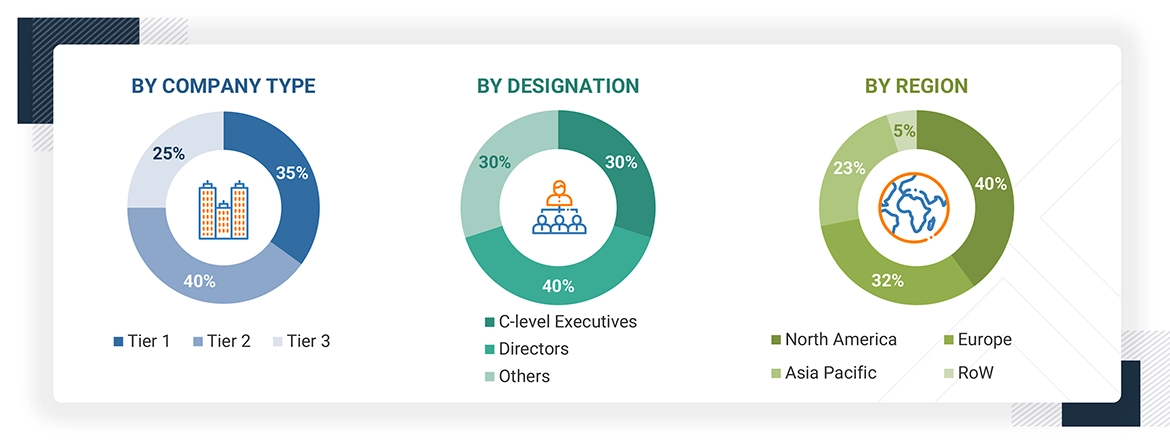
Notes: RoW mainly comprises the Middle East, Africa, and South America.
Other designations include product managers, sales managers, and marketing managers.
Three tiers of companies have been defined based on their total revenue as of 2024: tier 3: revenue less than USD 500 million; tier 2: revenue between USD 500 million and 1 billion; and tier 1: revenue more than USD 1 billion
To know about the assumptions considered for the study, download the pdf brochure
Market Size Estimation
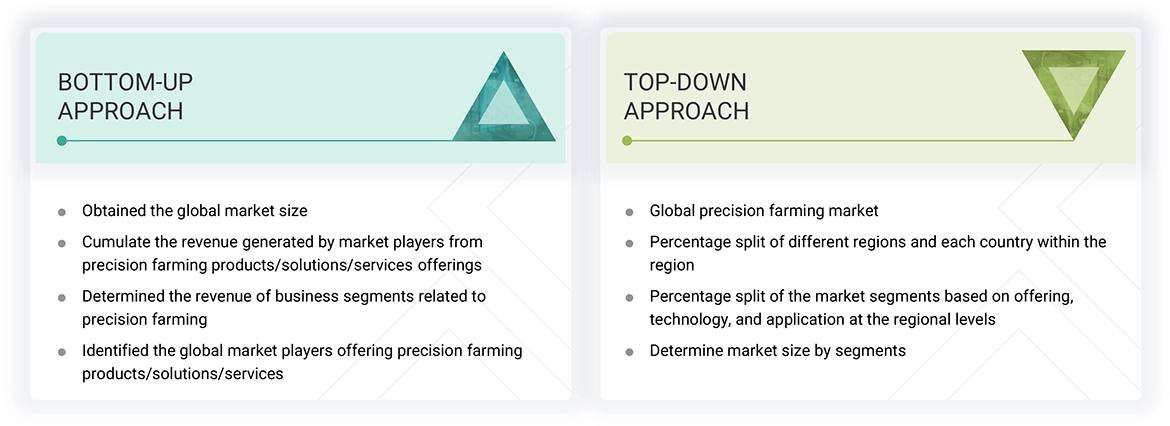
The bottom-up procedure has been employed to arrive at the overall size of the large format printer market.
- Identifying applications that are either used or are expected to use large format printers
- Analyzing major providers of large format printers and original equipment manufacturers (OEMs), as well as studying their portfolios and understanding different technologies used
- Analyzing historical and current data pertaining to the market, in terms of volume, for each technology used in large format printers
- Analyzing the average selling price of large format printers based on different technologies used in other applications
- Arriving at the market estimates by analyzing the revenue of companies and then combining these figures to arrive at the overall market size
- Studying various paid and unpaid sources, such as annual reports, press releases, white papers, and databases, to gather the required information
- Tracking the ongoing developments and identifying the upcoming ones in the market that include research and development activities, product launches, collaborations, and partnerships undertaken, as well as forecasting the market based on these developments and other critical parameters
- Carrying out multiple discussions with the key opinion leaders to understand the large format printer technologies and related raw materials, as well as products designed and developed to analyze the break-up of the scope of work carried out by key companies manufacturing printers
- Verifying and cross-checking the estimate at every level through discussions with key opinion leaders such as chief experience officers (CXOs), directors, and operation managers, and finally with the domain experts in MarketsandMarkets
The top-down approach has been used to estimate and validate the total size of the large format printer market.
- Focusing initially on the investments and expenditures made in the ecosystems of various applications
- Calculating the market size considering revenues generated by major players through the cost of the large format printers
- Segmenting each application of large format printer in each region and deriving the global market size based on region
- Acquiring and analyzing information related to revenues generated by players through their key offerings
- Conducting multiple on-field discussions with key opinion leaders involved in the development of large format printers based on different technologies and a wide variety of applications of such printers
- Estimating the geographic split using secondary sources based on various factors, such as the number of players in a specific country and region, and the technologies used in large format printers that are used in apparel & textile, signage & advertising, décor, CAD & technical printing applications
Large Format Printer Market : Top-Down and Bottom-Up Approach
Data Triangulation
After arriving at the overall market size using the market size estimation processes as explained above, the market has been split into several segments and subsegments. To complete the entire market engineering process and arrive at the exact statistics of each market segment and subsegment, data triangulation and market breakdown procedures have been employed, wherever applicable. The data has been triangulated by studying various factors and trends from the demand and supply sides in the large format printer market.
Market Definition
Large format printing, also referred to as wide-format printing, is a specialized segment of the printing industry that involves the production of high-resolution, large-scale graphics and technical documents using printers capable of handling media widths greater than standard sizes, typically from 17” to 72” and above. It focuses on delivering high-quality output for visual communication across applications such as apparel & textile, signage & advertisement, décor, and CAD & technical printing. Technologies such as ink-based and toner-based printing, utilizing ink types including aqueous, latex, UV-cured, solvent, and dye sublimation, enable compatibility with diverse substrates like canvas, fabric, and film. These printers meet commercial and industrial demands by ensuring precision, media versatility, and efficient output across advertising, design, and engineering environments.
Key Stakeholders
- Large format printing material and component suppliers
- Manufacturing equipment suppliers
- System integrators
- Technology/IP developers
- End users of printers, printing service providers, and printing presses
- Investors (private equity, venture capital, and others)
- Original equipment manufacturers (OEMs)
- Large format printing and material-related associations, organizations, forums, and alliances
- Venture capitalists and startups
- Research institutes and organizations
- Market research and consulting firms
- Distributors and resellers
Report Objectives
- To define, describe, and forecast the large format printer market size, by offering, connectivity, print width, printing material, ink type, technology, and application, in terms of value
- To forecast the large format printer market size for the technology segment, in terms of volume
- To estimate and forecast the market size, in terms of value, for various segments across four regions—North America, Europe, Asia Pacific (APAC), and Rest of the World (RoW)
- To provide detailed information regarding drivers, restraints, opportunities, and challenges influencing the growth of the market
- To provide a detailed overview of the value chain pertaining to the large format printer ecosystem, along with the average selling prices of different types of large format printers
- To strategically analyze trends/disruptions impacting customer business, pricing analysis, technology analysis, key stakeholders & buying criteria, case study analysis, trade analysis, patent analysis, Porter’s five forces, key conferences & events, AI impact, impact of 2025 US tariff, and regulations related to the large format printer market
- To analyze the manufacturers of large format printers, their strategies, and new production plans to evaluate the large format printer ecosystem/supply chain, which consists of suppliers of materials and components, and product manufacturers
- To strategically analyze micromarkets with respect to individual growth trends, prospects, and contributions to the overall market
- To analyze opportunities in the market for stakeholders by identifying high-growth segments of the market and providing a detailed competitive landscape for market leaders
- To strategically profile key players and comprehensively analyze their market share and ranking, as well as core competencies
- To analyze competitive developments, such as collaborations, contracts, partnerships, acquisitions, and product launches and developments, in the large format printer market
Available customizations:
With the given market data, MarketsandMarkets offers customizations according to the company‘s specific needs. The following customization options are available for the report.
Company Information:
- Detailed analysis and profiling of additional market players (up to five)
Key Questions Addressed by the Report
What is the current size of the Large Format Inkjet Printers Market?
The global Large Format Printer Market is estimated at around USD 7.94 billion in 2025 and is projected to reach USD 10.36 billion by 2030.
What is the expected growth rate of the Large Format Inkjet Printers Market?
The market is expected to grow at a CAGR of 5.5% during 2025–2030, driven by increasing demand for high-quality commercial and industrial printing solutions.
What are the major growth drivers of the Large Format Inkjet Printers Market?
Key drivers include rising demand for customized printing, growth of advertising and signage, expansion of textile printing, packaging applications, and adoption of eco-friendly printing technologies.
What are the key trends in the Large Format Inkjet Printers Market?
Major trends include adoption of UV-curable inks, wireless connectivity, sustainable inks, high-speed printing, and increasing use of digital textile and décor printing.
Which region dominates the Large Format Inkjet Printers Market?
North America accounted for a leading share with approximately 39.3% market share in 2024, while Asia Pacific is expected to be the fastest-growing region.
Which technology segment leads the Large Format Printer Market?
Ink-based technology dominates the market, accounting for approximately 91.5% share in 2025, due to high-quality output and wide application scope.
Which application segment is expected to grow fastest?
The décor application segment is projected to grow at the highest CAGR of around 12.3% from 2025 to 2030, driven by customized wallpapers, interiors, and creative printing.
Which industries use large format inkjet printers?
Major industries include advertising, retail, textiles, packaging, architecture, construction, décor, and industrial printing applications.
Who are the major companies in the Large Format Inkjet Printers Market?
Key players include HP Inc., Canon Inc., Seiko Epson Corporation, Brother Industries Ltd., and Mimaki Engineering Co., Ltd..
What does the Large Format Inkjet Printers Market report analyze?
The report covers market size, forecast, technology, connectivity, ink type, print width, applications, regional analysis, competitive landscape, trends, and growth opportunities through 2030.
Fact checked
Personalize This Research
- Triangulate with your Own Data
- Get Data as per your Format and Definition
- Gain a Deeper Dive on a Specific Application, Geography, Customer or Competitor
- Any level of Personalization
Let Us Help You
- What are the Known and Unknown Adjacencies Impacting the Large Format Printer Market
- What will your New Revenue Sources be?
- Who will be your Top Customer; what will make them switch?
- Defend your Market Share or Win Competitors
- Get a Scorecard for Target Partners

Custom Market Research Services
We Will Customise The Research For You, In Case The Report Listed Above Does Not Meet With Your Requirements
Get 10% Free CustomisationTESTIMONIALS

Tetsuya Ohhira
Business Development Manager-Technology Business
Nikon Corporation,
Leading Japanese MNC specializing in optics and imaging productswww.nikon.com
MarketsandMarkets™ response
is quick. Their attitude is flexible and positive. Analyst Insights are globally considered and
significant. Client Services quickly respond to our inquiry and demand. Their wide range of global
surveys help us make our strategic plan.
We hope Knowledge Store will be easier to search
for a report.
VP - Marketing & Business Development
Leading Provider of Process Control Solutions
We engaged with MarketsandMarkets on a study to perform an analysis and recommend a Go-To-Market strategy for metrology and process control in the semiconductor market. The study was tailored to our targets and needs with well-defined milestones. Our overall experience with the MarketsandMarkets team was very good throughout the project in all aspects including the analysis methodologies used, the quality and depth of primary and secondary data sets, the professionalism and flexibility of the team and the ability to meet the target schedule and milestones. We want to thank MarketsandMarkets team for a job well done.
- US Large Format Printer Market
- Canada Large Format Printer Market
- Mexico Large Format Printer Market
- Germany Large Format Printer Market
- UK Large Format Printer Market
- France Large Format Printer Market
- Italy Large Format Printer Market
- China Large Format Printer Market
- Japan Large Format Printer Market
- India Large Format Printer Market
- Australia Large Format Printer Market
Growth opportunities and latent adjacency in Large Format Printer Market






Edwin
Apr, 2026
How is the increasing adoption of large format printers across textile, e-commerce, retail, and outdoor advertising industries influencing demand patterns and long-term market growth?.
Jerry
Apr, 2026
How is the rising preference for digital advertising over traditional print media affecting the growth prospects of the large format printer market globally?.
Ethan
Apr, 2026
How is the integration of emerging technologies like Artificial Intelligence and automation influencing operational efficiency, print quality, and future innovation in the large format printer industry?.
Ethan
Apr, 2026
How is the integration of emerging technologies like Artificial Intelligence and automation influencing operational efficiency, print quality, and future innovation in the large format printer industry?.
Ethan
Apr, 2026
How is the integration of emerging technologies like Artificial Intelligence and automation influencing operational efficiency, print quality, and future innovation in the large format printer industry?.
Sergio
Oct, 2022
I am entering the large format digital printing market, both Mexico and USA, therefore I am looking for statisticts .
SavePlus
Oct, 2025
The large format printer market is booming with innovation and rising demand across industries. Exciting growth ahead! .