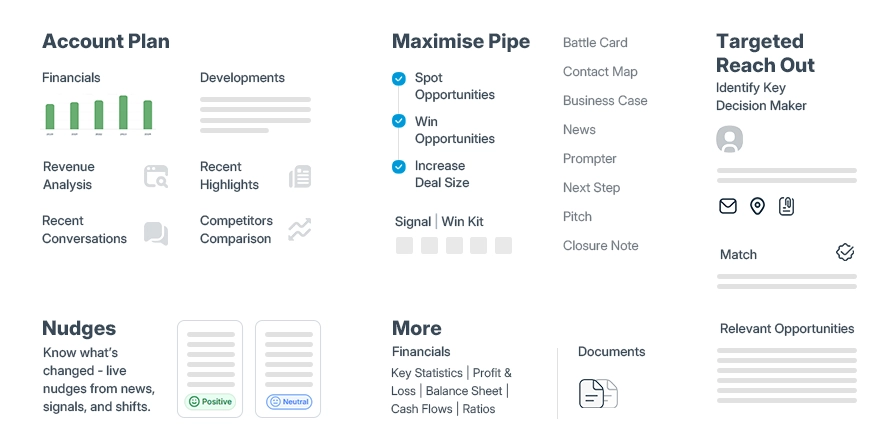
Enterprise sales teams waste countless hours chasing cold leads while revenue-ready opportunities sit dormant inside their existing account base. The traditional spray-and-pray approach to lead nurturing has become obsolete in an era where buying committees now involve seven to twelve stakeholders, sales cycles stretch beyond twelve months, and generic outreach gets ignored.
What if your team could identify which accounts are experiencing mission-critical shifts before your competitors even detect movement?
Opportunity-based nurturing fundamentally reimagines how enterprise sellers engage their book of business—moving from broadcast campaigns to precision-guided conversations triggered by real business change. This methodology recognizes a counterintuitive truth: the best pipeline doesn't come from net-new logos but from systematically uncovering expansion opportunities within accounts you already serve. Revenue intelligence platforms now track ecosystem signals, organizational restructuring, budget reallocations, and strategic initiative launches—the very catalysts that create buying windows.
When sellers connect these business movements to specific opportunities and arm themselves with contextual messaging, conversion velocity increases while cost per opportunity plummets. The shift from volume-based nurturing to pipeline generation from existing accounts represents the single most significant evolution in B2B sales methodology this decade.
The Fundamental Problem with Traditional Enterprise Lead Nurture
Traditional enterprise lead nurture operates on a flawed assumption: that timing follows your content calendar rather than the customer's business reality. Sales and marketing teams deploy drip campaigns based on arbitrary intervals—seven days after download, fourteen days post-webinar—without consideration for what's actually happening inside the target account. This disconnect creates a predictable pattern: sellers send generic value propositions while prospects deal with budget freezes, organizational changes, or strategic pivots that make those messages irrelevant. The result is noise, not engagement.
Enterprise buying committees don't respond to persistence alone. They respond when sellers demonstrate awareness of their current business context and connect solutions to problems they're actively trying to solve right now. When your nurture sequence discusses cost optimization while the prospect just secured additional funding for expansion, you've lost credibility. When you pitch integration capabilities while they're consolidating vendors, you're tone-deaf. The friction point isn't message quality—it's message timing and relevance to the account's present reality.
Most CRM systems compound this problem by treating accounts as static entities. They store historical data—past purchases, previous interactions, outdated org charts—but fail to capture the dynamic business movements that signal opportunity. A new CFO joins. A competitor exits the market. The company acquires a smaller firm in a different geography. These catalysts create urgency and budget allocation, yet they remain invisible to sales teams relying on quarterly business reviews and annual account planning cycles. By the time sellers learn about these changes through traditional channels, competitors who detected the shift earlier have already engaged.
The enterprise sales landscape has fundamentally shifted. Deals that once closed in six months now take twelve to eighteen months. Buying committees have expanded from three decision-makers to seven or more. Each stakeholder has different concerns, different success metrics, different reasons to say no. Generic nurture campaigns that treat the entire committee as a monolith fail spectacularly. The VP of Engineering cares about technical architecture and integration complexity. The CFO evaluates ROI and total cost of ownership. The CISO focuses on security, compliance, and risk mitigation. Sending identical content to all three represents malpractice in modern selling.
What Opportunity-Based Nurturing Actually Means for Pipeline Generation from Existing Accounts
Opportunity-based nurturing inverts the traditional approach. Instead of creating touchpoints and hoping they align with buying readiness, this methodology starts by identifying specific opportunities within accounts and then orchestrating engagement around those opportunities. The foundation is continuous account monitoring—tracking what's changing inside the organization, what initiatives they're launching, what challenges they're facing, and what signals indicate potential buying windows.
Revenue intelligence platforms now consolidate fragmented signals into coherent opportunity maps. They connect news about a company's expansion into new markets with your geographic coverage capabilities. They link leadership changes to likely technology stack reviews. They correlate financial performance with budget availability for your category. This isn't predictive in a probabilistic sense—it's observational. The opportunities exist; the challenge has always been seeing them and understanding their implications before your competitors do.
When sellers identify these opportunities, the nurture approach changes completely. Messages become contextual, not generic. Outreach references specific business movements the account is experiencing. Content addresses problems the opportunity creates or solves. Conversations start with "I noticed your recent acquisition in the Midwest" rather than "I wanted to follow up on our last conversation three months ago." This specificity signals competence and earns attention in crowded executive inboxes.
Pipeline generation from existing accounts through this methodology delivers three distinct advantages. First, warm relationships already exist—you're not cold calling into accounts with zero brand awareness. Second, you understand their business context from previous engagements, making message personalization faster and more accurate. Third, expansion opportunities often close faster than net-new deals because procurement processes, legal reviews, and vendor vetting have already occurred. You're selling into known entities, not unknown prospects.
The operational shift requires discipline. Sellers must prioritize accounts showing opportunity signals over accounts on an arbitrary touch schedule. They must invest time understanding what specific opportunities mean for different stakeholders within the buying committee. They must abandon the comfort of activity metrics—emails sent, calls made—in favor of outcome metrics: opportunities identified, conversations initiated with the right people about the right topics at the right time. This transition feels uncomfortable initially because it replaces volume with precision, but conversion rates justify the methodology shift.
How Revenue Intelligence Enables Enterprise Lead Nurture at Scale
Revenue intelligence platforms solve the fundamental challenge of opportunity-based nurturing: how do you monitor hundreds or thousands of accounts for relevant changes without building an army of researchers? The technology layer continuously scans multiple data sources—financial reports, news feeds, organizational changes, technology stack updates, hiring patterns, social signals, and ecosystem movements—then consolidates this information into account-specific intelligence feeds.
These systems don't just aggregate data; they contextualize it. When a company posts a job opening for a Director of Digital Transformation, the platform connects that signal to your digital transformation consulting services and flags it as a relevant opportunity. When quarterly earnings show revenue growth in a specific product line, it correlates that growth with potential technology needs in that business unit. The human seller receives curated opportunities with supporting context, not raw data requiring manual interpretation.
The sophistication extends to buying committee mapping. Revenue intelligence platforms identify who influences purchasing decisions for specific opportunity types within each account. They track when new executives join, when decision-makers change roles, when organizational structures shift. This visibility lets sellers understand not just what opportunities exist but who they need to engage and what those individuals care about based on their role, background, and publicly stated priorities.
Automation handles the repetitive work that traditionally consumed seller capacity. When opportunities are identified, the platform can draft initial outreach messages incorporating specific account context and relevant value propositions. It can suggest content that addresses the opportunity's underlying business challenge. It can schedule follow-up sequences that adapt based on engagement signals. The seller reviews, refines, and approves rather than creating everything from scratch—a productivity multiplier that lets teams cover more accounts without sacrificing personalization quality.
For pipeline generation from existing accounts, this technological foundation creates a sustainable competitive advantage. While competitors rely on quarterly account reviews to surface opportunities, your team receives real-time alerts when opportunity-creating events occur. While they craft generic check-in emails, your team sends contextual messages demonstrating business awareness. While they guess at stakeholder priorities, your team engages with role-specific value propositions. The cumulative effect is higher response rates, faster deal progression, and larger opportunity pipelines from the same account base.
Implementing Opportunity-Driven Workflows for Enterprise Lead Nurture
Transitioning to opportunity-based nurturing requires more than platform adoption—it demands workflow redesign. The first step involves defining what constitutes an actionable opportunity for your specific offerings. Not every account change matters equally. A company opening a new office might create opportunities for workplace technology providers but holds no relevance for cybersecurity vendors focused on data protection. Precision in opportunity definition prevents alert fatigue and keeps sellers focused on high-probability scenarios.
Once opportunity criteria are established, sellers need protocols for engagement prioritization. When the platform surfaces twelve opportunities across your account portfolio, which three warrant immediate attention? Prioritization typically factors in opportunity size, strategic account importance, competitive positioning, and time sensitivity. An opportunity with a narrow engagement window—triggered by a leadership change that will settle in sixty days—takes precedence over opportunities with longer timeframes. Strategic accounts receive priority even for smaller opportunities because relationship depth matters for long-term value.
Message development becomes contextual rather than templated. Instead of maintaining a library of generic nurture emails, sellers develop frameworks for incorporating opportunity-specific details into outreach. The structure might be consistent—problem acknowledgment, relevant capability, next step—but the content varies based on what's happening inside each account. This approach maintains personalization at scale without requiring sellers to craft completely unique messages for every opportunity.
Multi-threading across buying committees requires orchestration. For complex enterprise lead nurture scenarios, multiple stakeholders need engagement, but coordination matters. The message to the CFO shouldn't duplicate the message to the CTO—each should address role-specific concerns while maintaining consistent positioning. Revenue intelligence platforms help sellers identify all relevant stakeholders for each opportunity and suggest value propositions aligned with each person's priorities and success metrics. This coordinated approach prevents mixed messages and demonstrates organizational awareness.
Measurement shifts from activity to outcome. Traditional nurture programs track email open rates, content downloads, and meeting bookings. Opportunity-based nurturing measures opportunity identification velocity, engagement conversion rates by opportunity type, and progression speed from opportunity identification to qualified pipeline. These metrics provide feedback on both opportunity criteria accuracy and engagement approach effectiveness, enabling continuous refinement of the methodology.
Why Existing Accounts Represent the Highest-Value Pipeline Source
The economics of pipeline generation from existing accounts fundamentally differ from new logo acquisition. Customer acquisition costs for enterprise accounts routinely exceed $50,000 when factoring in marketing spend, sales cycles, and resource allocation. Once that investment is made, the incremental cost of identifying and pursuing expansion opportunities within the same account drops dramatically. The relationship infrastructure exists—established communication channels, proven credibility, understood business context—reducing friction at every stage.
Existing accounts also provide clearer opportunity qualification. When evaluating new prospects, sellers make educated guesses about budget, authority, need, and timing. With current customers, much of this information is known or easily discovered through relationship channels. You understand their buying process because you've navigated it previously. You know who influences decisions because you've mapped the organization. You've demonstrated value in one area, making expansion conversations easier than cold prospecting into unknown territory.
The data supports this focus. Research consistently shows that acquiring a new customer costs five to twenty-five times more than retaining and expanding an existing one. Companies with sophisticated account expansion programs see thirty to forty percent of revenue come from their current customer base. Yet most sales organizations allocate the majority of their resources to new logo hunting, leaving existing accounts under-covered and vulnerable to competitive displacement.
Competitive dynamics also favor the incumbent in expansion scenarios. When an existing customer considers adding capabilities, they face switching costs—not just financial but operational, political, and psychological. The team that championed your initial purchase has incentive to see you succeed because your success validates their decision. They prefer adding to a working relationship rather than starting fresh with a competitor. This incumbent advantage compounds when you demonstrate consistent awareness of their evolving needs through opportunity-based nurturing.
The strategic implication is clear: enterprise sales teams should invest disproportionately in systematic opportunity identification within their current account portfolio before allocating resources to net-new prospecting. This doesn't mean ignoring new logos entirely—healthy pipelines require both—but the balance has been wrong in most organizations. Redirecting even twenty percent of new logo resources to sophisticated existing account coverage typically yields outsized pipeline returns because opportunity density is higher and conversion probability improves with relationship maturity.
Orchestrating Multi-Stakeholder Engagement Through Opportunity-Based Nurturing
Enterprise buying committees have expanded beyond recognition. A decade ago, three to four decision-makers sufficed for most enterprise software purchases. Today, that number regularly exceeds seven, often reaching twelve for mission-critical implementations. Each stakeholder brings domain-specific concerns, political considerations, and personal risk tolerance to the evaluation. Enterprise lead nurture that ignores this complexity fails regardless of message quality because it reaches the wrong people or addresses the wrong concerns for each role.
Opportunity-based nurturing excels in multi-stakeholder environments because it maps opportunities to relevant buying committee members and tailors engagement accordingly. Consider a company experiencing rapid growth that creates opportunities for your customer data platform. The VP of Marketing cares about campaign personalization and customer segmentation capabilities. The Chief Data Officer focuses on data governance, compliance, and integration with existing data infrastructure. The CFO evaluates total cost of ownership and time to value. Generic nurture campaigns can't address these divergent priorities effectively.
The methodology instead creates stakeholder-specific nurture tracks within each opportunity. When the growth signal is detected, the platform identifies all relevant decision-makers and influencers for a customer data platform purchase at that account. Each person receives outreach addressing their specific concerns, using language appropriate to their role, and highlighting capabilities that map to their success metrics. The Marketing VP gets case studies showing campaign performance improvements. The CDO receives technical architecture documentation and compliance certifications. The CFO sees ROI calculations and implementation timeline projections.
Coordination across these parallel tracks matters enormously. Stakeholders talk to each other, compare notes, and align their positions. If the messages they receive from your team conflict or emphasize different positioning, confusion and skepticism result. Revenue intelligence platforms help sellers maintain message consistency while varying content depth and focus based on stakeholder role. Everyone hears the same core value proposition, but the supporting details and proof points adjust to match what each person cares about most.
Timing sequencing also requires orchestration. In complex sales, stakeholders don't all engage simultaneously. Technical evaluators often enter the process after business champions establish initial interest. Economic buyers engage late, typically for final approval rather than early exploration. Opportunity-based nurturing accounts for these patterns, staging stakeholder engagement to match typical buying committee progression for each opportunity type. The goal is ensuring the right people have the right context at the right stage without overwhelming anyone with premature outreach.
Measuring Success in Opportunity-Driven Pipeline Generation from Existing Accounts
Transitioning to opportunity-based nurturing requires new success metrics because traditional engagement measurements don't capture what matters. Email open rates and content downloads indicate interest but say nothing about opportunity quality or progression likelihood. The focus shifts to metrics that connect activity to revenue outcomes, particularly within the existing account base where relationship depth should accelerate conversion.
Opportunity identification velocity measures how quickly your team surfaces relevant opportunities within target accounts. If competitors identify opportunities faster, they engage first and establish positioning advantage. Best-in-class teams track the time lag between opportunity-creating events—executive hires, initiative announcements, strategic shifts—and seller awareness. Reducing this lag from weeks to days or hours creates competitive advantage because early engagement shapes the buying conversation.
Engagement conversion rates by opportunity type reveal which signals actually lead to qualified pipeline. Not all opportunities are created equal. Some trigger events correlate strongly with buying readiness; others represent interesting observations with minimal conversion probability. By tracking which opportunity types consistently progress to qualified pipeline and which stall, teams refine their opportunity criteria and focus seller attention on high-probability scenarios. This data-driven approach prevents wasted effort on low-value opportunities.
Pipeline velocity within existing accounts shows whether opportunity-based nurturing actually accelerates deals or simply identifies them earlier. The hypothesis is that contextual, timely engagement based on specific opportunities shortens sales cycles by reducing discovery time and increasing message relevance. Measuring average time from opportunity identification to closed-won across account expansion deals validates this hypothesis and quantifies the methodology's impact on revenue timing.
Multi-stakeholder coverage metrics track whether sellers engage all relevant buying committee members or focus narrowly on familiar contacts. For pipeline generation from existing accounts, relationship breadth matters because it prevents single-point-of-failure risk and improves deal resilience. If your champion leaves or loses political capital, have you built relationships with other stakeholders who can advocate for the purchase? Coverage metrics highlight gaps and ensure sellers systematically expand their influence across the buying committee.
Ultimately, the metric that matters most is expansion revenue as a percentage of total revenue. Organizations that successfully implement opportunity-driven approaches to existing account coverage consistently see this percentage climb from the typical fifteen to twenty percent toward thirty-five to forty-five percent. This shift indicates the methodology is working—opportunities are being identified faster, engagement is more relevant, and the existing account base is being fully monetized rather than under-utilized.
Common Implementation Pitfalls in Opportunity-Based Nurturing Programs
Many organizations adopt revenue intelligence platforms but fail to achieve promised results because they treat the technology as a dashboard rather than a workflow transformation. They collect opportunity signals but don't build systematic processes for acting on them. Sellers receive alerts about account changes but lack frameworks for translating those changes into engagement strategies. The result is data paralysis—more information without better outcomes.
Another common failure mode is maintaining old activity metrics while attempting new methodologies. When leadership continues measuring success by call volume and email sends, sellers optimize for those metrics regardless of new tools or processes. If a seller can hit quota through high-volume generic outreach, they won't invest time in contextual opportunity-based nurturing that requires more preparation per interaction. Metric alignment matters—what gets measured gets prioritized.
Over-automation represents a more subtle risk. Revenue intelligence platforms can draft messages, schedule sequences, and manage follow-up—but completely automated enterprise lead nurture loses the human judgment that creates breakthrough conversations. The platform should handle research, initial drafting, and sequencing logistics, but sellers must add relationship context, account-specific nuance, and strategic thinking that algorithms can't replicate. The goal is augmented selling, not automated selling.
Opportunity criteria that are too broad or too narrow both create problems. Overly broad criteria generate so many opportunities that sellers can't act on them all, leading to prioritization paralysis and alert fatigue. Overly narrow criteria miss legitimate opportunities because the definitions don't account for the diverse ways buying signals manifest across different industries and account types. Finding the right balance requires iteration—start with focused criteria based on known high-probability opportunities, then expand carefully as the team develops capacity to handle increased volume.
Finally, many teams neglect the feedback loop between opportunity identification and opportunity outcomes. When opportunities identified by the platform don't convert, sellers need mechanisms to indicate why—was the signal wrong, was the timing off, did competitive factors intervene? This feedback helps refine opportunity criteria and improve signal quality over time. Without it, the platform continues surfacing the same type of low-probability opportunities indefinitely, wasting seller time and eroding trust in the methodology.
The Evolution of Enterprise Lead Nurture Beyond Opportunity-Based Approaches
While opportunity-based nurturing represents a significant advancement over generic drip campaigns, the methodology continues evolving. The next frontier involves predictive opportunity identification—using pattern recognition to surface opportunities before obvious trigger events occur. By analyzing historical data about what account characteristics and business movements preceded successful expansion deals, platforms can identify accounts matching those patterns before leadership changes, initiative announcements, or growth signals become public.
Integration with customer success data creates another dimension of opportunity intelligence. Customer health scores, product adoption metrics, and support interaction patterns all signal expansion readiness or risk that traditional enterprise lead nurture programs ignore. An account with high product adoption but limited feature utilization represents a clear expansion opportunity. An account with declining engagement needs retention focus before expansion conversations make sense. Connecting these operational signals to opportunity workflows improves targeting precision.
Cross-account pattern recognition adds strategic value beyond individual opportunity identification. When multiple accounts in the same industry begin exhibiting similar signals—new regulations, market pressures, technology shifts—understanding that pattern lets revenue teams develop industry-specific plays that work across the portfolio. This macro view complements the account-specific micro view, enabling both targeted opportunity-based nurturing within accounts and coordinated campaigns across similar accounts facing common challenges.
The role of artificial intelligence will expand beyond signal detection into conversation guidance and objection handling. Imagine sellers entering discovery calls with real-time suggestions about which questions to ask based on the specific opportunity type, the stakeholder's role, and the account's business context. Or receiving instant guidance when a prospect raises an objection about pricing, integration complexity, or competitive alternatives. These AI-augmented conversations maintain the human relationship while eliminating the expertise gap between top performers and average sellers.
Looking forward, the distinction between new logo acquisition and account expansion will blur as revenue intelligence platforms track prospects long before they become customers and continue monitoring them throughout the customer lifecycle. Pipeline generation from existing accounts won't be a separate discipline from new business development—both will operate on the same opportunity-driven foundation, differentiated only by relationship maturity and available context rather than fundamentally different approaches to engagement.
Frequently Asked Questions About Opportunity-Based Nurturing
What is opportunity-based nurturing and how does it differ from traditional lead nurturing?
Opportunity-based nurturing focuses engagement on specific, identified opportunities within accounts triggered by real business changes—such as leadership transitions, strategic initiatives, or market expansions. Traditional lead nurturing operates on fixed schedules and generic content sequences regardless of what's happening inside the account. The key difference is relevance: opportunity-based approaches connect outreach to actual business context, making messages timely and contextual rather than arbitrary and generic.
How does pipeline generation from existing accounts compare to new logo acquisition?
Pipeline generation from existing accounts typically delivers higher ROI because relationship infrastructure already exists, procurement processes are understood, and credibility has been established. Customer acquisition costs for new enterprise logos can exceed $50,000, while expansion opportunities within current accounts require significantly lower investment. Research shows existing customer expansion costs five to twenty-five times less than new customer acquisition, yet most organizations under-invest in systematic existing account coverage.
What signals indicate expansion opportunities within existing accounts?
High-probability opportunity signals include executive leadership changes, organizational restructuring, geographic expansion, new product launches, funding rounds, mergers and acquisitions, strategic initiative announcements, technology stack changes, regulatory compliance requirements, and significant revenue growth or decline. Revenue intelligence platforms monitor these signals continuously and correlate them with your specific offerings to surface relevant opportunities before competitors detect movement.
How do you personalize enterprise lead nurture for multiple stakeholders?
Enterprise lead nurture for complex buying committees requires stakeholder-specific messaging that addresses role-based concerns while maintaining consistent positioning. The VP of Engineering receives technical architecture details, the CFO gets ROI calculations and total cost of ownership analysis, and the CISO focuses on security and compliance documentation. Revenue intelligence platforms help identify all relevant stakeholders for each opportunity and suggest value propositions aligned with each person's priorities and success metrics.
What metrics should sales leaders track for opportunity-based nurturing programs?
Critical metrics include opportunity identification velocity (time from trigger event to seller awareness), engagement conversion rates by opportunity type, pipeline velocity within existing accounts, multi-stakeholder coverage across buying committees, and expansion revenue as a percentage of total revenue. These outcome-based metrics provide better insights than traditional activity metrics like email open rates or call volume because they connect directly to revenue impact.
How long does it take to implement opportunity-based nurturing effectively?
Initial platform setup and opportunity criteria definition typically requires four to six weeks. Achieving full team adoption and workflow optimization usually takes three to six months as sellers develop comfort with the methodology and refine their approach based on results. Most organizations see measurable improvements in opportunity identification and engagement conversion within the first ninety days, with compounding returns as the team masters the approach and opportunity criteria become more precise.
Can opportunity-based nurturing work for smaller sales teams?
Yes—in fact, smaller teams often benefit more because they have limited capacity for manual account research and monitoring. Revenue intelligence platforms level the playing field by providing enterprise-grade opportunity identification capabilities regardless of team size. A five-person sales team can cover their account portfolio as systematically as a fifty-person team when the platform handles continuous monitoring, signal detection, and initial message drafting, allowing sellers to focus on high-value relationship building and deal progression.
What role does AI play in modern enterprise lead nurture?
AI continuously scans multiple data sources to detect opportunity-creating signals, correlates those signals with your offerings, identifies relevant buying committee members, drafts contextual outreach messages, and suggests engagement sequences based on opportunity type and stakeholder role. The technology handles research-intensive tasks that traditionally consumed seller capacity, allowing revenue teams to focus on relationship development and strategic selling rather than manual prospecting and content creation.
Conclusion
The shift from broadcast nurture campaigns to opportunity-based nurturing addresses the fundamental mismatch between how sellers traditionally engage accounts and how modern enterprise buying actually happens. Generic touchpoints on arbitrary schedules ignore the reality that buying windows open and close based on business circumstances, not marketing calendars. When sellers connect engagement to specific opportunities triggered by real account changes, relevance increases, response rates improve, and conversion velocity accelerates.
For enterprise sales organizations, pipeline generation from existing accounts through systematic opportunity identification represents the highest-return investment available. The relationship infrastructure already exists, procurement friction is reduced, and opportunity density exceeds what new logo prospecting can deliver. Yet most teams leave this opportunity pool under-monetized because they lack the visibility, processes, and tools to identify and act on expansion opportunities systematically.
Revenue intelligence platforms provide the technological foundation, but success requires more than software adoption. It demands workflow transformation, metric realignment, and mindset shifts from activity-based to outcome-based selling. Sellers must prioritize depth over breadth, focusing on high-probability opportunities within fewer accounts rather than shallow coverage across many. Sales leaders must measure what matters—opportunity identification velocity, engagement relevance, pipeline quality—rather than legacy activity metrics that encourage volume over value.
The organizations that master opportunity-based nurturing within their existing account base will fundamentally outperform competitors still operating on traditional enterprise lead nurture methodologies. They'll engage earlier when opportunities emerge, demonstrate superior business awareness that builds credibility, and convert at higher rates because their outreach aligns with actual buying readiness rather than hoping for lucky timing. This competitive advantage compounds over time as relationship depth increases and opportunity identification improves through continuous learning.
The path forward is clear: invest in revenue intelligence capabilities that surface opportunities within your account portfolio, redesign nurture workflows around those opportunities rather than arbitrary touch schedules, train sellers to engage with context and precision rather than volume and persistence, and measure success by opportunity outcomes rather than activity outputs. The revenue impact of getting this right—higher win rates, faster cycle times, increased expansion revenue, and more efficient resource allocation—justifies whatever organizational change is required to make the transition.
Experience the Future of Opportunity-Driven Pipeline Generation
Ready to transform how your team identifies and pursues expansion opportunities within your existing accounts? SalesPlay—the revenue intelligence co-pilot that continuously monitors your target accounts, surfaces relevant opportunities before competitors detect movement, and guides sellers with contextual engagement strategies that accelerate pipeline velocity. Stop guessing where to focus. Start knowing where opportunities exist, why they matter, and how to convert them. See how SalesPlay turns pipeline generation from existing accounts from ad-hoc activity into systematic execution.
Experience SalesPlay Today