Next-Generation Sales Automation: AI and Machine Learning Integration
September 05, 2025

I used to spend hours logging sales calls and sorting leads manually—until the best sales automation software transformed my workday from data entry to actual selling. Today's sales teams face fierce competition, shrinking attention spans, and higher customer expectations than ever before. In fact, without proper automation, you're likely leaving money on the table while drowning in administrative tasks.
AI sales automation is no longer a futuristic concept—it's the competitive edge separating top performers from everyone else. Next-generation sales automation combines artificial intelligence with workflow tools to handle everything from lead scoring to personalized follow-ups. These AI-powered sales tools don't just save time; they actively improve conversion rates by identifying patterns humans simply can't see. As a result, sales professionals can focus on what they do best: building relationships and closing deals.
Throughout this article, I'll walk you through the game-changing technologies reshaping sales processes, showcase the top platforms worth your investment, and explain how machine learning is making personalization at scale not just possible but remarkably effective. Whether you're looking to upgrade your current system or implementing automation for the first time, you're about to discover how these tools can revolutionize your sales performance.
STOP GUESSING YOUR PIPELINE
START GROWING IT WITH AI SALES!!
The sales landscape has fundamentally changed. Salespeople traditionally spent 71% of their time on non-selling tasks such as administrative work and data entry. This reality has forced organizations to seek more efficient approaches to sales workflows.
Traditional sales processes require extensive human intervention at every stage. From qualifying leads to following up with prospects, sales representatives have historically managed these tasks manually. Furthermore, service representatives spend 66% of their time on non-customer facing tasks. These manual processes create significant inefficiencies:
Time consumption: Manual data entry and administrative tasks consume nearly three-quarters of sales professionals' time
Error rates: Human-driven processes typically have higher error rates than automated alternatives
Limited scalability: Manual efforts restrict the number of leads a salesperson can effectively manage
Inconsistent follow-up: Without automation, timely follow-ups often fall through the cracks
In contrast, AI-augmented sales processes deliver measurable advantages. Companies have seen more than 40% increase in case resolution using AI-powered agents. Additionally, implementing AI-driven workflows enables sales teams to spend more time on high-value activities like relationship building. According to research by McKinsey, organizations that invest in AI are seeing a 13-15% increase in revenue and a 10-20% increase in sales ROI.
The value of AI comes specifically from rewiring how companies run. McKinsey's research shows that among 25 attributes tested for organizations of all sizes, the redesign of workflows has the biggest effect on an organization's ability to see EBIT impact from its use of generative AI.
The shift toward AI-driven sales automation is accelerating rapidly. Currently, 65% of sales teams rely on AI-powered tools for lead generation and qualification. Moreover, 61% of sales teams have already adopted AI-powered tools to streamline their processes, according to Gartner.
However, adoption isn't uniform across all sales functions. Notably, adoption rates drop as you move down the sales funnel. More teams use AI for early-stage prospecting, such as automating lead enrichment, than for negotiation. This pattern suggests organizations are prioritizing automation of repetitive tasks before tackling more complex sales interactions.
Looking ahead, adoption is expected to accelerate significantly. By 2025, 85% of customer interactions will be managed without a human customer service representative. Gartner further predicts that by 2027, 95% of seller research workflows will begin with AI, up from less than 20% in 2024.
McKinsey's research indicates 21% of respondents reporting generative AI use by their organizations say they have fundamentally redesigned at least some workflows. Nevertheless, most organizations are still in early stages of implementing AI sales automation. A survey found only 1% of company executives describe their generative AI rollouts as 'mature'.
The future of sales automation clearly points toward an AI-led model rather than merely AI-assisted processes. Instead of sellers spending excessive time researching, building workflows, and determining next steps, next-generation sales automation will leverage AI and data to direct the optimal sales execution plan. Consequently, this approach will free sellers to focus on relationship management, strategic input, and serving as trusted advisors to customers.
Despite the clear benefits, sales teams have shown some resistance. According to monday.com's World of Work report, sales teams demonstrated some of the lowest adoption rates of AI technology at just 51%, compared to departments like IT, marketing, or finance. This hesitation likely stems from the customer-facing nature of sales roles and the perceived risk of AI mistakes in client interactions.
Behind every effective sales automation platform lies three powerful technologies that form the backbone of modern sales operations. These core technologies transform raw data into actionable insights that drive revenue growth. Let's examine how each technology works and why they matter for sales teams.
Machine learning (ML) has fundamentally altered how sales teams prioritize prospects. ML-powered lead scoring analyzes historical data to predict which leads are most likely to convert, allowing sales representatives to focus their efforts on the most promising opportunities.
Unlike traditional manual scoring methods, ML algorithms evaluate data from multiple sources to determine conversion potential. These systems analyze patterns in customer behavior, engagement metrics, and demographic information to build a clear profile of ideal prospects. The technology eliminates human bias and error that often plague manual lead qualification processes.
The primary advantages of ML-based lead scoring include:
Continuous improvement: ML models dynamically adapt to new data, making them more accurate over time as they learn from outcomes
Objective evaluation: AI calculates without emotional influence, identifying quality leads that sales teams might otherwise miss
Integration with CRM: Modern systems display AI-powered lead scores directly within CRM platforms, eliminating the need to switch between multiple tools
For effective implementation, organizations should focus on platforms offering "explainable AI," which provides transparency into how the system derives its scores. Additionally, quality data is essential—AI lead scoring requires substantial historical information to produce accurate results.
Ready to turn your Rep
INTO BEST PERFORMER ?
Natural language processing (NLP) enables computers to understand, interpret, and generate human language, fundamentally changing how CRM systems process unstructured customer data. This technology powers everything from chatbots to sentiment analysis within modern sales platforms.
NLP processes vast amounts of unstructured data—emails, social media posts, customer reviews, and support interactions—extracting valuable insights that would overwhelm human analysis. By analyzing text data, NLP identifies trends, patterns, and customer preferences, enabling personalized offerings and optimized marketing strategies.
Within CRM systems, NLP automates routine tasks like text summarization and data entry, drastically improving operational efficiency. It also enables contextual understanding in customer interactions by analyzing syntax, semantics, and conversational cues, thereby delivering more relevant responses and minimizing miscommunication.
Moreover, NLP facilitates multilingual support, allowing businesses to engage with diverse customer bases worldwide through translation and interpretation capabilities. This global reach expands market opportunities without requiring extensive language expertise from sales teams.
Predictive analytics transforms sales forecasting from a reactive, opinion-driven process into a proactive, data-driven strategy. Traditional forecasting methods rely heavily on manual inputs, static assumptions, and subjective assessments, creating significant room for error. In contrast, predictive analytics systematically analyzes historical data, current pipeline dynamics, and external market factors to minimize bias and guesswork.
The technology layers advanced statistical models and machine learning algorithms onto core data, ingesting far more signals than traditional methods—including deal age, activity cadence, product mix, buyer engagement, and macroeconomic indicators. The model continuously recalculates win probabilities as conditions change, learning which patterns lead to revenue while filtering out noise and bias.
Time series models analyze historical and current data to predict future values at specific points in time. Other techniques include linear regression, which examines relationships between dependent variables (like sales revenue) and independent variables (such as advertising spend), and more advanced machine learning algorithms like gradient boosting and random forests.
These predictive models provide sales organizations with probability-weighted ranges rather than single top-line numbers. Each opportunity carries its own win score, and the system tracks how quickly similar deals have historically progressed, triggering alerts when opportunities stall beyond expected timeframes. This early warning system enables proactive intervention well before targets become unreachable.
Today's AI-powered sales tools offer specialized solutions for every stage of the sales process. These eight platforms stand out for their innovative approaches to solving common sales challenges through machine learning, natural language processing, and predictive analytics.
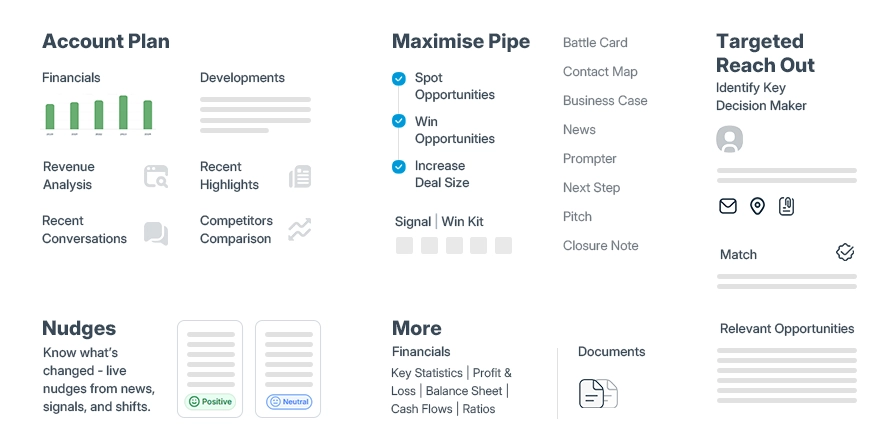
SalesPlay is the world's first AI Sales Intelligence Platform that transforms sales execution speed and precision through its revolutionary suite of 7 AI Agents. Unlike competitors offering fragmented data, SalesPlay delivers pitch-ready opportunity ecosystems—hyper-personalized sales kits, mapped buying centers, and conversion-ready outreach sequences that eliminate 80% of manual work while consistently closing deals others can't identify. Built on exclusive MarketsandMarkets intelligence and thousands of premium data sources, and exclusive vendor partnerships, the platform creates a competitive moat that drives 3x productivity gains by enabling every rep to execute with the precision of your organization's elite performers.
ChatGPT helps sales teams create essential sales materials quickly. Sales professionals using generative AI report impressive productivity gains—over 80% use it to develop basic content like sales pitches and emails, whereas 70% utilize it for market data analysis. This AI assistant excels at drafting personalized outreach, presentations, and training content, allowing reps to focus on relationship-building activities.
Key benefits include faster content creation, consistent messaging across teams, and the ability to quickly adjust messaging based on customer feedback.
Gong transforms customer conversations into actionable insights through AI-powered analysis. The platform records, transcribes, and analyzes sales calls and meetings, providing data-backed coaching opportunities. Teams using conversation intelligence technology have experienced an overall 21% growth in revenue and a 48% improvement in customer ratings.
Gong's newest features include generative AI Smart Trackers that analyze sales conversations, detect positive and negative signals, summarize calls, and provide coaching suggestions. This empowers managers to identify coaching opportunities without needing to listen to entire calls.

Apollo.io maintains the world's largest B2B database with over 210 million contacts and 35 million companies. Its AI-powered lead scoring combines machine learning with your sales history data to identify your highest-potential leads.
The platform automatically enriches contact and company information with over 30 data points, ensuring your CRM remains current. Apollo's accuracy varies by field—emails and job titles are generally reliable, primarily company data is decent, though phone coverage can be inconsistent.
monday CRM integrates AI throughout its platform to streamline sales workflows. Its automation capabilities include AI-powered task generation, prebuilt automation recipes, and personalized email sequences.
The platform's Digital Workers handle specific tasks autonomously—the Sales Advisor identifies performance gaps, provides coaching tips, and flags potential deal blockers. These AI agents have helped teams cut manual work by 50%, allowing sales representatives to focus exclusively on selling.
Salesloft employs AI to optimize sales cadences and prioritize high-impact actions. Its Conductor AI evaluates seller activity, buyer engagement, and opportunity data to prioritize actions most likely to generate pipeline or close deals.
The platform continuously learns from results, automatically adjusting its recommendations based on what works. One customer using Salesloft's AI-guided selling increased meetings booked by 25% weekly while requiring fewer total activities.
RegieOne combines sales engagement, parallel dialing, enrichment, and intent data into a unified prospecting platform. Its AI Agents monitor over 100 custom signals from various sources to determine ideal prospects, messages, channels, and timing.
The platform addresses a critical challenge in sales—77% of B2B sellers struggle with prospecting tasks, yet 66% feel overwhelmed by their tools. RegieOne simplifies this by consolidating functionality into a single workflow where AI handles research, writing, and lead prioritization.
Lavender's AI email coach analyzes and scores sales emails in real-time, offering specific improvements to increase reply rates. Users average a 20.5% reply rate (compared to the 1-2% industry average), with some teams reporting a 42% increase in replies and a 300% increase in pipeline.
The platform analyzes nearly 200 million sales emails to identify what drives email performance, providing real-time coaching as reps draft messages. Teams using Lavender write emails in half the time while receiving twice as many replies.
Outreach's AI Revenue Workflow Platform employs specialized AI agents for different sales functions. Its Revenue Agent and Research Agent gather relevant details from various sources, eliminating the need for reps to toggle between applications when researching prospects.
The platform includes AI agents for prospecting, conversation intelligence, deal management, and forecasting. These agents handle repetitive tasks autonomously, allowing sales professionals to focus on relationship-building and deal closure. Customers implementing Outreach have reported a 15% increase in qualified pipeline.
Personalized customer experiences once required enormous human effort—now AI makes it possible at scale. Advanced sales automation platforms now empower businesses to create individualized interactions for thousands or even millions of customers simultaneously. This shift toward hyper-personalization is primarily driven by three AI capabilities that are changing how sales teams engage with prospects.
Machine learning algorithms excel at analyzing vast amounts of customer data to identify patterns that would be impossible for humans to detect. These systems continuously learn from customer interactions, preferences, and purchase history to create increasingly accurate segments.
AI customer segmentation moves beyond static demographic-based grouping, enabling dynamic, behavior-driven models that constantly evolve with each customer interaction. Companies implementing this approach experience substantial benefits:
Revenue growth: Organizations using AI-powered segmentation report an average 25% increase in sales
Improved satisfaction: Customer satisfaction rates increase by approximately 30% with personalized experiences
Enhanced engagement: Hyper-targeted segments receive more relevant communications, resulting in higher engagement metrics
Dynamic micro-segmentation subsequently allows for instant re-classification of customers based on their latest interactions or preferences. Netflix, for instance, utilizes predictive analytics to segment viewers based on watching history, search queries, and ratings—creating highly personalized content recommendations.
STOP CHASING PROSPECTS
START CLOSING DEALS!!
Dynamic email content refers to personalized elements that automatically change based on user data, behavior, or preferences. This approach transforms standard marketing messages into individualized communications that speak directly to each recipient's interests and needs.
Modern AI systems can analyze emotional tone, urgency, and keywords to craft subject lines that increase open rates. Natural language processing adapts content language based on user profiles—using formal tones for professionals or casual language for younger audiences.
The effectiveness of dynamic content is clear—personalized emails are more likely to be opened and read. Companies implementing dynamic content in email marketing campaigns see notable improvements in engagement metrics, including:
Higher open rates
Increased click-through rates
Greater conversion percentages
Improved customer retention
First-party data collection becomes increasingly valuable as third-party cookies disappear. Email provides a direct communication channel for gathering insights into subscriber preferences through interactive elements like live polls.
AI-powered recommendation engines analyze browsing history, past purchases, and personal preferences to suggest products that align with each customer's unique interests. These systems update relevant recommendations in real-time based on customer behavior.
The results are impressive—companies using Google's Recommendations AI have reported significant business impacts. Newsweek increased total revenue per visit by 10%, essentially turning browsing into buying through intelligent suggestions. IKEA Retail increased global average order value for e-commerce by 2% after implementing recommendation technology.
Three primary approaches power these recommendation systems:
Collaborative filtering: Suggests products based on similar users' interactions
Content-based filtering: Recommends items similar to those a user previously engaged with
Hybrid models: Combines both approaches for improved accuracy
These systems simultaneously enhance customer experience while driving business results—as McKinsey research shows, companies excelling at personalization generate 40% more revenue from these activities than average performers.
The best sales automation software now incorporates these AI-driven personalization capabilities, turning raw data into meaningful customer interactions at unprecedented scale.
Predictive forecasting has emerged as a critical advantage for sales teams seeking better accuracy and efficiency. By analyzing historical data through machine learning algorithms, modern sales platforms now deliver reliable predictions that far outperform traditional methods.
STOP GUESSING YOUR PIPELINE
START GROWING IT WITH AI SALES!!
Time series analysis forms the backbone of effective revenue forecasting by examining data collected at specific time intervals to identify patterns and relationships. These models break down historical sales data into four components: trend (overall direction), seasonality (predictable fluctuations), cycles (multi-year patterns), and noise (random variations). This structured approach helps filter out random blips that might otherwise derail strategic planning.
Several time series techniques stand out for sales forecasting:
ARIMA models excel when companies have stable quarter-over-quarter growth patterns
SARIMA models automatically handle predictable quarterly variations for businesses with strong seasonal influences
Exponential smoothing allocates progressively less weight to older data points, emphasizing recent performance
For enterprise-grade sales automation software, AI-enhanced models match the complexity by processing thousands of engagement signals and CRM variables simultaneously. These systems continuously retrain on fresh pipeline data and automatically flag outliers, maintaining accuracy as sales organizations scale.
Early detection of client churn enables businesses to take proactive measures for customer retention—a critical revenue factor for subscription-based models. Machine learning algorithms excel at identifying subtle patterns in customer behavior that often precede cancelations.
Four prominent algorithms show impressive accuracy in churn prediction:
Stochastic gradient booster (83.9%)
Random Forest (82.6%)
Logistics Regression (82.9%)
K-Nearest Neighbors (78.1%)
The most effective next-generation sales automation platforms utilize historical data from approximately nine months before churn occurs to build predictive models. This approach creates an early warning system, enabling sales teams to intervene with at-risk accounts before it's too late.
AI-powered demand forecasting represents a significant leap forward from traditional methods that rely primarily on historical sales data and basic statistical models. Modern forecasting solutions analyze a diverse range of data sources, including point-of-sale information, customer demographics, economic indicators, weather patterns, and even social media sentiment.
The business impact of these advanced forecasting capabilities is substantial. C3 AI's Demand Forecasting application helped a global food manufacturer significantly improve daily forecast accuracy while reducing production scheduling time by 96%. Similarly, IKEA's AI-driven Demand Sensing tool boosted forecast accuracy from 92% to 98% while reducing the need for corrections from 8% to just 2%.
Machine learning algorithms excel at identifying complex patterns that human analysts might miss. By processing vast datasets through sophisticated models, AI can identify correlations between seemingly unrelated factors, such as weather conditions and purchasing behavior. These insights enable businesses to optimize inventory levels by accurately predicting future demand—avoiding both stockouts and overstock situations.
Perhaps most importantly, AI enables real-time forecast updates. Unlike traditional methods that might update monthly or quarterly, AI-powered systems can adjust predictions instantly in response to market changes, enabling agile responses to external factors like holidays or economic shifts.
Communication automation has become vital for modern sales operations. Research shows that nearly half of salespeople never follow up after their first interaction, yet 80% of customers only accept sales offers after the fifth email. This disconnect creates a major opportunity for AI to bridge the gap between limited sales resources and customer expectations.
Make Every Rep Speak
Like Your Top 1%
AI email automation systems now handle the tedious process of sending timely follow-ups, eliminating the need for manual tracking. These systems can assess open rates to determine optimal email frequency, automate post-purchase communications, and maintain consistent outreach schedules. Coupled with intelligent timing capabilities, modern platforms analyze recipient behavior to identify the perfect moment for follow-up messages.
First-party data collection becomes increasingly valuable as tools like Bardeen integrate with over 100 different platforms to enable sophisticated automation workflows. Indeed, these integrations allow sales teams to create automated email sequences based on triggers or scheduled actions through simple no-code interfaces.
AI sales script generators now create personalized content in seconds, giving sales representatives back valuable time for other revenue-generating activities. Given that sales professionals spend less than 30% of their week actually selling, these tools address a critical productivity gap.
The technology works by using natural language processing to understand context and generate relevant scripts:
AI analyzes the customer profile, prior interactions, and industry information
The system generates customized scripts that establish credibility
Sales professionals can modify outputs to maintain a human touch
This approach particularly helps new team members who can perform like seasoned professionals by following AI prompts, drastically shortening the learning curve. Ultimately, these tools don't replace human sellers but rather assist them with content suggestions, personalization, and sequence automation.
Personalized video outreach represents the newest frontier in sales communication automation. AI-generated personalized videos can now be created through simple prompts combined with CRM data points. The technology handles everything from scripting and voiceovers to visuals and thumbnails—no filming required.
The impact of personalized video is substantial, with sales teams reporting 41% higher close rates when incorporating videos in proposals versus text-only approaches. Sales representatives can now send highly customized videos automatically without sacrificing speed or consistency.
Finally, voice message automation allows reps to leave AI-generated personalized voice messages during outreach. This capability, alongside automated SMS and built-in dialers, creates multi-channel communication possibilities that were previously impossible to scale.
While AI offers powerful advantages for sales teams, it comes with significant ethical challenges that can't be overlooked. The best sales automation software requires careful implementation to avoid undermining trust and effectiveness. Even as automation accelerates, responsible use remains crucial for sustainable success.
AI systems aren't inherently neutral—they often reflect biases present in their training data or programming. These biases can lead to skewed sales strategies that not only hurt potential sales but also create ethical problems. For example, Target's AI prediction system once identified a teen customer as pregnant and sent relevant product campaigns before her parents knew, crossing privacy boundaries and breaking customer trust.
Algorithmic bias in sales contexts appears in several forms:
Favoring certain demographics over others in lead qualification
Prioritizing prospects based on historically biased data
Unfairly targeting specific customer groups
To address these issues, companies must regularly audit AI systems for bias, use diverse training data, implement fairness constraints in algorithms, and involve diverse teams in AI development. Although 65% of sales teams rely on AI-powered tools for lead generation and qualification, ethical oversight remains essential for identifying and mitigating these biases.
AI sales technologies collect vast amounts of customer data, raising serious privacy concerns. Under the EU's General Data Protection Regulation (GDPR), companies must ensure that personal information is protected, yet AI mechanisms often require large volumes of data to function effectively.
GDPR compliance plays a key role throughout the AI development lifecycle, reflecting the requirement for data protection by design. Organizations using AI must:
Implement robust security measures to prevent data breaches
Be transparent about data collection and usage
Obtain explicit consent before using AI tools
Adhere strictly to data protection regulations
The European Data Protection Board clearly states that AI models trained with personal data cannot be considered anonymous. Hence, transparency practices are crucial—companies must inform individuals about how AI is used and enable them to access, correct, or erase their personal data when legally required.
As automation becomes more sophisticated, it paradoxically becomes less effective. The very tools designed to help reach customers efficiently now create noise that drowns out meaningful communication. Despite technological advances, humans will always need compassion, empathy, and relationships.
The effectiveness of AI often leads to over-reliance by sales teams, causing them to neglect essential human elements in relationship-based selling. This can result in losing the personal touch with customers—a factor often crucial for closing sales and building long-term relationships.
AI should enhance human interaction, not replace it. It should identify promising leads, suggest optimal outreach times, and provide insightful talking points for sales representatives, thus leaving the human element intact. This balance is vital because customers are increasingly savvy—they can tell when they're interacting with a bot or receiving an automated email.
Successful implementation of the best sales automation software requires more than just purchasing technology—it demands strategic team development. My experience shows that investing in people skills first maximizes AI adoption rates across sales teams.
Effective training starts with structured programs that demystify AI fundamentals. Initial workshops should focus on hands-on experience with actual tools, allowing sales professionals to experiment in risk-free environments. This practical approach accelerates familiarity with new technologies. Many organizations now conduct pilot programs where small groups test AI-powered tools before company-wide implementation. These simulation-based exercises help bridge the gap between theory and practice, enabling sales teams to grasp complex functionalities quickly.
Partnership with data experts dramatically enriches the upskilling process. Expert-led sessions provide sales teams with deeper understanding of AI systems while opening access to cutting-edge resources. Continuous communication between teams helps managers address concerns promptly—creating a valuable feedback loop that identifies areas for improvement. These collaborations enable sales professionals to understand not just how to use AI tools, but why they work, ultimately fostering innovative applications of next-generation sales automation.
AI literacy extends beyond tool proficiency to understanding AI's capabilities, limitations, and ethical implications. Organizations that prioritize AI literacy see measurable results—including 20-30% increases in efficiency. Establishing mentorship programs accelerates skill development by connecting experienced AI users with newcomers. Above all, fostering a culture that values continuous learning through regular knowledge sharing sessions and incentives for skill development creates sustainable adoption.
STOP GUESSING YOUR PIPELINE
START GROWING IT WITH AI SALES!!
The evolution of sales automation through AI and machine learning marks a pivotal shift in how sales teams operate. Throughout this article, we've seen how these technologies transform everything from lead scoring to personalized communications. AI-powered sales tools now handle the mundane tasks that once consumed nearly 71% of sales professionals' time, allowing them to focus on meaningful customer relationships.
Machine learning models, natural language processing, and predictive analytics form the foundation of modern sales automation platforms. These technologies work together to identify patterns, extract insights from unstructured data, and forecast outcomes with remarkable accuracy. Subsequently, tools like ChatGPT, Gong, Apollo.io, and Lavender demonstrate how AI addresses specific sales challenges while delivering measurable results.
Perhaps most importantly, AI enables personalization at an unprecedented scale. Sales teams can now segment customers based on behavior, generate dynamic content, and provide real-time product recommendations without sacrificing efficiency. This capability alone transforms customer experiences while simultaneously driving revenue growth.
Predictive forecasting represents another game-changing application of AI in sales. Time series models, churn prediction algorithms, and demand forecasting tools help sales organizations make data-driven decisions rather than relying on gut instinct or outdated methods. Teams using these technologies report significant improvements in forecast accuracy and business outcomes.
Despite these advantages, ethical considerations remain paramount. Algorithmic bias, data privacy concerns, and the risk of over-automation require careful management. The most successful sales teams view AI as a complement to human skills rather than a replacement. After all, customers still value authentic connections that only people can provide.
Sales professionals therefore need proper training to maximize AI's potential. Cross-functional collaboration with data teams and building organization-wide AI literacy ensures these powerful tools enhance rather than diminish human capabilities.
Next-generation sales automation fundamentally changes what's possible in sales. The best approach combines cutting-edge AI tools with skilled sales professionals who understand both technology and human psychology. Sales teams who master this balance will undoubtedly outperform their competitors in the coming years.
AI enhances sales automation by handling tasks like lead scoring, personalized communications, and predictive forecasting. It analyzes vast amounts of data to identify patterns and insights, allowing sales teams to focus on building relationships and closing deals.
Some leading AI tools for sales automation include ChatGPT for content generation, Gong for conversation intelligence, Apollo.io for lead enrichment, Lavender for email coaching, and Outreach.io for revenue workflow automation.
AI enables personalization at scale through behavioral segmentation, dynamic content generation for emails and ads, and real-time product recommendations. These capabilities allow businesses to create individualized interactions for thousands of customers simultaneously.
Ethical challenges in AI-driven sales include potential bias in lead scoring algorithms, data privacy concerns (especially regarding GDPR compliance), and the risk of over-automation leading to a loss of human touch in customer interactions.
Sales teams can prepare for AI integration by participating in structured training programs on AI tools and platforms, collaborating with data teams, and building AI literacy across the organization. This includes hands-on experience with tools, understanding AI capabilities and limitations, and fostering a culture of continuous learning.

Category: Uncategorized Tags: ai, AIOps, Artificial Intelligence, cloud, cloud platform, Cybersecurity, Information and Communications Technology , VR