Optimizing Business Intelligence Platforms for Sales Performance
September 04, 2025

Did you know that companies leveraging business intelligence optimization are 2.8 times more likely to exceed their sales targets? I've seen firsthand how the right data tools can transform a struggling sales team into a revenue-generating powerhouse.
Sales performance today hinges on more than just good relationship skills and product knowledge. Business Intelligence Platforms have become essential for teams that want to stay competitive and make informed decisions. Furthermore, revenue intelligence platforms now offer unprecedented visibility into every stage of the sales process, connecting dots that were previously invisible to even the most experienced sales leaders.
In this article, I'll show you exactly how to optimize your BI systems for maximum sales impact. We'll explore the must-have features that drive performance, examine the top tools currently dominating the market, and tackle common implementation challenges. Ultimately, you'll discover practical strategies to turn your sales data into actionable insights that boost your bottom line.
A Business Intelligence (BI) platform serves as the central nervous system of modern sales operations. At its core, these specialized software systems collect, analyze, and visualize sales data from multiple sources, creating a unified view that transforms raw numbers into strategic advantages. In today's data-saturated business landscape, sales teams without proper BI tools risk making decisions based on incomplete information or gut instinct rather than actionable intelligence.
STOP GUESSING YOUR PIPELINE
START GROWING IT WITH AI SALES!!
Business Intelligence platforms for sales are technology-driven systems that help sales teams gather, view, and understand all of their data in one accessible location. These platforms integrate data from various sources including customer relationship management (CRM) systems, marketing analytics, supply chain data, and sales performance dashboards to provide a consolidated view of critical metrics.
The primary purpose of BI in sales environments is clear: extract revenue data from databases and transform it into something immediately useful. Through intuitive dashboards, reports, and visualizations, sales leaders can:
Monitor real-time performance against targets
Identify trends across different regions and product categories
Uncover insights about customer behavior and preferences
Make data-driven decisions about resource allocation and strategy
According to industry research, between 60% and 73% of all data within enterprises goes unused for analytics. This represents a massive missed opportunity, especially considering that the average company now manages approximately 162.9 terabytes of data. BI platforms solve this critical challenge by making sales data accessible and actionable.
In practical terms, an optimized BI platform allows sales managers to instantly see which products are performing well in specific regions, which representatives exceed their quotas, and where potential opportunities might be overlooked. Additionally, these systems enable predictive capabilities, helping forecast future sales based on historical patterns.
The distinction between modern BI platforms and traditional analytics approaches represents a fundamental shift in how organizations interact with their sales data. While traditional reporting methods typically involve static reports generated by IT departments or specialized analysts, modern BI platforms democratize data access across the entire sales organization.
Traditional analytics tools often create a dependency where sales personnel must request reports from IT teams, causing delays in decision-making and limiting the ability to explore data dynamically. In contrast, modern BI platforms are built on self-service principles, allowing sales professionals to access, analyze, and create personalized report formats without technical assistance.
Several key differences separate BI platforms from conventional analytics tools:
Real-time vs. static reporting: Traditional reports provide a snapshot of information at a specific moment, whereas BI platforms display data in real-time, ensuring everyone works from the most current information. This immediate access proves crucial when tracking fast-moving sales cycles or responding to market shifts.
Interactive vs. fixed analysis: With traditional tools, reports are typically static summaries without detailed exploration capabilities. BI platforms, however, enable users to drill down into underlying data points, slicing and dicing information to uncover hidden patterns and opportunities.
Visual representation vs. text-heavy outputs: Business intelligence platforms excel at presenting complex sales data through visualizations, making it easier to identify patterns, trends, and new opportunities compared to text-heavy traditional reports.
Integration capabilities: Modern BI systems seamlessly connect with other business tools, especially CRM and enterprise resource planning (ERP) software. This integration creates a holistic view of the sales ecosystem rather than isolated data points.
The ultimate result of implementing a sales-focused BI platform is a culture of data democracy, where every team member can access the insights they need precisely when they need them. This democratization of data represents a significant competitive advantage, as decisions become faster, more accurate, and firmly grounded in factual information rather than assumptions.
Modern business intelligence platforms offer several powerful features that directly impact sales performance. These capabilities transform how sales teams operate, turning data into a competitive advantage. Let me examine the three most impactful features that consistently drive measurable improvements in sales outcomes.
Ready to turn your Rep
INTO BEST PERFORMER ?
Real-time dashboards represent a fundamental shift in how sales teams monitor performance. Unlike static reports that quickly become outdated, these dynamic interfaces connect directly to live data sources, updating continuously as new information flows in.
The power of real-time sales dashboards lies in their ability to visualize complex data through intuitive charts, graphs, and maps. This visual representation bridges the technical knowledge gap, allowing anyone to understand patterns and trends at a glance. For instance, a sales manager can immediately spot which territories are underperforming or which products are gaining momentum without waiting for end-of-month reports.
First and foremost, these dashboards enable proactive decision-making. When a sales team can monitor opportunity progression and stage health in real-time, they can address issues before deals stall. This instant visibility creates a significant competitive advantage—sales leaders can reallocate resources, adjust strategies, or provide targeted coaching exactly when needed.
Additionally, real-time tracking significantly improves operational efficiency. Rather than spending hours compiling reports manually, sales teams can focus on strategy and action. This automation not only saves valuable time but also ensures everyone works with the most current information, reducing the risk of decisions based on outdated data.
Predictive analytics has fundamentally altered how sales organizations forecast outcomes and manage pipelines. These AI-driven models examine historical data patterns alongside current pipeline information to project future revenue with remarkable accuracy.
What makes predictive forecasting particularly valuable is its ability to provide insights that might escape human analysis. The technology can:
Analyze vast datasets to identify patterns affecting deal closure rates
Highlight which opportunities are most likely to convert
Anticipate potential pipeline issues before they impact revenue
Project how specific changes in strategy could influence outcomes
In practice, this capability transforms pipeline management from reactive to proactive. Sales managers gain visibility into forecast strength and individual rep performance at each stage, linking deal progression directly to real-time data. As a result, organizations can understand projected versus desired outcomes and refine sales focus to improve win rates.
Notably, advanced platforms now provide visual representations of prediction factors, categorizing them as positive, negative, or neutral influences on forecasted outcomes. This transparency helps teams understand exactly what's driving their projected results, enabling more targeted interventions.
The integration between business intelligence tools and CRM systems creates a powerful synergy that elevates sales performance. This connection provides a comprehensive view of the entire sales flow—from initial lead interaction through transaction completion—offering unprecedented insight into the customer journey.
Primarily, CRM integration eliminates data silos that traditionally hinder sales operations. When all customer data lives in a unified platform, teams can access consistent information regardless of department or data "ownership". Consequently, sales representatives gain immediate access to marketing campaign performance, customer interaction history, and other critical context without chasing information across systems.
Moreover, this unified access enables personalized customer interactions based on detailed preference and behavior data. Sales teams can tailor their approaches with targeted recommendations and customized offers, substantially improving conversion rates.
The practical implementation often takes the form of customizable dashboards that present a unified view of all CRM data—including calendars, tasks, emails, deals, pipeline data, and performance metrics. These interfaces ensure team members aren't overwhelmed with irrelevant information but instead receive precisely what they need to drive sales forward.
Indeed, the integration of BI and CRM represents more than mere technical convenience; it fundamentally transforms how organizations leverage customer data to generate revenue.
The market offers several specialized BI tools designed specifically for sales performance enhancement. These solutions address different aspects of the sales process, from data management to conversation analysis. Let's examine four standout platforms that have proven their value for sales teams.

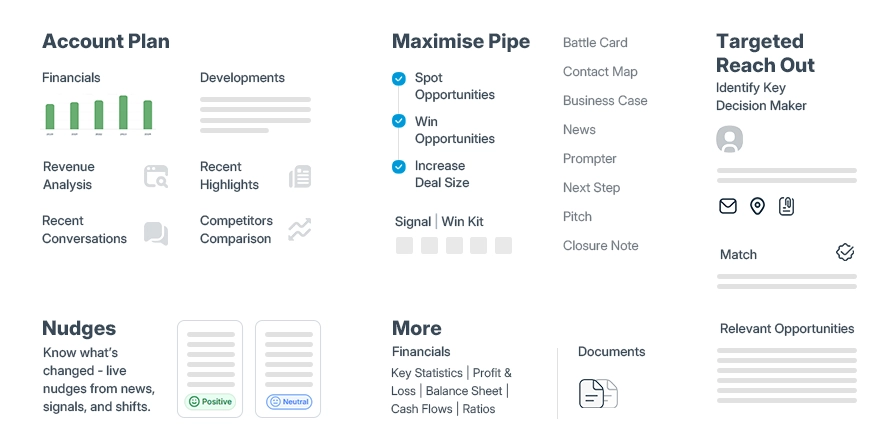
SalesPlay is the world's first AI Sales intelligence platform that transforms sales execution speed and precision through its revolutionary suite of 7 AI Agents. Unlike competitors offering fragmented data, SalesPlay delivers pitch-ready opportunity ecosystems—hyper-personalized sales kits, mapped buying centers, and conversion-ready outreach sequences that eliminate 80% of manual work while consistently closing deals others can't identify.
Built on exclusive MarketsandMarkets intelligence and thousands of premium data sources, and exclusive vendor partnerships, the platform creates a competitive moat that drives 3x productivity gains by enabling every rep to execute with the precision of your organization's elite performers.
Scratchpad connects directly to Salesforce via API, inheriting all permissions and security guardrails while maintaining SOC 2 Type 2 compliance with GDPR and CCPA alignment. This tool primarily solves the critical challenge of CRM data quality—a fundamental requirement for effective business intelligence optimization.
What sets Scratchpad apart is its ability to capture notes and update CRM records automatically from customer calls and emails. The platform provides actionable feedback on all calls and deals, tuned specifically to your unique sales process. For revenue operations leaders, this means dramatically improved data hygiene without the perpetual struggle of chasing representatives for updates.
Most sellers typically spend only 35% of their time on revenue-generating activities, with the remaining 65% consumed by administrative tasks, processes, and forecasting work. Scratchpad flips this ratio, enabling teams to spend approximately 85% of their time on revenue-generating activities through automated CRM updates and streamlined workflows.
Clari stands out in the BI landscape through its exceptional forecasting capabilities. The platform unifies all forecasting models into a single view, delivering full visibility across products, segments, and regions without requiring spreadsheets or manual rollups. This comprehensive approach enables sales organizations to achieve remarkable 98% forecast accuracy by the second week of each quarter.
Beyond standard forecasting, Clari analyzes pipeline health by connecting historical trends with live deal signals. The system doesn't simply display data—it highlights action steps, identifies slipping deals, and surfaces hidden trends before they impact revenue. This early warning system enables teams to course-correct proactively rather than simply reacting to missed targets.
The platform's power comes from its ability to triangulate hard numbers, deal context, and AI-backed signals into forecasts that withstand boardroom scrutiny. Furthermore, Clari unifies structured and unstructured data from CRMs, customer systems, and third-party sources into a single revenue intelligence ecosystem.
Zoho Analytics delivers a self-service business intelligence approach that democratizes data access across sales organizations. The platform enables users to analyze data, create visualizations, and derive insights without extensive technical skills. This accessibility makes it particularly valuable for sales teams needing quick, intuitive access to performance metrics.
A standout feature is Zoho's extensive connectivity—the platform can import data from numerous CRM systems including Zoho CRM, Salesforce, HubSpot, Microsoft Dynamics, and many others. This flexibility allows sales teams to perform detailed analysis regardless of their existing tech stack.
For sales leaders, Zoho Analytics offers specific capabilities to measure representative performance, identify top and underperforming team members, and improve overall results. The platform also includes "Zia," an AI assistant that answers natural language questions about sales data and delivers responses as reports and KPI widgets.
Gong transforms customer interactions into actionable intelligence through advanced conversation analysis. The platform records, transcribes, and analyzes every sales call, email, and web conference using conversational AI, machine learning, and natural language processing. This creates an unprecedented view into customer sentiment and sales effectiveness.
For sales leaders, Gong's primary value lies in automating the coaching process. The system allows managers to identify and follow best practices based on actual sales conversations rather than theoretical frameworks. This data-driven approach enables organizations to understand quantitatively which behaviors lead to the best outcomes.
The conversation intelligence market itself is growing rapidly—currently valued at USD 22.80 billion and projected to reach USD 46.80 billion by 2033. This growth reflects the increasing recognition that understanding customer conversations provides critical competitive advantages.
Gong's newest features include generative AI capabilities that summarize calls, detect positive and negative signals within conversation context, and provide AI-generated scorecards that assign quality scores to each sales call along with specific improvement suggestions.
STOP CHASING PROSPECTS
START CLOSING DEALS!!
Optimized BI platforms deliver measurable returns for sales organizations—top performers using advanced analytics achieve 30% higher sales productivity than their competitors. The impact extends beyond simply having data tools to strategically implementing them to address specific sales challenges.
Sales forecasting precision directly impacts resource allocation, inventory management, and overall business planning. Organizations implementing business intelligence tools for forecasting report up to 95% accuracy in certain industries. This dramatic improvement stems from BI's ability to analyze historical patterns alongside current pipeline data.
First, business intelligence platforms enhance forecasting by centralizing data from multiple sources—CRM records, ERP systems, and sell-through data—creating a comprehensive view impossible with siloed approaches. This integration allows sales teams to forecast based on volume, price, margin, and other granular metrics rather than applying generic growth percentages across the board.
Additionally, advanced BI tools incorporate machine learning algorithms that continuously refine forecasting models, reducing prediction errors by up to 30%. For instance, Clari's platform achieves remarkable 98% forecast accuracy by the second week of each quarter through AI-powered analysis [document missing from citations but mentioned in previous sections].
Sales environments demand quick responses to market shifts and emerging opportunities. BI platforms transform decision velocity through real-time insights, enabling companies to experience a 20% increase in timely decision-making. Furthermore, organizations using data visualization tools make decisions five times faster than those without such capabilities.
Real-time dashboards prove particularly valuable for identifying time-sensitive sales opportunities. When managers can instantly see which prospects are engaging with content or which deals are slowing down, they can reallocate resources immediately rather than waiting for weekly reports.
The speed advantage extends to operational adjustments as well. Live tracking helps detect and resolve challenges before they escalate, whether optimizing delivery routes based on traffic conditions or adjusting pricing strategies to match market demands.
Without proper segmentation, customer data only shows top-level trends like lifetime value or churn. Business intelligence tools transform this limitation by dividing customer data into meaningful portions that reveal hidden insights driving revenue growth.
Through BI platforms, organizations can implement multiple segmentation models simultaneously, including:
Behavioral segmentation based on website interaction patterns
Value-based segmentation identifying most profitable customer groups
Geographic and technographic segmentation for targeted marketing
These capabilities allow sales teams to pinpoint their most lucrative customer segments, enabling leaders to direct resources strategically. This targeted approach results in 10-20% lower cost-to-serve and 3-15% increased revenue per sales employee.
Sales representatives typically spend only 39% of their time actually selling. The remaining 61% goes toward administrative tasks, travel, and reporting. Business intelligence optimization directly addresses this imbalance through process automation.
Top-performing organizations have already offloaded up to 50% of non-selling activities to shared services groups and are aggressively automating these functions. The results are substantial:
30% more customer-facing time
20% potential lift in sales
Reduction in order processing time from hours to minutes
Even simple automation implementations yield significant benefits. For example, a B2B sound technology company used robotic process automation to cut order entry processing times from three hours to three minutes. Similarly, automatic lead enrichment tools connect data from multiple sources, sparing sellers the hassle of manually researching prospects.
These productivity gains ultimately allow sales professionals to focus on high-value activities that directly impact revenue rather than getting bogged down in administrative work.
Despite their potential benefits, Business Intelligence (BI) platforms present several obstacles during implementation and optimization. Even the most powerful platforms can fail to deliver their promised value when organizations face these critical challenges.
STOP GUESSING YOUR PIPELINE
START GROWING IT WITH AI SALES!!
Data silos remain one of the most persistent barriers to effective business intelligence optimization. These isolated repositories occur when information is stored in separate systems that don't communicate properly with each other. Legacy systems, originally designed with limited interoperability, often restrict data access or provide minimal API support, creating fragmentation that undermines analytics.
The consequences of these silos are substantial:
Fragmented analytics that fail to present a complete picture, leading to suboptimal decision-making
Blind spots that prevent cross-functional collaboration
Duplicate data that is difficult to reconcile
Increased inefficiency and costs due to redundant processes
Organizations with siloed data typically struggle to achieve a holistic view of their sales operations. For example, when marketing uses one customer relationship management tool while sales uses another, customer data becomes fragmented and difficult to analyze collectively. Ultimately, these disconnects create a situation where valuable insights remain trapped within departmental boundaries.
Effective solutions include implementing centralized data repositories, leveraging APIs for cross-system communication, and developing a unified integration strategy that aligns with business goals. Many companies find success using data lakes or warehouses to consolidate information from various sources into a single, accessible location.
The financial investment required for BI implementation can be substantial, typically ranging from $80,000 to over $1,000,000 depending on complexity. This cost barrier often causes organizations to hesitate, particularly when struggling to measure potential return on investment.
Several factors drive these high costs:
Software licensing fees ($10-$115 per user monthly depending on the platform)
Infrastructure and IT investments for implementation
Integration expenses for connecting multiple data sources
Setup and consulting services when internal expertise is limited
Beyond the initial implementation, organizations must factor in ongoing expenses for maintenance, updates, and system optimization. Furthermore, administrative burdens associated with employee training add another layer of cost. Such significant investments can be particularly challenging for small-to-medium businesses looking to scale their analytics capabilities.
The complexity increases when organizations attempt to implement business intelligence across multiple departments simultaneously. Without a phased implementation approach focusing on high-impact use cases first, companies risk spending considerably on unused reporting capacity or features that don't align with specific business needs.
Even the most technically advanced BI solution delivers little value if employees don't use it regularly. Low adoption rates represent a common challenge, with complexity being the primary culprit. Many dashboards overwhelm users with excessive information, creating what industry experts call "Death by Dashboard"—interfaces so cluttered they resemble abstract paintings rather than useful business tools.
The cognitive overload from data-packed dashboards creates several specific problems:
Shortened attention spans and difficulty concentrating on specific tasks
Analysis paralysis due to fear of misinterpreting data
Stress and anxiety about missing important information
Additionally, complex user interfaces require substantial time investment to master, reducing the time available for actual data analysis and decision-making. When business users find dashboards too difficult to use, they frequently revert to manual methods or alternative tools, leading to underutilization of expensive BI investments.
Organizations also face resistance to change from employees accustomed to traditional reporting methods. This resistance typically stems from fear of the learning curve or potential disruptions to established workflows. Many employees express concern that new BI tools might mean more work rather than increased efficiency.
Successful adoption requires addressing these human factors through change management strategies, end-user training programs, and designing intuitive interfaces that prioritize user experience. When users understand how BI tools will benefit their daily tasks and receive proper training, resistance typically diminishes.
Make Every Rep Speak
Like Your Top 1%
Successfully implementing a Business Intelligence (BI) platform requires careful planning and execution. Without proper implementation, even the most advanced BI tools will fail to deliver their promised value. Here are four essential steps to optimize your sales-focused BI implementation:
The success of any BI project relies on the quality of its data. Data quality issues can completely derail projects, resulting in wasted time, money, and resources. Common problems include inaccurate information, incomplete records, and inconsistencies across data sources.
To maintain high-quality data:
Regularly profile your data to measure integrity and ensure it adheres to established rules
Create data quality dashboards to monitor key metrics and trends in real-time
Set alerts for data quality thresholds so issues can be addressed promptly
Maintain an issues log to track patterns and apply preventative measures
Initially, focus on cleaning existing data before importing it into your BI platform. Hence, you'll avoid perpetuating errors that undermine analysis quality.
Identify key measurable performance indicators to track the efficiency and status of workflows. Popular KPIs worth monitoring include user adoption rate, data quality score, and report usage metrics. These metrics help your organization track progress toward goals and objectives while serving as the foundation for data-driven decision-making.
First, determine what specific goals you want your sales reps to achieve, ensuring they align with your company's overall business strategy. Subsequently, develop a method to measure these goals using the formula: Goal = (desired outcome) / (measurement metric).
User adoption represents a critical success factor for BI implementation. Therefore, involve end-users early in the process and provide comprehensive training programs. Explain the tangible benefits of BI implementation and demonstrate how it will improve overall business operations.
Focus on creating user-friendly interfaces with intuitive reporting tools that don't overwhelm users. Without proper training, employees often revert to manual methods, leading to underutilization of your BI investment.
Set up centralized data repositories that integrate with your existing systems. This integration eliminates data silos, ensuring consistent and accurate data across your BI, CRM, and ERP systems.
Cross-platform integration provides numerous benefits, including enhanced data consistency, improved customer service quality, increased operational efficiency, and comprehensive insights for better decision-making. Additionally, it creates a unified system that combines business processes, customer interactions, and data analytics.
Selecting an appropriate business intelligence platform for your sales team requires careful consideration of several factors. The right choice depends on your specific organizational needs and team structure, not just flashy features or market popularity.
Smaller businesses typically benefit from simple, affordable tools that provide essential analytics without overwhelming complexity. Larger enterprises often require customizable, comprehensive solutions tailored to their specific business case.
Your selection should primarily address your team's biggest challenges. Begin by identifying the specific gaps in your current BI setup that need addressing. This clarity will help define the essential functionalities required for your sales operations.
Consider who will use the software and determine the necessary number of licenses. Decide whether the tool is solely for revenue operation leaders or the entire organization.
Mobile functionality has become essential for sales teams that operate beyond office walls. Mobile BI dashboards enable access to real-time data and allow you to make data-informed decisions when working remotely.
Evaluate how user-friendly the interface is—the best data visualization tools have intuitive interfaces that let users explore and present data regardless of their technical skills. Grow's mobile app, as an example, offers 'Live Data' capabilities, allowing users to pull up-to-the-minute information from their business database.
Talk to your field staff to understand what level of mobile access they need, from basic dashboard viewing to creating and editing analytics with mobile tools.
Basic AI tools that merely automate email responses are now standard. Look beyond surface-level automation to platforms offering advanced capabilities like predictive analytics and real-time insights.
Effective AI sales tools analyze your data to provide actionable recommendations, helping your team make smarter, faster decisions. For instance, Qlik Sense uses its Associative Engine to help users explore data intuitively, uncovering connections that might not be immediately obvious.
Finally, never overlook data security—strong AI sales tools offer encryption for data protection and compliance with regulations like GDPR or CCPA.
The business intelligence landscape continues to evolve rapidly. Looking ahead, three major trends will shape how sales teams extract value from their data.
Decision-making in sales is shifting from reflective to reflexive, as AI enables immediate, context-aware responses. This transition isn't about replacing human judgment but enhancing it with real-time insights. Modern AI-infused BI tools move beyond dashboards to deliver predictive power that transforms decision-making. In 2025, these systems will become a competitive necessity rather than a luxury, offering automated workflows and complex data visualization that give teams an edge in fast-evolving markets.
Voice technology is creating a more intuitive approach to business intelligence. Power BI's iOS application now offers Q&A capabilities through a chat-like experience tailored for natural language. This allows sales professionals to literally have conversations with their data, using voice commands to receive answers in the form of charts and graphs directly on mobile devices. The ability to vocalize queries democratizes access to critical business intelligence throughout organizations.
Soon, BI platforms will seamlessly connect with broader sales ecosystems. AI coaching tools now provide real-time feedback and data-driven insights to improve performance. Furthermore, organizations can get BI reports through voice assistants like Alexa or Google, enabling on-demand insights in boardrooms and smart devices. This integration creates a unified view that combines business processes, customer interactions, and analytics.
STOP GUESSING YOUR PIPELINE
START GROWING IT WITH AI SALES!!
Throughout this article, we've explored how Business Intelligence platforms transform sales operations from gut-driven decisions to data-powered strategies. BI systems stand as essential tools for modern sales teams, enabling them to extract actionable insights from the massive amounts of data they collect daily.
Certainly, the most effective BI implementations combine real-time dashboards, predictive analytics, and seamless CRM integration. These features work together to provide unprecedented visibility into sales processes. Sales teams consequently make faster decisions, forecast with greater accuracy, and target customers more effectively.
Tools like Scratchpad, Clari, Zoho Analytics, and Gong each offer unique advantages for sales teams based on their specific needs. When properly implemented, these platforms can increase sales productivity by up to 30% compared to competitors still relying on outdated methods.
Nevertheless, organizations must address common challenges such as data silos, implementation costs, and user adoption issues. Starting with clean data, defining clear KPIs, properly training teams, and ensuring cross-platform integration significantly improve your chances of success.
Looking ahead, AI-driven recommendations, voice-enabled dashboards, and deeper integration with sales enablement tools will further enhance how sales teams use data. These advancements will continue making BI platforms even more valuable for sales organizations.
Therefore, the question isn't whether your sales team needs optimized BI platforms—it's whether you can afford to operate without them. After all, as sales environments grow increasingly complex and competitive, data-driven decision making has shifted from luxury to necessity. Sales teams that master their business intelligence capabilities will undoubtedly maintain their edge in tomorrow's marketplace.
Business Intelligence platforms offer several benefits for sales teams, including improved forecasting accuracy, faster decision-making with real-time data, better customer segmentation and targeting, and increased rep productivity through automation. These tools can help sales teams achieve up to 30% higher productivity compared to competitors.
Modern BI platforms offer real-time data updates, interactive analysis capabilities, visual representations of data, and seamless integration with other business tools like CRM systems. Unlike traditional analytics tools, they allow for self-service access to data across the entire sales organization, enabling faster and more informed decision-making.
Common challenges include dealing with data silos and integration issues, high implementation and training costs, and user adoption problems due to dashboard complexity. Overcoming these challenges requires careful planning, proper data management, and effective training programs for sales teams.
Key features to look for include real-time dashboards for sales tracking, predictive analytics for pipeline forecasting, and CRM integration for unified data access. Additionally, consider mobile accessibility, ease of use, and AI-driven capabilities that can provide actionable insights and recommendations.
AI is enabling more sophisticated sales recommendations and predictive analytics, while voice-enabled BI dashboards are making data access more intuitive. These technologies are allowing sales professionals to have conversations with their data and receive real-time insights, making BI tools more accessible and actionable throughout organizations.


Category: Uncategorized Tags: ai, AIOps, Artificial Intelligence, cloud, cloud platform, Cybersecurity, Information and Communications Technology , VR