SalesPlay for Pipeline Generation: How Sellers Know Where to Focus
February 12, 2026

SalesPlay solves this through continuous account monitoring, systematic opportunity detection, and execution-ready guidance. It watches your Salesforce-connected accounts, identifies where you can sell based on real business movements, and tells sellers exactly where to focus—with context on why timing matters and who to engage.
This isn’t about creating more pipeline. It’s about creating the right pipeline—opportunities grounded in account reality, not seller intuition or marketing campaigns that spray content hoping something sticks.
Most sales organizations approach pipeline generation the same way: assign territory, provide account lists, expect sellers to figure out where to engage. The tools they use—CRMs, intent platforms, data enrichment services—create more problems than they solve.
📊 Industry Reality: According to Forrester Research, 68% of B2B sales opportunities are lost to “no decision” rather than to competitors. The root cause? Sellers engage accounts without understanding timing, context, or internal priorities. Pipeline generation software that ignores these factors creates activity without revenue.
Walk through a typical seller’s morning. They open the CRM to review accounts. Jump to LinkedIn Sales Navigator for contact research. Check an intent platform for signals. Pull financial data from another source. Read industry news for context. Paste everything into a spreadsheet to decide who to call.
By the time they’ve researched three accounts, two hours have passed. The information is already outdated. And they still don’t know if timing is right or which offering fits current priorities.
Without systematic opportunity detection, sellers rely on intuition. They call the accounts they know. Pursue relationships they have. Ignore accounts that might be ready because nothing in the CRM suggests urgency.
This creates pipeline driven by seller preference, not account readiness. Revenue becomes unpredictable. Quota attainment varies wildly across teams.
Sellers spend 40-50% of their time on non-selling activities, according to Salesforce research. Most of that time? Manual account research across disconnected tools. By the time a seller understands an account well enough to engage, the opportunity window has closed or a competitor has already moved.
Intent data platforms flag anonymous website visits or content downloads. These signals tell you someone at the account is researching—not who, not why, and not whether budget exists or priorities align. Sellers reach out based on activity that might mean nothing. Prospects ignore emails because timing doesn’t match internal reality.
Sales leaders pressure teams to create more pipeline. Sellers respond by lowering qualification standards. Opportunities enter the funnel based on hope, not evidence. Forecasts become fiction. Sales cycles stretch because deals were never real to begin with.
💡 The Real Cost: It’s not just lost time. It’s lost credibility with prospects receiving irrelevant outreach. Lost confidence from sales leaders unable to trust forecasts. Lost revenue from opportunities that existed but were never identified because sellers focused elsewhere.
SalesPlay replaces fragmented research and guesswork with a system that continuously watches target accounts and surfaces opportunities before they become obvious to competitors. This is revenue intelligence built for how enterprise sales actually works—long cycles, multiple stakeholders, opportunities buried inside organizational changes and strategic shifts.
Traditional pipeline generation is reactive. Sellers wait for inbound requests, respond to RFPs, chase whatever opportunity appears easiest. SalesPlay makes it systematic—continuously monitoring accounts, detecting business changes that create buying conditions, surfacing opportunities tied to funded initiatives and organizational priorities.
The shift fundamentally changes how sellers spend their time. Instead of researching accounts manually, they review pre-built intelligence. Instead of guessing which accounts matter this week, they see ranked opportunities with context on why timing is right. Instead of crafting messaging from scratch, they access battle cards tailored to specific account situations.
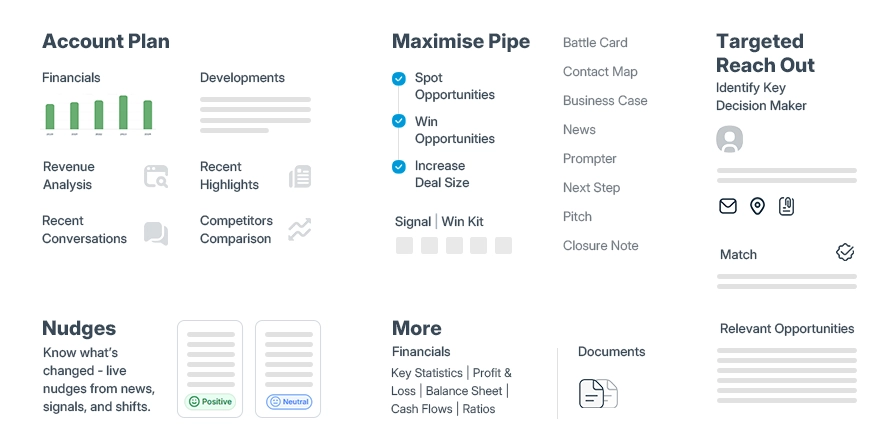
SalesPlay operates through specialized agents—each designed to handle a specific part of the pipeline generation workflow. Agents work together, not in isolation. This is not a dashboard you check. It’s a system that tells you where to act.
This agent continuously watches every Salesforce-connected target account. It tracks multi-source changes: financial performance, organizational shifts, recent news, strategic initiatives, technology investments, market movements.
What sellers see: A consolidated account overview that updates as the account changes. Five-year revenue history. Key business developments. Recent relevant conversations. Signals tied to opportunity relevance.
What this eliminates: Jumping between tools. Outdated notes. Manual research. Long ramp time for new sellers who need to understand complex accounts.
This agent answers the question every seller asks before engaging: “What’s happening inside this account right now—and why should I care?”
This agent identifies opportunities inside target accounts tied to your specific offerings. It doesn’t wait for intent signals or inbound requests. It connects business movements to where you can sell.
For each opportunity, sellers see:
Sellers can review opportunity context and decide: ignore, monitor, or push into active pursuit. The system doesn’t force action. It provides clarity so sellers choose with confidence.
This agent answers: “Where can we sell here—and why now?”
Once a seller decides to pursue an opportunity, this agent converts it into execution-ready material. Battle cards. Elevator pitches. Talking points. Next-step guidance. Auto-generated pitch content.
Contacts are already attached. Messaging is personalized to the account’s situation. Sellers can review, adjust, and send—without starting from scratch or relying on generic templates that ignore context.
This agent answers: “What do I say, how do I say it, and how do I move this forward?”
Sometimes sellers already know someone at an account. They just don’t know what to talk about. This agent flips the workflow—start from a person, surface opportunities relevant to them.
Search for a contact. See their role, details, LinkedIn profile. View opportunities that matter to their function. See why each opportunity is relevant to them specifically. Access battle cards and messaging tied to those opportunities.
This is especially powerful for account expansion—leveraging existing relationships to open new conversations without awkward, generic asks.
This agent answers: “I know this person—what should I talk to them about?”
This agent creates personalized email nurture campaigns. Select opportunities. Select contacts. Choose number of touches. Set campaign timing.
SalesPlay drafts every email, personalizes by opportunity and individual, ensures each message is different, and runs the campaign automatically after approval.
This agent answers: “How do I stay relevant without manually writing everything?”
This agent generates a one-page meeting prep document. It includes opportunity summary, attendee context, relevant conversation starters, smart questions to guide discussion, and suggested next steps.
This agent answers: “How do I show up prepared and stay in control of the conversation?”
This agent surfaces relevant news and developments tied to accounts. It filters noise and highlights what matters.
This agent answers: “What just happened here that creates a reason to engage?”
💡 Key Insight: SalesPlay doesn’t just find opportunities. It connects them to execution. Most pipeline generation software stops at identification—leaving sellers to figure out messaging, timing, and stakeholders on their own. SalesPlay carries the workflow all the way through to outreach.
Pipeline generation software isn’t new. Intent platforms, data enrichment tools, and predictive analytics solutions have existed for years. What makes SalesPlay different isn’t a single feature—it’s the system architecture that connects account intelligence to seller action in ways no other platform does.
Most platforms provide account data at a point in time. You run a report. You get a snapshot. By next week, the information is outdated and sellers operate on stale context.
SalesPlay continuously watches accounts. Changes inside the account automatically update opportunity relevance, contact context, and messaging guidance. Sellers always see current reality, not last month’s data.
Intent platforms flag activity: someone downloaded a whitepaper, visited your website, opened an email. These signals tell you something happened. They don’t tell you why it matters or whether the account is ready to buy.
SalesPlay prioritizes opportunities based on business context—budget shifts, organizational changes, strategic initiatives that align with your offerings. Sellers understand not just that an opportunity exists, but why and what changed to create it.
Data platforms give you information. You still need to decide what to do with it. Most sellers look at dashboards, see interesting insights, and then struggle to convert those insights into outreach that resonates.
SalesPlay provides battle cards, messaging, talking points, and next steps. It doesn’t stop at “here’s an opportunity”—it tells you how to pursue it, who to contact, and what to say based on the specific account situation.
Many pipeline generation tools try to find new accounts for you—scanning the entire market for companies that match your ICP. This creates noise, not focus. Sellers get overwhelmed with leads they can’t properly research or engage.
SalesPlay works with your existing target account list. It assumes you’ve already identified who to sell to—strategic accounts, key customers, expansion targets. The question isn’t “who should we pursue?” It’s “where can we sell inside the accounts we’re already focused on?”
This is especially critical for account-based selling motions where success depends on depth, not breadth—understanding accounts deeply enough to identify multiple opportunities over time.
📈 Market Research: According to TOPO Research, high-performing sales organizations generate 40% more pipeline from existing target accounts than from net-new prospecting. The shift from volume-based lead generation to account-centric opportunity identification represents the fundamental change in B2B pipeline strategy over the past five years.
Evaluating pipeline generation software requires understanding what each platform type actually does—and what problems remain unsolved even after implementation. The table below compares SalesPlay against common categories of tools sales leaders consider.
| Capability | SalesPlay | Intent Data Platforms | CRM Systems | Data Enrichment Tools | Sales Engagement Platforms |
|---|---|---|---|---|---|
| Continuous Account Monitoring | ✓ Real-time watching, automatic updates | Partial Periodic signal tracking | ✗ Manual updates required | ✗ Point-in-time snapshots | ✗ No account monitoring |
| Opportunity Detection | ✓ Connects business changes to offerings | Partial Flags activity, not opportunities | ✗ Stores opportunities, doesn’t identify | ✗ Provides data, not opportunities | ✗ No detection capability |
| Seller Prioritization | ✓ Ranks by relevance across all accounts | Partial Scores by engagement activity | ✗ Manual seller prioritization | ✗ No prioritization logic | ✗ Prioritizes tasks, not accounts |
| Context for Why Now | ✓ Triggering events + business context | ✗ Activity signals without context | ✗ Static account records | ✗ Firmographic data only | ✗ No account context |
| Contact Identification | ✓ Maps contacts to opportunities | ✗ Anonymous activity tracking | ✓ Stores contact records | ✓ Enriches contact data | ✓ Manages contact sequences |
| Messaging & Battle Cards | ✓ Auto-generates account-specific content | ✗ No content generation | ✗ No content generation | ✗ No content generation | Partial Templates without context |
| Execution Guidance | ✓ Next steps, talking points, questions | ✗ Data only | ✗ Task management only | ✗ Data only | Partial Sequence steps, not strategy |
| Account Research Time | Minutes - consolidated view | Hours - manual synthesis required | Hours - fragmented across records | Hours - manual research | N/A - not for research |
| Integration Model | Direct Salesforce connection | Standalone or light CRM sync | Central system of record | API-based enrichment | CRM integration required |
| Primary Use Case | Pipeline generation from target accounts | Lead scoring & prioritization | Deal & contact management | Data hygiene & enrichment | Outreach automation & cadence |
The comparison reveals a critical gap in most sales technology stacks: tools either provide data or automate execution, but they don’t connect the two. SalesPlay closes that gap by moving from account intelligence to opportunity detection to seller action in one continuous workflow.
Understanding what SalesPlay does conceptually is different from seeing how sales teams actually use it day to day. The following workflows represent how sellers interact with the platform to generate pipeline systematically—not reactively.
Sales managers face the same challenge every Monday: helping sellers figure out where to focus for the week. Without SalesPlay, this involves reviewing CRM activity, discussing gut feelings, and assigning accounts based on incomplete information.
With SalesPlay:
The manager opens the Spot Opportunities view. High-priority opportunities are already ranked across the team’s target accounts. Each opportunity shows the triggering signal, the offering that fits, and the contacts involved.
The team reviews together. Opportunities with recent business changes—executive hires, budget approvals, technology decisions—move to immediate pursuit. Sellers pull the associated battle cards and messaging. By 10 AM, everyone knows exactly which accounts to engage and why.
This isn’t theoretical planning. It’s execution-ready prioritization based on what changed over the weekend inside target accounts.
A seller has successfully closed one deal at a major enterprise account. The account is strategic—high revenue potential, multiple business units, long-term partnership opportunity. But the seller doesn’t know where else to sell.
With SalesPlay:
The seller opens the Account Intelligence view. The system shows five-year revenue trends, recent organizational changes, and current strategic initiatives across different divisions.
The Spot Opportunities Agent has already identified three additional opportunities in different business units—each tied to a specific budget allocation or technology modernization project happening right now.
The seller reviews the opportunities, sees which contacts need to be engaged, and accesses pre-built messaging tailored to each division’s priorities. What used to require weeks of research and internal navigation happens in one sitting.
A deal has been stuck in negotiation for six weeks. The champion has gone quiet. The seller doesn’t know if the deal is dead or if something changed internally.
With SalesPlay:
The Account Intelligence Agent flags a recent change: the division president announced a cost reduction initiative last week. Budget scrutiny has increased across all pending purchases.
The seller sees the signal, understands the new context, and adjusts the approach. Instead of pushing for close, the seller reaches out with a revised ROI case that directly addresses cost concerns—referencing the specific initiative the president announced.
The deal doesn’t close immediately, but the seller stays relevant instead of getting ghosted. Context changes strategy.
💡 Why This Matters: Most tools focus only on creating new pipeline. SalesPlay also protects existing pipeline by keeping sellers informed about account changes that might stall or kill deals if ignored. Revenue comes from both creating opportunities and preventing losses.
A new seller joins the team with a territory of 150 target accounts. Traditional onboarding means: here’s your account list, start calling, good luck.
With SalesPlay:
The seller connects the account list to SalesPlay via Salesforce. Within 48 hours, the Account Intelligence Agent has built a comprehensive view of every account—revenue history, key developments, recent changes.
The Spot Opportunities Agent identifies 22 high-priority opportunities across the territory—ranked by relevance and timing. The seller doesn’t start with cold calls. They start with informed conversations about specific opportunities tied to real business movements.
Ramp time drops from months to weeks because the seller isn’t learning accounts through trial and error—they’re operating with institutional knowledge from day one.
Predictive capabilities in sales software are often oversold. Vendors promise AI that predicts which deals will close or which accounts will buy—predictions based on historical patterns that rarely account for the messy reality of enterprise sales.
SalesPlay’s predictive approach is different. It doesn’t predict the future. It identifies present-day opportunities that competitors miss because they’re not watching closely enough.
Intent data platforms track digital behavior: website visits, content downloads, search activity. These signals indicate interest, but they don’t tell you why interest exists or whether it connects to actual budget and priorities.
SalesPlay tracks business signals—the organizational, financial, and strategic changes that create real buying conditions:
These signals don’t just indicate someone might be researching. They indicate conditions where budget, urgency, and organizational alignment exist—the prerequisites for deals that actually close.
As SalesPlay watches your target accounts over time, it builds understanding of which signals correlate with successful opportunities for your specific offerings. This isn’t generic pattern matching. It’s learning what works for you.
If executive hires in supply chain operations consistently lead to opportunities for your logistics software, the system weights those signals higher. If budget increases in IT without corresponding headcount growth tend to indicate outsourcing consideration, those accounts get flagged.
This learning happens continuously, improving opportunity detection as the system understands your sales motion better.
By the time an opportunity appears in most sales pipelines, competitors are already engaged. Procurement has defined requirements. The buying process is underway. You’re fighting for position instead of shaping the deal.
SalesPlay identifies opportunities during the formation stage—when internal discussions are happening but formal buying processes haven’t started. This is when sellers have the most influence, when relationships matter more than RFP responses.
Getting there first isn’t about luck or aggressive prospecting. It’s about systematic monitoring that detects movement before it becomes obvious.
📈 Research Finding: CSO Insights found that sales opportunities influenced early in the buying process have 74% higher close rates than those engaged during active evaluation. Early engagement isn’t just about timing—it’s about shaping requirements before competitors can respond.
Technology adoption in sales organizations often fails because the tool requires behavior changes sellers resist or workflows that conflict with how teams actually operate. SalesPlay works differently because it fits into existing sales motions—it doesn’t demand wholesale process reinvention.
As soon as target accounts are connected via Salesforce, the Account Intelligence Agent begins building comprehensive account views. Sellers immediately see value in reduced research time. What used to take hours—pulling financial data, reading news, reviewing past conversations—now takes minutes.
This creates early adoption momentum. Sellers don’t need training on complex workflows. They open an account, see everything that matters in one place, and start using it.
Sales managers begin using Spot Opportunities in pipeline reviews. Instead of asking sellers “who are you calling this week?”—a question that produces politically correct answers and guesswork—managers review ranked opportunities with clear context.
Conversations shift from activity metrics to strategic choices: “This account just announced a digital transformation initiative. Should we pursue now or wait until budget is finalized?”
Pipeline quality improves because opportunities enter the funnel with supporting evidence, not optimism.
Sellers stop defaulting to familiar accounts and comfortable relationships. The system shows them where real opportunities exist across their entire territory—not just the accounts they already know well.
Coverage improves. High-potential accounts that were ignored because they seemed difficult or required research now get attention because SalesPlay removes the research barrier.
Revenue leaders face constant pressure to predict outcomes from incomplete information. Traditional forecasting relies on seller gut feel, stage-based probabilities, and historical close rates—none of which account for what’s actually happening inside accounts right now.
With SalesPlay, forecasts become grounded in account reality. Leaders can see which opportunities are tied to funded initiatives, which are speculative, and which are at risk due to organizational changes. Forecast accuracy improves not because predictions get better, but because the opportunities in the pipeline are more real to begin with.
SalesPlay doesn’t replace Salesforce. It makes Salesforce data actionable. Sellers still log activities, update stages, and manage contacts in the CRM. But they do it with better context, clearer priorities, and execution guidance that prevents wasted motion.
This is critical for adoption. Sales organizations have invested heavily in CRM infrastructure, training, and integrations. Tools that require abandoning those investments face organizational resistance. SalesPlay works on top of what already exists.
Watch a live demonstration of how SalesPlay identifies opportunities, prioritizes accounts, and guides sellers to focus on what matters most.
Book a Demo Explore SalesPlayNot every sales organization needs SalesPlay. The platform delivers highest value for specific sales motions—situations where account complexity, long sales cycles, and multiple stakeholders make systematic intelligence a competitive advantage.
If your average deal involves six-month sales cycles, multiple buying centers, and executive sign-off, you live in the world SalesPlay was built for. These sales environments require understanding not just what the account needs, but when internal conditions align to make a purchase decision possible.
Teams running account-based strategies have already identified their target accounts. The challenge isn’t finding more accounts—it’s maximizing revenue from the accounts they’ve chosen to pursue. SalesPlay’s continuous monitoring and opportunity detection turn ABM strategy into execution.
If you have named accounts, key account managers, or strategic account executives, SalesPlay gives those sellers the intelligence infrastructure they need to justify the investment. Strategic accounts should generate multiple opportunities over time—SalesPlay ensures those opportunities get identified and pursued systematically.
Revenue operations teams know what top sellers do differently: they research accounts deeply, they engage at the right time, they customize messaging. The problem? Those behaviors don’t scale because they rely on individual discipline and expertise.
SalesPlay scales best practices by making them systematic. Every seller gets the account intelligence top performers naturally seek out. Every opportunity gets the context high performers naturally discover. RevOps can measure and improve pipeline quality because the inputs—opportunity relevance, contact mapping, timing—become consistent.
If your pipeline is full of opportunities that never close, or if deals consistently slip quarter after quarter, the root cause is usually the same: opportunities entered the pipeline without supporting evidence they were ever real.
SalesPlay improves forecast accuracy by improving pipeline quality at the source. Opportunities tied to real business movements, funded initiatives, and mapped buying centers have fundamentally better close characteristics than opportunities based on seller optimism.
⚠️ When SalesPlay Might Not Fit: Transactional sales with short cycles and single decision-makers don’t need this level of account intelligence. High-volume inside sales teams prospecting into SMB markets typically benefit more from lead generation tools than account-based intelligence platforms. SalesPlay is built for complexity, not volume.
Sales leaders evaluating pipeline generation software need to know what success looks like—and how to measure it without relying on vendor-invented metrics that sound impressive but don’t connect to revenue.
Opportunity Win Rate: The percentage of opportunities that close. Better pipeline generation means higher win rates because opportunities entering the funnel are grounded in real account conditions, not seller hope.
Average Deal Size: When sellers identify opportunities systematically instead of reactively, they find larger, more strategic deals tied to funded initiatives rather than point solutions.
Sales Cycle Length: Opportunities engaged early—before formal buying processes start—move faster because sellers shape requirements instead of responding to RFPs designed by competitors.
Account Research Time: Measure how long sellers spend researching accounts before meaningful engagement. SalesPlay should reduce this from hours to minutes.
Opportunities Created Per Seller: Track how many qualified opportunities each seller identifies per month. Systematic opportunity detection should increase this number without lowering quality.
Coverage Across Target Accounts: Percentage of target accounts with active opportunities. Many sales teams see 80% of pipeline come from 20% of accounts—not because the other 80% lack opportunity, but because sellers default to familiar territory. Better pipeline generation increases coverage.
Forecast Accuracy: The gap between forecasted revenue and actual closed revenue. Improved pipeline quality directly improves forecast reliability.
Pipeline Coverage Ratio: The ratio of pipeline value to quota. Most sales organizations aim for 3:1 or 4:1 coverage. But coverage means nothing if pipeline quality is low. Track both coverage and conversion rates to understand true pipeline health.
Slipped Deal Rate: Percentage of forecasted deals that don’t close in the expected quarter. High slip rates indicate opportunities were never as real as sellers believed—often because timing and account readiness were misunderstood.
💡 Measurement Principle: The best metrics for pipeline generation aren’t activity metrics (calls made, emails sent, meetings booked). They’re outcome metrics tied to deal quality and revenue predictability. If your pipeline software increases activity but not revenue, it’s solving the wrong problem.
SalesPlay doesn’t exist in isolation. Enterprise sales teams already use multiple tools: CRM, sales enablement platforms, engagement tools, analytics systems. The question isn’t whether SalesPlay works standalone—it’s how it fits into existing infrastructure.
SalesPlay connects directly to Salesforce as the source of truth for target accounts. This isn’t a light sync or periodic import. It’s continuous bidirectional flow where account changes in Salesforce trigger intelligence updates in SalesPlay, and opportunities identified in SalesPlay flow back to Salesforce for pipeline management.
This integration model means sellers don’t choose between tools. They work in both—SalesPlay for intelligence and prioritization, Salesforce for opportunity management and forecasting.
Tools like SalesLoft and Outreach excel at cadence management and outreach automation. They don’t tell you who to put in sequences or why timing is right. SalesPlay fills that gap.
The workflow becomes: SalesPlay identifies opportunities and ranks them by relevance ? sellers decide which to pursue ? opportunities flow into sales engagement platforms for systematic outreach.
This combination is powerful because it connects opportunity intelligence to execution automation. You’re not automating random outreach. You’re automating outreach to opportunities that matter, at times when accounts are actually ready to engage.
Many sales organizations have invested in data enrichment tools like ZoomInfo, Clearbit, or Apollo. These platforms provide contact and firmographic data. SalesPlay doesn’t replace them—it adds the layer they lack: why does this data matter right now?
Contact data becomes actionable when you know which contacts are relevant to which opportunities. Firmographic data becomes strategic when you understand how recent changes create buying conditions. SalesPlay connects static data to dynamic opportunity context.
🔗 Integration Reality: According to SiriusDecisions research, the average enterprise sales team uses 12+ different sales technology tools. The problem isn’t too many tools—it’s disconnected tools that create fragmented workflows. SalesPlay doesn’t add to the fragmentation. It creates coherence by connecting intelligence to existing execution systems.
Every sales technology vendor claims to use AI. Most use it for basic automation—scheduling emails, suggesting meeting times, scoring leads based on simple rules. SalesPlay uses AI differently: to detect patterns humans miss and surface opportunities that would otherwise remain invisible.
A single account generates thousands of data points every quarter: financial filings, news mentions, executive changes, technology investments, hiring patterns, market movements. Humans can’t process this volume systematically across hundreds of target accounts.
SalesPlay’s AI continuously analyzes these signals, identifies correlations, and surfaces patterns that indicate buying conditions. It doesn’t just flag individual signals—it connects multiple signals to build a complete picture of why an opportunity exists and why timing matters.
Generic AI models trained on broad datasets don’t understand your specific sales motion. SalesPlay’s AI learns from your outcomes: which opportunities closed, which stalled, which signals preceded successful deals, which contacts were most influential.
This adaptive learning means the system gets better over time at identifying opportunities that match your actual close patterns—not theoretical patterns from someone else’s data.
When SalesPlay generates battle cards, elevator pitches, and email content, it’s not pulling from templates. It’s synthesizing account-specific context into messaging that references real business situations, recent changes, and relevant priorities.
This is where AI delivers practical value: reducing the time sellers spend crafting contextual outreach from hours to minutes, without sacrificing relevance or personalization.
🤖 AI Reality Check: The most powerful AI applications in sales aren’t the flashiest. They’re the ones that systematically solve problems sellers face every day—knowing where to focus, understanding account context, engaging at the right time. SalesPlay uses AI for these operational realities, not for marketing claims about “revolutionary intelligence.”
Revenue intelligence platforms like Gong and Chorus analyze sales conversations and provide coaching insights. They answer the question: “How are we selling?” SalesPlay answers a different question: “Where should we sell?”
These are complementary capabilities, not competing ones. Revenue intelligence platforms help sellers improve how they run meetings, handle objections, and progress deals. SalesPlay helps sellers identify which deals to pursue in the first place.
The combination is powerful:
Neither platform solves the full revenue challenge alone. Together, they create a system where opportunity identification and execution improvement reinforce each other.
For a detailed comparison of how these platforms differ, see our analysis of SalesPlay vs Gong.
Pipeline generation fails in most sales organizations not because sellers aren’t working hard, but because they’re working without systematic intelligence. They guess where to focus. They research manually. They engage at wrong times. They build pipeline based on hope, not evidence.
SalesPlay solves this through continuous account monitoring, systematic opportunity detection, and execution-ready guidance. It watches your Salesforce-connected accounts, identifies where you can sell based on real business movements, and tells sellers exactly where to focus—with context on why timing matters and who to engage.
What changes with SalesPlay:
This isn’t about generating more pipeline. It’s about generating the right pipeline—opportunities tied to account reality that have actual potential to close.
For enterprise sales teams tired of fragmented tools, inconsistent pipeline quality, and sellers defaulting to familiar accounts, SalesPlay provides the systematic intelligence infrastructure that transforms how pipeline gets created.
See how SalesPlay’s agent-based architecture identifies opportunities, prioritizes accounts, and guides sellers to focus on revenue that actually closes.
Start Your Free Trial | Learn More About Pipeline GenerationPipeline generation software systematically identifies and surfaces sales opportunities within target accounts before they become obvious to competitors. Enterprise sales teams need it because manual research, reactive outreach, and seller intuition create inconsistent pipeline quality and missed revenue opportunities. Pipeline generation software replaces fragmented workflows with continuous account monitoring, signal detection, and opportunity prioritization based on real business movements.
SalesPlay continuously watches Salesforce-connected target accounts and ranks opportunities by relevance across your entire territory. Unlike CRMs that store static data or intent platforms that flag anonymous activity, SalesPlay connects business movements to specific offerings, shows why timing matters now, identifies relevant contacts, and provides execution-ready battle cards and messaging—all in one continuous workflow from detection to action.
SalesPlay operates through specialized agents that work together: Account Intelligence Agent continuously monitors multi-source account changes; Spot Opportunities Agent identifies where you can sell and why; Win Opportunities Agent converts detection into execution with battle cards and messaging; Spot Contacts Agent maps opportunities to relevant stakeholders; and Auto-Nurture and Meeting Prep Agents maintain engagement. This architecture connects intelligence to action in ways disconnected tools cannot.
Teams see immediate value in week one with reduced account research time (hours to minutes). By week two, pipeline reviews become more disciplined with ranked, context-rich opportunities. Within the first month, systematic coverage improves across target accounts as sellers identify opportunities they previously missed. By quarter one, forecast accuracy increases because opportunities entering the pipeline are grounded in real account conditions, not seller optimism.
SalesPlay works on top of Salesforce—it does not replace your CRM. It connects directly to Salesforce-managed accounts and makes CRM data actionable by adding continuous intelligence, opportunity detection, and execution guidance. Sellers still log activities and manage contacts in the CRM, but now with better context, clearer priorities, and messaging that prevents wasted motion.
Enterprise sales teams selling into complex accounts with 6+ month sales cycles, multiple buying centers, and executive sign-off see highest impact. Account-based selling organizations, strategic account programs, and teams struggling with forecast accuracy benefit immediately. Organizations tired of manual research, inconsistent pipeline quality, and sellers defaulting to familiar accounts find SalesPlay solves core operational problems.
Intent platforms track digital behavior like website visits and downloads—signals that indicate interest but not buying conditions. SalesPlay tracks business signals: executive changes, budget reallocations, technology stack shifts, market pressures, and regulatory requirements. These signals identify present-day opportunities with budget, urgency, and organizational alignment—the prerequisites for deals that actually close. SalesPlay detects movement during formation stage before competitors engage.


Category: Uncategorized Tags: ai, AIOps, Artificial Intelligence, cloud, cloud platform, Cybersecurity, Information and Communications Technology , VR