SalesPlay vs Gong: Comprehensive Sales Intelligence Platform Comparison
December 11, 2025
The sales intelligence landscape has evolved dramatically, with organizations seeking platforms that go beyond basic conversation recording to deliver actionable insights and predictive capabilities. This comprehensive comparison examines two distinct approaches to sales intelligence: SalesPlay's market-driven, predictive intelligence platform versus Gong's conversation-centric revenue intelligence solution.
While both platforms aim to accelerate revenue growth, they serve fundamentally different purposes in the sales technology stack. SalesPlay focuses on identifying opportunities before they exist through market intelligence and ecosystem signals, whereas Gong specializes in analyzing existing customer interactions to optimize sales execution and coaching.
What is SalesPlay?
SalesPlay is an AI Sales intelligence platform built by MarketsandMarkets that transforms how B2B sales teams identify and pursue revenue opportunities. Unlike traditional sales intelligence tools that analyze past conversations, SalesPlay operates on a fundamentally different premise: spotting opportunities before competitors even know they exist.
The platform leverages real-time market intelligence, ecosystem signals, and mission-critical priorities to enable sales teams to engage prospects three to five weeks earlier than conventional approaches. SalesPlay combines three core pillars: opportunity identification, sales enablement through AI agents, and an integrated, hyper-personalized system that eliminates guesswork from the sales process.
What is Gong?
Gong is a revenue intelligence platform that captures and analyzes sales conversations across calls, emails, and meetings. Founded over a decade ago, Gong pioneered the conversation intelligence category by using AI and machine learning to extract insights from customer interactions. The platform helps sales teams understand what works in their conversations, identify deal risks, and improve forecasting accuracy.
Gong's approach centers on analyzing existing interactions to provide coaching insights, deal intelligence, and revenue operations visibility. The platform records, transcribes, and analyzes every customer touchpoint to help sales leaders understand team performance and customer sentiment.
SalesPlay's Advantage:
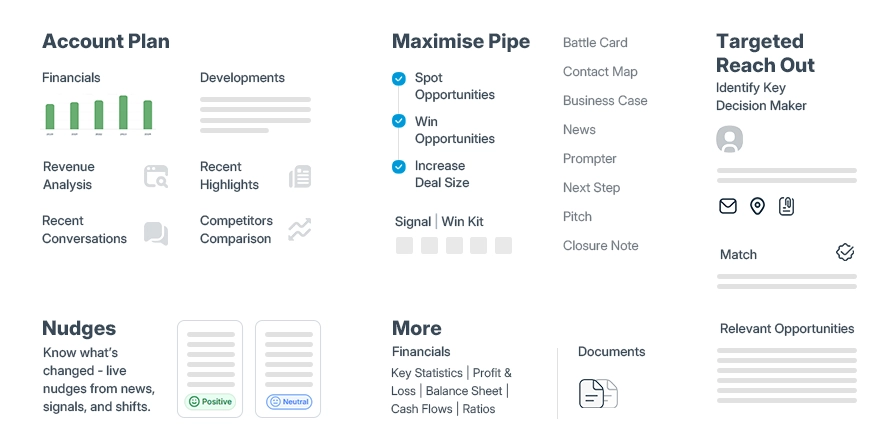
SalesPlay's defining differentiator lies in its proactive market intelligence capabilities. The Spot Opportunity Agent tracks real-time mission-critical priorities, surfaces latent use cases, and identifies client-of-client signals and ecosystem shifts. This enables sales teams to:
SalesPlay monitors market movements, budget allocations, strategic initiatives, and competitive dynamics to surface opportunities at the earliest stage. This market-first approach means teams aren't waiting for buyers to raise their hands—they're already in conversation when the need emerges.
Gong's Approach:
Gong does not provide proactive market intelligence or opportunity discovery capabilities. The platform focuses exclusively on analyzing interactions that have already occurred. Gong users must identify prospects through other means and then use Gong to optimize those conversations. This reactive approach means teams rely on traditional prospecting methods, intent data providers, or manual research to build pipeline.
Gong's Strength:
Conversation intelligence represents Gong's core competency. The platform excels at recording, transcribing, and analyzing sales calls with sophisticated AI capabilities:
Gong's conversation analytics help managers understand what top performers do differently, identify coaching opportunities, and build data-driven playbooks. The platform's deep learning models can detect subtle signals like customer engagement levels and deal momentum.
SalesPlay's Capabilities:
While SalesPlay focuses primarily on opportunity identification and sales enablement rather than conversation recording, the platform's Meeting Prep Agent and Win Opportunities Agent provide contextual intelligence for sales conversations. These agents deliver real-time insights about prospects, recent developments, and business context to ensure every conversation is relevant and impactful.
SalesPlay's approach emphasizes preparation over post-call analysis, equipping reps with the intelligence they need before conversations happen rather than analyzing what went wrong afterward.
SalesPlay's Comprehensive Enablement:
SalesPlay delivers exceptional sales enablement through seven AI agents working across the entire sales process:
This comprehensive agent ecosystem means every rep can perform like a top one percent seller, with personalized materials, value propositions, and strategies delivered automatically for each opportunity.
Gong's Enablement Capabilities:
Gong's enablement features focus on coaching and performance improvement through conversation analysis:
Gong helps managers scale coaching by identifying specific improvement areas and sharing examples of successful techniques. However, sales preparation materials, battlecards, and persona-specific messaging must be created separately or through other tools.
SalesPlay's Predictive Intelligence:
SalesPlay's predictive capabilities operate at the market level, identifying which accounts are likely to have budget, need, and urgency before these signals appear in conventional data sources. The platform analyzes ecosystem shifts, strategic priorities, and market movements to predict where opportunities will emerge.
This forward-looking intelligence enables teams to:
Gong's Forecasting:
Gong Forecast analyzes historical conversation data and deal activity to predict close probabilities and forecast accuracy. The platform claims up to 95 percent forecasting accuracy by analyzing over 300 unique buying signals extracted from customer interactions.
However, Gong's forecasting has received mixed reviews from users. Many organizations report that Gong Forecast requires substantial manual review, becomes unmanageable in high-velocity sales environments, and often necessitates supplementing with dedicated forecasting tools like Clari. Industry analysts rate Gong's forecasting capabilities at approximately four out of 10, noting limitations in proactive intelligence and dependency on historical patterns rather than forward-looking market signals.
Gong's Integrations:
Gong offers extensive integrations with major CRM platforms, communication tools, and sales engagement platforms:
Gong automatically updates CRM records with call notes, next steps, and interaction summaries. However, users frequently report that Gong functions as a standalone application requiring separate logins and workflows, which can reduce adoption among front-line sellers.
SalesPlay's Integrated Approach:
SalesPlay positions itself as "one integrated, hyper-personalized system" designed to eliminate tool sprawl. The platform provides a unified workspace where opportunity identification, sales preparation, and execution happen within a single interface. Sales teams can upload target accounts or let SalesPlay suggest high-potential accounts based on live market signals, then receive automatically generated sales kits for each opportunity.
The platform's integration philosophy emphasizes consolidation over proliferation—reducing the number of tools sales teams must navigate rather than adding another login to an already complex tech stack.
Gong Pricing: Gong operates on a complex pricing model that has become increasingly expensive:
For a 100-user deployment, first-year costs typically range from 140 thousand dollars to 200 thousand dollars or more when including all fees and modules. Many users report that Gong's bundled pricing pushes costs toward 250 dollars per user per month when combining multiple modules.
Additional cost considerations include:
SalesPlay Pricing:
SalesPlay offers enterprise pricing tailored to organizational needs. The platform emphasizes value through measurable outcomes: 70 percent faster research time, 40 percent more pipeline growth, and 25 percent higher win rates. While specific pricing is not publicly disclosed, SalesPlay's approach focuses on ROI-based conversations rather than seat-based licensing complexity.
Organizations interested in SalesPlay pricing can request personalized demos to understand costs specific to their requirements.
Early-Stage Pipeline Development:
SalesPlay excels when organizations need to build pipeline proactively. The platform's market intelligence and opportunity discovery capabilities make it ideal for:
Strategic Account Development:
For enterprises focused on landing and expanding strategic accounts, SalesPlay's ecosystem intelligence and expansion signal detection provide critical advantages. The Increase Deal Size Agent automatically identifies cross-sell and upsell opportunities, while the Account Planning Agent delivers comprehensive account intelligence for strategic planning.
Sales Teams Requiring Comprehensive Enablement:
Organizations where sales preparation time constrains productivity benefit significantly from SalesPlay's automated enablement capabilities. The platform's ability to generate personalized decks, battlecards, and messaging for each opportunity can save teams hundreds of hours monthly while ensuring consistent, high-quality customer engagement.
Market-Driven Sales Organizations:
Companies that compete based on market insights, industry expertise, and consultative selling approaches align well with SalesPlay's capabilities. The platform helps sales teams demonstrate deep market understanding and industry knowledge in every interaction.
Conversation-Centric Sales Processes:
Gong delivers maximum value when sales outcomes depend heavily on conversation quality and execution. Organizations with:
Sales Performance Optimization:
When organizations have established pipeline sources and need to optimize conversion rates, Gong's conversation analytics provide detailed insights into what separates winning deals from losses. The platform helps identify best practices, coach underperformers, and refine sales methodologies.
Revenue Operations and Forecasting:
Sales operations teams seeking data-driven pipeline visibility and forecast accuracy can benefit from Gong's deal intelligence and activity tracking. However, many organizations find they need to supplement Gong with dedicated forecasting tools for comprehensive revenue operations.
Established Sales Teams with High Call Volumes:
Gong's ROI improves with scale. Organizations with 50 or more sales representatives conducting numerous customer conversations daily can justify the platform's cost through improved win rates and rep productivity.
SalesPlay follows a four-step implementation process designed for rapid time-to-value:
This streamlined approach emphasizes immediate productivity rather than lengthy configuration periods. Sales teams can begin identifying opportunities and generating sales materials within days of implementation.
Gong implementation typically requires three to six months for full deployment and adoption:
Many organizations report that Gong requires dedicated sales operations or enablement resources to configure, manage, and maximize the platform's features. User adoption can be challenging, particularly among individual contributors who may view conversation recording as surveillance rather than enablement.
The complexity of Gong's interface represents a significant adoption barrier. Multiple users describe the platform as unintuitive and difficult to navigate, with basic actions like locating recorded calls taking excessive time. This complexity contributes to underutilization, with many organizations using only a fraction of Gong's capabilities despite significant investment.
SalesPlay's most distinctive capability is its integration with MarketsandMarkets' extensive market research and intelligence infrastructure. The platform monitors ecosystem shifts, competitive dynamics, strategic initiatives, and budget allocations across industries, providing sales teams with insights that competitors simply cannot access through conversation analysis alone.
This market-first approach fundamentally changes how sales teams operate—from reactive responders to proactive advisors who engage customers before needs are fully formed.
Where Gong looks backward at completed conversations, SalesPlay looks forward at emerging market conditions. The Spot Opportunity Agent identifies revenue shifts three to five weeks before traditional signals appear, enabling sales teams to position themselves as trusted advisors rather than product vendors responding to RFPs.
This predictive capability creates competitive moats that are difficult to overcome. By the time competitors using conventional prospecting methods identify an opportunity, SalesPlay users have already established relationships and shaped buying criteria.
SalesPlay's Win Opportunities Agent represents a significant innovation in sales enablement. Rather than requiring sales teams to manually create presentations, battlecards, and value propositions for each opportunity, the platform automatically generates these materials based on the specific account, opportunity, and decision-maker profile.
This automation addresses one of the most time-consuming aspects of B2B sales—preparation—while ensuring materials are highly relevant and personalized rather than generic templates.
SalesPlay's seven AI agents work together across the entire sales process, from opportunity identification through deal closure and expansion. This integrated approach contrasts with point solutions that address individual sales challenges in isolation.
The agents share intelligence and coordinate actions, ensuring that insights from market monitoring inform meeting preparation, which influences win plan development, which triggers expansion opportunity detection. This systemic approach creates compounding advantages as sales cycles progress.
Gong's sophisticated natural language processing and machine learning capabilities provide unmatched depth in conversation analysis. The platform can detect sentiment shifts, identify subtle buying signals, and recognize patterns across thousands of conversations that human managers could never manually review.
This analytical depth helps organizations understand not just what sales reps say, but how they say it—tone, pacing, question patterns, and engagement levels—all of which influence outcomes.
Gong enables sales leaders to coach entire teams with the same level of personalization previously possible only for a few key reps. Managers can quickly identify specific improvement areas, share relevant examples, and track coaching effectiveness over time.
The platform's scorecards and automated feedback mechanisms make coaching systematic rather than sporadic, helping organizations continuously improve sales execution at scale.
Gong has built what it calls the Revenue Graph—a living network of revenue data that automatically captures and connects every interaction across organizations. This comprehensive data asset grows more valuable over time as historical patterns inform current decisions and predictive models.
As the category pioneer, Gong benefits from extensive integration partnerships, a large user community, and proven implementation methodologies. Organizations choosing Gong gain access to established best practices and benchmark data from thousands of similar companies.
SalesPlay positions itself as a foundational intelligence layer that enhances rather than replaces existing sales tools. The platform complements:
Organizations using AI sales tools can integrate SalesPlay's intelligence into their existing workflows, enriching other platforms rather than requiring wholesale replacement.
Gong integrates with most major sales and marketing platforms but typically functions as a standalone conversation intelligence layer. Organizations often maintain:
This multi-tool approach provides comprehensive coverage but requires sales teams to navigate multiple interfaces and workflows, potentially reducing efficiency despite each tool's individual capabilities.
SalesPlay includes Customer Success Manager assignment as part of its enterprise offering, ensuring dedicated support for implementation and ongoing optimization. The platform's simpler interface and focused feature set generally require less intensive support than more complex conversation intelligence platforms.
Organizations can request personalized demos to evaluate the platform with guidance from product specialists who understand specific industry requirements and use cases.
Gong provides tiered support based on contract level, with higher-tier plans receiving faster response times and dedicated Customer Success resources. However, user reviews consistently cite support quality as a concern:
Organizations planning Gong deployments should factor in potential additional consulting costs for implementation assistance beyond standard support.
SalesPlay emphasizes three primary value drivers:
These metrics suggest that a team of 50 sales representatives saving 10 hours weekly on research (at 75 dollars per hour) while closing 25 percent more deals represents millions in additional revenue and hundreds of thousands in productivity gains annually.
Gong cites several impact metrics:
However, ROI heavily depends on adoption rates. Organizations where managers actively use Gong for coaching and representatives engage with insights see strong returns, while those with poor adoption often struggle to justify the investment.
Industry sources suggest Gong makes economic sense once organizations reach 25 to 30 or more representatives with complex deal cycles where forecasting accuracy and scaled coaching deliver measurable returns. Smaller teams often find that lighter, more affordable alternatives provide sufficient functionality without Gong's premium price tag.
SalesPlay scales effectively across organization sizes, from mid-market companies to global enterprises. The platform's market intelligence capabilities become increasingly valuable as organizations:
The unified platform architecture means that scaling doesn't require managing multiple integrations or dealing with increased system complexity.
Gong scales well for large enterprises with hundreds of sales representatives and high conversation volumes. The platform's architecture handles massive data volumes, and its analytics become more powerful as historical conversation data accumulates.
However, scaling Gong presents challenges:
Organizations with 200 or more representatives often negotiate enterprise agreements with dedicated support and customized pricing structures to address these scaling challenges.
Both platforms serve technology companies well, though with different emphases:
SalesPlay Advantages:
Gong Advantages:
SalesPlay Advantages:
Gong Advantages:
SalesPlay Advantages:
Gong Advantages:
SalesPlay continues expanding its AI agent capabilities and market intelligence depth. Future development focuses on:
The platform's foundation on MarketsandMarkets' research infrastructure provides unique opportunities for innovation that conversation-centric platforms cannot easily replicate.
Gong has introduced Gong Agents to address automation and workflow orchestration needs, moving beyond pure conversation analysis toward action execution. The platform continues developing:
However, Gong faces increasing competition from newer AI-native platforms that offer similar conversation intelligence at significantly lower costs with faster implementation.
Market Focus:
SalesPlay's strength in market intelligence means organizations must trust and act on forward-looking signals rather than waiting for explicit buyer interest. Sales teams accustomed to reactive prospecting may require cultural change to maximize platform value.
Enterprise Pricing:
While SalesPlay avoids complex per-user licensing, the platform positions itself as an enterprise solution. Smaller organizations or individual sales professionals may find limited options for entry-level access.
Newer Market Presence:
As a newer entrant compared to established players like Gong, SalesPlay has fewer public case studies and user reviews available for evaluation, though this reflects the platform's recent market entry rather than capability limitations.
Pricing Complexity and Cost:
Gong's expensive, complex pricing structure with platform fees, per-user costs, and module add-ons creates significant budget challenges. Many organizations report first-year costs exceeding expectations, and automatic renewal uplifts increase expenses over time.
Adoption Challenges:
Gong's complicated interface and learning curve result in poor adoption among front-line sellers. Many sales representatives view the platform as surveillance rather than enablement, leading to minimal engagement despite significant investment.
Reactive Rather Than Proactive:
Gong analyzes conversations after they occur but provides limited guidance for identifying which conversations to have. Teams must use separate tools for opportunity identification and prospecting, then apply Gong to optimize those interactions.
Forecasting Gaps:
Despite positioning as a revenue intelligence platform, Gong's forecasting capabilities receive consistently poor reviews. Many organizations supplement Gong with dedicated forecasting tools like Clari, effectively doubling costs while creating integration headaches.
Both platforms handle sensitive customer conversation data and require robust security measures:
SalesPlay Security:
Gong Security:
Organizations in regulated industries should evaluate each platform's specific security certifications and compliance documentation as part of vendor selection.
Gong users must navigate complex call recording regulations that vary by jurisdiction. Different regions require:
SalesPlay's focus on market intelligence rather than conversation recording eliminates many of these compliance complexities, though organizations should still understand data handling policies for market information.
Organizations transitioning to SalesPlay from traditional sales intelligence or prospecting tools typically experience straightforward migration:
The bigger transition involves sales process changes—shifting from reactive to proactive opportunity identification and adopting AI-generated sales materials rather than manually created content.
Gong migration involves more complexity:
Organizations should plan for three to six months of reduced analytics value while Gong accumulates sufficient conversation data to generate meaningful insights.
Both platforms involve significant switching costs once implemented:
SalesPlay: Process changes and sales team training on new opportunity identification approaches represent primary switching barriers.
Gong: Historical conversation data, established analytics baselines, and integrated workflows create substantial lock-in effects. Organizations often continue using Gong despite dissatisfaction due to the effort required to transition to alternatives.
The decision between SalesPlay and Gong ultimately depends on your organization's primary sales challenge:
Choose SalesPlay if:
Choose Gong if:
Consider both platforms if:
For most organizations, the choice comes down to timing in the buyer journey. If your challenge is identifying the right conversations to have and engaging customers early, SalesPlay's market intelligence and predictive capabilities provide unique advantages that conversation analysis cannot replicate. If your challenge is making existing conversations more effective and scaling sales execution across large teams, Gong's deep conversation analytics deliver proven value.
Evaluate your specific needs, budget constraints, and sales process maturity to make the decision that best positions your organization for sustainable revenue growth. Request demos from both platforms, involve sales representatives in evaluation processes, and clearly define success metrics before committing to either solution.
To explore SalesPlay's market intelligence capabilities and AI-powered sales agents, schedule a personalized demonstration to see how the platform can transform your sales approach and accelerate revenue growth.
SalesPlay is a market intelligence and predictive sales platform that identifies opportunities before they exist through ecosystem signals and market analysis. Gong is a conversation intelligence platform that records and analyzes sales calls and customer interactions to improve execution and coaching. SalesPlay focuses on proactive opportunity identification, while Gong focuses on reactive conversation optimization.
For small teams under 30 representatives, SalesPlay typically offers better ROI due to its focus on pipeline generation and sales enablement without complex per-user licensing. Gong's platform fees, implementation costs, and per-user pricing make economic sense primarily for organizations with 50 or more representatives conducting high volumes of sales conversations.
Yes, SalesPlay and Gong address different aspects of the sales process and can complement each other effectively. SalesPlay identifies opportunities and provides market intelligence for initial engagement, while Gong optimizes the execution of those conversations through recording and analysis. Organizations seeking comprehensive coverage might use SalesPlay for opportunity development and Gong for conversation improvement, though this dual-platform approach increases total technology costs.
No, SalesPlay does not record or transcribe sales conversations. The platform focuses on market intelligence, opportunity identification, and sales enablement through AI agents that generate materials and provide insights. Organizations requiring conversation recording and analysis should consider Gong or alternative conversation intelligence platforms alongside SalesPlay.
Gong typically costs 140 thousand dollars to 200 thousand dollars or more for 100 users in the first year, including platform fees, per-user licensing, implementation, and module add-ons. Per-user costs range from 1,360 dollars to 1,600 dollars annually, plus a mandatory platform fee of five thousand dollars to 50 thousand dollars. SalesPlay offers enterprise pricing tailored to organizational needs with a focus on ROI-based value rather than complex per-user licensing structures.
Both platforms serve enterprise organizations well but with different value propositions. SalesPlay excels for enterprises requiring proactive market intelligence, early opportunity engagement, and comprehensive sales enablement across large teams. Gong suits enterprises needing scaled coaching programs, conversation analytics, and pipeline visibility across hundreds of representatives. The choice depends on whether pipeline generation or conversation optimization represents the primary need.
SalesPlay implementation typically takes days to weeks, following a streamlined four-step process: account upload, opportunity identification, sales kit generation, and guided execution. Gong implementation requires three to six months for full deployment, including technical setup, data initialization, training, and workflow configuration. Organizations should factor these timelines into platform selection decisions.
Yes, both platforms integrate with major CRM systems. Gong offers native Salesforce and HubSpot integrations with bi-directional data sync, automatically updating CRM records with call notes and interaction summaries. SalesPlay integrates with CRM systems to enrich account records with market intelligence and opportunity insights, flowing sales intelligence into existing pipeline management workflows.
SalesPlay benefits industries where early market intelligence provides competitive advantages: technology, professional services, manufacturing, healthcare, and financial services. The platform helps organizations in complex B2B environments identify opportunities before formal buying processes begin. Gong benefits industries with high-volume sales motions requiring consistent conversation execution: SaaS, telecommunications, business services, and any organization with large sales teams conducting numerous customer calls daily.
Yes, the sales intelligence and conversation intelligence markets offer numerous alternatives. For conversation intelligence similar to Gong at lower costs, consider Chorus by ZoomInfo, Clari Copilot, or Avoma. For market intelligence and sales intelligence capabilities, explore ZoomInfo, LinkedIn Sales Navigator, or Cognism. Organizations should evaluate multiple options based on specific needs, budget constraints, and existing technology investments.
Category: Uncategorized Tags: ai, AIOps, Artificial Intelligence, cloud, cloud platform, Cybersecurity, Information and Communications Technology , VR