The B2B sales landscape has undergone a seismic transformation, and we're witnessing an unprecedented revolution in how organizations identify, engage, and convert high-value accounts. As we navigate through 2026, the question is no longer whether to adopt account intelligence platforms, but which solution will propel your sales organization to unprecedented heights. With the global account intelligence market projected to explode from $2.1 billion in 2024 to a staggering $4.8 billion by 2029—representing an impressive 18.2% compound annual growth rate—the competitive advantage lies in selecting the right platform that aligns with your strategic objectives.
The stakes have never been higher. Organizations leveraging advanced account intelligence platforms are reporting extraordinary results: 208% more revenue compared to traditional approaches, 25% better conversion rates, and deal sizes expanding by 11-50%. Furthermore, according to MarketsandMarkets research, businesses implementing data-driven sales-growth strategies experience above-market growth with EBITDA increases ranging from 15% to 25%. These aren't marginal improvements—they represent fundamental shifts in sales performance that separate industry leaders from those struggling to maintain relevance.
This comprehensive guide examines the leading account intelligence platforms shaping the future of B2B sales in 2026, providing you with the strategic insights needed to make informed investment decisions that will define your competitive positioning for years to come.
$4.8B
Projected Market Size by 2029
208%
Revenue Increase with Account Intelligence
75%
Fortune 1000 Adoption by End of 2026
90%
AI Forecasting Accuracy for Near-Term Deals
Understanding Account Intelligence: The Foundation of Modern B2B Sales
Before diving into specific platforms, it's essential to understand what distinguishes account intelligence from traditional sales tools and why this distinction matters for your bottom line. Account intelligence represents a paradigm shift from individual lead-centric approaches to comprehensive organizational analysis.
What Separates Account Intelligence from Sales Intelligence?
While the terms are often used interchangeably, understanding the distinction is crucial for selecting the appropriate solution. Sales intelligence focuses on individual prospects within companies, providing contact details, job titles, personal engagement data, and individual-level insights—ideal for high-volume outbound prospecting scenarios where quantity of touchpoints drives pipeline development.
Conversely, account intelligence takes a macro organizational perspective, analyzing entire companies' behaviors, technology adoption trends, buying patterns, organizational changes, and strategic initiatives. This holistic approach enables strategic account-based marketing (ABM) methodologies that prioritize relationship-building with high-value accounts over transactional interactions.
The most sophisticated platforms in 2026 seamlessly integrate both capabilities, enabling sales organizations to execute targeted prospecting within strategically prioritized accounts—combining the precision of account-based strategies with the velocity of modern sales engagement.
💡 Key Insight: The Data Integration Imperative
Modern account intelligence isn't just about data collection—it's about intelligent synthesis. The most effective platforms merge first-party data (direct insights from your engagement history) with third-party data (market behavior, competitor interactions, and industry-wide buying intent signals) to create actionable intelligence that drives decision-making. This integration allows organizations to prioritize high-intent accounts, refine outreach strategies with precision, and predict future opportunities with remarkable accuracy.
Essential Data Types Powering Account Intelligence Platforms
Comprehensive account intelligence platforms aggregate multiple critical data dimensions to provide 360-degree account visibility. Understanding these data types helps evaluate platform capabilities against your specific requirements.
Firmographic Data
Firmographic data forms the foundation of account profiling, encompassing company size, revenue bands, industry classifications, geographic footprint, organizational structure, growth trajectories, and employee count. This information enables precise market segmentation and account prioritization based on ideal customer profile (ICP) alignment, ensuring sales resources focus on accounts with highest potential value.
Technographic Intelligence
Technographic data reveals the complete technology stack deployed within target accounts, including software applications, infrastructure components, cloud platforms, and integration architectures. Understanding a prospect's technology environment enables sales teams to tailor solutions that integrate seamlessly with existing systems, identify replacement opportunities, and demonstrate relevant expertise that builds credibility.
Intent Data & Buying Signals
Perhaps the most transformative innovation in recent years, intent data identifies accounts actively researching solutions in your category. By monitoring content consumption patterns, search behaviors, website visits, and engagement with industry publications, intent platforms surface accounts demonstrating purchase readiness—often 3-6 months before traditional indicators become visible. Organizations leveraging intent data report 28% improvement in sales efficiency as resources concentrate on genuinely interested prospects.
Engagement Metrics & Relationship Intelligence
Comprehensive tracking of all account interactions across channels provides visibility into relationship depth, stakeholder engagement patterns, content preferences, and communication responsiveness. This multi-dimensional engagement data enables precise targeting of decision-makers and ensures consistent, coordinated outreach across the entire buying committee.
The Top Account Intelligence Platforms for 2026: Comprehensive Analysis
After extensive research analyzing features, capabilities, pricing models, and user experiences across dozens of platforms, we've identified the leading solutions that represent the cutting edge of account intelligence technology in 2026. Each platform brings unique strengths to address specific organizational needs and strategic priorities.
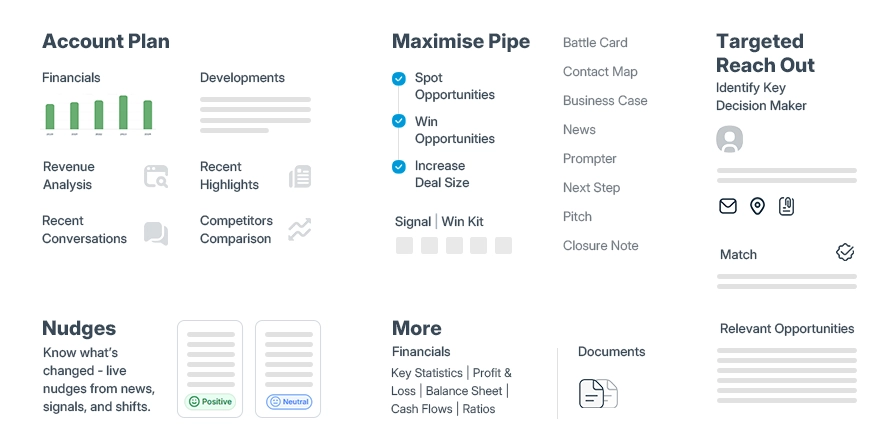
SalesPlay represents the next evolution in AI-powered sales intelligence, positioning itself as the world's first comprehensive platform that transforms sales execution through a revolutionary suite of 7 AI Agents working in concert to deliver unprecedented speed and precision. Unlike competitors offering fragmented data or point solutions, SalesPlay delivers pitch-ready opportunity ecosystems—complete with hyper-personalized sales kits, mapped buying centers, and conversion-ready outreach sequences that eliminate hours of manual research.
🚀 Revolutionary AI Agent Architecture
What truly distinguishes SalesPlay is its integrated AI agent framework that doesn't just provide data—it actively executes critical sales functions:
- Account Intelligence Agent: Uncovers real-time revenue shifts, ecosystem signals, and mission-critical priorities before intent data even registers changes, providing 3-6 month lead time on market movements
- Predictive Analytics Agent: Delivers 90%+ accuracy in deal outcome forecasting by analyzing hundreds of variables including historical performance, stakeholder engagement patterns, competitive positioning, and market dynamics
- Intent Signal Detection Agent: Monitors over 200,000+ verified global sources across 115+ languages to identify buying readiness signals invisible to traditional platforms
- Personalization Engine Agent: Automatically generates hyper-customized outreach sequences, value propositions, and engagement strategies tailored to specific account contexts and stakeholder personas
- Conversation Intelligence Agent: Records, transcribes, and analyzes sales interactions to identify winning behaviors, surface coaching opportunities, and extract actionable insights that improve team performance by 38%
- Research & Mapping Agent: Automatically constructs comprehensive buying center maps, identifies key stakeholders, charts reporting relationships, and tracks decision-maker movements across organizations
- Workflow Automation Agent: Eliminates manual data entry, automates CRM updates, schedules follow-ups intelligently, and orchestrates multi-channel engagement sequences without human intervention
🎯 Unique Market Intelligence Capabilities
SalesPlay's market intelligence engine provides strategic advantages that transcend traditional account data. The platform continuously monitors competitive positioning, market trend analysis, regulatory changes affecting target industries, merger and acquisition activity, funding announcements and financial health indicators, and technology adoption patterns across industries. This comprehensive market context enables sales teams to position solutions within broader strategic narratives that resonate with executive stakeholders.
✓ Key Strengths
- Integrated 7-AI-agent architecture eliminates tool fragmentation
- 90%+ predictive accuracy for deal forecasting
- Real-time market intelligence updates every 4-8 hours
- Pitch-ready opportunity packages save 15+ hours weekly per rep
- Seamless integration with major CRM platforms
- Global data coverage across 115+ languages
- Proven 2X faster deal closure rates
⚠ Considerations
- Premium pricing reflects enterprise-grade capabilities
- Full value realization requires 6-12 weeks of optimization
- Advanced features demand user training investment
- Best suited for mid-market to enterprise organizations
"SalesPlay transformed our sales operation from reactive prospecting to strategic account orchestration. The AI agents don't just provide data—they actually execute research, create personalized outreach, and predict which deals need attention. We've seen our average deal size increase 42% while cutting sales cycle time in half."
— Sarah Mitchell, VP of Sales, Enterprise SaaS Company
6sense leverages artificial intelligence to predict account buying stages and recommend optimal engagement strategies. The platform's predictive analytics engine analyzes vast quantities of behavioral data to identify accounts entering buying cycles, enabling proactive outreach before competitors recognize opportunities.
- Predictive account identification and prioritization
- Buying stage intelligence and propensity scoring
- Anonymous buyer identification capabilities
- Campaign orchestration across channels
- Revenue AI for pipeline prediction
Cognism differentiates through phone-verified contact data, GDPR and CCPA compliance, and emphasis on data accuracy over volume. The platform provides mobile numbers, direct dials, and business emails backed by strict verification processes, making it particularly valuable for organizations prioritizing outreach quality and regulatory compliance.
- Phone-verified mobile numbers and direct dials
- GDPR-compliant European coverage
- Intent data and buying signals
- Technographic intelligence
- Chrome extension for LinkedIn prospecting
Critical Selection Criteria: Choosing Your Ideal Platform
Selecting the right account intelligence platform requires systematic evaluation across multiple dimensions aligned with your organization's specific requirements, existing technology infrastructure, and strategic priorities. Consider these critical factors during your assessment process.
Data Quality & Coverage Comprehensiveness
Data quality supersedes data quantity in driving sales outcomes. Evaluate platforms based on data accuracy rates, verification methodologies, update frequencies (ideally 4-8 hours for critical information), geographic coverage matching your target markets, industry specialization alignment, and transparency regarding data sources and collection practices. Request data samples for your specific ICP to validate coverage quality before committing to enterprise agreements.
AI & Predictive Capabilities
The sophistication of artificial intelligence implementation varies dramatically across platforms. Gartner research indicates that by 2026, 65% of B2B sales teams will transition from intuition-based to data-driven decision-making using AI-powered platforms. Assess predictive accuracy metrics (leading platforms achieve 85-90%+ for near-term deal forecasting), algorithm transparency and explainability, ability to customize models for your specific business context, learning capabilities that improve over time, and integration of multiple prediction types (deal outcome, timing, account prioritization, churn risk).
Integration Ecosystem & Technical Architecture
Account intelligence platforms deliver maximum value when seamlessly integrated into existing workflows. According to SalesPlay research, organizations investing in strong integration foundations experience 64% fewer technical issues and 51% higher data accuracy. Evaluate native integrations with your CRM, marketing automation, sales engagement, and conversation intelligence tools, API robustness and documentation quality, bidirectional data sync capabilities preventing information silos, webhook support for real-time notifications, and pre-built workflow templates accelerating deployment.
User Experience & Adoption Enablement
The most powerful platform delivers zero value if users don't adopt it. Salesforce research reveals that high-performing teams are 4.9 times more likely to be using AI than underperforming teams—but only when adoption is genuine. Assess interface intuitiveness and mobile accessibility, onboarding program comprehensiveness and quality, ongoing training resources and certification programs, customer support responsiveness and expertise, user community engagement and peer learning opportunities, and role-based customization enabling relevant experiences for different team members.
Pricing Transparency & Total Cost of Ownership
Platform pricing structures vary significantly, often hiding true costs in add-on features, per-seat charges, or data access tiers. Request detailed pricing breakdowns including base platform fees, per-user costs, data access charges, implementation and onboarding expenses, ongoing training and support costs, and integration development requirements. Calculate total cost of ownership over a 3-year period and divide by projected user count for accurate per-user economics. Leading platforms demonstrate ROI within 6-12 months through productivity gains and revenue increases.
Platform Comparison Matrix: At-a-Glance Analysis
| Platform |
Best For |
AI Capabilities |
Data Coverage |
Starting Price Range |
| SalesPlay |
Comprehensive AI-powered sales intelligence with predictive capabilities |
⭐⭐⭐⭐⭐
7 integrated AI agents, 90%+ prediction accuracy |
⭐⭐⭐⭐⭐
Global, 115+ languages, 200K+ sources |
Enterprise (Contact for pricing) |
| ZoomInfo |
Large-scale contact data and technographics |
⭐⭐⭐⭐☆
Conversation intelligence, intent monitoring |
⭐⭐⭐⭐⭐
400M+ contacts, strong U.S. focus |
$15,000+ annually |
| Demandbase |
Account-based marketing orchestration |
⭐⭐⭐⭐☆
Account scoring, engagement tracking |
⭐⭐⭐⭐☆
Strong B2B coverage, ABM focus |
$25,000+ annually |
| 6sense |
Predictive account identification |
⭐⭐⭐⭐⭐
AI-powered buying stage detection |
⭐⭐⭐⭐☆
Anonymous visitor identification |
$20,000+ annually |
| Cognism |
GDPR-compliant European coverage |
⭐⭐⭐☆☆
Basic intent signals |
⭐⭐⭐⭐☆
Strong European data, verified contacts |
$8,000+ annually |
Implementation Best Practices: Maximizing Platform Value
Successful account intelligence deployment extends far beyond technology installation. Organizations achieving superior outcomes follow structured implementation methodologies that address technical, process, and cultural dimensions simultaneously.
Phase 1: Foundation Building (Weeks 1-4)
Establish clear success metrics aligned with business objectives (pipeline growth, conversion rate improvement, deal velocity acceleration, average deal size expansion). Audit existing data quality and identify cleanup requirements before migration. Define ideal customer profiles with quantifiable characteristics and scoring criteria. Map current sales processes to identify automation opportunities and workflow optimization potential. Assemble a cross-functional implementation team including sales operations, IT, sales leadership, and power users who will champion adoption.
Phase 2: Technical Integration (Weeks 5-8)
Configure CRM integrations ensuring bidirectional data flow and field mapping accuracy. Implement data enrichment rules and automated update schedules. Establish alert mechanisms for critical trigger events and high-priority signals. Create custom dashboards and reports aligned with different user roles and responsibilities. Conduct rigorous testing with real accounts before broader rollout to identify issues early.
Phase 3: User Enablement & Adoption (Weeks 9-16)
Develop role-specific training programs addressing unique workflows for sales development reps, account executives, sales managers, and executives. Create quick-reference guides, video tutorials, and practical use case documentation. Identify early adopters who can serve as internal champions and peer coaches. Establish feedback loops capturing user input for continuous refinement. Monitor adoption metrics daily and proactively address resistance or confusion before they calcify into permanent challenges.
Phase 4: Optimization & Scale (Months 4-12)
Analyze performance data to identify successful patterns and underutilized capabilities. Refine predictive models based on actual conversion outcomes in your specific context. Expand usage to additional teams and use cases beyond initial deployment scope. Integrate learnings into onboarding processes for new team members. Continuously evaluate emerging platform capabilities and beta features for strategic advantage opportunities.
⚡ Critical Success Factor: Executive Sponsorship
According to PwC's 2026 AI Business Predictions, organizations with strong top-down AI programs led by senior leadership achieve significantly better outcomes than those taking crowdsourced, bottom-up approaches. Ensure visible executive sponsorship, clear resource allocation, and consistent messaging about strategic importance to overcome inevitable implementation challenges and drive sustained adoption.
The Future of Account Intelligence: 2026 and Beyond
As we look toward the remainder of 2026 and into 2027, several transformative trends are reshaping account intelligence capabilities and expanding the strategic value these platforms deliver.
Agentic AI Evolution
The next frontier involves AI agents that move beyond analysis into autonomous action—not just recommending actions but executing complex multi-step workflows. We're already seeing early examples with platforms like SalesPlay that deploy specialized AI agents handling research, personalization, and coordination tasks that previously consumed hours of human time. Expect these capabilities to mature significantly throughout 2026, creating AI co-pilots that support representatives throughout entire sales cycles from initial prospecting through closing and renewal.
Predictive Opportunity Generation
Current platforms excel at forecasting existing opportunity outcomes. The next evolution involves moving upstream to predict where new opportunities will emerge before prospects even begin active research. Propensity modeling will identify which accounts are most likely to enter buying cycles, timing prediction will forecast optimal outreach windows, and personalization intelligence will recommend specific messaging and positioning by account context—transforming AI from forecasting tool into growth engine.
Unified Sales Intelligence Ecosystems
The proliferation of point solutions is giving way to comprehensive platforms that integrate previously separate capabilities. Organizations are consolidating tools to reduce complexity, improve data consistency, and eliminate workflow friction. Leading vendors are responding by acquiring complementary technologies and building unified platforms that address multiple needs within cohesive user experiences. This consolidation trend will accelerate through 2026 as organizations demand simpler, more integrated solutions.
Conversational Intelligence Mainstreaming
Recording and analyzing sales conversations has moved from innovative to essential. By 2026, conversation intelligence capabilities are becoming standard features within account intelligence platforms rather than standalone tools. These systems identify winning behaviors, flag risks, extract actionable insights, and provide objective performance data that improves coaching effectiveness. Organizations using conversation intelligence report 38% improvement in representative performance and 29% reduction in new hire ramp time.
Making Your Decision: A Strategic Framework
Selecting the optimal account intelligence platform requires balancing multiple competing priorities while maintaining focus on your specific strategic objectives. Use this decision framework to structure your evaluation process:
Step 1: Define Success Criteria
Articulate specific, measurable outcomes you expect from platform deployment. Avoid vague goals like "improve sales productivity" in favor of quantifiable targets: increase qualified pipeline by 35%, reduce average sales cycle from 120 to 85 days, improve win rates from 18% to 25%, or expand average deal size by $15,000. Clear success metrics enable objective vendor comparisons and provide accountability benchmarks post-implementation.
Step 2: Assess Organizational Readiness
Honestly evaluate your organization's current maturity across critical dimensions. Leading-edge platforms require sophisticated data infrastructure, change management capabilities, and user adoption support. Organizations lacking these foundations may achieve better outcomes with simpler solutions deployed well rather than comprehensive platforms deployed poorly. Consider data quality and governance practices, existing technology infrastructure complexity, change management track record, training and enablement capabilities, and sales team technological sophistication.
Step 3: Conduct Thorough Due Diligence
Move beyond marketing claims to validate actual capabilities through hands-on evaluation. Request extended trial periods with your real data in authentic workflows. Speak with current customers in similar industries and company sizes—preferably references you identify independently rather than vendor-provided contacts. Assess implementation team expertise and support quality through detailed scoping conversations. Review contract terms carefully, particularly regarding data ownership, price escalation clauses, and termination provisions.
Step 4: Calculate Total Economic Impact
Build comprehensive financial models incorporating all costs and quantified benefits over multi-year timeframes. Initial platform costs represent only one component of total investment. Factor in implementation services, training and change management, ongoing license fees and data costs, integration development and maintenance, and opportunity costs of team time during deployment. Balance against projected benefits including productivity gains from automation, increased win rates from better insights, larger deal sizes from strategic positioning, and faster sales cycles from timing optimization.
"The ROI from account intelligence platforms isn't just about the technology—it's about the strategic advantages that come from knowing more about your customers than competitors do. When we implemented SalesPlay, we didn't just get better data; we fundamentally transformed how our entire go-to-market team collaborates around account strategy."
— Michael Chen, Chief Revenue Officer, Global Technology Firm
Conclusion: Seizing the Competitive Advantage
The evidence is overwhelming: account intelligence platforms have transcended nice-to-have status to become fundamental infrastructure for competitive B2B sales organizations. With 75% of Fortune 1000 companies implementing these solutions by the end of 2026, the question facing sales leaders isn't whether to adopt account intelligence, but how quickly you can deploy capabilities that match or exceed competitor capabilities.
Organizations that move decisively while competitors deliberate will capture disproportionate advantages in market intelligence, customer intimacy, and sales execution excellence. The platforms highlighted in this analysis represent the current state-of-the-art, with SalesPlay's integrated AI agent architecture pushing the boundaries of what's possible when artificial intelligence and human expertise combine in service of revenue growth.
Success requires more than technology selection—it demands commitment to data quality, investment in user enablement, courage to challenge longstanding assumptions about sales processes, and patience to allow capabilities to mature through iterative refinement. Organizations that approach implementation strategically, following proven methodologies while adapting to their unique contexts, consistently achieve the extraordinary results documented in this analysis.
The competitive landscape of 2026 offers no participation trophies. Sales organizations equipped with sophisticated account intelligence capabilities will systematically outperform those relying on intuition, manual research, and fragmented data sources. The technology is mature, the ROI is proven, and the strategic imperative is clear.
The only remaining question is: Will you lead this transformation or respond to it?
Frequently Asked Questions (FAQs)
Q: What is account intelligence and why is it important for B2B sales?
Account intelligence is the systematic process of collecting, analyzing, and leveraging comprehensive data about target organizations to drive strategic sales decisions. Unlike traditional lead intelligence that focuses on individual contacts, account intelligence takes a holistic approach by examining firmographic data, technographic insights, intent signals, engagement metrics, and market intelligence. This comprehensive view enables sales teams to prioritize high-value accounts, personalize engagement strategies, and make data-driven decisions that improve conversion rates by 25% and increase deal sizes by 11-50%. In today's competitive B2B landscape, where buyers conduct extensive independent research before engaging with sales, account intelligence provides the contextual understanding necessary to deliver relevant, timely, and valuable interactions that differentiate your approach from generic outreach.
Q: How do AI-powered account intelligence platforms differ from traditional sales tools?
AI-powered account intelligence platforms leverage machine learning algorithms and predictive analytics to automatically identify buying signals, predict deal outcomes with 85-90% accuracy, and deliver real-time insights without manual research. Traditional tools require extensive manual data entry and provide static reports that quickly become outdated. AI platforms continuously monitor hundreds of data sources, detect patterns invisible to human analysis, and provide prescriptive recommendations for optimal engagement timing and messaging. For example, while traditional tools might show that an account visited your website, AI platforms analyze that behavior in context of market trends, competitive activities, and historical conversion patterns to predict likelihood of purchase and recommend specific next actions. Organizations using AI-powered platforms report 28% improvement in sales efficiency and 64% fewer integration issues compared to traditional approaches.
Q: What are the key features to look for in an account intelligence tool in 2026?
Essential features for 2026 include: predictive lead scoring and opportunity forecasting that anticipate which deals will close and when, real-time intent data and buying signal detection monitoring prospect research behaviors across the web, comprehensive technographic and firmographic data providing complete account profiles, automated CRM enrichment and data validation ensuring information accuracy without manual effort, conversation intelligence and sales coaching analyzing call recordings to surface winning behaviors, seamless integration with existing sales tech stack preventing data silos and workflow disruption, advanced analytics and customizable dashboards providing role-specific insights, AI-powered personalization and content generation creating tailored outreach at scale, trigger event monitoring and real-time alerts notifying teams of critical account changes, and mobile accessibility enabling on-the-go access. The best platforms combine these capabilities into unified ecosystems rather than requiring multiple disconnected tools that create complexity and reduce adoption.
Q: How much should companies expect to invest in account intelligence platforms?
Account intelligence platform pricing varies significantly based on company size, feature requirements, and data access needs. Entry-level solutions for small businesses typically range from $500-$2,000 per month, mid-market platforms cost between $2,000-$10,000 monthly, and enterprise solutions with advanced AI capabilities can exceed $15,000-$50,000+ per month depending on user count and data requirements. However, ROI studies consistently show that organizations implementing account intelligence see 208% more revenue and 15-25% EBITDA increases, making the investment highly justifiable when properly deployed. When evaluating costs, consider total cost of ownership including implementation services, training, ongoing support, and integration development rather than just licensing fees. Leading platforms typically deliver positive ROI within 6-12 months through improved productivity, higher win rates, and larger deal sizes that more than offset the investment.
Q: What is the difference between account intelligence and sales intelligence?
While often used interchangeably, account intelligence and sales intelligence serve different strategic purposes. Sales intelligence focuses on individual prospects within companies, providing contact details, job titles, and personal engagement data—ideal for outbound prospecting efforts where the goal is identifying and reaching decision-makers at scale. Account intelligence takes a macro organizational view, analyzing entire companies' behaviors, technology adoption trends, buying patterns, organizational changes, and strategic initiatives to inform account-based marketing approaches. Account intelligence answers questions like "Is this company a good fit for our solution?" and "What are their current strategic priorities?" while sales intelligence addresses "Who are the decision-makers?" and "How do I reach them?" Modern platforms increasingly combine both capabilities, enabling strategic account prioritization (account intelligence) followed by precise stakeholder targeting (sales intelligence) within those prioritized accounts.
Q: How can SalesPlay's AI agents improve sales team performance?
SalesPlay's revolutionary suite of 7 AI Agents transforms sales execution through specialized capabilities working in concert: The Account Intelligence Agent uncovers real-time revenue shifts and ecosystem signals before competitors, providing 3-6 month lead time on market movements. The Intent Signal Agent detects buying readiness by monitoring 200,000+ global sources across 115+ languages. The Personalization Agent creates hyper-customized outreach sequences with pitch-ready opportunity ecosystems mapped to specific stakeholder personas. The Predictive Analytics Agent forecasts deal outcomes with 90%+ accuracy by analyzing hundreds of variables. The Conversation Intelligence Agent analyzes sales calls for winning behaviors and coaching opportunities. The Research Agent automatically maps buying centers and stakeholder relationships, eliminating hours of manual LinkedIn research. The Workflow Automation Agent handles administrative tasks including CRM updates, follow-up scheduling, and multi-channel sequence orchestration. This integrated approach enables teams to close deals 2X faster while maintaining the authentic relationship-building that drives long-term customer success.
Q: What implementation timeline should companies expect when deploying account intelligence tools?
Implementation timelines vary based on organizational maturity and platform complexity. Basic deployments with simple integrations typically require 2-4 weeks for data migration, user training, and initial configuration. Mid-complexity implementations involving multiple system integrations and custom workflows generally take 6-12 weeks to complete technical setup and achieve initial user adoption. Enterprise deployments with advanced AI model training, extensive customization, change management programs, and phased rollouts can span 3-6 months from project kickoff to full production deployment. However, modern platforms like SalesPlay offer accelerated onboarding with pre-configured AI agents that deliver value within days rather than months. Regardless of initial implementation timeline, organizations should expect ongoing optimization for 18-36 months to achieve full platform maturity, advance through capability levels, and maximize ROI as teams discover new use cases and refine workflows based on experience. The key is viewing implementation as an ongoing journey rather than a one-time project with a fixed endpoint.
🚀 Ready to Transform Your Sales Intelligence?
Join the 75% of Fortune 1000 companies leveraging account intelligence to drive unprecedented sales performance. Whether you're evaluating platforms for the first time or considering an upgrade from legacy solutions, the right technology partner can mean the difference between leading your market and struggling to keep pace.
SalesPlay offers a comprehensive AI-powered sales intelligence platform that eliminates guesswork, accelerates deal velocity, and empowers your team with the insights needed to win in competitive markets. Our revolutionary 7 AI Agents work around the clock to deliver pitch-ready opportunities, predictive insights, and automated workflows that let your team focus on what they do best: building relationships and closing deals.
Schedule Your Demo Today ?
⏱ See how leading organizations are achieving 208% revenue growth and 2X faster deal closure with intelligent sales technology.