The study employed two primary approaches to estimate the current size of the food encapsulation market. Exhaustive secondary research was conducted to gather information on the market, peer markets, and parent markets. The next step was to validate these findings, assumptions, and sizing with industry experts across the value chain through primary research. Both top-down and bottom-up approaches were employed to estimate the complete market size. After that, market breakdown and data triangulation were used to estimate the market size of segments and subsegments.
Secondary Research
This research study involved the extensive use of secondary sources—directories and databases such as Bloomberg Businessweek and Factiva—to identify and collect information useful for a technical, market-oriented, and commercial study of the market.
In the secondary research process, various sources such as annual reports, press releases & investor presentations of companies, white papers, food journals, certified publications, articles from recognized authors, directories, and databases were referred to, to identify and collect information.
Secondary research was mainly used to obtain key information about the industry’s supply chain, the total pool of key players, and market classification and segmentation as per the industry trends to the bottom-most level, regional markets, and key developments from both market- and technology-oriented perspectives.
Primary Research
Extensive primary research was conducted after obtaining information regarding the food encapsulation market scenario through secondary research. Several primary interviews were conducted with market experts from both the demand and supply sides across major countries of North America, Europe, Asia Pacific, South America, and RoW. Primary data was collected through questionnaires, emails, and telephonic interviews. The primary sources from the supply side included various industry experts, such as Chief X Officers (CXOs), Vice Presidents (VPs), directors from business development, marketing, research, and development teams, and key opinion leaders. Primary interviews were conducted to gather insights such as market statistics, data on revenue collected from the products and services, market breakdowns, market size estimations, market forecasting, and data triangulation. Primary research also helped in understanding the various trends related to food encapsulation’s core material, shell material, method, technology, and application. Stakeholders from the demand side, such as research institutions and universities, and third-party vendors, were interviewed to understand the buyer’s perspective on the service, and their current usage of encapsulation and the outlook of their business, which will affect the overall market.
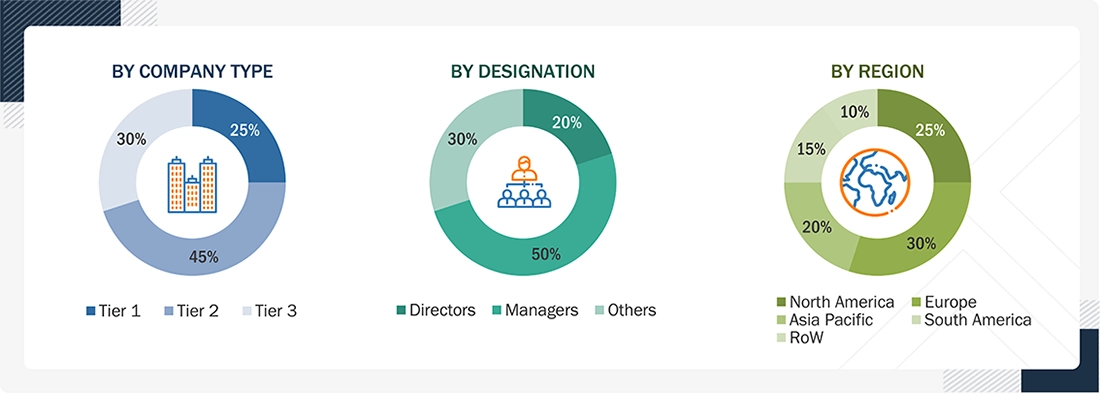
Note: The three tiers of the companies are defined based on their total revenues in 2023 or 2024, as per the availability of financial data: Tier 1: Revenue >USD 1 billion; Tier 2: USD 100 million ≤ Revenue ≤ USD 1 billion; Tier 3: Revenue USD 100 million.
To know about the assumptions considered for the study, download the pdf brochure
|
COMPANY NAME
|
DESIGNATION
|
|
ADM (US)
|
R&D Expert
|
|
BASF SE (Germany)
|
Sales Manager
|
|
Tate & Lyle PLC (UK)
|
Manager
|
|
TasteTech (US)
|
Sales Manager
|
|
Microcaps (US)
|
Marketing Manager
|
Market Size Estimation
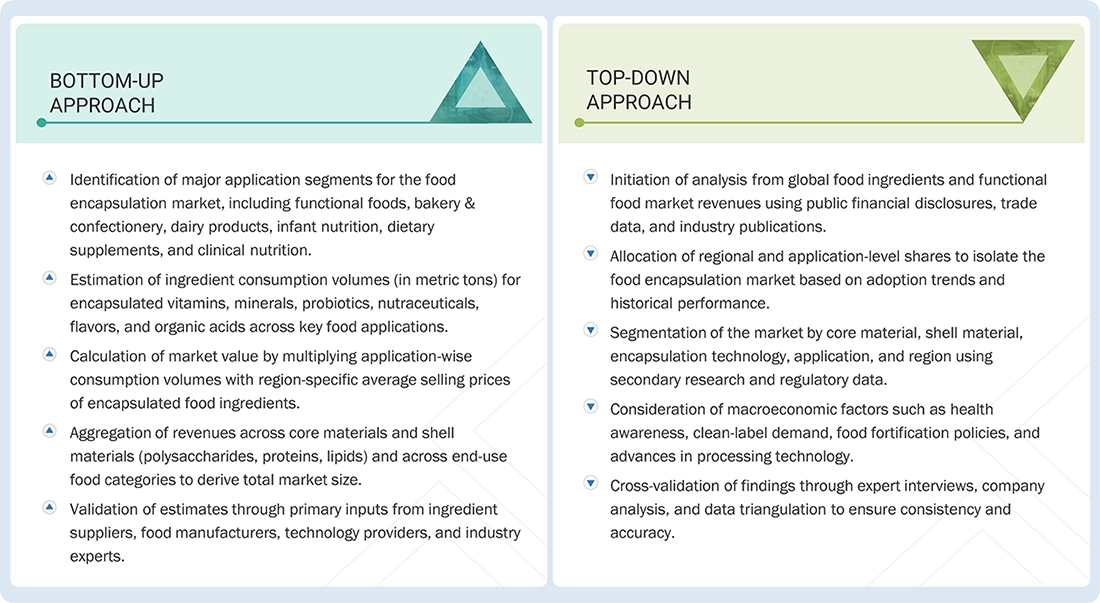
Both the top-down and bottom-up approaches were used to estimate and validate the total size of the food encapsulation market. These approaches were also used extensively to determine the size of various subsegments in the market. The research methodology used to estimate the market size includes the following details:
-
The key players in the industry and the overall markets were identified through extensive secondary research.
-
All shares, splits, and breakdowns were determined using secondary sources and verified through primary sources.
-
All possible parameters that affect the market covered in this research study were accounted for, viewed in extensive detail, verified through primary research, and analyzed to obtain final quantitative and qualitative data.
-
The research included the study of reports, reviews, and newsletters of top market players, along with extensive interviews for opinions from leaders, such as CEOs, directors, and marketing executives.
Food Encapsulation Market : Top-Down and Bottom-Up Approach
Data Triangulation
After arriving at the overall market size from the estimation process explained above, the total market was split into several segments and subsegments. The data triangulation and market breakdown procedures were employed, wherever applicable, to estimate the overall food encapsulation market and arrive at the exact statistics for all segments and subsegments. The data was triangulated by studying various factors and trends from the demand and supply sides. The market size was also validated using both the top-down and bottom-up approaches.
Market Definition
According to the National Library of Medicine, “encapsulation involves the incorporation of food ingredients, enzymes, cells, or other materials in small capsules. Applications for this technique have increased in the food industry since the encapsulated materials can be protected from moisture, heat, or other extreme conditions, thus enhancing their stability, and maintaining viability. Encapsulation in foods is also utilized to mask odors or tastes. The encapsulating or wall materials used generally consist of starch, starch derivatives, proteins, gums, lipids, or any combination of them. This technology enables a coat of food particles or ingredients such as flavors, fats, antioxidants, nutraceutical ingredients, and colors, among others, to ensure the bioavailability of such ingredients.
Key Stakeholders
-
Encapsulation raw material suppliers
-
Food encapsulation manufacturers
-
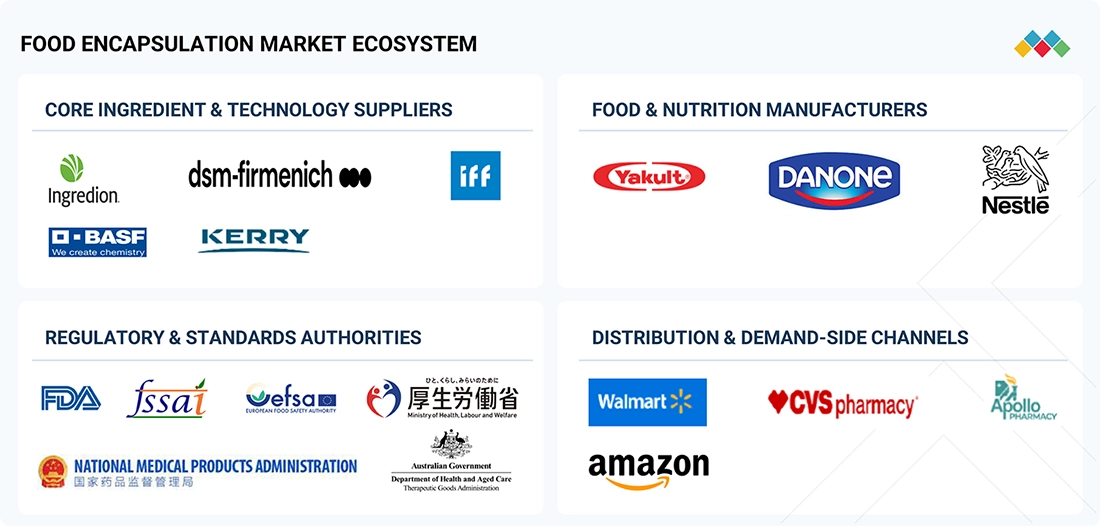
Food & beverage companies
-
Encapsulation technology providers
-
Intermediate suppliers, such as ingredient distributors, traders, and formulation service providers
-
Government and research organizations
-
Associations, regulatory bodies, and other industry-related bodies:
-
Food and Agriculture Organization (FAO)
-
European Food Safety Authority (EFSA)
-
US Food and Drug Administration (FDA
-
United States Department of Agriculture (USDA)
-
Food Safety and Standards Authority of India (FSSAI)
-
Food Standards Australia New Zealand (FSANZ)
-
Trade associations and professional bodies
-
Institute of Food Technologists (IFT)
-
European Federation of Food Science and Technology (EFFoST)
-
International Union of Food Science and Technology (IUFoST)
-
National and regional food ingredient associations
Report Objectives
-
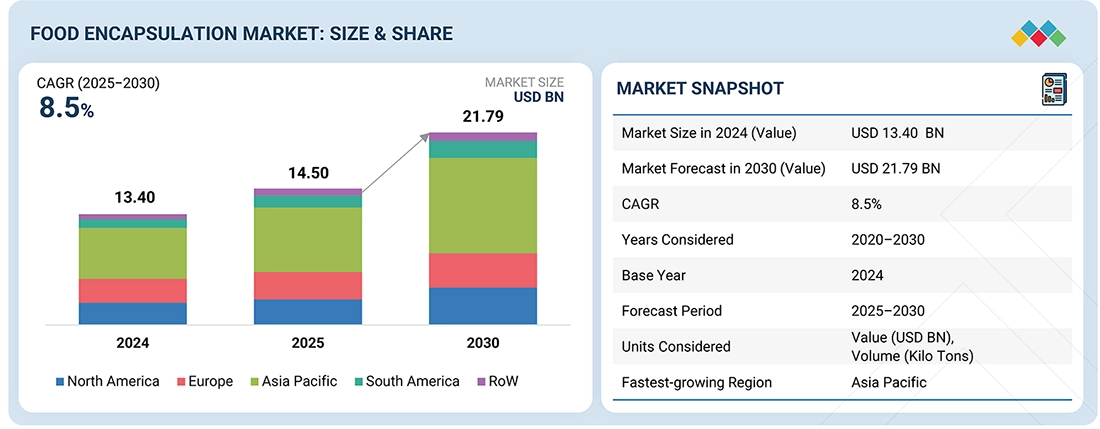
To determine, define, and project the size of the food encapsulation market, with respect to core material, shell material, method, technology, application, and regional markets, over a five-year period, ranging from 2025 to 2030
-
To identify the attractive opportunities in the market by determining the largest and fastest-growing segments across regions
-
To provide detailed information about the key factors influencing the growth of the market (drivers, restraints, opportunities, and challenges)
-
To analyze the micromarkets with respect to individual growth trends, prospects, and their contribution to the total market
-
To strategically profile key market players and comprehensively analyze their core competencies in each segment
-
To track and analyze competitive developments, such as alliances, joint ventures, product developments, mergers, and acquisitions, in the food encapsulation market
Customization Options:
With the given market data, MarketsandMarkets offers customizations according to company-specific scientific needs.
The following customization options are available for the report:
Product Analysis
-
Products Matrix, which gives a detailed comparison of the service portfolio of each company.
Geographic Analysis
With the given market data, MarketsandMarkets offers customizations according to company-specific scientific needs.
-
Further breakdown of the Rest of Europe food encapsulation market into key countries.
-
Further breakdown of the Rest of Asia Pacific food encapsulation market into key countries.
-
Further breakdown of the Rest of South America food encapsulation market into key countries.
Company Information
-
Detailed analyses and profiling of additional market players (up to five)











Daniel
Jul, 2026
Which encapsulation technology segment is dominating the market?.
Joseph
Jul, 2026
Why is food encapsulation becoming important in the food industry?.
Dennis
Jul, 2026
Which industries are driving demand for food encapsulation technologies?.
Frank
Jul, 2026
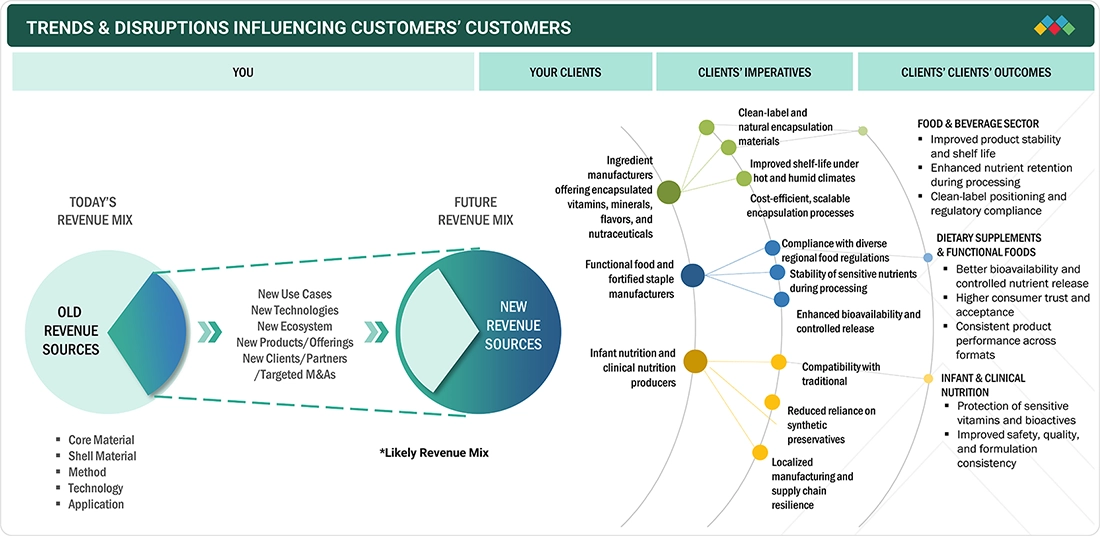
How does encapsulation support clean-label and functional food trends?.