



Food Encapsulation Market
Report Code
FB 2207
Published in
Mar, 2026, By MarketsandMarkets™
Food Encapsulation Market By Technology (Microencapsulation, Nanoencapsulation, Hybrid Technology), Method (Physical, Chemical, Physicochemical), Shell Material (Polysaccharides, Proteins, Lipids, Emulsifiers), Core Material, Application, and Region – Global Forecast to 2030

USD 21.79 BN
MARKET SIZE, 2030

CAGR 8.5%
(2025-2030)

300
REPORT PAGES

230
MARKET TABLES
OVERVIEW
Source: Secondary Research, Interviews with Experts, MarketsandMarkets Analysis
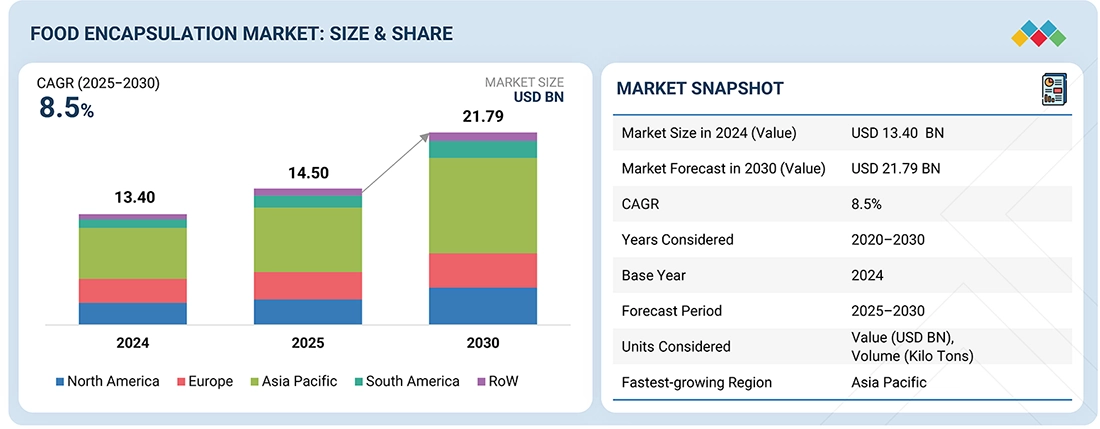
The global food encapsulation market was valued at USD 14.50 billion in 2025 and is projected to reach USD 21.79 billion by 2030, growing at a CAGR of 8.5% from 2025 to 2030. Food encapsulation is a rapidly growing market, with the food and nutrition industry increasingly adopting this technology to ensure stability of ingredients, enhance shelf-life, and enhance functional performances. Encapsulation makes it possible to save active ingredients that are sensitive to heat, moisture, oxygen, and other process stress, ensuring delivery as well as consistency throughout the lifecycle of a product. This gives significant support for functional foods, fortified foods, dietary supplements, infant nutrition, and pet food, where monotony and nutritional efficacy are of utmost centrality. Additionally, the market thrives due to the increased consumer demand for clean-label, health-oriented, and preventive food products. Mostly, flavor matching, controlled release, and highly consistent distribution make encapsulation desirable for manufacturers to fulfill regulatory requirements with the undiminished feasibility of their products. Technologies such as spray-drying, fluid-bed coating, coacervation, and lipid-based encapsulation are constantly improving by providing scalability and cost-effectiveness.
Market Size and Forecast:
- Market Size Value in 2024: USD 13.40 Billion
- Market Size Value in 2025: USD 14.50 Billion
- Revenue Forecast in 2030: USD 21.79 Billion
- Growth Rate: CAGR of 8.5% from 2025 to 2030
- Data available from 2020 to 2030
- Base year: 2024
- Forecast period: 2025–2030
- North America accounted for 32.4% market share in 2024.
- The nutraceuticals segment is expected to register the highest CAGR of 8.9% during the forecast period.
Key Market Trends and Insights
- By Technology: Rising adoption of spray drying, coacervation, liposomal encapsulation, and extrusion technologies is driving market growth.
-
Key Advantages: Food encapsulation improves ingredient stability, extends shelf life, masks unwanted flavors, and enables controlled release of bioactive compounds.
- Growing Trends: Increasing use of microencapsulation and nanoencapsulation in functional foods, fortified beverages, probiotics, and nutraceutical products is boosting demand.
- Growth Opportunities: Growing demand for functional foods, advancements in encapsulation technologies, and expanding nutraceutical applications are creating significant market opportunities.
KEY TAKEAWAYS
-
By RegionNorth America accounted for 32.4% market share in 2024.
-
By Core MaterialThe nutraceuticals segment is expected to register the highest CAGR of 8.9% during the forecast period.
-
By ApplicationThe sports & clinical nutrition segment will grow the fastest during the forecast period.
-
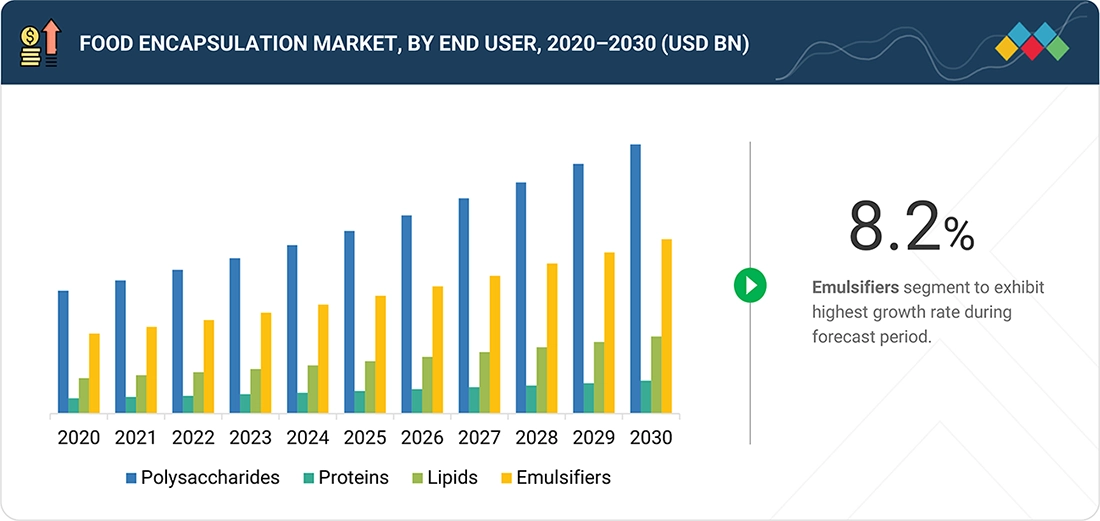
By Shell MaterialShell polysaccharides accounted for 48.5% market share in 2024.
-
Competitive Landscape – Key PlayersKey players include DSM-Firmenich, Kerry Group, ADM, Givaudan, and Ingredion, supported by strong formulation capabilities and global manufacturing presence.
-
Competitive Landscape – StartupsEmerging players such as Balchem, TasteTech, Lycored, and Microcaps are gaining traction through targeted, clean-label, and application-specific encapsulation solutions.
The global food encapsulation market was valued at USD 14.50 billion in 2025 and is projected to reach USD 21.79 billion by 2030, growing at a CAGR of 8.5% from 2025 to 2030. Demand for encapsulated food is increasing globally, as food manufacturers are adopting encapsulation technologies to ensure the stability, shelf life, and functionality of ingredients being used in food processing. Food encapsulation also helps in protecting heat-transparent, most often sensitive, components such as vitamins, minerals, flavors, omega-3 fatty acids, probiotics, enzymes, and bioactive compounds from heat, moisture, oxygen, and processing stress. This, in turn, leads to the controlled release systems, taste masking, and the standardized nutritional delivery in a vast assortment of processed and packaged food products.
TRENDS & DISRUPTIONS IMPACTING CUSTOMERS' CUSTOMERS
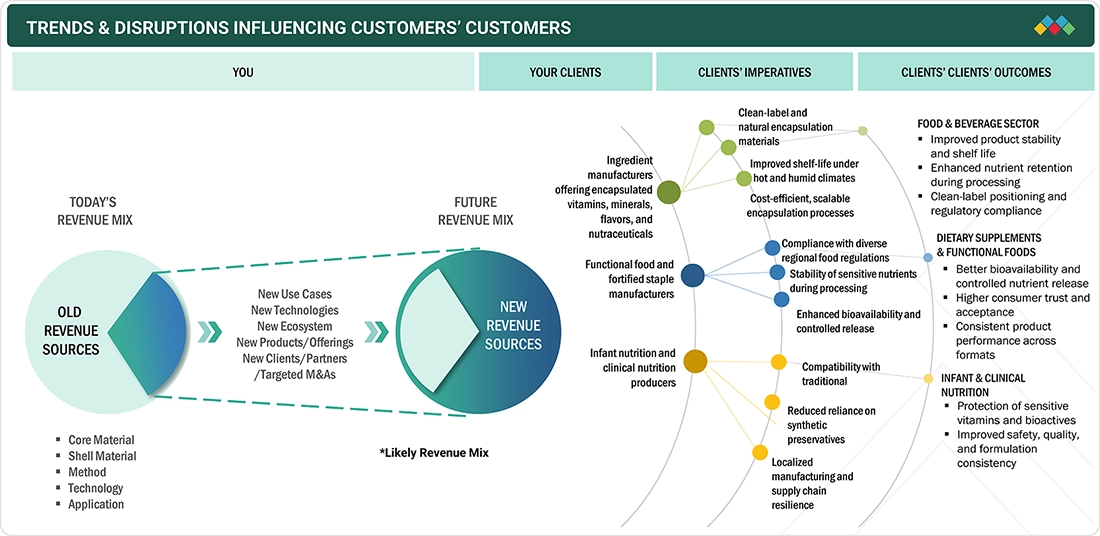
The food encapsulation market is increasingly shaped by downstream demand for stable, clean-label, and performance-driven food products, leading to a clear shift in revenue mix toward advanced encapsulated ingredients. Ingredient manufacturers are expanding offerings of encapsulated vitamins, minerals, flavors, and nutraceuticals to support functional foods, dietary supplements, and infant and clinical nutrition products. Clients’ imperatives focus on improving shelf life under heat and humidity, ensuring stability during processing, achieving cost-efficient scalability, and meeting evolving food safety and regulatory standards. Encapsulation technologies enable controlled release, enhanced bioavailability, and reduced reliance on synthetic preservatives, directly influencing customers’ customers across food and nutrition categories. For food and beverage manufacturers, this translates into improved product consistency, longer shelf life, and stronger clean-label positioning. In dietary supplements and functional foods, encapsulation supports consumer trust through consistent nutrient delivery, while in infant and clinical nutrition it ensures protection of sensitive actives and formulation reliability.
Source: Secondary Research, Interviews with Experts, MarketsandMarkets Analysis
MARKET DYNAMICS

Drivers
Impact
Level
Level
-
Rising demand for functional and fortified food products

-
Expanding processed food consumption across emerging Asian economies


RESTRAINTS
Impact
Level
Level
-
High cost of advanced encapsulation technologies and materials

-
Limited technical expertise among small and mid-scale food manufacturers


OPPORTUNITIES
Impact
Level
Level
-
Growing adoption of encapsulated probiotics in dairy and beverages

-
Increasing government focus on food fortification programs


CHALLENGES
Impact
Level
Level
-
Regulatory complexity across diverse Asia Pacific food markets

-
Ensuring stability of encapsulated ingredients under tropical climates

Source: Secondary Research, Interviews with Experts, MarketsandMarkets Analysis
Driver: Rising demand for functional and fortified food products
The food encapsulation market is primarily driven by the growing demand for functional and fortified food products that deliver targeted health benefits. Increasing consumer focus on immunity, digestive health, micronutrient adequacy, and preventive nutrition has accelerated the incorporation of vitamins, minerals, probiotics, and bioactive compounds into everyday food products. Encapsulation enables food manufacturers to protect these sensitive ingredients from heat, moisture, and oxidation during processing and storage, while ensuring consistent nutrient delivery. As clean-label and health-oriented food consumption expands across developed and emerging markets, encapsulation has become a key enabling technology supporting product differentiation, quality consistency, and regulatory compliance.
Restraint: High cost of advanced encapsulation technologies and materials
The adoption of food encapsulation technologies is constrained by the relatively high cost of advanced encapsulation processes and specialized coating materials. Techniques such as fluid-bed coating, lipid-based encapsulation, and multilayer systems require capital-intensive equipment, skilled technical expertise, and higher-quality raw materials. These cost factors can limit adoption, particularly among small and mid-sized food manufacturers operating in price-sensitive markets. In addition, formulation development, stability testing, and scale-up validation further increase overall production costs. As a result, cost considerations remain a key restraint affecting wider penetration of encapsulated ingredients across mass-market food applications.
Opportunity: Growing adoption of encapsulated probiotics in dairy and foods
Encapsulated probiotics present a significant growth opportunity within the food encapsulation market, particularly in dairy and fermented food applications. Encapsulation improves probiotic stability during processing, storage, and distribution, enabling consistent viable counts at the point of consumption. This has expanded probiotic usage beyond traditional refrigerated products into shelf-stable dairy, powdered foods, and fortified nutrition formats. Rising consumer awareness of gut health and immunity is further supporting demand for probiotic-enriched foods. As food manufacturers seek scalable solutions to maintain probiotic efficacy while extending shelf life, encapsulation technologies are expected to see increased adoption.
Challenge: Regulatory and compliance complexity
Regulatory complexity remains a significant challenge for the global food encapsulation market due to varying food safety standards, approval pathways, and labeling requirements across regions. Encapsulated ingredients must comply with regulations governing food additives, novel ingredients, carrier materials, and health claims. Regulatory authorities require detailed safety, stability, and bioavailability data to validate encapsulated formulations, particularly for probiotics, bioactives, and nanostructured systems. Differences in regulatory interpretation between regions such as North America, Europe, and Asia further increase compliance complexity for multinational manufacturers. Navigating these regulatory frameworks adds time and cost to product development and commercialization, influencing innovation timelines and market entry strategies.
FOOD ENCAPSULATION MARKET: COMMERCIAL USE CASES ACROSS INDUSTRIES
| COMPANY | USE CASE DESCRIPTION | BENEFITS |
|---|---|---|
 |
Use of encapsulation technologies to protect sensitive bioactive components in fermented food products, ensuring stability of functional ingredients during processing, storage, and distribution under varied temperature conditions. | Improved ingredient stability, consistent functional performance, extended shelf life, and reliable quality in mass-consumption functional foods. |
 |
Encapsulation of vitamins, minerals, and functional lipids in dairy and plant-based food products to enable fortification without affecting taste, texture, or product appearance. | Enhanced nutrient protection, uniform dispersion in food matrices, clean-label fortification, and improved consumer acceptance. |
 |
Application of encapsulated micronutrients, flavors, and bioactive ingredients in fortified foods, infant nutrition, and ready-to-consume products to maintain nutritional value throughout product shelf life. | Better nutrient retention, controlled release, sensory consistency, and compliance with stringent food safety and nutrition standards. |
 |
Integration of encapsulated nutrients in dairy-based functional foods to preserve efficacy during heat processing and long-term storage, particularly for products targeting digestive and immune health. | Improved product stability, enhanced bioavailability, longer shelf life, and reduced degradation of sensitive ingredients. |
Logos and trademarks shown above are the property of their respective owners. Their use here is for informational and illustrative purposes only.
MARKET ECOSYSTEM
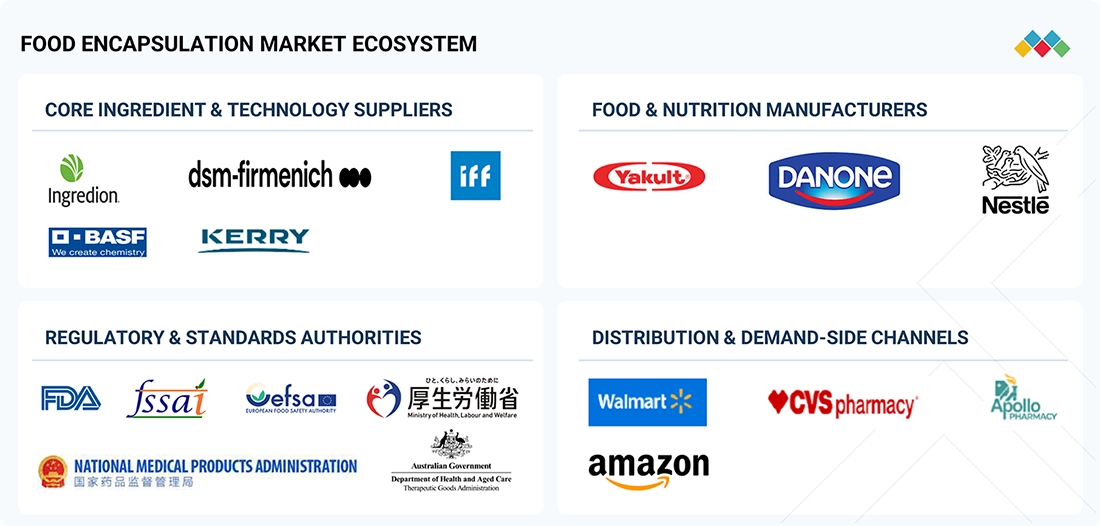
The food encapsulation market ecosystem comprises a well-integrated network of ingredient and technology suppliers, food and nutrition manufacturers, regulatory authorities, and distribution channels that collectively support large-scale adoption across global food systems. Core ingredient and technology suppliers provide encapsulation materials, processing know-how, and delivery systems that enable the stabilization and controlled release of sensitive nutrients. Food and nutrition manufacturers leverage these solutions to develop fortified foods, functional products, and specialized nutrition offerings with improved shelf life, safety, and consistency. Regulatory and standards authorities play a central role in defining compliance requirements for encapsulated ingredients, ensuring food safety, labeling accuracy, and quality assurance across regions. On the demand side, modern retail, pharmacy chains, and e-commerce platforms facilitate widespread market access and consumer reach. The interaction among these stakeholders enables continuous innovation, efficient scale-up, and regulatory alignment, positioning food encapsulation as a foundational technology supporting functional food development, clean-label positioning, and long-term growth in the global food and nutrition industry.
Logos and trademarks shown above are the property of their respective owners. Their use here is for informational and illustrative purposes only.
MARKET SEGMENTS
Source: Secondary Research, Interviews with Experts, MarketsandMarkets Analysis
Food Encapsulation Market, By Core Material
In the food encapsulation market, core materials include vitamins, minerals, probiotics, enzymes, nutraceuticals, flavors, and organic acids that require protection during processing and storage. Vitamins and minerals account for the largest share due to their extensive use in food fortification and their high sensitivity to heat, oxygen, moisture, and light. Encapsulation ensures stability, uniform dispersion, and improved bioavailability, enabling consistent nutritional delivery in functional foods, dietary supplements, infant nutrition, and clinical products. At the same time, probiotics and nutraceutical bioactives are emerging as faster-growing core materials, driven by rising interest in gut health, immunity, and preventive nutrition.
Food Encapsulation Market, By Shell Material
Shell materials play a critical role in determining the performance of encapsulated food ingredients. Polysaccharides such as starches, maltodextrin, alginates, and gums are widely used due to their food-grade status, cost efficiency, and compatibility with clean-label requirements. Lipids and proteins are also used where controlled release, moisture protection, or fat-soluble ingredient delivery is required. The selection of shell material directly influences encapsulation efficiency, release behavior, shelf stability, and sensory impact, making it a key formulation decision for food manufacturers targeting different applications and processing conditions.
Food Encapsulation Market, By Method
Encapsulation methods in the food market include physical, chemical, and physicochemical approaches, with physical methods accounting for the largest share. Techniques such as spray drying, fluid-bed coating, and extrusion are preferred due to their scalability, cost-effectiveness, and compatibility with existing food processing infrastructure. These methods enable high-volume production while maintaining ingredient stability and consistent quality. Physical encapsulation methods are particularly suitable for vitamins, minerals, flavors, and probiotics, supporting their widespread adoption across fortified foods, bakery, dairy, and nutrition products.
Food Encapsulation Market, By Technology
By technology, microencapsulation dominates the food encapsulation market owing to its proven industrial applicability and regulatory acceptance. Spray drying and fluid-bed coating are extensively used to encapsulate sensitive food ingredients at a commercial scale. These technologies offer reliable protection, controlled release, and ease of handling while balancing performance and production costs. Although advanced technologies such as nanoencapsulation are gaining attention for enhanced bioavailability, microencapsulation remains the preferred choice for most food applications due to its maturity, scalability, and alignment with food safety and labeling regulations.
Food Encapsulation Market, By Application
Food encapsulation finds extensive application across functional foods, dietary supplements, infant nutrition, bakery, dairy, confectionery, and clinical nutrition, where stability and performance of active ingredients are critical. In functional and fortified foods, encapsulation enables the effective incorporation of vitamins, minerals, probiotics, omega-3 fatty acids, and bioactive compounds without compromising taste, texture, or appearance. In dietary supplements, it supports precise dosage control, improved bioavailability, and extended shelf life, especially for sensitive ingredients prone to degradation. Infant nutrition and clinical nutrition applications rely heavily on encapsulation to ensure safety, consistent nutrient delivery, and protection of heat- and moisture-sensitive micronutrients during processing and storage. In bakery and dairy products, encapsulation helps ingredients withstand high temperatures and harsh processing conditions while ensuring controlled release during consumption. Overall, application-driven demand is a key factor shaping the food encapsulation market, as manufacturers increasingly use encapsulation to meet clean-label expectations, regulatory requirements, and rising consumer demand for health-focused, stable, and high-quality food products.
REGION
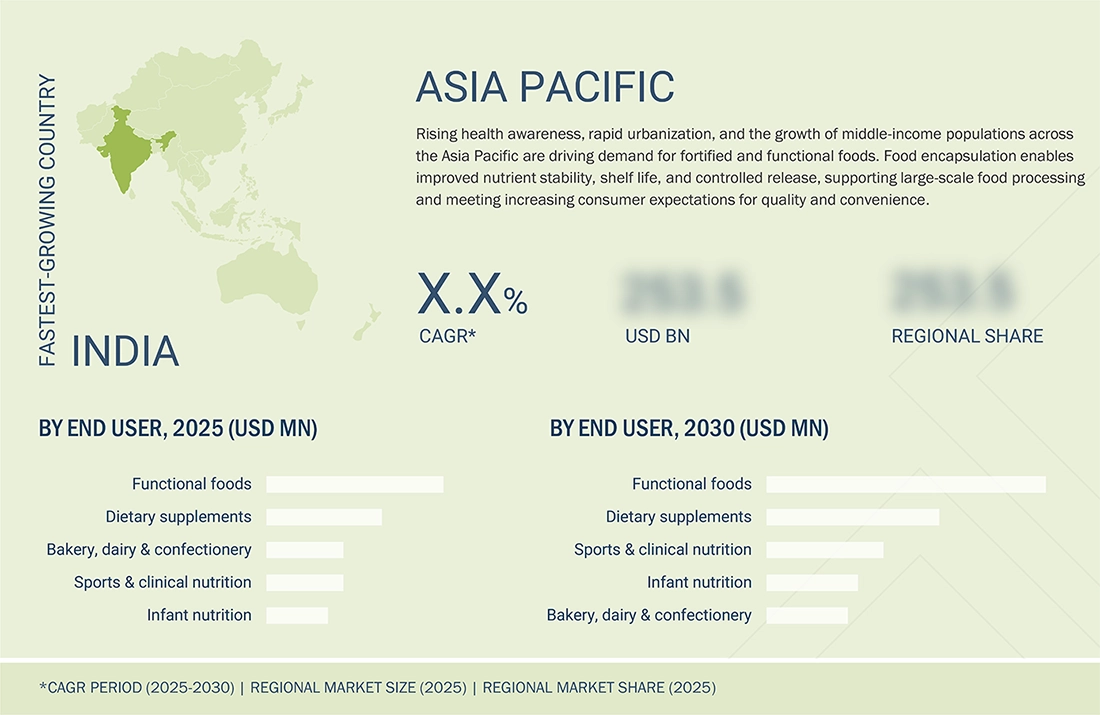
Asia Pacific is the fastest-growing food encapsulation market
The Asia Pacific region is considered the fastest-growing area in the food encapsulation market, mainly because of the dynamic changes in eating habits, better health awareness, and the growth of the functional food and nutraceutical industries. Urbanization plus disposable income are increasing in countries like China, India, Japan, and South Korea, which are leading to higher consumption of fortified foods, dietary supplements, and infant nutrition products, where microencapsulation is applied to enhance the stability and bioavailability of sensitive ingredients. There is also a strong demand for powdered and capsule formats of probiotics, vitamins & minerals, and organic acids in the region because of their convenience and longer shelf life. Local producers are gradually incorporating spray drying and polysaccharide-based shell materials to satisfy the cost and scalability needs. Furthermore, the technology adoption is being sped up by regulatory transparency in important markets and the investment of global food and ingredient companies into the construction of regional production plants. Thus, all these factors combined make Asia Pacific the most vibrant growth market during the projected period.
FOOD ENCAPSULATION MARKET: COMPANY EVALUATION MATRIX
The company evaluation matrix for the food encapsulation market classifies the companies according to the two factors that are most important: the product footprint and the share of the market or presence. The companies that are in the stars category usually have a large range of microencapsulation technologies, excellent skills in the core materials and shell materials, and they are very much involved in the markets of functional foods, dietary supplements, and infant nutrition. Furthermore, these players are capable of reaping the rewards of effective customer relationships and worldwide manufacturing capacity. Emerging leaders possess cutting-edge technology and are concentrating on their innovations, but they have a limited geographical reach or scope of applications compared to the stars. Pervasive players have a huge presence and sales network in the market, but their products might be based on old technology, and only slight changes are made to them. The participants in the market, who are mostly the smaller or niche-focused companies, cater to specific applications, materials, or regions and sometimes compete on price or customization. In general, the matrix shows the technological depth, application diversity, regulatory compliance capabilities, and production scaling as the main sources of competitive differentiation. It also provides a clear framework to compare strategic positioning within the evolving food encapsulation landscape.
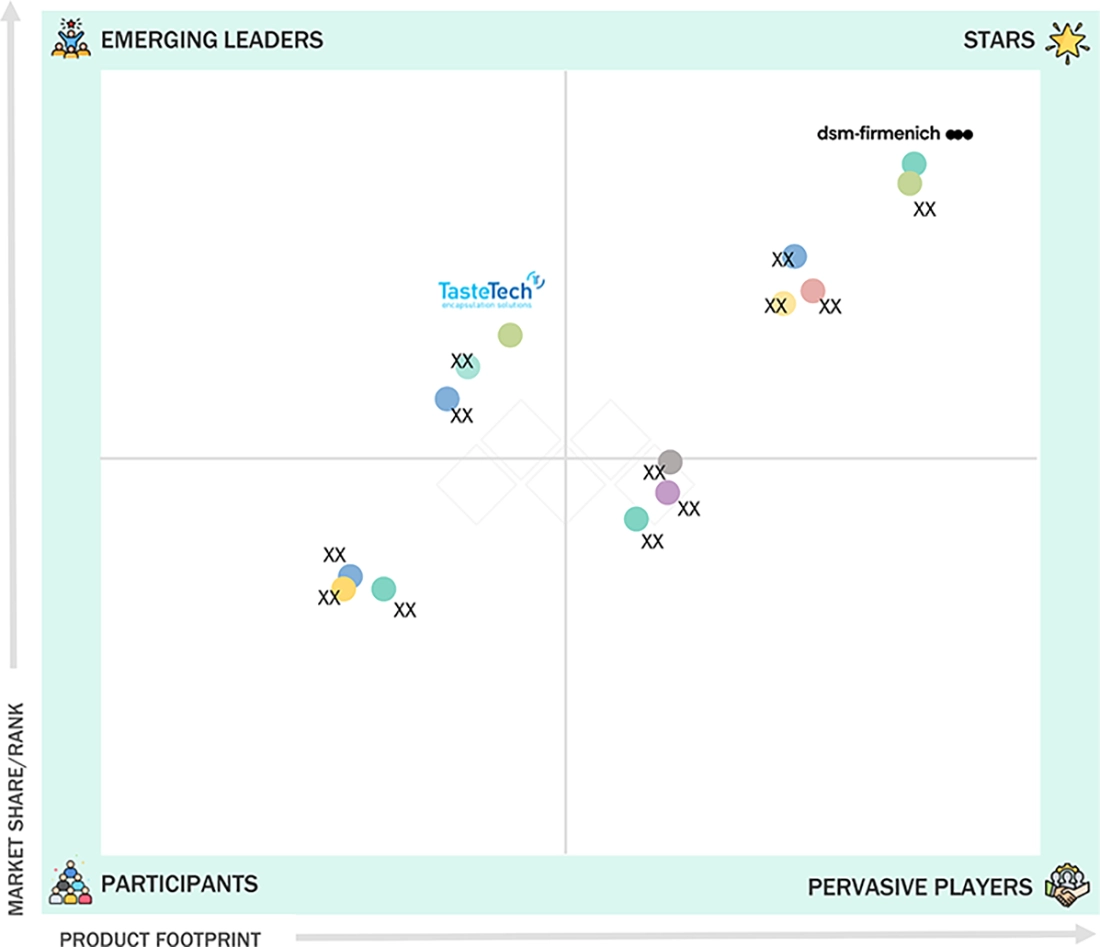
Source: Secondary Research, Interviews with Experts, MarketsandMarkets Analysis
KEY MARKET PLAYERS
- DSM-Firmenich (Switzerland)
- Givaudan (Switzerland)
- International Flavors & Fragrances (IFF) (US)
- Kerry Group (Ireland)
- ADM (US)
- BASF SE (Germany)
- Cargill, Incorporated (US)
- Ingredion Incorporated (US)
- Tate & Lyle PLC (UK)
- Sensient Technologies Corporation (US)
- Balchem Corporation (US)
- Lonza Group (Switzerland)
- Aveka Group (US)
- TasteTech (US)
- Microcaps (US/Global)
MARKET SCOPE
| REPORT METRIC | DETAILS |
|---|---|
| Market Size in 2024 (Value) | USD 13.40 BN |
| Market Forecast in 2030 (Value) | USD 21.79 BN |
| Growth Rate | CAGR of 8.5% during 2025–2030 |
| Years Considered | 2020–2030 |
| Base Year | 2024 |
| Forecast Period | 2025–2030 |
| Units Considered | Value (USD Billion), Volume (Kilo Tons) |
| Report Coverage | Revenue forecast, company ranking, competitive landscape, growth factors, and trends |
| Segments Covered |
|
| Regions Covered | North America, Europe, Asia Pacific, South America, RoW |
WHAT IS IN IT FOR YOU: FOOD ENCAPSULATION MARKET REPORT CONTENT GUIDE
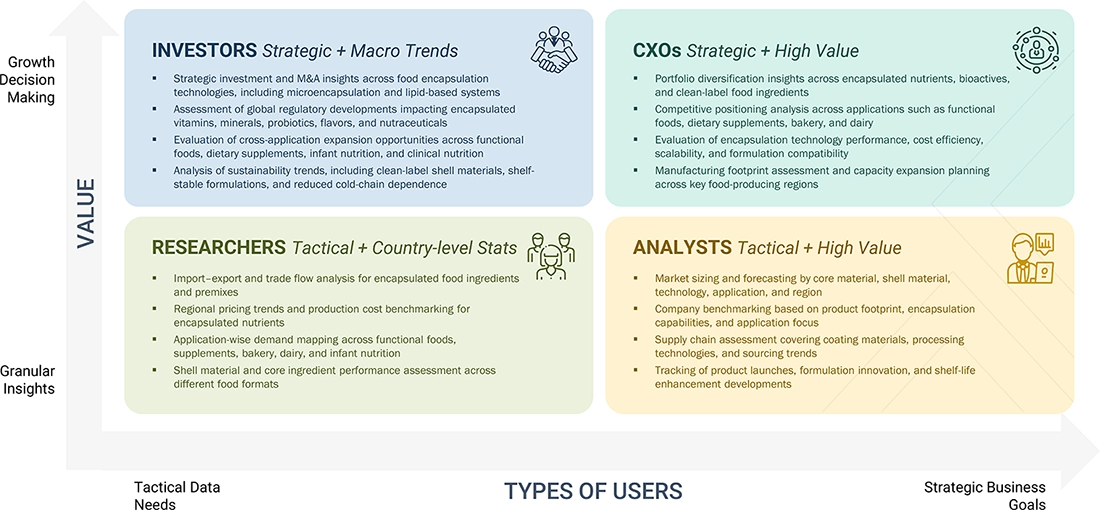
DELIVERED CUSTOMIZATIONS
We have successfully delivered the following deep-dive customizations:
| CLIENT REQUEST | CUSTOMIZATION DELIVERED | VALUE ADDS |
|---|---|---|
| Food Encapsulation Ingredients Market |
|
|
| Functional Foods & Fortified Foods Market |
|
|
| Bakery, Dairy & Processed Foods Market |
|
|
RECENT DEVELOPMENTS
- January 2025 : DSM-Firmenich expanded the Asia R&D hub launch, a dedicated research center to accelerate formulation and encapsulation technology development tailored for APAC functional food markets.
- October 2025 : Yakult Singapore launched Y1000, a concentrated probiotic drink, as an APAC consumer product, leveraging encapsulation for enhanced viability and digestive health positioning.
- August 2025 : Ajinomoto Co., Inc., introduced an encapsulation ingredient line with nanoemulsified carotenoid complexes designed for improved absorption in fortification applications.
- July 2025 : Kerry Group & FMC Corporation formed a strategic partnership for marine omega-3 encapsulation. Joint development of sustainable, heat-stable nanoencapsulated omega-3 oils for food fortification in Asia.
- May 2025 : Cargill, Inc. (Food Ingredients Division) Greenfield facility expansion (APAC). Increased production lines for encapsulated food ingredients to address rising functional food demand.
- April 2025 : Amul (Gujarat Cooperative, India) Brand-level encapsulated nutritional product launch. Functional nutrition product using encapsulated vitamins/minerals optimized for Asian diets.
- March 2025 : IFF (DuPont Nutrition & Biosciences) – India Partnership Regional technology co-creation program, collaborative research with universities on improved encapsulation carriers for plant-based protein applications.
- December 2024 : Lonza Group (APAC Functional Ingredients) Nanoencapsulated botanical ingredient launch. Specialty plant extracts delivered via nanocarrier systems for digestive wellness products.
Table of Contents
 Exclusive indicates content/data unique to MarketsandMarkets and not available with any competitors.
TITLE
PAGE NO
1
INTRODUCTION
15
2
EXECUTIVE SUMMARY
3
PREMIUM INSIGHTS
4
MARKET OVERVIEW
Outlines emerging trends, technology impact, and regulatory signals affecting growth trajectory and stakeholder decisions.
4.1
INTRODUCTION
4.2
MARKET DYNAMICS
4.3
INTERCONNECTED MARKETS AND CROSS-SECTOR OPPORTUNITIES
4.4
STRATEGIC MOVES BY TIER-1/2/3 PLAYERS
5
INDUSTRY TRENDS
This section summarizes market dynamics, key shifts, and high-impact trends shaping demand outlook.
5.1
PORTER'S FIVE FORCES ANALYSIS
5.2
MACROECONOMIC INDICATORS
5.2.1
INTRODUCTION
5.2.2
GDP TRENDS AND FORECAST
5.2.3
TRENDS IN FOOD ENCAPSULATION INDUSTRY
5.3
VALUE CHAIN ANALYSIS
5.4
ECOSYSTEM ANALYSIS
5.5
PRICING ANALYSIS
5.5.1
AVERAGE SELLING PRICE TREND OF KEY PLAYERS (2022-2025)
5.5.2
AVERAGE SELLING PRICE TREND, BY FOOD APPLICATION (2022-2025)
5.6
TRADE ANALYSIS
5.6.1
IMPORT SCENARIO
5.6.2
EXPORT SCENARIO
5.7
KEY CONFERENCES AND EVENTS (2026-2027)
5.8
TRENDS/DISRUPTIONS IMPACTING CUSTOMER BUSINESS
5.9
INVESTMENT AND FUNDING SCENARIO
5.10
CASE STUDY ANALYSIS
5.11
IMPACT OF 2025 US TARIFF – FOOD ENCAPSULATION MARKET
5.11.1
INTRODUCTION
5.11.2
KEY TARIFF RATES
5.11.3
PRICE IMPACT ANALYSIS
5.11.4
IMPACT ON END-USE INDUSTRIES
6
STRATEGIC DISRUPTION THROUGH TECHNOLOGY, PATENTS, DIGITAL, AND AI ADOPTION
6.1
KEY EMERGING TECHNOLOGIES
6.2
COMPLEMENTARY TECHNOLOGIES
6.3
TECHNOLOGY/PRODUCT ROADMAP
6.4
PATENT ANALYSIS
6.5
IMPACT OF AI/GEN AI ON FOOD ENCAPSULATION MARKET
6.5.1
TOP USE CASES AND MARKET POTENTIAL
6.5.2
CASE STUDIES OF AI IMPLEMENTATION IN FOOD ENCAPSULATION MARKET
6.5.3
INTERCONNECTED ADJACENT ECOSYSTEM AND IMPACT ON MARKET PLAYERS
6.5.4
CLIENTS’ READINESS TO ADOPT GENERATIVE AI IN FOOD ENCAPSULATION MARKET
7
REGULATORY LANDSCAPE
7.1
REGIONAL REGULATIONS AND COMPLIANCE
7.1.1
REGULATORY BODIES, GOVERNMENT AGENCIES, AND OTHER ORGANIZATIONS
7.1.2
INDUSTRY STANDARDS
8
CUSTOMER LANDSCAPE & BUYER BEHAVIOR
8.1
DECISION-MAKING PROCESS
8.2
BUYER STAKEHOLDERS AND BUYING EVALUATION CRITERIA
8.3
ADOPTION BARRIERS & INTERNAL CHALLENGES
8.4
UNMET NEEDS FROM VARIOUS END-USE INDUSTRIES
9
FOOD ENCAPSULATION MARKET, BY CORE MATERIAL (MARKET SIZE & FORECAST TO 2030 – USD BILLION)
9.1
INTRODUCTION
9.2
VITAMINS & MINERALS
9.3
ENZYMES
9.4
ORGANIC ACIDS
9.5
PROBIOTICS
9.6
SWEETENERS
9.7
NUTRITIONAL LIPIDS
9.8
PREBIOTICS
9.9
COLORS
9.10
AMINO ACIDS
9.11
PROTEINS
9.12
COLORS
9.13
FLAVORS
9.14
OTHER CORE MATERIALS
10
FOOD ENCAPSULATION MARKET, BY APPLICATION (MARKET SIZE & FORECAST TO 2030 – USD BILLION)
10.1
INTRODUCTION
10.2
DIETARY SUPPLEMENTS
10.3
FUNCTIONAL FOOD PRODUCTS
10.4
BAKERY PRODUCTS
10.5
CONFECTIONERY
10.6
BEVERAGES
10.7
FROZEN PRODUCTS
10.8
DAIRY PRODUCTS
10.9
OTHER APPLICATIONS
11
FOOD ENCAPSULATION MARKET, BY METHOD (MARKET SIZE & FORECAST TO 2030 – USD BILLION)
11.1
INTRODUCTION
11.2
PHYSICAL
11.3
CHEMICAL
11.4
PHYSICOCHEMICAL
12
FOOD ENCAPSULATION MARKET, BY TECHNOLOGY (MARKET SIZE & FORECAST TO 2030 – USD BILLION)
12.1
INTRODUCTION
12.2
MICROENCAPSULATION
12.3
NANOENCAPSULATION
12.4
HYBRID TECHNOLOGY
13
FOOD ENCAPSULATION MARKET, BY SHELL MATERIAL (MARKET SIZE & FORECAST TO 2030 – USD BILLION)
13.1
INTRODUCTION
13.2
POLYSACCHARIDES
13.3
PROTEINS
13.4
LIPIDS
13.5
EMULSIFIERS
14
FOOD ENCAPSULATION MARKET, BY REGION (MARKET SIZE & FORECAST TO 2030 – USD BILLION)
14.1
INTRODUCTION
14.2
NORTH AMERICA
14.2.1
US
14.2.2
CANADA
14.2.3
MEXICO
14.3
EUROPE
14.3.1
UK
14.3.2
GERMANY
14.3.3
FRANCE
14.3.4
SPAIN
14.3.5
REST OF EUROPE
14.4
ASIA PACIFIC
14.4.1
CHINA
14.4.2
JAPAN
14.4.3
SOUTH KOREA
14.4.4
INDIA
14.4.5
AUSTRALIA & NEW ZEALAND
14.4.6
REST OF ASIA PACIFIC
14.5
SOUTH AMERICA
14.5.1
BRAZIL
14.5.2
ARGENTINA
14.5.3
REST OF SOUTH AMERICA
14.6
ROW
14.6.1
AFRICA
14.6.2
MIDDLE EAST
15
FOOD ENCAPSULATION MARKET: COMPETITIVE LANDSCAPE
15.1
INTRODUCTION
15.2
KEY PLAYER STRATEGIES/RIGHT-TO-WIN
15.3
REVENUE ANALYSIS OF TOP 5 PLAYERS (2021 – 2025)
15.4
MARKET SHARE ANALYSIS,
15.5
COMPANY VALUATION AND FINANCIAL METRICS
15.6
BRAND COMPARISON
15.7
COMPANY EVALUATION MATRIX: KEY PLAYERS,
15.7.1
STARS
15.7.2
EMERGING LEADERS
15.7.3
PERVASIVE PLAYERS
15.7.4
PARTICIPANTS
15.7.5
COMPANY FOOTPRINT: KEY PLAYERS,
15.7.5.1
COMPANY FOOTPRINT
15.7.5.2
REGION FOOTPRINT
15.7.5.3
FOOD APPLICATION FOOTPRINT
15.7.5.4
CORE MATERIAL FOOTPRINT
15.7.5.5
SHELL MATERIAL FOOTPRINT
15.8
COMPANY EVALUATION MATRIX: STARTUPS/SMES,
15.8.1
PROGRESSIVE COMPANIES
15.8.2
RESPONSIVE COMPANIES
15.8.3
DYNAMIC COMPANIES
15.8.4
STARTING BLOCKS
15.8.5
COMPETITIVE BENCHMARKING: STARTUPS/SMES,
15.8.5.1
DETAILED LIST OF KEY STARTUPS/SMES
15.8.5.2
COMPETITIVE BENCHMARKING OF KEY STARTUPS/SMES
15.9
COMPETITIVE SITUATION AND TRENDS
16
FOOD ENCAPSULATION MARKET: COMPANY PROFILES
16.1
KEY PLAYERS
16.1.1
DSM-FIRMENICH
16.1.2
INTERNATIONAL FLAVORS & FRAGRANCES INC. (IFF)
16.1.3
KERRY GROUP PLC
16.1.4
GIVAUDAN SA
16.1.5
CARGILL, INCORPORATED
16.1.6
BASF SE
16.1.7
INGREDION INCORPORATED
16.1.8
TATE & LYLE PLC
16.1.9
SYMRISE AG
16.1.10
SENSIENT TECHNOLOGIES CORPORATION
16.1.11
ROQUETTE FRÈRES
16.1.12
ARCHER DANIELS MIDLAND COMPANY (ADM)
16.1.13
ASHLAND GLOBAL HOLDINGS INC.
16.1.14
BALCHEM CORPORATION
16.1.15
GLANBIA PLC
16.2
OTHER PLAYERS
15
RESEARCH METHODOLOGY
15.1
RESEARCH DATA
15.1.1
SECONDARY DATA
15.1.1.1
KEY DATA FROM SECONDARY SOURCES
15.1.2
PRIMARY DATA
15.1.2.1
KEY DATA FROM PRIMARY SOURCES
15.1.2.2
KEY PRIMARY PARTICIPANTS
15.1.2.3
BREAKDOWN OF PRIMARY INTERVIEWS
15.1.2.4
KEY INDUSTRY INSIGHTS
15.1.3
MARKET SIZE ESTIMATION
15.1.3.1
BOTTOM-UP APPROACH
15.1.3.2
TOP-DOWN APPROACH
15.1.3.3
BASE NUMBER CALCULATION
15.1.4
MARKET FORECAST APPROACH
15.1.4.1
SUPPLY SIDE
15.1.4.2
DEMAND SIDE
15.1.5
DATA TRIANGULATION
15.1.6
FACTOR ANALYSIS
15.1.7
RESEARCH ASSUMPTIONS
15.1.8
RESEARCH LIMITATIONS AND RISK ASSESSMENT
16
APPENDIX
16.1
DISCUSSION GUIDE
16.2
KNOWLEDGESTORE: MARKETSANDMARKETS’ SUBSCRIPTION PORTAL
16.3
CUSTOMIZATION OPTIONS
16.4
RELATED REPORTS
16.5
AUTHOR DETAILS
Methodology
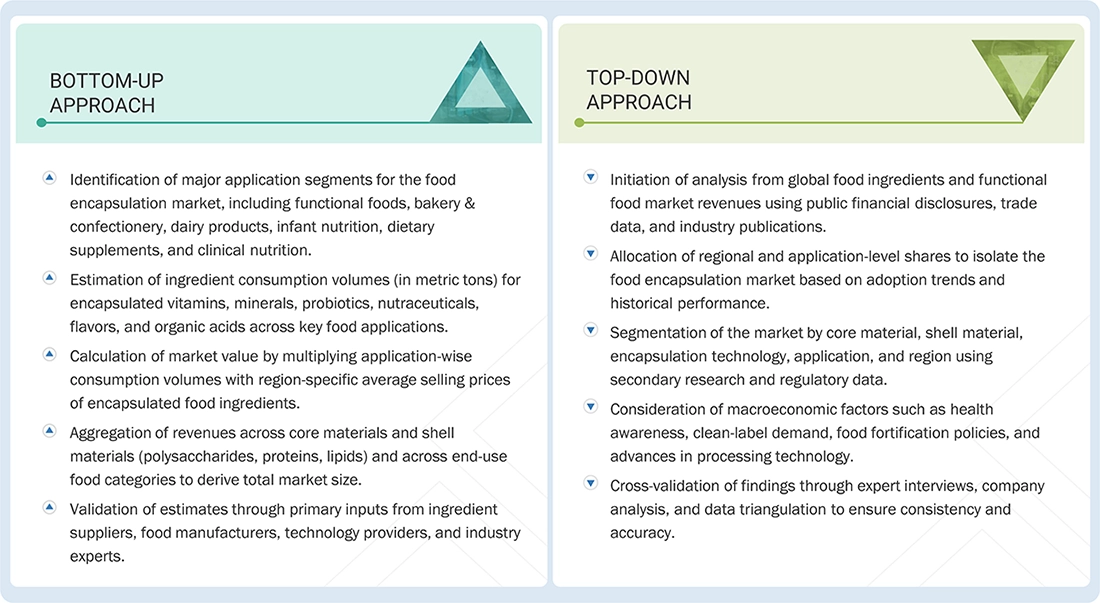
The study employed two primary approaches to estimate the current size of the food encapsulation market. Exhaustive secondary research was conducted to gather information on the market, peer markets, and parent markets. The next step was to validate these findings, assumptions, and sizing with industry experts across the value chain through primary research. Both top-down and bottom-up approaches were employed to estimate the complete market size. After that, market breakdown and data triangulation were used to estimate the market size of segments and subsegments.
Secondary Research
This research study involved the extensive use of secondary sources—directories and databases such as Bloomberg Businessweek and Factiva—to identify and collect information useful for a technical, market-oriented, and commercial study of the market.
In the secondary research process, various sources such as annual reports, press releases & investor presentations of companies, white papers, food journals, certified publications, articles from recognized authors, directories, and databases were referred to, to identify and collect information.
Secondary research was mainly used to obtain key information about the industry’s supply chain, the total pool of key players, and market classification and segmentation as per the industry trends to the bottom-most level, regional markets, and key developments from both market- and technology-oriented perspectives.
Primary Research
Extensive primary research was conducted after obtaining information regarding the food encapsulation market scenario through secondary research. Several primary interviews were conducted with market experts from both the demand and supply sides across major countries of North America, Europe, Asia Pacific, South America, and RoW. Primary data was collected through questionnaires, emails, and telephonic interviews. The primary sources from the supply side included various industry experts, such as Chief X Officers (CXOs), Vice Presidents (VPs), directors from business development, marketing, research, and development teams, and key opinion leaders. Primary interviews were conducted to gather insights such as market statistics, data on revenue collected from the products and services, market breakdowns, market size estimations, market forecasting, and data triangulation. Primary research also helped in understanding the various trends related to food encapsulation’s core material, shell material, method, technology, and application. Stakeholders from the demand side, such as research institutions and universities, and third-party vendors, were interviewed to understand the buyer’s perspective on the service, and their current usage of encapsulation and the outlook of their business, which will affect the overall market.
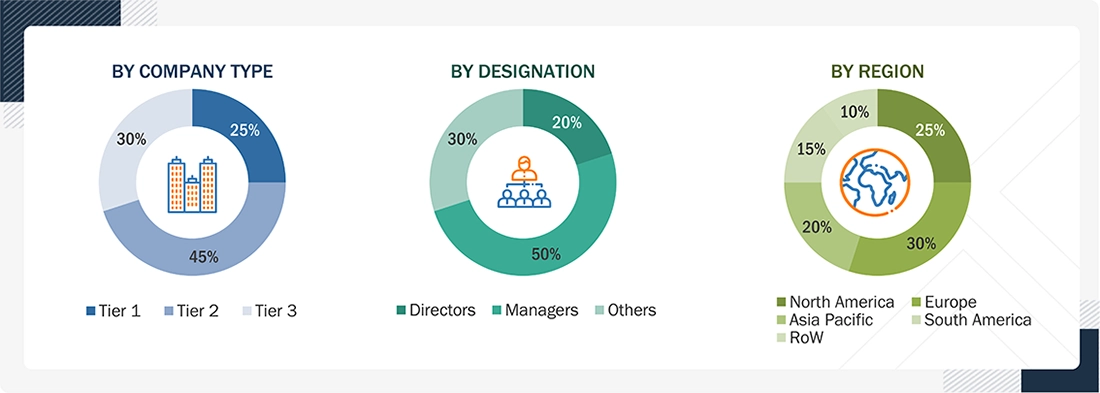
Note: The three tiers of the companies are defined based on their total revenues in 2023 or 2024, as per the availability of financial data: Tier 1: Revenue >USD 1 billion; Tier 2: USD 100 million ≤ Revenue ≤ USD 1 billion; Tier 3: Revenue USD 100 million.
To know about the assumptions considered for the study, download the pdf brochure
|
COMPANY NAME |
DESIGNATION |
|
ADM (US) |
R&D Expert |
|
BASF SE (Germany) |
Sales Manager |
|
Tate & Lyle PLC (UK) |
Manager |
|
TasteTech (US) |
Sales Manager |
|
Microcaps (US) |
Marketing Manager |
Market Size Estimation
Both the top-down and bottom-up approaches were used to estimate and validate the total size of the food encapsulation market. These approaches were also used extensively to determine the size of various subsegments in the market. The research methodology used to estimate the market size includes the following details:
- The key players in the industry and the overall markets were identified through extensive secondary research.
- All shares, splits, and breakdowns were determined using secondary sources and verified through primary sources.
- All possible parameters that affect the market covered in this research study were accounted for, viewed in extensive detail, verified through primary research, and analyzed to obtain final quantitative and qualitative data.
- The research included the study of reports, reviews, and newsletters of top market players, along with extensive interviews for opinions from leaders, such as CEOs, directors, and marketing executives.
Food Encapsulation Market : Top-Down and Bottom-Up Approach
Data Triangulation
After arriving at the overall market size from the estimation process explained above, the total market was split into several segments and subsegments. The data triangulation and market breakdown procedures were employed, wherever applicable, to estimate the overall food encapsulation market and arrive at the exact statistics for all segments and subsegments. The data was triangulated by studying various factors and trends from the demand and supply sides. The market size was also validated using both the top-down and bottom-up approaches.
Market Definition
According to the National Library of Medicine, “encapsulation involves the incorporation of food ingredients, enzymes, cells, or other materials in small capsules. Applications for this technique have increased in the food industry since the encapsulated materials can be protected from moisture, heat, or other extreme conditions, thus enhancing their stability, and maintaining viability. Encapsulation in foods is also utilized to mask odors or tastes. The encapsulating or wall materials used generally consist of starch, starch derivatives, proteins, gums, lipids, or any combination of them. This technology enables a coat of food particles or ingredients such as flavors, fats, antioxidants, nutraceutical ingredients, and colors, among others, to ensure the bioavailability of such ingredients.
Key Stakeholders
- Encapsulation raw material suppliers
- Food encapsulation manufacturers
- Food & beverage companies
- Encapsulation technology providers
- Intermediate suppliers, such as ingredient distributors, traders, and formulation service providers
- Government and research organizations
-
Associations, regulatory bodies, and other industry-related bodies:
- Food and Agriculture Organization (FAO)
- European Food Safety Authority (EFSA)
- US Food and Drug Administration (FDA
- United States Department of Agriculture (USDA)
- Food Safety and Standards Authority of India (FSSAI)
- Food Standards Australia New Zealand (FSANZ)
- Trade associations and professional bodies
- Institute of Food Technologists (IFT)
- European Federation of Food Science and Technology (EFFoST)
- International Union of Food Science and Technology (IUFoST)
- National and regional food ingredient associations
Report Objectives
- To determine, define, and project the size of the food encapsulation market, with respect to core material, shell material, method, technology, application, and regional markets, over a five-year period, ranging from 2025 to 2030
- To identify the attractive opportunities in the market by determining the largest and fastest-growing segments across regions
- To provide detailed information about the key factors influencing the growth of the market (drivers, restraints, opportunities, and challenges)
- To analyze the micromarkets with respect to individual growth trends, prospects, and their contribution to the total market
- To strategically profile key market players and comprehensively analyze their core competencies in each segment
- To track and analyze competitive developments, such as alliances, joint ventures, product developments, mergers, and acquisitions, in the food encapsulation market
Customization Options:
With the given market data, MarketsandMarkets offers customizations according to company-specific scientific needs.
The following customization options are available for the report:
Product Analysis
- Products Matrix, which gives a detailed comparison of the service portfolio of each company.
Geographic Analysis
With the given market data, MarketsandMarkets offers customizations according to company-specific scientific needs.
- Further breakdown of the Rest of Europe food encapsulation market into key countries.
- Further breakdown of the Rest of Asia Pacific food encapsulation market into key countries.
- Further breakdown of the Rest of South America food encapsulation market into key countries.
Company Information
- Detailed analyses and profiling of additional market players (up to five)
Key Questions Addressed by the Report
What is the current size of the food encapsulation market?
The food encapsulation market is valued at USD 14.50 billion in 2025 and is projected to reach USD 21.79 billion by 2030, reflecting strong demand for advanced ingredient protection technologies across food, beverage, and nutraceutical applications.
What is the expected CAGR of the food encapsulation market?
The food encapsulation market is expected to grow at a CAGR of 8.5% from 2025 to 2030. Growth is driven by increasing demand for functional foods, clean-label products, enhanced shelf life, and controlled-release ingredients.
What factors are driving food encapsulation market growth?
The food encapsulation market growth is supported by rising consumer preference for fortified foods, expanding nutraceutical consumption, increasing use of probiotics and bioactive ingredients, technological advancements in encapsulation methods, and growing investments in food innovation.
What are the latest trends in the food encapsulation market?
Major food encapsulation market trends include the adoption of nanoencapsulation technologies, increased use of natural encapsulating materials, demand for clean-label formulations, personalized nutrition, and wider application of microencapsulation in functional beverages and dietary supplements.
What opportunities exist in the food encapsulation market?
The food encapsulation market offers significant opportunities in plant-based nutrition, sports nutrition, pharmaceutical nutrition, infant nutrition, precision nutrition, and emerging economies where demand for value-added food ingredients continues to increase.
Fact checked
Personalize This Research
- Triangulate with your Own Data
- Get Data as per your Format and Definition
- Gain a Deeper Dive on a Specific Application, Geography, Customer or Competitor
- Any level of Personalization
Let Us Help You
- What are the Known and Unknown Adjacencies Impacting the Food Encapsulation Market
- What will your New Revenue Sources be?
- Who will be your Top Customer; what will make them switch?
- Defend your Market Share or Win Competitors
- Get a Scorecard for Target Partners

Custom Market Research Services
We Will Customise The Research For You, In Case The Report Listed Above Does Not Meet With Your Requirements
Get 10% Free CustomisationTESTIMONIALS

Business Innovation Director
US Based Leading Agribusiness,
Food and Ingredients ManufacturerI highly appreciate the team's efficiency for a well conducted study that helped us clarify some blind spots in food and agricultural niche markets. Although compiling information for B2B markets is very difficult, the MnM team pulled out the task successfully. The quality of research, level of insights, and responsiveness of team were commendable.
- US Food Encapsulation Market
- Canada Food Encapsulation Market
- Mexico Food Encapsulation Market
- Germany Food Encapsulation Market
- UK Food Encapsulation Market
- France Food Encapsulation Market
- Italy Food Encapsulation Market
- Spain Food Encapsulation Market
- China Food Encapsulation Market
- Japan Food Encapsulation Market
- India Food Encapsulation Market
- Brazil Food Encapsulation Market
- Argentina Food Encapsulation Market
Growth opportunities and latent adjacency in Food Encapsulation Market






Daniel
Jul, 2026
Which encapsulation technology segment is dominating the market?.
Joseph
Jul, 2026
Why is food encapsulation becoming important in the food industry?.
Dennis
Jul, 2026
Which industries are driving demand for food encapsulation technologies?.
Frank
Jul, 2026
How does encapsulation support clean-label and functional food trends?.