Advanced Lead Enrichment: AI-Powered Data Enhancement
September 05, 2025
Did you know that sales teams waste up to 40% of their time on manual data entry instead of actually selling? AI lead enrichment is changing this reality for forward-thinking businesses in 2025. I've watched countless sales teams struggle with incomplete contact records, spending hours researching basic information that should be at their fingertips.
The days of spreadsheet wrestling and LinkedIn tab overload are finally behind us. With modern data enrichment tools, what once took hours now happens automatically in seconds. I'm particularly excited about AI-powered lead enrichment tools that not only gather contact information but actually predict buying intent and suggest personalization strategies. Throughout this article, I'll show you exactly how these intelligent systems are revolutionizing sales workflows and which solutions deliver the best ROI.


After implementing these systems with dozens of clients, I've seen firsthand how the right AI enrichment strategy can transform conversion rates, shorten sales cycles, and dramatically improve team productivity. Ready to see what AI can do for your lead generation efforts? Let's get started!
Manual lead enrichment has become a significant barrier to sales success in 2025. The traditional approach of manually researching and updating lead information creates numerous challenges that hamper productivity and revenue growth.
Sales representatives waste an alarming 40-60% of their valuable selling time toggling between LinkedIn, Crunchbase, and multiple verification tools. This translates to approximately 80 minutes daily lost to manual data verification activities instead of actual selling. Furthermore, sales professionals spend an average of 5.7 hours per week researching prospects—time that could be better invested in building relationships and closing deals.

This inefficiency extends beyond individual productivity. For a team of 10 sales representatives each spending just 5 hours weekly on manual research, this amounts to 2,600 hours annually—equivalent to more than one full-time employee's entire work year. According to a report by Fifty Five and Five, sales teams that use AI-powered lead enrichment spend 30% less time on research and 25% more time on high-value activities like relationship building and deal closing.
The rapid decay of contact information presents another critical challenge. Nearly 30% of B2B contact data becomes stale every year, while other studies suggest the problem is even more severe with data decaying globally at a rate of 70% per year and 3% per month.
When examining specific data points:
18% of telephone numbers change annually
10.9% of people change jobs each year, creating a 32.7% workforce shift over just three years
For a CRM with 100,000 contact records, 32,700 become redundant after three years
Manual entry compounds these problems through human errors, inconsistent formatting, and duplicate records. About 30% of sales data is either incomplete, inaccurate, or outdated, leading to embarrassing personalization mistakes and damaged credibility. Poor data quality costs organizations an average of USD 12.90 million annually.
The consequences of poor data quality on sales performance are substantial. IBM found that incorrect data cuts into 27% of potential revenue—over a quarter of possible earnings vanishing due to stale information. Additionally, 44% of companies indicated that bad B2B data affected their sales teams' ability to communicate with existing clients and prospects.
Response time, a critical factor in lead conversion, suffers dramatically. The odds of qualifying a lead called within five minutes increase 21-fold compared to a 30-minute response time. However, the average lead response time is a sluggish 42 hours, with some data suggesting around half of companies take up to five days to respond.
This delay directly impacts conversion rates. HBR research shows that firms contacting potential customers within an hour of receiving a query were nearly seven times more likely to qualify the lead than those waiting an hour longer—and more than 60 times more likely than companies waiting 24 hours. Moreover, 35 to 50 percent of all sales go to the agent who makes first contact.
Beyond missed opportunities, manual enrichment leads to wasted marketing budgets. When form submissions contain incomplete information or leads aren't properly enriched before CRM entry, marketing campaigns target people who can't buy or have already moved on. Consequently, businesses waste 71 percent of their leads according to Forbes, with only 27 percent ever getting contacted.
As organizations scale, these inefficiencies become increasingly unsustainable, making AI lead enrichment no longer optional but essential for competitive sales operations in 2025.
STOP GUESSING YOUR PIPELINE
START GROWING IT WITH AI SALES!!
AI lead enrichment has transformed the tedious manual data processes of yesterday into automated, intelligent workflows that deliver richer, more actionable insights. Unlike traditional methods, AI-driven systems work continuously to enhance lead data quality while dramatically reducing human intervention.
The foundation of effective AI lead enrichment is the ability to gather and analyze information from diverse sources simultaneously. Every time you run a search with an AI-powered system, it scours the public web to pull the freshest, most up-to-date contact data. These systems connect to numerous data points, including:
Business intelligence platforms and funding databases
Company websites and PR releases
Professional networks and social media
Industry reports and intent data providers
This multi-source approach creates a significant advantage over manual methods. Rather than spending hours researching a single prospect, AI tools verify and validate people's contact information in real-time, often completing comprehensive lead enrichment within 30-60 seconds. This speed matters in today's competitive environment, especially since prompt responses to leads dramatically increase conversion potential.
Most importantly, AI enrichment operates continuously, ensuring your database stays current despite rapid data decay. This constant verification process significantly improves data accuracy, with 72% of companies implementing AI lead enrichment reporting increased data completeness.
Ready to turn your Rep
INTO BEST PERFORMER ?
Machine learning (ML) algorithms fundamentally alter how lead data is analyzed by detecting patterns and trends that humans typically miss. Unlike static, rule-based systems, ML integrates vast datasets to reveal intricate customer behaviors and tendencies.
The power of ML in lead enrichment comes from its ability to:
First, predict which leads are most likely to convert based on historical data analysis. Second, dynamically adapt scoring models in real-time as market conditions change. Third, identify hidden patterns in customer behavior that indicate purchase intent.
Random Forests—a powerful ML technique—aggregate results from multiple decision trees to minimize errors and improve predictive performance. This approach allows sales teams to segment and target their audience with greater precision, ultimately optimizing resources by focusing on high-value leads.
The learning aspect is particularly valuable; ML algorithms improve with each interaction, making the lead prioritization process increasingly effective as more data accumulates. According to HubSpot's 2023 State of AI in Sales survey, 43% of sales professionals agree that AI helps them uncover insights from data they wouldn't otherwise find.
Natural Language Processing (NLP) excels at extracting valuable information from unstructured content—a capability that's especially critical since much of the data about prospects exists in text format. NLP enables AI to analyze and understand:
Email communications revealing buying signals and budget discussions
Sales call transcripts showing objection patterns and emotional tone
Social media activity indicating industry challenges and solution preferences
Website interactions suggesting lead quality and conversion likelihood
Customer support data highlighting feature requests and expansion opportunities
This technology bridges the gap between human communication and data processing, allowing AI to transform complex information into actionable insights. Rather than manually combing through endless files and records, sales teams can rely on NLP to quickly extract meaningful patterns.
NLP's effectiveness stems from its ability to process and understand human language with remarkable accuracy. For lead enrichment, this means automatically extracting relevant information from conversations and documents while ensuring no valuable indicators are overlooked.
The results are striking—companies using intent analysis powered by NLP report a 78% increase in conversion rates and 65% lower acquisition costs. Similarly, businesses leveraging AI in marketing have seen a 12% improvement in lead quality, highlighting NLP's central role in modern lead enrichment strategies.
By combining real-time data aggregation, machine learning pattern recognition, and NLP-powered text analysis, AI creates lead enrichment workflows that are faster, more accurate, and increasingly intelligent over time.
The numbers speak for themselves: companies implementing AI lead enrichment consistently report significant performance improvements. This technology delivers measurable business outcomes through enhanced targeting accuracy, accelerated deal velocity, and tailored buyer interactions.
The impact of AI-powered targeting precision on conversion metrics is remarkable. Studies show that businesses adopting AI contact enrichment experience an average 25% increase in conversion rates. This improvement stems from the technology's ability to identify high-potential prospects with greater accuracy and engage them with relevant messaging.
AI enhances lead quality through multi-dimensional analysis. By examining firmographic data alongside digital behavior patterns, these systems create more nuanced prospect profiles. Companies using AI for lead qualification have cut their cost per lead by 30%, thus increasing marketing efficiency alongside effectiveness.
The precision advantage extends to lead prioritization as well. Organizations leveraging AI-driven lead scoring report a 30% increase in sales-qualified leads, enabling teams to concentrate their efforts on the most promising opportunities. In fact, research by HubSpot found that companies utilizing AI-powered lead scoring systems experienced this significant improvement compared to those relying on traditional methods.

Time-to-close represents a critical metric for sales teams, with AI verification tools delivering substantial improvements. Organizations using AI-powered contact enrichment tools report a 30% reduction in sales cycle time, allowing them to generate revenue more rapidly while improving cash flow predictability.
This acceleration occurs because enrichment platforms eliminate the delays caused by inaccurate contact information. Consider that responding within five minutes increases the likelihood of qualifying leads by 21 times compared to waiting 30 minutes. Accurate, instantly available contact data makes this speed possible.
Beyond initial contact, AI enrichment tools provide ongoing verification throughout the sales process. Cognism's Sales Companion, for instance, offers instant ICP fit checks, AI-powered intelligence summaries, and warm lead prioritization—all contributing to faster deal progression. As a result, sales cycles shrink by 40-50% after adopting AI-powered enrichment, a dramatic improvement that directly impacts quarterly performance.
Perhaps the most powerful benefit of AI lead enrichment comes from its ability to extract behavioral signals that enable truly customized interactions. Personalization delivers measurable results:
72% of consumers expect businesses to recognize them as individuals and understand their interests
Personalized emails based on behavior boost click-through rates by 152%
Companies growing faster drive 40% more revenue from personalization than slower-growing counterparts
Segmented email campaigns can increase revenue by 760%
AI excels at processing unstructured behavioral data that reveals subtle buying signals. As one industry expert explains, "Behavioral data is more dynamic and paints a clearer picture of current interests and buying intent". At its core, behavioral analysis enables marketers to understand how people actually make decisions—accounting for emotions, social factors, and environmental influences rather than assuming purely rational choice.
The financial impact is substantial. Personalization most often drives a 10-15% revenue increase, with company-specific improvements ranging from 5-25% depending on implementation quality. Furthermore, AI-driven personalization enables faster responses to changing customer preferences, creating what McKinsey describes as a "flywheel effect that generates strong, long-term customer lifetime value and loyalty".
By combining contact accuracy with behavioral understanding, AI enrichment tools transform how businesses target, engage, and convert prospects. The resulting improvements in conversion rates, sales velocity, and customer experience create a competitive advantage that becomes increasingly valuable as markets evolve.

The powerful capabilities of AI lead enrichment rest upon three foundational technologies that work together to transform raw data into actionable sales intelligence. These systems form the technological backbone that makes modern lead enrichment dramatically more effective than traditional approaches.
Predictive lead scoring leverages machine learning algorithms to calculate conversion probabilities based on historical patterns. Unlike basic rule-based systems, predictive models analyze vast datasets to identify which leads are most likely to convert. These algorithms examine multiple factors at once, creating a more nuanced understanding of lead quality.
The process begins with historical data collection and training. Machine learning models analyze past leads—both qualified and disqualified—to recognize patterns that indicate high conversion potential. For optimal results, organizations need at least 40 qualified and 40 disqualified leads from the relevant time period. Nevertheless, more training data consistently produces better predictions.
Predictive models evaluate leads based on several key factors:
Behavioral patterns across multiple channels
Demographic and firmographic details
Engagement metrics and interaction history
Past conversion patterns
Notably, these models continuously improve through ongoing learning. As new lead outcomes are recorded, the system adjusts its predictions to become increasingly accurate over time. This self-improving nature allows AI lead scoring to adapt to changing market conditions without manual intervention.
STOP CHASING PROSPECTS
START CLOSING DEALS!!
Natural Language Processing enables AI systems to understand and analyze unstructured text data—a crucial capability given that much valuable customer information exists in written form. This technology transforms social media posts, emails, website content, and other text-based interactions into structured data that enriches lead profiles.
At its core, NLP processing follows several key steps. First, tokenization breaks text into smaller pieces while part-of-speech tagging assigns grammatical categories to each element. Subsequently, named entity recognition identifies specific brands, products, or people mentioned in the text. These fundamental processes allow AI systems to parse complex content and extract relevant information.
Sentiment analysis represents another powerful NLP application, assessing the emotional tone behind social media posts and other communications. This capability helps sales teams understand not just what prospects are saying, but how they feel about specific topics or products.
Beyond sentiment, NLP excels at keyword extraction and trend detection, identifying important terms within social content and spotting emerging patterns in conversations. These insights provide crucial context about prospects' interests, challenges, and priorities.
Intent signals—the digital footprints left by potential customers as they research solutions—provide critical insights into buying readiness. Essentially, these signals indicate when prospects are actively in-market, allowing sales teams to prioritize leads based on actual purchase interest rather than just demographic fit.
What makes intent data particularly valuable is its ability to reveal purchase intentions before prospects ever fill out a form or contact sales. The system works by tracking billions of online browsing events across various platforms, establishing a baseline for normal content consumption, then identifying when activity around specific topics spikes above that baseline.
To identify meaningful intent signals, algorithms typically examine several factors: content consumption volume, number of individuals researching, types of content viewed, time spent on pages, and scroll behavior. This multi-dimensional analysis distinguishes genuine buying interest from casual research.
Unlike traditional demographic or behavioral data that tells you who leads are, intent signals reveal what they're actively interested in purchasing. This distinction makes intent data fundamentally more predictive of actual buying behavior, allowing sales teams to focus on prospects with demonstrated interest in relevant solutions.
In the landscape of AI lead enrichment, several platforms stand out for their innovative approaches and powerful capabilities. Each tool offers unique features that address specific enrichment needs while delivering substantial value to sales and marketing teams.
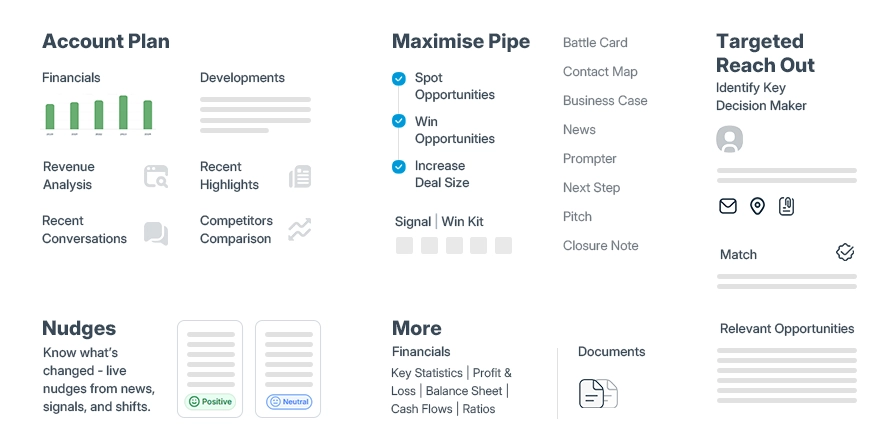
SalesPlay is the world's first AI-powered sales intelligence platform that transforms sales execution speed and precision through its revolutionary suite of 7 AI Agents. Unlike competitors offering fragmented data, SalesPlay delivers pitch-ready opportunity ecosystems—hyper-personalized sales kits, mapped buying centers, and conversion-ready outreach sequences that eliminate 80% of manual work while consistently closing deals others can't identify. Built on exclusive MarketsandMarkets intelligence and thousands of premium data sources, and exclusive vendor partnerships, the platform creates a competitive moat that drives 3x productivity gains by enabling every rep to execute with the precision of your organization's elite performers.
SuperAGI's Agentic CRM leverages a 275M+ agent-verified database to power outreach efforts with exceptional accuracy. Its Data Enrichment Agent processes uploaded CSVs or existing lists to instantly fill missing information such as phone numbers, emails, and LinkedIn profiles. With smart field selection, users can choose specific data points to enrich, from direct dials to company details. The platform's rapid matching and verification system ensures all data is accurately mapped before being added to your lists. Users receive real-time notifications upon completion, allowing immediate access to enriched information.
STOP GUESSING YOUR PIPELINE
START GROWING IT WITH AI SALES!!
ZoomInfo RevOS represents a comprehensive revenue operating system built upon the company's Data Cloud, featuring billions of data points and machine-learning technologies. The platform unifies login and administration experiences across all ZoomInfo products. RevOS comprises four primary pillars: Sales, Marketing, Talent, and Operations. Its marketing capabilities allow teams to identify and prioritize audiences based on fit, intent, and engagement. The platform's intent data enables marketers to engage buyers precisely when they're most likely to convert. Indeed, ZoomInfo's data includes 34M+ company profiles outside North America and 200M+ professional profiles internationally.
Clearbit X functions as a control center that combines marketing and sales data, including user activity, CRM, and marketing automation information. The platform enriches every record with relevant data points from trusted sources. Its capabilities enable social advertising with LinkedIn-level firmographic targeting across Facebook and Google ads. Clearbit can unmask anonymous website visitors as high-fit accounts in real-time, allowing immediate sales team alerts and website personalization. At its core, Clearbit Enrichment provides 100+ B2B attributes distilled from 250+ data sources and millions of data points. The platform automatically refreshes records when changes are detected.
Apollo.io delivers AI-generated auto-score models that leverage success data from CRM and account history to identify high-converting prospects. Users can build custom scoring models that define specific criteria, weightings, and variables. The platform enables real-time lead scoring directly in search results, ensuring teams never waste time on low-potential prospects. Apollo provides full transparency into scoring criteria, giving clear insight into lead evaluation. By combining product and marketing data from CRM with Apollo's demographic, firmographic, and behavioral information, users create powerful scoring models. The platform's AI model analyzes past prospecting efforts to identify features that drove previous successes.
LeadIQ's Chrome extension enables one-click prospecting without switching between platforms. The tool mirrors LinkedIn Sales Navigator lists, providing easy access to contact information including email, mobile numbers, and location. Users can capture top prospects to custom lead lists and push data directly into systems like Salesforce, HubSpot, Outreach, and Gong. LeadIQ now integrates with Groove, further accelerating prospecting workflows. For those who don't use LinkedIn Sales Navigator, the extension allows direct capture from LinkedIn, Outreach, and Salesforce. The platform auto-generates all contacts belonging to selected accounts and permits filtering by name, location, function, seniority, or title.
Hunter combines proprietary technology and artificial intelligence to find, verify, and enrich contact details. The platform helps identify relevant leads based on ideal customer profiles and find the best contacts from company names or websites. Its Email Verifier tool provides thorough validation at multiple levels: format, domain information, server response, and comparison with unique professional email databases. Hunter's Lead Enrichment API delivers 100+ attributes with a simple API call, providing comprehensive profiles from email addresses or LinkedIn handles. The system can connect to CRMs, enrich form submissions in real-time, and integrate with applications.
Lusha stands out for its strict compliance with data protection regulations, being both CCPA and GDPR compliant with validation from independent third-party auditors. As the only sales intelligence solution accredited under ISO 27701, the highest international privacy standard, Lusha maintains SOC 2 Type 2, ISO 27001, and ISO 27018 certifications. The platform collects business contact data from public sources, notifying contacts about data collection as required by GDPR Article 14. Individuals can opt-out anytime through Lusha's self-serve Privacy Center, which allows data subjects to submit access, erasure, or rectification requests.
Cognism specializes in intent data that provides insights into online behaviors of target audiences. The platform helps identify and connect with companies actively researching solutions similar to yours. By leveraging 14,000+ intent topics, users can prioritize outreach to the most engaged accounts. Cognism partners with Bombora to provide intent signals that show increased interest in specific products or services. The platform also offers buying signals including job changes, funding alerts, and M&A notifications—valuable indicators as companies that recently raised funding are 2.5x more likely to buy new solutions. For virtual prospecting, Cognism combines Bombora's behavioral data with sales intelligence to improve targeting.
Selecting the right AI lead enrichment tool requires evaluating several critical factors. When comparing solutions, focusing on key performance indicators helps businesses find the perfect match for their specific needs.
Make Every Rep Speak
Like Your Top 1%
Data quality serves as the foundation of effective enrichment. Studies show that 30-50% of CRM data becomes outdated quickly, making verification methods crucial. Top-performing tools employ multiple validation techniques, including cross-referencing information with numerous sources—Cognism checks against 150 distinct data sources.
Timeliness affects sales outcomes directly. Effective tools offer automated data refreshing at scheduled intervals, with some providing real-time enrichment capabilities. Clearbit automatically refreshes records as soon as changes are detected, ensuring teams work with current information.
Look for tools that verify both email addresses and phone numbers. Review their data cleansing processes and ask potential vendors about actual accuracy rates. Although some claim rates up to 95%, performance varies significantly.
According to Salesforce, 75% of companies consider CRM integration a key factor when selecting enrichment tools. Strong integration enables:
Automated data flow between systems without manual intervention
Real-time synchronization across platforms
Unified reporting across marketing and sales tools
Most leading tools integrate with popular CRMs like Salesforce, HubSpot, and Zoho. ZoomInfo, Clearbit, and Cognism offer particularly robust integration options.
Pricing remains one of the most challenging aspects of comparison. Many vendors require sales calls before revealing pricing information—including Demandbase and LeadGenius. Common pricing structures include:
Credit-based systems where each enriched contact costs credits
User-based pricing that scales with seat count
Tiered functionality with feature differences between plans
Monthly costs vary dramatically: UpLead charges $99 for 170 credits, whereas enterprise solutions like Clearbit may cost between $18,000-$80,000 annually. Free options exist—Apollo offers 100 monthly credits with basic features.
Ultimately, evaluate actual cost per contact based on subscription tier, user count, credit volume, and required integrations.
AI lead enrichment applications vary markedly across industries, with each sector leveraging these tools to address unique challenges and requirements.
SaaS companies typically implement AI enrichment to power account-based marketing strategies, specifically targeting high-value accounts through personalized approaches. ABM tools analyze vast amounts of data to uncover patterns and predict which accounts are most likely to convert. This precision matters—76% of marketers report significant results from account-based marketing with 45% seeing larger deal sizes. AI-powered intent data platforms track online behavior to determine buying readiness, identifying companies actively searching for solutions. For outbound sales, these tools automatically identify key decision-makers within target organizations by analyzing job titles, roles, and professional networks.
Healthcare organizations face unique regulatory challenges that make data accuracy not just beneficial but legally mandatory. Under HIPAA regulations, maintaining accurate provider and patient information is essential for compliance. Healthcare institutions must thoroughly verify credentials and licenses of professionals directly from issuing authorities like state medical boards. Undeniably, this verification process helps prevent fraud, protect patient safety, and maintain system integrity. Primary source verification specifically ensures that healthcare providers have valid qualifications to practice legally. These compliance programs allow organizations to stay current with evolving healthcare laws while avoiding potentially severe financial penalties.
Financial institutions utilize AI enrichment primarily for enhanced risk assessment and lead quality evaluation. AI algorithms process vast amounts of data from diverse sources to predict creditworthiness more accurately than traditional methods. The technology examines alternative data points beyond standard credit history, identifying subtle patterns that signal increased risk. Evidently effective, financial institutions using data-driven risk assessment tools can reduce credit losses by up to 20%. Additionally, AI helps analyze investment preferences, account balances, and compliance certifications to create targeted marketing campaigns. This precision ultimately enables financial services to extend credit to underserved populations responsibly while maintaining strong risk management practices.
Implementing AI lead enrichment tools requires careful planning and strategic execution. Initially, success depends on following established methodologies that minimize risk while maximizing returns.
Running a structured pilot with 1-10 users for 2-3 months provides meaningful data without overwhelming systems. Throughout testing, track baseline metrics including:
Lead conversion rates
Data accuracy and completeness
Sales cycle duration
Team engagement levels
This targeted approach allows for refinement before full-scale deployment. Organizations implementing pilot programs report 25% increased data accuracy and 30% improved data completeness.
Your enrichment solution must connect smoothly with existing systems to eliminate manual data transfers. Evaluate whether the tool supports real-time enrichment, scheduled updates, or on-demand processing. For maintaining data quality, implement validation protocols using standard regex patterns for email format verification.
Effective adoption begins with clear communication about how AI enhances—not replaces—existing roles. Primarily focus on showcasing tangible benefits: automating mundane tasks while freeing time for relationship building. Creating a continuous feedback loop between users and implementation teams enables ongoing optimization. Afterward, track adoption metrics to measure successful integration.
AI-powered lead enrichment has transformed the sales landscape from labor-intensive manual processes to streamlined, intelligent workflows. Throughout this article, we've seen how traditional methods waste valuable selling time, create data inaccuracies, and ultimately hamper conversion rates. The future clearly belongs to organizations embracing AI-enhanced data solutions.
Notably, these smart enrichment tools deliver three critical advantages: significantly higher lead conversion through precise targeting, accelerated sales cycles via instantly verified contact data, and personalized interactions based on behavioral insights. The combination of these benefits creates a powerful competitive edge for forward-thinking sales teams.
Behind these advantages stand sophisticated technologies – predictive analytics that score leads with remarkable accuracy, NLP systems extracting meaning from unstructured text, and intent signal detection revealing genuine buying interest. Together, they form an intelligence ecosystem far superior to manual research methods.
The market now offers excellent solutions for every business need, from SuperAGI's agentic CRM to ZoomInfo's extensive data platform. Each tool brings unique strengths, whether you prioritize compliance like Lusha or international prospecting like Cognism.
Your implementation success depends on starting small with clear KPIs, ensuring seamless CRM integration, and properly training teams on effective usage. The path forward is clear – companies that adopt AI lead enrichment gain a substantial competitive advantage while freeing their sales teams to focus on what they do best: building relationships and closing deals.
As data volumes continue growing and customer expectations rise, AI-powered enrichment will become not just beneficial but essential for sales success. The question isn't whether your organization should adopt these tools, but rather how quickly you can implement them to stay ahead of competitors still struggling with spreadsheets and manual research.
STOP GUESSING YOUR PIPELINE
START GROWING IT WITH AI SALES!!
AI-powered lead enrichment uses artificial intelligence to automatically gather, verify, and analyze data about potential customers from multiple sources. Unlike manual methods, it works in real-time, processes vast amounts of data quickly, and continuously improves its accuracy through machine learning.
AI lead enrichment tools can significantly boost sales performance by increasing lead conversion rates through better targeting, shortening sales cycles with verified contact data, and enabling more personalized interactions based on behavioral insights. This leads to more efficient use of sales resources and higher overall revenue.
The core technologies powering AI lead enrichment include predictive analytics for lead scoring, natural language processing (NLP) for extracting context from unstructured data, and intent signal detection from digital footprints. These technologies work together to provide comprehensive and actionable insights about potential customers.
When selecting an AI lead enrichment tool, consider factors such as data accuracy and refresh rates, integration capabilities with your existing CRM and marketing platforms, and pricing tiers that align with your budget and scalability needs. It's also important to evaluate industry-specific features that may be relevant to your business sector.
To successfully implement AI lead enrichment tools, start with a pilot program and establish clear KPIs to measure success. Ensure seamless integration with your CRM system and proper data synchronization. Additionally, provide thorough training to your team on how to leverage the tool for personalization and automation in their sales processes.

Category: Uncategorized Tags: ai, AIOps, Artificial Intelligence, cloud, cloud platform, Cybersecurity, Information and Communications Technology , VR