How AI is Revolutionizing Sales: Boost Efficiency, Close Deals Faster, and Drive Revenue in 2025
Artificial Intelligence (AI) is transforming how organizations approach sales. The concept of AI Sales or Sales AI integrates advanced technologies like machine learning, predictive analytics, natural language processing, and automation to streamline sales operations, improve forecasting accuracy, and personalize customer interactions at scale. By 2025, AI has become essential for any organization that wants to optimize revenue and achieve a competitive advantage.


The AI Sales Era Has Arrived-Are You Ready?
Learn how SalesPlay helps sales leaders crush quotas in 2025's new landscape
View Interactive Demo
Section 1: Introduction to AI Sales
AI Sales is not just about technology; it’s a strategy that leverages AI to optimize every stage of the sales funnel. From identifying high-potential leads to automating follow-ups, AI enhances both efficiency and effectiveness.
1.1 Why AI Matters in Modern Sales
The modern buyer journey is increasingly complex, spanning multiple channels and touchpoints. Sales teams are expected to deliver highly personalized experiences. AI enables organizations to collect, process, and analyze massive amounts of data to generate actionable insights, predict buyer behavior, and personalize outreach strategies.
1.2 Market Adoption and Statistics
According to MarketsandMarkets™, over 82% of sales organizations globally use AI in some form by 2025. The AI in Sales market is projected to reach USD 240 billion by 2030, growing at a CAGR of 32.9%. North America and APAC are leading adopters, with enterprises using AI for predictive lead scoring, personalized content, and conversational intelligence.
1.3 Key Benefits
-
Increased lead conversion rates by up to 50%
-
Reduction in sales cycle time by 40%
-
Improved forecast accuracy by 20%
-
Enhanced productivity for sales teams
-
Higher customer engagement and satisfaction
1.4 Challenges Organizations Face
-
Data privacy and regulatory compliance (GDPR, CCPA)
-
Integration with legacy systems
-
Over-reliance on automation reducing human interaction
-
Ensuring data quality for accurate AI predictions
-
AI adoption and team upskilling
Section 2: How AI Works in Sales – Technical Deep Dive
AI in sales leverages multiple technologies to automate, optimize, and enhance revenue operations. Understanding the underlying mechanisms can help organizations maximize adoption and ROI.
2.1 Machine Learning (ML) in Sales
Machine Learning algorithms analyze historical sales data to identify patterns and predict future outcomes. ML is used for lead scoring, churn prediction, and opportunity prioritization. Sales teams can identify high-value prospects and allocate resources efficiently. Various ML algorithms are used:
-
Supervised Learning: Uses labeled historical data for lead scoring, churn prediction, and pipeline analysis.
-
Unsupervised Learning: Identifies patterns in customer segmentation and account clustering without prior labeling.
-
Reinforcement Learning: Optimizes sales strategies over time by rewarding positive outcomes, such as closed deals.
Example: ML models can predict which accounts are most likely to purchase based on previous engagement patterns and firmographic data.
2.2 Natural Language Processing (NLP) for Conversation Intelligence
NLP allows AI systems to understand, interpret, and analyze human language from emails, chat conversations, and meeting transcripts. This technology is central to conversation intelligence, sentiment analysis, and automated follow-ups. Tools like Gong and Dialpad analyze the tone, intent, and engagement in sales calls to coach reps and optimize messaging. In sales, NLP is applied in:
-
Analyzing call transcripts to detect sentiment, objections, and engagement level.
-
Automating email response suggestions and summarizing long communications.
-
Monitoring social media and messaging platforms for brand mentions and buyer intent.
Advanced NLP models can provide conversation insights that guide coaching sessions and optimize messaging strategies.
2.3 Generative AI for Sales Content
Generative AI automates content creation, including emails, proposals, presentations, and social media posts. It can create personalized, high-quality messages at scale. SalesPlay leverages generative AI to provide hyper-personalized outreach sequences based on account data, increasing engagement and conversion rates.
-
AI drafts multi-channel outreach campaigns that adapt to buyer context.
-
Dynamic proposal generation tailored to client requirements.
-
Content personalization at scale, reducing manual effort.
Example: Sales reps can automatically generate follow-up emails for hundreds of leads, with context-specific recommendations for each recipient.
2.4 Predictive Analytics
Predictive analytics leverages statistical models and algorithms to forecast sales trends, pipeline health, and revenue outcomes. By integrating CRM, ERP, and marketing data, predictive models can highlight potential bottlenecks and recommend corrective actions. Companies using predictive analytics report a 20% improvement in forecast accuracy. Predictive analytics forecasts sales outcomes using historical data, engagement metrics, and market indicators.
-
Deal probability scoring to prioritize opportunities in the pipeline.
-
Revenue forecasting with scenario simulations for better planning.
-
Early risk identification for deals likely to stall.
By combining predictive analytics with ML and NLP, organizations gain a multi-dimensional view of their sales performance.
2.5 Conversational AI for Customer Engagement
Conversational AI powers chatbots, virtual assistants, and automated customer interactions. It enables instant responses to queries, schedules meetings, and gathers qualification information. By handling routine interactions, conversational AI frees up sales teams to focus on high-value activities.
-
Automated scheduling of demos and meetings.
-
Instant responses to routine queries, freeing sales reps for high-value interactions.
-
Context-aware engagement across email, chat, and voice channels.
Actionable Tip: Combine conversational AI with CRM data to personalize interactions and improve lead conversion.
Ready to turn your Rep
INTO BEST PERFORMER ?
2.6 Data Integration and Real-Time Analytics
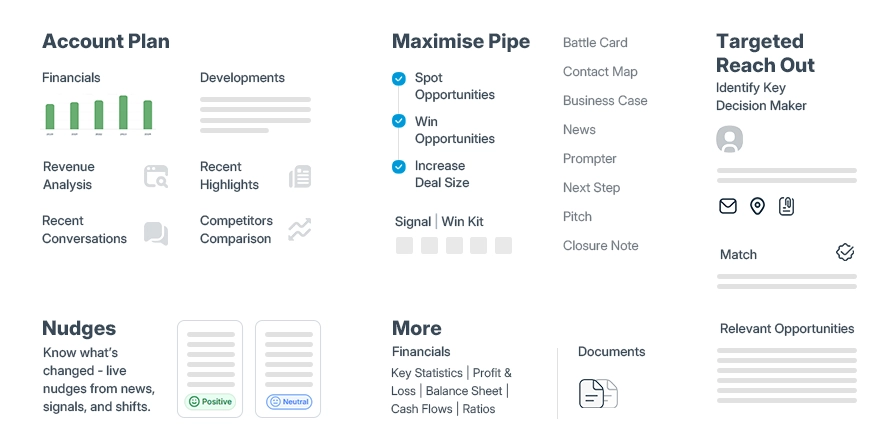
Modern AI Sales platforms combine ML, predictive analytics, NLP, and generative AI into unified dashboards. This integration ensures real-time insights, reduces manual data entry, and provides actionable recommendations for sales managers. Platforms like SalesPlay AI Analytics exemplify this convergence, offering pipeline visibility, lead scoring, and performance metrics in one interface.
AI requires seamless access to multiple data sources for accurate decision-making:
-
CRM systems for customer data and interactions.
-
ERP systems for sales and operational data.
-
Marketing platforms for campaign and engagement insights.
-
External sources like social media, news, and third-party data providers.
Real-time analytics ensures that AI recommendations are always based on the most recent customer behavior and market conditions.
2.7 Actionable Tips for Leveraging AI Technologies
-
Start with small projects focusing on lead scoring or conversation intelligence to build trust in AI tools.
-
Regularly update ML models to incorporate new data and maintain predictive accuracy.
-
Use NLP to identify common objections and improve messaging strategy across teams.
-
Integrate generative AI tools for content creation while maintaining brand voice consistency.
-
Combine predictive analytics with human intuition for final decision-making.\
Understanding these technologies lays the foundation for successful AI Sales implementation. In the next section, we will explore real-world applications across industries, detailing how organizations leverage these tools to drive revenue growth.
Section 3: Real-World Applications and Use Cases of AI Sales
AI Sales is no longer theoretical; organizations across industries are leveraging AI to optimize every step of the sales process. This section explores practical applications, industry-specific examples, and actionable strategies.
3.1 AI-Powered Lead Scoring and Prioritization
AI lead scoring evaluates prospects based on engagement history, demographic information, and behavioral signals. Sales reps can prioritize high-value leads, reduce wasted effort, and improve conversion rates. For example, B2B SaaS companies use AI to identify accounts most likely to purchase, enabling account-based marketing (ABM) strategies that focus resources on top prospects.
-
B2B SaaS: Companies use AI to rank inbound leads based on engagement level and product fit, reducing time wasted on low-probability accounts.
-
Enterprise Software: Predictive lead scoring identifies which prospects are ready to move from marketing to sales, improving handoff efficiency.
-
Actionable Tip: Regularly retrain scoring models to account for changing buyer behavior and market trends.
3.2 Conversation Intelligence and Coaching
AI analyzes sales conversations to provide actionable insights. NLP tools extract sentiment, identify objections, and highlight effective messaging patterns. Sales managers use this data for coaching, enabling reps to refine their techniques and close deals more efficiently.
-
Detect common objections and provide coaching suggestions for handling them effectively.
-
Analyze tone, speech patterns, and sentiment to identify opportunities for training.
-
Actionable Tip: Create AI-driven dashboards highlighting top-performing phrases and strategies for team-wide adoption.
3.3 AI-Driven Forecasting and Pipeline Management
Predictive analytics models examine historical sales data, market trends, and engagement metrics to forecast revenue and pipeline health. Organizations can identify at-risk deals, allocate resources efficiently, and make informed strategic decisions.
-
Retail: AI predicts future purchasing behavior based on historical data, enabling sales teams to allocate resources efficiently.
-
Financial Services: Forecasting models assess loan or insurance product uptake, improving sales targeting.
-
Actionable Tip: Combine AI forecasts with human insights for more accurate and actionable revenue predictions.
Case Study: A global financial services firm implemented predictive forecasting AI and improved forecast accuracy by 30%, enabling better resource allocation and reduced revenue risk.
3.4 Personalized Sales Enablement
Generative AI creates personalized communication at scale. By analyzing account history, past interactions, and buyer behavior, AI can craft emails, proposals, and presentations that resonate with prospects.
-
Dynamic content generation aligns messaging to buyer personas and engagement history.
-
AI-powered recommendation engines suggest next-best actions based on account behavior.
-
Actionable Tip: Use AI-generated content as a first draft and allow reps to add personal touches to maintain authenticity.

Spot Pipeline BeforeYour Competitors Even Know It Exists
Example: SalesPlay Lead Enrichment leverages AI to generate highly personalized messaging for targeted accounts, increasing response rates by over 35%.
3.5 Engagement Automation and Multichannel Outreach
AI-powered recommendation engines suggest the next-best actions, content, or offers based on buyer behavior and historical data. This ensures sales reps deliver relevant content and maintain consistency across interactions.
-
AI chatbots answer routine queries and guide prospects through the buying process.
-
Email sequences, SMS campaigns, and social media outreach are optimized based on engagement analytics.
-
Actionable Tip: Continuously test messaging strategies and let AI recommend the highest-performing combinations.
Example: Retail and e-commerce businesses use AI to recommend complementary products, increasing average deal value and customer lifetime value.
3.6 Industry-Specific Use Cases
-
Healthcare: Medical device and pharmaceutical companies use AI to analyze physician interactions, forecast demand, and identify high-potential accounts. AI assists in regulatory-compliant engagement strategies and efficient territory management
-
BFSI: Banks and insurance companies leverage AI for customer segmentation, predictive risk assessment, and automated lead nurturing, resulting in improved cross-sell and upsell revenue.
-
Manufacturing: AI optimizes territory assignments, monitors purchase cycles, and suggests upsell opportunities.
-
Technology/SaaS: Software companies implement AI for lead scoring, automated demos, and personalized onboarding, reducing sales cycles and improving adoption rates.
3.7 Actionable Tips for Implementing AI Use Cases
-
Start with one high-impact use case, such as lead scoring or predictive forecasting, to demonstrate value.
-
Integrate AI insights into daily workflows to increase adoption among sales reps.
-
Continuously analyze AI-driven recommendations and feedback from sales teams to refine models.
-
Document best practices and success stories to encourage broader AI adoption across teams.
Section 4: Implementation Strategies and Best Practices for AI Sales
Implementing AI in sales requires careful planning, strategic alignment, and ongoing evaluation. Successful adoption goes beyond technology—it involves processes, people, and culture.
4.1 Define Business Goals and Use Cases
Before adopting AI, evaluate the current sales processes, data infrastructure, and team capabilities. Organizations should identify areas where AI can add the most value, such as lead scoring, pipeline forecasting, or customer engagement.
-
Map sales processes to determine where AI can add the most value (e.g., lead scoring, pipeline forecasting, content personalization).
-
Define measurable KPIs such as conversion uplift, reduction in sales cycle time, or revenue growth.
-
Actionable Tip: Begin with a pilot project focusing on a single high-impact area to demonstrate ROI and gain stakeholder buy-in.
4.2 Build a Robust Data Foundation
AI relies on high-quality, structured data. Integrate datasets from multiple sources, clean duplicates, and ensure consistency. Unified and enriched data improves model accuracy and reliability.
-
Integrate CRM, ERP, marketing automation, and external data sources.
-
Cleanse and enrich data to remove duplicates and correct inconsistencies.
-
Ensure data governance policies for ongoing quality and compliance with regulations like GDPR and CCPA.
-
Actionable Tip: Leverage automated data enrichment tools to keep datasets accurate and actionable.
4.3 Tool Selection and Evaluation
Choosing the right platform is critical for seamless adoption. Evaluate vendors based on integration capabilities, scalability, and alignment with business objectives.
-
Compare vendors for scalability, integration capabilities, compliance, and analytics sophistication.
-
Evaluate AI platforms such as Salesforce Einstein, IBM Watson, and MarketsandMarkets SalesPlay AI.
-
Conduct trials and proof-of-concepts to ensure compatibility with existing workflows.
-
Actionable Tip: Prioritize platforms offering unified dashboards to consolidate multiple AI functionalities.
4.4 Team Alignment and Upskilling
Start with a pilot program to test AI tools in a controlled environment. Measure outcomes, gather feedback, and refine AI models before organization-wide deployment.
-
Conduct training programs covering AI literacy, interpreting insights, and actionable decision-making.
-
Identify champions within teams to guide adoption and mentor peers.
-
Actionable Tip: Encourage collaboration between sales operations, IT, and leadership to embed AI into daily routines.
4.5 Change Management Framework
AI adoption requires human collaboration. Sales teams must understand AI insights and act on recommendations effectively.
-
Communicate clear goals, benefits, and expectations to all stakeholders.
-
Use phased deployment to gradually introduce AI into workflows.
-
Provide continuous feedback channels for teams to share experiences and improvements.
-
Actionable Tip: Monitor adoption metrics and iterate to ensure sustained engagement.
4.6 Performance Measurement and Continuous Optimization
AI implementation is an iterative process. Establish metrics to monitor success and refine AI models to optimize performance.
-
Define KPIs: lead conversion, deal closure rates, forecast accuracy, and engagement metrics.
-
Establish regular review cycles for AI models and dashboards.
-
Iterate models using new data and team feedback for continuous improvement.
-
Actionable Tip: Combine quantitative KPIs with qualitative insights from sales teams to ensure AI outputs are actionable and trusted.
4.7 Risk Mitigation and Compliance
Implementing AI comes with technical, ethical, and operational risks.
-
Identify potential biases in AI models and correct them using explainable AI techniques.
-
Ensure compliance with privacy regulations, ethical standards, and organizational policies.
-
Develop contingency plans for system failures or inaccurate predictions.
-
Actionable Tip: Document best practices, lessons learned, and guidelines to build an AI governance framework.
By following these implementation strategies, organizations can ensure successful AI adoption, optimize sales performance, and maintain competitive advantage in the rapidly evolving sales ecosystem.
Section 5: Challenges, Pitfalls, and Mitigation Strategies in AI Sales
While AI Sales offers immense benefits, organizations often face challenges during adoption. Understanding these pitfalls and implementing mitigation strategies ensures smooth integration and maximizes ROI.
5.1 Data Quality and Fragmentation
AI models are only as good as the data they are trained on. Poor-quality data, missing information, and fragmented sources can lead to inaccurate predictions and suboptimal recommendations.
-
Disparate CRM, marketing, and operational systems create silos, making it difficult for AI to access complete datasets.
-
Incorrect or incomplete data reduces model accuracy, leading to suboptimal recommendations.
-
Actionable Tip: Implement a unified data platform and conduct regular data audits to maintain quality and integrity.
STOP GUESSING YOUR PIPELINE
START GROWING IT WITH AI SALES!!
5.2 Model Bias and Fairness
AI must comply with global privacy regulations, including GDPR, CCPA, and industry-specific standards. Additionally, ethical considerations like fairness and transparency are critical to maintain trust.
-
Example: A lead scoring model might inadvertently favor certain regions or industries due to historical sales trends.
-
Actionable Tip: Use explainable AI techniques, continuously monitor model outputs for bias, and adjust training datasets to ensure fairness.
5.3 Ethical and Privacy Concerns
Compliance with data privacy regulations such as GDPR and CCPA is critical in AI sales.
-
AI tools that use personal customer data must ensure consent, secure storage, and anonymization where necessary.
-
Failure to comply can result in legal penalties and reputational damage.
-
Actionable Tip: Develop clear privacy policies, maintain data audit trails, and educate teams on ethical AI use.
5.4 Adoption Resistance
Sales teams may resist AI adoption due to fear of job replacement or lack of understanding.
-
Reps may distrust AI recommendations or perceive them as a threat to their expertise.
-
Actionable Tip: Provide transparent communication, training programs, and involve sales teams in pilot projects to build trust.
5.5 Integration Complexity
Integrating AI tools into existing tech stacks can be complex and costly, particularly for organizations with legacy systems.
-
Challenges include aligning CRM, marketing automation, ERP, and external data feeds.
-
Actionable Tip: Use middleware solutions or AI platforms with built-in connectors to simplify integration.
5.6 Over-Automation Risks
Excessive reliance on AI can reduce human engagement and relationship building.
-
Example: Automated emails without personalization may damage trust and brand perception.
-
Actionable Tip: Balance AI efficiency with human touchpoints, especially for high-value accounts.
5.7 Continuous Monitoring and Feedback
AI models must evolve to reflect changing market conditions and buyer behavior.
-
Static models can lead to outdated predictions and reduced effectiveness.
-
Actionable Tip: Establish a feedback loop where sales teams provide input to improve model accuracy and relevance.
5.8 Actionable Framework for Mitigation
-
Data Management: Maintain centralized, cleansed, and structured data sources.
-
Bias & Ethics: Monitor AI outputs, apply explainable AI, and ensure compliance with privacy laws.
-
Change Management: Train teams, pilot small projects, and gather feedback.
-
Integration: Select platforms with seamless API connectivity and real-time synchronization.
-
Human-AI Balance: Define clear roles where AI augments decision-making rather than replacing human judgment.
By anticipating challenges and implementing mitigation strategies, organizations can maximize the benefits of AI Sales while minimizing risks.
Section 6: 2025 Trends and Future Outlook in AI Sales
As AI technologies continue to evolve, 2025 marks a pivotal year for innovations in AI Sales. Understanding emerging trends can help organizations stay ahead of the curve and gain competitive advantage.
6.1 Agentic AI and Autonomous Sales Agents
Agentic AI refers to self-learning systems capable of performing complex sales tasks with minimal human intervention. These agents can schedule meetings, draft proposals, and engage prospects based on contextual understanding. By automating repetitive tasks, sales teams can focus on strategic interactions and relationship building.
-
Autonomous lead engagement: AI agents initiate contact, qualify prospects, and schedule meetings.
-
Self-learning capabilities: These systems adapt to new data and buyer behavior without manual retraining.
-
Actionable Tip: Deploy agentic AI for repetitive tasks to free up human reps for strategic and relationship-building activities.
Make Every Rep Speak
Like Your Top 1%
6.2 Hyper-Personalization with Generative AI
Generative AI enables real-time creation of highly personalized content, including emails, presentations, and social media messaging. AI systems analyze buyer intent, engagement history, and behavioral patterns to deliver content that resonates with prospects, improving engagement and conversion.
-
Email sequences, proposals, and outreach campaigns are automatically personalized based on buyer persona and engagement history.
-
Content generation can include industry-specific language and solutions, improving conversion rates.
-
Actionable Tip: Use AI to generate drafts and allow human reps to add contextual touches, ensuring authenticity and relevance.
6.3 Predictive Forecasting Evolution
Predictive analytics continues to advance with multi-dimensional models that incorporate sentiment analysis, intent signals, and historical behavior. Organizations can anticipate buyer needs and identify pipeline risks before they become critical.
-
Forecasting not only considers historical sales but also dynamic variables like competitor activity and macroeconomic shifts.
-
Actionable Tip: Integrate predictive forecasts into CRM dashboards for real-time decision-making and resource allocation.
6.4 Vertical-Specific AI Models
Industries such as healthcare, BFSI, manufacturing, and technology are adopting specialized AI models tailored to their unique requirements. These vertical-specific models provide relevant recommendations and actionable insights based on industry-specific data.
-
Healthcare: Patient engagement and account targeting.
-
Finance: Risk scoring and product recommendation.
-
Manufacturing: Demand prediction and territory optimization.
-
Technology/SaaS: Lead prioritization and onboarding automation
6.5 Unified AI Sales Platforms
Companies are consolidating multiple AI tools into single platforms for streamlined access and actionable insights.
-
Centralized dashboards enable holistic views of sales performance, lead health, and pipeline status.
-
Integration with CRM, ERP, and marketing automation platforms ensures real-time intelligence flow.
-
Actionable Tip: Evaluate unified platforms for scalability, integration ease, and data security to future-proof AI investments.
6.6 Human-AI Collaboration
Despite automation, human expertise remains critical in AI Sales.
-
AI provides recommendations and insights, but human reps interpret context and build relationships.
-
Human-AI collaboration improves personalization, empathy, and negotiation outcomes.
-
Actionable Tip: Train sales teams to use AI dashboards effectively and balance automation with human judgment.
6.7 Ethical and Explainable AI
Transparency and accountability in AI decision-making are becoming critical. Explainable AI ensures sales teams understand the rationale behind AI recommendations, promoting trust and adoption. Ethical AI practices help maintain compliance, fairness, and customer trust.
-
AI models provide reasoning behind recommendations, allowing reps to validate and adjust actions accordingly.
-
Ethical AI practices prevent bias, ensure compliance, and reinforce organizational credibility.
-
Actionable Tip: Implement monitoring systems that highlight AI decisions, providing clarity for both sales teams and clients.
6.8 Actionable Insights for 2025 Adoption
-
Prioritize AI tools that offer autonomous capabilities without compromising human control.
-
Use generative AI to scale personalized engagement while preserving brand voice.
-
Leverage vertical-specific models to address industry nuances effectively.
-
Invest in unified AI platforms to reduce fragmentation and improve decision-making efficiency.
-
Embed explainable AI principles to maintain ethical and compliant operations.
-
Establish human-AI collaboration frameworks to optimize workflow and outcomes.
By adopting these 2025 trends, organizations can future-proof their sales strategies, enhance productivity, and maintain a competitive edge in a rapidly evolving market.
Spot Pipeline BeforeYour Competitors Even Know It Exists
Section 7: Conclusion, Actionable Takeaways, and Final Recommendations
AI Sales has evolved into a transformative force that reshapes how organizations engage with customers, optimize operations, and drive revenue. By integrating machine learning, NLP, generative AI, predictive analytics, and conversational AI, sales teams can achieve higher efficiency, personalized engagement, and data-driven decision-making.
7.1 Key Takeaways
-
Data is the foundation: Quality, centralized, and structured data ensures AI recommendations are accurate and actionable.
-
Start small, scale fast: Pilot projects for lead scoring, conversation intelligence, or forecasting demonstrate ROI and build trust.
-
Human-AI collaboration: AI enhances, not replaces, human judgment; human oversight is critical for relationship management.
-
Focus on adoption and change management: Training, clear communication, and feedback loops ensure teams leverage AI effectively.
-
Ethics and transparency: Explainable AI and bias mitigation safeguard compliance and build trust with customers.
-
Stay ahead with emerging trends: Agentic AI, generative hyper-personalization, vertical-specific models, and unified platforms define the future of AI Sales.
7.2 Actionable Recommendations for Organizations
-
Develop a structured AI adoption roadmap with clear business objectives and KPIs.
-
Invest in robust data infrastructure to unify and cleanse internal and external datasets.
-
Leverage AI tools like SalesPlay AI Analytics and AI Sales Team Management for predictive insights and workflow optimization.
-
Establish continuous training programs to improve AI literacy among sales reps and leaders.
-
Monitor AI models continuously, update algorithms, and implement feedback from teams to maintain relevance.
-
Balance automation with human intervention to ensure personalization, empathy, and trust in sales interactions.
Frequently Asked Questions (FAQs)
Q.1) What is AI Sales?
AI Sales uses artificial intelligence to automate, optimize, and enhance the sales process, including lead scoring, forecasting, and personalized engagement.
Q.2) How can AI improve sales performance?
AI improves sales performance through predictive insights, automation of routine tasks, and hyper-personalized engagement strategies.
Q.3) What are some examples of AI tools in sales?
Popular tools include Salesforce Einstein, IBM Watson, Dialpad AI, and SalesPlay by MarketsandMarkets.
Q.4) Is AI replacing human sales reps?
No. AI enhances human capabilities, allowing sales reps to focus on strategic relationship-building while automating repetitive tasks.
Q.5) What trends define AI Sales in 2025?
Key trends include agentic AI, hyper-personalization with generative AI, predictive forecasting, vertical-specific models, unified platforms, and explainable AI.
Q.6) Do you integrate with HubSpot?
Yes! SalesPlay supports integration with almost all major CRMs, including native integrations with HubSpot, Salesforce, Outlook, Teams, and 50+ other tools MarketsandMarkets your team already uses daily. This means you can leverage SalesPlay's AI-powered intelligence—real-time buyer intent signals, account intelligence, and personalized messaging—without leaving your existing workflow.
Q.7) Can I migrate my data easily?
Absolutely. SalesPlay is built to work seamlessly with your existing systems, making data migration straightforward. Whether you're coming from another sales intelligence platform or starting fresh, SalesPlay integrates with your CRM (HubSpot, Salesforce, etc.) to sync your account data, contact lists, and sales workflows automatically.
Q.8) What does onboarding look like?
SalesPlay's onboarding is designed to deliver value quickly with a phased approach. The process begins with uploading or syncing your target account lists—or letting SalesPlay suggest high-potential accounts based on live market signals. Our team provides personalized setup to integrate with your existing CRM and communication systems, followed by training to help your sales reps leverage AI-driven insights, auto-generated decks, and personalized messaging. For more you can get in touch with us at
[email protected]
STOP GUESSING YOUR PIPELINE
START GROWING IT WITH AI SALES!!