AI sales tools are revolutionizing the business world. Research shows these tools can boost productivity by up to 30% and increase revenue by up to 25%. This reality exists today, as 94% of employees and 99% of C-suite leaders already know and use AI tools.
The AI chance could add $4.4 trillion in productivity growth from corporate use cases. AI keeps changing workplace settings, especially when you have sales prospecting and customer connections. The best AI sales tools can handle routine tasks without errors and process more information than humans. On top of that, AI-powered sales tools help teams make better forecasts, enable smart prospecting, and personalize communication at scale. Companies recognize this vital shift - 92% plan to increase their AI investments over the next three years. Your business needs to understand these changes to stay competitive.
The field of artificial intelligence in sales is changing faster than ever. Two main categories have become real game-changers for today's sales teams. Sales leaders need to know the basic differences between these AI approaches to pick tools that will boost their team's results.
Unstructured AI tools, mainly Large Language Models (LLMs), have changed how we use technology. These powerful, general-purpose models like ChatGPT or Google's Gemini learn from huge datasets. They spot complex patterns and relationships. LLMs are smart learning engines that process language at massive scales. They predict word sequences and create text that sounds just like a human wrote it.
These tools work differently from regular sales software. LLMs excel at:
Writing email templates and sales pitches
Answering basic questions about sales methods
Finding solutions to sales problems
But these tools have clear limits. They work best only when you give them good input. They can't access your sales data, customer details, or company information directly. They also don't connect with your current workflows or study your sales numbers.

AI-enabled sales tools take a different path. These specialized platforms build AI right into their core features. They naturally fit with your sales data, including CRM details, call recordings, and activity logs. This gives you context-based, automated, and predictive insights.
AI-enabled selling brings AI technologies into traditional sales methods to make teams more effective. These platforms use machine learning and natural language processing. They offer valuable insights, handle routine tasks, and help sales teams perform better.
AI-enabled sales tools offer these key features:
Predictive analytics to forecast sales trends from past data
Conversation intelligence to find insights in sales calls
Smart lead scoring based on conversion chances
Revenue intelligence for complete performance insights
Task automation for data entry and follow-ups
To name just one example, Conductor AI looks at seller activity, buyer engagement, and opportunity data. It helps sellers choose their next steps across leads and pipeline. This turns regular sales processes into predictive cycles. Sales teams focus on actions that have proven to work.
Your specific sales goals and workflow needs should guide your choice between unstructured AI tools and AI-enabled platforms.
Unstructured AI tools (LLMs) work best for:
Creative tasks: Fresh ideas for messages or pitches
General knowledge: Answers about sales methods
On-demand assistance: Quick help with content

In stark comparison to this, AI-enabled sales platforms excel when:
Data integration matters: They link directly to your CRM and sales tools
Process automation is critical: 83% of sales teams using AI saw revenue growth versus 66% of teams without AI
You need structured insights: Like spotting deals most likely to close
Team efficiency is vital: They handle tasks like lead nurturing and early funnel work
LLMs act as creative partners, while AI-enabled tools serve as integrated strategic partners that deliver real business results. Teams looking to work smarter, make better decisions, and earn more through data-driven sales find AI-enabled tools valuable.
Smart sales teams now use both types of tools. They pick LLMs for creative work and specialized AI platforms to make processes better and analyze data.
Sales teams using AI-powered tools see real returns across their operations. These tools go way beyond the reach and influence of simple novelty. They show clear effects on efficiency, accuracy, and revenue.
Sales reps spend just 25% of their time selling to customers. AI could double this number by handling routine tasks. AI systems take over repetitive work that used to eat up hours of a rep's day.
So, AI sales tools can automate these time-consuming but essential processes:
Nurturing inbound leads and handling early funnel activities
Drafting and sending follow-up messages after calls
Logging meeting notes and updating contact records
Generating reports with key metrics and KPIs
Companies that adopted AI early report impressive results. Their win rates improved by 30% or more. The automation lets sales pros focus on building relationships and strategic selling that drives revenue directly.
Traditional forecasting methods often rely on gut feelings and old data that lead to costly mistakes. AI changes this by analyzing complete datasets to create reliable predictions.
The numbers tell the story - 83% of sales teams with AI saw revenue growth last year, compared to 66% of teams without it. This gap exists because AI can process information at a scale humans simply can't match.
Smart forecasting tools look at win rates, customer patterns, and sales cycles to predict outcomes with amazing accuracy. AI also gives real-time updates on pipeline health. This helps sales managers make quick adjustments instead of relying on old data.
Customer needs have changed - 71% want customized content, and 67% get frustrated when businesses don't tailor their approach. Before AI, delivering personalization at scale seemed impossible.
Modern AI tools analyze data from browsing history, purchases, and social media to create custom experiences. This tailored approach works - fast-growing companies make 40% more revenue from personalization than their slower competitors.
These changes affect every industry. Three in five consumers want to use AI while shopping. Companies that focus on AI-driven customer experiences grow three times faster than others.
STOP CHASING PROSPECTS
START CLOSING DEALS!!
Finding good leads has always been tough. AI has changed this through smart analysis of behavior signals and intent data.
AI scoring spots subtle patterns - like engaging with quality content or visiting sales pages - that show real buying interest. These systems update scores as new interactions happen. This keeps sales teams focused on leads showing strong buying signals now.
This smart approach removes human bias in scoring and finds hidden patterns that people might miss. Companies using AI-driven lead scoring tools cut their sales cycle time by 30%.
Teams that direct resources toward high-potential prospects close more deals. They also spend marketing budgets better and help sales and marketing teams work together with a clear view of lead quality.
AI technologies have transformed sales prospecting by identifying qualified prospects with remarkable precision. Recent studies show 54% of sales teams now use AI for customized outbound emails. About 45% of teams utilize AI to research accounts, which suggests a transformation in how businesses generate leads.
AI-powered prospecting systems now deliver predictive insights about potential customers that are nowhere near simple filtering. These systems analyze multiple data points at once to find prospects most likely to convert.
AI prospecting tools work through these key elements:
Pattern recognition: AI algorithms look at past conversion data to find common traits among your best customers
Behavioral analysis: Systems monitor digital actions that show buying intent, from content downloads to pricing page visits
Predictive scoring: Machine learning models calculate conversion probability based on demographics, engagement behaviors, firmographic data, and CRM activity logs
The results are clear. Companies that use AI-based scoring have cut lead follow-up time by 60%. They've also seen a 30% boost in conversion rates according to Gartner research. Sales teams can now focus only on prospects who show real buying potential.
Intent data shows the digital trail potential buyers leave while researching solutions. This information gives sales teams a vital edge by revealing which accounts are ready to buy before they visit your website.
First-party intent data from your digital properties gives the most reliable signals because AI can process more information. Third-party intent data helps find prospects early in their buying process through:
More searches for keywords related to your solutions
Research about competitor products
Time spent with industry reports and whitepapers
Updates to job titles or company funding
AI algorithms track these signals and create baseline content consumption patterns for each company. They find meaningful "spikes" in activity by looking at content consumed, number of readers, content types, time on page, and scroll speed.
Sales teams no longer rely on static lead scoring. AI shows which accounts are "in-market" now, so teams can reach out based on topics prospects actually research.
Make Every Rep Speak
Like Your Top 1%
The AI prospecting landscape has several leading platforms that offer smart targeting in different ways:
ZoomInfo Copilot combines intent data with various buying signals like executive moves and competitive research to rank accounts and give tailored suggestions.
6sense uses predictive analytics to spot high-potential accounts and rate each prospect's buying stage, which helps sales teams adjust their approach.
Origami Agents finds ICP-matched accounts online and detects buying signals such as funding, leadership changes, and tech stack updates.
Apollo.io puts database, email verification, and outreach sequences in one tool, which helps teams starting fresh.
Clay has a visual builder that pulls and transforms data from many providers for enrichment and scoring.
Humantic AI gives personality insights to help match message tone with each prospect, which works well for important outreach.
AI in prospecting has shown amazing results across industries. Companies that use AI intent data report shorter sales cycles when they focus on active buyers. Harvard Business Review found that teams who respond to leads within an hour are 7 times more likely to qualify them. This quick response only happens with AI-powered prioritization.
Companies of all sizes are using specialized AI sales tools to optimize their daily workflows. These platforms are way beyond simple automation and use artificial intelligence to change how sales teams will work in 2025.
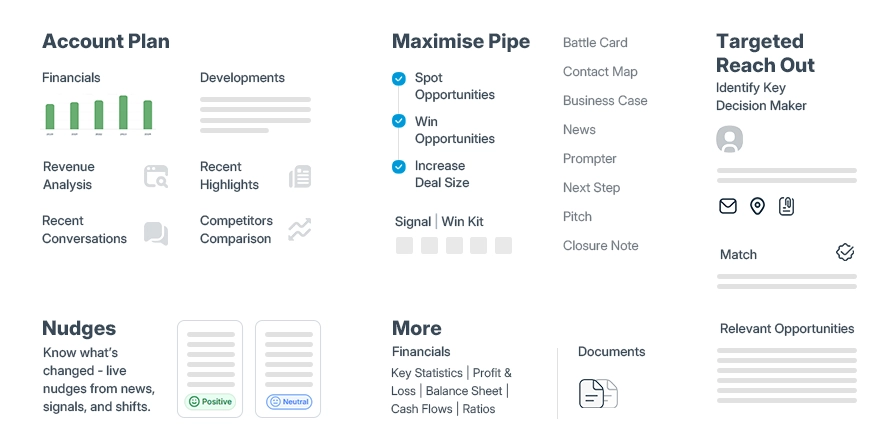
SalesPlay is the world's first AI-powered sales intelligence platform that transforms sales execution speed and precision through its revolutionary suite of 7 AI Agents. Unlike competitors offering fragmented data, SalesPlay delivers pitch-ready opportunity ecosystems—hyper-personalized sales kits, mapped buying centers, and conversion-ready outreach sequences that eliminate 80% of manual work while consistently closing deals others can't identify. Built on exclusive MarketsandMarkets intelligence and thousands of premium data sources, and exclusive vendor partnerships, the platform creates a competitive moat that drives 3x productivity gains by enabling every rep to execute with the precision of your organization's elite performers.
SPOTIO's AI-powered field sales platform gives reps immediate guidance with your selling strategy, processes, and product information at their fingertips. The AI field sales assistant provides step-by-step guidance on complex sales processes that cuts training time by a lot. It also gives managers AI-powered coaching tools to develop top performers. Beyond AI capabilities, SPOTIO helps teams boost revenue through territory management, route planning, and activity tracking that optimize field sales operations.
Einstein serves as the AI technology layer in the Salesforce platform and analyzes your CRM data to deliver predictions, recommendations, and automation within user workflows. The system has sales-specific capabilities like opportunity scoring, activity capture, and AI-driven forecasting. A powerful Trust Layer in Einstein protects sensitive customer data while letting you work with any model in an ecosystem of industry-leading LLM platforms.
HubSpot's AI-guided selling tools help reps target high-impact actions for their leads and deals. The platform has AI-powered insights, a meeting assistant, and a productivity-focused sales workspace. These features spot promising opportunities and suggest next best actions that help reps build meaningful relationships to close more deals. The platform also handles time-consuming tasks like meeting preparation, note capture, and deal health scoring so sellers can focus on building relationships.
Gong's Revenue AI Platform uses proprietary machine learning trained on over 3 billion signals to analyze sales conversations. The platform records, transcribes, and studies sales interactions to show what top reps do, what customers say, and which deals will likely close. Teams using Gong in enterprise deals win more often, with one organization saving 6,700 hours on call preparation, follow-up, and CRM updates.
Clari's Revenue Orchestration Platform combines AI-powered workflows for pipeline management, sales engagement, and forecasting. Their proprietary machine learning studies conversation data, sales activity, and CRM signals to predict deal outcomes accurately. Teams can spot risks early with the platform, and customers report 20% faster deal closures. Their forecast accuracy stays within 3-4% every quarter. Clari's AI Deal Summaries have grown 572% in just six months.
Apollo.io offers AI that works with real data, not just generated insights. The platform gives access to 210M+ contacts and smart features that automate research, scoring, and outreach. Teams see dramatic improvements - some companies' reply rates jump 200% in just one week. The platform's AI sales assistant helps teams craft tailored emails, rank leads using real-time web data, and reach prospects across multiple channels.
Outreach's AI Revenue Workflow Platform helps teams sell smarter by predicting deal closures with 81% accuracy. The system creates AI-generated account summaries, tailored emails, and transcripts with action item detection. Outreach's predictive AI knows what happens next and suggests best actions, while its generative AI handles many tasks to eliminate repetitive work.
Regie.ai combines sales engagement, parallel dialing, enrichment, and intent data into one platform, reducing the need for multiple prospecting tools. Their AI Agents handle research, writing, and lead prioritization so reps can focus on relationships. This approach works well - the company's annual recurring revenue grew 300% year-over-year, changing how teams prospect at scale.
AI sales platform selection needs strategic thinking beyond chasing the latest features. Success starts with a clear picture of your sales operation's problems.
A full picture of your existing sales process will help identify specific bottlenecks and inefficiencies. Research shows companies that exploit AI in their sales processes see a 10-20% boost in ROI. About 90% of knowledge workers say automation has improved their jobs.
To get the most from your AI investment:
Map out each stage of your sales workflow and spot tasks that eat up too much time
Find specific roadblocks where deals often get stuck
List repetitive tasks that AI could automate or improve
"The best AI tool isn't the one with flashy features—it's the one that solves your biggest time wasters," notes Salesforce. This review helps you see where AI saves time, cuts errors, and boosts revenue.
The most sophisticated AI tool becomes useless if your team can't adopt it easily. Industry research shows tools that blend well with existing systems can cut deployment time by up to 50%.
Your evaluation should focus on:
A unified platform that brings together customer and sales data removes the need for manual updates and creates efficient workflows. Check compatibility with your CRM, email platforms, and current sales tools to prevent information silos.
Start Your Demo Now with potential vendors to review how their interfaces work in ground scenarios before you commit.
On top of that, look at available training resources and support. Strong vendor support relates to 30% higher adoption rates and smoother setups. This matters more now as 55% of revenue operations teams use AI at least weekly for various sales tasks.
Your SDRs work 9–5
AI Sales works 24/7!!
AI sales tools often have complex pricing models that affect long-term value by a lot. Your evaluation should determine if the solution can grow with your business without breaking the bank.
Different pricing approaches need careful review:
Token-based pricing gives you a simple pay-as-you-use structure but costs can rise faster with more complex tasks like generating emails or playbooks. Freemium models offer low entry costs but often lack vital features like multi-user access or administrative tools.
Experts suggest asking vendors these specific questions:
Usage limits and extra fees
Credit expiration periods
Team expansion pricing changes
What similar companies actually pay
Along with pricing, check if the tool offers genuine AI capabilities instead of basic automation. Look for solutions that can make decisions based on machine learning and natural language processing that learn from your data.
Gartner reports many AI vendors compete for market share with low original pricing. Understanding total ownership costs are the foundations of avoiding budget surprises later. The right solution should deliver measurable results that line up with your sales challenges while showing clear ROI.
Today's workplace reveals a paradox in how organizations adopt AI. Research shows a widening gap between what leaders understand and how frontline employees actually use ai sales tools.
Organizations face a striking reality: employees use AI tools three times more than their leaders think. Leaders at the C-suite level estimate only 4% of their workforce uses generative AI for at least 30% of daily work. The actual number stands at 13%, which is more than triple their estimate.
This disconnect extends into future predictions. Only 20% of executives believe their employees will use AI for more than 30% of daily tasks within a year. However, 47% of employees see themselves doing exactly that. While boardrooms debate implementation schedules, employees have already started their own AI revolution throughout these organizations.
Almost half the workforce reports their companies talk about AI but take no action. Millennials lead this charge for change. Their familiarity with AI and positions in management make them strong supporters of this transformation.
Employees show great enthusiasm for ai in workplace settings, yet they don't get enough support. Half of them want more formal training and see it as the best way to boost AI adoption. More than one-fifth say they receive little to no support.
This gap raises serious concerns:
Only 39% of employees get AI training
54% of employees lack time and resources to fully use AI
97% of HR leaders say their organizations provide training
Global employees receive better support than their US counterparts. About 84% of international employees say they get substantial organizational support to learn AI skills. This number drops to just over half for US employees.
While adoption faces challenges, ethical issues remain the most important barriers to implementing ai powered sales tools. The biggest problems include:
Data privacy and security risks that could cause identity theft and financial loss
Algorithmic bias that might continue existing discrimination
Transparency issues that breed mistrust among customers and employees
Notwithstanding that, 71% of employees trust their employers to act ethically as they develop AI. This trust exceeds what they place in universities, large technology companies, or tech startups. Their main worries focus on cybersecurity, privacy, and accuracy.
Organizations need to tackle both the perception gap and ethical considerations at once. Leadership must recognize the widespread grassroots adoption already happening. Without this recognition, formal strategies will keep falling behind employee initiative.
Ground implementation data shows how ai sales tools affect business performance. Companies document major improvements in their key metrics after they add AI to their sales processes.
AI-adopting organizations see solid gains in productivity. These tools save US sales professionals more than 2 hours each day. This extra time lets them build relationships and close deals. The boost in productivity shows clear operational benefits:
Teams that make use of AI automation hit their sales targets and cut prospecting time by half
Sales professionals with AI see 50% more leads and appointments
AI-powered agents help companies solve 40% more cases
AI changes how sales teams work. Sales people spend 71% of their time on tasks unrelated to selling. AI tools free up 72% of this time previously spent on administrative work.
The financial effects of ai for sales prospecting tools tell a compelling story. Thomson Reuters found that companies with clear AI strategies double their revenue growth compared to those with casual adoption. This pattern shows up in every industry:
83% of AI-using sales teams grew their revenue last year, while only 66% of non-AI teams did the same. Companies that use AI in sales see 13-15% more revenue and 10-20% better sales ROI.
Start Your Demo Journey Now to see these productivity and revenue gains change your sales operation.
The way ai sales software speeds up deals stands out. About 51% of revenue teams close deals faster with AI. This happens because AI removes bottlenecks, provides applicable information, and moves deals forward.
Different industries see different levels of improvement, but the results stay consistent:
Companies using Salesforce's AI-powered Einstein platform close deals 25% faster. A manufacturing company cut its sales cycle from 120 days to 38 days - a 68% drop. This faster process led to 12% more revenue and 15% better sales ROI.
The digital world of ai sales tools is changing faster, and groundbreaking developments will alter how sales teams operate in the near future. Several emerging technologies will revolutionize the sales profession.
Agentic AI marks the next frontier for ai tools for sales. These systems work with growing independence to manage complete sales processes. They can identify prospects, reach out to customers, build relationships, and know when to pass complex cases to human representatives. Autonomous sales agents will take care of repetitive tasks such as meeting scheduling, follow-ups, and lead qualification without human input.
Modern best ai sales tools go beyond text-only features by adding visual, audio, and interactive elements. This integrated approach makes possible:
Live analysis of facial expressions during video meetings
Voice tone evaluation during calls that shows emotional intelligence
Custom content creation that matches each buyer's priorities
These tools process multiple information streams at once and give practical insights during customer conversations instead of just analyzing them later.
The growth of ai in workplace settings will not eliminate sales jobs but will change them. Future sales professionals need new skills to succeed with AI:
Strategic consultation abilities that machines can't copy
Emotional intelligence to build genuine relationships
Technical knowledge to work well with AI systems
The most successful companies will find the right balance. ai powered sales tools will handle routine work while human representatives tackle complex problems and relationship building. This partnership between humans and AI will boost productivity while keeping the human elements of trust and connection in sales.
AI sales tools now deliver real results for businesses of all sizes, moving well beyond the initial hype. These AI-powered tools have revolutionized sales operations by making them predictive rather than reactive, automated instead of manual, and tailored rather than generic. These technologies have become vital components of successful sales strategies in 2025.
Companies report remarkable improvements after they embrace both unstructured LLMs for creative work and specialized AI platforms to optimize processes. Their productivity jumped 30%, revenue grew by 13-15%, and sales cycles became 68% shorter. These numbers clearly show how AI adoption relates to better business performance.
A grassroots transformation shows that employees value AI even when their leaders fall behind. Smart organizations gain a lasting competitive edge by addressing training needs and setting up ethical guidelines.
Sales success now depends on combining human expertise with artificial intelligence effectively. While agentic AI, multimodal capabilities, and autonomous selling mark the next frontier, human sales representatives remain crucial to build trust and manage complex relationships.
Top sales teams don't blindly follow AI trends or resist them. They merge these powerful tools strategically while keeping the human touch that creates lasting customer relationships. Teams that strike this balance today will outperform their rivals tomorrow.
AI sales tools have become essential to modern sales operations, whether you're starting your AI trip or fine-tuning existing systems. Success depends not on whether to adopt AI, but on how quickly and smartly you utilize these technologies to boost your sales performance.
AI sales tools are delivering measurable business results, with companies reporting 30% productivity gains, 13-15% revenue increases, and up to 68% shorter sales cycles.
The transformation from experimental to essential is complete—successful sales teams now strategically integrate AI tools while preserving the uniquely human elements that build lasting customer relationships.
A. SalesPlay is an AI-powered enterprise sales intelligence platform that uncovers real-time revenue shifts, ecosystem signals, and mission-critical priorities before traditional intent data even registers activity. What sets SalesPlay apart is that while most platforms stop at research, SalesPlay drives execution through three core pillars: spotting opportunities before they exist by acting on revenue shifts before competitors even know there's a deal, making every rep speak like your top 1% with auto-delivered decks, messaging, ROI, and deal-specific strategy, and providing one integrated, hyper-personalized system where everything is tailored with every tool in one place. SalesPlay operates through 7 AI agents that help at every step of the sales process, transforming intelligence into execution.
A. AI in sales follows a four-step execution process: first, you add your target accounts by uploading or syncing your list, or let AI suggest high-potential accounts based on live market signals; second, AI automatically surfaces hot opportunities within those accounts based on real-time priorities, spend patterns, and ecosystem moves; third, AI builds a customized kit for each opportunity including decks, messaging, value prompters and more, all tailored to the specific opportunity and key decision makers; and fourth, AI keeps you moving with guided actions like meeting prep, next steps, and cross-sell plays so you never miss a beat in the deal cycle. This allows sales teams to spot hidden opportunities, target decision-makers, auto-create winning decks, grow deal size, prep in minutes, and get real-time nudges to close faster.
A. AI doesn't replace salespeople but fundamentally transforms how they perform. SalesPlay shifts sales from research to execution, automatically uncovering opportunities, building customized sales materials for each deal, and providing AI-driven nudges throughout the deal cycle. The platform makes every rep speak like your top 1% by auto-delivering decks, messaging, ROI calculations, and strategy tailored per deal. While AI excels at spotting pipeline before competitors, generating personalized content, and providing real-time guidance, human salespeople remain essential for building relationships, navigating complex negotiations, and closing deals. AI empowers sales professionals to focus on selling rather than searching, making them exponentially more effective.
A. While AI can support various aspects of sales calls, SalesPlay's approach focuses on empowering human sales reps with AI-driven meeting prep, next steps guidance, and customized materials tailored to each opportunity and key decision maker. Rather than replacing human callers, the platform ensures reps never miss a beat in the deal cycle by providing real-time nudges and guided actions. This includes auto-delivered decks, messaging, and ROI calculations specific to each deal, enabling sales professionals to enter every call fully prepared with personalized, data-driven insights. The combination of AI preparation with human relationship-building and adaptability creates more effective sales conversations than either could achieve alone.
AI sales tools are projected to increase productivity by up to 30% and boost revenue by up to 25%. They can automate routine tasks, freeing up sales professionals to focus on relationship-building and strategic activities.
Unstructured AI tools like large language models excel at creative tasks and general language understanding. AI-enabled sales platforms integrate directly with your sales data and automate specific workflows, providing contextual insights and predictive analytics for sales processes.
AI transforms sales forecasting by analyzing comprehensive datasets to generate highly reliable predictions. It examines factors like win rates, customer engagement patterns, and sales cycle durations to predict outcomes with unprecedented precision, enabling proactive adjustments to sales strategies.
Leading AI-powered prospecting tools include ZoomInfo Copilot, 6sense, SalesPlay, Origami Agents, Apollo.io, Clay, and Humantic AI. These platforms use advanced analytics, intent data, and behavioral signals to identify high-potential leads and provide tailored recommendations for outreach.
While AI will handle many routine tasks, sales professionals will need to develop new skills such as strategic consultation, emotional intelligence, and technical fluency to work effectively alongside AI systems. The focus will shift towards complex problem-solving and building authentic relationships with customers.