Building Predictable Pipeline from Strategic Accounts
February 11, 2026
Pipeline predictability separates elite enterprise sales organizations from reactive ones. This guide explains how revenue leaders build systematic pipeline generation from strategic accounts using continuous account intelligence and signal-based opportunity detection.
Most enterprise sales teams manage strategic accounts reactively. They wait for budget cycles. They respond to RFPs. They chase inbound signals that competitors see simultaneously.
This creates three predictable failures:
Pipeline drought between buying cycles. When target accounts go quiet, pipeline dries up. Teams scramble. Forecasts collapse. Revenue becomes volatile.
Late entry into competitive deals. By the time an opportunity appears in your CRM, competitors have shaped requirements and built relationships. You start behind.
Missed expansion opportunities. Strategic accounts change constantly. Budgets shift. Priorities evolve. Initiatives launch. Without continuous monitoring, these opportunities disappear before anyone notices.
📈 Industry Reality: According to Gartner's 2025 Sales Operations study, 67% of enterprise pipeline comes from reactive sources — inbound requests, expired contracts, and competitive RFPs. Only 33% originates from proactive account intelligence.
The solution is not more activity. It is systematic visibility into what is changing inside your strategic accounts before those changes become obvious.
Predictable pipeline does not mean perfect forecasting. It means knowing where your next opportunities will come from before they show up as inbound requests.
This requires three capabilities:
Strategic accounts do not stand still. They hire executives. They announce initiatives. They shift budgets. They change technology stacks. They enter new markets.
Each change creates potential opportunities. But only if you see them early.
Revenue intelligence platforms track these movements continuously across financial filings, news sources, organizational data, and technology signals. They consolidate fragmented information into a single account view that updates as the account moves.
This eliminates manual research. Account intelligence becomes current, not historical.
Not every account change matters. A new marketing hire does not create pipeline for infrastructure software. Expanded manufacturing capacity may not signal HR technology need.
Opportunity detection requires connecting account signals to your specific offerings.
Advanced systems evaluate multiple signal types:
The strongest opportunities appear where multiple signals converge. A new CTO hire alone is interesting. A new CTO combined with announced digital transformation goals and increased infrastructure budget becomes actionable.
Identifying opportunities means nothing without execution capability.
Revenue intelligence must answer four questions for every surfaced opportunity:
Without these elements, opportunity detection creates noise instead of pipeline.
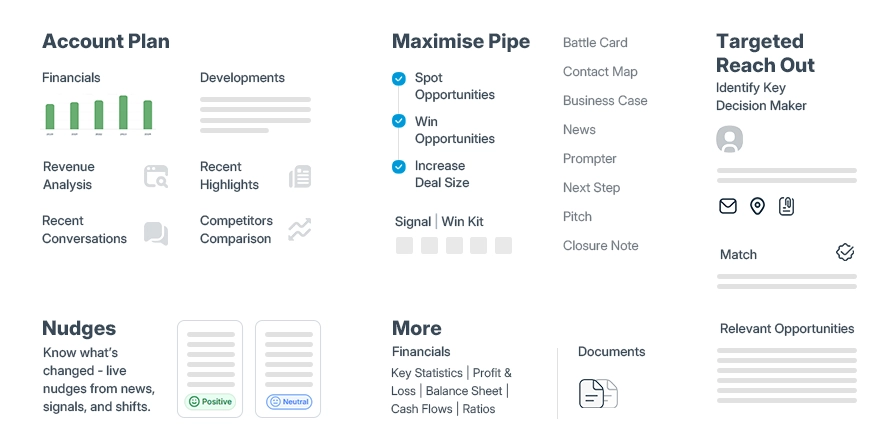
SalesPlay approaches pipeline generation through connected intelligence agents that work together across the opportunity lifecycle.
The Account Intelligence Agent establishes continuous account visibility.
For every Salesforce-connected strategic account, it consolidates:
This creates a living account plan. New team members get instant context. Account changes trigger automatic updates. Research that previously took hours happens in minutes.
The intelligence layer answers: What is happening inside this account right now, and why does it matter?
The Spot Opportunities Agent converts account intelligence into actionable pipeline.
It continuously scans monitored accounts for signals that indicate selling opportunities aligned with your offerings. Each identified opportunity includes:
Sellers review opportunities in context and decide whether to pursue, monitor, or ignore. Selected opportunities move into execution workflow.
This eliminates guessing. Pipeline generation becomes systematic rather than reactive.
The Win Opportunities Agent transforms selected opportunities into actionable deals.
For each opportunity, it generates:
Contacts are already attached. Messaging is pre-built. Sellers do not start from scratch.
This removes execution friction between opportunity identification and pipeline creation.
The Spot Contacts Agent enables relationship-driven opportunity discovery.
Instead of starting with an opportunity, sellers start with a known person. The system shows:
This is particularly valuable for expanding footprint within existing accounts where relationships exist but opportunity visibility is limited.
The Auto-Nurture Agent maintains pipeline momentum without manual effort.
For selected opportunities and contacts, it creates personalized email campaigns:
Each message is different. Each ties to specific account context. Sellers stay relevant without writing everything manually.
Account Intelligence continuously monitors strategic accounts. Spot Opportunities identifies where to sell based on detected signals. Win Opportunities provides execution context and messaging. Spot Contacts enables relationship-based expansion. Auto-Nurture maintains momentum across multiple opportunities.
This connected architecture creates pipeline generation that is systematic, not sporadic.
Revenue intelligence platforms differ fundamentally from traditional sales enablement tools in how they approach pipeline generation.
CRMs store data that sellers manually enter. Revenue intelligence platforms actively monitor external sources and detect changes without human input.
This shift from passive to active creates earlier visibility. Opportunities surface before they appear as inbound requests or competitive RFPs.
Traditional analytics platforms examine what happened. Revenue intelligence identifies what is happening now and what it means.
The difference is timing. Historical analysis tells you why you won or lost last quarter. Signal detection tells you where to sell this quarter.
Marketing automation scores inbound leads. Revenue intelligence creates opportunities from account signals before leads exist.
This is particularly valuable for enterprise sales where most revenue comes from strategic accounts, not inbound volume.
Dashboards display metrics. Revenue intelligence provides decision context.
For every opportunity, sellers need to know: Why does this exist? Who should I contact? What should I say? How should I position our offering?
Platforms that answer these questions accelerate pipeline creation. Those that only display data create analysis burden.
Different platforms approach pipeline generation with varying capabilities. This comparison evaluates core functionality relevant to strategic account pipeline creation.
| Capability | SalesPlay | Traditional Account Intelligence | CRM with AI Add-ons | Standalone Signal Tools |
|---|---|---|---|---|
| Continuous Account Monitoring | ✔ Multi-source signals consolidated automatically | ✔ News and financials tracked | ✘ Manual updates required | ✔ Single signal type focus |
| Opportunity Detection from Signals | ✔ Ranked by relevance with supporting context | Partial — alerts without opportunity mapping | ✘ Relies on manual identification | Partial — signals without product fit |
| Buying Center Identification | ✔ Contacts tied to specific opportunities | Partial — org charts without opportunity linkage | ✘ CRM contact data only | ✘ Not included |
| Execution-Ready Messaging | ✔ Battle cards, pitches, talking points auto-generated | ✘ Sellers build messaging manually | ✘ Generic templates only | ✘ Not included |
| Opportunity-to-Contact Workflow | ✔ Integrated — from signal to outreach in one system | ✘ Requires tool switching | ✘ Disconnected processes | ✘ Signal delivery only |
| Automated Nurture Campaigns | ✔ Personalized by opportunity and individual | ✘ Not included | Partial — generic sequences | ✘ Not included |
| Five-Year Account History | ✔ Financial and business context | Partial — varies by data source | ✘ CRM entry date forward only | ✘ Current signals only |
| Single-View Account Context | ✔ All account data in one place | Partial — requires navigation | ✘ Fragmented across modules | ✘ Signal-specific views |
Table evaluation based on publicly available product capabilities and documented platform features as of February 2026.
Building systematic pipeline generation from strategic accounts requires operational changes beyond platform deployment.
Not every account deserves continuous monitoring. Define clear criteria:
Start with 50-100 highest-value accounts. Expand coverage as processes mature.
Generic signals create noise. Define what matters for your specific offerings:
Revenue intelligence platforms learn from seller feedback. When opportunities marked as high-relevance convert to pipeline, the system reinforces those signal patterns.
Systematic pipeline generation requires regular opportunity review:
Integrate opportunity review into existing sales cadences. This becomes pipeline planning, not additional work.
Pipeline generation fails when opportunity identification disconnects from seller execution.
Effective programs ensure:
The goal is removal of friction between seeing an opportunity and acting on it.
Track metrics that indicate program health:
Early indicators focus on opportunity flow and action speed. Mature programs measure pipeline contribution and revenue impact.
Predictable pipeline programs fail for predictable reasons. Avoid these patterns:
The mistake: Reviewing opportunities without taking action. Teams discuss signals in meetings but do not create outreach or update CRM.
The fix: Require action on every reviewed opportunity. Pursue, monitor, or discard. No opportunity stays in review limbo.
The mistake: Tracking too many signal types without relevance filtering. Sellers receive dozens of alerts daily and ignore them.
The fix: Start narrow. Define 3-5 high-value signal types. Expand only after conversion data validates additional signals.
The mistake: Identifying opportunities without providing execution support. Sellers see what to pursue but not how to pursue it.
The fix: Opportunity identification must include contact identification, messaging frameworks, and next-step guidance.
The mistake: Revenue intelligence exists separate from CRM. Sellers manage two systems with duplicate data entry.
The fix: Require bidirectional sync. Opportunities flow to CRM automatically. Activity updates flow back to intelligence platform.
The mistake: Sales development uses different account intelligence than account executives. Handoffs lose context.
The fix: Single account intelligence source across all revenue roles. Everyone sees the same signals and opportunities.
Strategic account pipeline generation differs fundamentally from volume-based lead generation.
Marketing automation optimizes for lead volume. Strategic account programs optimize for opportunity quality within known accounts.
A single strategic account may generate 5-10 distinct opportunities over 12 months as priorities shift and budgets allocate. Continuous monitoring captures these opportunities as they emerge.
Generic outreach campaigns hope for good timing. Signal-based engagement creates timing precision.
When a strategic account announces a new initiative, allocates budget, or hires relevant leadership, the window for engagement is weeks, not months. Early visibility enables early entry.
Strategic accounts often have existing relationships. Revenue intelligence makes those relationships more productive by identifying what to discuss based on current account context.
Instead of generic check-ins, sellers engage with specific opportunities tied to what is changing inside the account.
Late entry into strategic account opportunities means competing on price against entrenched vendors. Early entry enables requirement shaping and relationship building before competition engages.
Signal-based opportunity detection creates this early entry advantage systematically.
Understanding how revenue intelligence differs from existing sales technology clarifies its role in predictable pipeline generation.
CRM: Stores historical data entered by sales teams. Tracks what happened after opportunities were identified.
Revenue Intelligence: Monitors external signals and identifies opportunities before they enter CRM. Tells sellers what to create pipeline from.
Relationship: Complementary. Revenue intelligence feeds opportunity creation. CRM manages opportunity progression.
Account Intelligence: Provides company research, org charts, technology stack data. Helps sellers understand accounts.
Revenue Intelligence: Connects account changes to selling opportunities. Tells sellers what to do with account understanding.
Difference: Account intelligence answers "what is this company?" Revenue intelligence answers "where can we sell here now?"
Sales Engagement: Automates outreach sequences and tracks activity. Helps sellers execute at scale.
Revenue Intelligence: Identifies who to contact and why based on account signals. Provides context for what engagement platforms automate.
Integration: Revenue intelligence informs engagement strategy. Engagement platforms execute that strategy efficiently.
Conversational Intelligence: Analyzes sales calls and emails to improve messaging and identify risks.
Revenue Intelligence: Identifies opportunities before conversations happen. Provides context for what to discuss.
Timing: Revenue intelligence operates pre-conversation. Conversational intelligence analyzes during and post-conversation.
Predictable pipeline from strategic accounts requires continuous account monitoring, signal-based opportunity detection, and integrated execution workflows. Revenue intelligence platforms enable this by connecting account changes to selling opportunities and providing the context sellers need to act.
The competitive advantage comes not from seeing signals — competitors have access to similar data sources. It comes from systematic processes that convert signals into pipeline before competitors engage.
Predictable pipeline means knowing where your next opportunities will come from before they appear as inbound requests. It involves systematically identifying selling opportunities within strategic accounts by tracking business changes, budget movements, and initiative alignments. Revenue intelligence platforms enable this by continuously monitoring account signals and connecting them to relevant offerings.
Early opportunity identification requires continuous monitoring of account signals including financial data, organizational changes, technology investments, and strategic initiatives. Revenue intelligence systems track these signals across multiple sources, detect patterns that indicate buying intent, and surface opportunities ranked by relevance before they become obvious to competitors.
Key buying signals include budget allocation announcements, leadership changes in relevant departments, technology stack expansions, regulatory compliance requirements, market expansion initiatives, and operational efficiency programs. The strongest indicators combine multiple signals — for example, a new CTO hire combined with announced digital transformation goals and increased technology budget.
CRMs store historical data entered by sales teams. Revenue intelligence platforms actively monitor external signals, track account changes in real-time, identify opportunities before they're logged, and connect business movements to selling opportunities. CRMs answer 'what happened'; revenue intelligence answers 'what's happening now and what should we do about it.'
Account intelligence provides the foundation for opportunity identification by consolidating financial data, business developments, organizational changes, and strategic initiatives into a single view. This context allows sales teams to understand what's changing inside an account, why those changes matter, and which of your offerings align with current priorities.
Opportunity prioritization requires evaluating signal strength, timing relevance, product fit, relationship access, and competitive position. Revenue intelligence platforms rank opportunities by combining these factors — surfacing high-relevance opportunities where multiple strong signals align with your offerings and you have relationship access to key stakeholders.
Key metrics include opportunities identified per account per quarter, time from signal detection to opportunity creation, percentage of opportunities sourced from account intelligence vs. inbound, conversion rate from identified opportunity to qualified pipeline, and average deal size from intelligence-sourced opportunities. Healthy programs show consistent opportunity flow and higher conversion rates than reactive selling.
Watch how revenue intelligence agents identify opportunities, connect signals to action, and build predictable pipeline from your strategic accounts.
Request a Demo | Explore the Platform →Predictable pipeline separates reactive sales organizations from strategic ones.
Most enterprise teams wait for opportunities to appear. They respond to budget cycles, chase RFPs, and compete on price against vendors who entered earlier.
Revenue intelligence reverses this dynamic. It watches strategic accounts continuously. It detects changes that indicate buying need. It surfaces opportunities before they become obvious. It provides the context sellers need to act.
This creates pipeline that is systematic, not sporadic. Opportunities flow from account intelligence rather than reactive response. Timing improves because engagement happens when signals emerge, not months later.
The platforms that enable this — like SalesPlay — do more than aggregate data. They connect account movements to selling opportunities. They identify buying centers. They generate messaging. They reduce execution friction.
Implementation requires more than platform deployment. It requires clear account selection, signal definition, opportunity review cadence, and execution workflow integration.
The teams that build these capabilities generate pipeline from strategic accounts predictably. The teams that rely on reactive selling remain dependent on timing luck and competitive discounting.
The difference compounds over quarters. Revenue becomes more predictable. Forecasts become more accurate. Growth becomes more controlled.
That is what predictable pipeline actually means. Learn more about how to generate pipeline from existing accounts and discover how sales leaders use revenue intelligence to create pipeline.


Category: Uncategorized Tags: ai, AIOps, Artificial Intelligence, cloud, cloud platform, Cybersecurity, Information and Communications Technology , VR