Here's what keeps VP of Sales up at night: by the time a prospect shows traditional buying intent, they're already 70% through their decision process. Your competitors are in the room. Pricing expectations are set. You're fighting for scraps.
Smart sales leaders stopped waiting for intent signals years ago.
They've figured out something the rest of the market is still catching up to—the best opportunities don't announce themselves through demo requests and whitepaper downloads. They reveal themselves through business movements most sellers ignore.
That's where revenue intelligence for pipeline changes everything.
Introduction
Revenue intelligence isn't another analytics dashboard. It's not a CRM bolt-on that generates reports your team ignores. It's a fundamental shift in how enterprise sales teams identify, prioritize, and pursue opportunities.
Think about how your team operates today. Sellers research accounts manually. They guess at timing. They reach out based on gut feel or outdated playbooks. Pipeline creation feels reactive—you're responding to signals instead of spotting opportunities first.
Now imagine this: your team knows which accounts are reorganizing budgets before anyone files a press release. They see executive appointments that signal strategic shifts. They spot expansion opportunities inside existing customers before procurement sends an RFP.
That's not hypothetical. That's what happens when you use revenue intelligence for pipeline to find early buying signals and build pre-intent pipeline.
Modern revenue intelligence platforms make this possible by continuously watching your target accounts, tracking what's changing inside them, and connecting business movement to opportunities and people. The system tells your sellers where to act, who to engage, and how—before anyone else sees the opportunity.
The Problem with Waiting for Intent
Traditional intent data has a fatal flaw—it tells you when someone is already looking. By that point, you've lost control of the conversation. You're one of six vendors being evaluated. Differentiation becomes a pricing exercise.
Here's what actually happens in most sales organizations:
-
Marketing surfaces "hot leads" based on website visits and content engagement
-
SDRs reach out weeks after competitors have already made contact
-
Account executives scramble to build relationships with stakeholders who've already formed opinions
-
Deal cycles extend because you're playing catch-up instead of leading the conversation
The brutal truth? Intent signals are lagging indicators. They confirm interest that already exists. They don't create opportunities—they just make existing opportunities visible to everyone at once.
And everyone includes your competition.
Meanwhile, the accounts you should be engaging right now are going through changes that create perfect conditions for what you sell. Executive movements. Budget reallocations. Strategic pivots. These are the moments that matter—and they happen weeks or months before anyone downloads a buyer's guide.
What Early Buying Signals Actually Look Like
So if you're not waiting for intent, what are you looking for?
Early buying signals aren't about someone searching for solutions. They're about business conditions that create the need for what you sell.
Here's the distinction:
Intent signal: VP of Sales downloads "Guide to Revenue Operations Transformation"
Early buying signal: Company misses earnings twice in a row, appoints new CRO with a track record of sales tech consolidation, and announces headcount freeze in marketing
See the difference? One tells you they're shopping. The other tells you why they'll need to buy—and gives you the context to lead that conversation before they even start evaluating vendors.
Early buying signals show up as:
-
Executive movements—new hires in roles that control budgets aligned with your solution
-
Financial shifts—revenue changes that trigger strategic pivots
-
Organizational changes—restructuring that creates new decision-making units
-
Strategic announcements—expansion plans, market entries, or product launches that require new infrastructure
-
Regulatory or compliance pressures—policy changes that force technology adoption
These aren't buying signals in the traditional sense. They're change signals. And change creates opportunity—if you know how to connect the dots.
The challenge? Most sales teams can't track this information at scale. One seller might catch an executive departure on LinkedIn. Another might notice a revenue miss during quarterly research. But there's no system watching every target account continuously, consolidating these signals, and connecting them to what you actually sell.
That's the gap revenue intelligence fills.
How Revenue Intelligence for Pipeline Actually Works
Let's get specific. Because if this sounds abstract, it won't land with your CFO when you're asking for budget.
Revenue intelligence platforms watch your target accounts continuously. Not once a quarter during QBRs. Not when someone remembers to update Salesforce. Continuously.
They track:
-
What's changing inside the account—leadership moves, financial performance, strategic initiatives
-
Why those changes matter—connection to pain points, budget priorities, or buying centers
-
Who's involved—stakeholders tied to specific opportunities, not just org charts
-
What to do next—messaging, timing, and entry points based on actual business context
This isn't data aggregation. It's intelligence—contextualized, prioritized, and connected to action.
When a seller opens an account, they don't see a CRM record with stale notes and a last-touched date from six months ago. They see what's happening now. What changed this week. Why it matters. Who to talk to. What to say.
The platform behaves like a living account plan that updates as the account moves. No jumping across tools. No manual research. No outdated information.
Think of it as having a dedicated researcher for every target account—one who never sleeps, never misses a development, and always knows how business changes connect to what you're selling.
Building Pre-Intent Pipeline: The Operational Reality
Here's where theory meets execution.
Pre-intent pipeline doesn't mean guessing. It means identifying opportunities before traditional buying signals appear—and doing it systematically, not sporadically.
Most pipeline creation follows this pattern:
Marketing generates leads → SDRs qualify → AEs pursue → Some convert
Pre-intent pipeline flips this:
Intelligence surfaces opportunities → Sellers validate relevance → Engage with context → Create demand
The difference isn't semantic. It's structural.
Instead of waiting for accounts to raise their hands, your team is:
-
Identifying accounts experiencing changes that align with what you solve
-
Understanding the business context behind those changes
-
Reaching out with relevance before competitors even know an opportunity exists
-
Shaping requirements instead of responding to RFPs
What This Looks Like in Practice
Let's say you sell revenue operations software to mid-market SaaS companies.
Traditional approach: Wait for inbound demo requests. Respond to "looking for RevOps tools" search queries. Chase Salesforce alerts when opportunities move to "evaluation stage."
Revenue intelligence approach: Your platform flags that one of your target accounts just appointed a new Chief Revenue Officer. This person came from a company where they implemented your competitor. The target account's revenue growth slowed last quarter. They're hiring aggressively in customer success but not in sales.
Your seller sees all of this in one consolidated view. They don't need to research the CRO on LinkedIn, pull earnings reports, or guess why this matters. The system tells them:
-
Why this opportunity exists right now (categorized by relevance level)
-
Which signal triggered it and supporting sub-signals
-
Who the CRO is and what they've implemented before
-
What angle makes sense given the revenue slowdown and CS expansion
-
Which product offering fits this specific situation
-
Associated buying centers and contacts
The seller can review the opportunity context, decide whether to pursue it, and access pre-built battle cards, elevator pitches, talking points, and messaging frameworks—all tied to this specific business context.
That's not intent. That's opportunity. Created, not captured.
Why Revenue Intelligence for Pipeline Beats Your Current Stack
You've got Salesforce. You've got intent tools. You've got data enrichment platforms and conversation intelligence and forecasting software.
And your pipeline still feels like a black box.
Because those tools weren't built to answer the question that actually matters: Where should my team focus right now—and why?
Revenue intelligence answers that question by connecting business movement to selling action. It doesn't just tell you what happened. It tells you what it means—and what to do about it.
The result isn't more data. It's more clarity.
Sellers stop jumping between tools. They stop guessing at timing. They stop showing up to accounts with generic messaging and hoping something sticks.
Instead, they operate with focus. They know where to sell, who to talk to, and how to position. They create pipeline in accounts where competitors don't even realize opportunities exist yet.
This is what separates top-performing sales organizations from everyone else. They're not better at responding to intent. They're better at spotting opportunity before intent forms.
The Shift from Reactive to Proactive Selling
Here's the thing nobody tells you about enterprise sales transformation—it's not about technology. It's about behavior.
Your team has been trained to react. Someone downloads content? React. Someone opens an email? React. An opportunity goes into "discovery"? React.
Proactive selling feels different. It requires sellers to trust intelligence over instinct. To engage based on business change, not expressed interest. To lead conversations instead of responding to them.
That shift doesn't happen overnight. But when it does, everything changes.
Pipeline becomes predictable. Not because you're better at forecasting what's already in the funnel—but because you're better at identifying what should be in the funnel before anyone else sees it.
Modern platforms help facilitate this shift by surfacing relevant news and developments tied to your accounts—filtering noise and highlighting what actually matters. It creates a reason to engage before your competitors even know something happened.
How to Turn Early Signals into Closed Deals
Finding opportunities early is valuable. Converting them is what matters.
Here's how the best sales teams connect early buying signals to revenue:
Step 1: Opportunity Identification
The system scans account signals and business movements continuously. It detects where budget, priorities, or initiatives align with your offerings and surfaces opportunities ranked by relevance—high, medium, or low.
For each opportunity, sellers see why it exists, which signal triggered it, supporting sub-signals, which product offering fits, and associated buying centers.
This eliminates the guesswork. Sellers aren't prospecting blind—they're engaging where business context creates natural fit.
Step 2: Contact Intelligence
The platform shows you who matters for each opportunity and why. You can start from an opportunity and see associated contacts, or start from a known person and see opportunities relevant to them.
For each contact, you see their role, contact details, opportunities tied to their function, why each opportunity matters to them, and messaging frameworks that align with their priorities.
No guessing who to contact. No generic outreach. No reliance on tribal knowledge.
Step 3: Deal Execution
Once you decide to pursue an opportunity, the platform provides everything needed to move forward:
-
Battle cards
-
Elevator pitches
-
Talking points
-
Next-step guidance
-
Conversation starters
-
Auto-generated pitch material
Contacts are already attached. Sellers can review messaging, send personalized emails, and prepare without starting from scratch.
Step 4: Sustained Engagement
Revenue intelligence platforms enable personalized nurture campaigns based on selected opportunities and contacts. You choose the number of touches and timing. The system drafts emails, personalizes by opportunity and individual, ensures variety, and runs campaigns automatically after approval.
For meetings, the platform generates prep documents including opportunity summary, attendee context, conversation starters, smart questions, and suggested next steps.
Every stage of deal progression happens with full context—because as the account changes, intelligence updates automatically.
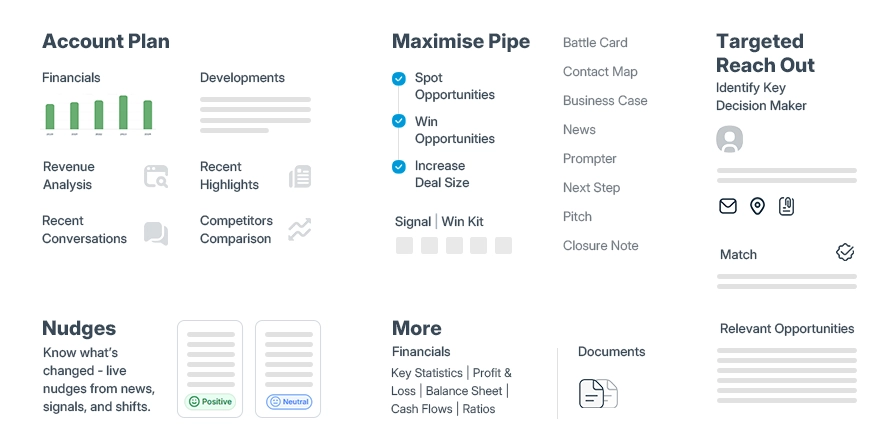
What SalesPlay Does Differently
Most revenue intelligence platforms show you data. SalesPlay tells you what to do with it.
The difference comes down to how the system is built. Instead of dashboards that require interpretation, SalesPlay uses specialized agents—each one focused on a specific part of the selling workflow.
The Account Intelligence Agent watches your Salesforce-connected accounts and consolidates five-year revenue history, financial data, key developments, and recent conversations in one place. It's a dynamic account plan that updates as the account moves.
The Spot Opportunities Agent identifies where you can sell based on business changes, categorizes opportunities by relevance, and shows you why each one exists—complete with signals, sub-signals, and buying center information.
The Win Opportunities Agent converts selected opportunities into execution-ready deals with battle cards, messaging, and next steps already prepared.
The Spot Contacts Agent lets you start from a known person and see what you should talk to them about—or start from an opportunity and see who you should engage.
Every agent works together. The result feels focused. Guided. Calm. Controlled. Predictable.
That's not marketing speak. That's how selling actually feels when you stop jumping between tools and guessing at next steps.
Common Objections (and Why They Don't Hold Up)
"Our team already uses intent data."
Good. Intent data has value—for accounts already shopping. But it's a trailing indicator. You're still reacting. Revenue intelligence gives you leading indicators. Business changes that create opportunities before buying committees form.
"This sounds like more work for sellers."
It's actually less work. Today, your sellers research accounts manually, dig through news feeds, guess at relevance. Modern platforms consolidate everything into one view. Research that used to take hours now takes minutes. Full account context appears in one tab. New team members ramp without tribal knowledge.
"We don't have the headcount to chase more opportunities."
You're not chasing more. You're chasing better. Pre-intent pipeline focuses effort on accounts where timing, fit, and business context align. Opportunities come pre-categorized by relevance so sellers know what deserves attention. Fewer dead ends. Higher conversion. Same headcount, better outcomes.
"How is this different from what our RevOps team does manually?"
RevOps can't watch hundreds of accounts continuously. They can't update intelligence in real-time. They can't connect every business change to your specific offerings at scale. Revenue intelligence does this automatically—giving your RevOps team insights they could never produce manually.
What Changes When You Build Pipeline This Way
When sales leaders adopt revenue intelligence for pipeline creation, a few things happen fast:
-
Qualification improves. Opportunities aren't just "this account fits our ICP." They're "this account is reorganizing around the problem we solve, right now."
-
Messaging gets sharper. Sellers aren't pitching features. They're connecting solutions to specific business movements the account is experiencing—with frameworks and talking points already prepared.
-
Deal cycles compress. When you enter conversations before competitors, you shape requirements instead of responding to them.
-
Pipeline becomes consistent. You're not dependent on inbound volume or campaign performance. You're systematically identifying opportunities inside existing target accounts.
-
Sellers operate with confidence. They know where to focus, who to engage, and what to say—because the intelligence is tied to real business context, not speculation.
This isn't incremental improvement. It's a different motion entirely.
Teams that make this shift report something interesting: selling feels calmer. There's less scrambling. Less context-switching. Less guessing. Sellers spend their time actually selling instead of researching, synthesizing, and figuring out next steps.
Implementation: What Actually Happens
You don't need to rip out your CRM or abandon existing tools. Revenue intelligence sits on top of what you already have.
It connects to Salesforce. It watches the accounts you're already targeting. It surfaces opportunities tied to business changes happening right now.
Implementation looks like this:
-
Connect your target accounts. The platform watches them continuously through your Salesforce integration.
-
Define what matters. Not every signal is relevant. Configure based on what actually correlates to buying in your market.
-
Route intelligence to the right sellers. Opportunities surface with full context—why it exists, who's involved, what to say, and how to move forward.
-
Track what works. Not vanity metrics. Real outcomes—meetings booked, opportunities created, deals closed.
Most teams see new pipeline within two weeks. But the real value compounds over quarters, not days. Because you're not just adding a tool—you're changing how your team creates demand.
Frequently Asked Questions
What exactly is pre-intent pipeline?
Pre-intent pipeline refers to opportunities identified before traditional buying signals appear. Instead of waiting for prospects to download whitepapers or request demos, you're spotting opportunities based on business changes—budget shifts, leadership appointments, strategic pivots—that create the conditions for a sale.
How do you identify early buying signals?
Early buying signals come from continuously watching target accounts for business movements—executive changes, financial shifts, organizational restructuring, strategic announcements. The key is connecting these changes to your offerings and surfacing opportunities with full context before traditional intent signals appear.
How is this different from account-based marketing?
ABM selects accounts to target. Revenue intelligence tells you when and why to engage those accounts. They're complementary. ABM gives you the list. Revenue intelligence tells you what's actually happening inside those accounts right now and where to act.
Won't this create too many false positives?
Not if the intelligence is tied to real business movement. The key is signal quality, not signal volume. Opportunities should be categorized by relevance—high, medium, low—based on signal quality and business context. One executive departure in your ICP might matter more than fifty content downloads. Context beats correlation every time.
How quickly can teams see results?
Most teams start identifying new opportunities within the first two weeks. But building muscle memory—teaching sellers to act on early buying signals instead of waiting for intent—takes a quarter. The technology works immediately. Behavior change takes longer.
What if sellers don't have time for more pipeline research?
That's exactly the point. Modern revenue intelligence reduces research time by consolidating everything that matters into one view. Account research that used to take hours now takes minutes. Sellers aren't doing more work—they're doing different work. Focused work instead of scattered work.
Conclusion
Pipeline creation doesn't have to feel like guesswork.
When you stop waiting for intent signals and start identifying opportunities based on business change, everything shifts. Your team knows where to focus. They engage with context. They create demand instead of chasing it.
That's what revenue intelligence for pipeline actually delivers—not more data, but more clarity. Not more opportunities, but better opportunities. Not busier sellers, but more focused sellers.
The best sales organizations have figured this out. They're not waiting for accounts to show intent. They're spotting early buying signals—executive movements, financial shifts, strategic changes—and engaging with relevance before competitors even know opportunities exist.
They're building pre-intent pipeline systematically. They're shaping conversations instead of responding to RFPs. They're winning deals that never make it to public evaluation.
The accounts you're targeting are changing right now. Budgets are shifting. Executives are moving. Strategic priorities are evolving. Those changes create opportunities—if you know how to see them.
Your competitors are waiting for intent signals. You don't have to.