Data Enrichment Trends: What's Changing in B2B Intelligence
September 03, 2025
Data enrichment isn't what it used to be. Just five years ago, 68% of B2B organizations relied on static databases that became outdated almost immediately. I've watched this landscape transform dramatically—from basic contact lists to dynamic intelligence ecosystems that update in real-time.


Today, b2b data enrichment combines artificial intelligence, machine learning, and automated processes to create living datasets. These evolving data enrichment trends are reshaping how businesses identify opportunities and make decisions. Additionally, modern data enrichment tools now integrate seamlessly across platforms, providing unified customer views that were impossible with legacy systems. While the technology has advanced significantly, the fundamentals remain centered on enhancing raw data with contextual intelligence.
In this article, I'll walk you through the most exciting changes happening in B2B intelligence and show you how forward-thinking companies are using these capabilities to outperform competitors. Whether you're just starting to explore data enrichment or looking to upgrade your current approach, you'll find actionable insights to implement right away.

Traditional CRM systems have primarily relied on manual input methods that quickly become obsolete. The inefficiency of these systems stems from their requirement for extensive manual data entry, which consumes valuable selling time for sales representatives. This outdated approach creates a significant contrast to today's dynamic data enrichment landscape.
Sales representatives typically dedicate 21% of their time to data entry and management instead of engaging with customers and closing deals. This time-intensive process doesn't just drain productivity—it introduces substantial errors. According to research, manual data entry can lead to error rates as high as 30%, resulting in considerable costs and losses for businesses.
Manual data enrichment presents several key challenges:
Time consumption: Businesses spend approximately 10 hours weekly on data cleaning and verification
Cost inefficiency: The average business invests around USD 15000.00 annually on manual data entry
Limited scalability: Manually researching and updating records becomes increasingly difficult with larger datasets
Reduced accuracy: Human error leads to outdated or incomplete information
In contrast, automated data enrichment transforms this landscape completely. Companies implementing automated enrichment processes can save up to 70% of their time and resources. Furthermore, automated enrichment continuously pulls data from updated sources, ensuring accuracy without constant manual intervention.
"Data enrichment tools analyze social media profiles, public records, and other sources to find data about companies and people in your database. They then update your database to reflect these findings, filling gaps and correcting inaccurate information—much like a good editor," notes one industry expert.
The most effective providers use a hybrid approach, leveraging AI to produce datasets that automatically grow, improve, and refresh over time. Consequently, businesses that use automated data enrichment can achieve an average ROI of 300% compared to companies that don't utilize these technologies.
Historically, B2B data has been characterized by its static nature. Updates to CRM systems occurred infrequently—at best quarterly—creating a misalignment with today's rapid business environment. This static approach fails to accommodate dynamic shifts within target organizations that could significantly affect sales strategies and outcomes.
The evolution toward dynamic intelligence represents a fundamental shift in how businesses handle customer data. Rather than maintaining static repositories of information, companies are now implementing systems that provide real-time updates and insights. For instance, Dynamic Signal Tracking (DST) systems ensure that custom data becomes "a living, breathing entity, continually refreshed to reflect the latest developments within key accounts".
These real-time systems track multiple signals simultaneously:
Employment changes of decision-makers and engaged prospects
Hiring trends for pivotal roles
Shifts in resource allocation or spending
This transformation to event-driven solutions provides immediate visual insights and enables organizations to act with unprecedented speed and precision. For this reason, businesses can make informed decisions swiftly, leveraging up-to-the-minute insights to drive actions at all levels.
Real-time intelligence allows businesses to spot market changes and adapt strategies accordingly. As one retail example demonstrates, "if you notice that sales are trending down, you can quickly make changes to your inventory or pricing strategy". In fact, the ability to identify trends as they happen, rather than analyzing historical data days or weeks later, provides a significant competitive edge.
The shift from static CRM lists to dynamic intelligence ultimately creates a single source of truth that collects, cleans, and updates data in real time. By bringing together information from website analytics, marketing campaigns, behavioral data, and customer interactions, dynamic intelligence eliminates data silos and creates a complete picture that enables more accurate assessments, predictions, and decisions.
The integration of artificial intelligence into B2B intelligence has transformed how organizations identify opportunities and understand customer behavior. Unlike traditional methods, AI-powered systems analyze vast datasets to predict outcomes with remarkable accuracy, creating a new standard for data enrichment in business environments.
Ready to turn your Rep
INTO BEST PERFORMER ?
AI lead scoring represents a significant advancement over traditional approaches. While conventional lead scoring relies on static rule-based systems with predetermined criteria, AI-powered methods utilize machine learning algorithms to dynamically assess and rank leads based on their likelihood to convert. These systems examine large datasets, historical information, and real-time behavior to determine which leads warrant immediate attention.
The process begins by collecting data from multiple sources—CRMs, marketing automation platforms, website interactions, email campaigns, and social media. After cleaning this information, AI systems perform "feature engineering," creating new data combinations to improve prediction accuracy. Machine learning models then train on historical data, learning which characteristics distinguish converted customers from non-converting leads.
Several key benefits emerge from this approach:
Minimized human error: AI uses data-driven analysis for objective and accurate scoring, eliminating subjective biases
Improved sales/marketing alignment: Both teams can agree on which leads are worth pursuing through a shared, AI-powered scoring system
Revenue growth: By prioritizing the most valuable prospects, teams increase conversion rates and achieve faster financial gains
Notably, AI lead scoring models continuously learn from new data. As additional leads enter the system and their outcomes are tracked, the model adjusts its predictions, becoming more accurate over time. This enables businesses to respond quickly to changing market conditions and evolving customer behaviors.
Predictive segmentation has evolved beyond simple demographic grouping to become a dynamic process that anticipates future customer actions. This approach utilizes sophisticated statistical algorithms to analyze historical and real-time customer data, creating multidimensional profiles.
What sets predictive segmentation apart is its ability to process various data types simultaneously:
Demographic information (age, gender, income)
Behavioral data (purchase history, website interactions)
Transactional data (frequency of purchases, average order value)
Psychographic information (interests, values, lifestyle choices)
The results offer substantial business advantages. Organizations can craft personalized marketing messages aligned with individual preferences and behaviors. AI-driven insights enable platforms to suggest products and content tailored to specific users, increasing conversion rates. Perhaps most importantly, customer interactions update profiles in real time, allowing businesses to respond instantly with relevant offers.
For B2B companies with smaller datasets, AI still offers significant value. These organizations can fully monitor model outputs and provide comprehensive feedback through reinforcement learning, ultimately optimizing performance. This makes predictive segmentation accessible regardless of data volume.
In the complex B2B sales landscape, understanding buyer behavior is essential for driving conversions. Unlike B2C customers, B2B buyers typically follow a prolonged decision-making process involving multiple stakeholders and touchpoints.
Behavioral analytics bridges this gap by collecting and interpreting data on how users interact with digital platforms. This includes tracking metrics like page views, click paths, session durations, and content engagement. For B2B businesses, this data provides critical insights into buyer intentions, helping sales and marketing teams make informed decisions.
AI-driven tools excel at identifying these patterns. For example, 6sense uses behavioral patterns to predict where prospects are in their buying journey, while Gong analyzes sales call behavior to uncover actionable insights. These tools can identify prospects who have consistently interacted with high-value content, visited key web pages, or demonstrated intent through third-party research.
The impact on conversion optimization is substantial. Personalization based on behavioral data can increase conversion rates by up to 20%. Additionally, behavioral tools pinpoint where users drop off in the sales funnel, allowing businesses to address pain points through clearer CTAs or streamlined navigation.
Above all, behavioral pattern recognition enhances lead qualification. By incorporating real-time engagement signals beyond traditional demographic and firmographic data, sales teams can prioritize high-value opportunities with genuine buying intent.

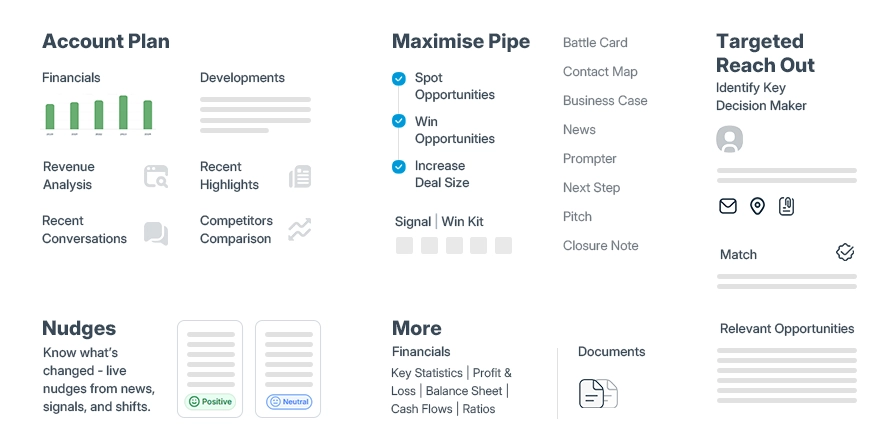
Real-time data processing has emerged as the cornerstone of modern B2B intelligence. The ability to enrich and activate data instantaneously—rather than in delayed batches—now separates industry leaders from laggards. This shift represents more than just a speed improvement; it fundamentally changes how businesses respond to opportunities and threats in their markets.
The foundation of real-time data enrichment lies in API-first development approaches. Unlike traditional methods that treat APIs as an afterthought, API-first design makes connectivity the central focus from the beginning. This architecture ensures better scalability, adaptability, and responsiveness in B2B data systems.
The benefits of API-first CRM integrations include:
Elimination of data silos - Customer information remains consistent across all platforms, creating a unified view
Enhanced security through controlled access and better data protection
Faster deployments - New features and integrations can be rolled out quickly
360-degree customer view enabling personalized interactions and improved service
Customer Data Platforms (CDPs) exemplify this approach by unifying the marketing stack. These systems aggregate, normalize, and activate data from multiple sources without replacing existing tools. By functioning as the central intelligence layer, CDPs build real-time customer profiles that reflect cross-channel behavior, firmographic changes, and dynamic segmentation triggers.
Modern CDPs connect to data sources through APIs, SDKs, and pre-built source connectors, enabling real-time activation. This architecture means marketing and sales teams receive fresh insights continuously rather than waiting for scheduled updates.
Trigger-based enrichment represents a fundamental shift in how B2B data works. Rather than enriching data on a schedule, these workflows respond instantly to specific events or signals, ensuring teams always have the most current information when making decisions.
AI-powered sales intelligence now enables real-time data enrichment, providing sales teams with up-to-the-minute information on customer behavior and preferences. By analyzing company signals, individual behaviors, intent data, and market indicators in real-time, businesses can identify high-potential leads, personalize messaging, and respond to market changes immediately.
These systems can scan for real-time changes at target accounts, including:
Job changes or title promotions
New product launches or press releases
Funding rounds or company growth signals
Hiring trends or tech stack changes
When these triggers are detected, enrichment happens automatically, with qualified leads routed to the appropriate systems and outreach sequences initiated based on the specific signal type, persona involved, and event timing.
This capability turns what was previously a manual process into an automated, intelligent workflow. According to recent research, AI-powered lead enrichment and scoring can increase productivity by 30% and lead generation by 25%.
In today's competitive environment, the speed at which businesses move data is no longer optional—it's a strategic necessity. Latency in data pipelines, or the lag between data creation and usability, undermines analytics, personalization, and operational agility.
Traditional batch ETL tools (Extract, Transform, Load) like Fivetran, Airbyte, and Stitch extract data at defined intervals, creating inherent delays. These approaches lead to delayed extraction, bulk processing bottlenecks, stale data between syncs, and scaling challenges as data volume grows.
In contrast, modern streaming platforms like Apache Kafka and Debezium use Change Data Capture (CDC) and event streaming to process data continuously. This architecture delivers several advantages:
Always-on ingestion: Data flows in real time rather than on a schedule
Stream-first transformations: Data is cleaned and joined as it arrives
Instant delivery: Fresh data lands in warehouses or applications within seconds
Consistent latency at scale: Adding more data doesn't slow processing
Organizations implementing these approaches have seen substantial improvements. Specifically, middleware platforms including integration-as-a-service (iPaaS) and event-streaming solutions enable continuous data flow between systems like CRMs, marketing automation platforms, and analytics tools, reducing latency and manual handoffs.
STOP CHASING PROSPECTS
START CLOSING DEALS!!
The business impact is significant—orchestration not only supports personalization at scale but also reduces campaign lag. When intent data is surfaced and synced to the right systems, marketers can act while prospects are still active, improving response rates and lowering cost per lead.
Privacy regulations have fundamentally altered the B2B data enrichment landscape. With over 60% of companies experiencing data breaches as of 2022, organizations must now balance robust intelligence with stringent data protection standards. This shift isn't just about compliance—it's about rebuilding trust in how business data is collected, processed, and activated.
The regulatory environment surrounding data enrichment has grown increasingly complex. The General Data Protection Regulation (GDPR) in Europe and California Consumer Privacy Act (CCPA) in the United States have established new standards that B2B companies cannot ignore. Under GDPR, businesses face penalties of up to €20 million or 4% of annual global turnover for violations. Similarly, CCPA violations can result in fines between USD 2500.00 to USD 7500.00 per incident.
These regulations affect B2B operations differently:
GDPR requires explicit consent before collecting personal data and mandates a legal basis for processing
CCPA gives California residents the right to know what data is collected and request deletion within 45 days
B2B data exemptions under CCPA ended on January 1, 2023, bringing B2B marketing under the same compliance rules as B2C
Despite common misconceptions, B2B communications definitely fall under GDPR's scope. Nevertheless, companies can still conduct marketing activities like cold calls or emails if they have a lawful basis such as legitimate interest and follow proper protocols.
Obtaining and managing valid consent has become essential in today's regulatory environment. According to Gartner, 75% of companies will need to implement a privacy governance framework by 2025. To address this requirement, organizations are adopting several key approaches:
Preference centers represent a crucial tool that empowers users while building trust. These interfaces allow customers to manage their data preferences and opt-in or opt-out of specific data uses. Moreover, layered notices provide transparent information about data usage at multiple touchpoints throughout the customer journey.
Just-in-time notifications have emerged as another effective strategy, offering real-time information about data usage at the moment of collection. This transparency helps individuals make informed decisions about their information. Indeed, many businesses now prioritize first-party data due to stricter data protection laws, making these mechanisms essential for compliant enrichment.
As AI becomes central to data enrichment, addressing bias has become a critical concern. Bias in ML models doesn't appear randomly—it originates at various stages of development, often unintentionally. These biases typically stem from three primary sources:
Sampling bias occurs when training data lacks diversity or represents only a subset of the population. This can lead to inaccurate predictions, unfair hiring practices, and discriminatory diagnostics. Algorithmic bias arises when mathematical formulas and assumptions favor certain groups, potentially perpetuating inequality in financial and employment opportunities.
To counteract these issues, companies can implement several strategies. Diversifying development teams brings global perspectives that help identify biases that might otherwise go unnoticed. Furthermore, employing diverse datasets to train and test AI models creates more equitable systems.
Establishing clear guidelines and oversight mechanisms also plays a vital role in creating fair AI systems. Many organizations now implement AI ethics boards consisting of experts who establish policies and ensure accountability. These approaches not only build trust but also avoid costly pivots or potential infractions as legislation evolves.

Successful B2B organizations no longer view their data as isolated assets scattered across departments. The unification of cross-platform data has emerged as a fundamental strategy that transforms fragmented information into actionable intelligence. Companies with mature data integration strategies now experience 2.5x higher operational efficiency compared to those operating with siloed systems.
B2B Customer Data Platforms differ substantially from their B2C counterparts, though both unify customer data. While B2C CDPs focus on individual consumers and quick purchase cycles, B2B platforms emphasize account-level tracking, complex buying groups, and extended sales processes. These specialized platforms solve unique challenges that standard data solutions cannot address.
B2B CDPs serve three core functions:
Building unified account and person profiles from disparate internal first-party data sources
Integrating first-party data with third-party firmographics, demographics, and intent signals
Activating these profiles within campaigns deployed across multiple engagement channels
Oracle Unity CDP exemplifies this approach, establishing a strong foundation that addresses customer data challenges across the entire B2B Revenue Waterfall™. Subsequently, these platforms empower businesses with essential insights that enhance marketing and sales strategies.
The impact of B2B CDPs on organizational performance is substantial. Companies implementing these solutions typically see a 40% improvement in data quality, double their lead conversion rates, and generate 30% more pipeline from target accounts. Perhaps most striking, they often achieve a 50% reduction in data spend through elimination of redundant systems.
Data matching represents the process of connecting multiple data columns from diverse sources to create a complete view of each customer. However, this isn't a one-time activity—it requires consistent, ongoing attention to ensure customer data remains enriched and updated.
Modern matching technologies employ defined business rules and text analytics to extract relevant information across departments. This process creates a comprehensive customer view by connecting addresses and contact details with behavioral, firmographic, and demographic data. The most advanced solutions allow organizations to:
Govern and standardize data from various sources
Achieve high matching accuracy with minimal false positives
Implement automated data quality frameworks
Essentially, this cross-functional approach eliminates the problem of duplicate records that occurs when customers use different name variations, email addresses, or phone numbers across touchpoints. It primarily addresses the challenges created by CRM migrations, mergers and acquisitions, and human data entry errors.
A unified customer profile represents a single, complete view of an individual customer created by combining data from various sources like CRM, website interactions, and applications. For B2B specifically, these profiles must establish connections at multiple levels—linking individuals to accounts, accounts to opportunities, and opportunities to revenue.
Adobe's Real-Time CDP B2B Edition showcases this capability, bringing together data from multiple sources and combining it into a single view of both people and account profiles. The platform enables marketers to precisely target specific audiences and engage them across all available channels.
The identity resolution systems within these platforms provide several key advantages:
Combined B2B and B2C people records for comprehensive views
Multi-level account hierarchies for organizational understanding
Many-to-many, people-to-account connections that reflect complex relationships
Real-time resolution of people and account identities
What's particularly valuable is how these systems track individuals using unique primary identifiers rather than changeable attributes like email addresses. This means when someone changes jobs, the system continues to follow them, maintaining the relationship history and intelligence.
In practice, unified real-time profiles allow B2B marketers to target specific accounts and individuals with personalized experiences at precisely the right moment. The result is higher conversion rates, better customer retention, and ultimately stronger revenue growth across all business units.
Make Every Rep Speak
Like Your Top 1%
Various industries apply data enrichment differently to solve unique challenges. Each sector adapts enrichment strategies to address specific requirements while creating distinct competitive advantages.
Healthcare organizations increasingly use data enrichment to enhance patient care outcomes. While electronic health records form the foundation, enriched data adds valuable context by incorporating socioeconomic factors, lifestyle habits, and environmental influences. This approach allows healthcare providers to tailor treatments more precisely and understand broader factors affecting patient health.
Provider data enrichment services deliver up-to-date contact information, including mailing addresses, phone numbers, and fax details for specific healthcare providers. These services typically include provider names, alternative names, licenses, credentials, taxonomy codes, specialties, and facility types. Organizations applying these enrichment techniques can:
Improve the speed and accuracy of crosswalks
Optimize claims for faster payment
Reduce days in accounts receivable
Enhance system efficiencies
Furthermore, life sciences organizations utilize data curation to accelerate drug development through digitally transformed processes. Real-world data (RWD) and real-world evidence (RWE) help assess safety and efficacy beyond traditional trials.
Financial institutions utilize data enrichment to refine risk assessment and develop investment strategies. Initially, credit scoring relied on traditional metrics, yet financial data enrichment has dramatically improved these algorithms by enhancing risk assessment efficiency. Enriched datasets enable the creation of detailed borrower profiles, making risk and default prediction more accurate.
Investment profiling likewise benefits from enrichment. Financial advisors use comprehensive frameworks to develop investment risk profiles for clients, considering that risk assessment forms the foundation of advisor-client relationships. Through enriched data, investment agencies can rebuild strategies and recommend high-potential investments for maximum returns.
Beyond traditional metrics, sentiment and popularity data now serve as proxies for company profitability. Research by CustomerGauge found that a 10-point increase in Net Promoter Score correlates with a 3.2% increase in revenue. Similarly, the London School of Economics calculated that a 7% boost in NPS equals approximately 1% revenue growth.
Manufacturing companies primarily use technographic data enrichment to identify potential suppliers and partners. Technographic data provides insights into technologies used by organizations, enabling manufacturers to make informed decisions about partnerships. Throughout the supply chain, enriched data helps identify vendors whose technical capabilities align with production requirements.
Additionally, manufacturing firms employ enrichment to monitor supplier financial health, track production capabilities, and assess future viability. This capability becomes especially valuable during supply chain disruptions or when considering long-term contracts with critical suppliers.
SuperAGI's suite of tools represents the cutting edge of autonomous data enrichment technology. In this rapidly evolving space, proprietary tools increasingly serve as the differentiators between basic data management and truly actionable intelligence.
Beyond traditional lead scoring, signals-based intent monitoring captures real-time digital footprints that indicate genuine purchasing interest. SuperAGI's system monitors multiple channels simultaneously, including:
Website engagement patterns
Content interaction sequences
Technical resource downloads
Competitor comparison activities
These signals allow for intent capturing at both individual and account levels. Hence, sales teams can distinguish between casual researchers and potential buyers with active purchase intent. Currently, signal-based systems vastly outperform traditional methods by detecting subtle behavioral patterns that often precede purchase decisions.
Agent swarms function as coordinated AI systems that handle data enrichment without human intervention. Unlike single-agent approaches, these swarms distribute specialized tasks across multiple autonomous agents working in concert. First, collection agents gather raw data from various sources. Then, verification agents cross-reference information across databases. Finally, enrichment agents add context and additional data points.
This multi-agent approach offers exceptional flexibility as each agent focuses on specific enrichment tasks. Therefore, the system can adapt to changing data sources without requiring complete reconfiguration. As a result, data enrichment becomes a continuous process rather than a periodic initiative.
The true power of modern data enrichment emerges through real-time CRM synchronization. SuperAGI's system doesn't just update static fields—it introduces AI variables that continuously recalculate based on fresh data inputs. Typically, these variables include probability scores, engagement metrics, and relationship strength indicators.
What makes this approach unique is the bidirectional nature of the sync. The CRM not only receives enriched data but also feeds behavioral information back into the enrichment engine. This creates a feedback loop that perpetually improves data quality while maintaining consistency across platforms.
By 2030, autonomous data agents will reshape B2B operations fundamentally. These intelligent systems will operate with minimal human oversight, handling complex workflows that once required extensive manual intervention. According to industry estimates, these AI agents could contribute between USD 2.60 trillion and USD 4.40 trillion to the global economy annually by the decade's end.
Self-healing data infrastructure represents a crucial advancement in autonomous systems. These intelligent platforms automatically detect and resolve issues before they impact business operations. Upon hardware failure, such systems immediately create new replicas of data containers located on failed nodes, ensuring business continuity without manual intervention. This capability enables organizations to maintain high availability while minimizing downtime costs. Eventually, AI-driven observability will analyze signals in real time, identifying patterns that point to degradation or failure before they occur.
The future of data enrichment lies in cross-platform synthesis capabilities. Even now, businesses struggle with approximately 897 applications across their ecosystems, with 95% reporting integration challenges. Autonomous agents will progressively eliminate these technical barriers through semantic layers that maintain consistent meaning across different systems. As AI capabilities advance, these agents will predict integration needs before they become business problems, proactively suggesting new connections between data sources.
Lead routing and scoring will undergo a complete transformation through autonomous agents. Currently, even sophisticated processes require extensive data preparation—ensuring sales-friendly attributes are enriched and verified for both companies and contacts. Through AI orchestration, multiple models will work under unified control systems to automatically qualify leads and distribute them to appropriate sales representatives. This approach minimizes human error through data-driven analysis while improving sales and marketing alignment around high-value prospects.
STOP GUESSING YOUR PIPELINE
START GROWING IT WITH AI SALES!!
Data enrichment has transformed dramatically over the past few years. Throughout this article, I've shown how B2B intelligence has evolved from static, error-prone databases to dynamic ecosystems powered by artificial intelligence and machine learning. The shift toward real-time intelligence represents perhaps the most significant change, as businesses now require up-to-the-minute information to make effective decisions.
AI-powered predictive models stand at the forefront of this evolution. These sophisticated systems analyze vast datasets to score leads, segment customers, and recognize behavioral patterns with remarkable accuracy. Therefore, sales teams can focus their efforts on high-potential opportunities rather than wasting time on unqualified prospects.
Real-time activation through API-first integrations has essentially eliminated the lag between data collection and action. This immediacy allows businesses to respond instantly to market changes and customer signals. Subsequently, trigger-based workflows automate enrichment processes that once required manual intervention, saving countless hours while improving accuracy.
Privacy regulations certainly changed how data enrichment works. GDPR and CCPA compliance now shape every aspect of data collection and usage. Thus, consent-based mechanisms have become essential components of any B2B data strategy. Companies must balance their need for robust intelligence with stringent data protection requirements.
Cross-platform unification strategies tie these elements together through Customer Data Platforms and advanced matching technologies. The creation of unified customer profiles enables personalized interactions across all touchpoints, regardless of which department manages the relationship.
Different industries adapt these capabilities to address their specific challenges. Healthcare organizations enhance provider data to improve patient outcomes. Financial institutions refine risk assessment and investment profiling. Manufacturing companies monitor supplier capabilities and technological compatibility.
Looking ahead, autonomous data agents will likely dominate the landscape by 2030. Self-healing infrastructure, cross-platform synthesis, and AI-driven routing systems will operate with minimal human oversight. These technologies promise greater efficiency and accuracy than even the most advanced current systems.
The future of B2B intelligence clearly depends on how effectively organizations implement these data enrichment strategies. Companies that embrace AI-powered enrichment, real-time activation, and privacy-centric approaches will undoubtedly gain significant advantages over competitors that cling to outdated methods. After all, business success increasingly depends not just on having data, but on how quickly and effectively you can transform it into actionable intelligence.
The main trends include the shift from static records to real-time intelligence, AI-powered predictive models, privacy-centric enrichment approaches, and cross-platform data unification strategies. There's also a growing focus on vertical-specific use cases and the rise of autonomous data agents.
AI-powered lead scoring uses machine learning algorithms to analyze large datasets, historical information, and real-time behavior to dynamically assess and rank leads based on their likelihood to convert. This approach minimizes human error, improves sales/marketing alignment, and leads to increased revenue growth.
Real-time data enrichment allows businesses to respond instantly to market changes and customer signals. It enables trigger-based workflows, reduces latency in data syncing, and provides up-to-the-minute information for decision-making, giving companies a significant competitive edge.
Regulations like GDPR and CCPA have made privacy-centric approaches essential in B2B data enrichment. Companies now need to implement consent-based data collection mechanisms, ensure compliance in their enrichment processes, and focus on building trust through transparent data practices.
By 2030, autonomous data agents are expected to handle complex workflows with minimal human oversight. They will enable self-healing data infrastructure, cross-platform data synthesis, and autonomous lead routing and scoring. These AI-driven systems could contribute significantly to the global economy and reshape B2B operations fundamentally.
Your SDRs work 9–5
AI Sales works 24/7!!

Category: Uncategorized Tags: ai, AIOps, Artificial Intelligence, cloud, cloud platform, Cybersecurity, Information and Communications Technology , VR