Sales Intelligence for Enterprise: Scaling B2B Success
September 02, 2025

Sales intelligence tools are revolutionizing how enterprise B2B teams close deals in today's data-driven world. I've seen firsthand how these powerful solutions transform scattered customer information into actionable insights that drive revenue growth. When properly implemented, they can boost win rates by up to 28% and shorten sales cycles by 23%.
However, selecting the right b2b sales intelligence platform requires careful consideration of your specific enterprise needs. The Sales Intelligence ROI can be substantial—many companies report a 3-5x return on their investment within the first year. Additionally, understanding the difference between Sales Intelligence Software vs Platform options is crucial for organizations scaling their operations. Throughout this article, I'll walk you through the essential components of modern sales intelligence, from AI-powered research to predictive modeling and automated coaching. By the end, you'll have a clear roadmap for implementing these tools across your enterprise sales organization.
STOP GUESSING YOUR PIPELINE
START GROWING IT WITH AI SALES!!
Enterprise sales teams that leverage AI-powered account research gain significant advantages over competitors still using traditional methods. My experience shows that AI brings precision to the prospecting process, enabling sales teams to identify and prioritize high-potential accounts with remarkable accuracy.
Modern sales intelligence tools utilize artificial intelligence to transform raw data into actionable insights, fundamentally changing how enterprise teams conduct account research. By automating data collection and analysis, sales professionals can focus more on building relationships and less on manual research tasks.
Firmographic data provides essential company information—industry, size, revenue, location, and growth indicators—functioning much like demographic data does for individuals. This information helps sales teams cut through market noise and focus on leads most likely to convert. For instance, knowing a prospect's annual revenue gives critical insight into their potential buying power and budget constraints.
Technographic data complements firmographic insights by revealing a company's technology stack—the software and hardware solutions they currently use. This knowledge is particularly valuable as it indicates:
Technical compatibility with your offerings
Potential integration opportunities
Gaps your solution could fill
Readiness to adopt new technologies
The power of modern b2b sales intelligence platforms lies in their ability to process these data points in real-time. Instead of relying on outdated static lists, AI tools gather live data every time you search, resulting in contact information with over 98% accuracy and bounce rates under 2%. Furthermore, AI algorithms can identify patterns that humans might miss, spotting connections between technology usage and buying potential.
Properly implemented sales intelligence tools enable sales teams to:
Create more precise target market analyzes
Determine optimal territory allocation
Tailor messaging based on specific company attributes
Prioritize accounts with the highest conversion potential
Perhaps the most powerful aspect of AI-powered account research is its ability to identify and respond to trigger events—specific occurrences that signal increased buying potential. As one expert notes, "A common set of trigger events compel decision makers to move forward".
Funding announcements represent prime trigger events for enterprise sales teams. Companies that secure new investments typically have fresh budgets, growth mandates from investors, and immediate pressure to scale quickly. These organizations actively seek software solutions to manage growth and optimize processes, making them exceptionally receptive to outreach.
The timing of engagement after funding announcements is critical. AI-powered monitoring systems track thousands of funding announcements weekly across industries and company stages—from seed rounds to Series C and beyond. This allows sales teams to connect with prospects who have the budget for significant investments before competitors flood their inboxes with generic messages.
Similarly, job changes serve as powerful indicators of buying potential. When a champion leaves a company or a new executive joins a target account, this presents a unique opportunity to build relationships early while they're getting established in their role. AI tools can automatically track these movements and trigger appropriate workflows, such as:
LinkedIn congratulatory messages to former champions
Introduction emails to new decision-makers
CRM updates to maintain accurate contact records
The Sales Intelligence ROI from trigger-based prospecting is substantial. Companies using this approach report reaching decision-makers before competitors, presenting solutions aligned with stated growth goals, and engaging prospects during critical buying windows. Consequently, sales cycles shorten and conversion rates improve.
By integrating these AI-powered research capabilities, enterprise sales teams move beyond reactive selling to proactive opportunity identification—a fundamental distinction between basic Sales Intelligence Software vs Platform solutions.
Predictive models form the backbone of modern b2b sales intelligence platforms, enabling teams to identify high-value opportunities with remarkable precision. According to McKinsey research, B2B sellers often struggle with oversimplified rules, manual customer research, and inadequate data integration. Fortunately, AI-powered predictive analytics addresses these challenges by processing multiple disparate data sources to prioritize possibilities and guide sales teams to their next-best opportunity.
Ready to turn your Rep
INTO BEST PERFORMER ?
Intent data comprises billions of online browsing events logged across digital platforms when prospects research products and solutions. Essentially, these digital signals act as breadcrumbs that reveal which companies are actively researching solutions like yours—often before they've ever visited your website or contacted your sales team.
To identify a meaningful 'spike' in interest, data vendors' algorithms typically factor in several indicators:
Amount of content consumed
Number of consumers
Types of content consumed
Time on page
Scroll speed
Third-party intent data comes from various sources and offers unique advantages:
B2B publisher networks: These track what content users consume across partner networks. When employees from a target company download reports related to your product category, that signals early interest.
Review site behavior: Platforms like G2 track when prospects view your profile, competitor pages, or category listings.
Technographic updates: Changes in a company's software stack often indicate new procurement cycles.
The reliability of intent signals depends on three critical factors: reliability (accuracy of data), relevance (how much the signal indicates buying propensity), and timeliness (how recent the signal is). Through careful analysis of these factors, sales intelligence tools can surface prospects with genuine buying interest.
According to Pipeline ZoomInfo, intent data allows sales teams to "streamline lead scoring and prioritization" by giving priority to companies demonstrating interest and purchase intent—before they initiate the buying process with competitors. This capability transforms how enterprise teams allocate their limited resources, focusing on accounts with the highest conversion potential.
For optimal effectiveness, predictive models must integrate directly with your existing CRM systems. Accordingly, many b2b sales intelligence platforms now offer opportunity scoring capabilities that analyze historical data to predict which deals are most likely to close.
Microsoft Dynamics 365 Sales, for instance, requires a minimum of 40 won opportunities and 40 lost opportunities created within the past two years to build an effective predictive model. Once established, these models analyze multiple factors including:
The opportunity's record details, history, and related activities
The related account's record details and history
Details about related products, quotes, and price books
What sets advanced opportunity scoring apart is its ability to reveal the "why" behind each score. Rather than simply assigning a number, robust sales intelligence tools identify which factors positively or negatively influence each opportunity's probability of closing. Moreover, these insights can often appear counterintuitive—for example, a delayed close date might signal higher closing probability for enterprise deals where legal reviews are expected, yet indicate trouble for SMB deals without such requirements.
The Sales Intelligence ROI from predictive opportunity scoring manifests in several ways. First, it enables more accurate forecasting by highlighting which deals truly deserve attention. Second, it allows sales managers to coach their teams more effectively by guiding them toward opportunities with the highest probability to close. Finally, it reduces administrative burden by automating what was previously a manual, subjective assessment process.

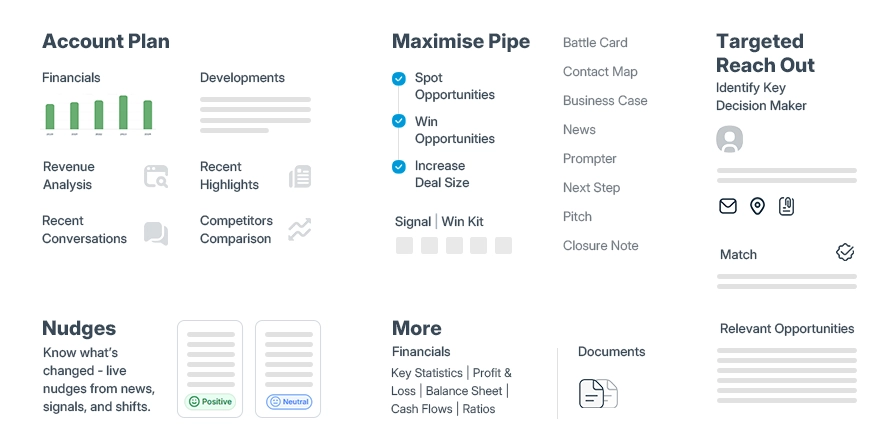
When evaluating Sales Intelligence Software vs Platform options, the sophistication of predictive scoring capabilities often distinguishes basic tools from enterprise-grade solutions. Leading platforms offer multiple predictive models customized for different products, business units, or industries—without requiring professional services to implement.
In essence, next-best opportunity identification bridges the gap between data collection and revenue generation by transforming raw information into actionable insights that drive sales success.
Identifying high-potential opportunities is only half the battle in enterprise sales. The next crucial step is determining precisely what actions will move deals forward. This is where next-best action recommendations come into play, guiding sales reps through complex buying journeys with AI-powered precision.
Modern sales intelligence tools now employ artificial intelligence to create highly personalized outreach sequences that drive meaningful engagement. These systems analyze prospect data and automatically generate tailored communication that resonates with potential buyers.
AI outreach tools use machine learning to improve, automate, and optimize communication with potential buyers, ultimately boosting engagement for your business. The most sophisticated systems can craft personalized outreach sequences in any language, incorporating custom variables that include company details, customer pain points, and campaign goals.
What makes these tools particularly valuable is their ability to:
Generate entire multi-channel campaigns instantly—including emails, LinkedIn messages, and call scripts
Auto-create follow-up messages based on previous interactions with prospects
Suggest messaging in real-time during live meetings to help reps answer prospect questions knowledgeably
Export personalized messages directly to your GTM stack, including Salesforce and Outreach
The impact of AI-generated sequences on Sales Intelligence ROI is substantial. Sales teams using these capabilities report securing more meetings and building stronger pipelines. Specifically, Reply's AI SDR feature enables reps to craft relevant emails that genuinely connect with audiences, while Outreach's tools empower teams to make data-driven decisions about when and how to engage prospects.
Nevertheless, the quality of your outreach matters immensely. For optimal results, effective sequences typically follow key principles: addressing prospect pain points, keeping CTAs under seven words, maintaining simplicity in language, and showing the impact of your solution on key metrics.
A standout feature of advanced b2b sales intelligence platforms is their ability to recommend not just what to say, but which channel to use based on historical engagement patterns. This capability proves especially valuable as enterprise buyers increasingly prefer different communication methods at various stages of their journey.
Channel prioritization systems analyze previous interactions to determine which communication methods are most likely to succeed with each prospect. This data-driven approach enables several powerful capabilities:
Channel escalation: If a prospect doesn't respond to an initial email within a defined timeframe, the system can automatically recommend following up via a different channel, such as SMS or LinkedIn
Event-based suppression: Once a customer completes a desired action (like scheduling a demo), the system automatically pauses or excludes them from related outreach
Preference respecting: If a prospect opts out of email communications, the system suppresses future outreach across all channels, maintaining relationship integrity
Sequenced messaging: Orchestration of multi-step campaigns that start in one channel (perhaps in-app) and continue through others (email, then personalized ads) based on engagement patterns
McKinsey research indicates that next-best action stands out as one of the most exciting use cases in industries like tech services, durable equipment, and insurance, where sellers face numerous options to expand accounts. Their analysis shows that even when opportunities are prioritized using engagement and intent data, sales organizations often struggle to determine immediate next steps—a challenge these systems directly address.
Furthermore, AI can categorize leads by recommended channel actions, identifying who might benefit from webinar invitations versus immediate one-to-one interaction. This approach allows sales teams to focus their efforts on leads most likely to convert, shortening sales cycles and boosting productivity.
The distinction between basic Sales Intelligence Software vs Platform solutions often lies in these next-best action capabilities. While simpler tools might provide basic contact information, sophisticated platforms offer intelligent guidance that transforms how enterprise sales teams operate, making every interaction more relevant and timely.
STOP CHASING PROSPECTS
START CLOSING DEALS!!
Successful B2B sales meetings depend heavily on proper preparation. Sales intelligence tools now eliminate hours of pre-meeting research through AI-generated briefs, allowing enterprise sales professionals to focus on relationship building instead of information gathering.
In today's fast-paced enterprise sales environment, sales representatives often lack adequate time to prepare for meetings. Subsequently, AI-powered systems have emerged that automatically compile relevant information before every customer interaction. These systems work by:
Connecting to your calendar and identifying upcoming meetings
Pulling relevant data from CRM records and email exchanges
Generating structured summaries with key contextual information
Delivering these insights through your preferred channel (email, Slack, or directly in your CRM)
The time-saving impact is substantial—what once took hours of manual research now happens automatically. Reps using these automated preparation tools receive personalized morning briefings listing all upcoming calls, complete with summaries of previous activities and internal notes for each contact. As a result, sales professionals can start conversations with confidence, armed with the right information at precisely the right moment.
Generally, modern b2b sales intelligence platforms go beyond basic contact information by incorporating multiple data sources. For instance, some systems analyze a prospect's LinkedIn profile to extract their name, job title, company details, and other professional information. Others gather company-specific data including domain, industry classification, employee headcount, and recent news. This comprehensive approach provides a complete view of both the individual and their organization.
At this point, the most valuable systems identify patterns in prospect data that might otherwise go unnoticed. Some platforms can determine if a prospect has experience with specific technologies relevant to your offering—creating natural conversation starters for sales calls. Others highlight recent social media posts or summarize press releases about the prospect's company, offering timely talking points.
Although preparation helps avoid many common obstacles, objections remain inevitable in enterprise sales. Thankfully, sales intelligence tools now analyze past interactions to develop effective objection handling strategies.
The process begins with gathering sales data from multiple sources:
Call recordings (from platforms like Gong or Chorus)
CRM data (from systems like HubSpot)
Lost deal analysis documents
Qualitative feedback from sales team communications
By analyzing this information, patterns emerge regarding which objections occur most frequently and which responses prove most effective. The most sophisticated systems process call transcripts to identify common objection trends, allowing teams to get ahead of newer objections before they become widespread.
In light of this data analysis, some platforms can generate customized objection handling scripts based on what has previously worked with similar prospects. These scripts typically follow a five-point framework:
Listen to the prospect
Ask open-ended questions
Solve the objection
Confirm the solution
Move forward with the sale
STOP GUESSING YOUR PIPELINE
START GROWING IT WITH AI SALES!!
The Sales Intelligence ROI from effective meeting preparation is clear. Teams utilizing AI-generated briefs report up to 30% higher win rates and drive more pipeline with fewer sales cycles. This efficiency stems from replacing hours of manual research with real-time, AI-generated sales briefs that deliver instant insights on every prospect.
When evaluating Sales Intelligence Software vs Platform options, meeting preparation capabilities often distinguish basic tools from enterprise-grade solutions. While simpler software might provide contact details, advanced platforms offer structured, AI-generated insights before every call and focused guidance tied to revenue-generating activities.
Responding to Request for Proposals (RFPs) represents one of the most resource-intensive activities for enterprise sales teams. Fortunately, modern sales intelligence tools now automate this process, dramatically reducing response time while maintaining quality.
Large Language Models (LLMs) have transformed RFP management by automatically extracting and analyzing critical information from complex documents. These advanced AI systems can process entire RFP documents—often hundreds of pages long—in minutes rather than the days required for manual review.
The process begins when sales teams upload RFP documents to their b2b sales intelligence platform. The system immediately starts analyzing the content using sophisticated document parsing techniques. Indeed, modern LLMs can analyze uploaded RFPs, automatically tagging critical instructions, evaluation criteria, and compliance checkpoints. This eliminates the need for manual requirement breakdowns that previously consumed countless hours.
Once parsed, the AI generates summaries that highlight key requirements and organizes them into manageable sections. On balance, these AI systems offer several distinct advantages:
They create initial RFP responses within minutes, providing a robust starting point
They maintain brand voice and accuracy throughout the document
They identify outdated content that needs refreshing
They can function across multiple languages, with some platforms supporting over 30 languages
To put it differently, what once took days of manual work now happens automatically, allowing sales teams to focus on customizing and refining responses rather than starting from scratch.
Given that enterprise RFPs typically require input from multiple departments, effective collaboration becomes essential. Coupled with document parsing capabilities, modern RFP management solutions offer sophisticated version control and collaboration features.
These platforms transform RFP response from an individual burden to a coordinated team effort by providing centralized dashboards that show task assignments and deadlines. Team members can work simultaneously on different sections without creating conflicting versions or duplicating efforts.
The workflow typically follows these steps:
The AI system assigns specific questions to subject matter experts based on their expertise
Contributors work in real-time on their assigned sections
The system tracks progress via central dashboards and sends automated reminders
Designated reviewers approve completed sections through established approval workflows
The final document is assembled with consistent formatting and branding
In the same way that version control systems revolutionized software development, these collaboration features have transformed how enterprise teams handle complex RFPs. Changes are tracked automatically, ensuring compliance throughout the process while maintaining a clear record of modifications.
The Sales Intelligence ROI from automated RFP response is substantial. Teams using RFP software submit an average of 46% more responses annually and influence 65% more revenue ($405.20M compared to $245.10M for teams without such software). Even more striking, high-performing teams using RFP response software win more than 50% of their bids.
By combining document parsing, summarization, and collaboration features, these systems enable enterprises to compete for premium opportunities while maintaining operational efficiency—a clear advantage when comparing Sales Intelligence Software vs Platform options for large organizations.
Make Every Rep Speak
Like Your Top 1%
Pricing optimization presents one of the most valuable applications of sales intelligence tools in enterprise environments. Smart pricing engines use AI to determine optimal price points, whereas deal scoring capabilities assess transaction quality—both essential components in maximizing B2B sales revenue.
Unlike traditional market segmentation, micro-segmentation divides your customer base into highly specific groups with common characteristics. This data-driven approach creates small, actionable segments that allow for precise pricing optimization. The return on investment for proper micro-segmentation work is remarkable—typically 5-10 times the initial investment.
Most b2b sales intelligence platforms now employ micro-segmentation through these methods:
Analyzing both qualitative and quantitative attributes to form detailed customer groups
Assigning values to specific traits and forming segments around common characteristics
Creating scoring models that accurately predict willingness to pay
Throughout the segmentation process, attributes such as customer size, geography, order size, product velocity, and product category are arranged in tree structures. Advanced statistical techniques then determine market prices for each segment, even in nodes with limited transaction data.
The key advantage of AI-driven pricing over legacy approaches lies in precision. Traditional systems force customers into predefined segments, often resulting in pricing errors. For instance, a $0.30 BIC pen and a $299.99 Mont Blanc pen might incorrectly end up in the same cluster due to data sparsity, leading to overpricing of the BIC and underpricing of the Mont Blanc.
Modern pricing engines utilize neural networks that analyze 100% of available data to find correlations in willingness-to-pay at the customer-SKU level. This approach allows businesses to set different prices for different customers based on their perceived value, competitive positioning, and price elasticity.
After establishing optimal price points, sales intelligence tools now offer AI-powered negotiation support. Dynamic Deal Scoring (DDS) represents a significant advancement in this area—an AI-driven system that evaluates specific deal situations and identifies opportunities for increased profitability in real-time.
The process starts with identifying crucial variables such as deal size, stage, product configuration, and sales channels. The system then segments deals using advanced analytics like K-means clustering and CHAID decision trees. Each deal receives color-coded price optimization insights based on quality and value.
In practice, AI negotiation support offers several benefits:
Suggesting optimal discounts and deal terms based on historical data
Formulating quotes automatically and responding to customers
Recommending dynamic bundling options
Learning from previous deals to inform future offers
Developing accurate price counters while maintaining margin requirements
Perhaps most notably, AI brings consistency to enterprise pricing. Since it's unemotional, AI can be trained to always make optimal pricing offers that benefit both buyer and seller. This reduces the back-and-forth typically required in negotiations, closing deals faster while ensuring consistency across teams and regions.
The Sales Intelligence ROI from smart pricing engines is substantial. By enabling real-time price calculations—processing tens of millions of daily price requests even in volatile markets—these systems eliminate manual work while delivering precise, account-specific prices businesses can trust.
When evaluating Sales Intelligence Software vs Platform options, the sophistication of pricing capabilities often distinguishes basic tools from enterprise-grade solutions. Advanced platforms handle complex pricing across products, segments, and channels without adding complexity, making them suitable for evolving requirements and long-term adaptability.
Effective coaching has emerged as a critical function of sales intelligence tools, enabling data-driven performance improvement across enterprise sales teams. Unlike traditional coaching methods that rely on subjective observations, AI-powered solutions offer objective analysis of specific behaviors and measurable improvement opportunities.
The talk-to-listen ratio serves as a fundamental metric for evaluating sales conversation quality. Based on an analysis of 326K sales calls, the optimal balance averages 60% talking to 40% listening. Interestingly, this ratio shifts slightly in successful outcomes—representatives who closed deals talked less (57% talk time) compared to those who lost deals (62% talk time).
What truly separates top performers isn't just how much they talk but their consistency. High performers maintain nearly identical talk patterns regardless of outcome, whereas lower performers exhibit dramatic swings—their talk time fluctuates by 10%, from 54% in won deals to 64% in lost deals. This inconsistency reveals that lower performers typically react to conversations rather than following structured approaches.
To improve this critical metric, successful b2b sales intelligence platforms recommend several techniques:
Implement the "two-second rule"—pausing briefly before responding
Rephrase what buyers say to confirm understanding
Replace yes/no questions with open-ended inquiries
Use the phrase "tell me more" to encourage deeper discussion
AI coaching systems address a persistent challenge in sales organizations—most managers simply lack sufficient time to provide personalized training to every team member. These systems analyze various inputs to create tailored development plans:
First, they evaluate call recordings to identify patterns in speech, sentiment, and objection handling. Next, they simulate realistic customer interactions, allowing reps to practice pitches in safe environments. As representatives deliver their pitches, the AI coach analyzes in real-time, offering immediate feedback on tone, clarity, empathy, and objection handling techniques.
The adoption of these tools continues to accelerate, with 40% of businesses increasing their use of AI for sales coaching. This growth stems from tangible benefits—organizations report reduced rep ramp time by up to 40% through immediate, call-specific feedback.
The most sophisticated systems adapt to individual learning preferences, generating coaching plans that evolve alongside the rep's development. Likewise, by identifying specific struggle areas—such as discovery, objection handling, or closing—these tools ensure coaching remains focused and actionable.
The Sales Intelligence ROI from AI coaching materializes through faster onboarding, more consistent selling behaviors, and ultimately, improved close rates. When evaluating Sales Intelligence Software vs Platform options, coaching capabilities often distinguish comprehensive solutions from basic tools.
Implementing sales intelligence tools across an enterprise requires careful strategic planning rather than rushing toward adoption. Organizations that apply structured implementation methods typically achieve 60-80% higher ROI from their sales intelligence investments compared to those pursuing ad hoc approaches.
STOP GUESSING YOUR PIPELINE
START GROWING IT WITH AI SALES!!
The foundational question for many enterprises centers on whether to build custom sales intelligence capabilities or partner with external providers. This decision impacts everything from budget allocation to competitive positioning.
Time-to-value often serves as the primary determining factor:
Building in-house: Takes 12-24 months for full production, with initial months spent on talent acquisition and infrastructure setup
Buying external solutions: Requires only 3-9 months to deployment, beginning with vendor selection and ending with advanced customization
Beyond timing, three critical factors influence this decision:
First, data sensitivity and regulatory requirements must be evaluated, as highly regulated industries often benefit from building solutions that provide complete data residency control. At the same time, less sensitive applications may leverage vendor solutions with proper security certifications.
Second, customization needs vary significantly. Organizations should build when AI directly contributes to competitive differentiation yet buy when speed to market outweighs customization requirements.
Third, total cost analysis must extend beyond initial investments to ongoing operational expenses. Building typically requires USD 2.50M-4.80M upfront in the first year, while buying involves annual recurring costs of USD 750.00K-2.25M.
Successful implementation hinges on effective change management—projects with proper change approaches are six times more likely to meet objectives. In fact, lack of adoption remains the primary reason change efforts fail.
Creating a supportive environment begins with addressing the human element:
Starting with clear explanations of how tools benefit individual sellers
Making space for questions and acknowledging concerns early
Setting explicit expectations for success metrics and desired behaviors
Developing people-first AI policies that establish psychological safety
Even the most advanced b2b sales intelligence platform delivers minimal Sales Intelligence ROI without proper enablement. Establishing structured training programs and certification paths drives adoption rates exceeding 85% within 90 days, compared to industry averages of 60-65% for similar technology deployments.
Through these frameworks, organizations create not merely an IT project but a genuine cultural shift that maximizes the value of their Sales Intelligence Software vs Platform investments.
Sales intelligence has evolved from a mere data-gathering tool to an essential strategic asset for enterprise B2B organizations. Throughout this article, we've explored how these powerful solutions transform scattered customer information into actionable insights that drive substantial revenue growth.
AI-powered account research gives sales teams unprecedented advantages, allowing them to identify high-potential accounts with remarkable accuracy through real-time firmographic data and trigger-based prospecting. Similarly, predictive models help teams pinpoint their next-best opportunities through intent signal analysis and CRM-integrated scoring, thus ensuring resources focus on deals most likely to close.
Beyond identification, modern sales intelligence equips representatives with next-best action recommendations, guiding them through complex buying journeys with AI-generated outreach sequences and channel prioritization based on engagement history. This guidance continues through meeting preparation, where AI-generated briefs eliminate hours of research, allowing teams to focus on relationship building instead of information gathering.
For large enterprise deals, automated RFP response generation significantly reduces the resource-intensive process while maintaining quality. Additionally, smart pricing and deal scoring engines help teams optimize pricing through micro-segmentation and provide AI-powered negotiation support that delivers consistent results across the organization.
Perhaps most significantly, AI-based sales coaching now enables data-driven performance improvement, analyzing call recordings for optimal talk-to-listen ratios and creating personalized development plans tailored to individual representatives.
Accordingly, organizations must approach implementation strategically, carefully evaluating the buy-vs-build decision and implementing effective change management practices to ensure adoption. Those who successfully deploy these tools report impressive results—boosting win rates by up to 28%, shortening sales cycles by 23%, and achieving 3-5x return on their investment within the first year.
Sales intelligence has undoubtedly changed the enterprise B2B landscape. Teams that embrace these technologies gain clear competitive advantages while those that hesitate risk falling behind. The future of enterprise sales belongs to organizations that recognize these tools not merely as software purchases but as fundamental strategic investments that transform how they identify, pursue, and win business opportunities.
Your SDRs work 9–5
AI Sales works 24/7!!
Sales intelligence refers to tools and technologies that provide data-driven insights to help sales teams identify, engage, and close deals more effectively. For enterprise B2B sales, it offers benefits like improved account targeting, predictive opportunity scoring, AI-powered outreach recommendations, and automated meeting preparation - ultimately leading to higher win rates and shorter sales cycles.
AI-powered account research automates data collection and analysis, allowing sales teams to identify high-potential accounts with greater accuracy. It provides real-time firmographic and technographic data, enabling more precise targeting. Additionally, it utilizes trigger-based prospecting by monitoring events like funding rounds and job changes, helping sales teams engage prospects at the right time.
Predictive models in sales intelligence platforms analyze various data points to identify next-best opportunities. They utilize intent signal analysis from third-party platforms to spot companies actively researching solutions. These models also integrate with CRM systems to provide opportunity scoring, helping sales teams prioritize deals with the highest likelihood of closing.
AI-generated meeting briefs automatically compile relevant information from CRM records and email exchanges before customer interactions. This saves sales representatives hours of manual research time. These briefs often include summaries of previous activities, company-specific data, and even objection handling scripts based on past interactions, allowing reps to enter meetings well-prepared and confident.
When implementing sales intelligence tools enterprise-wide, organizations should consider the buy vs. build decision, evaluating factors like time-to-value, data sensitivity, customization needs, and total cost of ownership. Effective change management is crucial for successful adoption, including clear communication of benefits, structured training programs, and establishing metrics for success. A strategic approach to implementation can lead to significantly higher ROI from sales intelligence investments.
STOP CHASING PROSPECTS
START CLOSING DEALS!!

Category: Uncategorized Tags: ai, AIOps, Artificial Intelligence, cloud, cloud platform, Cybersecurity, Information and Communications Technology , VR