How AI Is Rewriting the Rules of Revenue Growth in 2026 and Beyond
December 08, 2025
Let’s cut through the noise for a second. Selling today isn’t just harder—it’s radically different. Buyers are more informed than ever, competition is global by default, and attention? Well, that’s the rarest commodity in B2B. Against that backdrop, Sales Enablement isn’t just a function—it’s the strategic command center of modern revenue organizations.

Gone are the days when Sales Enablement merely meant uploading pitch decks into a shared drive and hoping reps would “figure it out.” Today, Sales Enablement is about precision, intelligence, orchestration, and timing. It’s about knowing who to engage, when to engage, what to say, and how to win—before your competitor even knows the deal exists.
And here’s the kicker: in 2026 and beyond, AI Sales platforms like SalesPlay by MarketsandMarkets are redefining what Sales Enablement actually means. It’s no longer about activity. It’s about signal-driven selling at scale.
At its core, Sales Enablement aligns people, process, content, coaching, and intelligence into one high-velocity revenue system. But its true power? It multiplies execution across every revenue role—SDRs, AEs, managers, RevOps, and even marketing.
When Sales Enablement is done right:
Reps ramp faster
Deals move cleaner
Forecasts tighten
Messaging stays consistent
Buyer trust increases
Revenue becomes predictable—not accidental
According to Gartner, organizations with formal Sales Enablement programs achieve up to 20% higher win rates than their peers. But here’s the real truth: the winners aren’t just enabling reps. They’re enabling decisions—with AI, intent data, and market-level intelligence.
Let’s rewind for perspective.
Sales Enablement started as digital storage. Reps searched folders. Old decks floated around. No usage tracking. No buyer context. Total chaos.
Organizations invested in onboarding, LMS platforms, and coaching. Helpful? Yes. Sufficient? Not anymore.
This is where SalesPlay enters the picture.
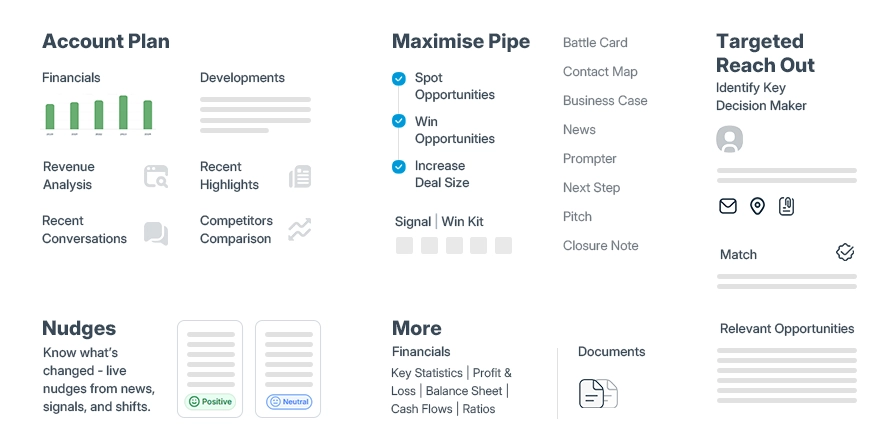
Modern Sales Enablement platforms don’t just store content—they interpret markets, read buyer signals, score deals, and recommend next-best actions in real time.
McKinsey confirms that AI-driven sales adoption now delivers 10–20% revenue uplift across industries. Sales Enablement has officially graduated—from support act to main stage.
Most Sales Enablement tools stop at the rep. SalesPlay goes one level higher—it enables the market motion itself.
While typical platforms focus on:
Call recordings
CRM notes
Sales emails
Training modules
SalesPlay connects Sales Enablement to:
Market demand intelligence
Buyer intent surges
Competitive deal pressure
Account-level buying committees
Win-loss analysis across industries
In short, SalesPlay doesn’t just enable selling—it enables market-winning.
Let’s get practical. High-performance Sales Enablement in 2026 stands on five unshakeable pillars—each powered by intelligence, not guesswork.
Sales content should never feel like a warehouse. It should feel like a GPS.
Modern enablement ensures:
Content mapped to buyer journey stages
Industry-specific credibility assets
Objection-handling playbooks
Competitive displacement tools
Dynamic ROI modeling
SalesPlay elevates this by contextualizing content using market demand and account readiness. That means reps don’t just see “what content exists”—they see what content converts for this buyer, right now.
Coaching without intelligence is just opinion. Coaching with AI is a revenue multiplier.
Modern Sales Enablement uses:
Call sentiment analysis
Objection pattern detection
Talk-to-listen ratio optimization
Deal-stage risk alerts
HubSpot reports that structured, data-backed coaching improves win rates by up to 16%. SalesPlay adds market feedback loops to coaching—so reps don’t just learn from internal performance but from external deal dynamics across the industry.
This is where most Sales Enablement programs fail—they enable activity, not timing.
SalesPlay introduces:
Account-level demand spikes
Category-level buying signals
Competitor displacement opportunities
Whitespace identification
This flips selling from reactive to predictive. Reps no longer chase leads—they intercept demand.
Forrester confirms that intent-driven teams outperform peers in pipeline velocity by over 2X. That’s not just enablement—that’s market interception.
Sales Enablement without RevOps alignment is like driving with one eye closed.
Modern enablement must feed:
Pipeline health scoring
Deal slippage prediction
Revenue leak detection
Forecast integrity modeling
SalesPlay merges market intelligence + deal intelligence to create forecasts that don’t depend on hope.
Let’s be blunt: if reps don’t adopt it, it doesn’t exist.
Modern Sales Enablement tracks:
Content usage by deal stage
Coaching adoption metrics
Enablement ROI attribution
Win-rate lift by asset usage
SalesPlay gives leadership a revenue lens on enablement, not vanity metrics.

This question keeps popping up in boardrooms:
Aren’t Sales Enablement and Sales Operations basically the same thing?
Not quite.
| Sales Operations | Sales Enablement |
|---|---|
| CRM systems | Behavior systems |
| Quotas & territories | Skills & execution |
| Reporting | Performance |
| Compensation | Capability |
| Process hygiene | Deal acceleration |
Sales Operations builds the highway.
Sales Enablement teaches you how to race on it.
SalesPlay connects both—with market-level intelligence as the bridge.
Let’s call out the uncomfortable truth.
Traditional Sales Enablement fails because:
It lacks external market awareness
It focuses on training over timing
It measures adoption, not outcomes
It ignores competitive deal pressure
It treats content as static
Today’s revenue battlefield demands:
Live market sensing
Competitive response automation
Predictive deal engagement
Buyer committee orchestration
This is why AI-native Sales Enablement platforms like SalesPlay aren’t incremental upgrades—they’re category reinventions.
Here’s how elite revenue teams now run their enablement engines:
Market demand is detected in real time
High-intent accounts are auto-prioritized
Reps receive context-rich deal signals
Personalized content & talk tracks deploy
Deal risk is continuously recalculated
Coaching triggers in-cycle, not post-mortem
Win/loss data feeds back into the system
This creates a self-optimizing revenue flywheel—and SalesPlay is designed to operate at the center of it.
Here’s a mindset shift most organizations haven’t made yet:
Sales Enablement is not a cost center.
It’s a competitive weapon.
When competitors are guessing, your team is anticipating.
When competitors are pitching, your team is advising.
When competitors are responding, your team is orchestrating.
LinkedIn Business confirms that aligned, enabled sales teams are 67% more effective at closing complex B2B deals. That’s not just improvement—that’s domination.
Enterprise selling isn’t persuasion—it’s problem orchestration across buying committees.
Modern Sales Enablement must support:
Multi-stakeholder narratives
Cross-functional proof points
Regulatory, IT, and ROI validations
Competitive counter-positioning
Executive-level business cases
SalesPlay integrates market intelligence with account intelligence, enabling sellers to align every stakeholder with real-world industry outcomes—not just internal case studies.
Let’s fast-forward.
Here’s what will define Sales Enablement leadership through 2030:
Autonomous AI sales copilots
Predictive deal negotiation guidance
Emotion-aware conversation analytics
Buying committee influence scoring
Market-guided account-based enablement
Sales Enablement will evolve from:
“Helping sellers sell”
to
“Orchestrating how markets buy.”
SalesPlay is already architected for this future.
Even strong organizations stumble here:
Treating enablement as onboarding-only
Separating enablement from Go-To-Market strategy
Ignoring competitive pressure modeling
Measuring downloads instead of deal impact
Under-investing in intelligence
If Sales Enablement doesn’t influence pipeline velocity, conversion rates, and forecast accuracy, it’s not enablement—it’s administration.
Here’s a proven enterprise-grade rollout approach:
Diagnose Market & GTM Readiness
Industry demand volatility
Buyer behavior shifts
Competitive intensity
Align Enablement with Revenue Strategy
ICP definition
Market segmentation
Revenue motion mapping
Activate AI-Led Demand Intelligence
Market surge detection
Account prioritization
Competitive activation
Operationalize Coaching & Content
In-cycle coaching
Buyer-stage content routing
Objection intelligence
Tie Enablement to Revenue Outcomes
Win-rate lift
Time-to-close reduction
Forecast accuracy gain
SalesPlay operationalizes all five—natively.
Here’s the paradox:
The more you enable sellers, the less buyers feel like they’re being “sold to.”
Great Sales Enablement ensures:
Buyers never repeat context
Conversations feel consultative
Solutions feel tailored
Decisions feel safe
Trust compounds naturally
That’s not sales psychology. That’s enablement design.
Organizations using AI + market-driven Sales Enablement consistently outperform by:
Up to 30–40% faster pipeline velocity
15–25% higher deal sizes
2–3X better forecast accuracy
Significant churn reduction
These aren’t incremental lifts—they redefine revenue reliability.
Let’s land this clearly.
Sales Enablement is no longer:
A sales support function
A content distribution role
A training facilitator
It is now:
A revenue strategy discipline
A market intelligence orchestrator
A deal acceleration engine
A forecast stabilization system
And in a world where growth is no longer guaranteed, Sales Enablement powered by platforms like SalesPlay isn’t optional—it’s existential.
The companies that master it will shape markets.
The ones that ignore it will chase them.
Not anymore. Tools enable actions. Intelligence enables outcomes. Modern Sales Enablement is about decision systems, not software stacks.
Sales Enablement feeds behavior signals into Revenue Intelligence, while Revenue Intelligence feeds deal risk signals back into Enablement. SalesPlay unifies both into one market-aware loop.
Absolutely. By prioritizing high-intent accounts, improving conversion rates, and reducing deal friction, Sales Enablement directly lowers CAC.
Complexity scales in B2B. The more stakeholders, competition, and deal size involved—the more critical Sales Enablement becomes.
Timing. The right message at the wrong time still loses. Market-driven timing is the ultimate ROI multiplier.

Category: Uncategorized Tags: ai, AIOps, Artificial Intelligence, cloud, cloud platform, Cybersecurity, Information and Communications Technology , VR