SalesPlay vs Salesloft: The Ultimate Comparison Guide for B2B Sales Teams
December 16, 2025
The sales technology landscape has undergone a seismic transformation in 2025, with artificial intelligence fundamentally reshaping how B2B teams identify opportunities, engage prospects, and close deals. As organizations navigate an increasingly competitive marketplace where traditional outbound tactics deliver diminishing returns, the choice between sales platforms has never been more critical to revenue success.
Two platforms have emerged at distinct ends of the sales intelligence spectrum: SalesPlay, an AI-powered sales and revenue intelligence co-pilot built by MarketsandMarkets, and Salesloft, an established revenue orchestration platform focused on sales engagement and execution. While both aim to accelerate revenue growth, they address fundamentally different challenges in the modern sales process—one predicting opportunities before they exist, the other optimizing engagement with known prospects.
This comprehensive analysis examines these two platforms through the lens of what matters most to sales leaders in 2025: predictive capabilities, market intelligence depth, execution efficiency, pricing transparency, and measurable ROI. Whether you're a VP of Sales evaluating your technology stack, a revenue operations leader seeking to consolidate tools, or a sales enablement professional looking to empower your team, this guide provides the insights you need to make an informed decision.
Before diving into platform specifics, it's essential to understand the explosive growth reshaping the sales intelligence market. According to recent market research, the AI in sales market will reach $8.8 billion in 2025 and expand at a remarkable 32.6% compound annual growth rate through 2032, reaching $63.5 billion. This growth reflects a fundamental shift in how organizations approach revenue generation.
The sales intelligence segment specifically is projected to grow from $4.42 billion in 2025 to $8.19 billion by 2030, delivering a 13.12% CAGR. What's driving this surge? Artificial intelligence is compressing prospect research cycles from 3-5 hours to just 10-15 minutes by analyzing intent signals from over 100,000 sources. Meanwhile, 75% of high-growth companies plan to formalize Revenue Operations by 2025, creating unprecedented demand for platforms that unify data across the customer lifecycle.
For context, the broader sales intelligence market encompasses contact databases (ZoomInfo, Apollo.io), conversation intelligence (Gong, Chorus.ai), sales engagement platforms (Salesloft, Outreach), and predictive intelligence platforms (SalesPlay). Each category serves distinct use cases, and understanding where platforms fit in this ecosystem is crucial for making the right investment.
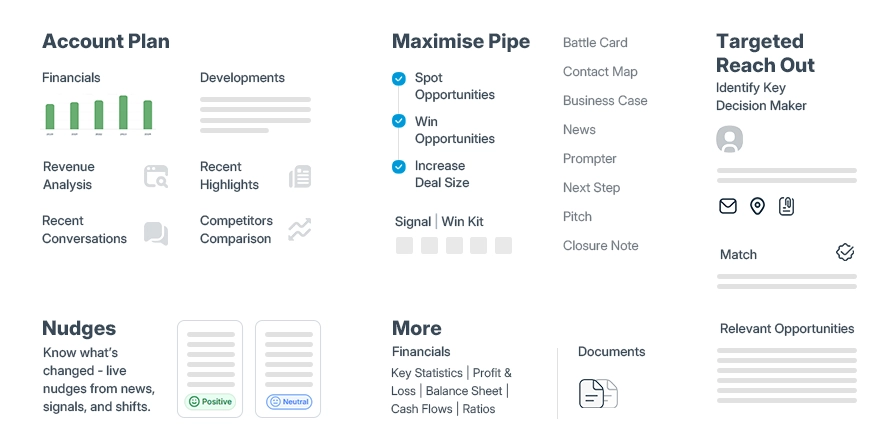
SalesPlay represents a paradigm shift from reactive sales intelligence to proactive opportunity identification. Built by MarketsandMarkets—a company trusted by 80% of Fortune 2000 enterprises—SalesPlay leverages real-time market intelligence to uncover revenue opportunities 3-5 weeks before traditional intent data signals emerge.
The platform operates on three core pillars:
1. Opportunity Identification Before Intent Signals Rather than waiting for prospects to research solutions, SalesPlay monitors ecosystem signals, revenue shifts, and mission-critical priorities that indicate upcoming needs. The platform analyzes factors like organizational restructuring, technology stack changes, regulatory compliance requirements, budget cycle patterns, competitive landscape shifts, and market expansion plans.
2. AI Sales Enablement Through Specialized Agents SalesPlay deploys 7 AI agents that work across the entire sales cycle. These agents automatically generate customized sales decks, create personalized messaging and value propositions, calculate ROI based on prospect-specific data, develop account-specific strategies, provide real-time competitive intelligence, and offer guided next-best actions for deal progression.
3. Integrated Hyper-Personalized System Unlike platforms requiring multiple tools, SalesPlay provides an all-in-one environment where intelligence seamlessly flows into execution. Sales teams receive auto-delivered materials tailored to each opportunity, eliminating the guesswork that typically plagues sales processes.
The platform's integration with MarketsandMarkets' database of over 15 million company profiles provides unparalleled market coverage. More importantly, SalesPlay focuses on the "why" behind buying decisions—understanding strategic initiatives, pain points, and priorities that drive enterprise purchases.
Salesloft has evolved from its origins as a sales prospecting tool into what it now brands as a "Revenue Orchestration Platform." The platform combines sales engagement, conversation intelligence, and pipeline management into a comprehensive suite designed to guide deals from initial outreach through close.
Core Capabilities:
Cadence & Automation Salesloft's foundation rests on its cadence functionality, enabling sales teams to create multi-touch sequences across email, phone, social, and other channels. The platform automates follow-ups, tracks engagement, and ensures consistent outreach patterns. Teams can build templates, A/B test messaging, and optimize send times based on historical performance data.
Conversations & Coaching The platform includes call recording, transcription, and basic analysis capabilities designed to help managers coach representatives. However, user reviews consistently indicate that Salesloft's conversation intelligence functionality lags significantly behind specialized tools like Gong, with many organizations purchasing Gong separately despite Salesloft's conversation features.
Deals & Pipeline Management Salesloft provides visibility into pipeline health, opportunity progression, and deal risk indicators. The Premier plan includes forecasting capabilities that leverage AI to predict revenue outcomes and identify pipeline risks.
Dialer & Messenger Communication tools integrate with Salesloft's cadence system, though the dialer functionality requires an additional purchase and has received mixed reviews from users who describe it as "clunky" compared to specialized dialing solutions.
Analytics & Reporting The platform centralizes metrics across sales activities, providing dashboards for activity tracking, email performance, call outcomes, and representative productivity. However, several users note that reporting features can be complex and difficult to extract actionable insights from.
The most fundamental difference between SalesPlay and Salesloft lies in their approach to sales intelligence:
SalesPlay's Predictive Approach SalesPlay operates under the premise that the best opportunities aren't visible in traditional intent data. By the time a prospect appears on your radar through content downloads or website visits, they've already engaged with 3-5 competitors and developed preliminary vendor preferences. SalesPlay's intelligence surfaces opportunities based on real-time revenue shifts, ecosystem changes, and strategic priorities—signals that precede traditional buying behavior.
For example, when a target company announces a $50 million Series C funding round focused on international expansion, SalesPlay automatically identifies this as a high-priority opportunity for infrastructure, localization, and compliance solutions. The platform generates a customized sales kit that addresses expansion challenges, regulatory requirements in target markets, and technology needs for scaling operations—all before the company issues an RFP or engages with vendors.
Salesloft's Execution Focus Salesloft assumes you already know who to target and focuses on optimizing how you engage those known prospects. The platform excels at managing outreach sequences, tracking engagement metrics, and ensuring representatives follow consistent workflows. If you have a well-defined target account list and need to execute a coordinated outreach strategy, Salesloft provides the infrastructure to do so efficiently.
However, Salesloft doesn't help you identify which accounts should be on that list in the first place, nor does it provide the market intelligence to understand why a particular account might be ready to buy. You're essentially optimizing outreach to prospects who may or may not have an active need—the classic "spray and pray" approach, albeit executed more efficiently.
SalesPlay's Comprehensive Intelligence Layer As a product of MarketsandMarkets, SalesPlay leverages a research infrastructure that has served Fortune 2000 companies for decades. The platform provides:
This intelligence isn't scraped from public sources or inferred from behavioral data—it's derived from primary research, analyst insights, and comprehensive market analysis that goes far deeper than typical B2B data providers.
Salesloft's Limited Intelligence Capabilities Salesloft primarily integrates with third-party data providers rather than providing native intelligence. Users can connect tools like ZoomInfo, Clearbit, LinkedIn Sales Navigator, and others to enrich contact data, but Salesloft itself doesn't generate original market intelligence.
This integration-dependent approach creates several challenges:
SalesPlay's Six Specialized AI Agents SalesPlay's AI agents represent a significant advancement over basic automation. These agents don't just execute pre-defined workflows—they make intelligent decisions based on real-time context:
Each agent learns from successful patterns across your organization, improving recommendations over time. When a deal closes, the agents analyze which materials, messages, and tactics contributed to success, applying those insights to future opportunities.
Salesloft's Limited AI Functionality While Salesloft has introduced some AI features, user feedback suggests these remain rudimentary compared to dedicated AI platforms. The platform offers:
Reviews consistently note that Salesloft's AI-powered features lag significantly behind competitors, particularly in conversation intelligence where users report Salesloft's native capabilities as "very poorly built" and only functional for calls made through its proprietary dialer.
SalesPlay Pricing SalesPlay follows an enterprise pricing model with custom quotes based on organization size and needs. While specific pricing isn't publicly disclosed, the platform's value proposition centers on pipeline generation that wouldn't exist otherwise—accounts that surface through SalesPlay typically don't appear in traditional prospecting workflows.
The key consideration: SalesPlay helps you identify opportunities competitors don't see, potentially creating an entirely new pipeline segment. When evaluating ROI, organizations should compare SalesPlay's cost against the revenue from opportunities that would never have entered your pipeline through conventional prospecting methods.
Salesloft Pricing: The Hidden Costs Salesloft's pricing structure has evolved into a complex model that often surprises buyers with unexpected costs:
Base Platform Pricing:
According to negotiation data from Vendr, actual Salesloft costs typically range:
The Add-On Trap: What catches many buyers off-guard are Salesloft's additional costs:
One user reported that their organization's total Salesloft spend, including add-ons and integrations, reached $1,000+ per user annually—significantly higher than the base pricing would suggest. Factor in the cost of complementary tools many teams purchase (Gong for conversation intelligence, a separate data provider), and the total cost of ownership can exceed $500/user/month.
SalesPlay Implementation SalesPlay's implementation focuses on aligning the platform with your ideal customer profile and strategic priorities. The process typically includes:
Users report achieving value within 2-3 weeks, as the platform immediately begins surfacing opportunities. The learning curve is relatively gentle because SalesPlay presents actionable intelligence rather than requiring complex configuration.
Salesloft Implementation: The 90-Day Reality Despite Salesloft's marketing around quick deployment, actual implementation timelines often extend significantly:
Week 1-2: Initial Setup
Week 3-6: Customization Phase
Week 7-10: Integration & Optimization
Week 11-12: Adoption & Refinement
Multiple users report that achieving full adoption and realizing value from Salesloft took 3-4 months, with ongoing RevOps resources required to maintain integrations and optimize configurations.
SalesPlay: Intelligence-First Design SalesPlay's interface prioritizes delivering actionable intelligence with minimal friction. The platform automatically surfaces relevant opportunities on your dashboard, with each account displayed alongside key signals, recommended actions, and auto-generated materials. Representatives can review intelligence, access pre-built sales kits, and execute outreach without navigating multiple screens.
The design philosophy centers on elimination of research time—everything a representative needs to engage an account is presented in context, eliminating the need to switch between multiple tools or hunt for information.
Salesloft: Complex but Comprehensive Salesloft's interface reflects its evolution from simple email sequencing to full revenue orchestration platform. Users describe it as "functional but overwhelming," with numerous sections, settings, and configuration options that require significant training to navigate effectively.
Common user complaints include:
That said, for teams that invest the time to master Salesloft's interface, the platform provides comprehensive visibility into sales activities and pipeline health. The challenge lies in the initial learning curve and ongoing navigation complexity.
| Feature/Capability | SalesPlay | Salesloft |
|---|---|---|
| Predictive Opportunity Identification | Core capability - identifies opportunities 3-5 weeks early | Not available - requires external intent data providers |
| Real-Time Market Intelligence | Comprehensive - revenue shifts, ecosystem signals, priorities | Limited - relies on third-party integrations |
| AI Agent Automation | Six specialized agents for full sales cycle | Basic AI features - email optimization, send time recommendations |
| Sales Engagement Sequences | Execution support through guided actions | Core strength - advanced cadence management |
| Conversation Intelligence | Not primary focus | Available but poorly reviewed - most users buy Gong separately |
| Auto-Generated Sales Materials | Decks, messaging, ROI calculations, strategies | Not available - templates must be manually created |
| Technology Stack Intelligence | Built-in technology discovery and integration mapping | Requires separate data provider |
| Budget Cycle & Timing Insights | Native capability | Not available |
| Competitive Intelligence | Real-time competitive landscape analysis | Not available |
| Email Automation | Basic capabilities | Advanced with A/B testing, templates, tracking |
| Dialer Functionality | Not included | Available as paid add-on - mixed reviews |
| CRM Integration | Bi-directional sync with major CRMs | Deep integration with Salesforce, others |
| Forecasting | Pipeline visibility | AI-powered forecasting (Premier plan only) |
| Pricing Transparency | Custom enterprise pricing | Opaque with significant add-on costs |
| Implementation Timeframe | 2-3 weeks to value | 3-4 months for full adoption |
| Learning Curve | Intuitive intelligence presentation | Steep - described as “overwhelming” |
Scenario 1: New Market Entry or Product Launch A cybersecurity company launching a cloud security compliance solution needs to identify enterprises facing regulatory requirements. SalesPlay monitors regulatory changes (GDPR, CCPA, SOC 2), tracks companies implementing cloud migrations, and surfaces organizations hiring compliance officers—all signals that precede active vendor evaluation. The platform generates customized materials addressing specific regulatory frameworks relevant to each prospect.
Result: Sales team engages 30+ qualified prospects before RFPs are issued, winning 7 deals by positioning as strategic advisors rather than responding to procurement processes.
Scenario 2: Account-Based Marketing at Enterprise Scale A SaaS company with 250 target enterprise accounts struggles to prioritize outreach. SalesPlay analyzes all 250 accounts continuously, surfacing the 15 showing highest propensity to buy based on recent funding events, technology stack changes, leadership transitions, and competitive movements.
Result: Instead of spreading resources across 250 accounts, the team concentrates on 15 high-probability opportunities, achieving 3x higher win rates and 40% shorter sales cycles.
Scenario 3: Competitive Displacement Strategy A unified communications provider wants to win customers from a legacy competitor facing technical debt issues. SalesPlay identifies accounts using the competitor's platform that are simultaneously investing in digital transformation initiatives, expanding remote workforce capabilities, or experiencing customer service challenges.
Result: Targeted outreach at the exact moment prospects are evaluating alternatives, resulting in 25% competitive win rate improvement.
Scenario 1: High-Volume Outbound with Known Target Lists A sales development team with a clear target account list (derived from firmographic criteria) needs to execute consistent, repeatable outbound sequences at scale. Salesloft enables the team to create multi-touch cadences, track engagement, and ensure no prospect falls through the cracks.
Result: Standardized outreach increases SDR productivity by 40%, with better visibility into which messages and touchpoints drive responses.
Scenario 2: CRM Hygiene and Activity Tracking A sales organization struggles with incomplete CRM data and poor activity logging. Salesloft automatically syncs emails, calls, and meeting activities to Salesforce, ensuring complete records without manual data entry.
Result: Improved forecast accuracy due to better visibility into actual sales activities and engagement patterns.
Scenario 3: Manager Visibility and Coaching Sales leadership wants better insight into representative activities and performance. Salesloft provides dashboards showing call volumes, email metrics, cadence execution, and pipeline progression for each team member.
Result: Managers can identify underperformers, provide targeted coaching, and replicate successful patterns across the team.
SalesPlay integrates with major CRM platforms (Salesforce, HubSpot, Microsoft Dynamics) to ensure intelligence flows directly into existing workflows. The key advantage is that SalesPlay enriches your CRM with market intelligence and auto-generated materials rather than simply syncing activity data.
When an opportunity is identified in SalesPlay, it can automatically create or update records in your CRM, attach generated sales materials, and log intelligence signals as notes. Representatives working in either platform see consistent information without manual data entry.
Additionally, SalesPlay's integration philosophy focuses on reducing tool sprawl. Rather than requiring separate providers for contact data, intent signals, competitive intelligence, and sales enablement content, SalesPlay consolidates these capabilities into a single platform.
Salesloft: Extensive Integration Marketplace
Salesloft offers a comprehensive integration marketplace with 150+ connectors covering:
The breadth of integrations is impressive, but it also highlights Salesloft's positioning as an orchestration layer rather than a complete solution. Organizations often find themselves licensing 5-7 different tools to achieve comprehensive sales intelligence and execution capabilities.
This multi-tool approach has several implications:
SalesPlay Success Metrics
Organizations leveraging SalesPlay report significant pipeline impact:
The platform is particularly effective for organizations selling complex B2B solutions where understanding strategic context and priorities is crucial for effective positioning.
Salesloft Performance Data
Salesloft users report operational improvements:
These metrics reflect Salesloft's strength in optimizing execution of known sales motions rather than fundamentally changing what opportunities enter your pipeline.
Choose SalesPlay If:
? Your primary challenge is pipeline generation, not optimizing existing workflows
? You sell complex solutions where understanding strategic context is essential
? Your market is competitive and early engagement provides significant advantage
? You want to consolidate tools rather than managing multiple point solutions
? Your sales cycle is long and positioning matters more than activity volume
? You’re entering new markets or launching products where target accounts aren’t obvious
? Your team spends excessive time researching accounts and creating custom materials
Choose Salesloft If:
? You have a well-defined target account list and need to execute outreach at scale
? Your sales motion is high-volume with shorter, transactional sales cycles
? CRM hygiene and activity tracking are significant pain points
? You need detailed manager visibility into representative activities
? Your organization has RevOps resources to maintain integrations and configurations
? You’re willing to invest 3-4 months in implementation and adoption
? Budget allows for multiple tools to complement Salesloft’s capabilities
Some sophisticated sales organizations leverage both platforms in complementary ways:
However, this approach requires significant investment and careful orchestration to prevent workflow duplication and data inconsistencies. Most organizations will find greater value and simplicity in selecting the platform that best aligns with their primary revenue motion.
According to McKinsey's 2025 State of AI report, revenue increases from AI use are most commonly reported in marketing and sales functions, with 6% of organizations achieving 5% or more EBIT impact—McKinsey's definition of "AI high performers." These high performers share common characteristics: they push for transformative innovation via AI, redesign workflows around AI capabilities, and invest in platforms that deliver predictive insights rather than just automating existing processes.
The implication for sales technology selection is clear: platforms that help you identify opportunities earlier and understand buyer context deliver more transformative value than those that simply optimize manual workflows. While activity automation provides incremental gains, predictive intelligence can fundamentally change what deals enter your pipeline.
Revenue operations leaders are increasingly frustrated with technology stack fragmentation. A typical B2B sales organization now licenses 8-12 different tools for prospecting, engagement, intelligence, conversation analysis, forecasting, and enablement—each requiring integration, maintenance, and user adoption efforts.
The trend toward platform consolidation is accelerating, with organizations seeking fewer, more comprehensive solutions rather than best-of-breed point solutions. This shift favors platforms like SalesPlay that integrate multiple capabilities (intelligence, enablement, execution guidance) over orchestration platforms like Salesloft that coordinate separate tools.
Consider a 50-person sales organization with $50 million annual revenue target:
Without SalesPlay:
With SalesPlay:
Impact:
Same 50-person organization:
Without Salesloft:
With Salesloft:
Impact:
The Critical Difference: SalesPlay's ROI derives from accessing opportunities that wouldn't exist in your pipeline otherwise. Salesloft's ROI comes from more efficiently working opportunities you would have pursued anyway. Both deliver value, but they address fundamentally different bottlenecks.
The sales technology landscape is shifting from AI-assisted features (auto-complete, suggestions, optimization) to AI agents that autonomously execute complex workflows. SalesPlay's deployment of six specialized agents represents this next generation, where AI doesn't just support human decisions but makes intelligent decisions independently.
As this agent-based approach matures, platforms built with AI agents as the foundation will have significant advantages over those bolting AI features onto manual workflows. Organizations should consider whether their platform choice positions them for this AI-first future or locks them into increasingly outdated human-driven processes.
With GDPR, CCPA, and emerging privacy regulations globally, how platforms handle prospect data becomes increasingly important. SalesPlay's approach of deriving intelligence from market signals and strategic analysis rather than tracking individual digital behavior may prove more resilient as privacy regulations tighten.
Platforms heavily dependent on behavioral tracking, cookie-based intent data, and personal information scraping face growing compliance challenges. When evaluating platforms, consider not just current capabilities but regulatory risk and data sourcing transparency.
The choice between SalesPlay and Salesloft ultimately reflects a strategic decision about your organization's primary sales challenge:
If pipeline generation is your bottleneck—if your sales team has capacity but lacks sufficient qualified opportunities—SalesPlay's predictive intelligence and early opportunity identification will deliver transformative impact. The platform helps you build pipeline that wouldn't exist otherwise, engaging prospects before competition and positioning your solutions as strategic imperatives rather than vendor options.
If execution optimization is your focus—if you have clear target accounts and need to improve outreach efficiency, CRM hygiene, and manager visibility—Salesloft provides the operational infrastructure to standardize and scale sales activities. The platform won't necessarily change who you target, but it will help you engage them more consistently and measurably.
For most B2B organizations selling complex solutions in competitive markets, early opportunity identification and strategic positioning deliver greater revenue impact than activity automation. The ability to engage prospects 3-5 weeks before competitors, armed with intelligence about their strategic priorities and auto-generated materials addressing their specific context, fundamentally changes win rates and sales cycle velocity.
However, organizations should carefully assess their unique situation, including:
The sales intelligence market will continue evolving rapidly, with AI capabilities advancing and buyers expecting more sophisticated, data-driven approaches. The platforms that deliver transformative value—those that fundamentally change what opportunities you pursue and how early you engage them—will justify their investment more compellingly than those providing incremental efficiency gains.
If Considering SalesPlay:
If Evaluating Salesloft:
For Comprehensive Evaluation:
The decision you make today will shape your sales organization's trajectory for years. Choose the platform that addresses your most critical bottleneck and aligns with where sales intelligence is heading—toward predictive, AI-powered opportunity identification that positions your team to win before competitors even know deals exist.
While basic sales intelligence software often focuses on providing contact details and static data, an enterprise-grade platform offers a comprehensive ecosystem. This includes AI-powered research, predictive modeling, CRM-integrated opportunity scoring, and automated coaching tools that scale across large organizations to drive strategic revenue growth.
Implementing advanced sales intelligence tools can lead to significant performance improvements. According to the article, properly implemented solutions can boost win rates by up to 28% and shorten sales cycles by 23%, helping teams close deals faster and more efficiently.
Trigger-based prospecting involves monitoring specific events—such as funding rounds or executive job changes—that signal a high potential for buying. By tracking these in real-time, sales teams can reach out with the right message at the exact moment a prospect has a fresh budget or a new mandate to scale, giving them a competitive edge.
Intent signals are digital "breadcrumbs" (like content downloads or review site visits) that reveal when a company is actively researching solutions. AI algorithms analyze factors like time on page and scroll speed to identify a "spike" in interest, allowing sales teams to prioritize accounts that are ready to buy before they even contact a vendor.
AI transforms meeting prep by generating concise sales briefs from LinkedIn profiles, technographic data, and recent news, saving reps hours of manual research. Furthermore, it analyzes past call recordings (from tools like Gong or Chorus) to provide proven objection-handling scripts, ensuring reps are prepared for common pushbacks.
AI coaching tools provide objective, data-driven feedback by analyzing metrics like the "talk-to-listen ratio." For example, research shows that top performers typically maintain a 43% listening rate. AI can also simulate customer interactions and create personalized development plans based on a rep's specific speech patterns and sentiment during calls.
The Sales Intelligence ROI is often substantial, with many companies reporting a 3-5x return on their investment within the first year. These gains come from reduced administrative burdens, more accurate forecasting, and a higher focus on high-conversion potential accounts.

Category: Uncategorized Tags: ai, AIOps, Artificial Intelligence, cloud, cloud platform, Cybersecurity, Information and Communications Technology , VR